 November 18, 2025
 18 min. read

Math Kangaroo participation in 2025 reached 6.5 million students across more than 90 countries, a number that makes it, by a significant margin, the largest math competition in the world.
To put that scale in perspective: the entire population of Singapore is about 6 million people. Math Kangaroo draws more participants in a single annual competition day than some countries have citizens.
In the United States alone, a record 53,562 students participated in 2025, with California leading all states with nearly 21,000 participants.
If you are new to the competition and want to understand its format and structure before exploring the participation data, what is Kangaroo Math covers the competition’s history, grade levels, scoring, and how it works from the ground up.
Global Math Kangaroo Participation: The Full Picture
The headline numbers for Math Kangaroo participation are striking on their own.
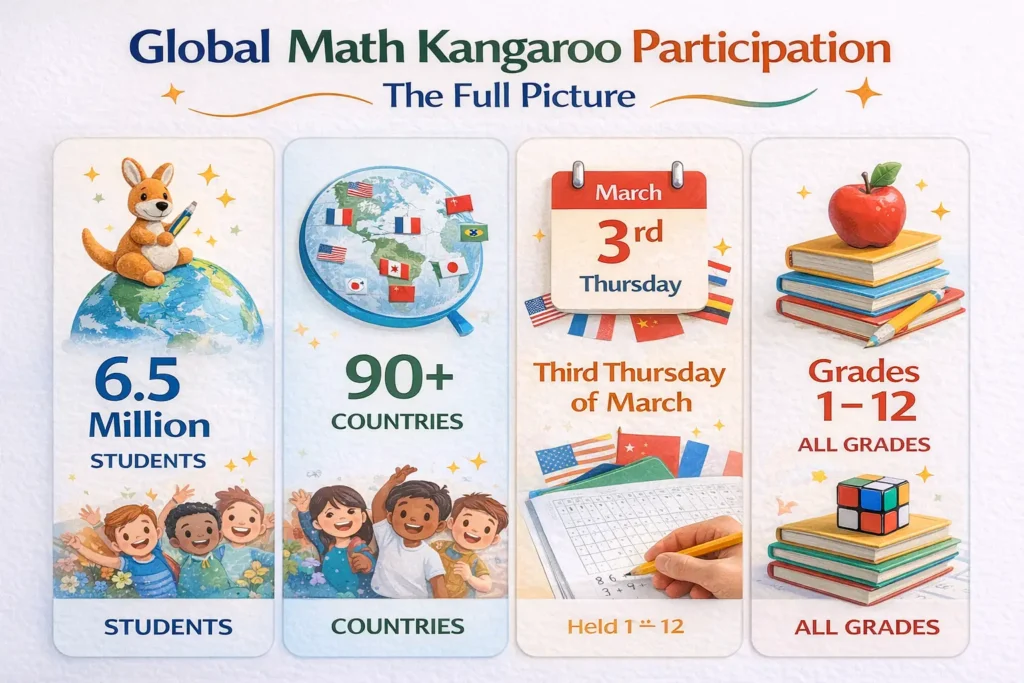
2025 Global Participation Summary
| Metric | 2025 Figure |
|---|---|
| Total global participants | 6.5 million+ |
| Countries participating | 90+ |
| U.S. total participants | 53,562 |
| Largest U.S. state | California (~21,000 students) |
| Grade levels | 1 through 12 (six age categories) |
| Competition date | Third Thursday of March (most countries) |
| Format | Single-round, simultaneous global event |
The single-round, simultaneous global format is one of the features that makes Math Kangaroo participation statistics uniquely meaningful.
Unlike multi-round competitions where participation drops sharply at each qualification stage, every registered Math Kangaroo student worldwide sits the same exam on the same day.
The 6.5 million figure represents students who actually competed, not students who registered or expressed interest.
For context on how this compares to other major math competitions, what is the best math competition in the world places Kangaroo’s scale alongside AMC, IMO, and other major contests.
The participation gap is enormous: AMC 8 draws approximately 100,000–150,000 U.S. participants annually, and the IMO fields around 600 students from 100+ countries. Math Kangaroo’s 6.5 million represents an entirely different category of global reach.
Country-by-Country Participation Breakdown
Math Kangaroo participation is genuinely global, but it is not evenly distributed.
Understanding which regions and countries lead in participation and why helps make sense of the competition’s growth trajectory and what it means to be a national competitor in different contexts.
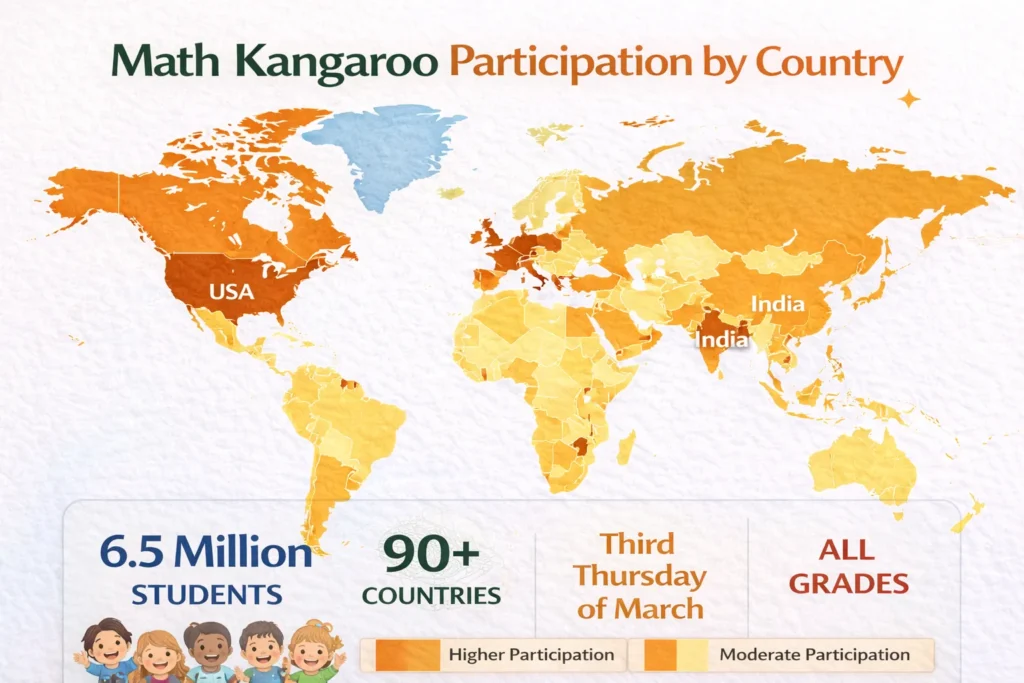
Europe: The Participation Stronghold
Europe has the highest Math Kangaroo participation density of any region, reflecting the competition’s origins on the continent and the deep integration of Kangaroo Math into European school systems.
France is among the highest-participation countries globally, which reflects the competition’s French roots.
It was French educators André Deledicq and Jean-Pierre Boudine who brought the Australian model to Europe in 1991 and named it Kangourou.
Math Kangaroo is now embedded across thousands of French schools as a routine annual activity.
Poland is consistently one of the largest participants globally. The Polish mathematical tradition is exceptionally strong.
Poland has historically produced outstanding IMO performers, and Math Kangaroo is deeply woven into the Polish school competition culture from early grades.
Germany runs one of the largest national Kangaroo programs in Europe, with participation spread across all 16 federal states.
The German Kangaroo competition (Känguru der Mathematik) is one of the country’s most widely recognized school math events.
Other strong European participants include Romania, Hungary, Slovakia, Czech Republic, and the Netherlands — all countries with strong mathematical traditions and well-organized national Kangaroo programs.
Asia: The Fastest-Growing Region
Asia represents the most significant growth area in Math Kangaroo participation over the past decade, with several countries showing dramatic year-on-year increases.
India has emerged as one of the largest participation countries globally, driven by the country’s strong cultural emphasis on mathematics education and a growing awareness of international math competitions among parents and educators.
Indian participation has grown particularly rapidly in urban centers and among students whose families are preparing for engineering and science careers.
Singapore participates at high rates relative to its population — a reflection of Singapore’s internationally recognized mathematics education system and the cultural priority placed on competition math preparation.
For a country of approximately 6 million people, Singaporean participation numbers represent a significant share of school-age students.
Bangladesh has shown strong participation growth in recent years, appearing specifically in the U.S. competition’s demographic data as one of the communities driving participation among immigrant student populations in major American cities.
Malaysia, China, Thailand, and the Philippines all maintain active national Math Kangaroo programs with growing participation.
North America: Rapid Growth Through Community Engagement
U.S. Math Kangaroo participation has grown substantially over the past decade, driven by a combination of school-based programs and community-level engagement, particularly among immigrant communities with strong mathematical traditions.
California’s nearly 21,000 participants — representing approximately 39% of all U.S. Math Kangaroo students — reflects the state’s large student population and the particularly strong engagement of the Bay Area’s Asian-American community, many of whom have strong connections to mathematical competition traditions from their countries of origin.
Texas, New York, New Jersey, and Illinois are also among the leading U.S. states by participation, each with large student populations and active community-based math enrichment programs.
The U.S. program is organized by Math Kangaroo USA and operates through a network of registered test centers including schools, community centers, libraries, and other venues.
The growth in online participation options has expanded the program’s reach to areas without nearby test centers.
Canada maintains consistent participation through its own national coordinator, with strong programs particularly in Ontario and British Columbia.
Africa, Latin America, and the Middle East: Emerging Participation
These regions represent Math Kangaroo’s frontier of growth.
Countries including Brazil, Argentina, Morocco, South Africa, Qatar, and the UAE have established national programs, with participation growing as awareness of the competition spreads through educator networks.
The Association Kangourou Sans Frontières (AKSF) actively works to expand participation in underrepresented regions, offering support to national coordinators establishing new programs.
The competition’s no-prerequisites, accessible format makes it particularly well-suited for introduction in new markets where advanced competition math infrastructure may not yet exist.
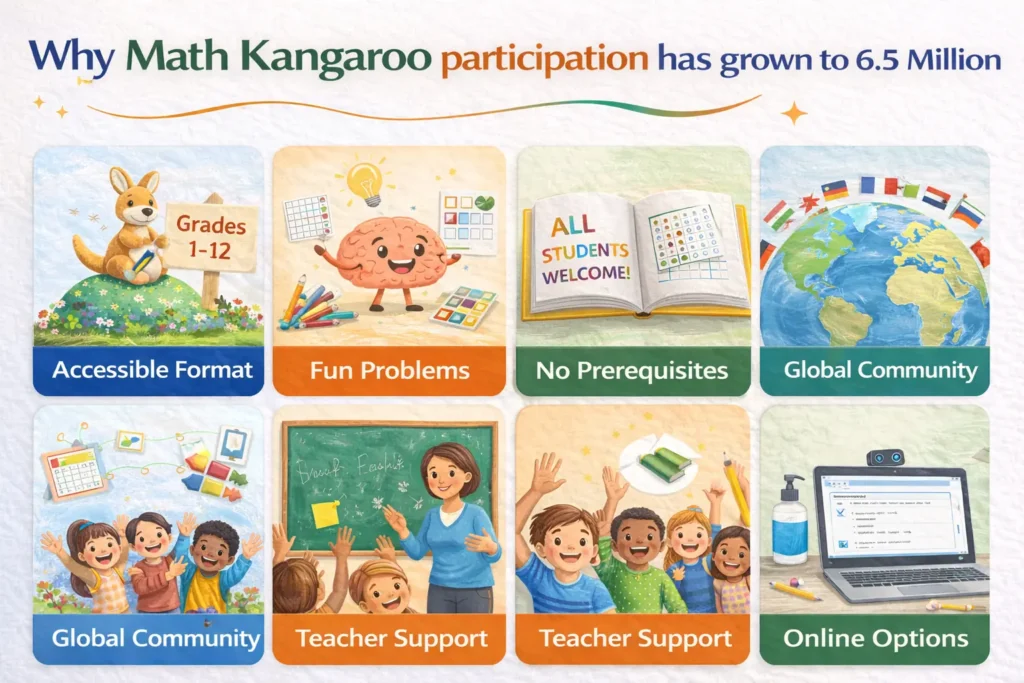
Why Math Kangaroo Participation Has Grown to 6.5 Million
Understanding why Math Kangaroo draws 6.5 million participants annually when most math competitions struggle to reach.
Even a fraction of that number requires understanding the specific design decisions that make this competition fundamentally different from most.
The Accessible Entry Design
The most important driver of Math Kangaroo’s massive participation is a deliberate design choice: the competition has no prerequisites, no qualifying requirements, and no prior competition experience needed.
Any student in Grades 1–12 can register and compete. This removes the self-selection barrier that limits other competitions to students who already identify as strong math performers.
Most students who participate in advanced math competitions like AMC 10/12 or national olympiad programs already self-select as high achievers in mathematics.
Math Kangaroo is explicitly designed to reach beyond that population to the student who enjoys math but has never thought of themselves as a competition mathematician, and to the student who has never encountered math problems designed for curiosity rather than curriculum.
This is a fundamentally different philosophy from how most competition math programs are built, and it is the primary reason for the participation differential.
For comparison, the difference between the math olympiad and kangaroo math explains how the structural and philosophical differences between the competition formats play out in terms of who participates and what the experience looks like.
The No-Penalty Scoring Encourages Everyone to Try
The absence of negative marking for wrong answers scores 0, blank answers score 0, removing the anxiety that penalty based scoring creates among less confident students.
Students who attempt every question without fear of losing points for mistakes tend to experience the competition as genuinely engaging rather than stressful.
This contrasts with AMC 10/12 scoring, where blank answers (1.5 points) outperform wrong answers (0 points), creating an incentive to leave questions unanswered.
A dynamic that favors students who have specifically trained for the AMC-style test-taking strategy. Average AMC math scores explain how this scoring dynamic shapes AMC performance distributions.
The Problem Style Rewards Curiosity Over Memorization
Kangaroo Math problems are specifically designed to reward logical reasoning and creative thinking rather than curriculum knowledge.
This means that students who have not studied extensively for the competition can still find the problems genuinely engaging and challenging.
The problems meet students where they are, rather than demanding a specific level of prior preparation.
This problem philosophy is consistent with the broader Olympiad tradition. What type of questions are asked in math olympiads explains the reasoning-over-recall design principle that Kangaroo shares with higher-level competitions, and how this makes competition math fundamentally different from school exam math.
Teacher and School Integration
Math Kangaroo is organized to be easy for schools to run. Teachers can register their entire class, the competition paper is delivered to the school, and the single-round format means no ongoing coordination is required beyond the one competition day.
This low logistical burden makes school-wide participation far more likely than for competitions requiring individual student registration and external venue travel.
For classroom teachers looking to introduce competition mathematics to students who have not self-identified as math enthusiasts, Math Kangaroo represents an ideal entry point.
The foundational mathematical thinking skills the competition develops — number sense, pattern recognition, spatial reasoning — directly support classroom learning, as resources like number sense for class 1, teach number sequences to class 1 students, and geometrical shapes for grade 1 demonstrate.
The Prize and Recognition Structure Motivates Broad Engagement
The prize structure is specifically designed to motivate participation at every level — not just among top performers. Every student receives a participation certificate.
State winners receive ribbons. National winners receive medals and scholarships. This tiered recognition means there is meaningful motivation for every student, regardless of their expected performance.
Math Kangaroo prizes covers the full prize structure in detail, including the U.S. scholarship grants of up to $1,000 for top high school performers and the international math camp invitations for national winners.
Online Participation Options Expanded Access
The introduction of online participation options, which accelerated significantly during the COVID-19 pandemic and has continued as a permanent offering in many countries, removed the geographic access barrier for students in areas without nearby test centers.
Students who previously could not participate due to distance from authorized venues can now register and compete digitally.
This expansion has been a meaningful driver of participation growth in both rural areas of participating countries and in countries that are newly establishing national programs.
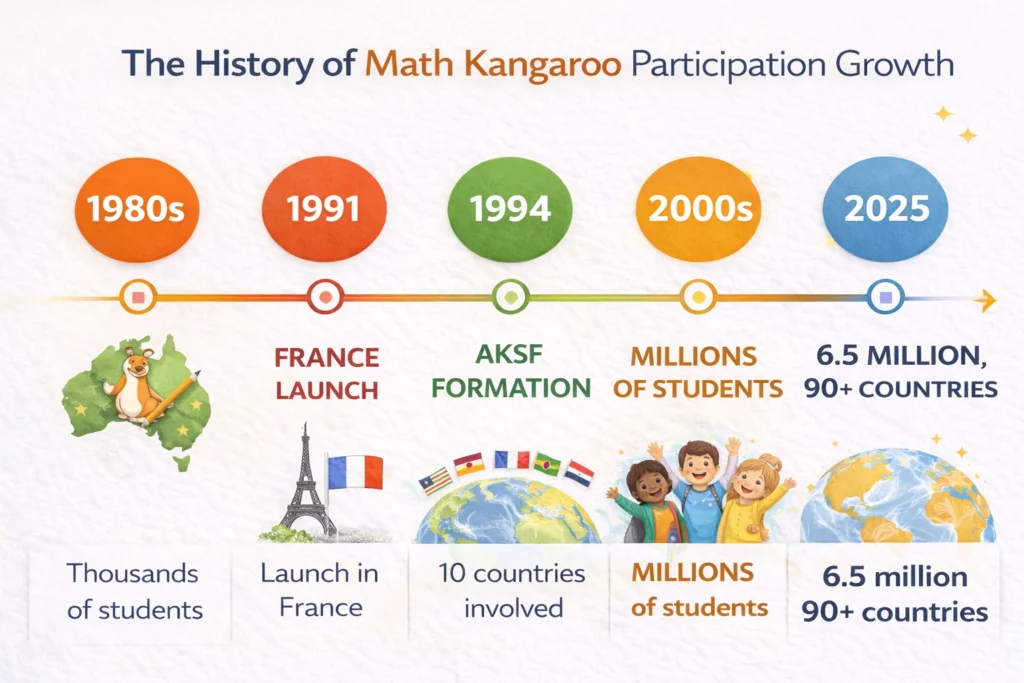
The History of Math Kangaroo Participation Growth
The growth of Math Kangaroo participation from a small Australian experiment to the world’s largest math competition is one of the most striking expansion stories in global education.
1980s: The Australian Origin
Peter O’Halloran, an Australian mathematics teacher, developed the original competition format with a clear philosophical goal: create a math contest that was accessible and enjoyable for all students, not just those who already excelled at mathematics.
The multiple-choice format with carefully crafted reasoning problems was specifically designed to welcome students who found traditional exam math intimidating.
The Australian competition drew thousands of students in its early years, meaningful for a new competition, but modest by the scale it would eventually reach.
1991: The French Launch and the Kangaroo Name
Two French educators, André Deledicq and Jean-Pierre Boudine, brought the model to France after learning about the Australian competition.
They named it Kangourou in tribute to the Australian origin and to symbolize the exploratory, leaping quality they wanted the competition to evoke in students encountering mathematical challenges.
The French launch was immediately successful, drawing large numbers of participants across French schools and establishing the model that would spread across Europe.
1994: AKSF Formation and Pan-European Coordination
The rapid European growth led educators from 10 countries to formalize the competition’s international structure.
Meeting in Strasbourg, France, in June 1994, they established the Association Kangourou Sans Frontières (AKSF) “Kangaroo Without Borders” as the governing body responsible for coordinating shared problem sets, standardizing competition dates, and supporting new national programs.
This institutional structure was critical to the competition’s subsequent global expansion.
By centralizing problem design and coordination while giving national programs full autonomy over logistics and prizes, AKSF created a model that could scale to dozens of countries without requiring centralized administration.
Late 1990s–2000s: Continental Expansion to Millions
Through the late 1990s and 2000s, Math Kangaroo expanded progressively across Asia, the Americas, and Africa. Each new national program brought thousands to hundreds of thousands of additional students.
By the early 2000s, global participation had crossed 1 million students. By the mid-2000s, it had crossed 3 million. By the 2010s, the competition regularly exceeded 5 million participants annually.
2020–Present: Online Expansion and Record Participation
The COVID-19 pandemic forced Math Kangaroo programs worldwide to rapidly develop online participation infrastructure. While the pandemic reduced in-person participation in 2020.
The online options developed during that period have permanently expanded the competition’s reach.
The 2025 figure of 6.5 million represents a record, reflecting both the recovery of in-person participation and the continued growth of online access.
What Math Kangaroo’s Scale Means for Students Who Participate
Understanding the participation numbers changes how you interpret your own performance in the competition. The scale of participation is directly relevant to what different achievement levels actually represent.
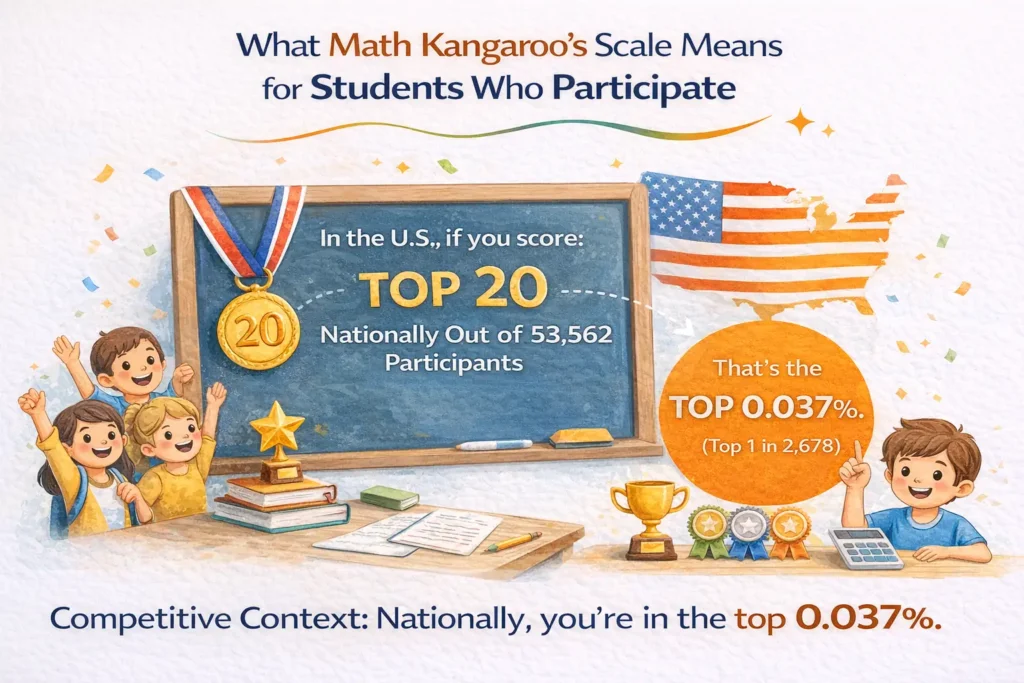
National Rankings in Context
In the United States, the top 20 students per grade nationally out of 53,562 participants represents the top 0.037% of all U.S. participants in that grade.
National winner status in a competition of this scale is a genuinely exceptional achievement. It demonstrates mathematical reasoning ability that exceeds the vast majority of mathematically engaged students in the country.
For context in the broader competition landscape, national Kangaroo winner status is comparable in selectivity to AMC Honor Roll and approaches the selectivity of AIME qualification from a participation-rate perspective.
Even though the underlying skills tested are different. The AMC math competition awards explain the AMC award tiers for comparison.
Percentile Rankings in Context
The large participation base means that percentile rankings carry meaningful statistical weight.
A 90th percentile score in Math Kangaroo means outperforming approximately 590,000 students in comparable grades globally not just a classroom or school, but a genuinely large international sample.
This makes the competition’s percentile data meaningfully informative about mathematical reasoning ability relative to a broad peer group.
What the Numbers Say About Competition Readiness
For students aiming to progress toward AMC and higher olympiad competitions, Math Kangaroo performance provides early signal about mathematical reasoning ability.
Students who reach the 75th percentile or above in Math Kangaroo have demonstrated the logical reasoning and pattern recognition foundations that AMC preparation builds on.
What is a good AMC math competition score explains what strong performance looks like at the next level of competition difficulty, providing useful context for students transitioning from Kangaroo to AMC.
The Community Effect of Millions of Participants
There is a less quantifiable but genuinely important benefit of large-scale participation: the community it creates. When 6.5 million students worldwide solve the same problems on the same day, it produces a global conversation about mathematical thinking.
The AoPS forums, national Kangaroo websites, and school math clubs all buzz with discussion of that year’s problems in the days after the competition exposing students to multiple solution approaches, creative alternative methods, and the experience of seeing how others thought about the same problems.
This community dimension is why Math Kangaroo participation is valuable even for students who do not reach top prize tiers.
The shared experience of engaging with the same mathematical challenges as millions of peers creates the sense of belonging to a global community of mathematical thinkers an experience that builds the long-term motivation to continue developing mathematical skills.
For students who find that experience motivating and want to continue developing the logical reasoning that Kangaroo builds, how to get better at solving math olympiad questions provides the structured improvement framework for taking those skills to the next level.
How to Register and Join Math Kangaroo Participation in 2026
With global participation records being set annually, there has never been a better time to join. Here is exactly how to register for Math Kangaroo participation in 2026.
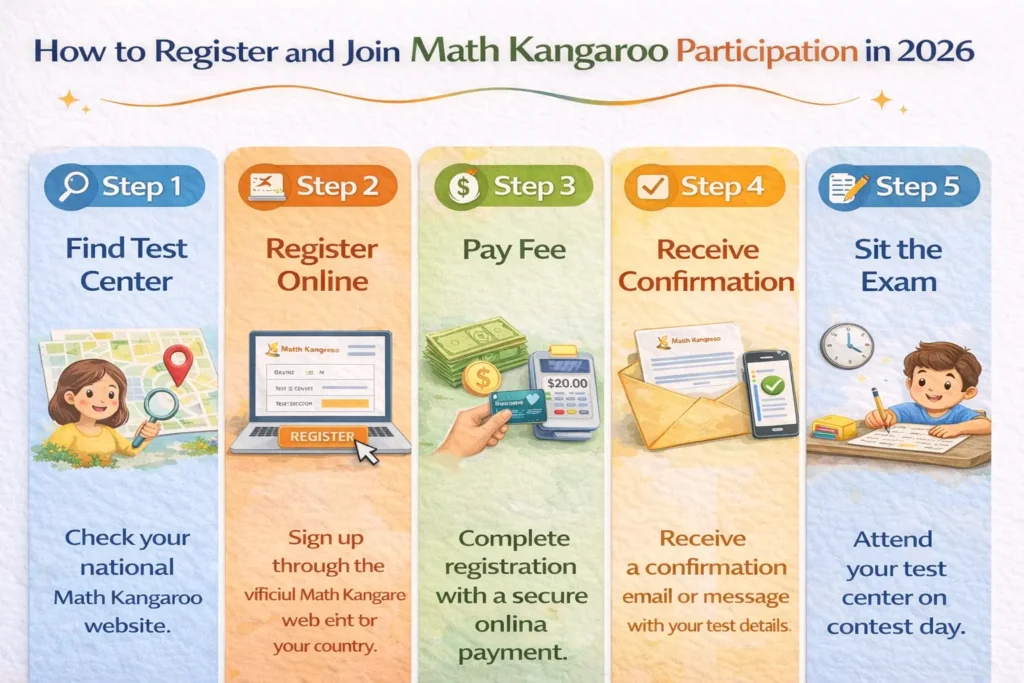
Step 1 — Find Your National Coordinator or Test Center
Registration is managed nationally. In the U.S., visit the official Math Kangaroo USA website to find your nearest registered test center — these include schools, community centers, libraries, and educational organizations that are authorized to administer the competition.
In other countries, search for your country’s national AKSF coordinator website. If your school is already a registered Math Kangaroo center, your teacher may be able to register you directly.
Step 2 — Register Online and Pay the Registration Fee
Most national programs use online registration portals. In the U.S., the registration fee is typically $20–$25 per student. Many schools cover the registration fee for students through their math enrichment budgets. Check with your teacher or school coordinator about fee assistance options.
Step 3 — Prepare for the Competition
Once registered, begin preparation. For a complete structured preparation guide including grade-level study plans, past paper strategies, and practice resources, how to prepare for Math Kangaroo covers the full preparation framework.
For free online training resources applicable across all grade levels, free math olympiad training online covers every free platform available.
Step 4 — Sit the Competition
The competition takes place on the third Thursday of March in most countries (confirm your country’s date with your national coordinator).
Bring a pencil, an eraser, and your registration confirmation. No calculator or electronic device is permitted.
Step 5 — Receive Your Results and Awards
Results are typically available within 4–8 weeks of the competition date through the national coordinator’s website.
Certificates, medals, ribbons, and other prizes are distributed to schools and test centers or mailed directly to participants depending on your national program.
How many students participate in Math Kangaroo globally?
In 2025, more than 6.5 million students from 90+ countries participated, making it the largest math competition in the world by participation.
How many students participate in Math Kangaroo in the U.S.?
In 2025, 53,562 U.S. students participated. California led all states with approximately 21,000 participants, followed by Texas, New York, New Jersey, and Illinois.
Which country has the most Math Kangaroo participants?
France and Poland are among the highest-participation countries globally relative to their student populations, reflecting the competition’s deep integration into European school systems. India and other Asian countries have been growing rapidly and may reach or exceed European leaders in absolute numbers in coming years.
Can any student participate in Math Kangaroo?
Yes. Math Kangaroo is open to all students from Grade 1 through Grade 12 with no prerequisites, no prior competition experience required, and no qualifying round to pass. Homeschooled students can participate through authorized test centers.
Has Math Kangaroo participation declined in any period?
Participation dipped in 2020 due to the COVID-19 pandemic, which forced cancellation of in-person events in many countries. However, the rapid development of online participation options allowed the competition to continue in modified form, and participation rebounded strongly in subsequent years, reaching record numbers by 2025.
How does U.S. Math Kangaroo participation compare to AMC participation?
AMC 8 draws approximately 100,000–150,000 U.S. participants annually. AMC 10/12 draws approximately 200,000–300,000 combined. Math Kangaroo USA’s 53,562 participants in 2025 positions it as a significant but smaller competition in the U.S. context — though globally, Kangaroo’s 6.5 million dwarfs AMC’s total participation by a wide margin.
What grade level has the most Math Kangaroo participants?
Participation tends to be highest in the middle grade levels — Benjamin (Grades 5–6) and Cadet (Grades 7–8) — where students are old enough to engage seriously with competition math but the problems remain accessible to a broad range of ability levels. Participation at the Senior (Grades 11–12) level is typically the lowest of the six categories.
Does larger participation make the competition harder to win?
Larger national participation makes national ranking more competitive in the sense that more students are competing for the same number of prize positions (top 20 per grade nationally). However, the exam itself does not change with participation size; the same problems are used regardless of how many students register. What changes is the score distribution: in years and states with higher participation, the score threshold for reaching the top 20 nationally tends to be higher.
Make Preparing for Math Olympiad Simple!



Conclusion
Math Kangaroo participation 6.5 million students, 90+ countries, every grade from 1 through 12 is not just a statistic.
It is the most concrete evidence available that mathematics, when presented as something curious and enjoyable rather than intimidating and exclusive, can reach and engage students at a scale that no other competition in the world has matched.
For everything about what the competition involves and how it works, see what is Kangaroo Math. For a complete preparation guide, see how to prepare for Math Kangaroo.
For what you can win and how the prize structure works, see Math Kangaroo prizes.
For where the competition pathway leads beyond Kangaroo, how to qualify for the IMO in the USA maps the full journey from accessible entry competitions through international olympiad qualification.