 December 9, 2025
 6 min. read

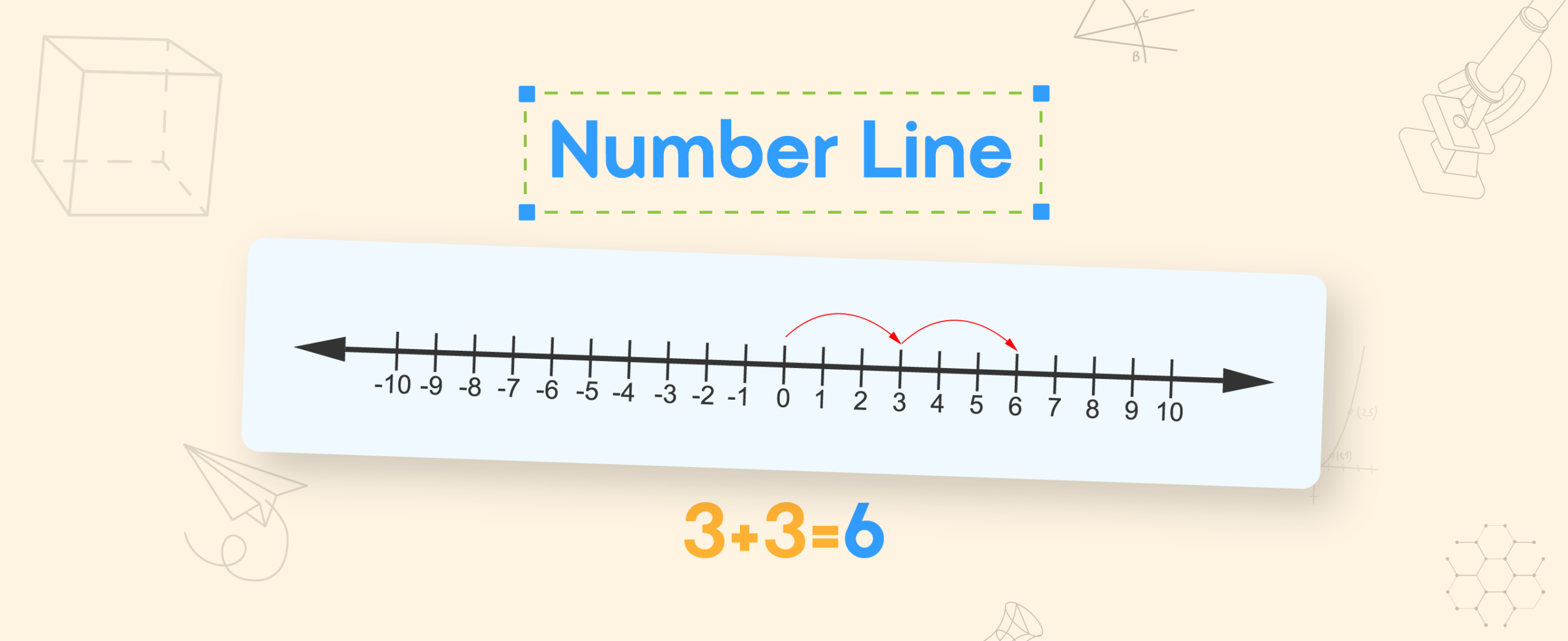
A number line for Class 1 is a straight horizontal line with numbers placed at equal intervals, starting from 0 and increasing to the right.
For a 6–7-year-old, it does something no worksheet can: it makes the abstract structure of numbers visible and physically navigable.
When a child hops two steps right from 7 to land on 9, they are not just calculating 7 + 2; they are understanding what addition means in space.
The number line bridges physical counting and mental arithmetic.
Building it firmly in Class 1 creates mathematical intuitions children carry for life and directly supports number ordering, ascending and descending order, and the broader number sense foundations every Class 1 child needs.
What a Number Line Looks Like
A Class 1 number line has four key features, each teaching a distinct concept:
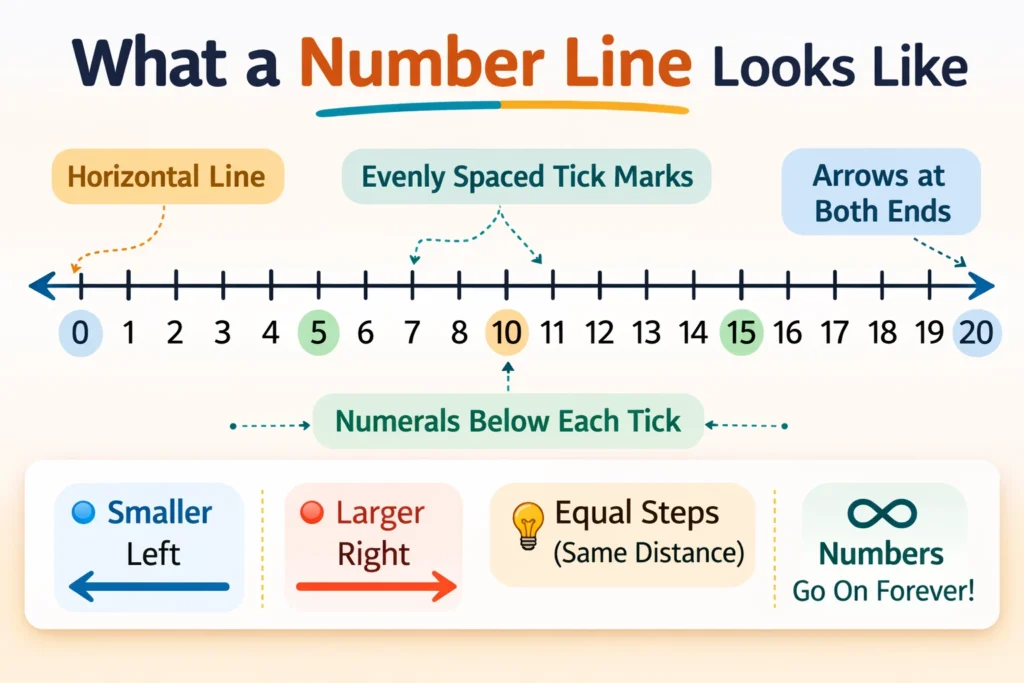
The horizontal line runs left to right — smaller numbers left, larger numbers right — establishing the spatial convention children will use throughout their mathematical education.
Evenly spaced tick marks make the most important fact about numbers visible: the distance from 3 to 4 is exactly the same as the distance from 9 to 10. Every unit step is equal.
Numerals below each tick connect the position to the written symbol.
Early in Class 1, number lines run 0–10 or 0–20, then extend to 0–100 as skip-counting and place value develop, matching the sequence work in what is the number sequence for Class 1 Maths.
Arrows at both ends show that numbers continue beyond what is shown — an early and important idea that the number system has no walls.
5 Core Concepts a Number Line Teaches
1. Number Order and Sequence
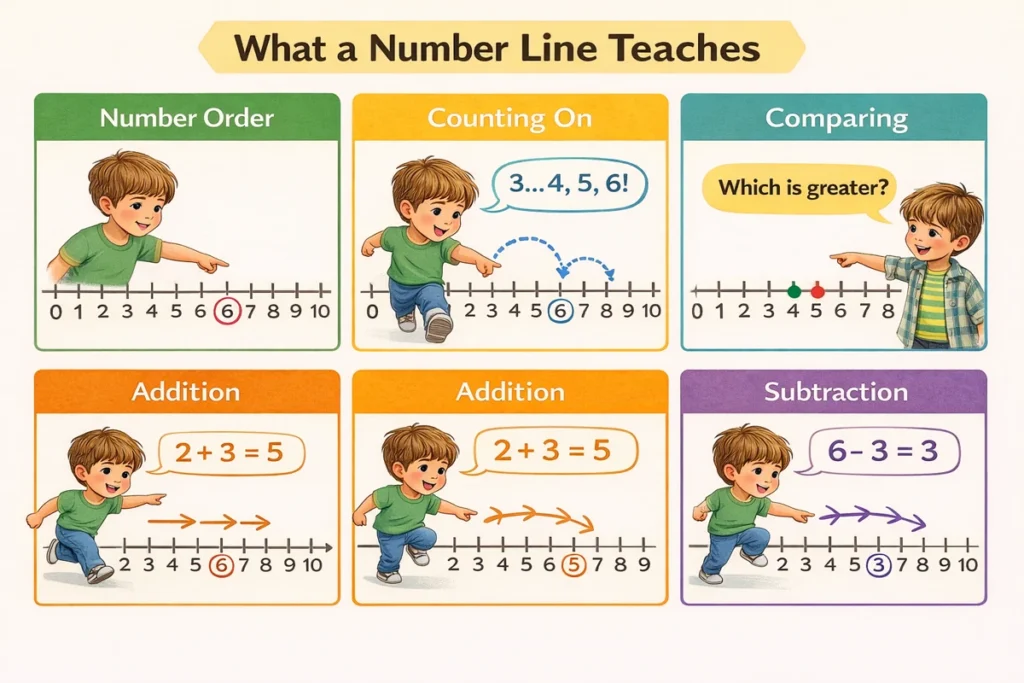
The left-to-right structure makes order immediately visible, no counting required to see that 13 comes after 12. Children see that every number is exactly one step from its neighbours: no gaps, no jumps, no surprises.
This predictability builds the deep sequence confidence that teaches number sequences to class 1 students builds on structurally.
2. Counting Forward and Backward
Moving right means counting forward; moving left means counting backward.
These physical movements make the direction of counting concrete and backward counting, which is significantly harder for Class 1 children, become far more intuitive when it corresponds to a visible leftward movement.
This connects to the ascending and descending understanding in ascending and descending order in maths for class 1.
3. Comparing Numbers
“Which is more, 8 or 13?” becomes a visual question rather than a counting exercise, simply look at which is further right. “How far apart are 5 and 9?” becomes a matter of counting the spaces between them.
Both skills are central to the comparison and magnitude work in number sense for class 1.
4. Addition as Moving Right
To solve 6 + 4, start at 6 and hop 4 spaces right to land on 10. Addition means increasing, and increasing means moving right.
Children who understand addition this way transition far more naturally to mental strategies than those who only ever “count all from one.” The spatial reasoning this builds connects directly to spatial understanding for class 1.
5. Subtraction as Moving Left
To solve 11 − 3, start at 11 and hop 3 spaces left to land on 8. This makes subtraction feel like the logical reverse of addition rather than a separate, harder operation.
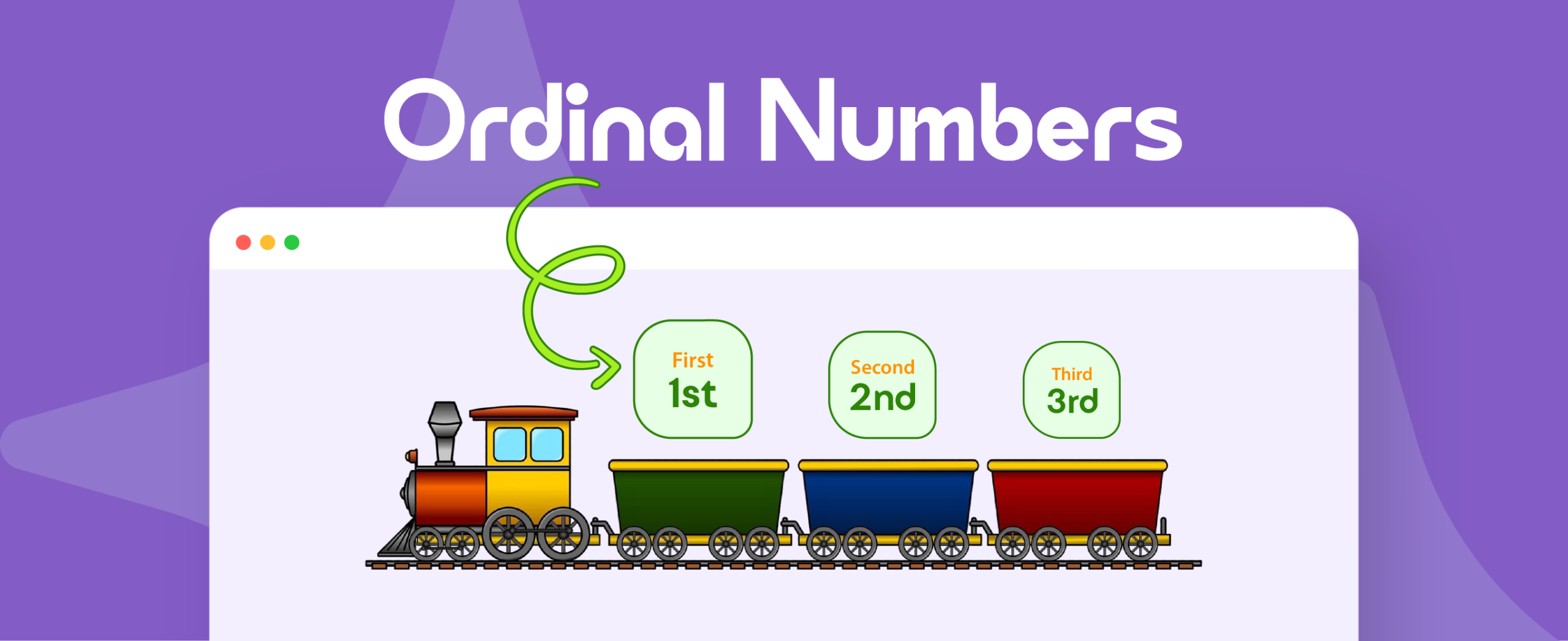
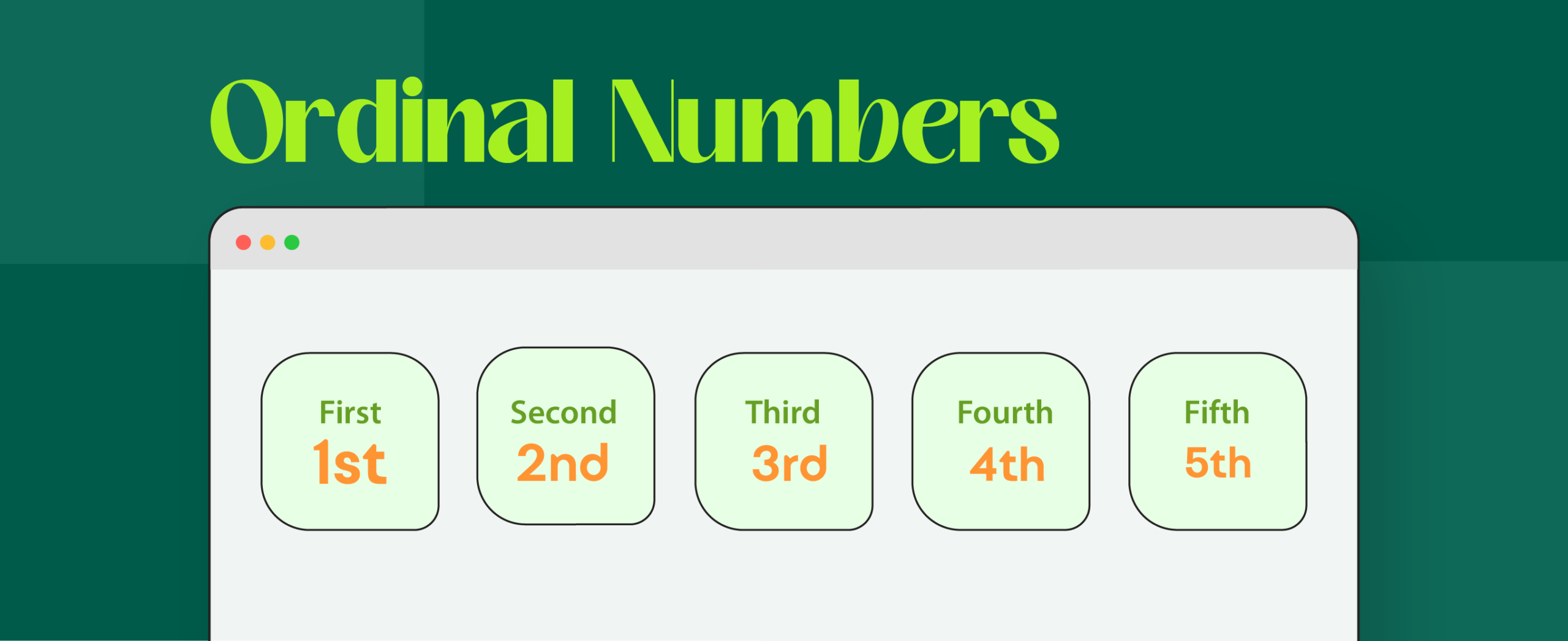
The positional language “move forward,” “go back” connects naturally to ordinal numbers for class 1 math and the directional vocabulary children use across mathematics.
4 Practical Number Line Activities
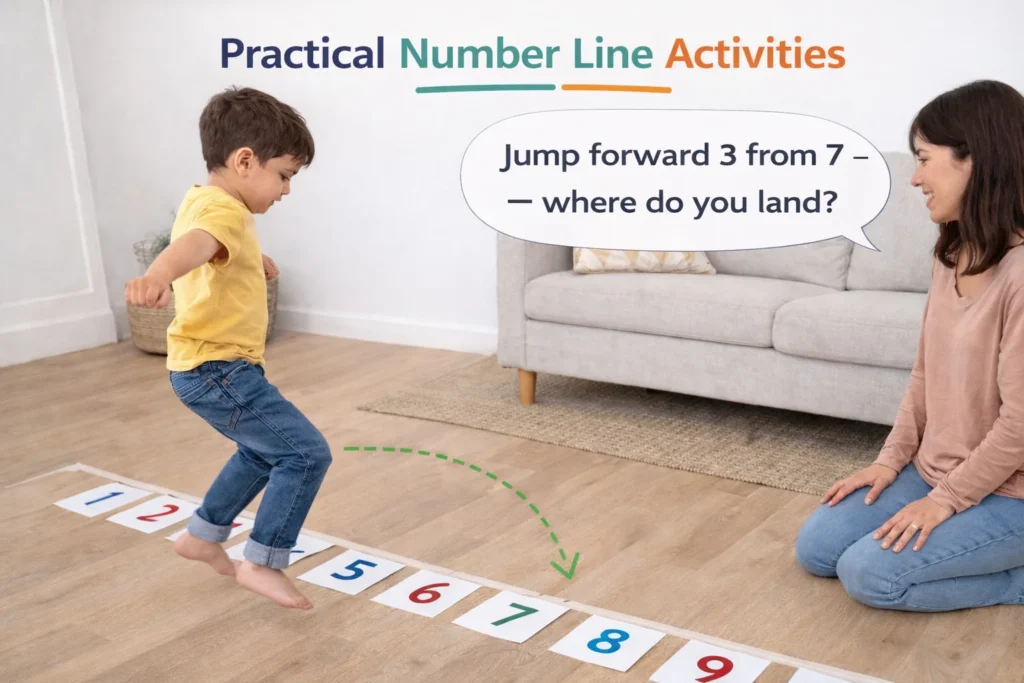
Activity 1: Floor Number Line
Mark a number line on the floor with masking tape and paper cards (or chalk outside). Call out: “Stand on 8. Jump forward 4. Where did you land?”
Physical movement landing on each number with their feet makes the arithmetic visceral and memorable. This is the single most effective activity for building number line intuition.
Activity 2: Frog Jumps
Place a small toy on a printed 0–20 number line. Call “jump forward 3” or “jump back 5” and ask your child to move the frog and name the landing number.
Record each move as a number sentence: “7 + 3 = 10.” This bridges physical activity directly to written arithmetic notation.
Activity 3: Missing Number Hunt
Cover several numbers on a number line with sticky notes. Ask your child to identify each hidden number by counting forward or backward from visible neighbours.
This consolidates sequence understanding efficiently the same skills that teach number sequences to class 1 students develops systematically.
Activity 4: Skip Count Hops
On a 0–100 number line, use different coloured pencils to mark skip counts: hop by 2s in one colour, 5s in another, 10s in a third.
The overlapping coloured marks make the patterns of the number system visually striking and lay the groundwork for the multiplication foundations in multiplication for class 1.
How the Number Line Connects to the Wider Class 1 Curriculum
The number line is not an isolated tool — it connects to virtually every major topic in Class 1 mathematics.
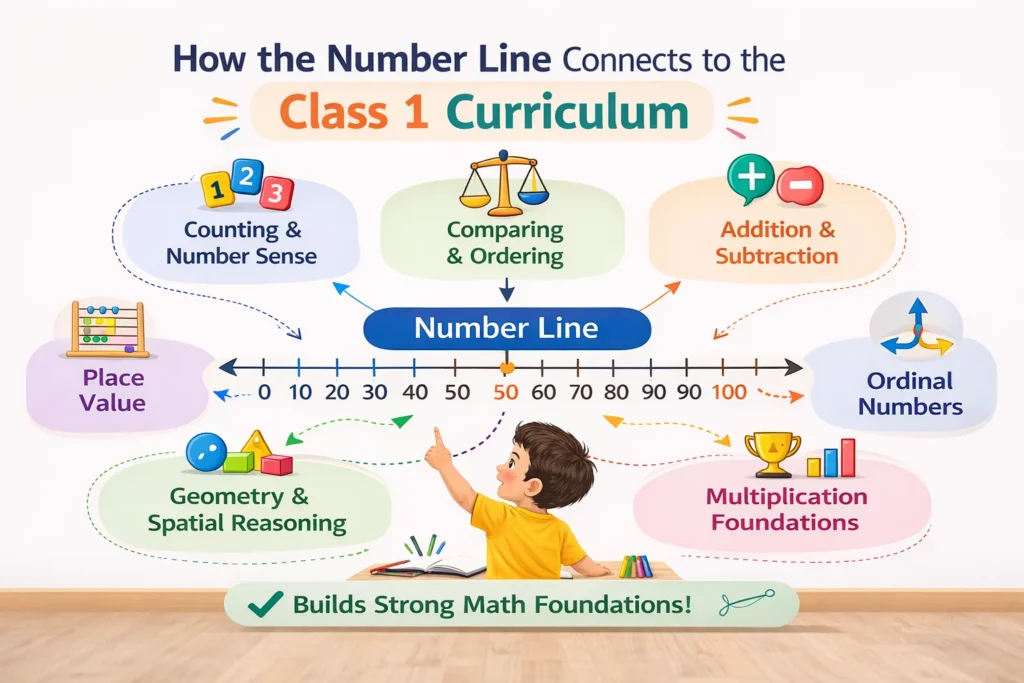
Its left-to-right structure mirrors the ordering work in ascending and descending order in maths for class 1.
The directional movement involved in hopping forward and back develops the positional and spatial awareness central to spatial understanding for class 1 and geometrical shapes for grade 1.
The skip-count patterns visible on a 0–100 number line introduce the equal-grouping logic that underpins multiplication for class 1.
For competition mathematics, number line intuition supports the pattern recognition and logical sequencing that the IMO syllabus for class 1 assesses.
Children who have a strong internalized number line find sequence and pattern problems significantly more approachable.
What range should a Class 1 number line cover?
Start with 0–10 at the beginning of Class 1, move to 0–20 by mid-year, and introduce 0–100 in the second half as skip-counting and place value work develops. The range should always match the numbers children are currently working with.
Should a number line always start at zero?
For Class 1, yes. Starting at zero allows the number line to be used for subtraction all the way back to zero and establishes the correct convention. Children will encounter number lines starting at other values as they advance.
Can children use a number line as a calculation aid during class?
Yes — and they should. Using a number line to check or complete a calculation is a sign of mathematical reasoning, not weakness. Children encouraged to use tools alongside developing understanding, build accuracy and confidence together.
Make Preparing for Math Olympiad Simple!



Conclusion
A number line for Class 1 is a visual model of the entire number system showing order, magnitude, distance, and direction in a single coherent representation that children can see, touch, and physically move along.
Use it daily: during morning routines, while playing games, when solving simple problems together.
Children who build a strong mental number line in Class 1 find every subsequent arithmetic concept more intuitive, because they already understand numbers as positions in a predictable structure rather than isolated symbols to memorize.
For the number sense foundations the number line supports, see number sense for class 1. For building those foundations early and consistently, see why number sense is important for class 1.