 November 28, 2025
 13 min. read

Number sense teaching strategies for first graders matter more than most realize.
The difference between a child who memorizes number facts and one who genuinely understands numbers is almost entirely a function of how they were taught, not how capable they are.
First grade is the critical window. Children at age 6–7 translate concrete, hands-on experiences into genuine conceptual understanding most efficiently.
This guide covers ten proven classroom strategies, five home-based approaches, effective use of digital tools, a practical assessment framework, and the most common teaching mistakes that quietly undermine number sense development even when teachers are working hard.
For the foundational concepts these strategies build on, see what is number sense for Class 1 and the 5 characteristics of number sense.
For supporting number pattern work, see number sequences for Class 1. For home support tools, see number sense resources for parents.
The Teaching Principle That Underpins Every Strategy
Every effective number sense strategy follows the Concrete–Representational–Abstract (CRA) progression.
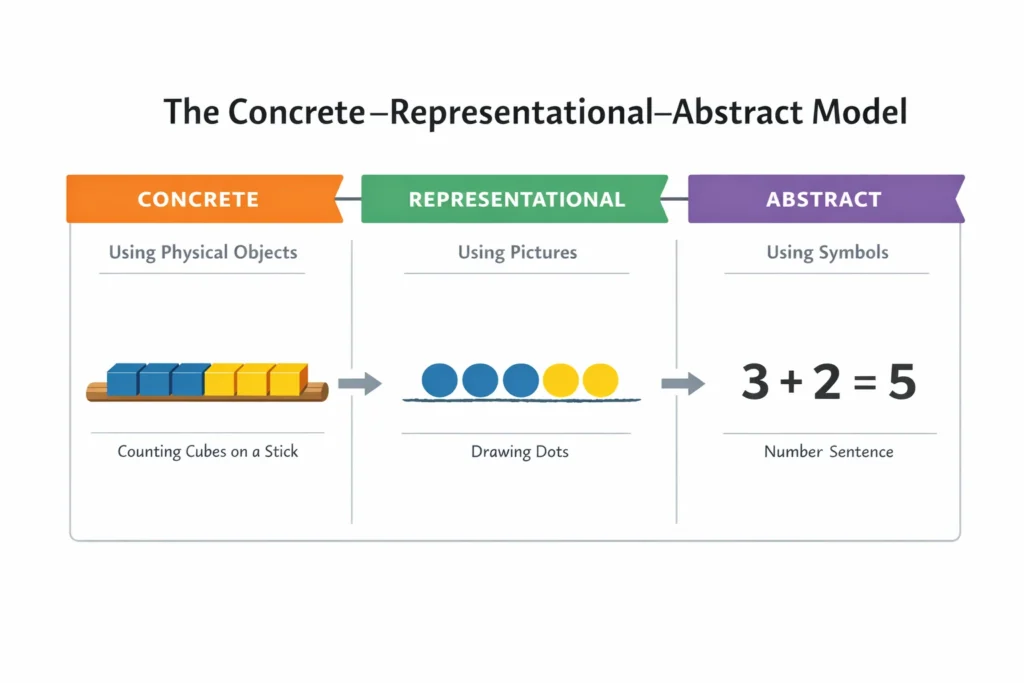
Children first work with physical objects, then with visual representations like number lines and dot cards, and only then with abstract symbols.
The most common Class 1 teaching mistake is moving too quickly to the abstract stage — producing children who can write “5 + 3 = 8” but cannot explain what it means.
For the foundational framework, see what number sense for Class 1 is and why number sense matters.
10 Classroom Teaching Strategies for First Grade Number Sense
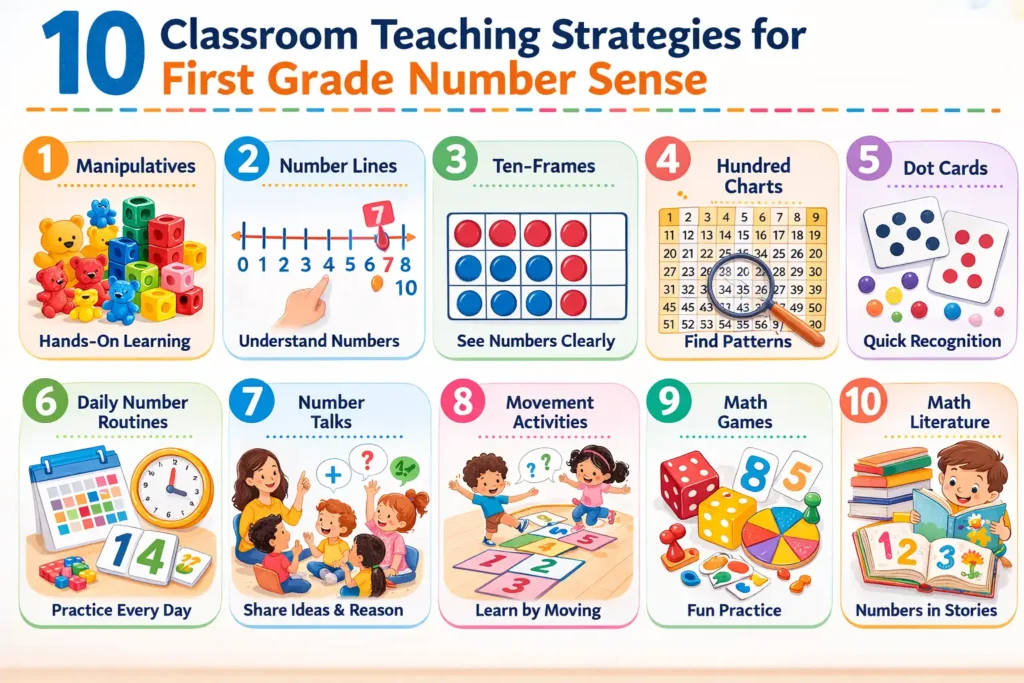
1. Manipulatives — Concrete Understanding Counting bears, linking cubes, and base-ten blocks make numbers physically real. The key is guided questioning, not free play.
Base-ten blocks are especially powerful for place value. Physically exchanging 10 units for 1 rod makes the concept tangible. Link cubes also build foundations for multiplication.
2. Number Lines — Magnitude and Relationships A number line shows quantity as position — developing the intuitive sense of how big a number is.
Use three types: a classroom number line children can touch, a personal desk strip, and a blank number line where children place numbers themselves. This directly supports ascending and descending order.
3. Ten-Frames — Quantity Recognition A 2×5 grid makes relationships to 10 instantly visible. A child placing 7 counters immediately sees “3 away from 10” and “2 more than 5.”
Progress from filled frames to building frames to double ten-frames for numbers 11–20, which builds place value understanding naturally.
4. Hundred Charts — Number System Patterns Colouring every 2nd, 5th, or 10th number makes skip-counting sequences visually obvious.
“Guess my number” riddles “more than 40, less than 50, one digit is 3” build logical reasoning alongside number knowledge. Connects directly to number sequences for Class 1.
5. Dot Cards and Subitizing Flash a dot card for 2–3 seconds and ask “how many, and how did you see it?”
The second question is critical it develops conceptual subitizing, recognizing larger quantities as groups of smaller ones. Use varied arrangements: rows, clusters, dice, and ten-frame patterns.
6. Daily Number Routines A 10-minute morning routine calendar, attendance, and weather builds counting, pattern recognition, and comparison daily.
A “number of the day” represented multiple ways to build representational flexibility. Transition counting (count backward while packing up, skip-count by 5s while lining up) costs no instructional time.
7. Number Talks — Reasoning Through Discussion Present a mental math problem, give quiet thinking time, then collect strategies. “7 + 5: I made 10 from 7 + 3, then added 2 more.”
Hearing multiple strategies from peers counting on, making ten, near-doubles expands every child’s numerical reasoning toolkit. Recording strategies visually shows mathematics as creative, not procedural.
8. Movement-Based Activities Number line hopscotch makes addition and subtraction physical. A human number line children arranging themselves by number cards, develops ordering and magnitude.
Skip-count clapping games make sequences memorable. Connects to the spatial understanding that underpins early mathematics.
9. Games — Fluency Without Pressure. Low emotional stakes mean children take risks and try new strategies. High-value games: War (number comparison),
Make Ten Memory (complement fluency), Race to 100 (addition and magnitude), and Guess My Number (logical reasoning).
Games also introduce ordinal language naturally through ranking and sequence.
10. Math Literature — Numbers in Context Mathematical picture books embed concepts in narrative — which is how young children naturally make sense of the world.
Read first for enjoyment, then re-read with a mathematical focus. Connect story concepts to manipulatives afterward. Bridges naturally into teaching number sequences and geometrical shapes for Grade 1.
5 Strategies for Building Number Sense at Home
The most effective home number sense strategies are not structured lessons they are mathematical conversations and activities embedded in the daily routines that already exist.
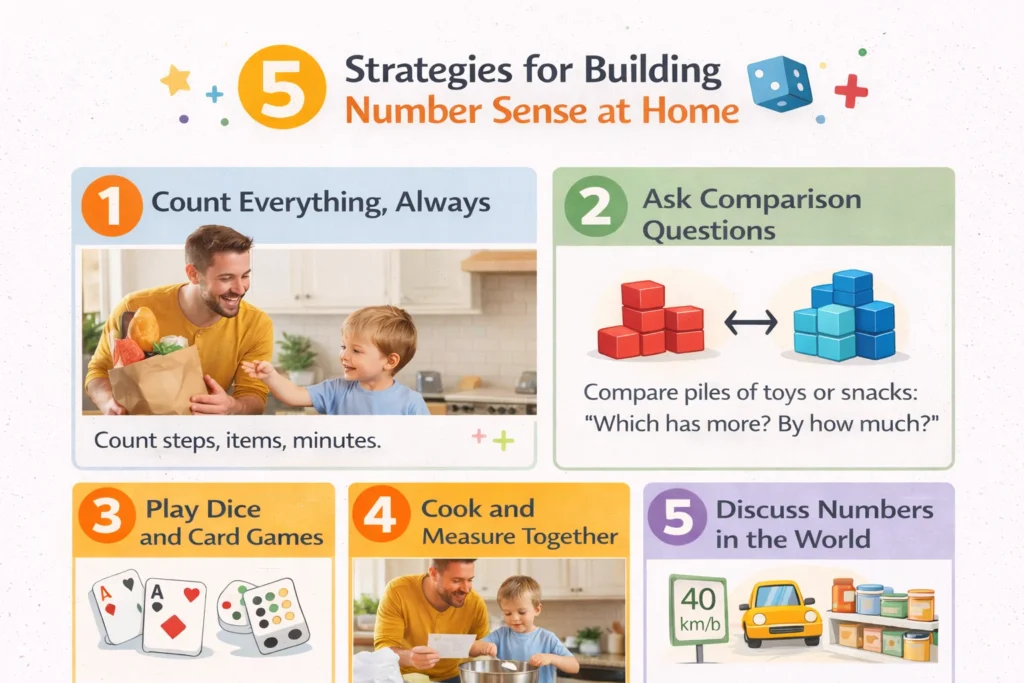
Here are five approaches that parents can begin immediately without any special materials or preparation.
1. Count Everything, Always: Make counting a natural part of daily life, count steps on the stairs, count items while unpacking groceries, count how many minutes until dinner.
The goal is not drilling but building the automatic habit of numerical attention that underlies strong number sense. When counting becomes second nature, numerical reasoning follows naturally.
2. Ask Comparison Questions: “Which pile has more blue blocks or red blocks? How do you know?” “We have 8 grapes and 5 crackers. Which is more? By how much?”
Regular comparison questions develop the number magnitude understanding that formal exercises rarely match for authenticity.
3. Play Dice and Card Games: Any game that involves reading a die, counting spaces, or comparing card values is building number sense.
Keep a simple deck of cards and one or two dice accessible for spontaneous 10-minute games. These provide more genuine number sense practice per minute than most structured home activities.
4. Cook and Measure Together: Measuring ingredients combines number reading, quantity understanding, and comparison in an authentic, meaningful context.
“We need 3 cups of flour. We’ve added 1. How many more?” These embedded arithmetic questions arise naturally and feel purposeful rather than like practice.
5. Discuss Numbers in the World: Point out numbers in the environment and talk about them. “That sign says 40 km/h is that fast or slow? That shelf has 6 items on it. If we buy 2, how many will be left?”
The habit of noticing and reasoning about numbers in context is the adult expression of the number sense that begins with these childhood conversations.
Digital Tools: How to Use Technology Without Replacing Hands-On Learning
Digital tools can be a valuable component of a balanced number sense teaching approach, but only when they supplement rather than replace concrete, hands-on experiences.
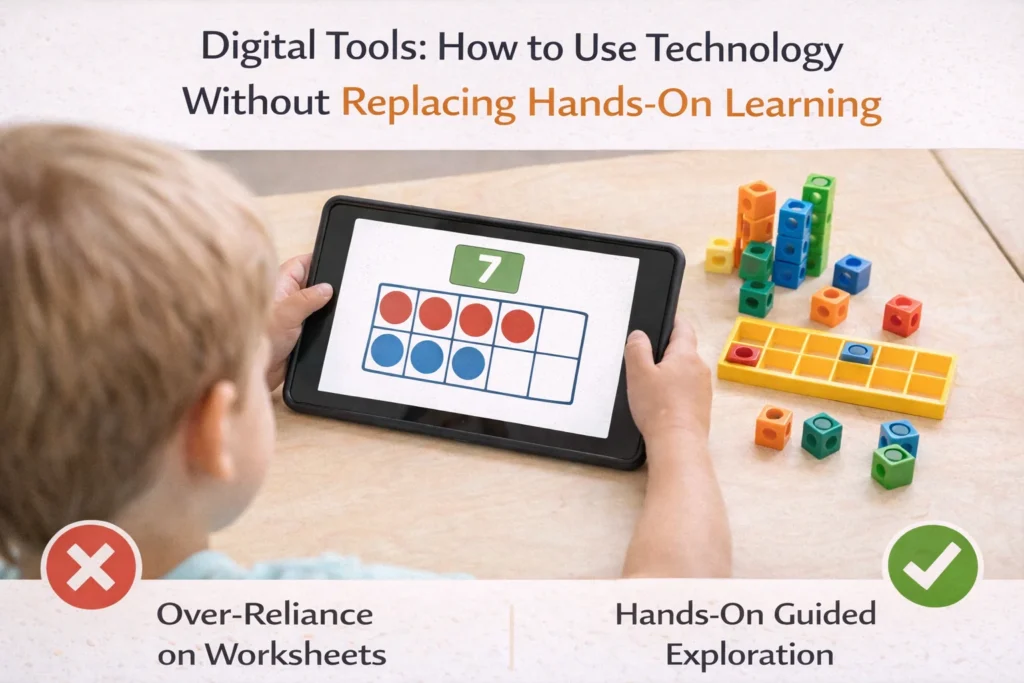
The risk of over-relying on digital tools for first-grade mathematics is that screens present quantities visually in ways that feel concrete but lack the tactile, physical experience that builds the deepest early number understanding.
Best uses of digital tools for first grade number sense:
Adaptive practice apps — apps that adjust difficulty based on a child’s responses and provide immediate feedback are genuinely useful for building fluency with number recognition and counting once the underlying concepts are established through concrete work.
The Gonit App provides structured number sense practice with a competition mathematics progression. Khan Academy Kids offers free, research-aligned number activities calibrated to first grade level.
Virtual manipulatives — digital ten-frames, number lines, and base-ten blocks are particularly useful when physical manipulatives are not available or when working with large numbers that would require impractically many physical pieces.
The National Library of Virtual Manipulatives offers free access to high-quality virtual versions of every major first-grade mathematics tool.
Animated concept videos — short (3–5 minute) animated explanations of number concepts work well as introduction or review, particularly for visual learners.
They are most effective when followed immediately by hands-on application of the same concept watch then do, not watch instead of do.
What to avoid: Apps and games that reward speed of recall over understanding, passive viewing without any mathematical interaction, and screen time that substitutes for rather than extends physical manipulation.
The rule of thumb is simple: if a digital activity has no hands-on equivalent that could teach the same thing, it is probably not targeting genuine number sense development.
Assessment: How to Know If Number Sense Strategies Are Working
Effective assessment of first-grade number sense does not require formal tests.
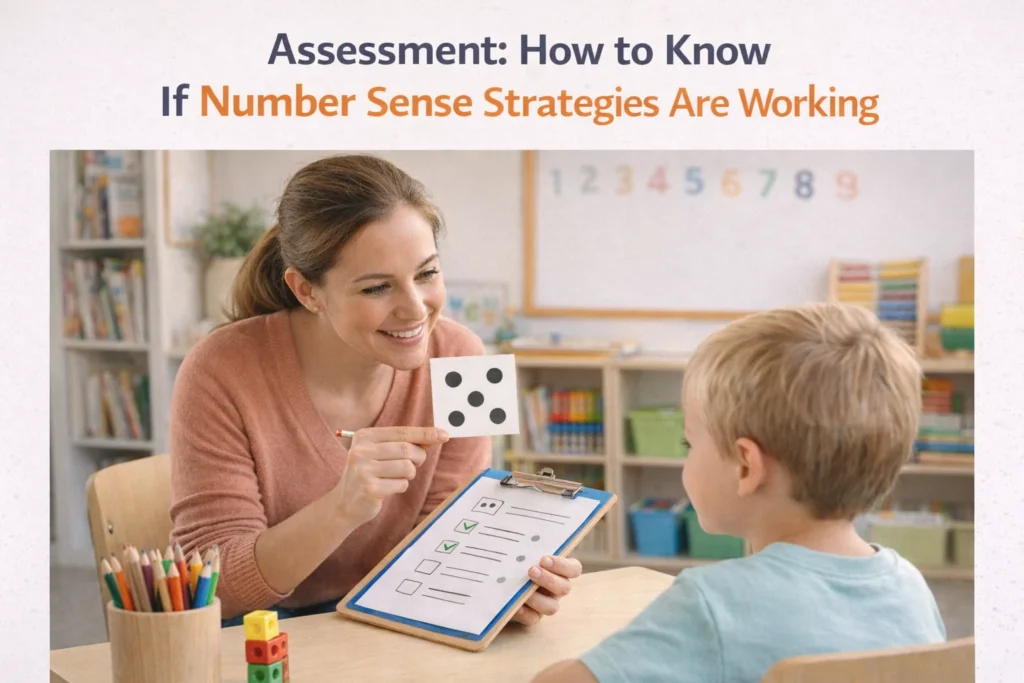
The most valuable assessment information comes from structured observation of children using the strategies above, watching how children interact with manipulatives, listening to their reasoning during number talks, and using quick targeted checks during daily routines.
The 5-Minute Individual Number Sense Check
The most efficient way to assess an individual child’s current number sense level is through a brief (5-minute) structured conversation using simple materials. Ask the child to:
| Task | What It Assesses |
|---|---|
| Count a collection of 15 objects | One-to-one correspondence and counting accuracy |
| Show you “8” with counters, then “13” | Quantity understanding and teen number comprehension |
| Point to the bigger number: 7 or 9, 34 or 28 | Number magnitude understanding |
| Extend the pattern: 2, 4, 6, ___, ___ | Pattern recognition and skip-counting |
| Place 47 on a blank 0–100 number line | Number magnitude and estimation |
| “Show me 24 in tens and ones” | Place value understanding |
This 6-task check takes under 5 minutes per child and gives you a clear picture of which number sense components are secure and which need further development. Conducting it at the start of term, mid-year, and end of term tracks development and identifies children who need additional support before gaps compound.
Observation During Strategy Activities
The richest assessment information comes from observing children during the ten classroom strategies above. Watch for:
During manipulative activities: Does the child recount from 1 each time, or do they count on from a known quantity? Do they use grouping strategies, or do they arrange objects randomly?
During number line work: Can the child identify where a number belongs without counting every position from the start? Do they use landmark numbers (0, 10, 50, 100) as reference points?
During number talks: Does the child always use the same strategy, or do they adapt their approach based on the specific numbers? Can they explain another child’s strategy in their own words?
During games: Does the child compare numbers instantly, or do they need to count up to both before deciding which is larger? Do they notice when an outcome is unexpected?
These observations, recorded informally in a simple class list, give far richer and more actionable information than any worksheet or formal test — and they are gathered naturally during activities children enjoy.
Common Teaching Mistakes That Undermine Number Sense Development
Even teachers and parents who are working hard and using good materials can inadvertently undermine number sense development through these common approaches:
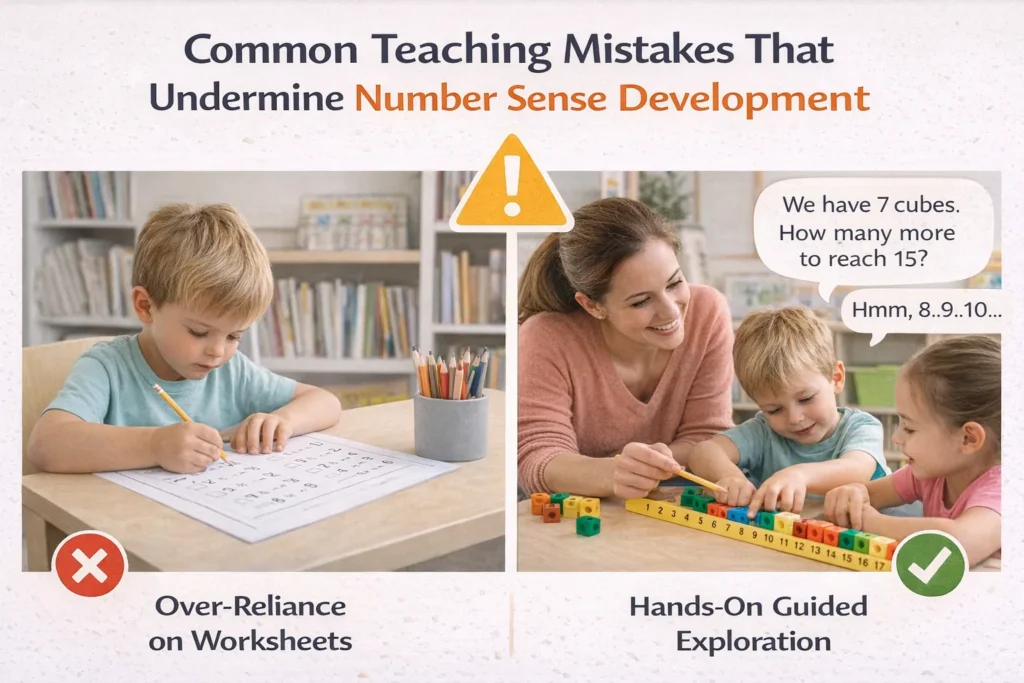
Over-reliance on worksheets: Worksheets develop procedural accuracy, not conceptual understanding.
A child can complete a hundred addition worksheets correctly without developing genuine number sense by applying a memorized counting procedure to each problem.
Worksheets are useful for consolidation after understanding is established, not as the primary teaching tool.
Moving to abstract too quickly: Introducing the “+” and “=” symbols before children have extensive concrete and representational experience with combining quantities causes children to treat arithmetic as symbol manipulation rather than quantity reasoning.
Spend more time than feels necessary at the concrete and representational stages, this investment always pays back.
Prioritizing speed over understanding: Timed drills and speed challenges signal to children that mathematics is about fast recall rather than reasoning.
For children who think and process more deliberately, speed pressure produces anxiety rather than fluency.
Speed develops naturally as understanding deepens it cannot be forced ahead of understanding without damaging both.
Teaching one representation exclusively: Children who have only ever seen numbers as digit symbols struggle when they encounter ten-frames, number lines, or base-ten block representations.
Using multiple representations consistently and explicitly connecting between them builds the representational flexibility that is one of the most reliable markers of strong number sense.
Correcting counting errors without diagnosing them: When a child makes a counting error, simply correcting the answer misses the teaching opportunity.
The error is a window into the specific gap, a subitizing weakness, a sequence gap, a one-to-one correspondence issue that targeted teaching can address.
Always ask “how did you count?” before providing the correct answer.
Skipping place value development: Many teachers underestimate how long place value understanding takes to develop genuinely.
Children can learn to write two-digit numbers correctly without understanding what the tens digit actually means.
Sustained, concrete place value work with physical tens-and-ones materials used daily is essential and cannot be rushed.
How long should number sense activities take each day?
Effective number sense development does not require a dedicated hour-long session. Research supports the approach of shorter, more frequent activities embedded throughout the day — a 10-minute morning number routine, a 5-minute number talk, number-embedded transitions, and brief game-based practice during learning centres or free choice time. This totals 25–35 minutes of number sense development daily without requiring a single dedicated lesson block.
What if a child enters Class 1 with very weak counting skills?
Begin at the concrete stage with very small numbers — quantities of 3–5 — using physical objects exclusively. Focus on one-to-one correspondence (matching one object to one counting word) before extending the range. Subitizing activities with quantities of 2–4 are particularly effective for building the foundational quantity recognition that more complex counting depends on. With consistent support, most children with weak entry-level counting skills can reach grade-level number sense by mid-year.
Should parents teach the same strategies as the classroom?
Ideally, yes — when home and classroom approaches align, children receive consistent messages about what numbers are and how to think about them. Ask your child’s teacher which manipulatives and representations they are using so you can use the same language and tools at home. The five home strategies in this guide are specifically designed to complement classroom instruction without requiring specialist knowledge or special materials.
How do number sense teaching strategies connect to competition mathematics?
Directly. The IMO syllabus for class 1 assesses exactly the kinds of flexible numerical reasoning that number sense teaching strategies develop — pattern recognition, quantity comparison, sequence completion, and logical number reasoning. Children who have been taught through the strategies in this guide — particularly number talks, hundred chart exploration, and structured games — approach Class 1 competition problems with significantly more confidence and adaptability than those who have only experienced procedural instruction.
When should I be concerned that number sense strategies are not working?
If a child has been consistently engaged with hands-on, varied number sense activities for 6–8 weeks and shows no improvement in any of the six number sense components (recognition, counting, comparing, quantities, patterns, place value), it is worth discussing with the class teacher or a specialist. Some children need more structured support or a different entry point into the concrete stage. Early identification and response is always better than waiting.
Make Preparing for Math Olympiad Simple!



Conclusion
Number sense teaching strategies work best when used consistently, with guided questioning, across varied contexts, not occasionally with specialist materials.
A daily number talk, weekly game, regular manipulative use, and embedded counting routines will build deeper understanding than any elaborate one-off lesson.
For the full conceptual framework, see Number Sense for Class 1. For the evidence of why it matters, see why number sense is important for Class 1.
For children ready for the next challenge, see number sense teaching strategies and number sense resources for parents.