

Measurement activities for kindergarten work best when kids can touch, compare, and talk about what they’re measuring, not just fill in a worksheet.
- Activity 1: Measuring Nature
- Activity 2: Measuring with LEGO
- Activity 3: Measurement Games
- Activity 4: Sensory Measurement Station
- Activity 5: Crafting Measurement Tools
- What Kindergartners Should Know About Measurement by Year's End
- Tips for Teachers and Parents: Making Measurement Practice Stick
- Keep the Learning Going with Gonit
Nature hunts, LEGO towers, sensory bins, relays, and DIY rulers are five simple ways to teach length, weight, height, and capacity to five- and six-year-olds.
Long before kids can add or subtract, they’re already comparing who is taller, whose cup holds more juice, or which backpack feels heavier. That everyday curiosity is exactly what makes learning measurements such a natural fit at this age.
A solid kindergarten measurement activity does more than teach a single skill. It builds the foundation for length, weight, capacity, and even early geometry, while also strengthening number sense, spatial reasoning, and fine motor skills along the way.
Below are five hands-on measurement ideas that turn length, height, weight, and volume into something kids can see, touch, and talk about, using everyday tools like rulers, blocks, and measuring cups.
Activity 1: Measuring Nature
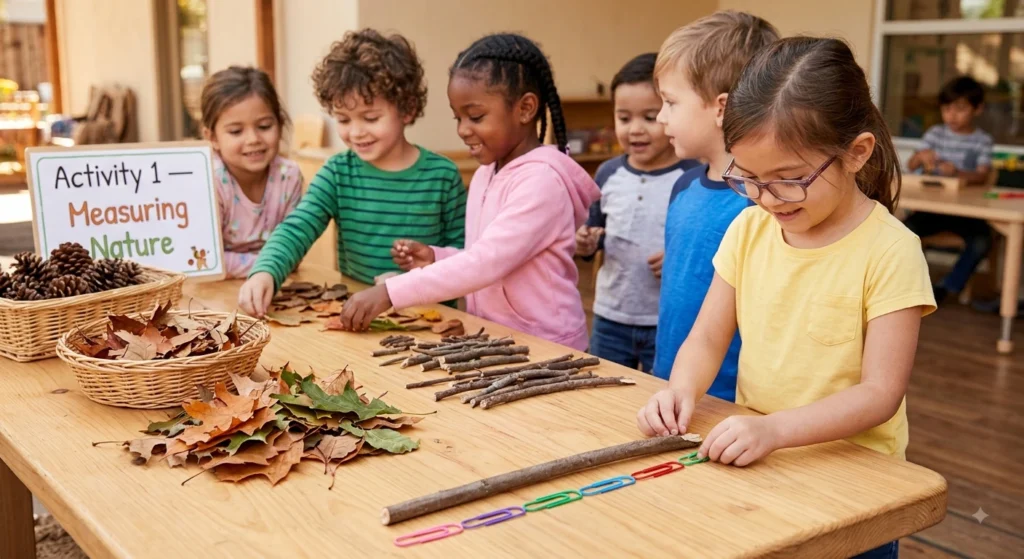
Nature is a free, ready-made measurement lab, and it’s one of the easiest ways to introduce measurement kindergarten concepts without any special equipment or store-bought materials.
Collecting Natural Items
Send kids on a nature scavenger hunt for leaves, sticks, rocks, and pinecones. Let them gather a small basket of items to measure once they’re back at the table.
Each item becomes its own mini measurement challenge. Kids naturally want to know which leaf is biggest or which stick is longest, which makes this a genuinely fun measurement activity for preschool rather than a forced one, and a great way to get outdoor learning and math practice into the same afternoon.
Using Standard and Non-Standard Units
Start with non-standard units of measurement like paperclips, cubes, or even a child’s own hand span. Ask questions like, “How many paperclips long is this stick?” or “How many hands tall is this rock?”
Then introduce a ruler or measuring tape for standard units like inches or centimeters. Comparing both methods helps kids understand why standard units matter, which is a core idea behind most preschool measurement lessons and a common building block in early math curriculum, including the more structured work kids will see in our measurement for Class 1 guide.
This activity naturally builds vocabulary like longer, shorter, heavier, and lighter, giving kids the language they need before they even reach for formal learning measurement concepts later in school.
Activity 2: Measuring with LEGO
Building blocks are one of the best tools around for kindergarten measuring, mostly because kids already love playing with them and rarely realize they’re practicing math skills at all.
Building and Measuring Structures
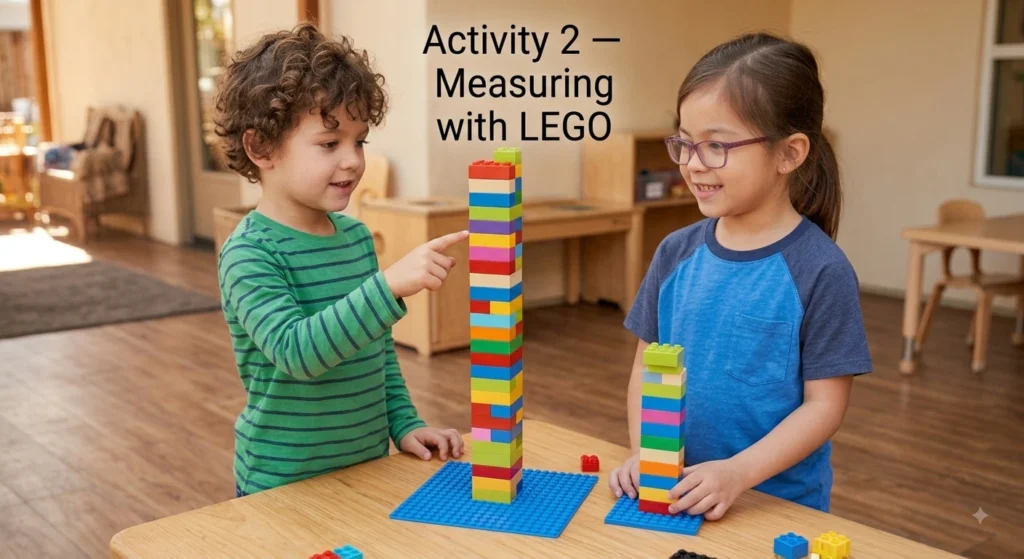
Have kids build a tower using a set number of blocks, then ask them to measure its height using a ruler or a stack of same-size blocks. This turns building time into counting and measuring practice without any extra prep, and it doubles as a light introduction to nonstandard measurement units.
It’s a simple, low-cost measurement activities for preschool idea that works just as well at home as it does in a classroom, since most families already have building blocks somewhere in the house.
Comparing Heights and Lengths
Build two or three different towers or roads, then ask kids to compare which is tallest, shortest, longest, or widest. This is a great moment to introduce comparison words like taller than and shorter than, which start to click once kids can physically see the difference.
LEGO-based measurement games for kids work especially well in small groups, since children naturally want to compare their build to a friend’s. That built-in competitiveness is a great motivator for repeated practice and helps reinforce comparative language and early data comparison skills.
Activity 3: Measurement Games
Games turn a kindergarten measurement activity into something kids actively look forward to instead of something they’re told to do.
Movement-based games also help wiggly kindergartners burn energy while learning, which makes them a favorite for both classroom teachers and homeschool parents.
Interactive Measurement Relay
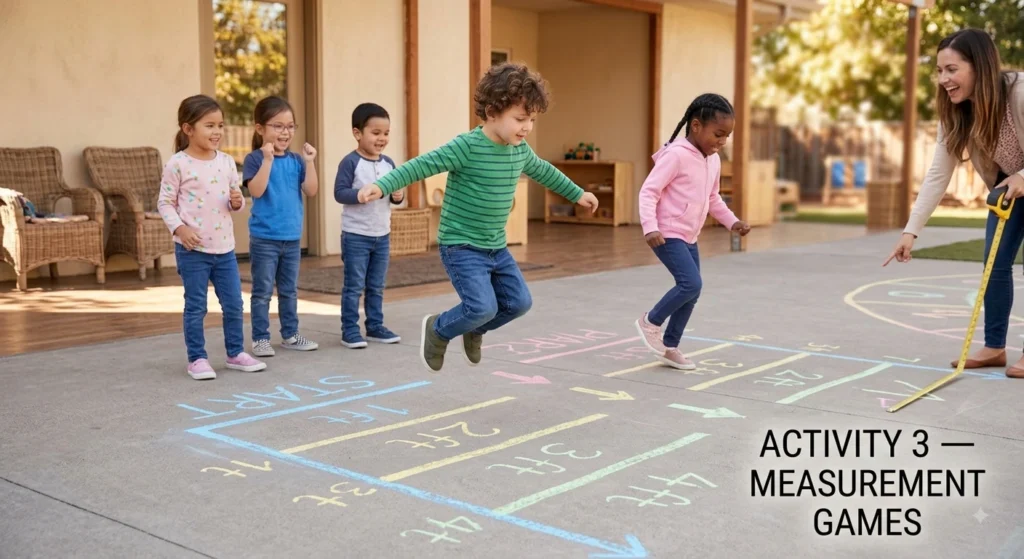
Set up a relay race where each team measures a set distance using footsteps, jumps, or hops. The team estimates the distance first, then measures it for real to check how close their guess was.
This blends physical activity with measurement practice and introduces the idea of estimating before checking an answer, an important early step in learning to measure accurately and a skill that carries directly into later estimation and rounding lessons.
Estimation Race Game
Place a few objects on a table and ask kids to guess their length before measuring. Whoever guesses closest earns a point.
This game builds estimation skills, a key part of early math thinking and critical thinking for kids, and it’s one of the more popular measurement games for kids because every round brings a new guess and a new answer. It also works as a quick warm-up before diving into more structured measurement in kindergarten lessons or a formal math lesson plan.
Activity 4: Sensory Measurement Station
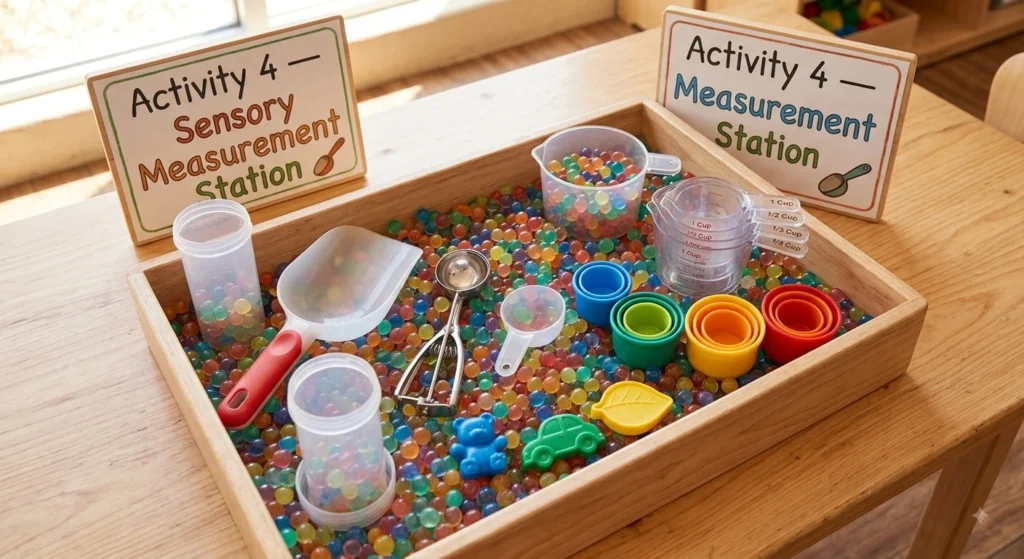
A sensory station brings texture and touch into the mix, which is especially helpful for kids who learn best by doing rather than watching, and it’s a favorite among teachers looking for low-prep, high-engagement math centers.
Materials Needed
A few simple supplies are all it takes to set up this measurement for kindergarten activities station:
- A shallow bin or tray
- Sand, rice, water beads, or dried beans
- Small scoops, cups, and containers of different sizes
- A basic kitchen scale (optional, for exploring weight and mass)
Nothing here needs to be fancy or expensive. Most of these materials are likely already at home or sitting in a classroom supply closet.
Exploring with Different Textures
Let kids scoop, pour, and fill containers of different sizes. Ask questions like, “Which cup holds more rice?” or “How many scoops fill this jar?”
This hands-on approach introduces volume and capacity in a natural, low-pressure way, and it’s one of the clearest ways to bring teaching length weight capacity to life for young children. Rotating materials each week, sand one day, water beads the next, keeps the station fresh and gives kids new textures to explore while reinforcing the same core measurement vocabulary.
Activity 5: Crafting Measurement Tools
Kids understand measurement tools far better once they’ve made one themselves. This activity blends art with early math and works as a memorable, hands-on measuring activity for preschool.
DIY Rulers and Measuring Tapes
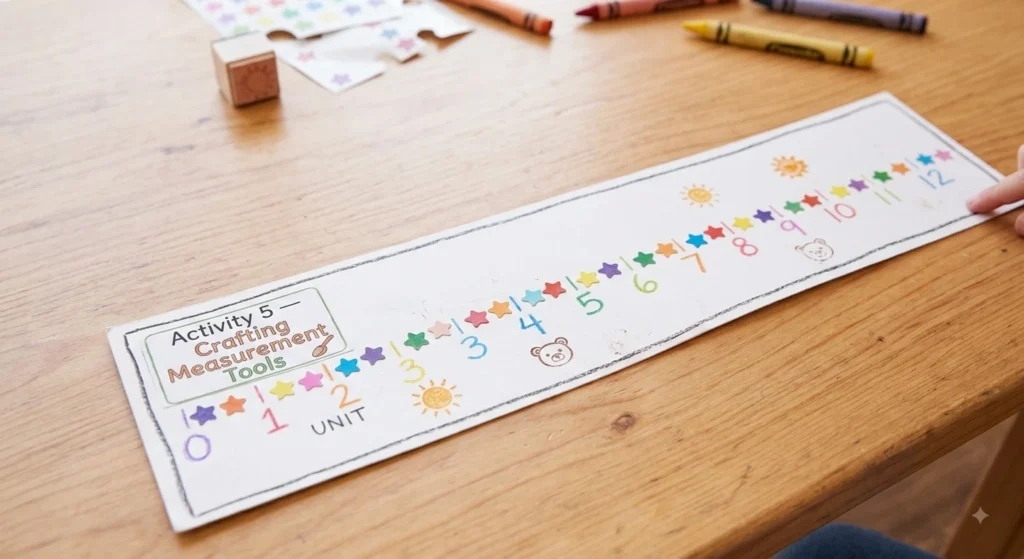
Have kids create their own paper rulers using a strip of cardstock, marking it off in equal sections with a stamp, sticker, or drawn line for each unit. Once finished, kids can use their homemade ruler to measure objects around the room.
Making the tool first helps kids understand what a ruler actually represents, rather than treating it as just another object they’re handed. It’s a small shift that makes a real difference in how well learning measurement concepts actually sticks, and it introduces the idea that measuring tools are just a consistent, repeatable unit lined up in a row, an idea kids will build on directly when they move into Grade 2 measurement of length, weight, and time.
Incorporating Measurement into Art
Extend the activity into an art project by asking kids to draw a picture where every object is a certain number of units tall or wide. This blends creativity with measurement practice in a way that feels playful, not like a math drill, and it doubles as a keepsake project parents love to see.
What Kindergartners Should Know About Measurement by Year’s End
By the end of the kindergarten year, most children can compare two objects directly and describe the difference using simple measurement vocabulary, such as longer/shorter, taller/shorter, and heavier/lighter. This kind of direct comparison is usually the first measurement skill kids master, well before they’re using rulers with any real precision.
From there, kids typically move on to measuring objects using non-standard, repeated units, like paperclips, blocks, or footsteps, lined up end to end. This step matters because it teaches the core idea behind all measurement: using a consistent unit to describe size. Only after this do most kindergartners start experimenting with standard units like inches and centimeters, usually with adult guidance.
Capacity and weight tend to develop slightly later than length, since they require a bit more abstract thinking, along with the kind of visual reasoning that grows with practice. Simple questions like “which container holds more?” or “which is heavier?” are usually enough at this stage. Kids aren’t expected to read a scale accurately yet, just to understand the concept of more, less, heavier, and lighter through hands-on comparison.
Tips for Teachers and Parents: Making Measurement Practice Stick
A few small habits go a long way when it comes to learning to measure at this age:
- Use real, everyday objects. Toys, snacks, shoes, and furniture are far more meaningful to a five-year-old than abstract worksheet drawings.
- Talk out loud while measuring. Narrating your own thinking (“I wonder if this book is longer than my hand”) models the reasoning kids will eventually use on their own.
- Let estimation come first. Guessing before measuring builds number sense and makes the final answer feel like a discovery rather than a fact to memorize.
- Repeat activities with new objects. Kids don’t need a new game every time; swapping out what they’re measuring keeps the same skill fresh without extra planning.
- Connect measurement to daily routines. Cooking, packing lunch, and comparing heights at bath time all count as valid, low-effort measurement practice. Even simple routines like counting money during a pretend shopping game reinforce the same skills of comparing and using consistent units.
These small adjustments turn any kindergarten measurement activity into a repeatable habit rather than a one-time lesson, which is ultimately what makes the skill stick.
Keep the Learning Going with Gonit
Hands-on activities are a great starting point, and pairing them with a little consistent practice helps measurement in kindergarten skills stick even faster. That’s where Gonit comes in.
Gonit is a fun, easy-to-use math platform built for kids, with bite-sized lessons and practice designed to match how young learners actually think and grow. As your child moves from hands-on measurement activities for preschool toward more structured learning measurement concepts like place value and skip counting, Gonit offers a simple way to reinforce those same skills at their own pace, whether that’s at home or alongside classroom learning.
What are some good measurement activities for kindergarten?
Some of the best measurement activities for preschool and kindergarten use everyday objects kids already enjoy, like nature items, building blocks, sand, or water. Nature scavenger hunts, LEGO towers, sensory bins, and DIY paper rulers all turn abstract measurement concepts into something kids can see and touch.
How do you teach measurement to kindergarteners?
The most effective preschool measurement lessons start with non-standard units, like paperclips, blocks, or hand spans, before moving on to standard tools like rulers and scales. Hands-on play, comparison games, and simple vocabulary (longer, shorter, heavier, lighter) help kids build a real understanding of learning measurement concepts rather than just memorizing terms.
What is the best way to introduce learning to measure at home?
Parents don’t need special tools to start learning to measure at home. Everyday moments, like comparing who’s taller, measuring ingredients while cooking, or lining up toys from shortest to longest, are simple, low-pressure ways to build measurement skills into daily routines.
What units of measurement do kids learn in kindergarten?
Kindergartners typically start with teaching length weight capacity using non-standard units before moving toward standard ones. They compare length (longer/shorter), weight (heavier/lighter), and capacity (more/less), and are gradually introduced to formal units like inches and centimeters as they get more comfortable with the basics.
Why is measurement important in early childhood education?
Measurement in kindergarten builds a foundation for number sense, comparison, and problem-solving that carries into later math skills. Kids who practice math measurement for kids activities early on tend to develop stronger spatial reasoning and a more intuitive grasp of quantity, which supports everything from basic arithmetic to geometry.
Are there fun measurement games for kids?
Yes. Measurement games for kids like estimation races, measurement relays, and “guess and check” challenges make practice feel like play rather than a lesson. Turning measurement into a game with a winner or a goal keeps kids engaged and encourages them to try again, which naturally reinforces the skill.
What is the difference between standard and non-standard measurement for kids?
Non-standard units are informal, everyday objects, like paperclips, blocks, or footsteps, used to measure length, height, or distance. Standard units, like inches, centimeters, or pounds, are fixed and consistent no matter who is measuring. Kindergartners usually start with non-standard units since they’re more intuitive, then move toward standard tools like rulers and scales as their understanding of measurement grows, a progression covered in more depth in our measurement for Class 1 article.
Make Preparing for Math Olympiad Simple!



Conclusion
Measurement activities for kindergarten work because they turn an abstract idea into something kids can hold, pour, stack, and compare.
Nature walks, LEGO towers, sensory bins, relays, and DIY rulers build real understanding of length, weight, and capacity through play.
Try one activity this week and see how your child responds. Chances are, they’ll ask to do it again before you even suggest it. And once they’re ready for the next step, resources like Gonit’s Class 1 measurement guide and Grade 2 measurement lessons are there to keep the skill growing well beyond kindergarten.

Mikha Piregu is a Content Writer with experience spanning educational content, including math and math olympiad topics, as well as advocacy writing, research-based articles, and SEO-driven web content. He creates high-quality blog content, web copy, and feature articles that support brand visibility, audience engagement, and long-term organic growth through data-informed storytelling. Skilled in WordPress, WooCommerce, and modern digital tools, Mikha adapts content across various platforms, including blogs, websites, campaigns, and advocacy initiatives, with clarity and purpose.

There are no comments posted here yet.
Sign in to leave a comment