

Grade 2 measurement covers three connected skills: measuring length, measuring weight, and telling time to the nearest 5 minutes.
All three teach the same underlying idea, learning to compare and quantify the world around you, starting with everyday objects and hands-on comparison, then moving to standard tools like rulers, scales, and clocks.
This guide walks through all three skills together, in the order most Grade 2 classrooms teach them, with a dedicated section for clock-reading since it’s the sub-skill that tends to worry parents and kids the most.
The One Idea Behind All Three Skills
Before jumping into rulers, scales, and clocks, it helps to understand why these three topics are grouped together in the Grade 2 curriculum.
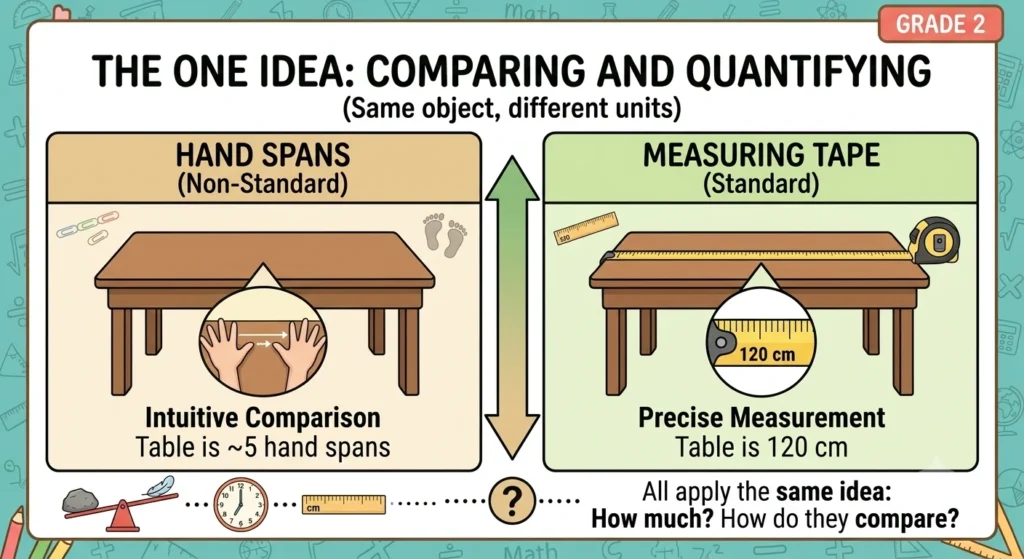
Before jumping into rulers, scales, and clocks, it helps to understand why these three topics are grouped together in the Grade 2 curriculum. Length, weight, and time all ask the same basic question: how much of something is there, and how does it compare to something else?
Two terms come up constantly in this unit, so let’s define them plainly:
Non-standard units are everyday objects used to measure something, like using paperclips to measure a pencil’s length, or a hand span to measure a table. They’re useful for building the concept of measurement without needing special tools.
Standard units are the official, agreed-upon units everyone uses, like centimeters, grams, and hours. They let people compare measurements accurately no matter who is measuring or where.
Grade 2 curriculums move children through both stages on purpose: non-standard units first, to build intuition, then standard units, to build precision. Keep that sequence in mind as you work through length and weight below. Time works a little differently, since clocks are a fixed standard tool from the start, but the same core idea, comparing and quantifying, still applies. If this is your child’s first real exposure to measurement, the Class 1 measurement guide covers the basics in more depth before jumping into standard units here.
Measuring Length
Start with Non-Standard Units
Before your child picks up a ruler, it helps for them to measure things with objects they already understand. Hand spans, paperclips, pencils, or even footsteps all work well.
Ask your child to measure the length of a book using paperclips laid end to end, then measure the same book using hand spans. They’ll notice the number changes depending on the unit, which is exactly the lesson: the size of the unit affects the count.
This step matters because it builds the intuition that measurement is about comparing a length to a repeated unit, long before your child needs to understand what a centimeter actually is.
Move to Standard Units (cm and m)
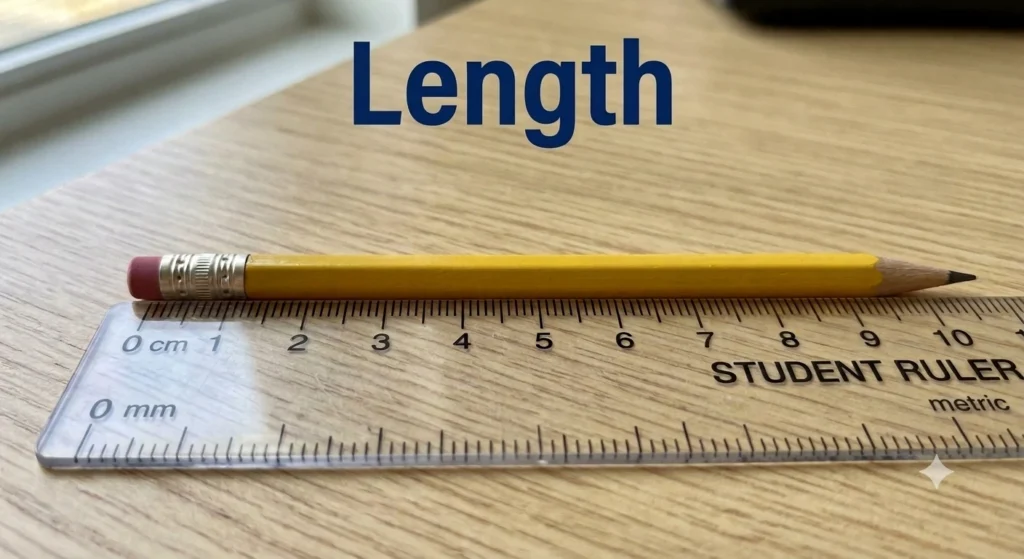
Once your child is comfortable comparing lengths with everyday objects, introduce the ruler. In Grade 2, the two standard units that matter most are centimeters (cm) for smaller objects and meters (m) for longer distances, like the length of a room.
A simple way to practice: hand your child a ruler and ask them to measure a crayon, a shoe, and a book, writing down the length in centimeters for each. For longer objects, a meter stick or tape measure works the same way.
A quick note for readers outside Bangladesh: some curriculums also use inches and feet. The core skill, lining up the zero point and reading the correct number, transfers directly between metric and imperial units, so a child who understands centimeters picks up inches quickly if needed.
Common Mistakes in Measuring Length
- Starting the measurement from the edge of the ruler instead of the zero mark. This is the single most common ruler mistake at this age, and it’s worth checking every time until it becomes automatic.
- Skipping numbers or losing count when using non-standard units like paperclips, especially with longer objects.
- Confusing centimeters and meters when estimating, for example guessing a pencil is “2 meters” long instead of 2 centimeters or roughly 15 to 18 centimeters.
- Reading the nearest whole number instead of noticing when an object falls between two markings.
Practice Problems: Length
- Use paperclips to measure the length of your math notebook. How many paperclips long is it?
- Using a ruler, measure three household objects (a spoon, a toothbrush, a remote control) in centimeters.
- Which is longer: a 15 cm pencil or a 20 cm ruler? By how many centimeters?
- Estimate the length of your bedroom door in meters, then check with a tape measure. How close was your estimate?
Measuring Weight
Weight is consistently the thinnest topic in most Grade 2 resources, which is unfortunate, because the same non-standard-to-standard progression that works for length applies here too, and kids who struggle with grams and kilograms often just need the comparison stage explained more slowly.
Start with Comparison
Before introducing a scale, focus on comparing: which object is heavier, and which is lighter? A simple homemade balance (a coat hanger with two bags, or a see-saw made from a ruler balanced on a pencil) lets your child physically feel the difference between a heavy object and a light one.
Ask your child to predict which of two objects is heavier before testing it, for example a spoon versus a fork, or an apple versus an orange. This builds the same intuition length-comparison builds: an understanding that weight is something that can be measured and compared, not just guessed.
Move to Standard Units (g and kg)
Once comparison feels natural, introduce grams (g) and kilograms (kg) as the standard units used to measure weight precisely.
A simple guideline that helps at this age: light, everyday objects like a pencil or an apple are measured in grams, while heavier objects like a bag of rice or a child’s own body weight are measured in kilograms.
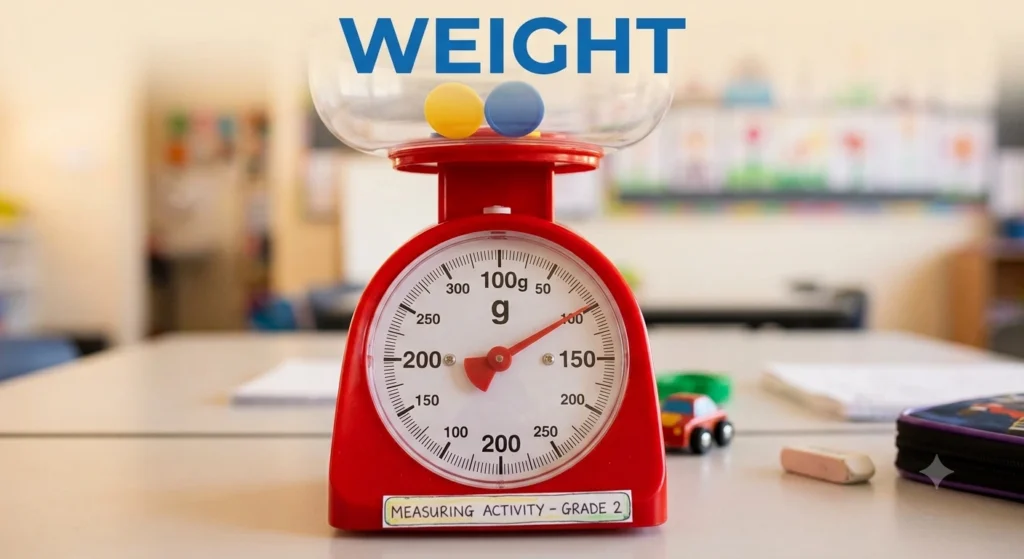
If you have a kitchen scale at home, weighing a few familiar objects together, a banana, a cup, a bag of sugar, gives your child a concrete sense of what 100 grams or 1 kilogram actually feels like, which is far more useful than memorizing the number alone.
Common Mistakes in Measuring Weight
- Confusing grams and kilograms, especially when estimating the weight of an object without a scale.
- Assuming a bigger object is always heavier. Size and weight don’t always match (a large balloon is lighter than a small stone), and this is a genuinely useful lesson for building measurement reasoning.
- Reading a scale incorrectly, particularly rounding to the nearest mark instead of reading the exact number shown.
- Skipping the comparison stage entirely and jumping straight to units, which often leaves the underlying concept shaky even if the child can recite that 1 kg equals 1000 g.
Practice Problems: Weight
- Predict which is heavier: a pencil or an eraser. Then weigh both on a kitchen scale to check.
- List three objects at home that you’d measure in grams, and three you’d measure in kilograms.
- A bag of rice weighs 2 kilograms. How many grams is that?
- Which weighs more: 500 grams of flour or half a kilogram of sugar? (This one has a trick, see if your child notices they’re equal.)
Telling Time to the Nearest 5 Minutes
This is usually the sub-skill parents reach out for help with first, and often the one that causes the most frustration for kids. That’s normal.
Reading an analog clock asks a child to track two moving hands at once, on a scale (5-minute intervals) that doesn’t match the simple counting-by-ones they’ve done up to now. Give this stage time, and avoid framing it as something a child should already “just know.”
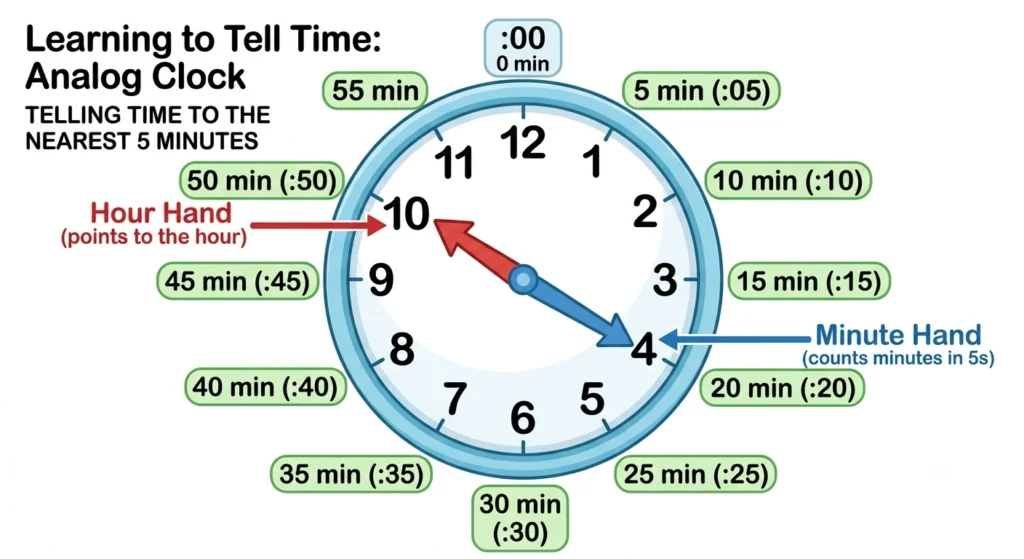
How to Read an Analog Clock
Here’s a clear, step-by-step method for reading the time to the nearest 5 minutes:
- Identify the hour hand (the shorter hand) and the minute hand (the longer hand). Mixing these up is the number one source of errors, so this step is worth confirming every time at first.
- Look at the hour hand first. It points close to a number, and that number tells you the hour, even if the hand isn’t exactly on it.
- Look at the minute hand. Each number on the clock face represents 5 minutes, so count by fives around the clock: 12 is 0 minutes, 1 is 5 minutes, 2 is 10 minutes, and so on up to 11, which is 55 minutes.
- Combine the two: the hour from the hour hand, and the minutes from the minute hand, to read the full time (for example, “7:35”).
A useful home practice: point to a clock at random moments during the day and ask your child to read it. Real-world repetition, rather than worksheets alone, is often what makes clock-reading click.
Common Mistakes in Telling Time
- Confusing the hour and minute hands, especially on clocks where the two hands are similar in length.
- Counting the minute hand by ones instead of fives, which leads to answers like “7:3” instead of “7:15.”
- Reading the hour hand as if it should point exactly at a number, rather than understanding it moves gradually between numbers as the minutes pass.
- Losing track partway around the clock face when counting by fives, particularly past the 6.
If your child is still mixing up the hands or losing count by fives, that’s a completely normal stage of learning this skill, not a sign of falling behind. Most children need repeated, low-pressure practice with a real clock before the two-hand system feels automatic.
Practice Problems: Time
- Draw the hands on a clock face to show 3:20.
- What time is it if the hour hand is between the 6 and 7, and the minute hand points to the 6?
- Count by fives around a clock face out loud, starting at 12.
- Set a real clock (or a clock app) to 9:45 and check your answer with a grown-up.
Comparison and Conversion Table
| Category | Non-Standard Unit | Standard Unit (Metric) | Standard Unit (Imperial) |
| Length | Hand spans, paperclips, footsteps | Centimeter (cm), meter (m) | Inch, foot |
| Weight | Balance comparison (heavier/lighter) | Gram (g), kilogram (kg) | Ounce, pound |
| Time | Not applicable, clocks are a fixed standard | Hours, minutes (5-minute intervals) | Same as metric |
Quick conversions worth remembering at this level: 100 centimeters equal 1 meter, 1000 grams equal 1 kilogram, and 2.5 centimeters are roughly equal to 1 inch.
Keep Practicing at Home
The three skills in this guide build on each other more than they might seem to at first. A child who’s comfortable comparing objects before measuring them, whether that’s length, weight, or time, tends to pick up each new tool (ruler, scale, clock) faster, because the underlying concept, quantifying and comparing, is already familiar.
If your child has mastered measurement and is ready for related skills, Gonit’s guides on Grade 2 addition and skip counting for Grade 2 build on the same number sense this unit introduces. If clock-reading is still the tricky part, the Grade 1 telling time guide covers the fundamentals in more depth.
What measurement topics are covered in Grade 2 math?
Grade 2 measurement typically covers length (using non-standard and standard units like centimeters and meters), weight (comparing objects and using grams and kilograms), and telling time to the nearest 5 minutes.
Why do kids learn non-standard units before standard units like centimeters?
Non-standard units, like paperclips or hand spans, build the basic idea that measurement means comparing something to a repeated unit. This makes standard units like centimeters and grams easier to understand once they’re introduced.
What’s the easiest way to teach a child to read an analog clock?
Start by helping them tell the hour and minute hands apart, then practice counting by fives around the clock face for the minutes. Real-world practice with an actual clock, rather than worksheets alone, tends to work best.
Is it normal for a Grade 2 student to struggle with telling time?
Yes. Telling time asks a child to track two hands on a 5-minute scale, which is more complex than the counting-by-ones they’ve done previously. Most children need repeated, low-pressure practice before it feels automatic.
How can I help my child at home without formal tools?
Everyday objects work well: paperclips or hand spans for length, a homemade balance for weight, and a real clock or clock app for time. Hands-on comparison builds the same understanding as formal worksheets, often faster.
What’s the difference between grams and kilograms, and how do I explain it simply?
A gram measures light, everyday objects like a pencil or an apple. A kilogram measures heavier objects, like a bag of rice or a child’s body weight. 1,000 grams equal 1 kilogram.
Make Preparing for Math Olympiad Simple!



Conclusion
Grade 2 measurement is one skill, not three: comparing and quantifying the world with growing precision.
Once your child sees length, weight, and time that way, each tool (ruler, scale, clock) gets easier to pick up.
Struggling with clocks or grams and kilograms is normal at this stage. Keep practice short, use objects around the house, and let your child move at their own pace.

Mikha Piregu is a Content Writer with experience spanning educational content, including math and math olympiad topics, as well as advocacy writing, research-based articles, and SEO-driven web content. He creates high-quality blog content, web copy, and feature articles that support brand visibility, audience engagement, and long-term organic growth through data-informed storytelling. Skilled in WordPress, WooCommerce, and modern digital tools, Mikha adapts content across various platforms, including blogs, websites, campaigns, and advocacy initiatives, with clarity and purpose.

There are no comments posted here yet.
Sign in to leave a comment