

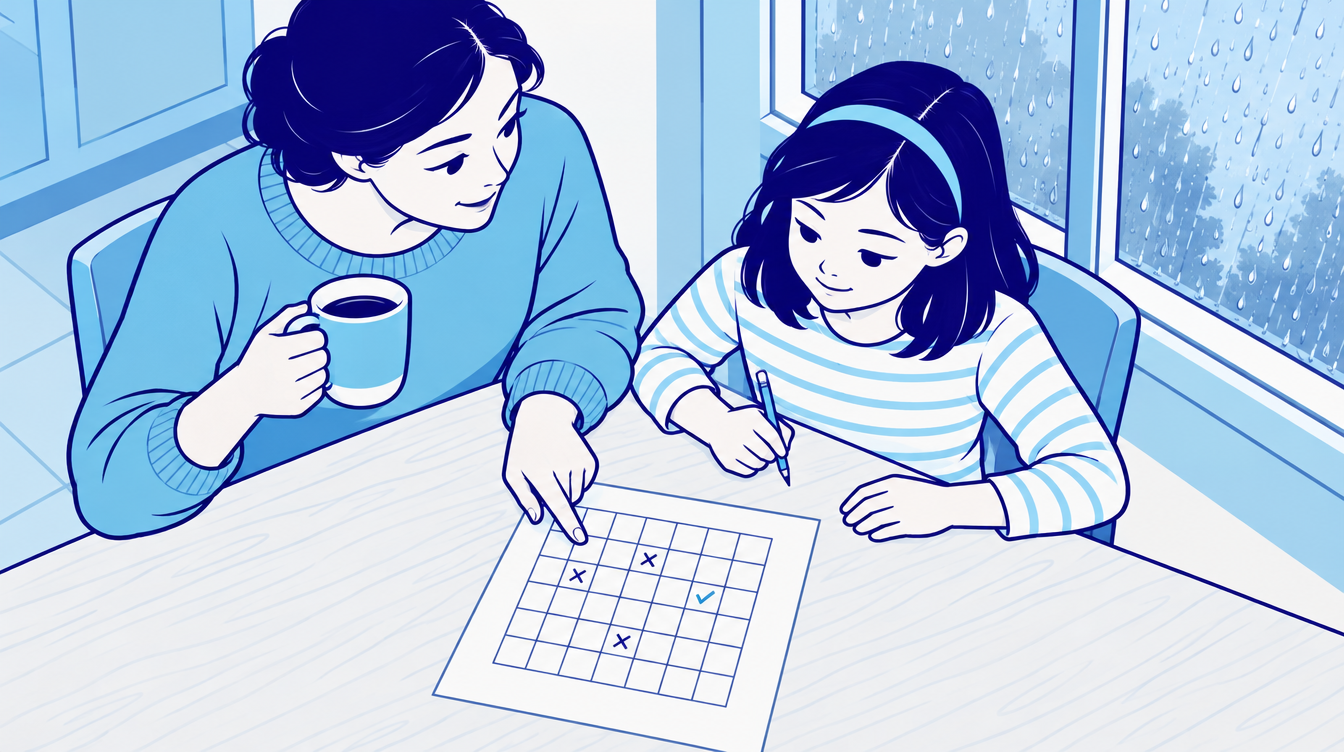
Homework is done by four, it’s raining, and you’d like twenty minutes that are quiet, screen-free and still count as thinking. So you search for printable logic puzzles, pick a free pack that says “ages 7–10” and hand over page one. The first puzzle takes her four minutes. So does the second. The third is a 4×4 grid, and ten minutes later the pencil is down and she’s announcing that this one is broken.
It isn’t broken. It asks for a move the first two never needed, and nothing on the page says so.
Why Does the Puzzle Pack End Up in a Drawer?
Most printable packs are labeled by age or by grid size. That sounds sensible. The trouble is that a 3×3 grid can be easy or hard depending on the kind of clue inside it, and a seven-year-old can be ready for one kind and miles from the next.
So the easy pages go by in a blur and teach nothing new, and then one page is a wall. When she gets stuck, the kind thing seems to be reading out the answer key, or at least the next answer, so the afternoon doesn’t end in tears.
That gets you to dinner. It also ends the puzzle without the move she was missing, which is usually crossing things out, or putting two clues together. The next puzzle that needs that move stalls in exactly the same spot. A child who hits that wall twice may decide logic puzzles “aren’t my thing,” about a skill that’s very teachable. The pack goes in a drawer, and the puzzle habit you were hoping for never gets started.
Which Logic Puzzle Should Your Child Start With?
Pick logic puzzles by the reasoning step your child can’t do yet, and ignore the age on the pack. We’d start most children with a short elimination puzzle, where clues say what is not true and the answer is the one option left. Two clean solves at a step, with no help, means it’s time to move up.
That’s the way we sort them. There are five steps, and each one shows up as a particular shape of clue. Once you can spot the shape, you can tell what a puzzle is going to ask of your child before she starts.
| Step | What the clue looks like | A sign your child has it |
|---|---|---|
| 1. Direct placement | “Leo has the dog.” One clue puts one thing in its place. | She reads a clue and marks the grid without asking what to do. |
| 2. Elimination | “Ana doesn’t swim.” The clue rules something out. You cross out options until one is left. | She crosses things out on her own and spots the last box standing. |
| 3. Combining clues | “The dog lives in the blue house” plus “Nora lives in the red house.” Together they tell you Nora doesn’t have the dog. Neither clue says that alone. | She says “so that means…” and joins two clues out loud. |
| 4. Order and position | “Finn is right behind Eva,” “Hugo is somewhere in front of her.” | She draws the line or the row of houses before she starts. |
| 5. If-then | Nothing settles it directly, so you try a case (“suppose Ruby’s kite is green”), follow it, and drop it when it breaks a clue. | She tries a guess on purpose, then rubs it out because of a clue. |
To find her step in about five minutes, start with Puzzle 2 below. If she solves it alone, try Puzzle 3. If she stalls, drop back to Puzzle 1 and come up again next time. If she’s five or six, or reading clues is still slow going, picture-based reasoning puzzles for younger children cover the same thinking with fewer words. We’d start most six- and seven-year-olds at step 1 and most nine-year-olds at step 2, but her step matters more than her birthday.
One habit helps at every step: on a grid, mark an X for “no” and a check for “yes,” and use a pencil. When a row has two X’s in a three-column grid, the empty box is the answer.
Five Printable Logic Puzzles, One for Each Step
We wrote these five for this page, one per step, easy to hard. Each has exactly one answer, and you can reach it with the step it’s labeled for. Print the page or copy the grids onto scrap paper.
Puzzle 1: Direct Placement
Mia, Leo and Sam each have one pet: a cat, a dog or a fish. Who has which pet?
- Clue 1: Leo has the dog.
- Clue 2: Mia has the fish.
| Cat | Dog | Fish | |
|---|---|---|---|
| Mia | |||
| Leo | |||
| Sam |
Show solution
Answer: Mia has the fish, Leo has the dog and Sam has the cat. Each clue places one pet, so put a check in Leo’s dog box and Mia’s fish box. The cat is the only pet left, and Sam is the only child left. This puzzle trains reading a clue and marking it on the grid.
Puzzle 2: Elimination
Ana, Ben and Cara each chose one sport: soccer, swimming or tennis. Who chose which?
- Clue 1: Ana doesn’t swim and doesn’t play tennis.
- Clue 2: Ben doesn’t play tennis.
| Soccer | Swimming | Tennis | |
|---|---|---|---|
| Ana | |||
| Ben | |||
| Cara |
Show solution
Answer: Ana plays soccer, Ben swims and Cara plays tennis. Clue 1 puts two X’s in Ana’s row, so soccer is the only box left for her. Now soccer is taken, and clue 2 crosses out tennis for Ben, so Ben swims. Cara gets tennis. This puzzle trains crossing out until one option is left.
Puzzle 3: Combining Clues
Max, Nora and Owen each have one pet (a cat, a dog or a rabbit) and live in one house (red, blue or yellow). Who has which pet, and who lives where?
- Clue 1: The dog lives in the blue house.
- Clue 2: Nora lives in the red house.
- Clue 3: Max doesn’t have the dog.
- Clue 4: The cat doesn’t live in the yellow house.
Show solution
Answer: Max has the rabbit and lives in the yellow house. Nora has the cat and lives in the red house. Owen has the dog and lives in the blue house. Put clues 1 and 2 together: Nora is in the red house and the dog is in the blue one, so Nora doesn’t have the dog. Clue 3 says Max doesn’t either, so the dog is Owen’s, and he lives in the blue house. That leaves the yellow house for Max. By clue 4 the cat isn’t in the yellow house, so Max has the rabbit and Nora has the cat. This puzzle trains joining two clues to find a fact neither one says.
Puzzle 4: Order and Position
Eva, Finn, Gia and Hugo are lining up for the slide. Spot 1 is the front of the line and spot 4 is the back. Who is in each spot?
- Clue 1: Finn is right behind Eva.
- Clue 2: Hugo is somewhere in front of Eva.
- Clue 3: Gia is last.
Show solution
Answer: Hugo is 1st, Eva is 2nd, Finn is 3rd and Gia is 4th. Clue 3 puts Gia in spot 4, so the other three share spots 1 to 3. Eva needs Finn right behind her and Hugo somewhere in front, so she can’t be first or third. She’s second, Finn is third and Hugo is first. Drawing four boxes in a row makes this one much easier. This puzzle trains placing things by their order.
Puzzle 5: If-Then
Pip, Ruby, Theo and Uma each fly one kite: red, blue, green or yellow. Who flies which kite?
- Clue 1: Pip’s kite is red or blue.
- Clue 2: Ruby’s kite is red or green.
- Clue 3: Theo’s kite is blue or green.
- Clue 4: If Ruby’s kite is green, then Pip’s kite is blue.
| Red | Blue | Green | Yellow | |
|---|---|---|---|---|
| Pip | ||||
| Ruby | ||||
| Theo | ||||
| Uma |
Show solution
Answer: Pip flies blue, Ruby flies red, Theo flies green and Uma flies yellow. Clues 1 to 3 leave yellow for nobody but Uma, so Uma’s kite is yellow. After that the clues stop telling you anything for sure, so try a case. Suppose Ruby’s kite is green. Then clue 4 makes Pip’s kite blue, and Theo is left with neither blue nor green, which breaks clue 3. So Ruby’s kite isn’t green. It’s red, which makes Pip’s blue and Theo’s green. This puzzle trains trying a case and dropping it when it breaks a clue.
What Do You Say When Your Child Is Stuck?
When the pencil goes down, hold the answer key back for a minute and hand her a question. Each of these three matches a step on the ladder, so the question tells her which move to try. Ask them in this order.
- “Which clue tells you something for sure?” This sends her back to steps 1 and 2. A child who’s stuck has often read every clue once and is now staring at the grid.
- “What can you cross out because of it?” This is elimination, and in our experience it’s the move kids skip most. If she found a sure thing, it usually rules out a whole row and column. Once she marks those X’s, she can often see a box with nothing left beside it.
- “If you tried this one, which clue would it break?” This is the if-then question for step 5, and it also works on hard step 3 puzzles. Let her choose the guess. Following her own guess to a broken clue is the move step 5 teaches.
If all three questions still leave her stuck, reveal one box and let her carry on from there. The rest of the puzzle is still hers to finish.
Sometimes she isn’t stuck at all. She finishes fast, proudly, and the grid is wrong. Skip “that’s not right” and read the clues back to her one at a time, letting her check each against her grid. The clue her answer breaks is the clue she skimmed, and she finds it herself.
It also helps to ask her afterward which clue broke it open. A child who can point to the clue has learned the move, and she’ll recognize that shape of clue in the next puzzle.
When Is It Time for Harder Puzzles?
Move her up a step when she solves two puzzles in a row at her current step without any of the three questions, and when she can tell you which clue cracked each one. Speed doesn’t matter much here. A slow solve she did alone counts for more than a fast one you nudged.
A good session is short. Two or three puzzles is plenty, and we’d open with one from the step below so the first win comes quickly. Then give her one at her step, and if she’s flying, one from the step above to look at together. Stopping while she still wants another one makes the next afternoon easier to start.
Drop back a step if she needs the third question on every puzzle, or if puzzles have started to feel like a chore. Dropping back for a week costs nothing. She’ll come up again, and the next step will feel like hers.
If puzzles become her favorite part of the afternoon, there’s a natural next place for them. We think of these five steps as early contest thinking, and Math Kangaroo, a contest for grades K–12, says it “promotes problem-solving, logical reasoning, and a love for mathematics.” If you’re curious, here’s which math olympiad fits your child’s grade. For more ideas that don’t need a printer, see what critical thinking practice looks like at home. There are also logic worksheets for a first grader and number puzzles for a second grader if you’d like more at those levels.
Next rainy afternoon, you’ll know which page to hand over first: the step she’s on, with the three questions ready for when she’s stuck. The pack stays on the table, because every page is one she can do or one she’s about to learn. Here are 15 more puzzles to print, three for each step, with answers and short solutions.
NOTE FOR THE EDITOR (replace this box before publishing): [LEAD: Printable logic puzzles by reasoning step (15 puzzles + answers)]. Put the OptinMonster + ActiveCampaign email form that delivers the worksheet PDF here, as described in the WCMT Jira task for CT-000025. The PDF is attached to that task.
Gonit started when its founder went looking for practice for his sixth grader and found theory books instead. The app’s own line for that is “A sequence. Not a pile of problems.” Sorting your printed puzzles by step does the same thing for a stack of paper. When she’s ready for more, Gonit’s practice includes a logical-reasoning track alongside math, with 10,000+ original questions for grades 1–12.
Make Preparing for Math Olympiad Simple!


FAQ
What age are logic puzzles for?
We’d start most children on simple logic puzzles once they can read short clues, often around six or seven. We’d pick by the reasoning step your child is on, since two puzzles marked for the same age can ask for very different moves.
How do you solve a logic grid puzzle?
Read every clue first. Mark an X on the grid for no and a check for yes. When a row has only one empty box left, that’s the answer. Then look for two clues that work together, and if nothing is certain, try a case and see if it breaks a clue.
Are logic puzzles good for kids?
Logic puzzles for kids practice specific moves: crossing out what can’t be true, putting two clues together, and testing a guess against the rules. Printable puzzles with answers let your child check her own work when she’s done.
Related guides

Bianca R. Samuels holds a Bachelor's degree in Mathematics and writes about building strong problem-solving foundations for young learners. Based in the United States, she focuses on making early math concepts clear, practical, and genuinely engaging for students and parents alike.

There are no comments posted here yet.
Sign in to leave a comment