


Math Puzzles for 2nd Graders help kids practice addition, subtraction, and logic using fun shapes and word clues.
- Why Puzzle Practice Matters for 7 and 8 Year Olds
- How to Use This Math Puzzles for 2nd Graders Guide
- Number Pattern Puzzles (Skip Counting)
- Math Riddles (Place Value and Number Sense)
- Simple Logic Grid Puzzles (Reasoning)
- Visual and Spatial Puzzles (Shapes and Geometry)
- A Number Word Mini Crossword
- Tips for Getting the Most Out of These Puzzles
- Free Printable Puzzle Sheet
- Keep the Momentum Going
This guide gives you four types of math puzzles for second graders: number pattern puzzles (skip counting), math riddles (place value and number sense), logic grid puzzles (reasoning), and visual and spatial puzzles (shapes and geometry).
Every puzzle is labeled easy, medium, or hard, and every answer is printed right below the puzzle so you never have to hunt for a separate answer key.
Second grade is the age where kids start to enjoy a real challenge, not just a worksheet. Puzzles work well here because they hide skill practice inside something that feels like a game.
Below, each section explains exactly which Grade 2 skill the puzzles reinforce, so you know this is doing more than passing the time.
Why Puzzle Practice Matters for 7 and 8 Year Olds
A puzzle is different from a regular math problem because the path to the answer is not always obvious right away. That’s the point.
When a child works through a puzzle, they’re practicing logical reasoning, which means figuring out what must be true based on the clues they’re given. They’re also building persistence: the ability to sit with a problem that doesn’t solve itself in ten seconds and keep trying.
These two skills matter beyond the puzzle itself. Kids who get comfortable with “I don’t know yet, but let me try something” carry that confidence into harder classroom math and, later, into timed competition formats like Math Olympiad rounds.
Many early Math Olympiad and Math Kangaroo questions are, structurally, puzzles: a set of clues, a bit of arithmetic, and a logical conclusion. Practicing puzzles now is quiet preparation for that later.
How to Use This Math Puzzles for 2nd Graders Guide
Each of these fun math questions for kids is labeled:
- Easy: a good warm-up, usually one step
- Medium: two steps, or a clue that takes a moment to untangle
- Hard: multiple steps or clues that must be combined
Work through them in order for a natural difficulty ramp, or jump to whichever type matches what your child is working on in school right now. Grab a pencil and paper for the logic grid puzzles. Everything else can be done in your head or with scratch paper.
Number Pattern Puzzles (Skip Counting)
These are some of the most popular number puzzles for grade 2 because they turn skip counting into a game.
Number patterns are one of the clearest ways to practice skip counting, a core Grade 2 skill where kids count by 2s, 5s, and 10s instead of by 1s.
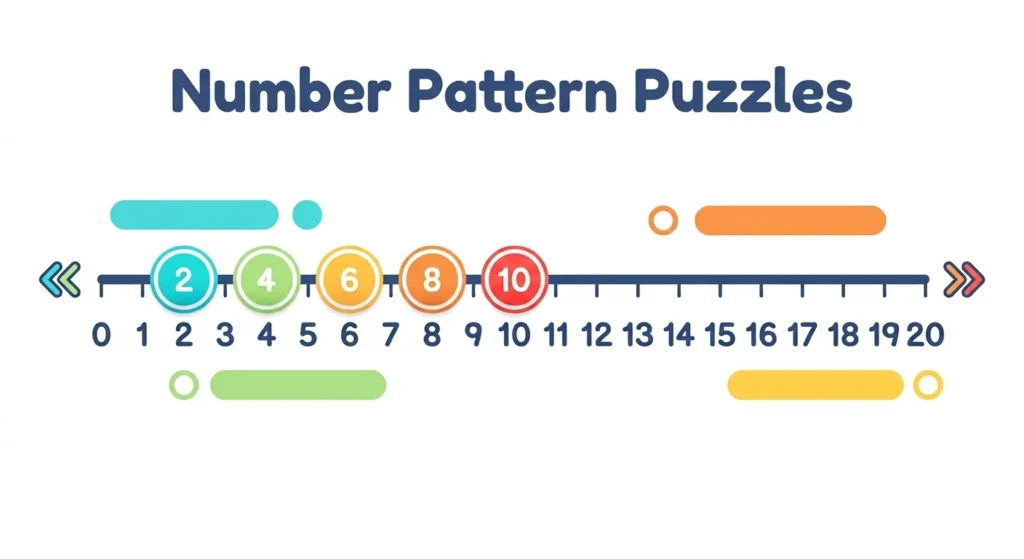
In each puzzle, figure out the rule, then fill in the missing number.
Easy: 2, 4, 6, 8, __ The pattern skips by 2. The answer is 10.
Easy: 5, 10, 15, __, 25 The pattern skips by 5. The answer is 20.
Medium: 10, 20, __, 40, 50 The pattern skips by 10. The answer is 30.
Medium: 3, 6, 9, 12, __ The pattern skips by 3. The answer is 15.
Hard: 100, 90, 80, __, 60 This pattern counts backward by 10. The answer is 70.
Hard: 2, 4, 8, 16, __ This one is not skip counting. Each number doubles. The answer is 32. This puzzle is a good stretch question for a child who has mastered simple skip counting and is ready to notice a different kind of rule.
If your child gets stuck, ask them to say the pattern out loud first: “2, 4, 6, 8…” Hearing the rhythm often makes the next number click before they even do the math.
Math Riddles (Place Value and Number Sense)
Riddles are a fun way to build number sense and place value, which is the idea that a digit’s position tells you its value (the 3 in 30 means three tens, not three ones).
Read each clue carefully. Some riddles have more than one clue that needs to work together.
Easy: I am a number between 10 and 20. I have a 5 in my ones place. What number am I? Answer: 15
Easy: I have 2 tens and 3 ones. What number am I? Answer: 23
Medium: I am an even number. I am greater than 40 but less than 50. My ones digit is 6. What number am I? Answer: 46
Medium: I have the same digit in my tens place and my ones place. I am greater than 70 but less than 80. What number am I? Answer: 77
Hard: I am a two-digit number. The sum of my digits is 9. My tens digit is one more than my ones digit. What number am I? Work it through: the digits add to 9, and the tens digit is one more than the ones digit. Trying pairs that add to 9, the pair where tens is one more than ones is 5 (tens) and 4 (ones). Answer: 54
Hard: I am less than 100. My digits add to 9. My tens digit is double my ones digit. If ones is 3, tens is double that, which is 6, and 6 plus 3 equals 9. Answer: 63
Riddles like these work best when a child writes down the clues one at a time and crosses out numbers that don’t fit, rather than trying to solve everything in their head at once.
Simple Logic Grid Puzzles (Reasoning)
Logic grid puzzles are a favorite style of logic puzzle for 2nd graders because they ask kids to use a small set of clues to figure out how different things match up.
They strengthen reasoning skills and give early practice with the kind of step-by-step thinking used in place value comparisons.
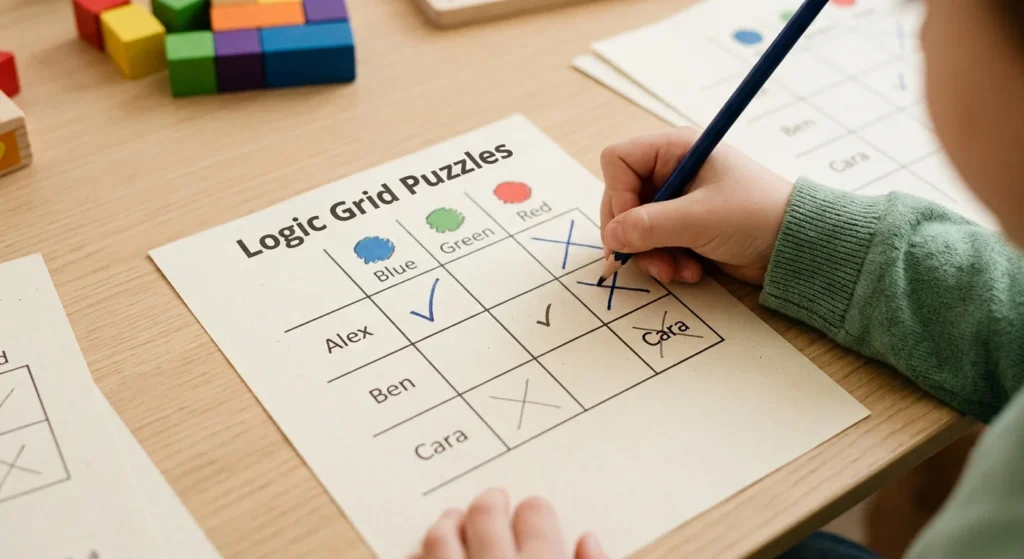
Easy: Three friends, Amir, Lily, and Sam, each have a different number of marbles: 4, 6, and 8. Amir has more marbles than Lily. Sam has the most marbles. Who has 4 marbles?
Since Sam has the most, Sam has 8. Amir has more than Lily, so Amir has 6 and Lily has 4. Answer: Lily has 4 marbles.
Medium: Three kids, Priya, Noah, and Zara, each picked a different shape: circle, square, and triangle. Priya did not pick the circle. Noah picked the triangle. Zara did not pick the square. What did Priya pick?
Noah has the triangle, so Priya and Zara have circle and square between them. Priya did not pick circle, so Priya has square. That leaves Zara with circle, which fits since Zara did not pick square. Answer: Priya picked the square.
Hard: Four kids, Ben, Mia, Theo, and Ana, are in a race and finish in 1st, 2nd, 3rd, and 4th place. Ben did not finish first or last. Mia finished right before Theo. Ana finished first. Who finished last?
Ana is first. Ben is not first or last, so Ben is 2nd or 3rd. Mia finished right before Theo, meaning Mia and Theo are next to each other in order. Testing Mia in 3rd and Theo in 4th leaves Ben in 2nd, which fits every clue. Answer: Theo finished last.
A simple grid drawn on paper, with names across the top and options down the side, helps a lot here. Kids can mark an X when a clue rules something out and an O when something is confirmed.
Visual and Spatial Puzzles (Shapes and Geometry)
These puzzles build spatial reasoning and reinforce shape recognition and geometry concepts like sides, corners, and symmetry.
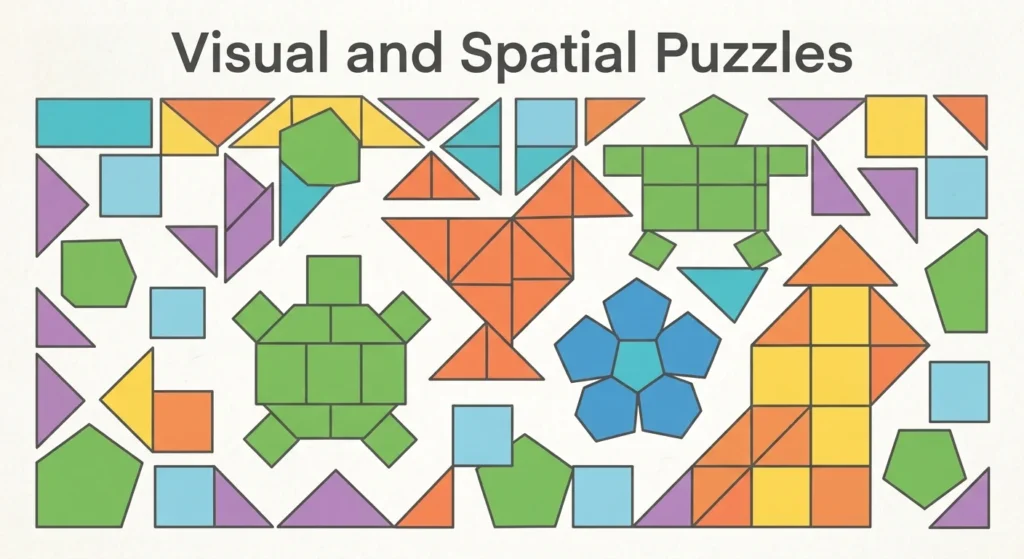
Easy: I have 3 sides and 3 corners. What shape am I? Answer: Triangle
Easy: I have 4 sides that are all the same length, and all my corners are square corners. What shape am I? Answer: Square
Medium: Count the triangles. Draw a large triangle, then draw a horizontal line through the middle connecting the two slanted sides, and draw a small triangle at the top pointing the same direction as the large one. The shape at the bottom is a trapezoid, not a triangle, so it does not count. Answer: 2 triangles.
Medium: I have 5 sides and 5 corners. What shape am I? Answer: Pentagon
Hard: Look at a shape made of 4 small squares arranged in an L shape (three squares stacked in a column, with one more square attached to the right of the bottom square). How many total squares of any size can you find? There are 4 small squares to start. Since the squares are arranged in an L rather than a full 2 by 2 block, no larger square can be formed. Answer: 4 squares total.
Hard: A rectangle is cut in half diagonally, from one corner to the opposite corner. What two shapes are formed, and how many sides does each new shape have? Answer: Two triangles, each with 3 sides.
A Number Word Mini Crossword
Here is a short, original number word puzzle. Fill in each blank with the number word that matches the clue.
- The number that comes after 9: TEN
- The number of sides on a triangle: THREE
- Half of ten: FIVE
- The number of corners on a square: FOUR
You can also challenge your child to build their own three-clue number crossword using words like six, seven, or eight.
Tips for Getting the Most Out of These Puzzles
- Let your child use their fingers, scratch paper, or objects like coins and blocks. Puzzles are about thinking, not mental math speed.
- If a puzzle feels too hard, read the clues one at a time instead of all at once.
- Celebrate a good guess-and-check strategy as much as a fast answer. Guessing, checking, and adjusting is exactly how real problem solving works.
- Mix puzzle types across a week rather than doing all of one kind in a single sitting. This keeps different skills warm at the same time.
- If your child breezes through the hard puzzles here, that’s a good sign they’re ready for structured Olympiad-style practice, which builds on exactly this kind of reasoning.
Free Printable Puzzle Sheet
Every puzzle in this guide is also available as a free printable PDF, with all 25 puzzles on one set of pages and a separate answer key page at the end.
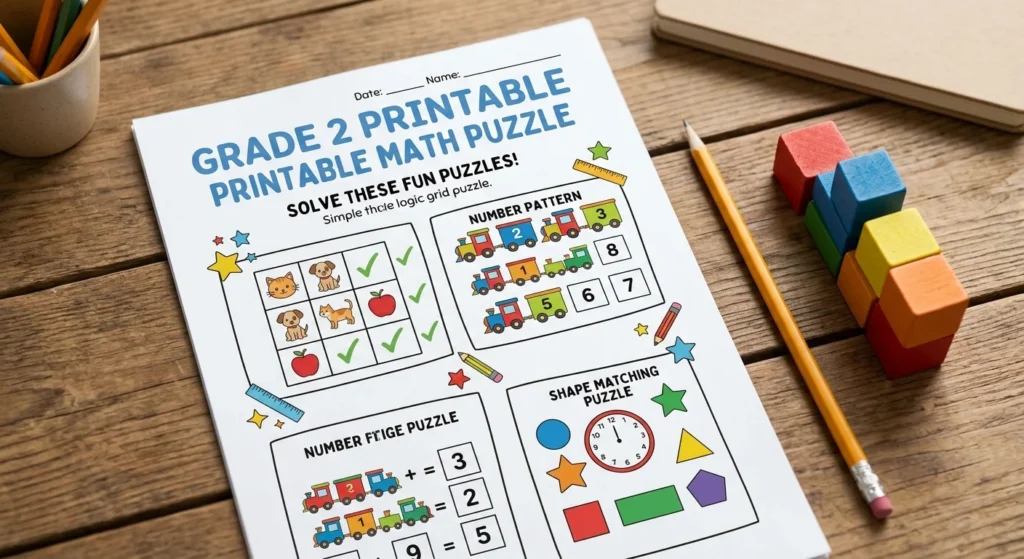
Print it for a car ride, a rainy afternoon, or a classroom warm-up stack; no login or sign-up needed.
What are good math puzzles for a 7 or 8 year old?
Number pattern puzzles, simple riddles about place value, easy logic grids with two or three clues, and shape-counting puzzles are all a good fit for this age. The puzzles in this guide are organized by type and difficulty so you can match them to your child’s comfort level.
Do math puzzles actually help with schoolwork?
Yes. Puzzles reinforce the same skills taught in class, including skip counting, place value, and shape recognition, but they present the skill inside a challenge instead of a repetitive worksheet. This keeps kids engaged while they practice.
How long should a puzzle session take?
Ten to fifteen minutes is plenty for most second graders. It’s better to stop while they’re still enjoying it than to push until they lose interest.
Are these puzzles the same as Math Olympiad questions?
Not exactly, but they use the same kind of thinking. Early rounds of competitions like Math Kangaroo and MOEMS often include puzzle-style questions that combine a clue or two with basic arithmetic, so practicing puzzles now builds a foundation for that kind of format later.
Can I print these puzzles for classroom or homeschool use?
Yes. A printable version of every puzzle in this guide, formatted as ready-to-use math puzzle worksheets with a separate answer key page, is available to download and print at home or in the classroom.
Make Preparing for Math Olympiad Simple!



Keep the Momentum Going
Whether you’re looking for brain teasers for second graders to use as classroom warm-ups or math puzzles for weekend home practice, these puzzles pair well with structured practice in addition, subtraction, and word problems, which build the number fluency that makes harder puzzles easier to tackle.
If your child enjoyed working through these, Gonit’s app has structured practice across skip counting, place value, geometry, and more for Grade 2, along with Olympiad-style problems for kids who are ready for an extra challenge.
It’s a natural next step once “just for fun” puzzles start feeling easy.

Mikha Piregu is a Content Writer with experience spanning educational content, including math and math olympiad topics, as well as advocacy writing, research-based articles, and SEO-driven web content. He creates high-quality blog content, web copy, and feature articles that support brand visibility, audience engagement, and long-term organic growth through data-informed storytelling. Skilled in WordPress, WooCommerce, and modern digital tools, Mikha adapts content across various platforms, including blogs, websites, campaigns, and advocacy initiatives, with clarity and purpose.

There are no comments posted here yet.
Sign in to leave a comment