 September 12, 2025
 19 min. read

The International Mathematical Olympiad (IMO) is the most prestigious math competition in the world, and qualifying for it as a US student is one of the most demanding achievements in pre-university mathematics.
If you have been searching for how to qualify for the IMO in the USA, or how to get into the math olympiad and eventually make Team USA, this guide maps the entire road to the IMO for you.
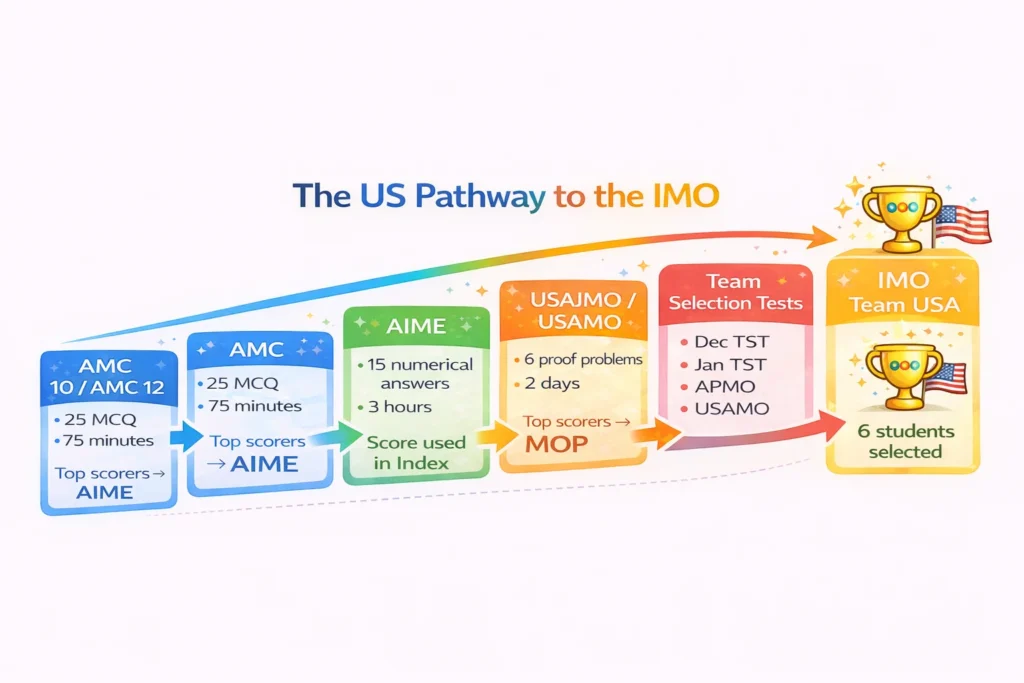
The US selection process runs through five distinct stages: AMC, AIME, USAJMO/USAMO, MOP, and the Team Selection Tests. Each stage cuts the field significantly.
Roughly 300,000 students take the AMC each year. Just six make Team USA. Understanding this IMO selection process early is the single biggest advantage a young competitor can have.
This guide walks through every step of the US qualification pathway, with exact formats, cutoff guidance, scoring formulas, the IMO scoring system, eligibility rules, and preparation tips.

How Do You Qualify for the IMO in the USA?
To qualify for the IMO in the USA, students must pass five stages: (1) Score well on the AMC 10 or AMC 12, (2) qualify for and perform strongly on the AIME, (3) earn a high enough combined index to be invited to USAJMO or USAMO, (4) be selected for MOP (Mathematical Olympiad Program) based on USAMO/USAJMO performance, and (5) score highest on the Team Selection Tests (TSTs) to earn one of six spots on Team USA
The US IMO Qualification Pathway at a Glance
Here is the full road to the IMO in one view, from the AMC entry point to the six-person Team USA.
This is the math olympiad qualification funnel every US student moves through.
| Stage | Competition | Format | Who Qualifies | Participants | Next Step |
|---|---|---|---|---|---|
| 1 | AMC 10 / AMC 12 | 25 MCQ, 75 min | All US high school students | 300,000+ | AIME invite |
| 2 | AIME | 15 short answer, 3 hrs | Top ~5% of AMC takers | ~15,000 | USAJMO/USAMO index |
| 3 | USAJMO / USAMO | 6 proofs, 9 hrs total | Top AMC+AIME index | ~500 | MOP invite |
| 4 | MOP | 3-week training camp | Top ~60 USAMO/USAJMO | ~60 | TST eligibility |
| 5 | Team Selection Tests | Multiple proof exams | Top ~24 from MOP | ~24 | Team USA (6 spots) |
What is the International Mathematical Olympiad (IMO)?
The IMO is the world’s oldest and most prestigious international mathematics competition for high school students.
People search for it by many names, including the International Math Olympiad, international maths olympiad, the IMO math olympiad, and simply olympiad math, but they all point to the same contest.

Founded in Romania in 1959 with just seven countries, it now draws over 600 students from more than 100 nations every year.
The contest runs over two consecutive days, with three proof-based problems per day (six total) and 4.5 hours per session.
Each problem is worth 7 points, making 42 the maximum possible score per student. Topics cover algebra, geometry, number theory, and combinatorics. Calculus is not required, and no calculator is permitted.
For US students, the IMO represents the culmination of years of competition math. Alumni include Fields Medalists, Turing Award winners, and some of the most influential mathematicians and scientists of the modern era.
IMO Eligibility Requirements
A common question is whether the IMO is only for high school students and what the IMO age limit is.
Here are the core eligibility rules.
- Age: Must be under 20 years old on the day of the first exam.
- Pre-university: Must not have started a university degree program (the IMO is for pre-university students).
- Team size: Each country sends up to 6 students plus a team leader and deputy. That fixed IMO team size is why the US can only send six.
- No fixed syllabus: Problems require creative thinking, not memorization of advanced topics.
Is the IMO Only for High School Students?
Not strictly. The IMO is open to any pre-university student under 20, so middle school students who reach the required level can and do compete. In several countries, younger students have represented their nation.
What matters is mathematical ability and the under-20, pre-university rule, not your grade level. In practice, almost all US competitors are in high school, but strong middle schoolers regularly qualify for USAJMO and MOP on the same pathway.
Can International Students Qualify for the US IMO Team?
No. To represent the USA at the IMO, you must be a US citizen or permanent resident and be currently enrolled in a US school.
International students studying in the US on a visa are not eligible to represent Team USA, though they may take the AMC and AIME exams for practice and personal development. Eligibility for higher rounds, such as USAMO, also follows these citizenship and residency requirements.
How to qualify for the IMO in the USA: The Full Pathway
The Mathematical Association of America (MAA) manages the US selection process through a year-long competitive pathway. Here is every stage in detail.
Step 1 — AMC 10 / AMC 12: The Entry Point
Your IMO journey begins with the American Mathematics Competitions (AMC) — the largest math competition in the US and the mandatory first gateway for IMO qualification.
AMC Format
| AMC 10 | AMC 12 | |
|---|---|---|
| Who can take it | Grade 10 and below | Grade 12 and below |
| Questions | 25 multiple-choice | 25 multiple-choice |
| Time | 75 minutes | 75 minutes |
| Scoring | 6 pts correct, 0 blank, -1.5 wrong | 6 pts correct, 0 blank, -1.5 wrong |
| Max score | 150 points | 150 points |
| Topics | Algebra, geometry, number theory, counting, probability | All AMC 10 topics + precalculus, advanced algebra |
| AIME cutoff (approx.) | Typically ~90–100 points | Typically ~85–95 points |
Cutoff scores change every year based on exam difficulty and the number of test takers. The top roughly 2.5% of AMC 10 takers and top 5% of AMC 12 takers earn an AIME invitation.
Ready to register? → How to register for AMC math competitions | AMC awards and recognition explained
AMC Preparation Tips
- Speed matters. 25 problems in 75 minutes is about 3 minutes per question practice under timed conditions from day one.
- Don’t guess recklessly. The -1.5 penalty for wrong answers means leaving a question blank is often better than a random guess.
- Review past papers. AMC papers from 2000 onwards are freely available at Art of Problem Solving (artofproblemsolving.com).
- Focus on weak topics. Most students have a clear weak area number theory, combinatorics, or geometry. Targeted practice on one area gives the fastest improvement.
Not sure if your AMC score is competitive? → What is a good AMC score for IMO qualification? | Average AMC scores and AIME cutoffs
Step 2: AIME, The Make-or-Break Stage
The American Invitational Mathematics Examination (AIME) is where the IMO pathway starts to get serious.
It separates students who are quick and accurate at multiple-choice from those who can sustain deep mathematical focus for hours.
Knowing how to qualify for the AIME and then the AIME score you need for USAMO is the turning point of the whole journey.
AIME Format
- Questions: 15 problems.
- Time: 3 hours.
- Answer format: Integer from 000 to 999, no multiple choice, no partial credit.
- Calculators: Not permitted.
- Topics: Deep algebra, number theory, geometry, combinatorics, probability.
The AIME is genuinely hard. The median score among qualifiers is typically 3 to 5 out of 15. A score of 10+ places you among the top handful of students in the country.
The Index Formula: How AMC + AIME Combine
Your AMC and AIME scores are combined into a single index that determines whether you qualify for USAJMO or USAMO. This is the famous USAMO index and USAJMO index that students track every year:
USAJMO Index = AMC 10 Score + (10 x AIME Score)
USAMO Index = AMC 12 Score + (10 x AIME Score)
Example: AMC 12 score of 100.5 + (AIME score of 9 x 10) = Index of 190.5. USAMO cutoffs typically fall in the range of 215 to 230, but vary significantly by year.
The AIME score is weighted 10x the AMC score in the index, which means AIME performance is the single most important factor in determining who qualifies for USAMO.
What AIME Score Do You Need to Qualify for USAMO?
There is no fixed number, because the USAMO cutoff is set by index each year, not by a single AIME score. As a working benchmark, USAMO contenders usually pair an AMC 12 score above 100 with an AIME score of 10 or higher, while USAJMO contenders pair a strong AMC 10 with a similar AIME result.
Because the index multiplies AIME by 10, even one extra AIME problem can move you above the USAMO qualifying score. Treat 10+ on the AIME as the realistic target for USAMO qualification, and aim higher if your AMC score is on the lower end.
For the exact benchmarks by year, see Average AMC math scores and what they mean.
Step 3: USAJMO and USAMO, The Proof-Based Challenge
Qualifying for the USA Junior Mathematical Olympiad (USAJMO) or the USA Mathematical Olympiad (USAMO) is the first truly elite milestone in the US IMO pathway.
This is where the format shifts entirely, from multiple-choice and short-answer to full mathematical proofs.
USAJMO vs USAMO: What Is the Difference?
| USAJMO | USAMO | |
|---|---|---|
| Who qualifies | AMC 10 + AIME index | AMC 12 + AIME index |
| Grade level | Grade 10 and below | Grade 12 and below |
| Format | 6 proof problems, 2 days | 6 proof problems, 2 days |
| Time per day | 4.5 hours (3 problems) | 4.5 hours (3 problems) |
| Total time | 9 hours | 9 hours |
| Scoring | 0 to 7 per problem, max 42 | 0 to 7 per problem, max 42 |
| MOP pathway | Top USAJMO scorers | Top USAMO scorers |
Both exams are identical in format and are graded by the same panel. The problems are not shared between the two exams, but the difficulty level and scoring criteria are the same. In short, USAJMO is the junior version of USAMO for younger qualifiers.
What Makes a Strong USAMO / USAJMO Score?
A perfect score of 42 is extraordinarily rare. A score of 14 to 21 (2 to 3 fully solved problems) is generally sufficient to earn a MOP invitation. The key is not just solving problems correctly, it is writing proofs that are rigorous, complete, and clearly structured. Partial solutions that are mathematically sound can earn 4 to 6 points out of 7.
How Many Students Qualify for USAMO and USAJMO?
Numbers vary by year, but a useful rule of thumb is that a few hundred students across the country qualify for USAMO and USAJMO combined. Out of roughly 300,000 AMC takers, only about 500 reach this proof-based stage. From there, the field narrows again to roughly 60 MOP invitees and finally to the six members of Team USA. This steep drop-off is exactly why the USAMO qualification is treated as a national-level achievement on college applications.
New to proof-based problems? Types of questions asked in math olympiads, all 6 formats explained
Step 4: MOP, The Mathematical Olympiad Program
The Mathematical Olympiad Program (MOP), also known as the Mathematical Olympiad Summer Program, is a three-week residential summer training camp held at Carnegie Mellon University.
It is the most selective math training program in the United States, and participation essentially guarantees you are among the top 60 or so young mathematicians in the country.
If you have wondered what MOP math is or how to qualify for MOP, this is the stage that matters most.
Who Gets Invited to MOP?
MOP qualifiers and MOP cutoffs are set directly by USAMO and USAJMO performance. The approximate allocation looks like this:
- Top USAMO scorers: Approximately the top 45 US USAMO participants who have not yet graduated high school.
- Top USAJMO scorers: Approximately the top 12 to 15 USAJMO participants.
- Girls’ team: Top female scorers are also invited regardless of score cutoff, supporting the EGMO and Girls’ IMO teams.
What Happens at MOP?
MOP is intense and immersive. A typical day includes morning lectures on advanced mathematical topics, afternoon problem-solving sessions with competition-level problems, and evening proof-writing review.
Students are divided into groups based on experience and prior performance, traditionally labelled Black, Blue, Red, and Green (or similar). The Black group contains current and likely future IMO team members and receives the most advanced training.
Within MOP, students sit the TSTST (Team Selection Test Selection Test), a preliminary exam used to identify the approximately 24 students who will continue into the full Team Selection Test process.
Only non-graduating students who score in the top 24 of the TSTST advance.
Want to simulate MOP-level problem intensity before you get there? Free math olympiad training platforms online
SStep 5: Team Selection Tests, Choosing Team USA
The final stage of US IMO qualification involves a year-long series of Team Selection Tests (TSTs) taken by the approximately 24 students who qualified through the TSTST at MOP.
This is the last filter before the USA IMO team is announced.
The TST Components and Scoring
| Exam | Format | Max Points | When |
|---|---|---|---|
| December TST | 3 proof problems, 4.5 hrs | 21 pts | December |
| January TST | 3 proof problems, 4.5 hrs | 21 pts | January |
| RMM Day 1 | 3 proof problems (Romanian Master) | 21 pts | February |
| APMO | 5 proof problems, 4 hrs | ~21 pts (x0.6) | March |
| USAMO | 6 proof problems, 9 hrs | 42 pts | April |
The IMO Index Formula
IMO Index = Dec TST + Jan TST + RMM Day 1 + (0.6 x APMO) + USAMO
Maximum possible IMO Index is approximately 126 points. The six students with the highest IMO Index are selected as Team USA. Tie-breaking rules apply if needed.
Importantly, no single exam determines your spot. Poor performance on the December TST can be offset by strong USAMO and APMO scores. Consistency across all five components is the surest path to selection.
The IMO Scoring System Explained
Once you reach the IMO itself, the scoring is simple to state but unforgiving to earn. Understanding the IMO scoring system helps you set realistic targets at every earlier stage too.
- Problems: There are 6 problems, 3 on each of the two contest days.
- Points per problem: Each problem is graded from 0 to 7, so the IMO maximum score per student is 42 points.
- Team score: With six students, a country’s maximum team score is 252 points, which is how the IMO team score is calculated.
- Medal thresholds: Gold, silver, and bronze medal thresholds are set each year so that roughly the top half of contestants earn a medal, with cutoffs adjusted to problem difficulty.
Because partial credit is awarded, a clear, well-structured partial proof can still earn 1 to 6 points. This is why proof-writing technique, not just final answers, is emphasized throughout the US pathway.
AMC, AIME, USAMO, IMO: The Full Ladder in Order
If you are mapping the road to the IMO and want the stages in one clean ladder, here is the order every US competitor climbs:
- AMC 10 or AMC 12, the open entry exam.
- AIME, by invitation for top AMC scorers.
- USAJMO or USAMO, by combined AMC and AIME index.
- MOP, the summer training camp for top USAMO and USAJMO scorers.
- TSTST and Team Selection Tests, the final exams that pick the six-person Team USA.
- The IMO, where Team USA competes against 100+ countries.
How to Prepare for IMO Qualification in the USA
The US IMO pathway takes most successful candidates 4 to 6 years of dedicated preparation.
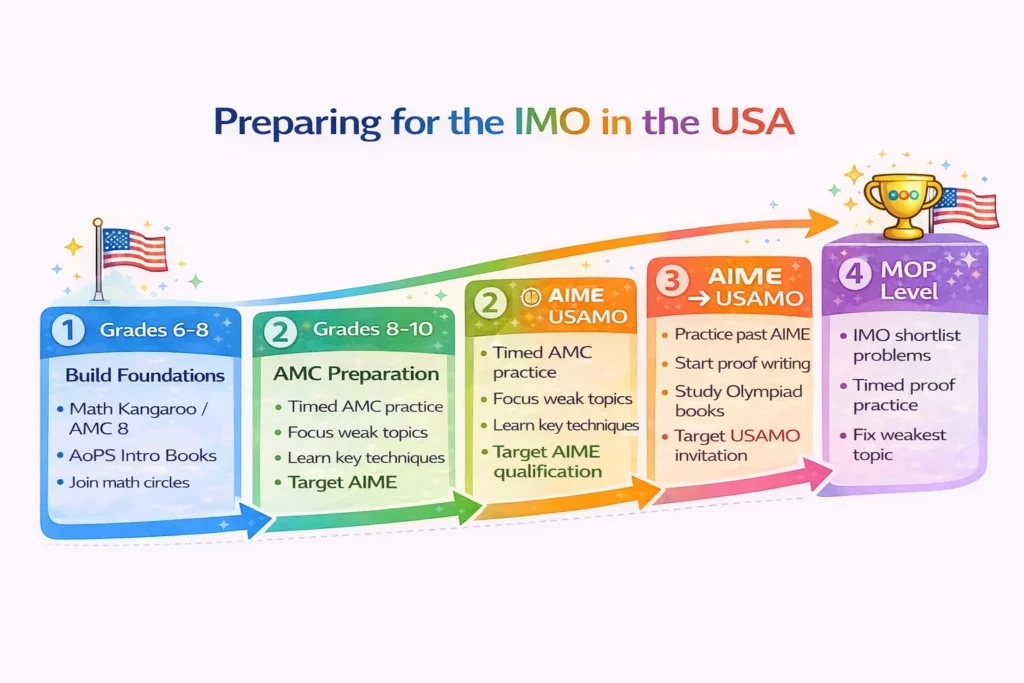
Here is how to structure that journey at each stage, whether you are just starting out or already aiming at USAMO.
Starting Out (Grades 6 to 8): Build the Foundation
The students who make Team USA typically begin serious competition math before age 13. At this stage, the goal is not IMO problems, it is building deep familiarity with the four core topics and developing genuine enjoyment of problem-solving. This is also where many students first ask how to get into the math olympiad, and the honest answer is to simply start entering accessible contests.
- Enter Math Kangaroo or AMC 8 to get comfortable with competition formats.
- Study Art of Problem Solving Introduction series (Algebra, Geometry, Number Theory, Counting and Probability).
- Solve one challenging problem per day, not from a textbook, but from a competition archive.
- Join a math circle if available in your area, since peer learning accelerates progress.
For a structured early-stage preparation plan, see How to prepare for the Junior Math Olympiad
AMC Preparation Phase (Grades 8 to 10): Target AIME Qualification
Your first concrete milestone is qualifying for the AIME via AMC 10 or AMC 12. This requires consistent timed practice and honest assessment of your weak topics.
- Complete at least 5 full past AMC papers under timed conditions before your first real attempt.
- Identify your weakest of the four core topics and dedicate 50% of study time to it.
- Learn the key AMC problem techniques: modular arithmetic, AM-GM inequality, angle chasing, bijections.
- Aim to qualify AIME first. Don’t skip ahead to USAMO-level problems until you are consistently scoring 110+ on AMC 12.
AIME and Proof-Writing Phase (Grades 10 to 12): Target USAMO
Once you are qualifying for the AIME, the next goal is achieving an index score high enough for USAMO. This is where proof-writing practice becomes essential alongside calculation-heavy problem solving.
- Work through past AIME papers, since the style is consistent and mastering common problem types pays dividends.
- Begin proof-writing practice using past USAMO problems, focusing on clarity, logical flow, and handling edge cases.
- Study Olympiad handbooks: ‘The Art and Craft of Problem Solving’ (Zeitz), ‘Problem Solving Strategies’ (Engel), AoPS Volume 2.
- Target a USAMO invitation. This typically requires an AMC 12 score of 100+ and an AIME score of 10+, though cutoffs vary annually.
For targeted strategies to improve at proof-based problems, see How to get better at solving math olympiad questions
MOP and TST Phase: Prepare for the IMO
If you earn a MOP invitation, the preparation focus shifts entirely to proof quality, speed under pressure, and mastery of advanced olympiad techniques across all four topics.
- Study past IMO shortlist problems, these are problems that were considered but not selected for the official exam.
- Practice writing proofs in competition conditions: timed, no hints, full write-up required.
- Work intensively on your weakest olympiad topic. At MOP level, a weakness in geometry or combinatorics will show up in TST scores.
- Compete in ARML, HMMT, and Putnam-preparation contests to maintain competitive sharpness across the year.
How Early Should You Start Preparing for the IMO?
Most students who reach the IMO began serious competition math preparation between ages 11 and 14. Starting earlier gives more time to build the deep problem-solving instincts that the later stages require. However, students who begin at 15 or 16 and commit intensively have reached USAMO and even MOP. The pathway is demanding but not closed to late starters.
Best Resources to Qualify for the IMO in the USA
| Resource | What It Offers | Best For Stage |
|---|---|---|
| Art of Problem Solving (AoPS) | Textbooks, forums, past papers for all competition levels | All stages |
| Gonit App | Structured olympiad problem sets, topic-wise practice, progress tracking | All stages |
| Past AMC/AIME papers | Official past exams (aops.com/contests) | AMC and AIME stages |
| Past USAMO papers | Official past exams (maa.org) | USAMO preparation |
| Past IMO papers + shortlists | Official problems (imo-official.org) | MOP and TST stages |
| ‘Problem Solving Strategies’ (Engel) | Comprehensive olympiad techniques by topic | USAMO and above |
| ‘The Art and Craft of Problem Solving’ (Zeitz) | Problem-solving mindset and technique | AIME and above |
| Math circles and clubs | Peer learning, collaborative problem solving | All stages |
For a curated list of free online training platforms, see Free math olympiad training online
How many students qualify for the IMO from the USA each year?
Exactly six students represent the USA at the IMO each year. These six are selected from approximately 24 students who compete in the full Team Selection Test process, who were themselves selected from about 60 MOP participants, who were selected from several hundred USAMO qualifiers, out of roughly 300,000 AMC test takers.
What AMC score do I need to qualify for the IMO?
There is no single AMC score that guarantees IMO qualification the pathway runs through five stages. However, as a rough benchmark: to have a realistic chance of eventually making Team USA, you should be targeting AMC 12 scores above 120 and AIME scores of 10 or higher by the time you are in Grade 11 or 12. Many Team USA members scored 13–15 on the AIME.
Can international students qualify for the US IMO team?
No. To represent the USA at the IMO, you must be a US citizen or permanent resident and be currently enrolled in a US school. International students studying in the US on a visa are not eligible to represent Team USA, though they may take the AMC and AIME exams for practice and personal development.
What is MOP and how do you get invited?
MOP (Mathematical Olympiad Program) is a three-week residential training camp held each summer, primarily at Carnegie Mellon University. Invitations are based on USAMO and USAJMO scores: approximately the top 45 USAMO scorers and top 12–15 USAJMO scorers who have not yet graduated high school are invited. Girls who score highly on USAMO or USAJMO may also receive invitations through a separate allocation to ensure gender diversity.
How early should I start preparing for the IMO?
Most students who reach the IMO began serious competition math preparation between the ages of 11 and 14. Starting earlier gives more time to build the deep problem-solving instincts that the later stages require. However, students who begin at 15 or 16 and commit intensively have reached USAMO and even MOP. The pathway is demanding but not closed to late starters.
Is the IMO harder than the USAMO?
Yes, but not dramatically so in terms of problem type. Both use proof-based problems across algebra, geometry, number theory, and combinatorics. The IMO draws on the best students from 100+ countries, so the competition is broader. Historically, US students have performed very strongly at the IMO, regularly winning multiple gold medals, reflecting the rigor of the USAMO and MOP preparation pathway. For a deeper look at how to prepare for the IMO exam itself, → How to prepare for the IMO
Is a calculator allowed in the IMO?
No. Calculators are not permitted at the IMO, nor at the AIME, USAMO, or USAJMO. The contests are designed to test mathematical reasoning and proof, not computation, so no calculating devices of any kind are allowed.
Does the IMO have calculus?
No, calculus is not required. The IMO covers algebra, geometry, number theory, and combinatorics. Problems are built on creative reasoning rather than advanced university topics, so a strong grasp of elementary mathematics applied in deep ways matters far more than calculus
How long is the IMO exam?
The IMO runs over two consecutive days, with one 4.5-hour session each day. Each session contains three problems, for six problems and nine total hours of exam time across the competition.
What is the difference between USAMO and USAJMO?
USAMO and USAJMO have the same format: six proof problems over two days. The difference is qualification: USAMO is reached through the AMC 12 plus AIME index and is open through Grade 12, while USAJMO is reached through the AMC 10 plus AIME index for students in Grade 10 and below. USAJMO is effectively the junior division of USAM
Make Preparing for Math Olympiad Simple!



Final Thoughts
Qualifying for the IMO in the USA is a five-stage journey that demands years of preparation, genuine mathematical talent, and remarkable persistence. The path runs: AMC, AIME, USAJMO/USAMO, MOP, Team Selection Tests, and finally Team USA.
At every stage, the number of students who continue drops sharply. But the preparation itself, the problems you solve, the proofs you write, and the mathematical thinking you develop, is valuable far beyond any competition result.
Start early. Practice consistently. Focus on proof-writing as a skill separate from calculation. And remember that every student who has ever represented Team USA at the IMO started exactly where you are now.
Explore More on Gonit
- What type of questions are asked in math olympiads?
- Best math competition in the world, top 7 ranked
- Average AMC math scores and what they mean
- What is a good AMC math competition score?
- How to get better at solving math olympiad questions
- Free math olympiad training online
- How to prepare for the IMO
- How to prepare for the Junior Math Olympiad
- AMC registration guide