 January 12, 2026
 13 min. read

Skip counting for class 1 is a simple but powerful skill where children count in equal jumps by 2s, 5s, or 10s instead of counting one by one. Rather than 1, 2, 3, 4, a child skip-counting by 2s says 2, 4, 6, 8, 10.
It is far more than a speed trick. Skip counting is the bridge between basic counting and multiplication, helping children understand equal groups, number patterns, and repeated addition.
In simple terms, the meaning of skip counting is counting forward or backward by adding or subtracting the same number every time.
Children who master it early find multiplication tables more intuitive and mental arithmetic significantly faster.
If your child is still building number confidence, start with number ordering for Class 1 before moving to skip counting.
This guide covers the three key sequences to teach first, worked examples with number lines, effective activities, and the most common mistakes with how to fix each one.
What is Skip Counting?
Skip counting means counting in equal jumps by adding the same number each time.
The “skip” refers to the numbers passed over when counting by 2s, every odd number is skipped. When counting by 5s, four numbers between each multiple of 5 are skipped.
A clear skip counting definition for kids: count some, skip some, in a fixed pattern every time.
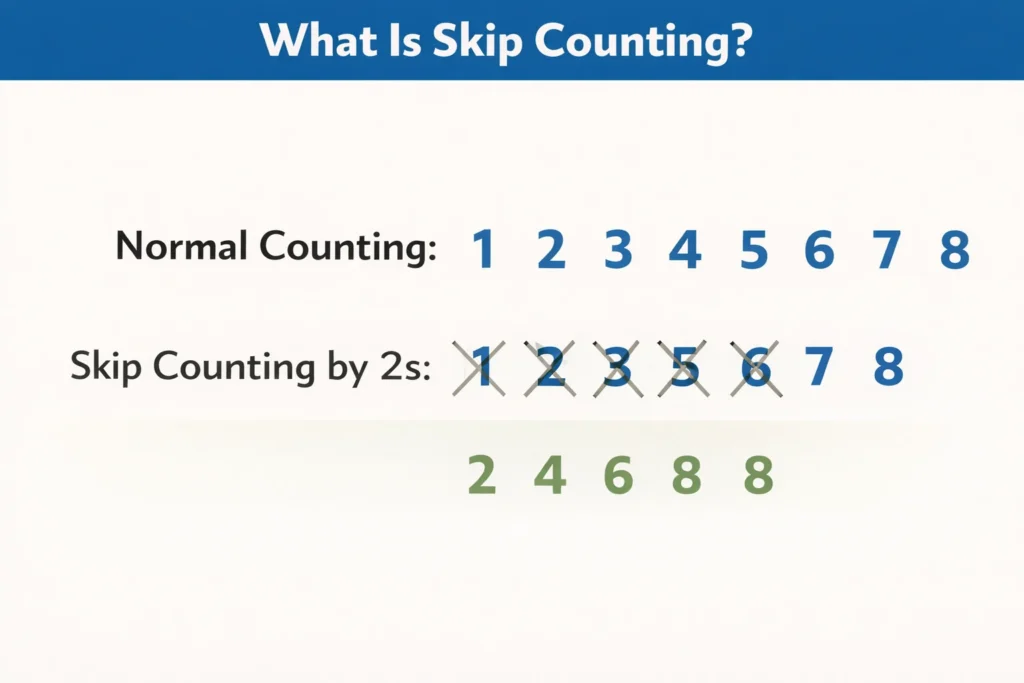
The mathematical operation behind every skip count is repeated addition. Counting by 2s means adding 2 each time: 0 + 2 = 2, 2 + 2 = 4, 4 + 2 = 6.
Counting by 5s means adding 5 each time: 0 + 5 = 5, 5 + 5 = 10, 10 + 5 = 15. This repeated addition understanding is precisely what multiplication means — 3 × 5 is simply skip counting by 5 three times.
Children who understand this connection find multiplication tables far less abstract when they encounter them in Class 2 and beyond.
Forward skip counting adds the same number each time numbers increase. Backward skip counting subtracts the same number each time numbers decrease.
Both directions matter. Forward skip counting builds addition foundations. Backward skip counting builds subtraction foundations and prepares children for the descending patterns covered in ascending and descending order in Maths Class 1.
Skip Counting Examples for Class 1
Understanding the definition is one thing seeing it in action makes it concrete. Here are clear skip counting examples children can follow immediately:
Skip counting by 2s: 2, 4, 6, 8, 10, 12, 14, 16, 18, 20
Skip counting by 5s: 5, 10, 15, 20, 25, 30, 35, 40, 45, 50
Skip counting by 10s: 10, 20, 30, 40, 50, 60, 70, 80, 90, 100
Skip counting by 1s (as a concept bridge): 1, 2, 3, 4, 5, the familiar sequence children already know, where the “jump” is 1 each time.
In every case, the pattern is the same: start at a number, add the same value, land, repeat. That consistency a fixed jump size, every time, is the entire skip counting definition in action.
Why Skip Counting Matters in Class 1
Skip counting for Class 1 serves four distinct mathematical purposes simultaneously, which is why it receives such emphasis in early mathematics curricula.
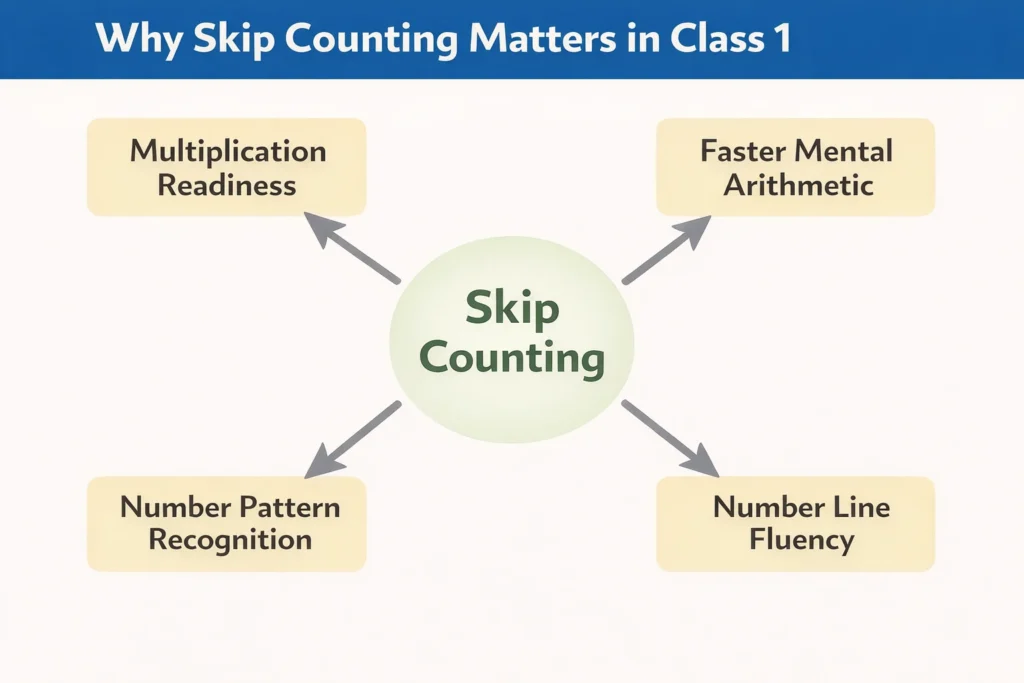
It builds multiplication foundations. Every multiplication table is a skip-counting sequence. The 2 times table is counting by 2s. The 5 times table is counting by 5s. The 10 times table is counting by 10s.
Is skip counting the same as multiplication? Conceptually, yes, skip counting is repeated addition, which is the same operation as multiplication. 4 × 5 is the same as skip counting by 5 four times.
Children who have internalized skip counting sequences before encountering multiplication symbols find the times tables genuinely familiar rather than arbitrary new material to memorize.
It develops number pattern recognition. Skip counting makes number patterns visible. The 5-times sequence always ends in 0 or 5, the 2-times sequence always produces even numbers, and the 10-times sequence always ends in 0.
These patterns are foundational to number sense and the kind of reasoning that number sense for class 1 develops.
It strengthens number line fluency. Equal jumps on a number line are the most visual representation of skip counting.
Children who skip count while moving along a number line develop the number magnitude intuition that the number line is designed to build, and each equal jump produces a predictable landing.
This directly reinforces the number line teaching in how to teach number line maths class 1.
It accelerates mental arithmetic. A child who can count by 5s can find 25 + 5 = 30 by continuing a familiar sequence rather than computing.
A child who counts by 10s can solve 40 + 30 = 70 by three 10-jumps rather than by adding column by column. Skip counting makes large arithmetic manageable through pattern fluency.
Why is Skip Counting Important for Young Learners?
Beyond the four curriculum benefits above, why is skip counting important comes down to cognitive efficiency. Children who count by ones for every calculation use up working memory on individual steps.
Children who skip count in chunks free up working memory for reasoning, estimation, and problem-solving the higher-order skills that matter in both classroom mathematics and competition mathematics.
The IMO syllabus for class 1 includes number sequence problems and pattern-based reasoning because these skills are the early markers of mathematical fluency.
The Three Skip Counting Sequences to Teach First
Skip Counting by 2s
Counting by 2s is typically the first skip counting sequence taught because it connects directly to the concept of pairs — an idea most children already understand from everyday life (pairs of shoes, pairs of hands, pairs of eyes).
Sequence: 2, 4, 6, 8, 10, 12, 14, 16, 18, 20
Key pattern: Every number in this sequence is even. Skip counting by 2s and learning even numbers are the same activity. This is also why counting in 2s is the most common entry point in Class 1 curricula globally.
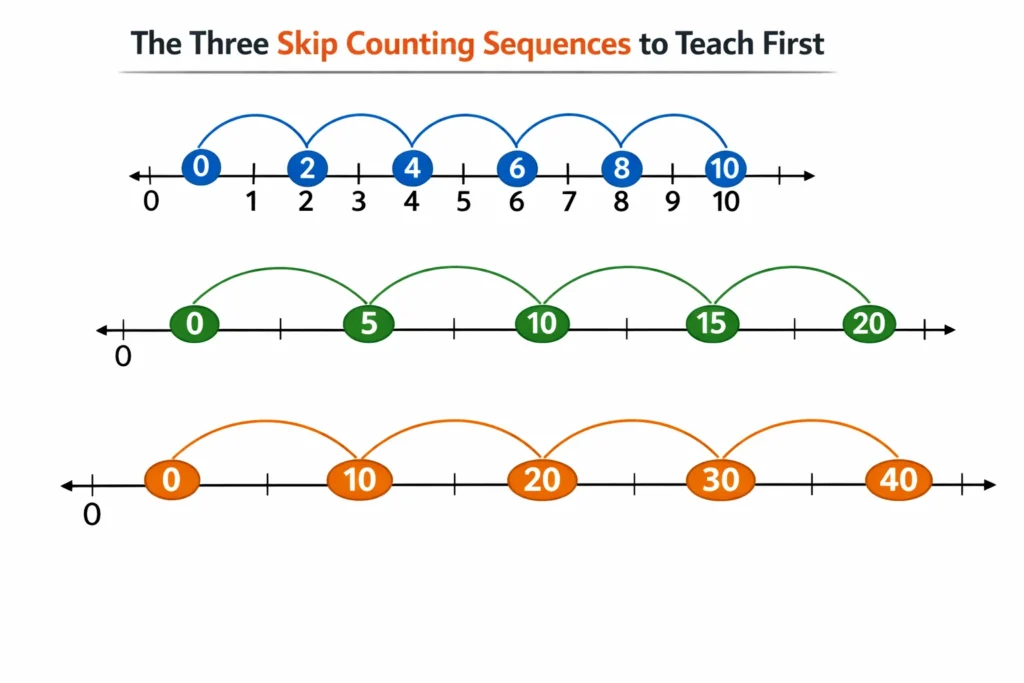
Number line: Start at 0, draw arcs of equal size landing on 2, 4, 6, 8, 10. Each arc represents “add 2.” Circle each landing number.
Real-life connection: Count socks in pairs, eyes on faces, wheels on bicycles. The physical grouping makes the sequence feel meaningful rather than arbitrary.
Skip Counting by 5s
Counting by 5s is the second sequence because it connects to the most familiar real-world counting context: fingers. Every child has experience with groups of 5 one hand’s fingers before they begin formal schooling.
Sequence: 5, 10, 15, 20, 25, 30, 35, 40, 45, 50
Key pattern: Every number in this sequence ends in 0 or 5. This predictable pattern makes skip counting by 5s self-checking if a child says a number that doesn’t end in 0 or 5, they know immediately they have made an error.
Number line: Start at 0, draw arcs of equal size (twice as large as the by-2 arcs) landing on 5, 10, 15, 20. Circle each landing number.
Real-life connection: Count fingers in fives, toes in fives, 5p coins. Clock reading each number on a clock face represents 5 minutes — is a daily-life application of skip counting by 5s.
Skip Counting by 10s
Counting by 10s is the third sequence and the most directly connected to place value understanding. Each jump of 10 increases the tens digit by 1, making this sequence the clearest demonstration of the base-ten structure of our number system.
Sequence: 10, 20, 30, 40, 50, 60, 70, 80, 90, 100
Key pattern: Every number ends in 0. Only the tens digit changes with each jump — the ones digit stays 0 throughout. Skip counting by 10s is therefore the easiest sequence for most children to self-check and extend.
Number line: Start at 0, draw arcs of equal size (large jumps) landing on 10, 20, 30, 40, 50. These large equal jumps visually represent the magnitude of each +10.
Real-life connection: Count money in 10s, count in groups of 10 objects. The connection between skip counting by 10s and place value structure is explored in what is the number sequence for class 1 maths.
Skip Counting on a Number Line: Worked Examples
The number line is the most powerful visual tool for teaching skip counting because it makes equal jumps and equal spacing simultaneously visible. Use it from the very first lesson.
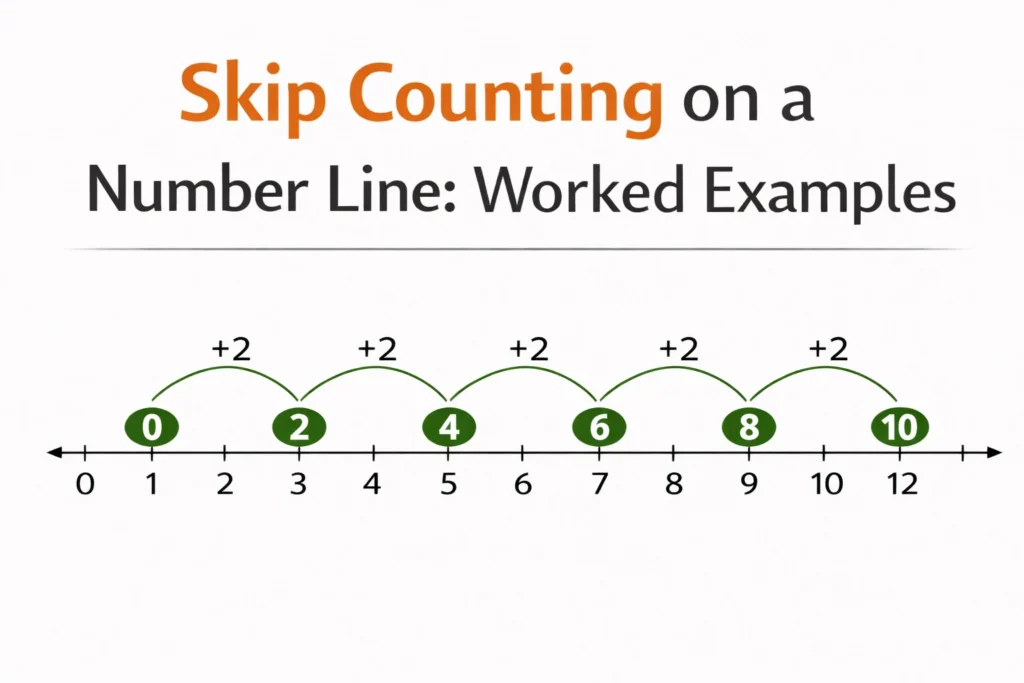
Skip counting by 2s on a number line (0 to 12): Start at 0 → jump +2 → land on 2 → jump +2 → land on 4 → jump +2 → land on 6 → jump +2 → land on 8 → jump +2 → land on 10 → jump +2 → land on 12.
Draw curved arcs above the line for each jump. Circle each landing number.
Skip counting by 5s on a number line (0 to 25): Start at 0 → jump +5 → 5 → jump +5 → 10 → jump +5 → 15 → jump +5 → 20 → jump +5 → 25. Each arc is the same size equal jumps make equal arcs.
Skip counting by 10s on a number line (0 to 50): Start at 0 → 10 → 20 → 30 → 40 → 50. Five equal large arcs. Ask children: “What do all landing numbers have in common?” (They all end in 0.)
Skip counting using a number line: the teaching principle. Always label the jump size above each arc. Children who see “+2” written on every arc understand why the sequence works, not just what it produces.
This transforms rote sequence recitation into genuine mathematical understanding.
The number line position understanding that makes these examples clear is covered in number positions on a number line class 1.
5 Activities That Make Skip Counting Stick
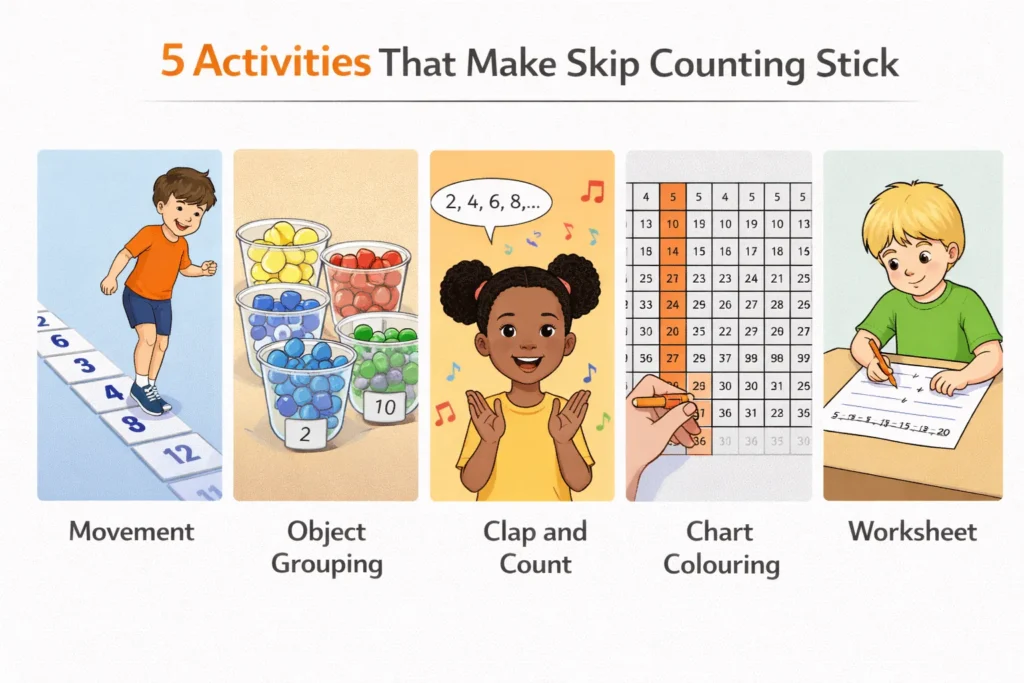
1. Floor Number Line Hops: Tape a 0–20 number line on the floor. Call a skip-counting sequence (by 2s, 5s, or 10s) and have children hop from number to number, saying each landing number aloud.
The physical movement creates body memory for the sequence. Children who have hopped the pattern rarely forget the direction or size of the jump.
2. Object Grouping Count: Place small objects (buttons, blocks, coins) into equal groups in cups or bowls, 2 per cup, 5 per cup, or 10 per cup. Ask children to count only the cup totals. “How many in 2 cups? 3 cups? 5 cups?”
This grounds the abstract skip counting pattern in real, countable quantities. Connects to the number sense activities in the number sense resources for parents.
3. Clap and Count: Chant the skip counting sequence while clapping in rhythm, one clap per number. The rhythm makes sequences memorable in the same way songs are memorable through repetition embedded in a predictable pattern.
Extend by whispering skipped numbers and saying landing numbers aloud: “one (whisper), TWO (loud), three (whisper), FOUR (loud).”
This variation is particularly effective for skip counting by 2s because it trains children to distinguish even from odd numbers simultaneously.
4. Hundred Chart Colouring: Give children a printed 1–100 chart. Ask them to colour every 2nd number in red, every 5th in blue, every 10th in green.
The overlapping colour patterns reveal which numbers appear in multiple sequences: 10, 20, 30 appear in all three, making the connection between sequences visually obvious. Connects to the pattern recognition in teach number sequences to class 1 students.
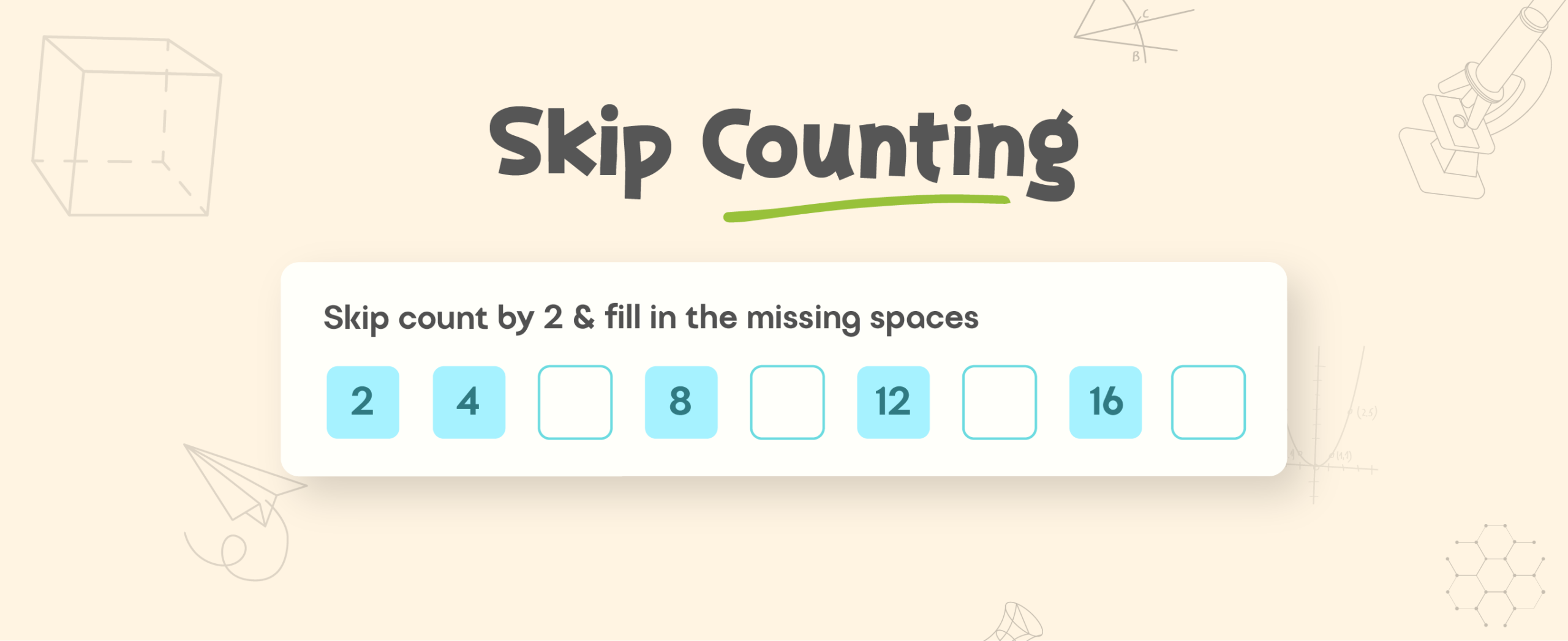
5. Fill in the Missing Numbers: Write a partial skip counting sequence with blanks “2, 4, __, 8, __, 12” or “5, 10, __, 20, __, 30” and ask children to complete it.
This is the most effective diagnostic activity: children who can fill missing numbers have genuinely internalized the sequence rather than recited it by rote.
The skip counting pattern recognition required here is also the core skill tested in the Class 1 competition mathematics.
How to Teach Skip Counting Step by Step
Parents and teachers often ask how to teach skip counting in a way that sticks. The answer is a concrete-to-abstract progression:
- Start with objects. Count physical groups before counting numbers. Two shoes, two shoes, two shoes “2, 4, 6.” The skip count emerges from grouping, not from recitation.
- Move to the number line. Transfer the grouping pattern onto a visual number line with marked arcs. Children see the equal spacing and connect it to the object groups.
- Introduce oral chanting. Once the number line is fluent, practise saying the sequence aloud forward first, then backward.
- Add written practice. Fill-in-the-blank sequences and missing number problems cement the pattern without requiring objects or visuals.
- Apply to real contexts. Counting coins, clock faces, or calendar squares in the appropriate skip brings the sequence into daily life.
This five-step method answers both “how to teach skip counting” and “how to skip count” because the teaching sequence mirrors the learning sequence.
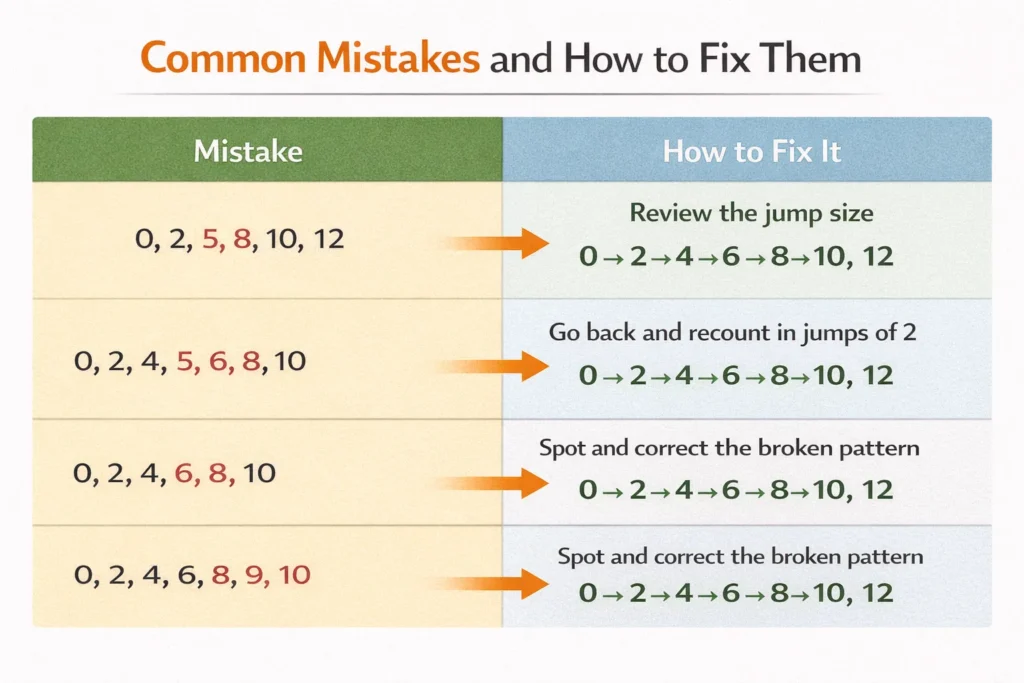
Common Mistakes and How to Fix Them
| Mistake | What It Looks Like | Fix |
|---|---|---|
| Wrong jump size | 2, 4, 7, 9 instead of 2, 4, 6, 8 | Use number line arcs — each arc must be the same size. Ask: “Is your jump the same size each time?” |
| Reverting to counting by ones | 10, 20, 30, 31, 32 | Connect to repeated addition: “We always add 10. What is 30 + 10?” Reinforce with physical jumps. |
| Starting from wrong position | Starts the sequence from 1 instead of 0 | Establish starting position explicitly — “Put your finger on 0. Now make your first jump.” |
| Losing the pattern mid-sequence | 5, 10, 15, 25 (skipped 20) | Use arcs on the number line — each arc must land on a circled number. Visual arcs prevent mid-sequence skips. |
| Confusing skip counting with regular counting | Says every number rather than jumping | Physically cross out skipped numbers on a number chart to make “skipping” visible and intentional. |
The fifth mistake, confusing skip counting with regular sequential counting, is extremely common in the first weeks of instruction. Children who have counted 1, 2, 3, 4 fluently for months need a concrete signal that the rule has changed.
Physically crossing out or colouring over skipped numbers on a hundred chart makes the concept of deliberately leaving numbers out feel purposeful rather than confusing.
When should skip counting by 2s, 5s, and 10s be introduced?
Begin skip counting by 2s once children can count forward to 20 fluently and have some experience with even and odd numbers. Skip counting by 5s and 10s can follow within the same half-term. Most Class 1 curricula introduce all three sequences across the school year, with 10s typically easiest and 2s requiring the most practice for most children.
Is skip counting the same as multiplication?
Conceptually, yes — skip counting is repeated addition, which is the same operation as multiplication. 4 × 5 is the same as skip counting by 5 four times. Children who are fluent at skip counting by 5s will find the 5 times table familiar and accessible when it is formally introduced in Class 2 or 3.
How does skip counting connect to competition mathematics at Class 1 level?
Number sequence problems, completing a pattern, identifying the missing number in a sequence, or finding the next value in a repeating pattern are among the most common Class 1 competition question types. Children with fluent skip-counting ability recognize these patterns immediately. The IMO syllabus for class 1 maps all number topics assessed at this level, and pattern-based sequence reasoning features prominently.
What is skip counting in maths, and why does it matter?
In maths, skip counting means counting in equal-sized jumps rather than one by one. It matters because it is the conceptual foundation of multiplication, the fastest route to recognizing number patterns, and the most effective early intervention for mental arithmetic fluency.
Make Preparing for Math Olympiad Simple!



Conclusion
Skip counting for Class 1 counting in equal jumps by 2s, 5s, and 10s is one of the most valuable skills children develop in their first year of formal mathematics.
It builds faster counting, pattern recognition, number line fluency, and the conceptual foundation for multiplication all at once.
Start with 2s using real object pairs, introduce 5s with finger groups, and extend to 10s for place value reinforcement.
Use the number line for every sequence and practise daily in short, varied sessions, five minutes every day, which builds more fluency than a longer weekly session ever will.
Understanding what skip counting means, seeing clear skip counting examples, and practising how to skip count step by step gives every Class 1 learner the number fluency to move confidently toward multiplication, number sequences, and competition mathematics.
For the number sense foundations that skip counting builds on, see number sense for class 1. For the number sequence context, see what the number sequence for class 1 maths. For the competition mathematics pathway, see the IMO syllabus for class 1.