


The SOF IMO results 2026-27 for Level 1 are expected in mid-January 2027 (4–5 weeks after the exam), while Level 2 results are likely in March 2027.
- SOF IMO Result Date 2026-27 — Level 1 & Level 2
- How to Check SOF IMO Results 2026-27 — Step-by-Step Guide
- Understanding Your SOF IMO Scorecard
- SOF IMO Rank System Explained
- Marks vs Rank — What Does Your Score Actually Mean?
- Who Qualifies for SOF IMO Level 2?
- Certificates and Awards — What Can You Win?
- SOF IMO Result Not Showing? Common Issues & Fixes
- What to Do After Your SOF IMO Result
- Conclusion
SOF IMO 2026-27 results can be checked online at results.sofworld.org approximately 4–5 weeks after the Level 1 exam.
Whether you aced the SOF IMO 2026–27 exam or feel like the exam pattern and syllabus caught you off guard, your result is the starting point, not the finish line.
And if you’re already thinking about the preparation strategy of Level 2, the right preparation makes all the difference.
SOF IMO Result Date 2026-27 — Level 1 & Level 2
One of the biggest questions every student has after the IMO exam: when will results come out?
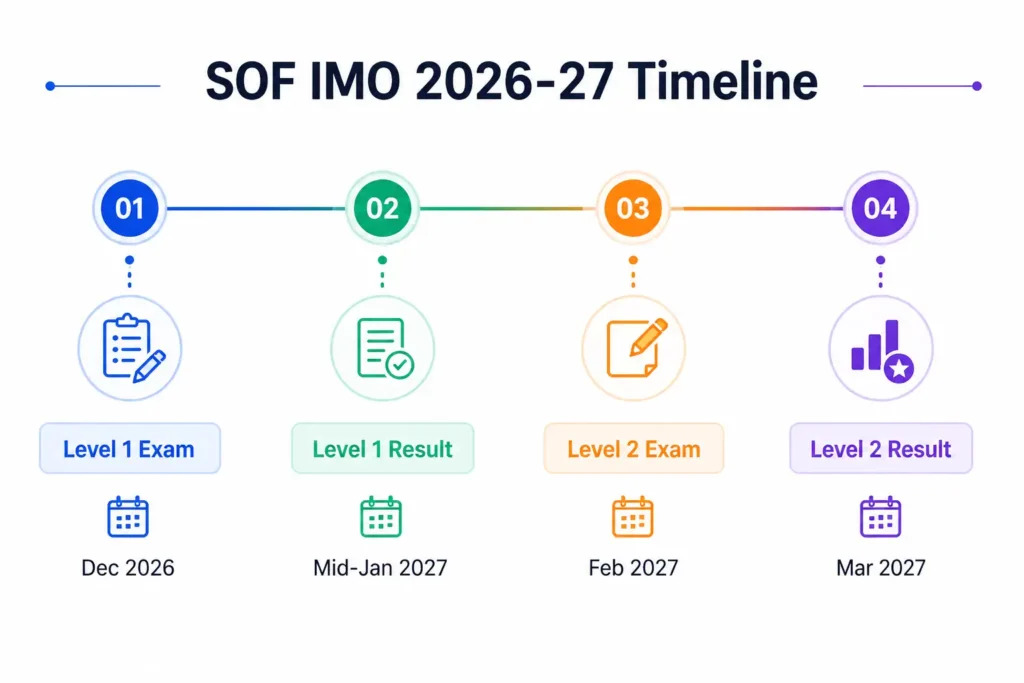
SOF (Science Olympiad Foundation) doesn’t always announce result dates in advance, which makes the wait even harder.
Check our SOF IMO 2026-27 complete exam guide for full exam dates and registration details.
Here’s what the historical result pattern tells us, along with a clear disclaimer.
📌 Result dates are officially announced by SOF at sofworld.org. Always check there for the latest updates. The dates below are based on historical trends and should be treated as estimates until SOF confirms.
Level 1 Result Date
SOF IMO Level 1 is held in two sets, typically in November (Set A) and December–January (Set B).
Results for Level 1 are generally released about 6–8 weeks after the exam.
Expected Level 1 Result Date 2026-27: January–March 2027 (based on previous year trends).
We’ll update this page the moment SOF makes an official announcement.
Level 2 Result Date
Level 2 is held in February–March for students who qualified from Level 1.
The Level 2 result is typically released 4–6 weeks after the exam.
Expected Level 2 Result Date 2026-27: April–May 2027 (estimate). Check sofworld.org for official confirmation.
Previous Year Result Timeline Trends
The table below shows previous year result release patterns to help you estimate when to check.
| Exam Level | Exam Month | Result Release (Typical) | 2025-26 Actual Date |
| Level 1 (Set A) | November | January–February | February 2026 |
| Level 1 (Set B) | December–January | February–March | March 2026 |
| Level 2 | February–March | April–May | April–May 2026 |
⚠️ Note: Dates above reflect known historical patterns. SOF may release results earlier or later depending on exam schedule and volume. Always check sofworld.org for official dates.
How to Check SOF IMO Results 2026-27 — Step-by-Step Guide
The official SOF result link is: https://results.sofworld.org/results.
There are three ways to access your results. Choose whichever is easiest for you.
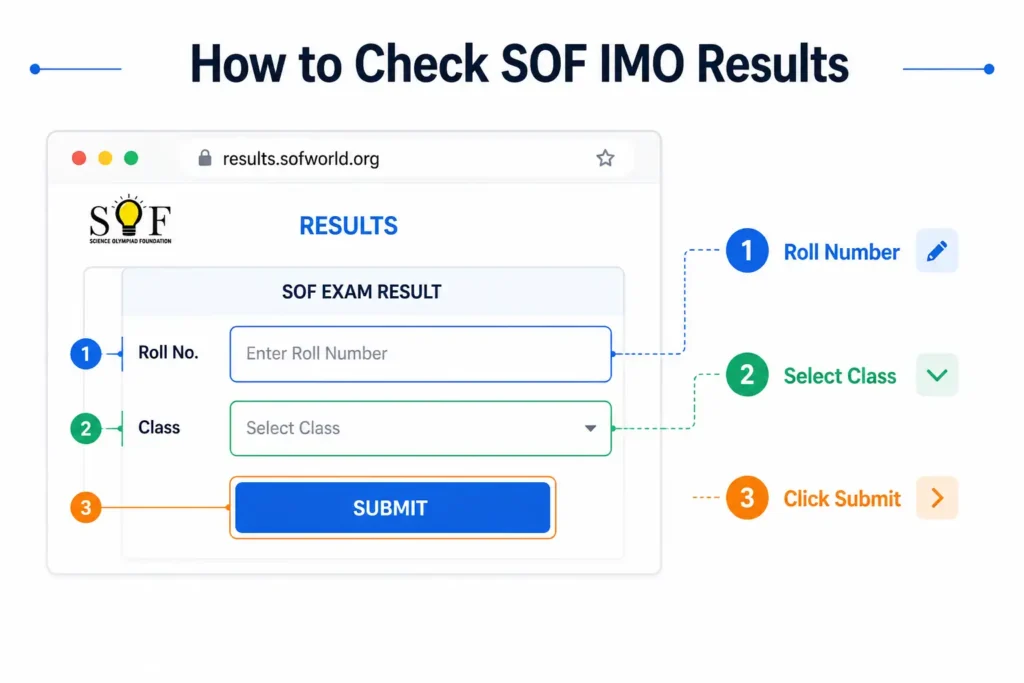
Method 1 — Check by Roll Number
This is the fastest and most reliable method. Your roll number is printed on your admit card.
- Go to https://results.sofworld.org/results in your browser.
- Select the exam: IMO (International Mathematics Olympiad).
- Select your class from the dropdown (Class 1–12).
- Enter your Roll Number exactly as printed on your admit card.
- Enter the Captcha code shown on screen.
- Click “Submit” or “View Result”.
- Your result will appear on screen. Take a screenshot or note your scores.
Can’t find your roll number? Check your school’s notice board many schools display admit cards or result slips for students.
Method 2 — Check by Name
If you don’t have your roll number handy, you can try searching by name (availability depends on SOF’s current portal version).
- Visit https://results.sofworld.org/results.
- Select IMO as the exam and choose your class.
- Look for a “Search by Name” option (if available).
- Enter your full name exactly as registered spelling and spacing matter.
- Enter your school code if prompted (available from your school).
- Click Submit. If your name appears in the list, click on it to view your full result.
📌 Name-based search may not always be available. If you can’t find the option, use your roll number instead, or ask your school coordinator.
Method 3 — School-Based Result Access
SOF also sends consolidated result data directly to registered schools.
Your school coordinator or class teacher may already have your result.
- Contact your school’s SOF coordinator or class teacher.
- Ask them to check the school-level result sheet shared by SOF.
- Schools receive a complete list of participating students and their scores.
- Your scorecard and certificate (if eligible) will also be sent to your school.
Understanding Your SOF IMO Scorecard
Once your SOF IMO result is out, you’ll get access to your scorecard a detailed performance report that tells you much more than just a total score.
Here’s how to read every part of it.
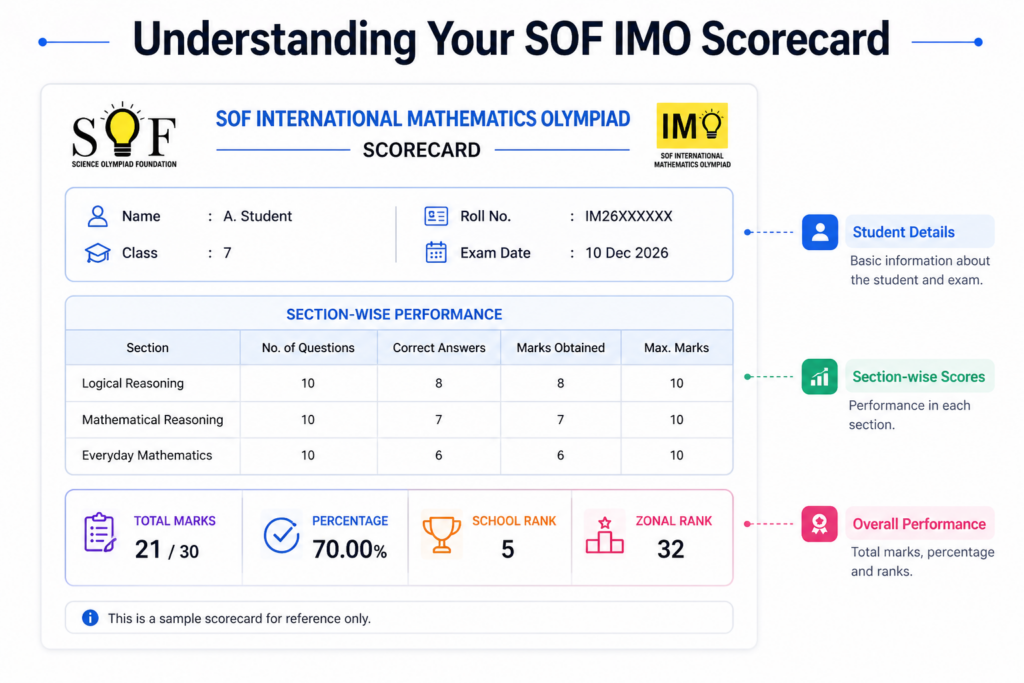
What the Scorecard Contains
The SOF IMO scorecard is your official performance document.
It shows your individual section scores, total marks, and three different types of ranks.
Think of it as your full report card for the Olympiad.
| Field on Scorecard | What It Means |
| Student Name | Your full registered name |
| Roll Number | Your unique exam identifier |
| School Name & Code | Your school’s registered SOF code |
| Class & Section | Your class and section at time of exam |
| Section 1 Score | Marks in Logical Reasoning |
| Section 2 Score | Marks in Mathematical Reasoning |
| Section 3 Score | Marks in Everyday Mathematics |
| Section 4 Score | Achievers Section (for top scorers only) |
| Total Marks | Sum of all section scores |
| International Rank | Your rank among all students globally in your class |
| Zonal Rank | Your rank in your geographic zone |
| School Rank | Your rank within your own school |
Section-Wise Score Breakdown
The IMO paper is divided into four sections:
- Logical Reasoning
- Mathematical Reasoning
- Everyday Mathematics
- The Achievers Section (higher-difficulty questions).
Section-wise scores help you identify exactly where you lost marks useful for planning your preparation for next year.
Download SOF IMO sample papers to practise each section before next year’s exam.
How to Download Your Scorecard (PDF)
- Log in at results.sofworld.org/results using your roll number.
- Once your result is displayed, look for a “Download Scorecard” or “Print” button.
- Click the button to download the SOF IMO score card as a PDF.
- Save it to your device you may need it for school records or future reference.
If the download option is not visible, try Ctrl + P (Windows) or Cmd + P (Mac) to print the result page directly as a PDF.
SOF IMO Rank System Explained
Your SOF IMO result shows three different ranks, and many students aren’t sure what each one means.
Here’s a clear explanation.
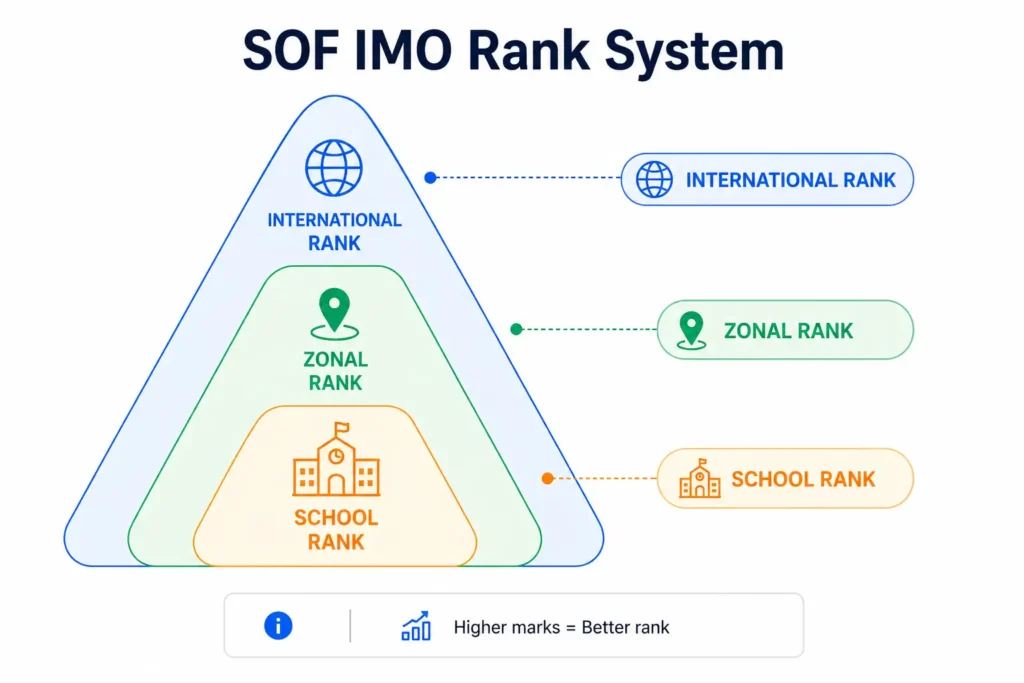
International Rank
Your International Rank is your position among all IMO participants in your class across India and all other countries that participate in SOF exams.
This is the broadest and most competitive ranking.
An International Rank of 1 means you scored the highest in your class worldwide.
The lower your international rank number, the better your performance globally.
Zonal Rank
India is divided into geographic zones for SOF exams.
Your Zonal Rank is your position among all students in your class within your region (e.g., North, South, East, West, Central).
Zonal ranks are used to determine Level 2 qualification students who rank in the top percentage of their zone are invited to appear for Level 2.
School Rank
Your School Rank is the simplest to understand.
It’s your position among all students from your school who appeared for IMO in your class.
A School Rank of 1 means you scored the highest in your class at your school.
Class-Wise and School-Wise Rankings
All three ranks International, Zonal, and School are calculated class-wise.
This means a Class 5 student is only ranked against other Class 5 students.
This makes the comparison fair, as question papers are different for each class.
SOF also recognises top-performing schools through a school-wise ranking that counts the number of medal winners and top-ranked students.
This is separate from individual student rankings.
Marks vs Rank — What Does Your Score Actually Mean?
You’ve got your total score. But what does that number actually mean in terms of rank?
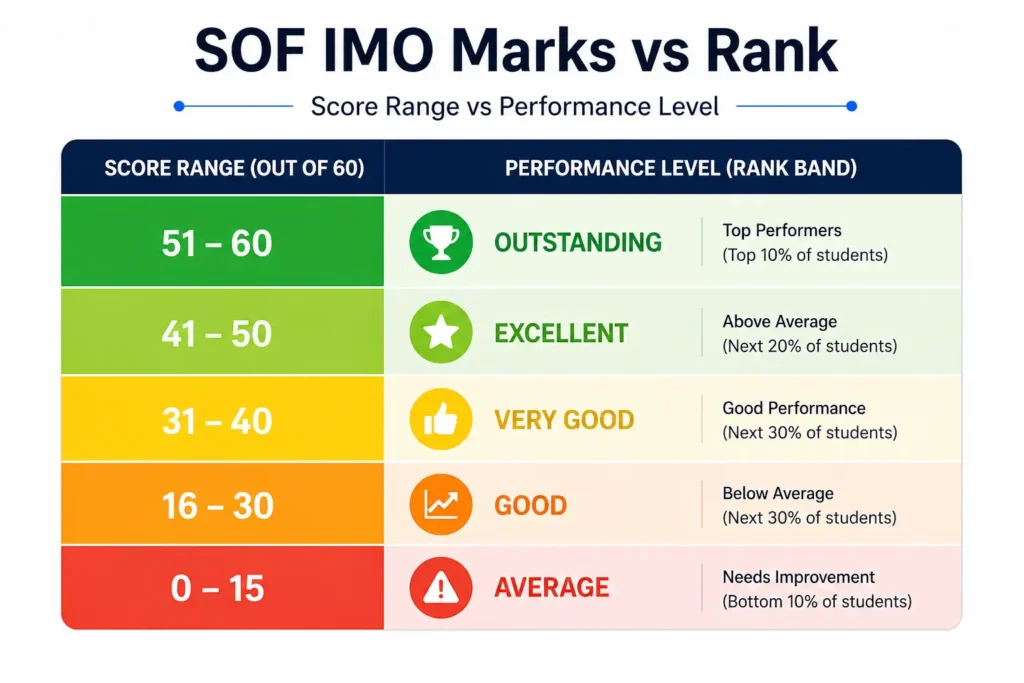
Here’s the honest breakdown based on previous year patterns.
Score Benchmarks (Class-Wise)
The total marks in IMO Level 1 are typically 60 (for most classes).
The Achievers Section carries higher marks per question, so students who attempt it well can score significantly higher.
⚠️ The table below uses approximate benchmarks derived from previous year patterns and community reports. Actual cutoffs vary by class, zone, and year. These are estimates, not official SOF data.
| Score Range (out of 60) | Performance Level | Approx. Rank Band | Level 2 Eligibility |
| 54–60 | Outstanding | Top 1% (International) | ✅ Very likely |
| 48–53 | Excellent | Top 5% | ✅ Likely |
| 42–47 | Very Good | Top 10–15% | ✅ Possible (zone-dependent) |
| 35–41 | Good | Top 25% | ⚠️ Borderline |
| 25–34 | Average | Top 50% | ❌ Unlikely |
| Below 25 | Needs Improvement | Lower 50% | ❌ Not likely |
How Ranks Are Calculated from Marks
SOF calculates ranks purely based on marks the higher your marks, the lower (better) your rank number.
In case of a tie, both students receive the same rank.
The Achievers Section can be a rank decider if two students with the same score in the main three sections can differ significantly in rank if one performed better in the Achievers Section.
What Is a Good Score in SOF IMO?
There’s no single answer, it depends on your class and zone. But as a general rule: if you scored above 42 out of 60, you’re in a strong position.
Scoring above 48 puts you in medal contention. Anything above 54 is exceptional.
Don’t judge your performance only by the total.
Check your section-wise scores to understand where you were strongest and where there’s room to improve.
Read what types of questions are asked in Math Olympiads to understand which sections demand the most from top scorers.
Who Qualifies for SOF IMO Level 2?
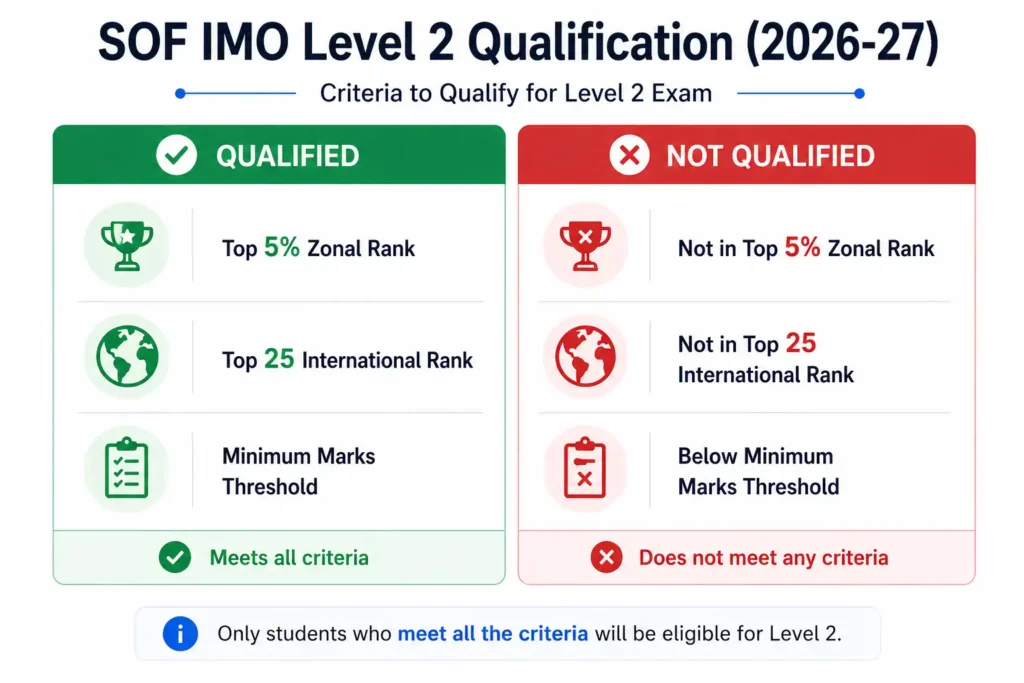
Level 2 Qualification Criteria
Not everyone who writes IMO Level 1 gets to appear for Level 2.
SOF selects a limited number of top performers from Level 1 to write the second round.
The criteria for qualifying to Level 2 are:
- Top 5% of students class-wise from each zone qualify for Level 2.
- Additionally, the top 25 rank holders from each class (international) also qualify, regardless of zone percentages.
- Students who score above a certain minimum threshold in their class may also be considered SOF announces this threshold with the result.
Cutoff Logic and Minimum Marks
The cutoff for Level 2 qualification is not a fixed number; it changes every year based on how students performed nationally. A high-scoring year means a higher cutoff.
How to check: When your SOF IMO Level 1 result is released, it will clearly indicate whether you’ve qualified for Level 2.
Your scorecard will show a “Qualified” or “Not Qualified” status for Level 2.
📌 If you’ve qualified, SOF will send your Level 2 admit card and exam date details to your school. Keep in touch with your school coordinator after the Level 1 result is out.
Certificates and Awards — What Can You Win?
Regardless of your rank, every IMO participant has the potential to walk away with recognition.
Here’s what’s available.
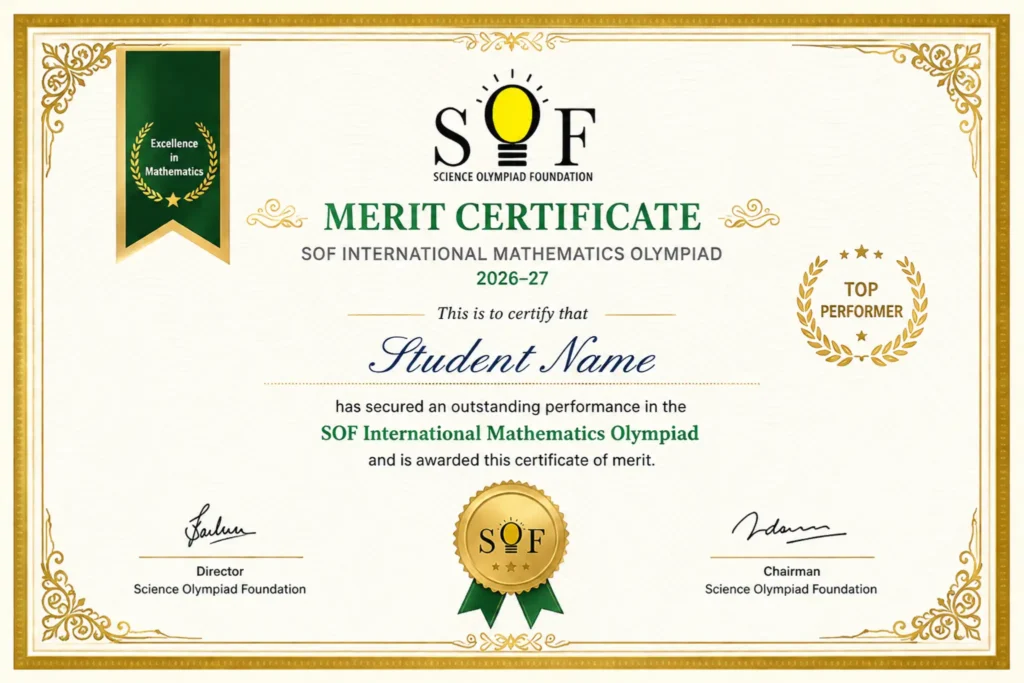
Merit Certificate Eligibility
SOF Merit Certificates are awarded to students who achieve distinction in the exam.
Eligibility typically includes:
- Students who rank in the top 25% of their class internationally receive a Merit Certificate.
- Students who achieve a Zonal Rank of 1 receive a Gold Medal and a special Merit Certificate.
- Students who score above 60% marks in Level 1 are generally eligible.
Participation Certificate
Every student who appeared for the SOF IMO exam received a Participation Certificate.
This is sent to your school along with results.
It’s a great addition to your academic portfolio, even if you didn’t qualify for Level 2.
Prizes and Medal Criteria
SOF offers cash prizes, medals, and gift vouchers for top performers.
The prize structure includes:
- International Rank 1 (class-wise): Gold Medal + Certificate of Merit + Cash Prize
- International Rank 2 & 3: Silver/Bronze Medal + Certificate of Merit
- Zonal Rank 1 (class-wise): Gold Medal + Merit Certificate
- Class toppers from each school: School Excellence Award
For the complete and up-to-date prizes list, visit the SOF IMO awards and prizes guide on Gonit Blog.
SOF IMO Result Not Showing? Common Issues & Fixes
If your result isn’t loading or something looks wrong, don’t panic.
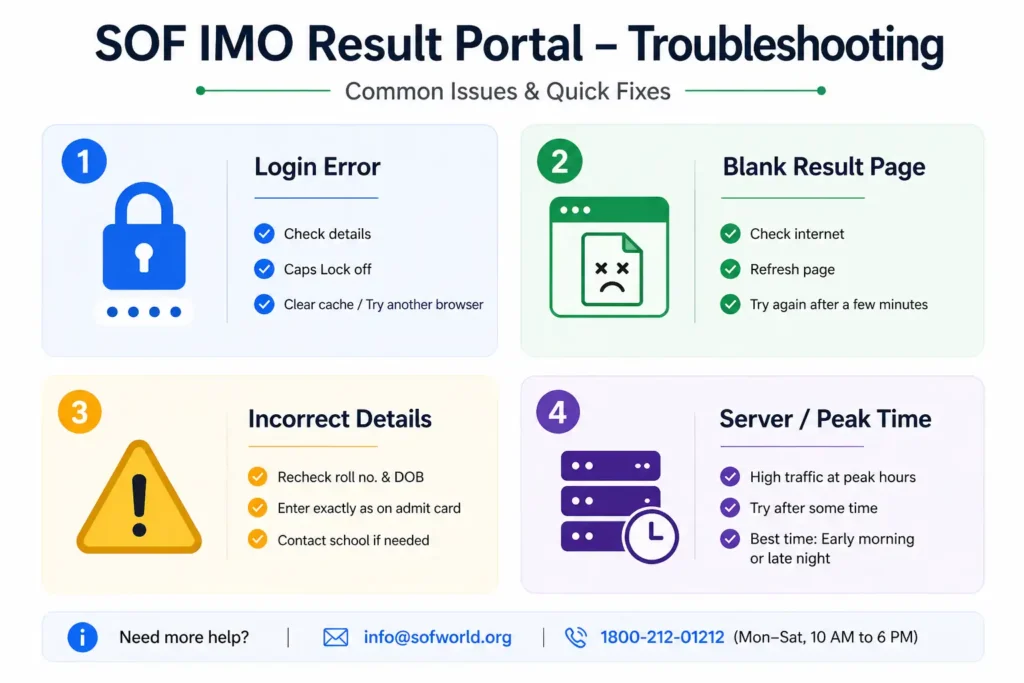
Here are the most common problems students face and exactly how to fix them.
Login Errors and How to Fix Them
Problem: “Invalid Roll Number” or “Details Not Found” error.
Fix: Double-check your roll number; it must be entered exactly as it appears on your admit card, including leading zeros if any.
Make sure you’ve selected the correct class and exam (IMO).
If the problem persists, contact your school coordinator to verify your registered roll number.
Result Not Loading or Blank Page
Problem: The SOF result page loads but shows blank, or keeps spinning without showing your result.
Fix: Clear your browser cache and cookies, then try again. Use Google Chrome or Mozilla Firefox for best compatibility.
Disable any ad-blockers or extensions. Try opening the page in an incognito/private window.
Incorrect Details in Result
Problem: Your name is misspelled, your class is wrong, or your school name doesn’t match.
Fix: Contact SOF directly via the official website (sofworld.org).
Your school coordinator can also raise a correction request on your behalf.
Keep your admit card and registration details ready when contacting them. SOF has a process for result verification and correction.
Server Issues During Peak Time
Problem: The SOF result website is slow or crashes especially on the first day results are released.
Fix: This is normal. Thousands of students try to check the results at the same time.
Wait a few hours and try again, or try late at night when server load is lower.
You can also ask your school to check the consolidated result sheet they receive from SOF.
What to Do After Your SOF IMO Result
You’ve checked your result.
Now what? Here’s a clear plan for every outcome.
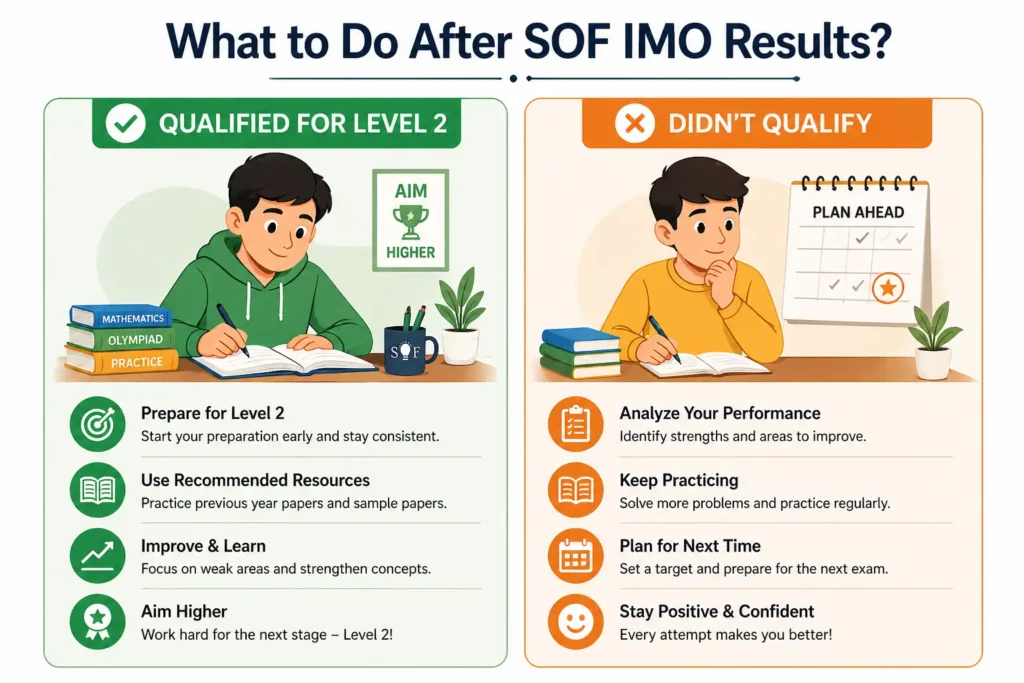
If You Qualified for Level 2 — Next Steps
Congratulations qualifying for Level 2 is a real achievement.
Here’s how to make the most of it:
- Contact your school coordinator immediately to confirm your Level 2 registration.
- Ask about your Level 2 exam date it’s usually in February or March.
- Start focused Level 2 preparation right away the questions are harder and more concept-heavy.
- Practice Olympiad-level problems, especially in areas where you lost marks in Level 1.
- Read our full guide on how to prepare for the IMO for a structured Level 2 plan.
If You Didn’t Qualify — How to Improve
Not qualifying for Level 2 this year doesn’t define you.
Most students who eventually top the IMO didn’t make Level 2 in their first attempt.
Here’s how to turn this result into a springboard:
- Analyse your scorecard to identify which sections cost you the most marks.
- Our guide on improving IMO problem-solving skills explains exactly where most students lose marks.
- Focus on your weakest section over the next few months.
- Start practising Olympiad-style problems regularly, not just before the exam.
- See how to get better at solving Math Olympiad questions for daily habits that move the needle.
- Aim to build consistency rank improvement comes from habit, not last-minute cramming.
Planning for Next Year’s IMO
The best time to start preparing for next year’s SOF IMO is right now, while the paper is still fresh in your memory.
Note the topics that felt hardest, and build a consistent daily practice routine.
Free Math Olympiad training online is a great place to start.
Check out the SOF IMO syllabus and SOF IMO exam pattern guides on Gonit Blog to start building a structured study plan.
When will SOF IMO results 2026-27 be declared?
SOF typically releases Level 1 results 6–8 weeks after the exam. Based on historical trends, Level 1 results are expected between January and March 2027, and Level 2 results by April–May 2027. Check sofworld.org for the official announcement.
How can I check my SOF IMO result by roll number?
Visit results.sofworld.org/results, select IMO, choose your class, enter your roll number from your admit card, complete the captcha, and click Submit. Your result will be displayed on screen.
What is the difference between zonal rank and international rank?
Your Zonal Rank is your position among students in your geographic region (zone) in your class. Your International Rank is your position among all IMO participants globally in your class. The International Rank is broader and more competitive.
How many marks are needed to qualify for Level 2?
There’s no fixed cutoff; it varies by class, zone, and how students performed that year. Generally, scoring in the top 5% of your class in your zone qualifies you. Historically, this tends to be 42+ marks out of 60 for most classes, but check your result — SOF will indicate directly whether you’ve qualified.
Can I check SOF IMO results by name?
Yes, in some cases. The SOF result portal may offer a name-based search option. Enter your full registered name and school code if prompted. If this option isn’t available, use your roll number instead, it’s faster and more reliable.
What certificates do I get if I don’t qualify for Level 2?
Every student who appeared for the IMO received a Participation Certificate. Students who score in the top 25% internationally for their class also receive a Merit Certificate. These are delivered through your school.
Make Preparing for Math Olympiad Simple!



Conclusion
You have your result. Now you know exactly where you stand and where you need to improve.
Gonit App is built for Math Olympiad students in Classes 1–12, designed around the actual IMO question pattern.
Here’s what students use it for after results day:
- Level 2 prep: Achievers Section-style problems, timed sets, and class-specific question pools matched to IMO Level 2 difficulty. Read our full scoring strategy to go in prepared.
- Weak-area targeting: Lost marks in Logical Reasoning or Everyday Mathematics? Focused topic drills so you fix specific gaps, not just revise everything.
- Classes 1–12 coverage: Every question set is class-specific and mapped to the current SOF IMO syllabus, with no mismatched content.

Mikha Piregu is a Content Writer with experience spanning educational content, including math and math olympiad topics, as well as advocacy writing, research-based articles, and SEO-driven web content. He creates high-quality blog content, web copy, and feature articles that support brand visibility, audience engagement, and long-term organic growth through data-informed storytelling. Skilled in WordPress, WooCommerce, and modern digital tools, Mikha adapts content across various platforms, including blogs, websites, campaigns, and advocacy initiatives, with clarity and purpose.

There are no comments posted here yet.
Sign in to leave a comment