


SOF IMO Level 2 isn’t a harder Level 1 it’s a different competition. Smaller pool, heavier questions, and one section that decides most ranks.
- What is SOF IMO Level 2?
- Level 1 vs Level 2 — What Changes and Why It Matters
- SOF IMO Level 2 Exam Pattern
- Advanced Syllabus Focus — What to Prioritize
- Section-wise Advanced Strategy
- Topper-Level Study Strategy
- Time Management During the Exam
- Speed and Accuracy Optimization
- Mock Test Strategy — The Improvement Loop
- Common Mistakes Level 2 Qualifiers Make
- Rank Strategy — How to Target Top Positions
- Best Preparation Resources
- Conclusion
Most qualifiers fail here for the same reason: they prep the same way.
That doesn’t work when everyone in the room is already in the top 5% and knows the syllabus. What separates rank holders isn’t more practice, it’s a rank strategy.
This guide gives you exactly that: the official exam pattern, highest-weight topics by section, and a complete Achievers Section playbook.
If you’re still building your Level 1 base, start with our complete 60-day SOF IMO preparation guide first.
What is SOF IMO Level 2?
SOF (Science Olympiad Foundation) conducts the IMO Level 2 exam for students in Classes 3 to 12.
It’s an invitation-only exam; you can only sit for it if you qualify at Level 1.
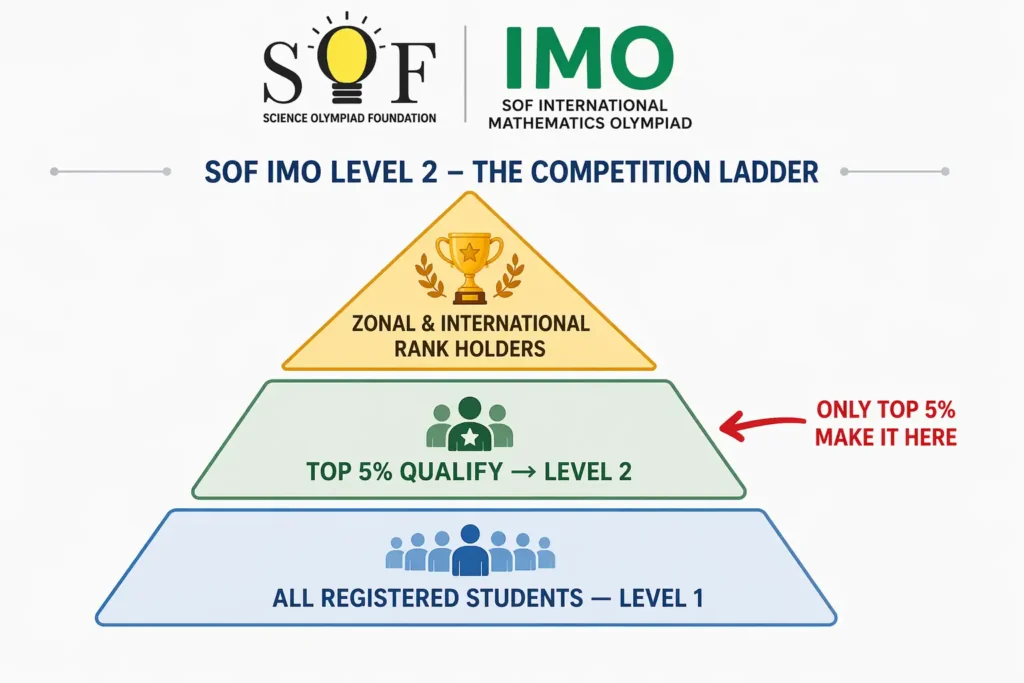
Who qualifies?
- The top 5% of class-wise students from each country who appeared in Level 1
- Top 25 rank holders from each class in each zone
- Students who score at or above the cutoff set by SOF each year
This means you’re no longer competing against your school or your city.
You’re competing against the best math students across India and internationally.
What’s at stake:
| Achievement | Award |
| International Rank 1–3 (each class) | Gold medal + ₹50,000 |
| International Rank 4–10 | Silver medal + ₹25,000 |
| International Rank 11–25 | Bronze medal + ₹10,000 |
| Zonal Rank 1 | Gold medal + gift voucher |
| Participation | Certificate of Merit |
Note: Prize amounts and medal criteria are based on SOF’s published guidelines. For the full breakdown of medals, cash prizes, and certificates, see the SOF IMO awards and prizes guide. Confirm current details at sofworld.org.
The competition is real, and the rewards are significant. More importantly, the ranking itself international or zonal carries weight in academic portfolios and scholarship applications.
Level 1 vs Level 2 — What Changes and Why It Matters
Most students who underperform at Level 2 make one mistake: they prepare the same way they did for Level 1.
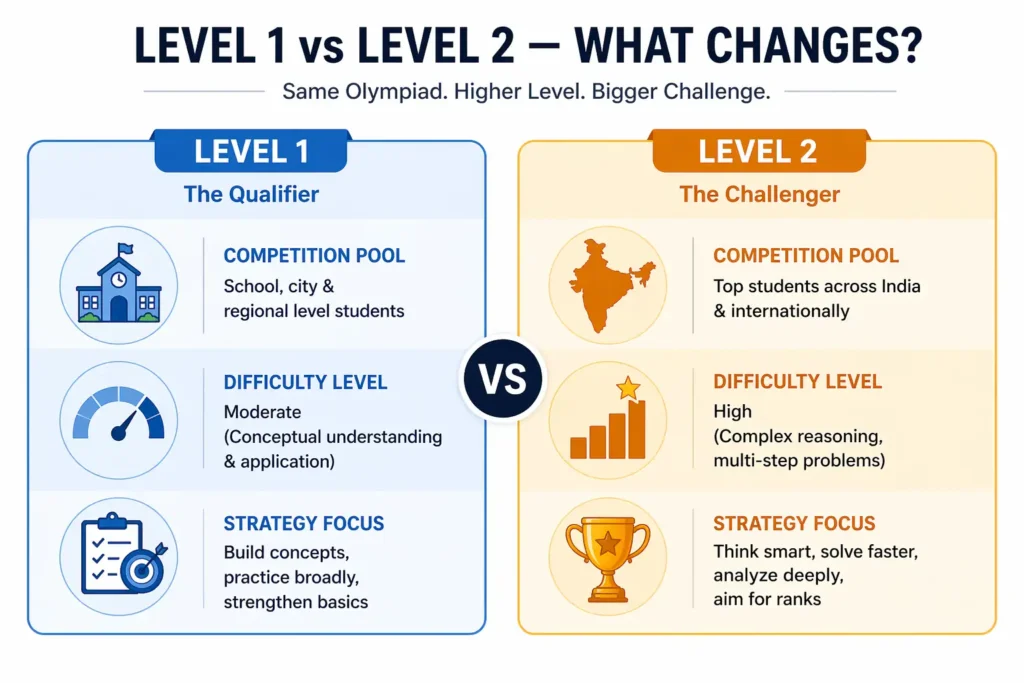
That doesn’t work. Here’s why:
| Dimension | Level 1 | Level 2 |
| Competition pool | All registered students (school-wide) | Top 5% of Level 1 qualifiers (nationwide) |
| Question difficulty | Concept application, direct problems | Multi-step reasoning, concept combinations |
| Achievers Section weight | Moderate | High — often rank-deciding |
| Scoring pressure | Comfortable; room for errors | Every mark counts |
| Strategy needed | Concept coverage + speed | Precision + strategic section focus |
| Time pressure | Manageable | Tight for high-scorers |
The strategy shift you must make:
At Level 1, covering the syllabus broadly and solving quickly was enough.
At Level 2, you need depth over breadth, accuracy over speed, and a specific Achievers Section game plan.
The students who rank highly at Level 2 aren’t the ones who revised more, they’re the ones who revised smarter and targeted the right marks.
SOF IMO Level 2 Exam Pattern
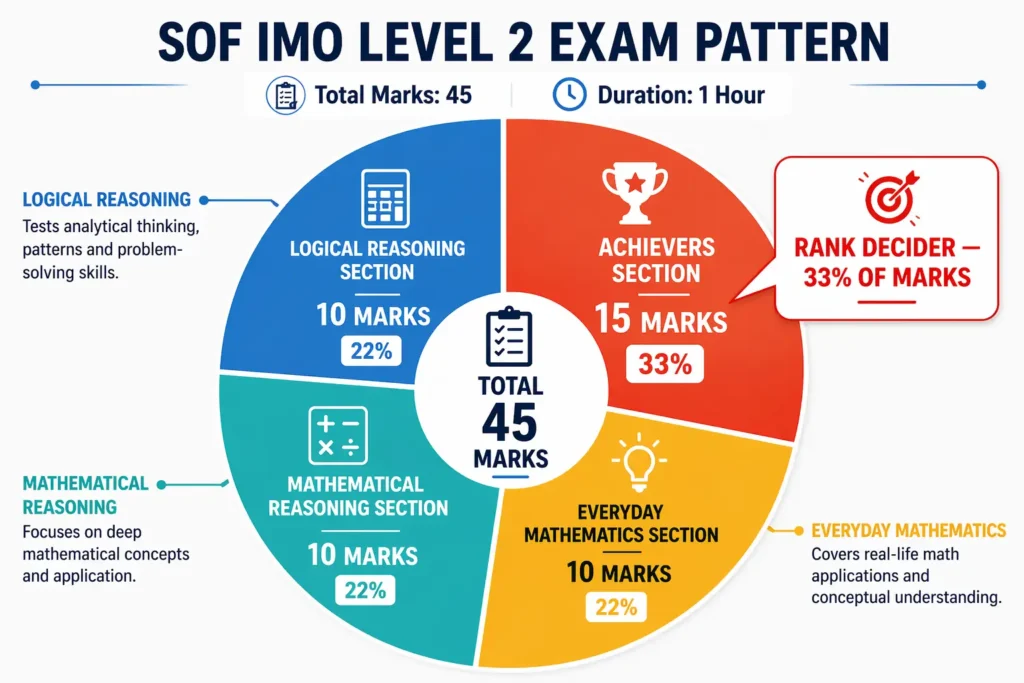
The Level 2 exam follows a structured format across four sections. Here’s the breakdown:
| Section | No. of Questions | Marks per Question | Total Marks | Difficulty |
| Logical Reasoning | 10 | 1 | 10 | Moderate–High |
| Mathematical Reasoning | 10 | 1 | 10 | High |
| Everyday Mathematics | 10 | 1 | 10 | Moderate |
| Achievers Section | 5 | 3 | 15 | Very High |
| Total | 35 | — | 45 | — |
Time limit: 60 minutes
Key differences from Level 1:
- Level 1 typically has 35 questions for 40 marks; Level 2 has the same count but more weight on the Achievers Section
- No negative marking (SOF policy confirm at sofworld.org for the current year)
- The Achievers Section carries 33% of total marks despite being just 5 questions
For a complete section-wise breakdown across all classes, read our SOF IMO exam pattern guide.
Flag: Always verify the exact exam pattern on the official SOF website (sofworld.org) before the exam, as minor adjustments can occur year to year.
Advanced Syllabus Focus — What to Prioritize
Level 2 tests the same syllabus as Level 1 but at a deeper level.
The questions don’t just ask you to apply a formula, they ask you to combine multiple concepts, reason under unfamiliar conditions, or identify patterns in complex data.
High-priority topics by section:
| Section | High-Priority Topics |
| Logical Reasoning | Series completion, analogy (complex), coding-decoding, blood relations, direction sense |
| Mathematical Reasoning | Number theory, algebra (equations & inequalities), geometry (properties & proofs), mensuration |
| Everyday Mathematics | Word problems (multi-step), ratio & proportion, percentage, profit/loss with conditions |
| Achievers Section | Integration of 2–3 topics in one question; pattern recognition; higher-order application |
What to de-prioritize: Straightforward single-concept questions that you can solve reflexively.
At Level 2, these are rarely where marks are lost or won.
Focus your preparation energy on multi-concept problems.
What to master: Any topic where you’re 80% confident but not 100%. These are your highest-return study areas.
For the official class-wise topic list, check the SOF IMO syllabus guide it covers every class from 3 to 12 in detail.
Section-wise Advanced Strategy
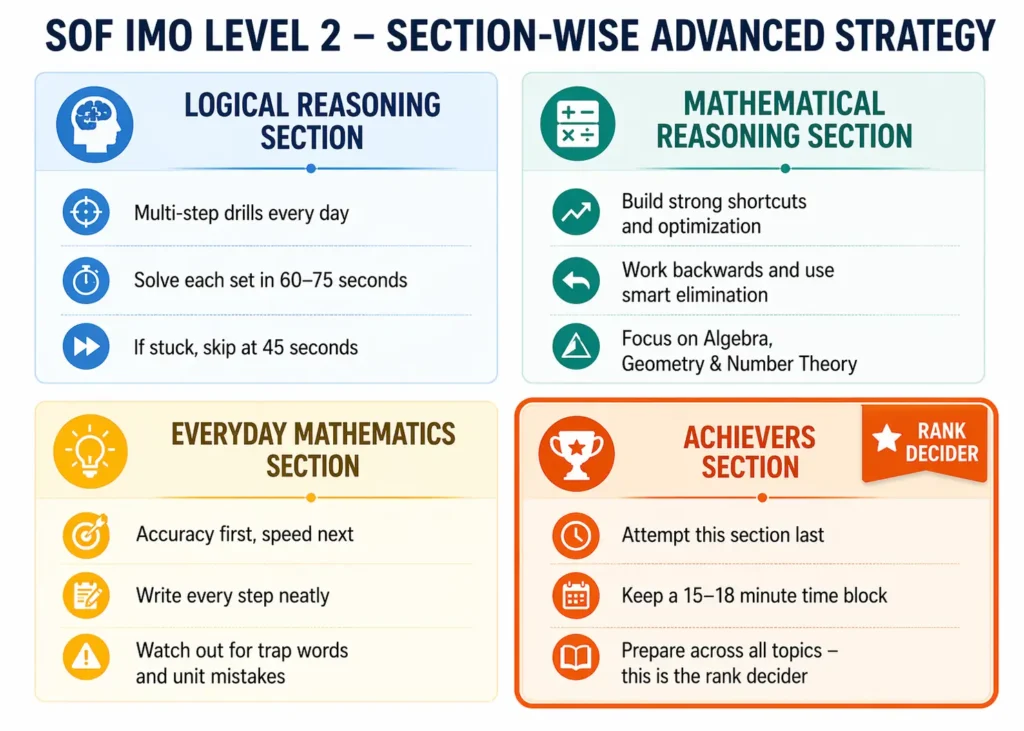
Logical Reasoning
At Level 2, logical reasoning questions often combine two or three reasoning types in one problem.
A “simple” direction sense question might embed a coding step. A series might require you to identify the pattern before applying it.
What works:
- Practice multi-step deduction problems, not just single-type drills
- Time yourself: each LR question should take no more than 60–75 seconds
- If you’re stuck after 45 seconds, mark and move on this section rewards decisive thinkers
Common trap: Spending too long on one tricky LR question early in the exam, which cascades into time pressure later.
Mathematical Reasoning
This is typically the hardest section for most students and the most rewarding if you prepare it well.
What works:
- Build a library of shortcuts for recurring problem types (HCF/LCM, divisibility, geometry proofs)
- Practice working backward from answer options on unfamiliar problems
- At Level 2, algebra and geometry together account for a significant portion of this section give them disproportionate attention
Higher-order thinking practice: Solve problems where you don’t immediately see the method.
The discomfort of not knowing the path forward is exactly what Level 2 will test.
Everyday Mathematics
Don’t underestimate this section. Students often approach it casually and lose marks to careless errors.
What works:
- Focus on accuracy, not just speed marks lost here are the most avoidable marks lost
- Multi-step word problems: write out the steps, don’t try to solve mentally
- Practice percentage, ratio, and profit/loss problems with embedded conditions (e.g., “after two successive discounts”)
Our guide on how to solve math word problems covers the exact step-by-step approach that works for Everyday Mathematics questions at Level 2.
Achievers Section — The Rank Decider
This section deserves more of your prep time than the other three combined.
Here’s why: five questions, three marks each, for 15 out of 45 total marks.
That’s 33% of your score from 14% of your questions.
In practice, this is where rank separation happens. Students who score 30 marks in the regular sections cluster together.
It’s the Achievers Section that decides who ranks 1st versus 50th.
What makes these questions hard:
- They combine 2–3 topics from different sections
- They test conceptual understanding, not just procedure
- There’s no “standard” question type you need to think, not just recall
Recommended approach:
- Attempt Achievers Section questions after completing the other sections don’t burn time here first
- Allocate 15–18 minutes for this section (see time management table below)
- For each question, identify the topic(s) being tested before attempting to solve
- If you can’t identify the approach in 30 seconds, move on and return if time allows
How to practice specifically:
- Solve past year Level 2 Achievers Section questions as a distinct practice block
- Practice “topic combination” problems: take two topics you know well and look for problems that combine them
- After every Achievers practice session, review every question you got wrong not just the answer, but the reasoning path you should have taken
Topper-Level Study Strategy
There’s no one-size-fits-all timeline, but here’s a framework that works for most Level 2 qualifiers:
Phase 1: Foundation (4–6 weeks before exam)
- Identify your 3 weakest topics per section using a diagnostic mock
- Spend 60% of study time on these weak topics, 40% on reinforcing strengths
- Goal: No obvious gaps in any section
Phase 2: Integration (2–3 weeks before exam)
- Shift from topic practice to full-length mock tests (2–3 per week)
- After each mock: analyze section scores, identify error patterns, fix gaps
- Goal: Consistent performance across all four sections
Phase 3: Precision (1 week before exam)
- Reduce new problem-solving; focus on accuracy review
- Revisit high-difficulty problems you got wrong
- Goal: Mental sharpness and exam-condition familiarity
Daily practice structure:
- 45–60 minutes on weekdays: 20 min topic drill + 25 min mixed practice
- 90–120 minutes on weekends: full mock or extended review session
- Daily review: 10 minutes reviewing any errors from the previous session
Time Management During the Exam
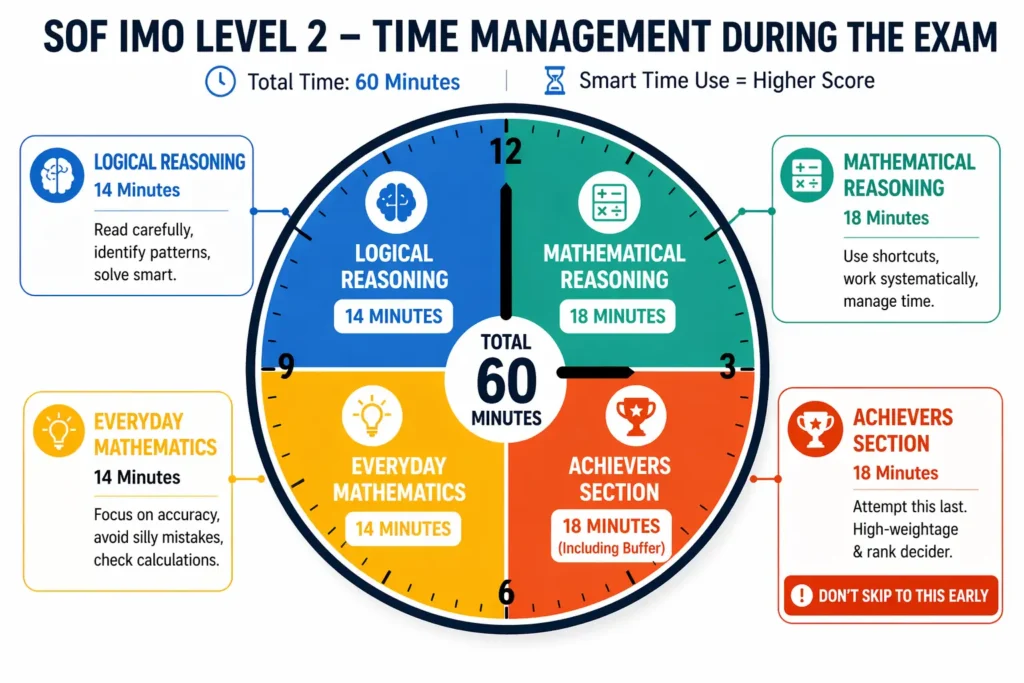
Time is tight at Level 2. Here’s a section-wise allocation that maximizes your score:
| Section | Questions | Recommended Time | Time per Question |
| Logical Reasoning | 10 | 12–14 minutes | ~75 seconds |
| Mathematical Reasoning | 10 | 16–18 minutes | ~100 seconds |
| Everyday Mathematics | 10 | 12–14 minutes | ~75 seconds |
| Achievers Section | 5 | 15–18 minutes | ~3 minutes |
| Buffer / Review | — | 3–5 minutes | — |
Question prioritization strategy:
- In each section, quickly skim all questions first (30 seconds) flag the ones you’re confident about
- Solve confident questions first to bank easy marks
- Return to uncertain questions with remaining time
- In the Achievers Section, attempt questions where you can identify the topic immediately
If you’re unsure: Skip and move on. In a 60-minute, 35-question exam, spending 4 minutes on one unsolvable question is a costly mistake.
There’s no negative marking; an unattempted question costs the same as a wrong one.
Speed and Accuracy Optimization
At Level 2, most students can solve most problems.
The difference-maker is how many you solve correctly, not just how many you attempt.
Mental math techniques:
- Practice multiplication tables up to 25×25 (faster calculation in Everyday Mathematics)
- Develop number sense shortcuts: squaring numbers ending in 5, multiplying by 11, mental percentage calculations
- Train yourself to estimate before calculating it catches errors and speeds up verification
Error-reduction habits:
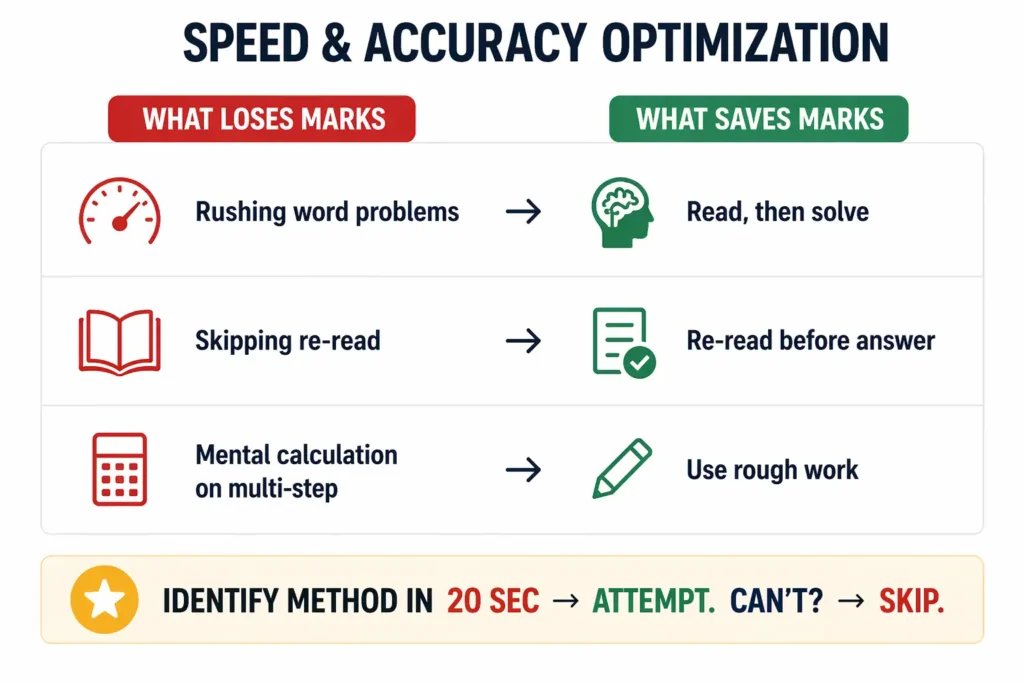
- Re-read the question after solving (30 seconds well spent)
- Watch for trap words: “not,” “except,” “least,” “most” Level 2 questions use these deliberately
- For word problems: always write down what’s being asked before solving
The skip-or-attempt framework:
- Can you identify the method within 20 seconds? → Attempt
- Do you know the topic but need time? → Attempt after finishing easier questions
- A completely unfamiliar approach? → Skip, return if time allows, guess if not
Mock Test Strategy — The Improvement Loop
Taking mocks isn’t the goal. Getting better from mocks is.
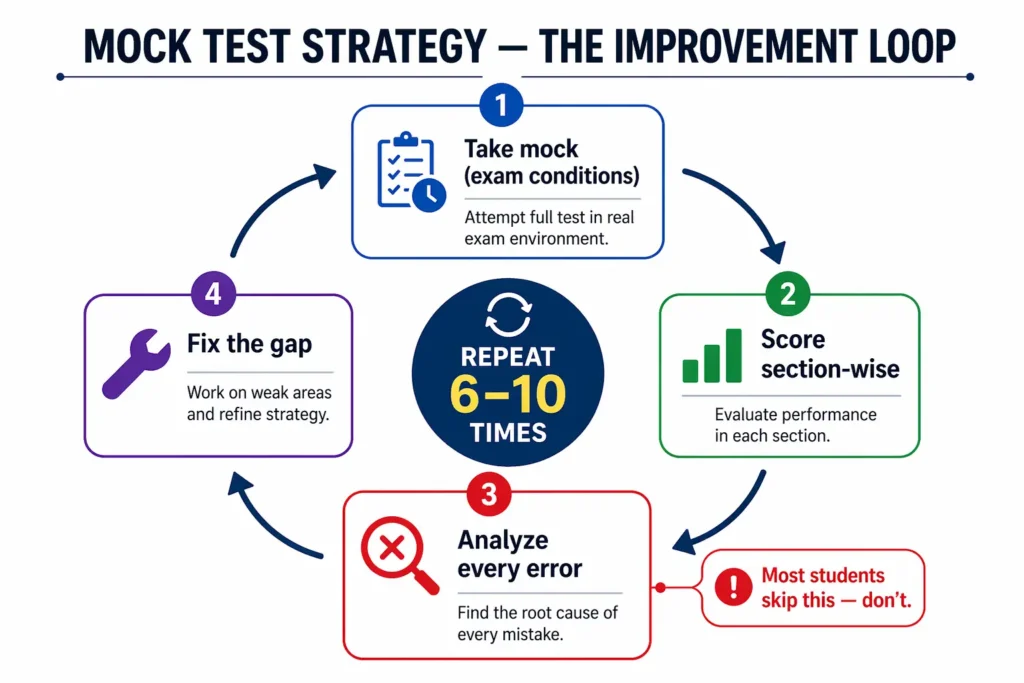
When to start: Begin full-length mocks 4–5 weeks before the exam once you have reasonable coverage of the syllabus.
How to take mocks:
- Simulate exam conditions: timed, no interruptions, no calculator
- Use official SOF IMO sample papers the most accurate Level 2 mock test source available
- Don’t check answers during complete the full test first
The post-mock analysis (this is where improvement actually happens):
- Score each section separately
- For every wrong answer: identify whether it was a concept gap, a careless error, or a time-pressure mistake
- For every question you skipped: could you have solved it with more time?
- Track your section-wise scores across mocks in a simple table
Tracking improvement:
| Mock # | LR | MR | EM | Achievers | Total | Notes |
| 1 | ||||||
| 2 | ||||||
| 3+ |
A student who takes 8 mocks and analyzes each one will consistently outperform a student who takes 20 mocks with no analysis.
Common Mistakes Level 2 Qualifiers Make
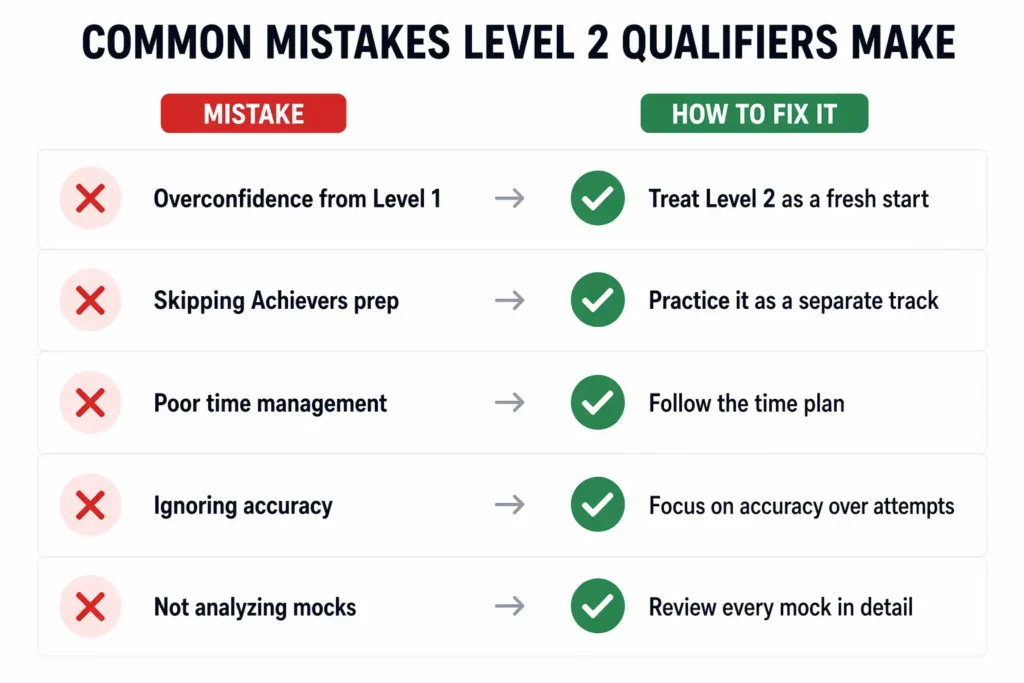
| Mistake | Why It Hurts | How to Fix It |
| Overconfidence from Level 1 performance | Level 2 tests different skills familiarity with the syllabus isn’t enough | Treat Level 2 as a fresh competition with higher bar |
| Not shifting strategy | Breadth-first preparation doesn’t work when everyone knows the basics | Focus on depth, multi-concept problems, and Achievers Section |
| Skipping Achievers Section prep | 33% of marks; where rank is actually decided | Dedicate the most practice time to this section specifically |
| Time mismanagement under pressure | Spending too long on hard questions, rushing through easy ones | Practice section-wise time allocation in every mock |
| Accuracy drop from rushing | Careless errors in Everyday Mathematics and Logical Reasoning | Slow down on “easy” questions they’re where mark loss hurts most |
Rank Strategy — How to Target Top Positions
Let’s talk about real numbers. While exact cutoffs vary by class and year, here are realistic benchmark ranges based on historical Level 2 performance:
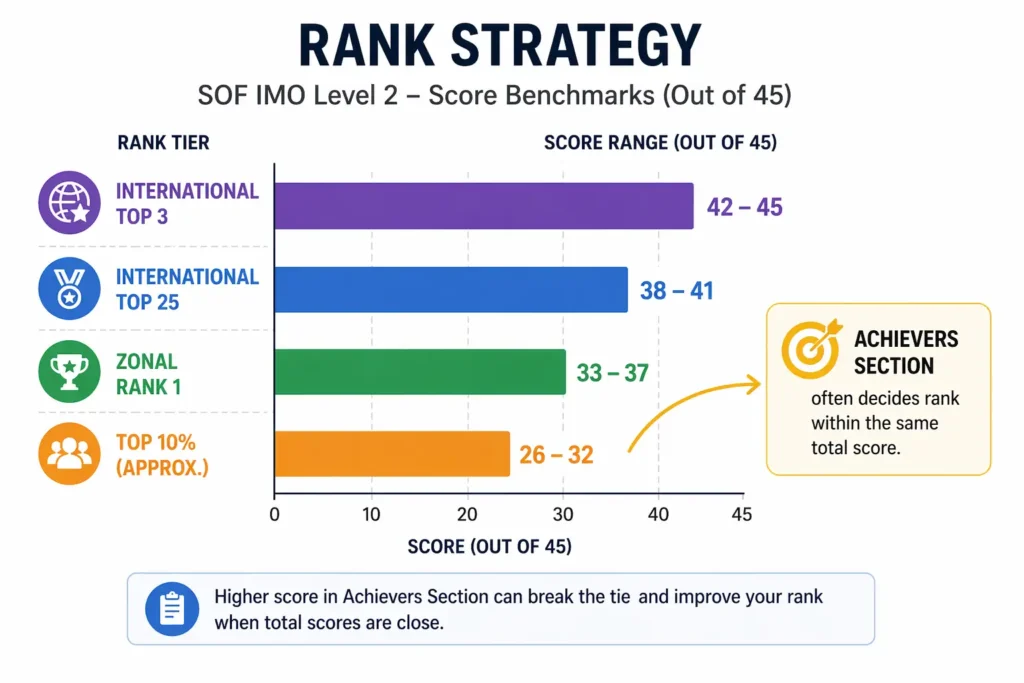
| Target Rank | Approximate Score Required (out of 45) | Key Requirement |
| International Top 3 | 40–45 | Near-perfect across all sections |
| International Top 25 | 36–40 | Strong MR + strong Achievers Section |
| Zonal Rank 1 | 33–38 | Solid all-round + at least 3/5 Achievers |
| Top 10% nationally | 28–33 | Good coverage, 2–3 Achievers questions |
These are approximate ranges. Exact cutoffs depend on the year, class, and total participant count. Treat these as planning benchmarks, not guarantees.
For official dates and eligibility details, see the complete SOF IMO 2026–27 guide.
Where rank improvement actually comes from:
Most students at Level 2 score within a tight band on the regular sections (LR, MR, EM). The students who break into top ranks do so through the Achievers Section.
Getting 4/5 instead of 2/5 on Achievers can shift you from rank 40 to rank 8. That’s the return on investment in Achievers-specific preparation.
Best Preparation Resources
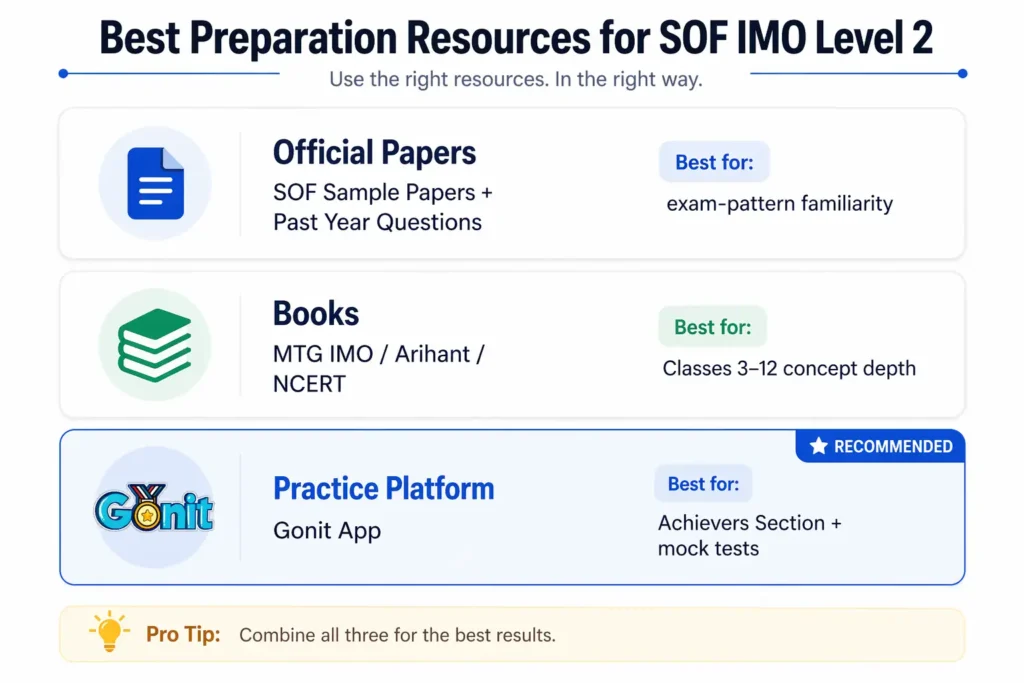
Official SOF resources (start here):
- SOF IMO sample papers — free PDF download for all classes: the most accurate practice material available, closely mirroring the real exam format and difficulty
- SOF official website (sofworld.org): past year papers, sample papers, and official syllabus
Recommended books (class-wise guidance):
- Classes 3–5: MTG IMO Workbooks, Pearson Olympiad series
- Classes 6–8: MTG IMO Level 2 previous year papers, Arihant IMO Practice Sets
- Classes 9–10: RD Sharma + MTG IMO papers (strong conceptual foundation needed)
- Classes 11–12: NCERT + additional Olympiad-level problem sets
Practice platforms:
- Gonit App: dedicated SOF IMO Level 2 practice, Achievers Section mode, mock tests with detailed analytics, topic-wise performance tracking, start free on Gonit App
- SOF Olympiad Trainer: official practice portal
Make Preparing for Math Olympiad Simple!



What is the syllabus for SOF IMO Level 2?
The SOF IMO Level 2 syllabus is the same as Level 1 for your class but tested at a higher difficulty level. It covers Logical Reasoning, Mathematical Reasoning, Everyday Mathematics, and the Achievers Section. For the exact class-wise syllabus, visit sofworld.org.
How is SOF IMO Level 2 different from Level 1?
Level 2 is restricted to the top 5% of Level 1 qualifiers, making the competition significantly more intense. Questions are harder, multi-concept, and the Achievers Section, which carries 33% of total marks, has a far greater impact on your final rank than at Level 1.
How many students qualify for SOF IMO Level 2?
SOF qualifies the top 5% of class-wise students from each country, plus the top 25 rank holders from each class in each zone. The exact number varies by year and class, but it’s a small, highly competitive cohort.
How can I score high in the Achievers Section?
Prepare the Achievers Section separately from the rest of the exam. Practice multi-concept problems that combine two or more topics. During the exam, attempt Achievers questions after completing the other three sections. Allocate 15–18 minutes for it. Getting 3–4 correct out of 5 can significantly improve your rank.
What score do I need for an international rank in SOF IMO Level 2?
Approximate benchmarks based on historical data: international top 25 typically requires 36–40 out of 45, and international top 3 requires near-perfect scores of 40–45. Exact cutoffs vary by class and year. Focus on maximizing Achievers Section performance, it’s the biggest rank differentiator.
How many mocks should I take before SOF IMO Level 2?
Aim for 6–10 full-length mocks in the 4–5 weeks before the exam. More important than the number is the analysis: review every mistake after each mock. Download free SOF IMO sample papers for all classes to use as your primary mock test source.
What are the best books for SOF IMO Level 2 preparation?
MTG IMO Level 2 previous year papers are the most widely used resource. Arihant IMO practice sets are strong for Classes 6–10. For Classes 9–12, a solid NCERT foundation plus dedicated Olympiad problem sets is the most effective combination.
Conclusion
Clearing SOF IMO Level 2 takes more than re-reading your Level 1 notes.
The students who reach international and zonal ranks do three things differently.
They treat the Achievers Section as a separate preparation track, they analyze every mock test instead of just taking one, and they know their score target before they walk into the exam hall.
Those are learnable habits, and the earlier you build them, the more marks they’re worth.
Once results are out, track your performance using our guide on SOF IMO results 2026–27.

Mikha Piregu is a Content Writer with experience spanning educational content, including math and math olympiad topics, as well as advocacy writing, research-based articles, and SEO-driven web content. He creates high-quality blog content, web copy, and feature articles that support brand visibility, audience engagement, and long-term organic growth through data-informed storytelling. Skilled in WordPress, WooCommerce, and modern digital tools, Mikha adapts content across various platforms, including blogs, websites, campaigns, and advocacy initiatives, with clarity and purpose.



There are no comments posted here yet.
Sign in to leave a comment