January 19, 2026
 9 min. read

Skip-counting activities for Class 1 are one of the best ways to help young children understand number patterns without memorisation drills.
Skip counting simply means counting in equal jumps 2, 4, 6, 8 (by 2s) or 5, 10, 15, 20 (by 5s) instead of going one by one.
Children already use skip counting every day without realising it: pairs of shoes represent counting by 2s, fingers on both hands represent counting by 5s, and ten-rupee notes or dimes show counting by 10s.
The ten activities below harness these natural connections to make skip counting feel like play.
📌 New to skip counting? Start with What is Skip Counting for Class 1 Math Students? before trying these activities.
Why Are Skip-Counting Activities Important for Class 1?
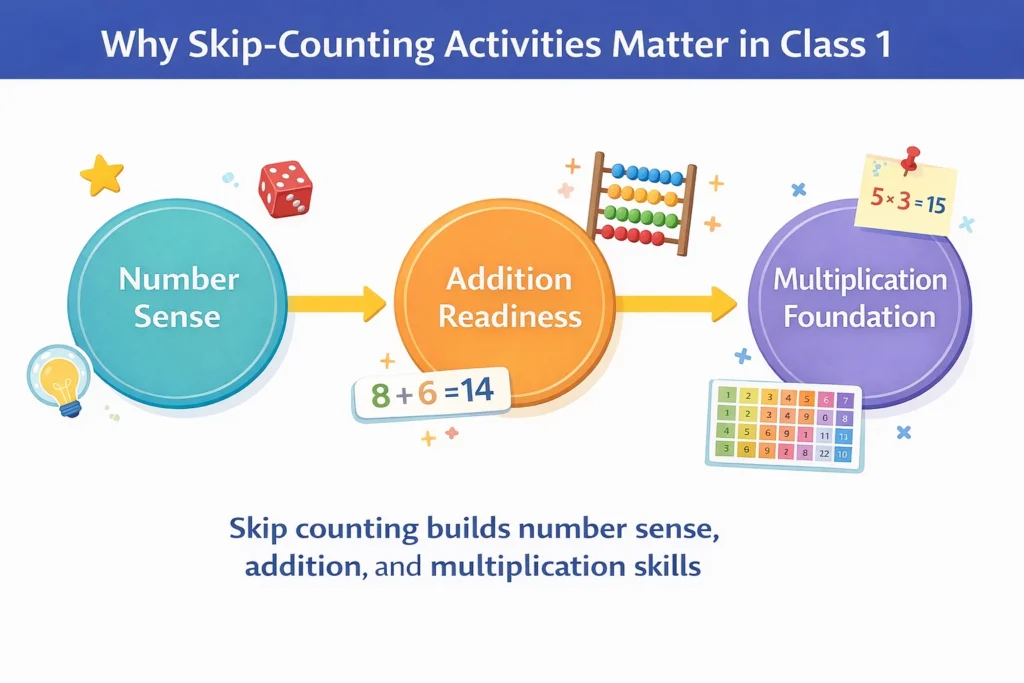
Skip-counting activities are important in Class 1 math because they transform abstract numbers into visible patterns children can see, touch, and feel. Here is what the research and classroom practice confirm:
| Skill Built | How Skip Counting Helps | Later Math Connection |
|---|---|---|
| Number sense | Children see numbers as groups (2, 4, 6 = pairs) | Place value, estimation |
| Speed & confidence | Counting large groups faster reduces frustration | Mental math, fluency |
| Addition readiness | 5 + 5 + 5 = counting by 5s | Column addition, carrying |
| Multiplication readiness | Repeated equal jumps = early multiplication | Times tables, Class 3–4 |
| Pattern recognition | Noticing even/odd, multiples | Algebra, sequences |
📌 Related: Understand the bigger picture in Why Number Sense is Important for Class 1 and What is Number Sense for Class 1?
Skip-Counting Activities Using Everyday Objects
Hands-on activities with real objects are the most effective starting point for Class 1 learners because they connect abstract numbers to something tangible.
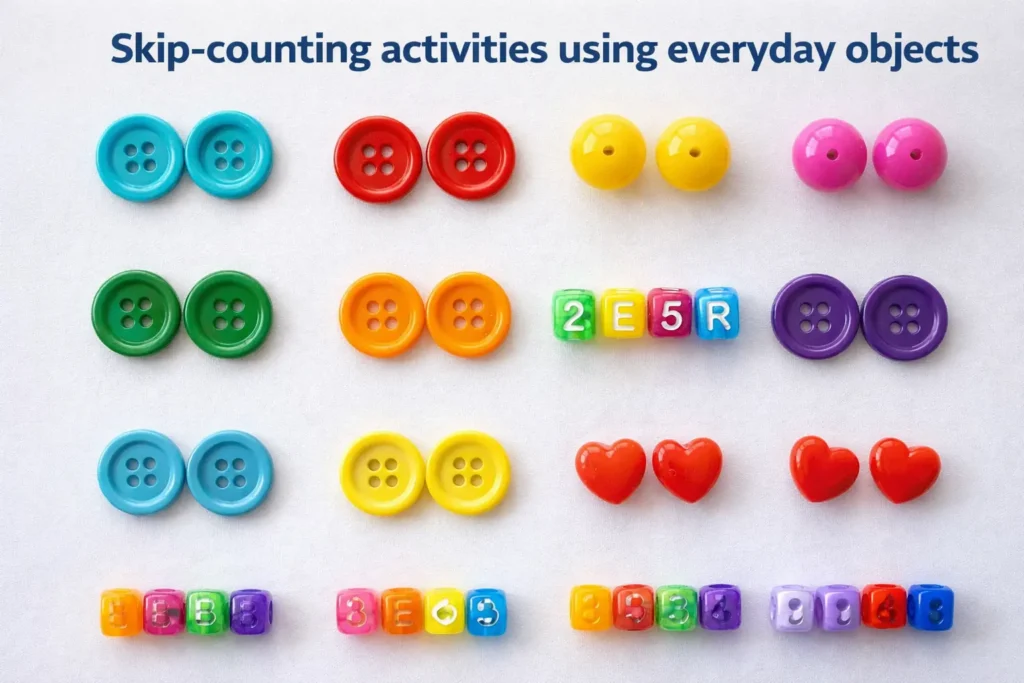
These are also the easiest activities to run at home or in a classroom with zero preparation.
Activity 1 — Touch-and-Count with Toys or Beads
How to do it: Line up 20 small objects, toys, beads, or pieces of fruit. Ask the child to touch every 2nd object while saying “2, 4, 6, 8…” aloud. Repeat for 5s and 10s once the child is confident.
Why it works: Multisensory engagement (touching + saying + hearing) strengthens memory far better than writing alone.
Activity 2 — Make Bundles and Count the Groups
- By 2s: Pair up socks, crayons, or stickers. Count only the pairs: “2 socks, 4 socks, 6 socks.”
- By 5s: Bundle craft sticks with a rubber band. Count the bundles: “5, 10, 15.”
- By 10s: Group coins or seeds into tens. Count the groups: “10, 20, 30.”
Why it works: Grouping makes the “equal jump” visual and concrete before it becomes abstract.
📌 Related: For a structured classroom approach, see How to Teach Skip Counting to Class 1 Kids and How to Write a Lesson Plan on Skip Counting for Class 1.
Fun Skip-Counting Games for Class 1
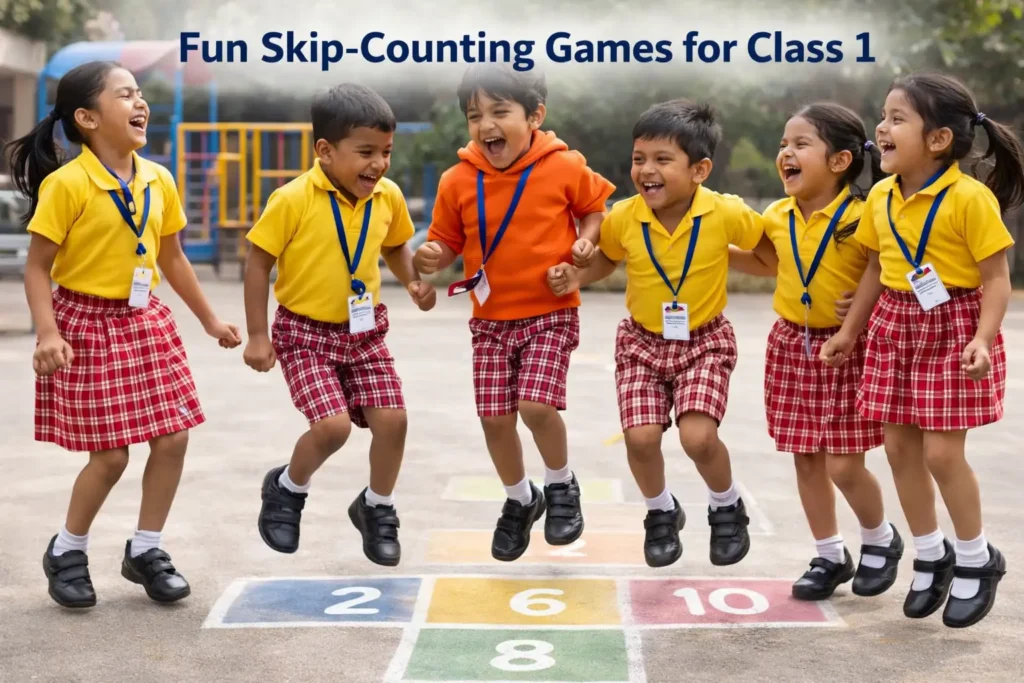
Games add competition and laughter, which makes number patterns stick. These three activities work in classrooms, after-school groups, and even on the living-room floor.
Activity 3 — Jump-and-Count Game
Children stand in a line and jump forward on each skip-count number: “2 — jump! 4 — jump! 6 — jump!” Use chalk numbers on the floor for a visual guide.
Variation: Draw a hopscotch grid with only the skip-count numbers filled in (2, 4, 6…). Children hop the blanks and land on the numbers.
Activity 4 — Clap-and-Count Rhythm Game
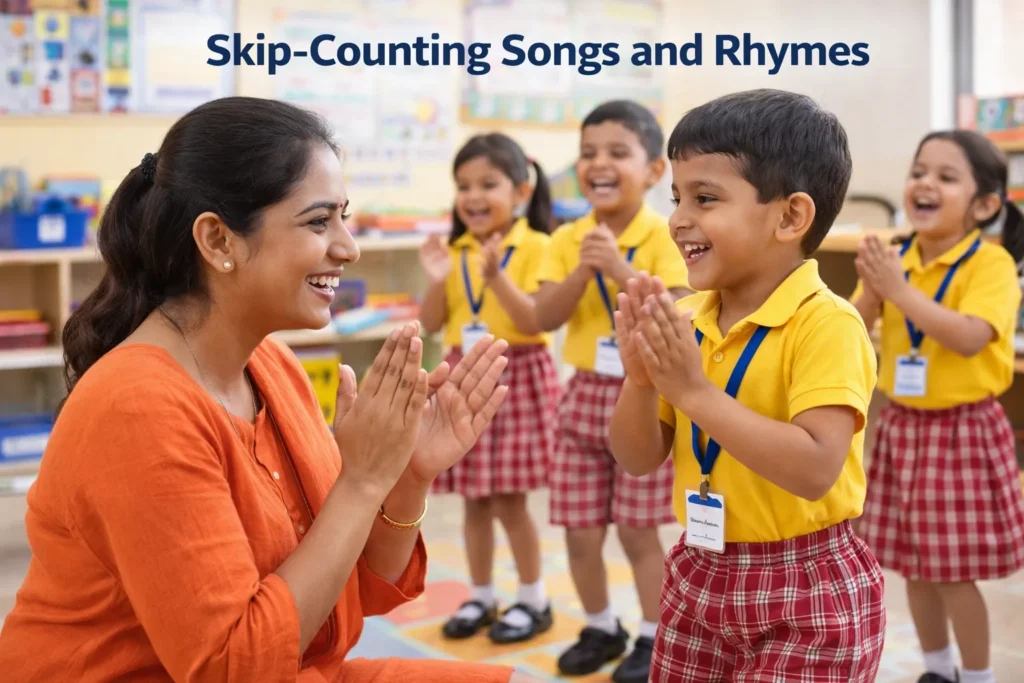
The class claps once per number — fast for 2s, medium for 5s, slow for 10s. The different rhythms help children internalise that each pattern has its own “beat.”
Variation: Alternate clapping (say the skip number) and silence (skip the ones-in-between). The contrast of sound and silence makes the pattern physical.
Activity 5 — Pass-the-Ball Counting Circle
Children sit in a circle and pass a ball, each child saying the next skip-count number (10, 20, 30…). If the ball drops, the group starts from zero. This gentle pressure improves quick recall.
Challenge mode: Start from a number other than zero (e.g., “Start at 4, count by 2s”) to build flexibility.
📌 Related: The patterns children spot in these games connect directly to Ascending and Descending Order Maths for Class 1 and Number Ordering for Class 1.
Skip-Counting Activities Using a Number Line
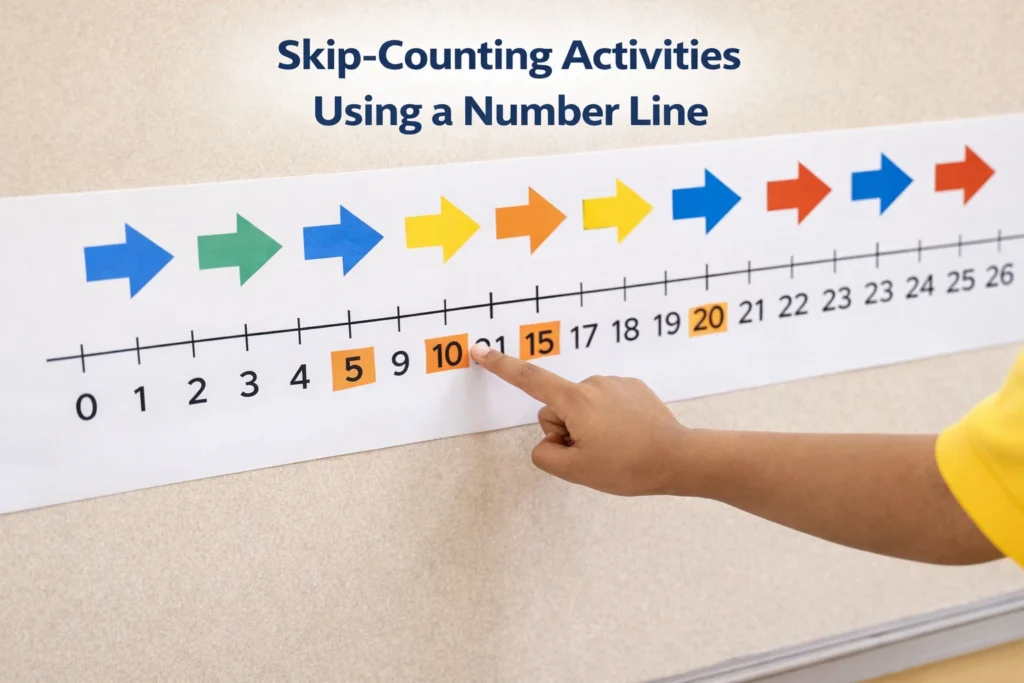
A number line turns skip counting from an audio exercise into a visual one. Children can see the equal jumps, which is crucial for those who struggle to grasp the pattern through chanting alone.
Activity 6 — Forward Jumps on the Number Line
Draw (or tape) a 0–30 number line on the floor or whiteboard. Children start at 0 and make equal jumps, pointing to each landing number: “0 → 2 → 4 → 6.”
Visual tip: Colour the landing numbers (e.g., every 5th number in orange). This lets children see the rhythm of the pattern without counting every step.
Activity 7 — Blank Number Line Fill-In
Give children a printed number line with the skip-count numbers blanked out. Children must fill in the missing numbers by continuing the pattern.
For example: 0, __, 4, __, 8, __, 12 (counting by 2s). This bridges visual and written practice.
📌 Related: If children are still learning what a number line is, see Number Line for Class 1. For drawing one yourself, follow Steps to Draw a Number Line for Class 1 Maths.
Skip-Counting Songs and Rhymes for Class 1
Music engages a different part of the brain than rote counting. When children attach a skip-count sequence to a familiar melody, they can recall it more easily because it is stored as both language and music memory.
Activity 8 — Counting by 2s Song (to “Twinkle Twinkle”)
Use the familiar tune of Twinkle, Twinkle, Little Star to make the even numbers memorable:
“2, 4, 6, 8, 10, we count by twos today,
12, 14, 16, 18, 20 — let’s all count and play!”
Children can clap on each number. This also introduces the concept of even numbers naturally, which links to later work on addition and subtraction for Class 1.
Activity 9 — Counting by 5s and 10s Chants
Chants work especially well for 5s and 10s because the rhythm is very regular:
- By 5s: “5, 10, 15, 20 — fingers high we go!” (Raise a finger on each number.)
- By 10s: “10, 20, 30, 40 — counting tens is fun!” (Stamp a foot on each number.)
These rhythmic patterns are the direct predecessor of the times tables children will learn in Class 3–4, particularly multiplication foundations for Class 1.
Everyday Life Skip-Counting Activities
The most powerful learning happens when children realise that skip counting is not just a classroom exercise it is something they already do in real life.
These daily-routine activities take less than two minutes each.
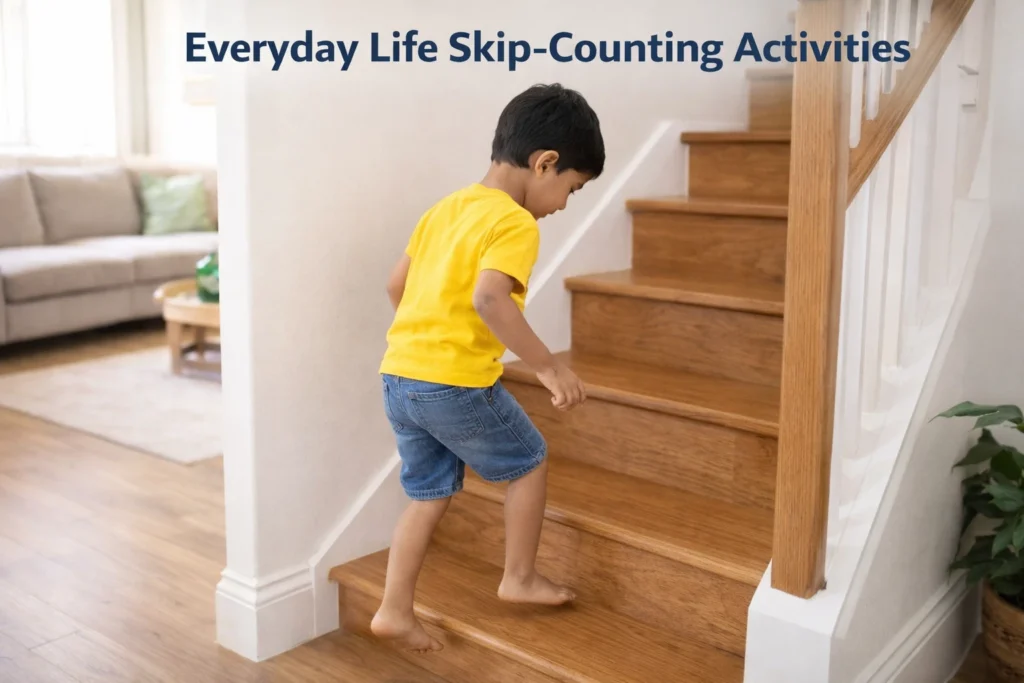
Counting Stairs Two at a Time
Climb stairs by taking two steps at once and saying “2, 4, 6, 8” aloud. The physical action directly mirrors the “jump” on a number line.
Kitchen Math: Plates, Cups, and Spoons
While setting the table or tidying up, stack plates in pairs (“2 plates, 4 plates, 6 plates”) or count cutlery in groups of five. These small moments add up to dozens of repetitions across the week.
Counting Books or Crayons Before Bed
Pick up 20 crayons and place them in groups of 5 on the way to the box: “5, 10, 15, 20 — done!” Tidying becomes a math exercise without any extra effort.
📌 Related: These everyday experiences build the number-sense foundation described in Number Sense Characteristics for Class 1.
Skip-Counting Worksheets and Charts
After children are comfortable with physical and auditory activities, written practice reinforces and assesses their understanding. Worksheets should follow active activities never replace them.
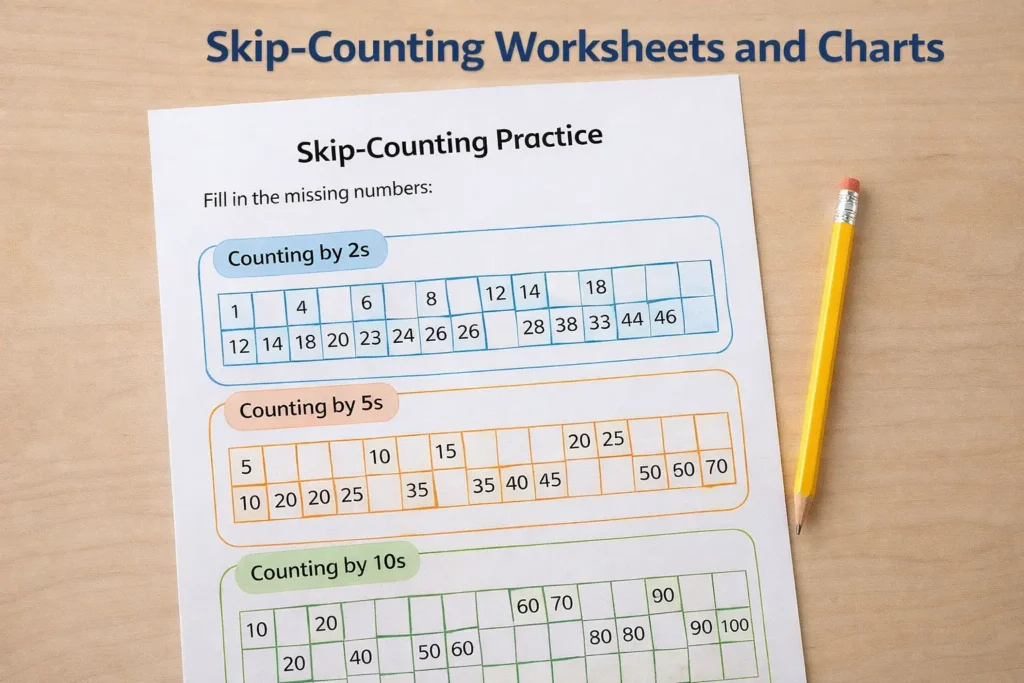
Effective Class 1 skip-counting worksheets include:
- Fill-in-the-blank number lines — e.g., 0, 2, __, 6, __, 10
- Colour-the-pattern grids — 100-chart where children colour every 5th number
- Connect-the-dots — only the skip-count numbers are used as dot numbers (2, 4, 6, 8…)
- Word problems — “You have 4 bags of 5 apples. How many apples altogether?” (introduces skip-counting as multiplication)
📌 Related: Connect this written practice to What is the Number Sequence for Class 1 Maths? and How to Teach Number Sequences to Class 1 Students.
Tips for Teachers and Parents
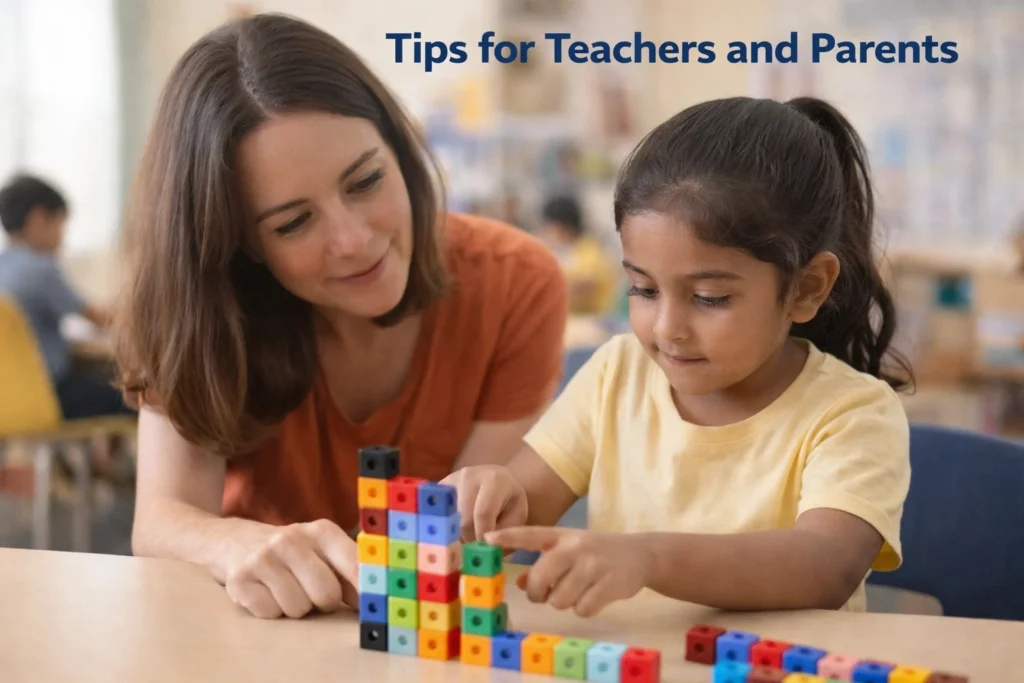
⏱ Keep sessions short (5–10 minutes). Young children’s attention spans are 10–15 minutes at best. Daily micro-sessions of 5–10 minutes are more effective than a single 30-minute lesson each week.
🎉 Praise the process, not just the answer. Say “You spotted the pattern great work!” rather than “Right answer.” Effort-focused praise builds a growth mindset and makes children more willing to try again after mistakes.
🧩 Master one pattern before introducing the next. Spend at least three days on counting by 2s before introducing 5s. Use a different colour, movement, or song for each pattern so children can tell them apart clearly.
🔁 Recycle activities across different skip patterns. Once children know the Jump-and-Count game for 2s, they can immediately play it for 5s and 10s without relearning the rules. This reduces cognitive load and increases practice time.
📊 Use diagnostic questions. Ask “What comes after 15 when we count by 5s?” before and after a week of practice. Progress that children can see themselves is a powerful motivator.
📌 Related: These strategies align with the broader approach in Number Sense Teaching Strategies for First Graders.
What is skip counting, and why is it taught in Class 1?
Skip counting means counting in equal jumps, such as 2, 4, 6, 8 (by 2s) instead of 1, 2, 3, 4. It is taught in Class 1 because it builds number sense, speeds up mental math, and prepares children for addition, subtraction, and multiplication in later years.
Which skip-counting pattern should children learn first?
Most educators recommend teaching counting by 2s first because children already encounter pairs (shoes, socks, hands) daily. After 2s are confident, move to 5s (fingers on one hand) and then 10s (both hands, or coins/notes).
How long does it take a Class 1 child to learn skip counting?
With 5–10 minutes of daily practice, most Class 1 children become comfortable counting by 2s within one to two weeks. Counting by 5s and 10s typically follow within another two to three weeks each.
Can skip counting help children learn their times tables?
Yes. Counting by 2s is the 2× table; counting by 5s is the 5× table; counting by 10s is the 10× table. Children who are fluent skip counters have a significant head start when formal multiplication is introduced. See multiplication for Class 1 for more.
What is the difference between skip counting and forward/backward counting?
Forward counting goes up by 1 each time (1, 2, 3, 4…) and backward counting goes down by 1 (10, 9, 8…). Skip counting goes up or down by a number greater than 1 (e.g., 2, 4, 6 or 10, 8, 6). For the basics of forward and backward counting, see How to Teach Forward and Backward Counting to Kindergarten.
Make Preparing for Math Olympiad Simple!



Final Thought
The ten skip-counting activities above, from grouping socks by 2s to passing a ball while chanting by 10s all share one principle: learning is fastest when children move, sing, touch, and laugh while they count.
Start with one activity that matches your child’s or class’s energy level. Keep sessions to 5–10 minutes, praise the effort, and add variety once a pattern is mastered.
Within a few weeks, children will be skip-counting fluently and without realising it, they will already be doing early multiplication.
For a fully structured approach, explore the complete skip-counting lesson plan for Class 1 or browse all Class 1 math resources on the Gonit blog.