 January 24, 2026
 9 min. read

Why is backward counting important for Class 1 is a question that matters far more than it might initially appear.
Backward counting is not simply forward counting in reverse.
It develops subtraction understanding, number magnitude intuition, and the bidirectional number sense that makes all subsequent arithmetic feel coherent rather than arbitrary.
Children who count forward fluently but not backward have a one-directional understanding of numbers.
For the complete picture of what it is and how to teach it, see backward counting for Class 1.
For the number sense foundations it builds on, see number sense for Class 1. This guide focuses specifically on why it matters.
Reason 1: It Is the Conceptual Foundation of Subtraction
The single most important reason backward counting matters in Class 1 is its direct and complete alignment with what subtraction means as a mathematical operation.
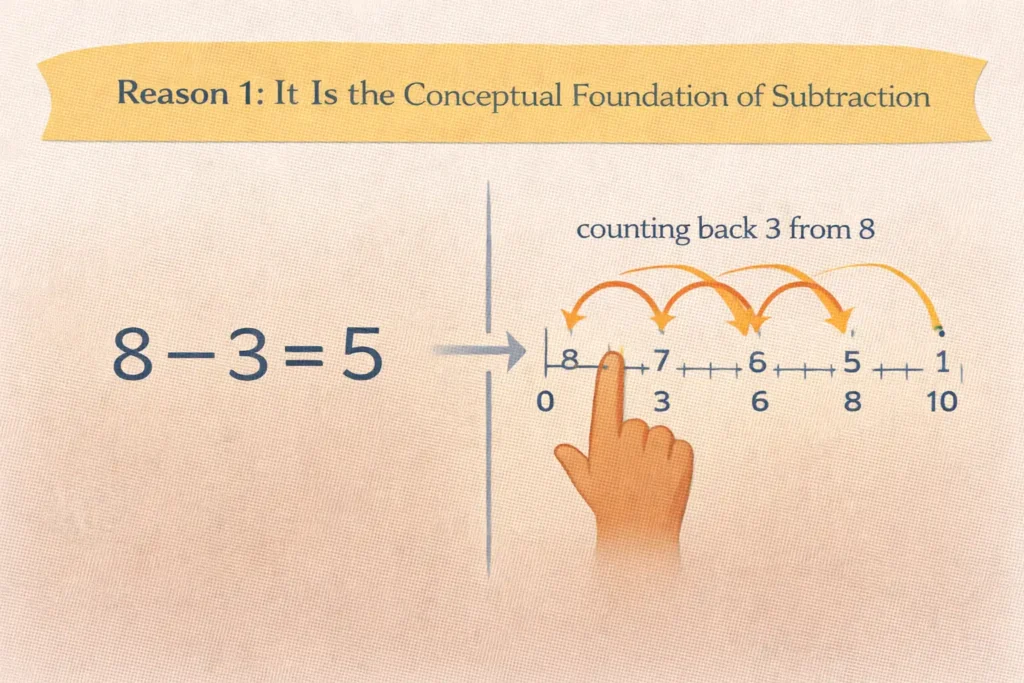
Subtraction is not an abstract rule; it is the act of starting with a quantity and reducing it by a specified amount. Backward counting is that exact act, performed step by step.
When a child counts backward from 8 three steps — 8, 7, 6, 5 — they have just solved 8 − 3 = 5 without needing to know what the subtraction symbol means.
The operation has happened through the counting sequence itself. This is what mathematics educators call the “counting back” strategy, and it is the most natural and reliable early subtraction method available to Class 1 children.
The consequence of weak backward counting for subtraction learning is direct and measurable. Children who cannot count backward fluently from any starting point within 20 consistently struggle with early subtraction problems — not because they lack mathematical ability, but because they lack the counting tool that makes subtraction intuitive. They must instead rely on memorized facts or procedures they do not understand, which produce errors and anxiety rather than fluent mathematical thinking.
This connection makes backward counting fluency the most critical prerequisite for the subtraction concepts explored in addition and subtraction for Class 1. No other single skill predicts subtraction readiness in Class 1 as reliably as backward counting fluency from varied starting points.
Reason 2: It Builds Bidirectional Number Sense
Number sense is not complete when numbers are only understood as increasing.
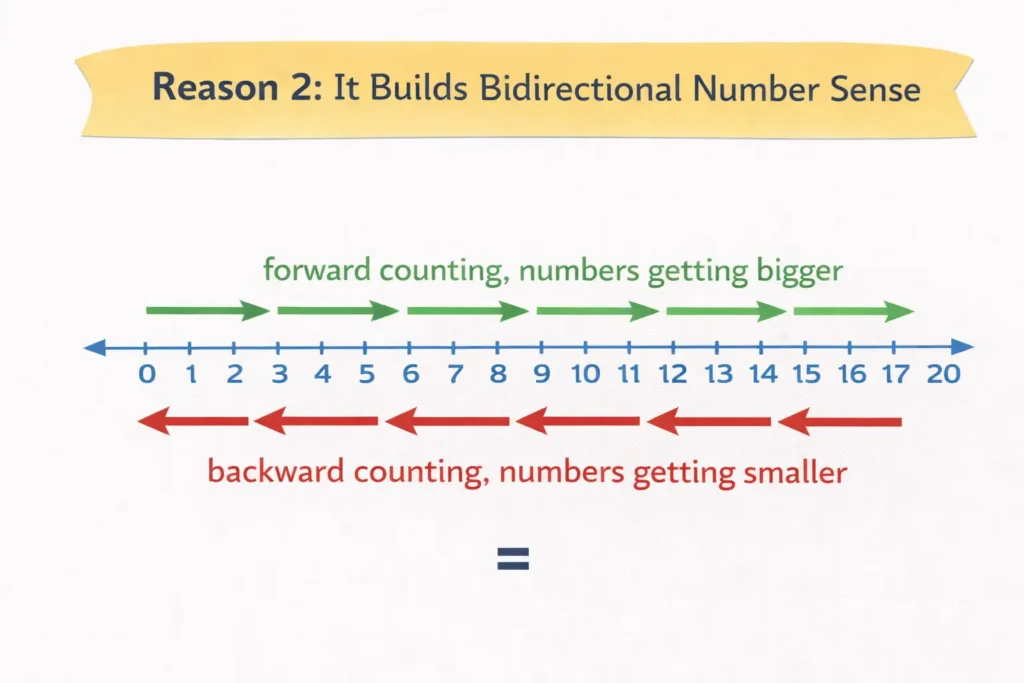
A child with genuine number sense understands that numbers can move in both directions, increasing when more is added, decreasing when something is taken away, and can reason about both directions with equal fluency.
Backward counting is what develops this bidirectional fluency. A child who has practised backward counting extensively from varied starting points has an internal mental number line that runs in both directions.
They know that 7 is to the left of 9 as confidently as they know 9 is to the right of 7. They can answer “what is one less than 8?” as quickly as “what is one more than 8?” This symmetry of understanding is what genuine number sense looks like.
Children who only have forward counting fluency have a one-directional internal number line.
They can find numbers larger than a given value quickly, but struggle with numbers smaller a gap that shows up in comparison problems, ordering tasks, and any subtraction or estimation activity.
The five characteristics of number sense that backward counting contributes to are detailed in characteristics of number sense class 1.
The full importance of number sense development is covered in why number sense is important for class 1.
Reason 3: It Enables Number Line Navigation in Both Directions
The number line is the foundational visual tool of Class 1 mathematics for counting, ordering, comparing, adding, and subtracting.
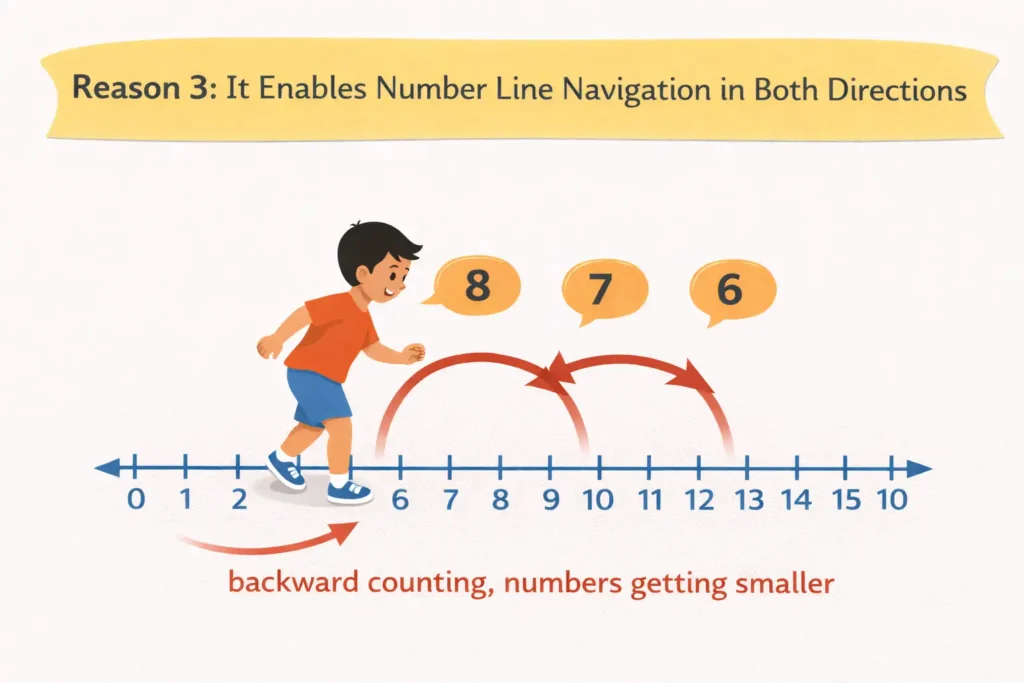
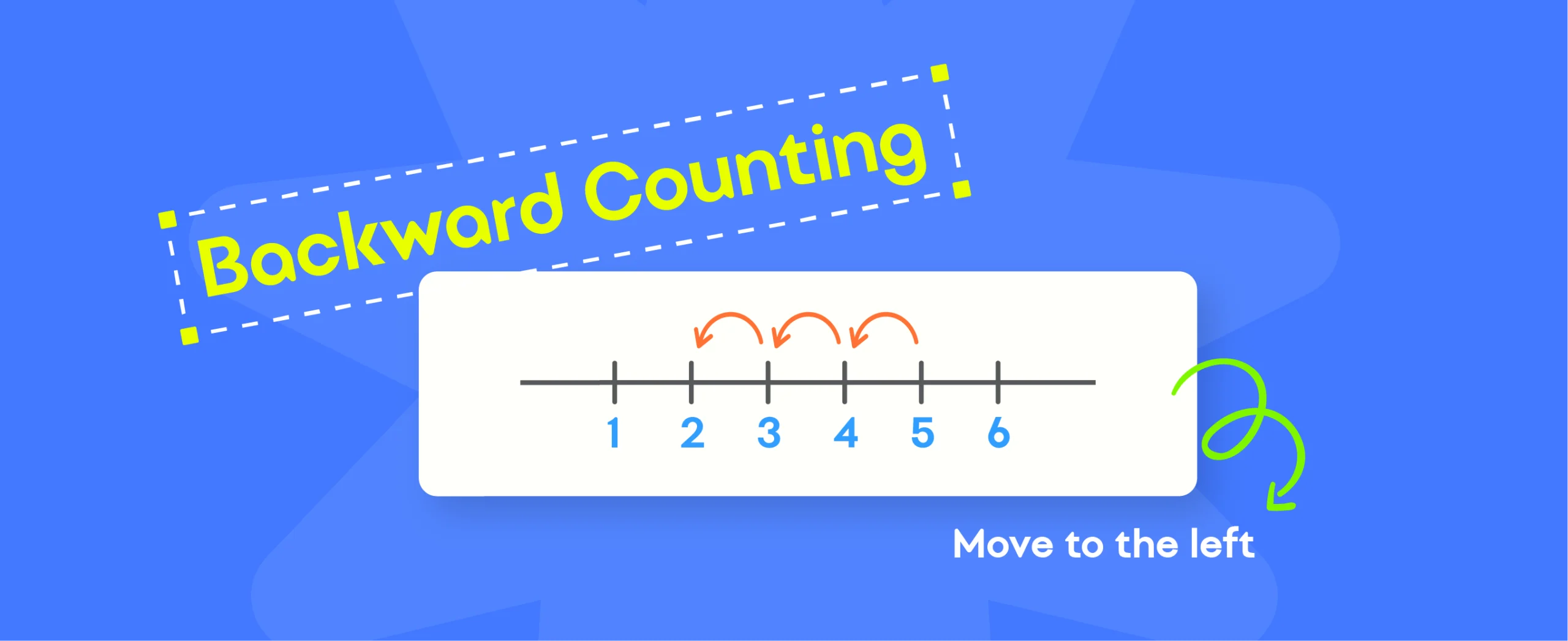
But the number line only fully functions as a bidirectional thinking tool when children can navigate it confidently in both directions. A child who can only move right (forward counting) is using half a number line.
Backward counting fluency gives children the ability to move left on the number line with the same confidence as moving right.
This bidirectional navigation is the visual foundation for subtraction as leftward movement, the most consistent and mathematically accurate representation of what subtraction means spatially.
It also supports the number position understanding that underpins all comparison work.
A child who can count backward from any point can immediately locate “one less,” “two less,” or “five less” from any position on the number line.
Which is precisely the skill that the position and comparison activities in number positions on a number line class 1 develop.
Reason 4: It Directly Supports Descending Order Understanding
Descending order, arranging numbers from largest to smallest, is one of the two ordering directions every Class 1 child must master. And descending order is, at its core, backward counting applied to an arrangement task.
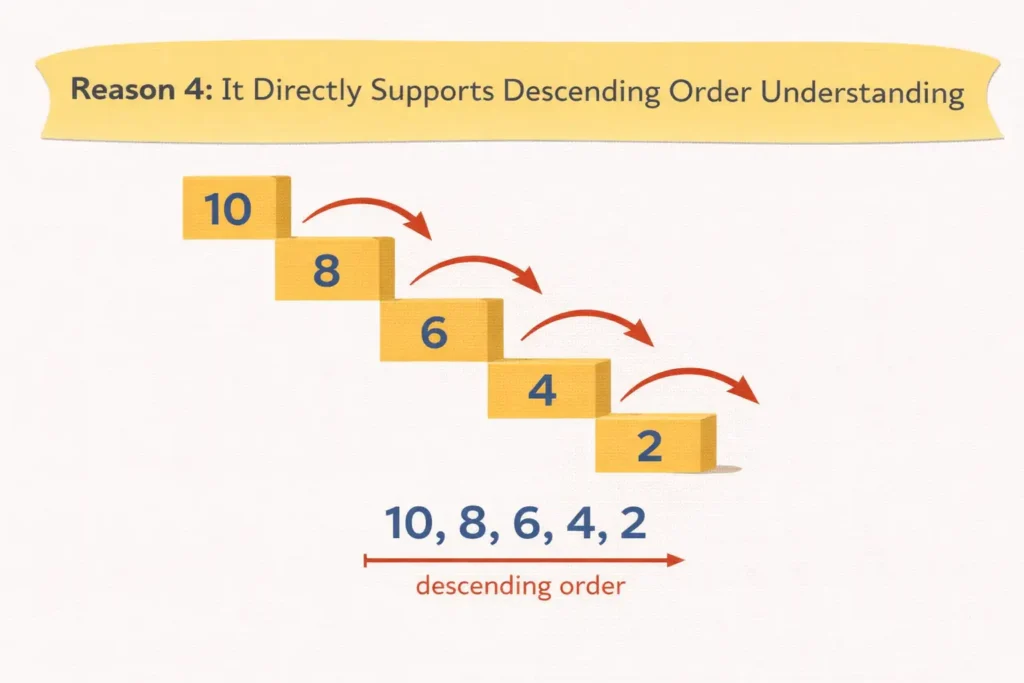
When a child arranges 8, 3, 6, 1 in descending order as 8, 6, 3, 1, they are applying exactly the “each number is smaller than the one before it” principle that backward counting develops.
Children with strong backward counting fluency find descending order tasks natural, they are simply applying a direction they already understand.
Children with weak backward counting fluency consistently struggle with descending order because they have no intuitive feel for the direction of decreasing numbers.
The full ordering curriculum that this supports, including ascending and descending order, ordering rules, and ordering examples, is covered in ascending and descending order in maths class 1 and number ordering for class 1.
Reason 5: It Develops Mental Arithmetic Flexibility
Mental arithmetic, solving mathematical problems without physical objects or written working, requires the ability to hold numbers in mind and manipulate them flexibly.
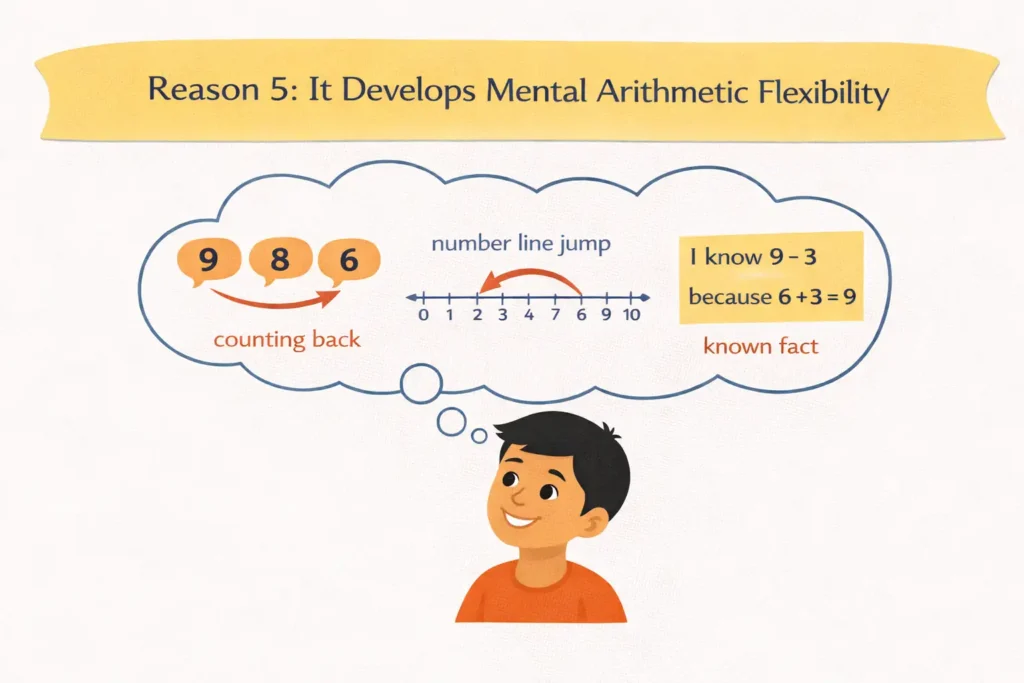
Backward counting is the primary mental flexibility tool available to Class 1 children, and fluency with it dramatically expands the range of problems children can solve mentally.
A child who can count backward fluently from any starting point can solve simple subtraction problems in their head: “9 − 4? Count back 4 from 9: 9, 8, 7, 6, 5. Answer: 5.”
This mental backward count can happen quickly and reliably once the counting sequence itself is automatic, freeing cognitive capacity to focus on understanding the problem rather than executing the counting procedure.
This mental arithmetic flexibility is the same flexibility explored in Characteristic 5 of the characteristics of number sense class 1.
The ability to think flexibly with numbers and choose efficient strategies based on the specific values involved. Backward counting fluency is one of its earliest and most reliable foundations.
Reason 6: It Prepares Children for Backward Skip Counting
Skip counting counting in equal jumps, is one of the most important Class 1 skills, building directly toward multiplication understanding. But skip counting is not just a forward activity.
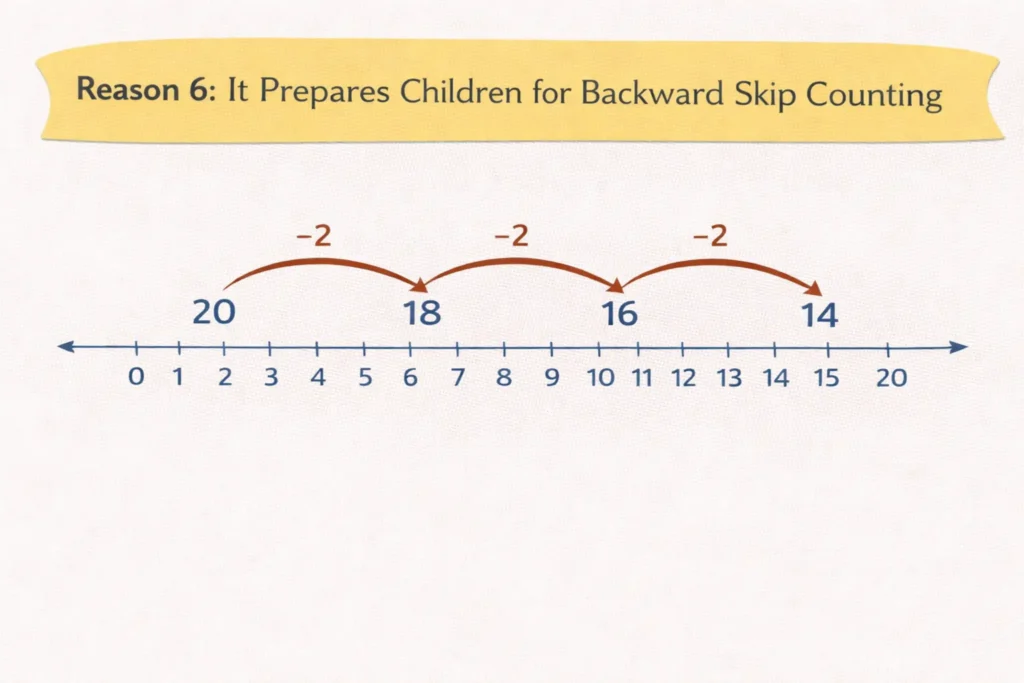
Backward skip counting (counting back by 2s, 5s, or 10s) directly develops subtraction fluency with larger numbers and reinforces the equal-step structure that makes skip counting mathematically meaningful.
A child who has not developed fluent backward counting by 1s will struggle with backward skip counting. The direction and the “getting smaller” concept must be secure before equal jumps in that direction can be introduced.
This is why backward counting fluency is a prerequisite for the skip counting development covered in skip counting for class 1 and the teaching methodology in how to teach skip counting to class 1 kids.
Reason 7: It Builds Cognitive Skills Beyond Mathematics
Beyond the direct mathematical benefits, backward counting develops cognitive skills that transfer across all learning areas.
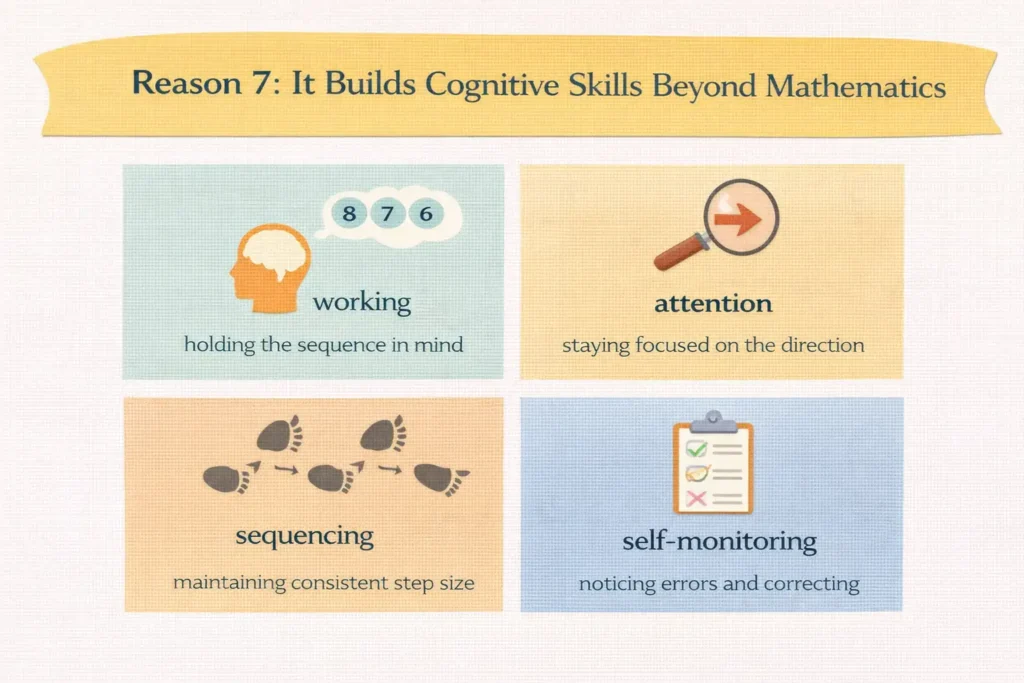
This is why early mathematics educators consistently note that children who master backward counting show improvements not just in mathematics but in language, reading, and general academic performance.
Working memory — backward counting requires holding the current position in the sequence while simultaneously computing the next number. This working memory demand is higher than forward counting and builds the same cognitive capacity that reading comprehension requires.
Sustained attention — backward counting requires continuous focused attention to avoid errors (skipping numbers, switching direction, repeating values). The sustained attention practice it provides transfers to any task requiring careful, step-by-step execution.
Sequencing ability — maintaining a consistent step size in a decreasing direction develops the sequencing cognition that underlies procedural mathematics, logical reasoning, and narrative understanding.
Self-monitoring — children who practise backward counting regularly develop the habit of checking whether each number is one less than the previous, which is an early form of mathematical self-correction that serves them throughout their education.
These cognitive benefits make backward counting practice more than a mathematics activity — it is one of the most effective cognitive development tools available in the Class 1 curriculum. The number sense teaching methodology that maximises these benefits is in number sense teaching strategies for first graders.
When Is a Child Ready for Backward Counting?
Backward counting readiness depends on specific counting skills, not age alone. A child is ready to begin backward counting when they can:
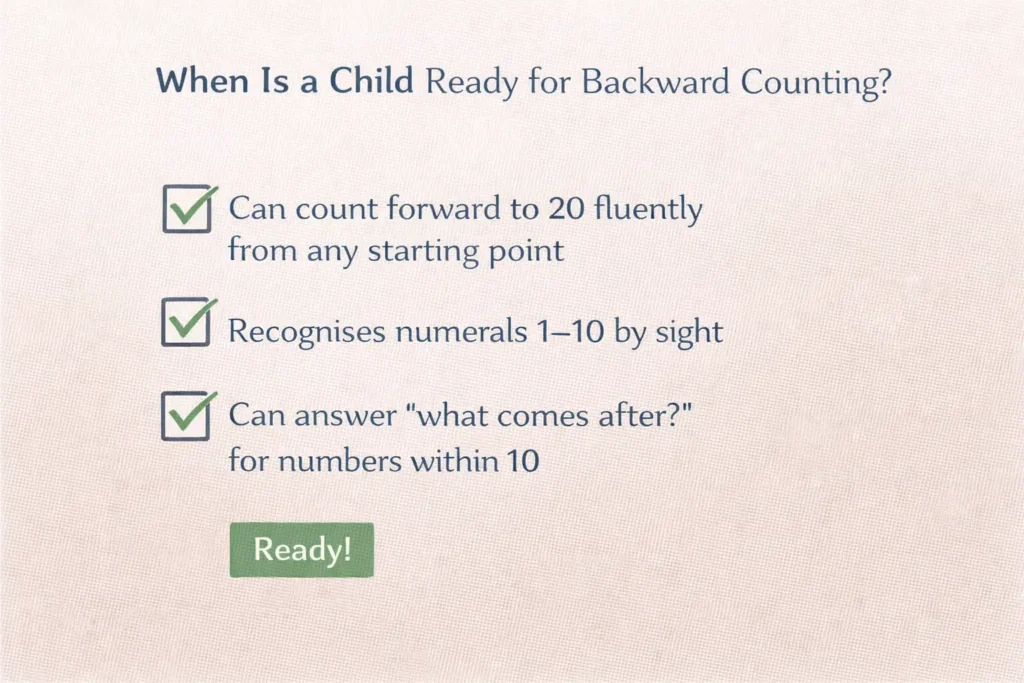
- Count forward to 20 fluently from any starting point (not just from 1)
- Recognize numerals 1–10 by sight without counting up to them
- Answer “what comes after?” for numbers within 10 without hesitation
Children who meet these three criteria are ready to begin backward counting from 5 to 1, extending to 10 once 5-to-1 is fluent, and to 20 once 10-to-1 is fluent.
The progression takes 3–6 weeks of daily short practice (5–10 minutes) for most Class 1 children. The number sequence development that supports this readiness is detailed in what is the number sequence for class 1 maths.
What happens if backward counting is not taught in Class 1?
Children who do not develop backward counting fluency in Class 1 typically struggle with subtraction throughout primary school, not because subtraction is inherently difficult, but because they lack the intuitive counting-back tool that makes it accessible. They rely on memorized procedures that break down with larger numbers and non-routine problems. The gap compounds as mathematics becomes more demanding in later years.
How much daily practice does backward counting need?
Research in early mathematics education supports short, daily practice rather than occasional longer sessions. Five to ten minutes of backward counting daily across countdown games, object removal activities, and number line hops produces significantly faster fluency development than weekly longer sessions. The key is consistency and variety rather than duration.
How does backward counting connect to competition mathematics?
Counting back, sequence completion in descending order, and “what comes before?” reasoning appear regularly in Class 1 competition problems. Children with fluent backward counting ability approach these problems naturally and quickly. The IMO syllabus for class 1 covers the full range of number topics assessed at this level, and backward sequence reasoning features prominently in multiple problem categories.
Make Preparing for Math Olympiad Simple!



Conclusion
Backward counting matters for Class 1 across seven interconnected areas.
Subtraction understanding, bidirectional number sense, number line navigation, descending order fluency, mental arithmetic flexibility, backward skip counting preparation, and cognitive skills that transfer beyond mathematics.
No other single Class 1 skill delivers such broad developmental returns. Every minute invested in genuine backward counting fluency pays back across all of these areas simultaneously.
For the complete teaching guide, see backward counting for Class 1.
For the number sense foundations it builds, see number sense for Class 1.
For the competition mathematics pathway, see the IMO syllabus for Class 1.