

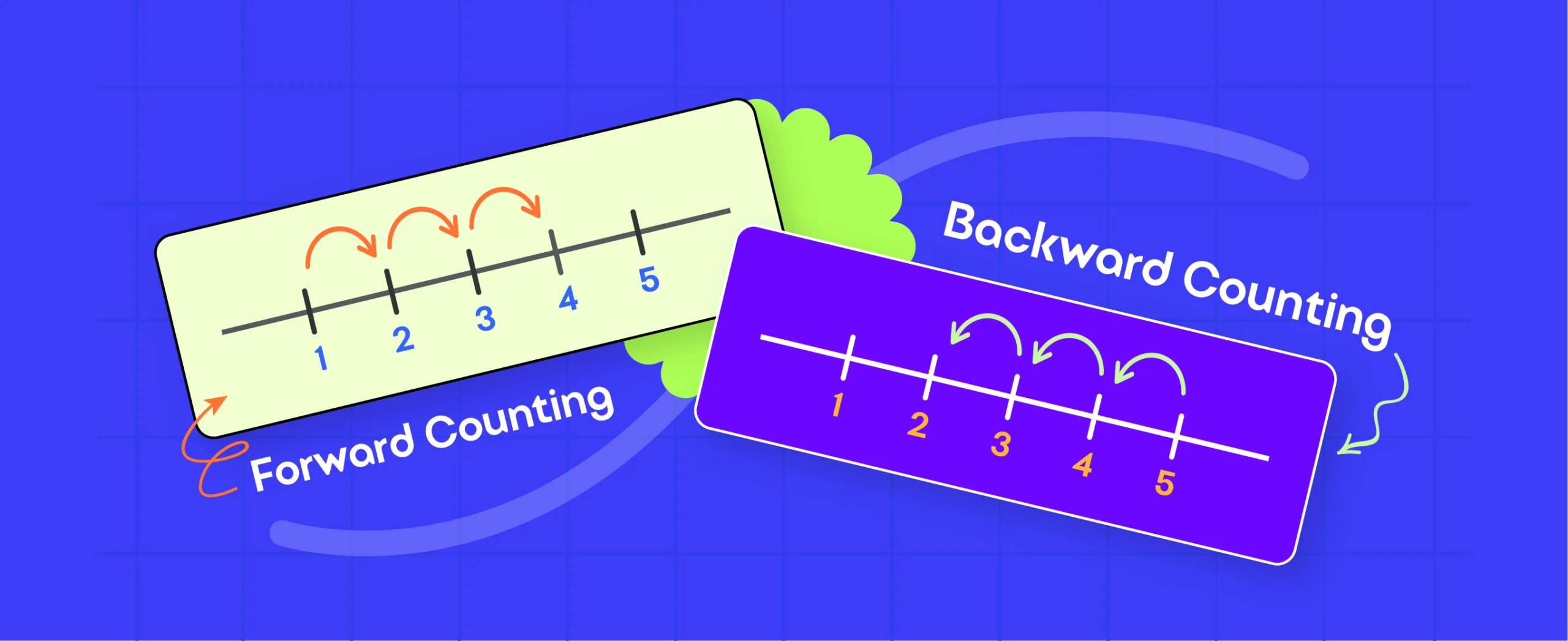
How to teach forward and backward counting to kindergarten is one of the foundational questions in early childhood mathematics and the answer differs for each direction.
Forward counting develops naturally through songs and daily life. Backward counting must be deliberately taught.
That distinction matters enormously. Children taught backward counting through rote chanting can recite the sequence, but cannot use it flexibly.
Children taught through a physical, step-by-step approach develop genuine bidirectional number sense that makes all subsequent mathematics more intuitive.
For the foundations both directions build on, see number sense for Class 1 and backward counting for Class 1.
This guide covers the complete teaching sequence, activities, visual tools, and the most common errors to fix.
Readiness: When Are Kindergarten Children Ready to Learn?
Teaching counting before children are ready produces frustration rather than fluency. Three specific readiness indicators tell you a child is ready to begin:
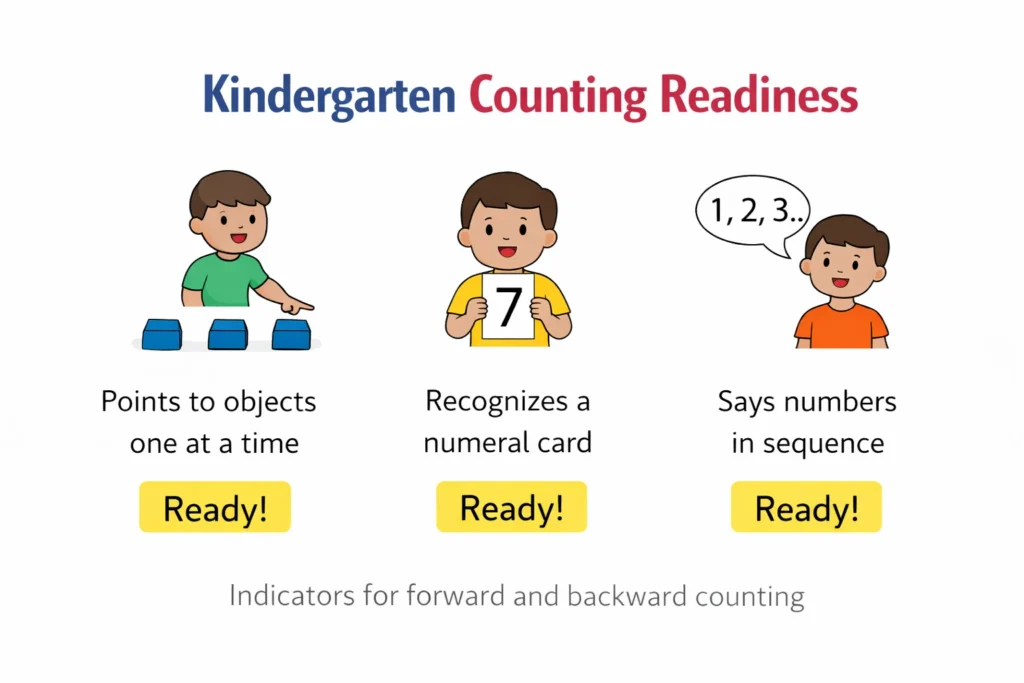
One-to-one correspondence — the child can touch each object in a group exactly once while saying one counting word per object, without double-touching or skipping.
This is the foundational counting skill that all subsequent counting builds on.
Numeral recognition — the child can identify written numerals 1–5 (extending to 1–10 as counting develops). Without numeral recognition, number line work and written activities have no meaning.
Oral number sequence recall — the child can say numbers in forward order to at least 5 without skipping. This sequence knowledge is the prerequisite for using that sequence in both directions.
Forward counting readiness develops before backward counting readiness. Do not introduce backward counting until forward counting to 10 is fluent and automatic.
A child who is still shaky on forward counting will find backward counting overwhelming and discouraging.
The typical kindergarten progression is forward counting to 5 (early term), forward to 10 (mid-term), backward from 5 (mid-to-late term), backward from 10 (late term to early Class 1).
The number ordering and sequencing foundations that readiness prepares children for are explored in number ordering for class 1 and the sequence development in what is the number sequence for class 1 maths.
Teaching Forward Counting: Step-by-Step Approach
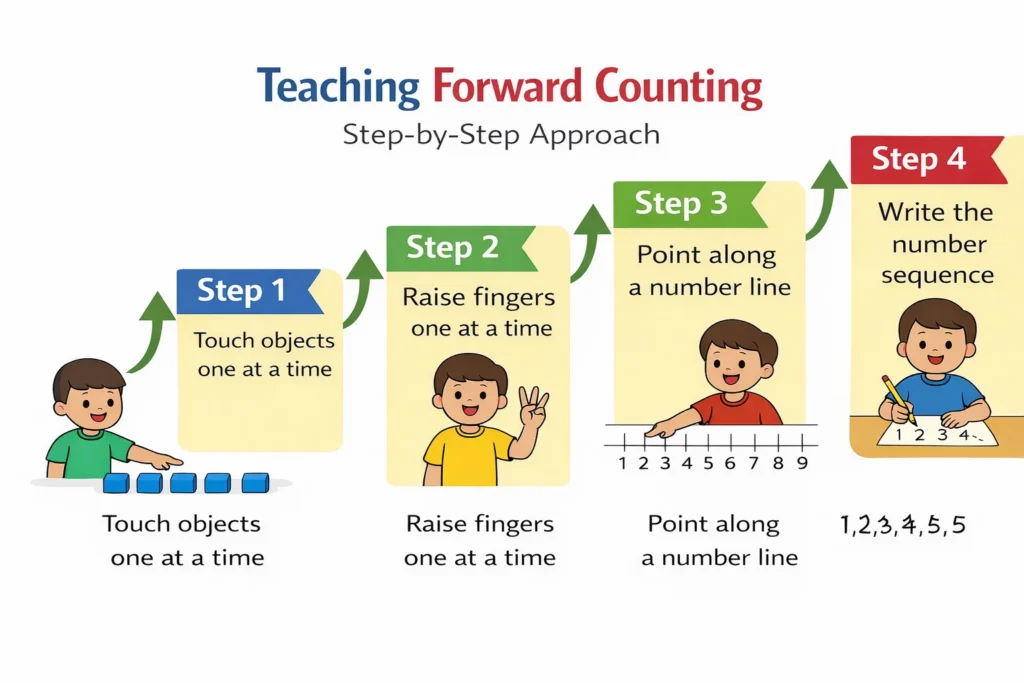
Step 1: Count Real Objects (Concrete)
Always begin with physical objects children can touch. Place 5 objects in a line. Model touching each object one at a time while counting aloud: “1 (touch), 2 (touch), 3 (touch), 4 (touch), 5 (touch). There are 5!”
The critical teaching point here is the moment of stopping children must understand that the last number said tells us “how many.” Counting to 5 and then immediately saying “there are 5!” explicitly teaches this concept.
It is not obvious to young children without this demonstration.
Lesson script: “Let’s count these bears together. I’ll touch each one and you say the number. Ready? (touch) — children say ‘1!’ (touch) — ‘2!’ Let’s keep going…”
Step 2: Finger Counting (Concrete — Self-Referencing)
Fingers are the most portable and always-available counting tool. Raise one finger at a time while counting: “1 (raise), 2 (raise), 3 (raise)…”
The fingers provide a visual and physical record of the count that the child can always see.
Extend to counting forward from various starting points — not just from 1. “Start with 3 fingers up. Count forward: 3, 4, 5, 6, 7.” This counting-on ability is the precursor to all addition strategies.
Step 3: Number Line Navigation (Representational)
Display a 0–10 number line at child’s eye level, touchable, not merely decorative. Model pointing to each number while counting forward, moving right along the line. Children copy the movement.
Key language to establish firmly: “When we count forward, we move to the right. Numbers get bigger as we go right.” This directional convention must be taught explicitly; it is not intuitive.
The complete number line teaching approach that extends this foundation is in how to teach number line maths class 1.
Step 4: Written Sequences (Abstract)
Written sequence work comes last — after object counting and number line work are fluent.
Simple fill-in-the-blank exercises (“1, 2, __, 4, 5”) or connect-the-dot activities provide the written practice that consolidates oral and physical counting into a permanent representational skill.
Teaching Backward Counting: Step-by-Step Approach
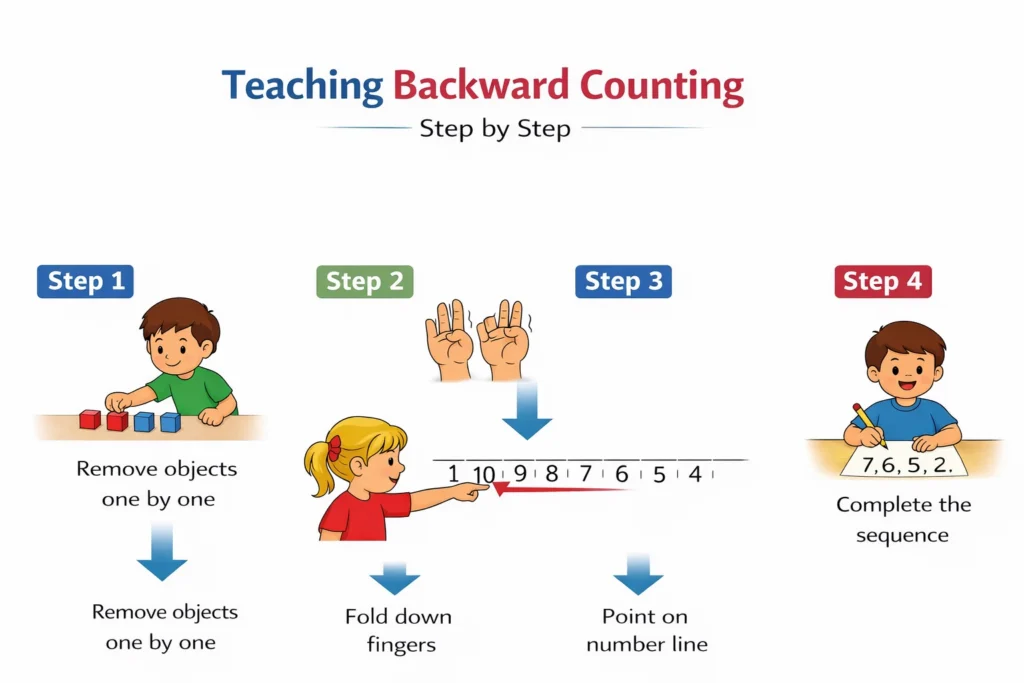
Step 1: Object Removal (Concrete — “One Less” Made Physical)
Backward counting must be grounded in the physical experience of removing objects — not just reversing a verbal sequence.
The conceptual core of backward counting is “one less each time,” and this is most powerfully understood through actually removing one object and counting what remains.
Lesson script: “I have 5 blocks. Watch — I take one away. How many now? Let’s count: 4. I take another away. How many? 3. We’re counting backward — the number gets smaller each time.”
This object-removal approach makes the “one less” concept physically real before any number sequence is introduced.
Children who have this physical experience find backward counting sequences far more intuitive than those who learned the sequence as a chant.
Step 2: Finger Folding (Concrete — Self-Referencing)
Start with all 5 (or 10) fingers extended. Fold one down at a time while counting backward: “5 (fold), 4 (fold), 3 (fold), 2 (fold), 1 (fold).” T
he diminishing number of fingers visible makes the decreasing sequence physically and visually obvious.
The folding action is the key — it is the physical “one less” operation performed on the child’s own hands. This creates a body memory for the backward direction that oral chanting cannot replicate.
The importance of this physical foundation is detailed in why is backward counting important for class 1.
Step 3: Number Line Navigation Backward (Representational)
Using the same number line from forward counting, introduce leftward movement. “When we count backward, we move to the left. Numbers get smaller as we go left.”
Model: start at 5, point to 5, hop left to 4, hop left to 3, hop left to 2, hop left to 1. Say each number as you land. Children copy on their desk number lines.
The explicit connection between leftward movement and decreasing numbers is the number line’s most important contribution to backward counting development.
Once children associate “left = smaller = backward,” the number line becomes a reliable self-correction tool whenever they lose track of the sequence direction.
Step 4: Countdown Sequences (Building Fluency)
Once physical and number line backward counting are established, oral countdown fluency can be built through games and routines.
The rocket launch countdown crouch at 10, counts backward together, jump at 1 is the single most effective kindergarten backward counting fluency activity because it combines oral practice, movement, rhythm, and a memorable climax in one 30-second activity.
Practice daily. Within 2–3 weeks of daily rocket launch countdowns, most kindergarten children achieve fluent backward counting from 10.
6 Activities for Both Counting Directions
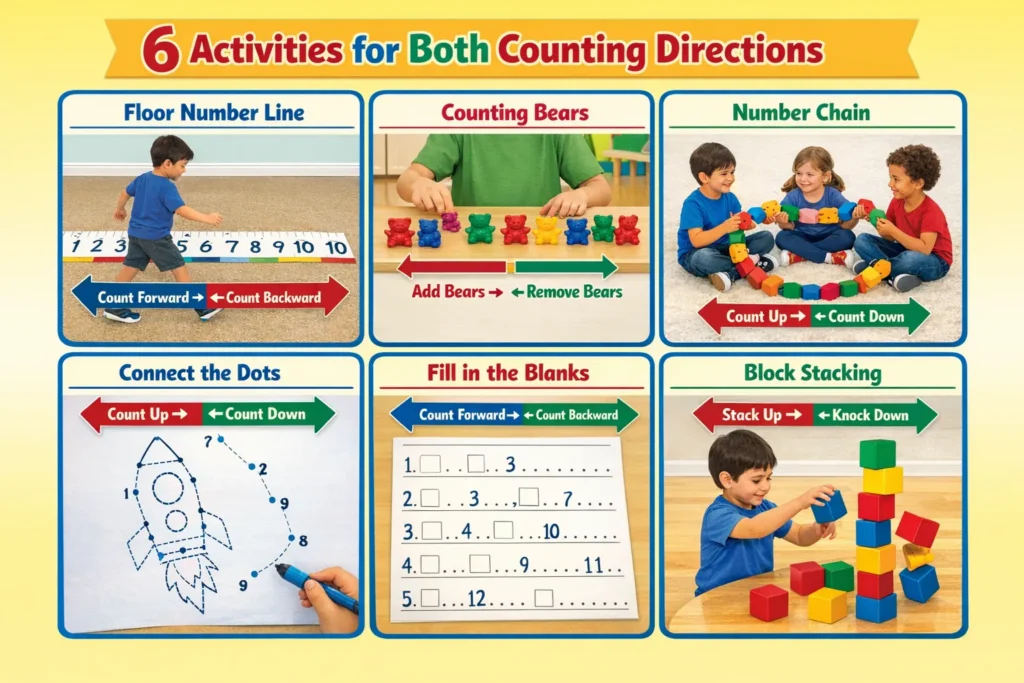
1. Floor Number Line — Both Directions: Tape a 0–10 number line on the floor. Call “forward!” — children hop right, calling each number. Call “backward!” — children hop left.
The direction switch requires genuine understanding, not rote recall. This is the most diagnostic activity for checking whether both directions are truly fluent. Connects to the spatial understanding in spatial understanding for class 1.
2. Build Up, Knock Down: Stack counting blocks while counting forward (1, 2, 3, 4, 5 — add one block per count). Then knock them down one at a time while counting backward (5, 4, 3, 2, 1).
The same physical sequence in both directions builds the connection between the two counting directions as inverses of each other.
3. Pass the Number Chain: Sit in a circle. One child starts at a number and passes the count to the next child — each child says the next number forward. After reaching 10, restart in the backward direction.
The social accountability of the circle format every child must produce the correct next number, provides the diagnostic pressure that reveals who is genuinely fluent and who is following along.
4. Countdown Songs: Counting songs make sequences memorable through rhythm. Classic examples — “Five Little Ducks,” “Ten Green Bottles,” “Five Little Monkeys” — all use backward counting in narrative contexts that make “one less each time” feel natural and purposeful.
The narrative context is particularly valuable because it grounds the abstract number sequence in a meaningful story.
5. Fill-in-the-Missing-Number: Forward: “3, 4, __, 6, 7” — Backward: “8, 7, __, 5, 4” These written exercises require genuine sequence knowledge; children cannot complete them by chanting from the beginning.
Start with one missing number, extend to two, then include questions where the start or end is missing.
6. Object Count and Remove: Place 10 objects in a line. Child counts forward while adding them: “1, 2, 3…” then counts backward while removing them: “10, 9, 8…”
The same set of objects used for both directions makes the inverse relationship between the two counting directions visually and physically obvious.
Visual Tools: How to Use Them Effectively
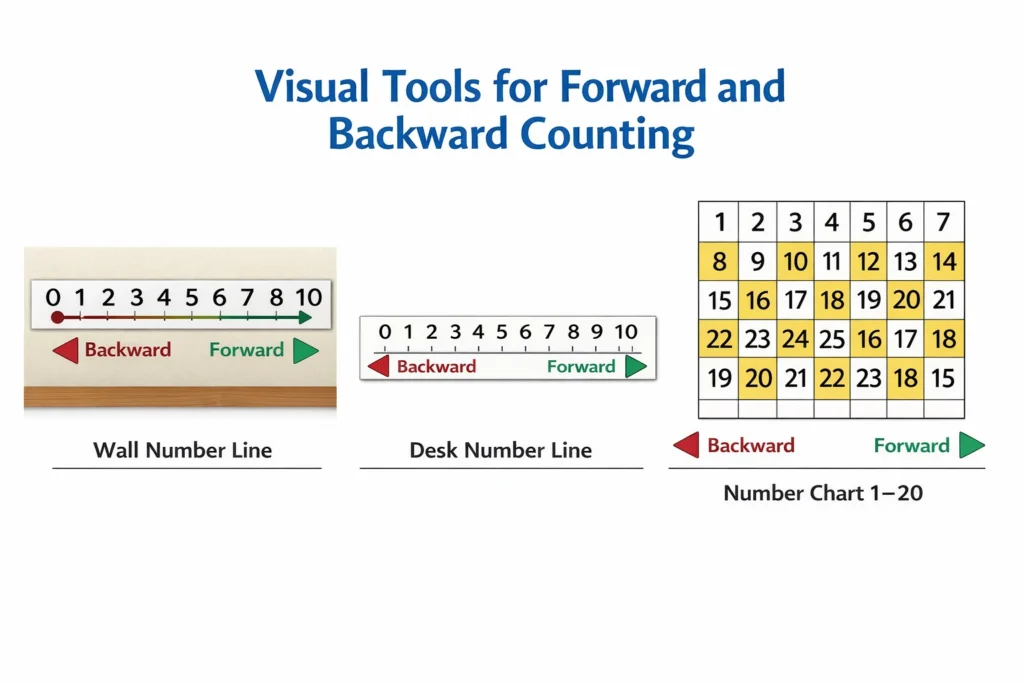
Wall number line: Display at child eye level touchable, reachable, and used daily. The most important feature is positioning: a number line hung above the board that children cannot touch is decoration, not a learning tool.
Children must be able to point to, hop along, and physically interact with it.
Desk number line: A personal strip at the top of each child’s workspace for individual counting activities.
Children who have their own number line use it spontaneously as a reference tool a reliable sign that genuine counting understanding is developing.
Number chart (1–20 or 1–100): Most useful for pattern recognition rather than individual counting.
Colouring alternate numbers, circling every 5th number, or hiding numbers for the class to identify all build number pattern awareness that extends forward and backward counting into pattern understanding.
The connection between number charts and the skip counting patterns in skip counting for class 1 makes the chart a bridging tool between counting and later Class 1 content.
Common Mistakes and How to Fix Them
| Mistake | What It Looks Like | Fix |
|---|---|---|
| Skipping numbers | “1, 2, 4, 5” or “10, 9, 7, 6” | Slow down and use physical touch one object, one number. Use finger folding for backward counting |
| Repeating numbers | “1, 2, 2, 3” or “10, 9, 9, 8” | Count with a physical marker moving along a number line the marker cannot be on two positions simultaneously |
| Switching direction mid-sequence | “10, 9, 8, 9, 10” | Clear verbal cue before starting: “We’re going down numbers get smaller.” Number line visual shows the direction |
| One-to-one mismatch | Counting faster than touching, producing wrong totals | Establish slow rhythm: touch and say simultaneously. Use a drum beat or metronome to pace the counting |
Should forward and backward counting be taught in the same lesson?
In general, no established forward counting first and build it to fluency before introducing backward. Once both directions are introduced, alternating between them in the same activity (like the floor number line direction-switch game) is highly valuable. But for initial introduction, one direction at a time prevents the confusion that simultaneous introduction often produces.
How do I know if a child genuinely understands backward counting rather than just reciting it?
Ask the child to start from a non-round number: “Start at 7 and count backward to 3.” A child who has genuinely internalized backward counting can do this. A child who has only memorized the chant from 10 will struggle significantly. Starting from non-standard positions is the most reliable diagnostic for genuine vs. rote backward counting.
How does kindergarten counting teaching connect to Class 1 mathematics?
The counting skills developed in kindergarten are the direct prerequisite for Class 1 number sense, ordering, addition, and subtraction. Children who arrive in Class 1 with fluent forward and backward counting from varied starting points find number line navigation, ordering, and early arithmetic significantly more accessible. The characteristics of number sense class 1 maps exactly what counting fluency enables in Class 1.
Make Preparing for Math Olympiad Simple!



Conclusion
Teaching forward and backward counting follows one clear principle: concrete before abstract, physical before written, one direction before both simultaneously.
Teach forward counting to fluency first, then introduce backward counting through object removal and finger folding making “one less each time” physically real before the verbal sequence is practised.
The counting fluency built through this progression is the foundation of everything that follows in Class 1 number ordering, skip counting, subtraction, and the number sense that makes early mathematics feel coherent rather than arbitrary.
For further support, see backward counting for Class 1
For the complete teaching guide, why is backward counting important for Class 1
For the broader case, and number sense for Class 1
For the foundations these skills build toward.

Mikha Piregu is a Content Writer with experience spanning educational content, including math and math olympiad topics, as well as advocacy writing, research-based articles, and SEO-driven web content. He creates high-quality blog content, web copy, and feature articles that support brand visibility, audience engagement, and long-term organic growth through data-informed storytelling. Skilled in WordPress, WooCommerce, and modern digital tools, Mikha adapts content across various platforms, including blogs, websites, campaigns, and advocacy initiatives, with clarity and purpose. You can reach out to him at [email protected].

There are no comments posted here yet.
Sign in to leave a comment