

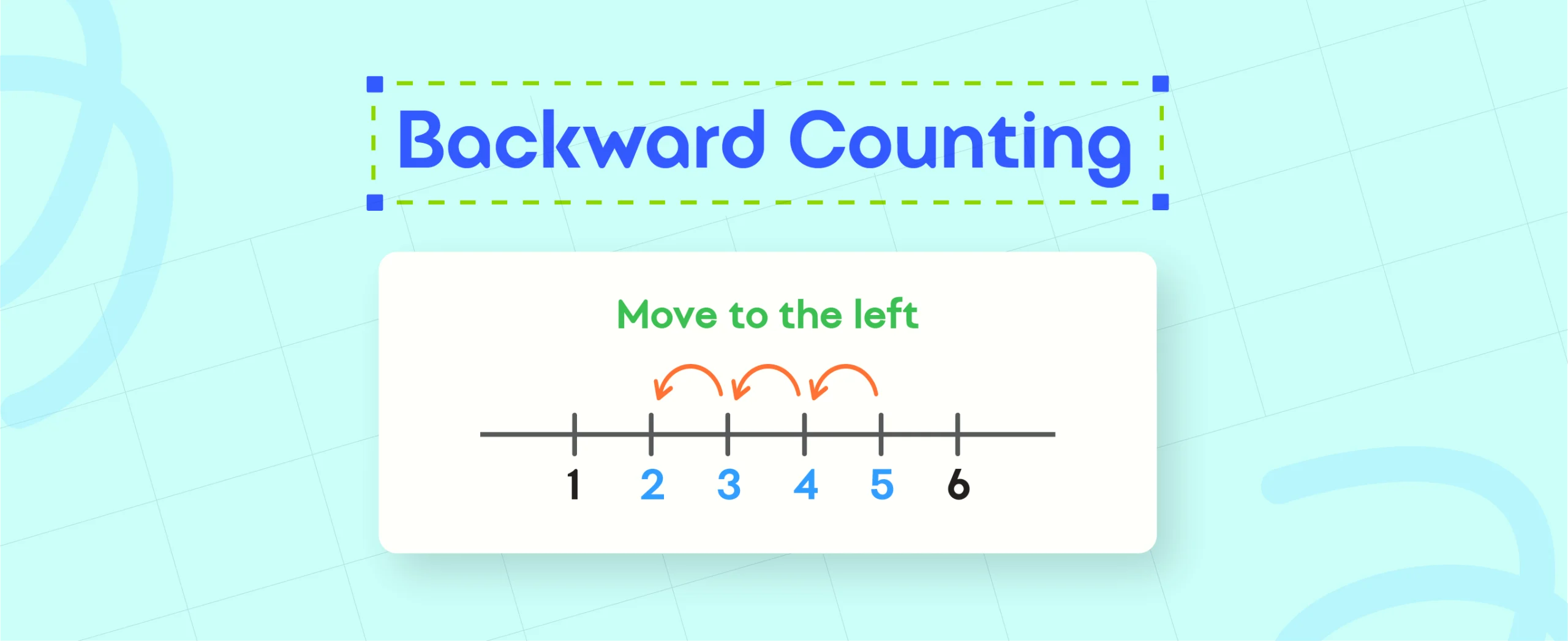
Backward counting for Class 1 is the ability to count down from a larger number to a smaller one, saying each number that is one less than the previous one. Instead of building up (1, 2, 3, 4, 5), children count down (5, 4, 3, 2, 1).
This sounds simple, but backward counting is considerably more demanding than forward counting, and considerably more important.
Every time a child counts backward, they are doing exactly what subtraction means: starting with a quantity and reducing it one unit at a time.
For the number sense foundations that make this understanding meaningful, see number sense for Class 1.
What is Backward Counting? A Clear Definition
Backward counting means counting in decreasing order, subtracting 1 from the previous number each time.
Every step produces a number that is exactly 1 smaller than the step before it.
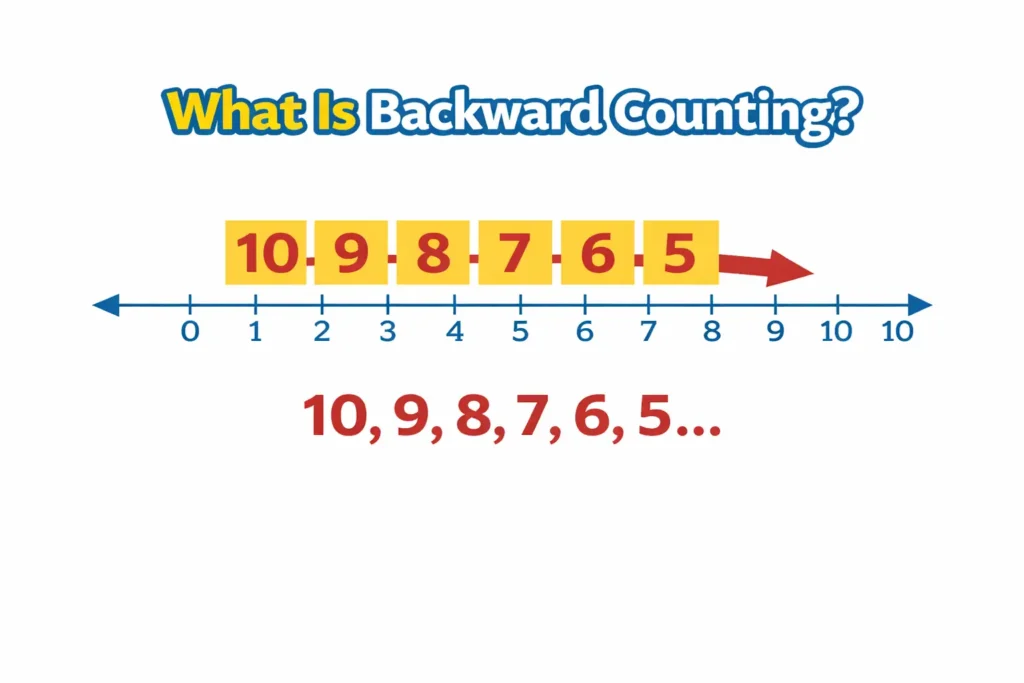
Backward counting from 10 to 1: 10, 9, 8, 7, 6, 5, 4, 3, 2, 1
Backward counting from 20 to 11: 20, 19, 18, 17, 16, 15, 14, 13, 12, 11
Backward counting from any starting point: “Start at 7 and count backward to 3” → 7, 6, 5, 4, 3
The most important distinction between backward counting and forward counting is the direction of movement on a number line. Forward counting moves right toward larger numbers.
Backward counting moves left toward smaller numbers.
This directional understanding is the same spatial knowledge explored in number positions on a number line class 1, and the number line teaching in how to teach number line maths class 1.
| Forward Counting | Backward Counting | |
|---|---|---|
| Direction | Increasing — small to large | Decreasing — large to small |
| Mathematical operation | Adding 1 each time | Subtracting 1 each time |
| Number line direction | Moving right → | Moving left ← |
| Example | 3, 4, 5, 6, 7 | 7, 6, 5, 4, 3 |
| Real-life use | Counting objects collected | Countdown, taking away |
Why Backward Counting Matters: The Subtraction Connection
The most important reason to teach backward counting in Class 1 is its direct connection to subtraction.
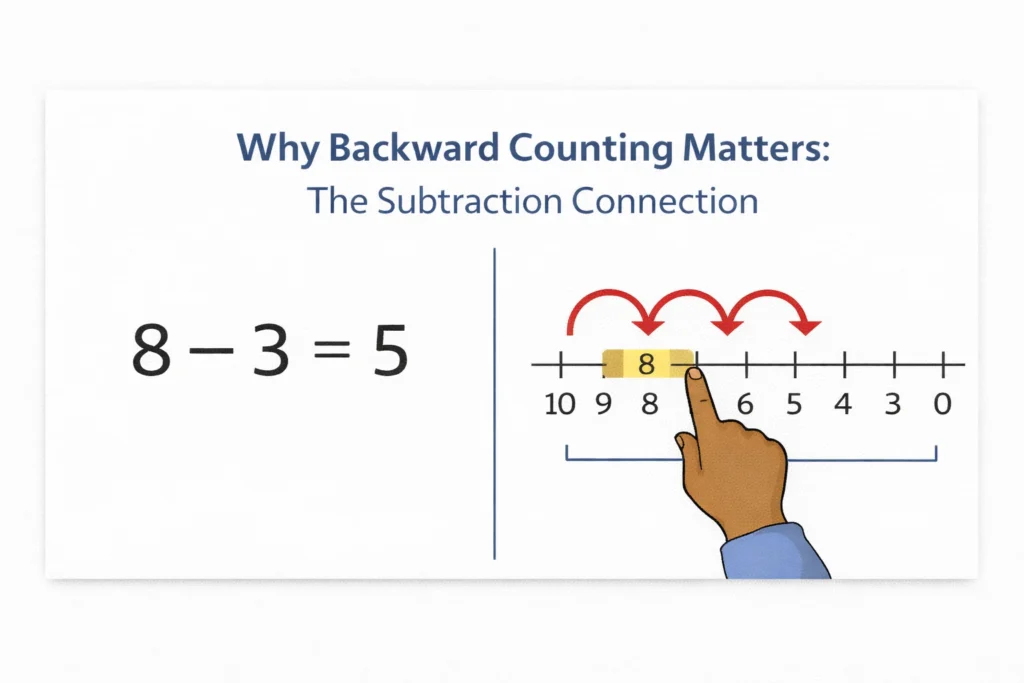
When a child counts backward from 8 three times 8, 7, 6, 5 they have just solved 8 − 3 = 5 using a completely intuitive method that they already understand.
The subtraction symbol does not need to be introduced. The operation is already happening.
This “counting back” strategy is the earliest and most natural subtraction method.
It works reliably for small subtractions (subtracting 1, 2, or 3 from any number within 20) and gives children a mental model for what subtraction means, reducing a quantity, before formal subtraction procedures are introduced.
Worked example — counting back for subtraction:
Problem: 9 − 2 = ?
Count back 2 steps from 9: 9 → 8 → 7
Answer: 7 ✅
Worked example — counting back on a number line:
Problem: 7 − 3 = ?
Start at 7 on the number line. Jump left 3 times: 7 → 6 → 5 → 4
Answer: 4 ✅
Each leftward jump on the number line is one subtraction. The number line makes this visible and permanent — forward jumps for addition, backward jumps for subtraction.
This is the clearest visual model of both operations and connects directly to the ascending and descending direction work in ascending and descending order in maths class 1.
Backward Counting Examples for Class 1
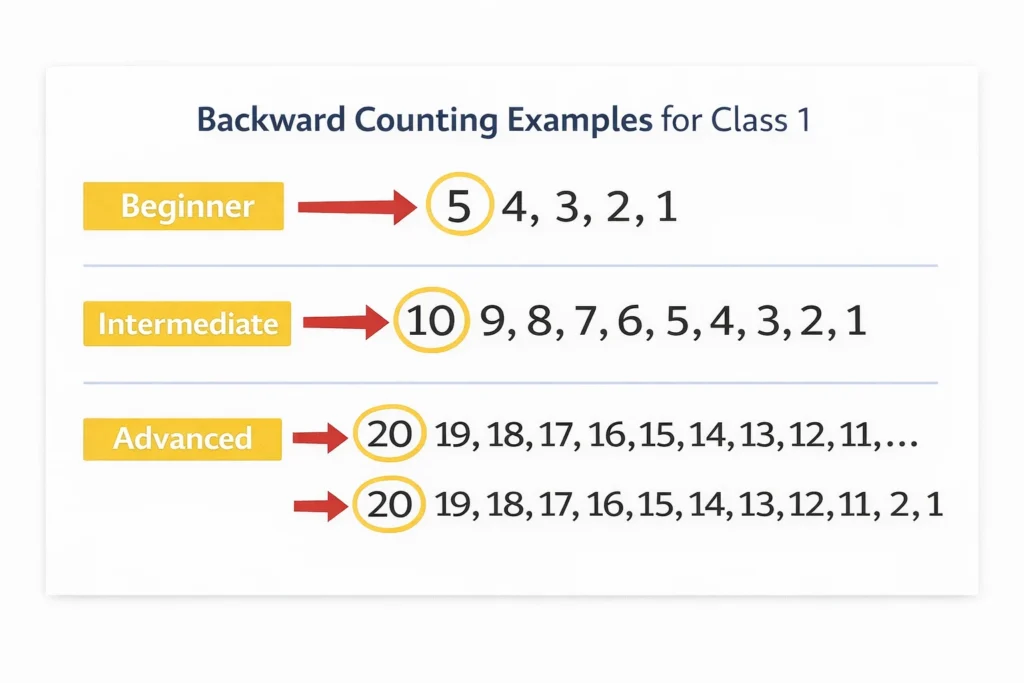
Beginner level — counting back from 5: 5, 4, 3, 2, 1
Start here. Small ranges build confidence before larger sequences are attempted. Use fingers: start with 5 fingers up, fold one down at a time.
Intermediate level — counting back from 10: 10, 9, 8, 7, 6, 5, 4, 3, 2, 1
The classic rocket countdown: crouch down counting from 10, jump up at 1. This makes the sequence physically memorable.
Intermediate level — counting back from any starting point: “Start at 8, count back to 4”: 8, 7, 6, 5, 4 “Start at 12, count back 3 steps”: 12, 11, 10, 9
Starting from mid-range numbers is harder than starting from 10 — it requires genuine number understanding rather than sequence recall. Practise this regularly once from-10 counting is fluent.
Advanced level — counting back from 20: 20, 19, 18, 17, 16, 15, 14, 13, 12, 11, 10, 9, 8, 7, 6, 5, 4, 3, 2, 1
Break into two sections initially: 20 to 11, then 10 to 1. Combine once each section is fluent.
The number sequence structure that underpins these ranges is explored in what is the number sequence for class 1 maths.
How to Teach Backward Counting Step by Step
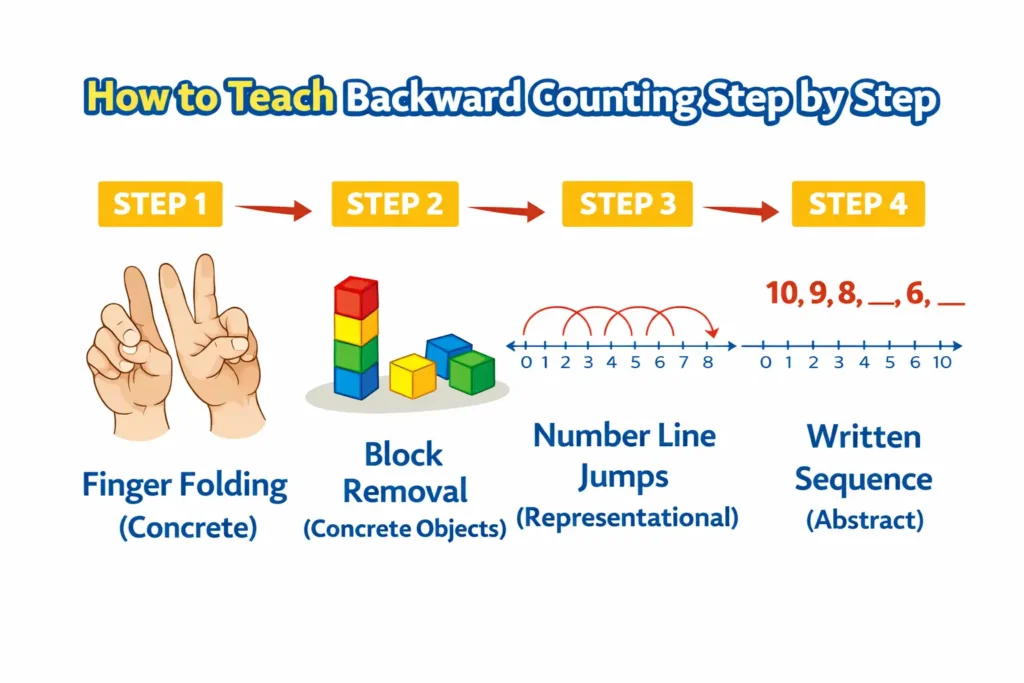
Step 1: Finger folding (concrete) Start with all 10 fingers up. Count backward, folding one finger down per number: “10 (fold), 9 (fold), 8 (fold)…”
The physical folding creates a body memory for the decreasing sequence that oral chanting alone cannot replicate.
Step 2: Object removal (concrete) Place 8 blocks on a table. Remove one at a time while counting backward: “8 (remove one), 7 (remove one), 6…”
The physical removal of objects makes “one less” tangibly real — children see and feel the quantity decreasing with each backward count.
Step 3: Number line backward jumps (representational) Use a desk or floor number line. Start at a given number and physically point to or jump to each successive left position, saying the number aloud.
Draw arcs above the line for each jump. This bridges physical counting to visual-spatial understanding of the counting back strategy.
Step 4: Written sequences (abstract) Fill-in-the-blank sequences: “10, 9, __, 7, 6” or “__, 14, 13, 12, 11.” Written practice comes last after physical and visual understanding is secure.
The full number sense teaching methodology that this progression follows is in the number sense teaching strategies for first graders.
Fun Activities for Backward Counting Practice
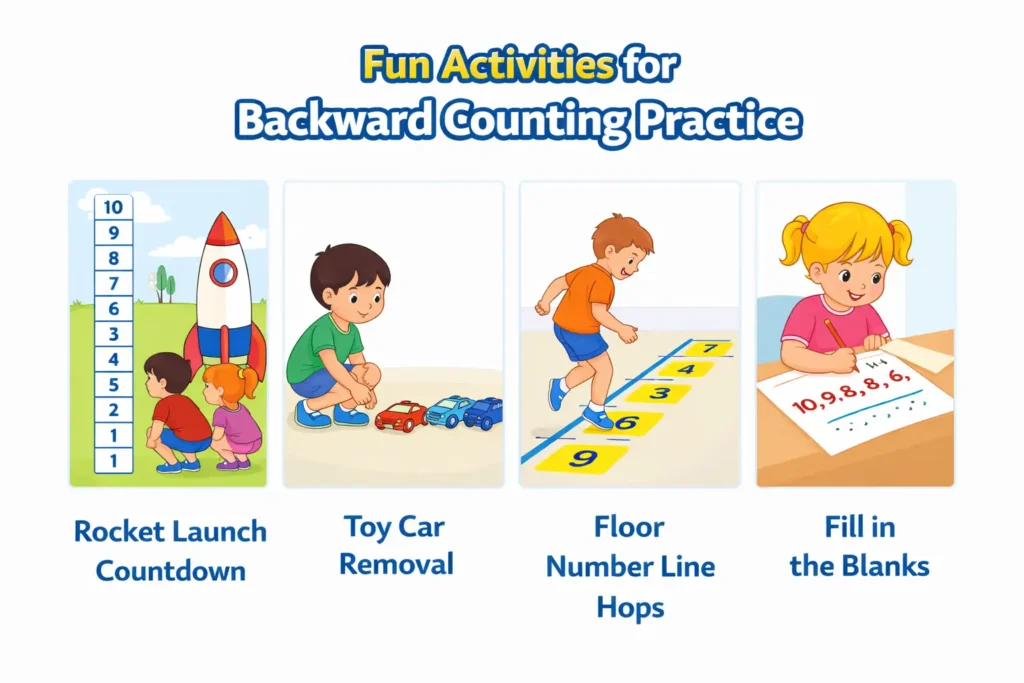
Rocket Launch Countdown: Count backward from 10 together: “10, 9, 8, 7, 6, 5, 4, 3, 2, 1 BLAST OFF!” Children crouch at 10 and jump at 1.
The physical movement, group energy, and memorable climax make this the single most effective activity for building backward-counting-from-10fluency. Repeat daily as a 60-second warm-up; children never tire of it.
Object Removal Counting: Place 10 small objects in a line. Child removes one at a time, counting backward: “10… take one away… 9… take one away… 8.”
The one-at-a-time removal makes the “one less” concept physically concrete. Use toys, blocks, stones, or any small household items.
Backward Floor Number Line Hops: Mark a 0–10 number line on the floor with tape or chalk. Child stands at 10 and hops backward, saying each number as they land: “10, 9, 8, 7…” Call instructions: “Start at 8, hop back to 5.”
The combination of physical movement and number line use reinforces the left-direction convention in the most kinesthetic way possible.
Countdown Chain: Sit in a circle. Start at 20. Each child says the next number in the countdown sequence. If a child hesitates for more than 3 seconds, they can “pass” and the next child continues.
Track the chain, try to reach 1 without any pauses. This social, low-pressure activity builds backward counting fluency from 20 in an enjoyable group context.
These activities connect naturally to the skip counting activities in skip counting for class 1, both forward and backward skip counting use the same activity structures.
Common Mistakes and How to Fix Them
| Mistake | What It Looks Like | Fix |
|---|---|---|
| Skipping a number | 10, 9, 7, 6 (skipped 8) | Slow down — use finger folding or object removal to force one-at-a-time counting |
| Repeating a number | 10, 9, 9, 8 | Ask: “What is one less than 9?” Connect to object removal: remove one and count the remaining |
| Switching to forward counting | 10, 9, 10, 11 | Clear verbal cue: “We’re going down — each number is smaller than the one before.” Use number line visual |
| Stalling at certain numbers | Hesitates at transitions (e.g., 11 to 10) | Practice these transition points explicitly — they mark the boundary between tens and are consistently the hardest points |
Practice Questions
Oral practice:
- “Start at 5 and count back to 1.”
- “Start at 9 and count back 3 steps. Where do you land?”
- “What comes after 7 when counting backward?”
Fill in the blanks:
- 10, 9, __, 7, 6
- 15, 14, 13, __, 11
- __, 8, 7, 6, 5
- 20, __, 18, __, 16
Match the correct path:
| Start | Finish | Sequence |
|---|---|---|
| 10 | 7 | 10, 9, 8, 7 |
| 5 | 2 | 5, 4, 3, 2 |
| 12 | 9 | 12, 11, 10, 9 |
Subtraction using counting back:
- 8 − 2 = ? (count back 2 from 8)
- 6 − 3 = ? (count back 3 from 6)
- 10 − 4 = ? (count back 4 from 10)
These practice questions connect directly to the number ordering fluency developed in number ordering for class 1 backward counting is descending order applied to counting rather than arranging.
When should backward counting be introduced in Class 1?
After forward counting to 10 is fluent and automatic. Most Class 1 children are ready for backward counting introduction within the first 4–6 weeks of the school year. Start with backward counting from 5, extend to 10 once 5-to-1 is fluent, then extend to 20.
Why is backward counting harder than forward counting?
Forward counting follows the natural order children have encountered since infancy through songs, games, and daily life. Backward counting reverses that familiar direction and requires actively holding the “one less” rule in mind with each step. The cognitive load is genuinely higher, which is why backward counting needs more deliberate practice and more time than forward counting.
How does backward counting connect to competition mathematics?
Counting back, sequence completion, and “what comes before?” problems appear regularly in Class 1 competition mathematics. Children who are fluent backward counters approach these naturally. The IMO syllabus for class 1 covers the full range of number topics assessed at this level, and backward sequence reasoning features in multiple problem types.
Make Preparing for Math Olympiad Simple!



Conclusion
Backward counting turns counting from a one-directional recitation into a genuine two-directional number sense tool and in doing so, lays the complete conceptual foundation for subtraction.
When children count backward fluently from any starting point within 20, they understand what “taking away” means before the subtraction symbol is ever introduced.
Practise daily in short sessions, fix mistakes by returning to physical one-at-a-time counting, and connect every activity to its number line representation.
For further support, explore what is the number sequence for Class 1 maths for the number sequence foundations,
number sense for Class 1 for the broader context,
and IMO syllabus for Class 1 for the competition mathematics pathway.

Mikha Piregu is a Content Writer with experience spanning educational content, including math and math olympiad topics, as well as advocacy writing, research-based articles, and SEO-driven web content. He creates high-quality blog content, web copy, and feature articles that support brand visibility, audience engagement, and long-term organic growth through data-informed storytelling. Skilled in WordPress, WooCommerce, and modern digital tools, Mikha adapts content across various platforms, including blogs, websites, campaigns, and advocacy initiatives, with clarity and purpose. You can reach out to him at [email protected].

There are no comments posted here yet.
Sign in to leave a comment