March 5, 2026
 12 min. read

A fraction for class 1 math is a part of a whole, and teaching it well starts with two words: equal parts.
This guide gives you a simple definition, real-life examples, hands-on activities, and clear ways to check your child understands no formal test needed.
What is a Fraction?
A fraction is a part of a whole. When we divide something into equal parts and take one or more of those parts, we have a fraction.
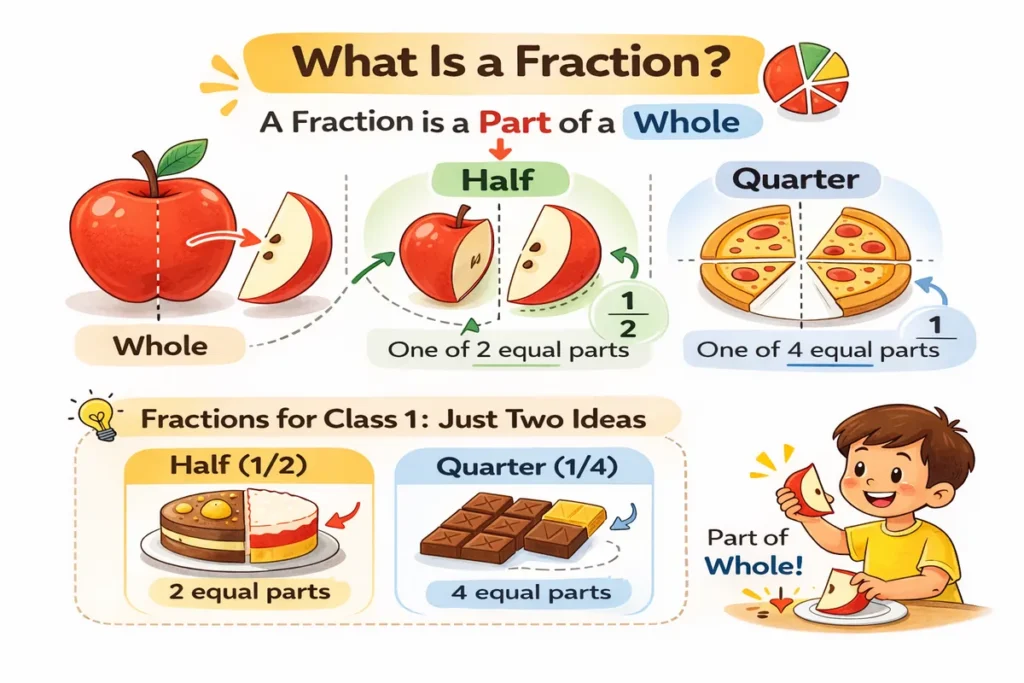
For example: if you cut an apple into 2 equal pieces and eat one piece, you have eaten one half of the apple. That one piece is a fraction of the whole apple.
For Class 1, fractions for class 1 start with just two ideas: half and quarter. Nothing more is needed at this stage and that’s perfectly fine.
Understanding fractions builds naturally on the number sense children develop in early Class 1, where they learn to compare quantities and understand that numbers represent different amounts.
What Are Equal Parts? (Why This Matters)
Here’s the most important idea in all of early fraction learning: the parts must be equal.
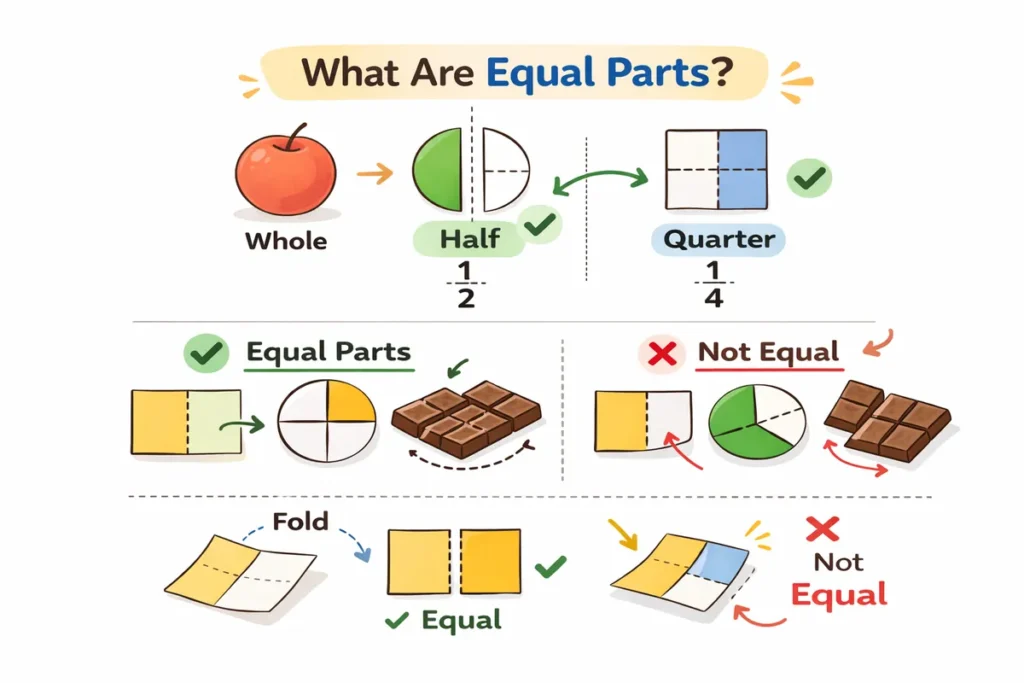
Imagine cutting a sandwich for two children. If one child gets a big chunk and the other gets a tiny sliver, that’s not fair and it’s not a fraction either.
A fraction only works when every piece is the same size.
How to explain this to a child
Ask them to fold a piece of paper in half. If both sides match up exactly when folded, the two parts are equal. If one side is bigger, it isn’t half; it’s just two unequal pieces.
This simple test do the parts match? is one of the most powerful concepts in early maths. Children who understand equal parts will avoid a huge number of fraction mistakes later on.
This idea of equal sharing also connects directly to multiplication for Class 1, where children learn to group objects into equal sets the same foundational thinking that makes fractions make sense
Half and Quarter — The Only Two Fractions for Class 1
At Class 1 level (ages 6–7), children only need to understand two fractions:
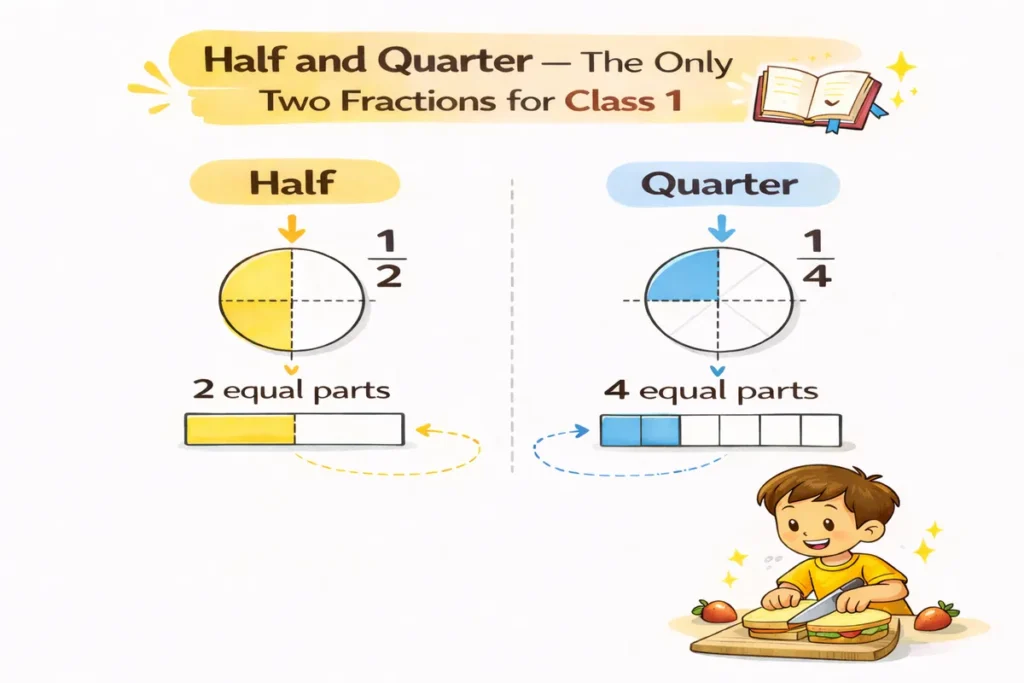
Half (1/2) — when a whole is divided into 2 equal parts, each part is one half.
Quarter (1/4) — when a whole is divided into 4 equal parts, each part is one quarter.
That’s it. You don’t need to introduce numerators and denominators formally. Half and quarter, understood deeply and confidently, is exactly the right goal.
A common worry among parents is that ‘just two fractions’ isn’t enough.
But teaching half and quarter properly with real objects, activities, and understanding gives children a stronger foundation than rushing through a dozen fraction types they can’t visualise.
This mirrors the approach used when teaching number sequences to Class 1 students, where depth of understanding at each stage matters far more than speed of coverage.
Real-Life Fraction Examples for Class 1
The best way to make fractions stick is to find them in everyday life:
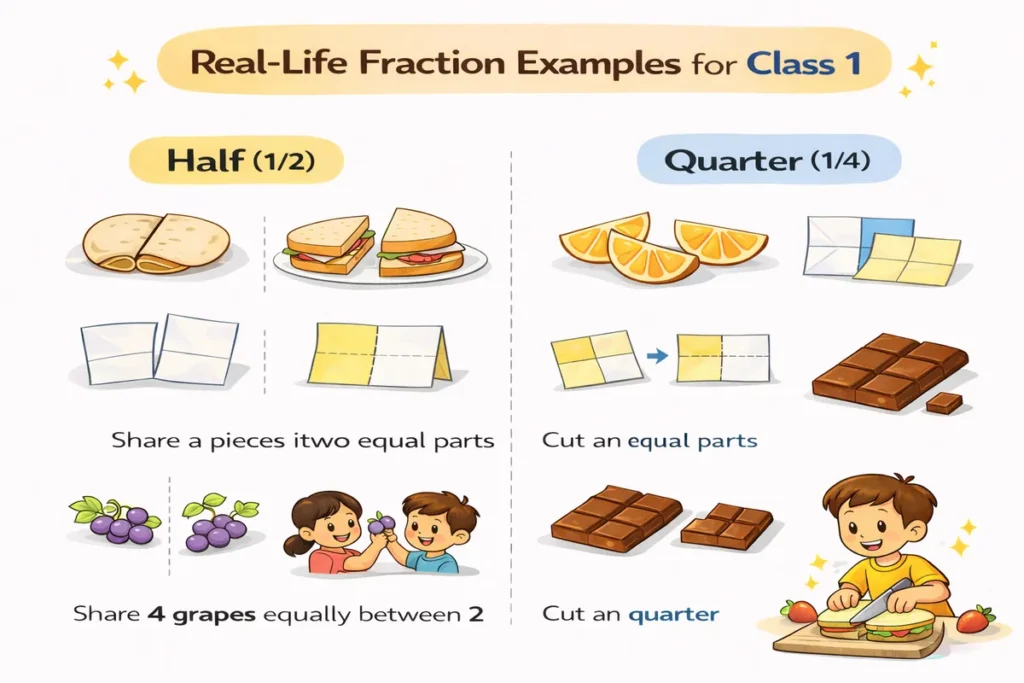
Half (1/2)
- Cut a chapati or sandwich into 2 equal pieces — each piece is one half
- Fold a sheet of paper into 2 matching parts — each part is half
- Share 4 grapes equally between 2 children — each child gets half
Quarter (1/4)
- Cut an orange into 4 equal pieces — each piece is one quarter
- Fold a square piece of paper in half, then in half again — you’ve made 4 equal parts, each is a quarter
- Divide a chocolate bar with 4 equal sections — each section is one quarter
The keyword across all examples is equal. Always point it out: ‘Are these pieces the same size? They are so each one is a half.’
These real-life sharing scenarios also reinforce addition and subtraction for Class 1, as children naturally start to reason about how parts combine to make a whole.
How to teach fractions to Class 1? (Step-by-Step)
Is Your Child Ready?
Before starting, look for these readiness signs:
- They can count to at least 4 reliably
- They understand the idea of ‘sharing equally’ (e.g., 4 biscuits for 4 friends)
- They can compare sizes (‘this piece is bigger than that one’)
Understanding why number sense is important for Class 1 students helps explain why these readiness signs matter. A child who can compare quantities and count reliably is already thinking in the way that fractions require.
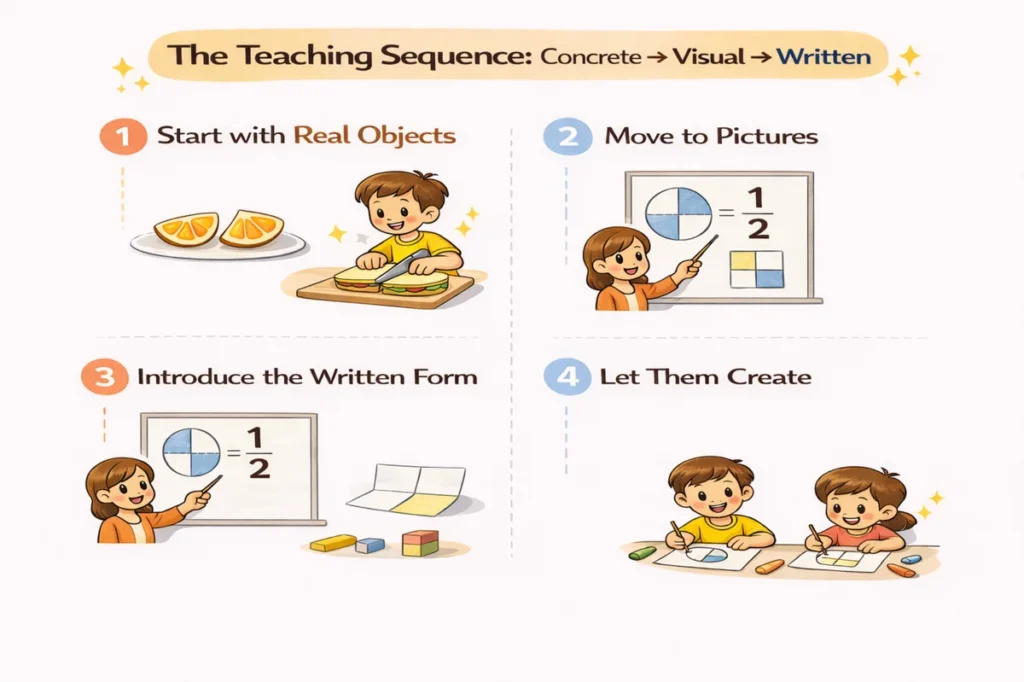
The Teaching Sequence: Concrete → Visual → Written
Step 1: Start with real objects. Use food, paper, or toys. Cut, fold, or share. Let children touch and handle the parts. Say the words out loud: ‘This is one half. This is one whole.’
Step 2: Move to pictures. Draw circles and squares divided into parts. Ask: ‘Is this half? How do you know?’ Shade one part and name it together.
Using a number line for Class 1 can also help here; children can see that a half sits exactly in the middle between zero and a whole, giving the concept a visual anchor.
Step 3: Introduce the written form. Only once they can confidently identify half and quarter by sight should you show the numbers 1/2 and 1/4. Keep it brief and visual.
Step 4: Let them create. Ask children to draw their own halves and quarters. Drawing cements understanding better than any worksheet.
Hands-On Fraction Activities
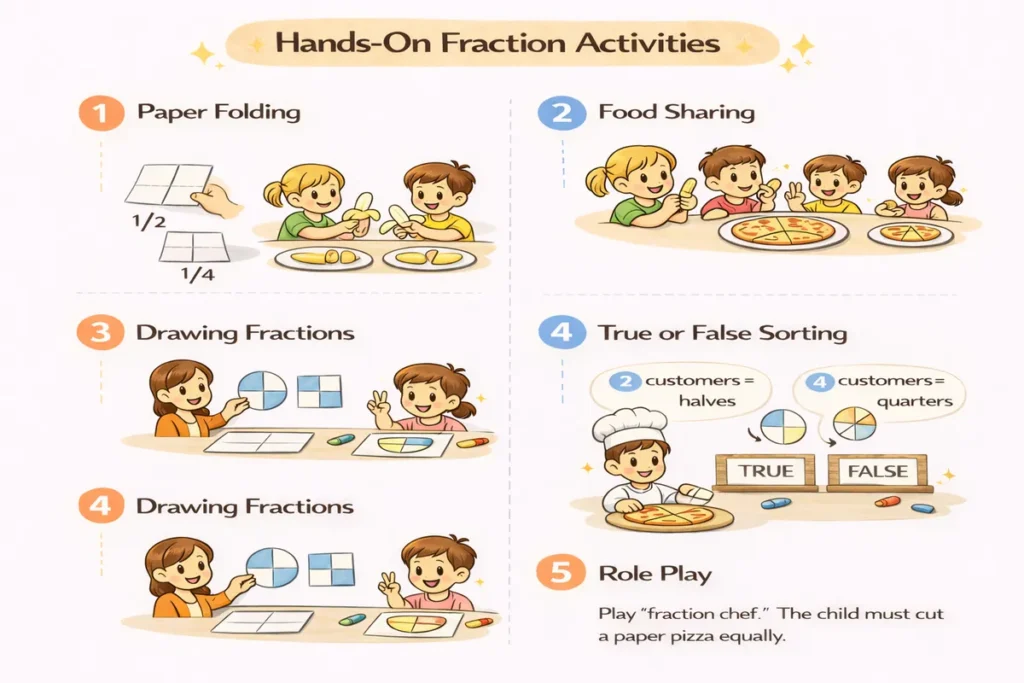
Paper Folding: Give children a square piece of paper. Ask them to fold it to show half, then unfold and fold again to show quarters. Count the equal parts together.
This activity pairs well with geometrical shapes for Grade 1, as children apply their knowledge of squares, rectangles, and circles when folding and dividing shapes into equal parts.
Food Sharing: At snack time, ask: ‘Can you cut this banana in half?’ Then: ‘Now can we cut this into quarters for four of us?’ Real stakes make the maths memorable.
Drawing Fractions: Ask children to draw a circle and shade half. Then draw a square and shade one quarter. Compare — do the parts look equal?
True or False Sorting: Show pictures of shapes divided into parts (some equal, some not). Ask: ‘Is this half — true or false?’
This kind of logical checking reinforces the same reasoning skills children build when working with the types of questions asked in math olympiads, where evaluating whether something is correct or incorrect is a core skill.
Role Play: Play ‘fraction chef.’ The child must cut a paper pizza equally: 2 customers = halves, 4 customers = quarters.
Fraction Vocabulary Table
Here are the key words your child needs for basic fractions for class 1:
| Word | Meaning | Example |
| Whole | The complete object, nothing missing | A full apple |
| Part | A piece of the whole | A slice of the apple |
| Equal parts | Parts that are exactly the same size | Two sandwich halves that match |
| Half | One of 2 equal parts (written as 1/2) | Half a chapati |
| Quarter | One of 4 equal parts (written as 1/4) | One slice of an orange cut into 4 |
| Fraction | A part of a whole, made of equal parts | Half a glass of water |
Building this vocabulary connects naturally to spatial understanding for Class 1, where children also learn positional and descriptive language to talk about shapes, parts, and relationships between objects.
Printable-Style Worksheet Section
Use these exercises at home or in the classroom. Just a pencil needed.
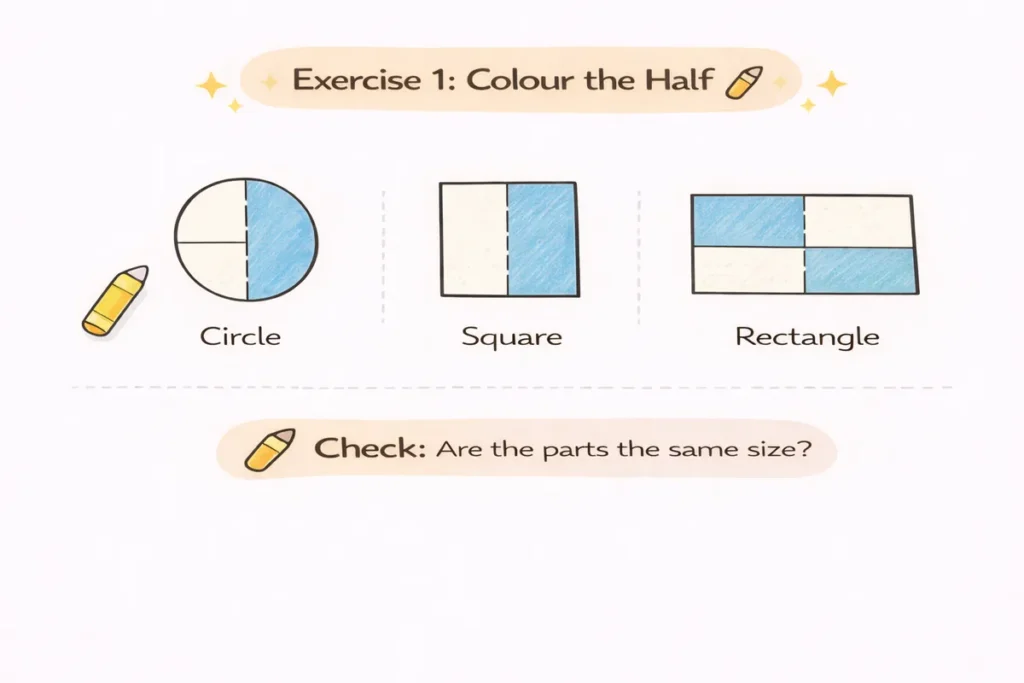
Exercise 1: Colour the Half ✏️
Draw three shapes: a circle, a square, and a rectangle. Divide each into 2 equal parts. Ask your child to colour one half of each shape.
Check: Is the coloured part the same size as the uncoloured part?
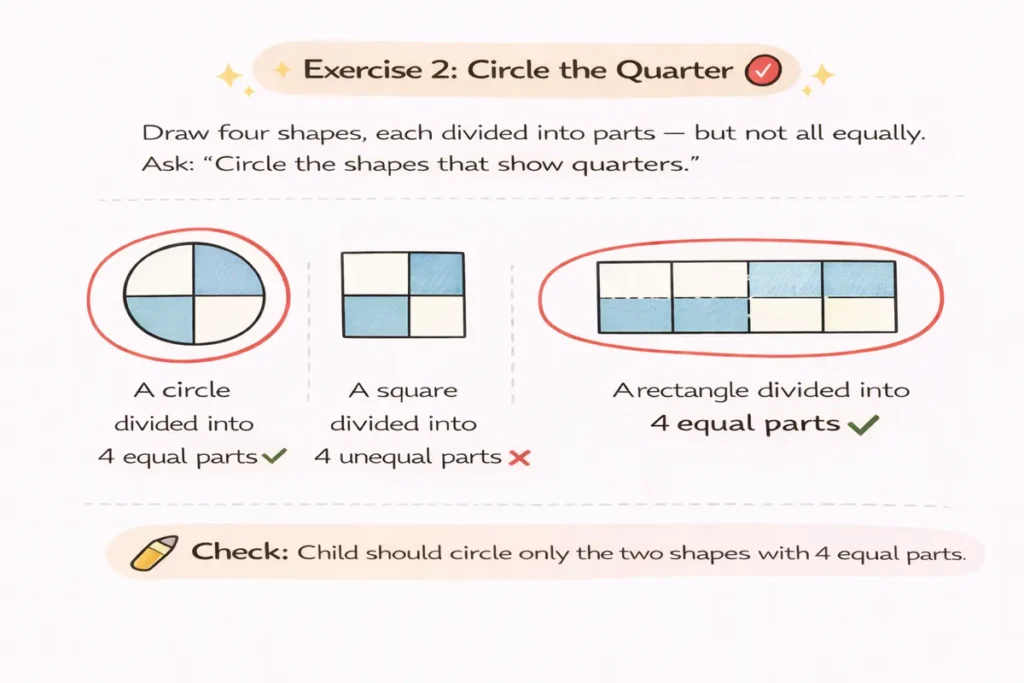
Exercise 2: Circle the Quarter
Draw four shapes, each divided into parts — but not all equally. Ask: ‘Circle the shapes that show quarters.’
- A circle divided into 4 equal parts ✓
- A square divided into 4 unequal parts ✗
- A rectangle divided into 4 equal parts ✓
- A triangle divided into 2 parts ✗
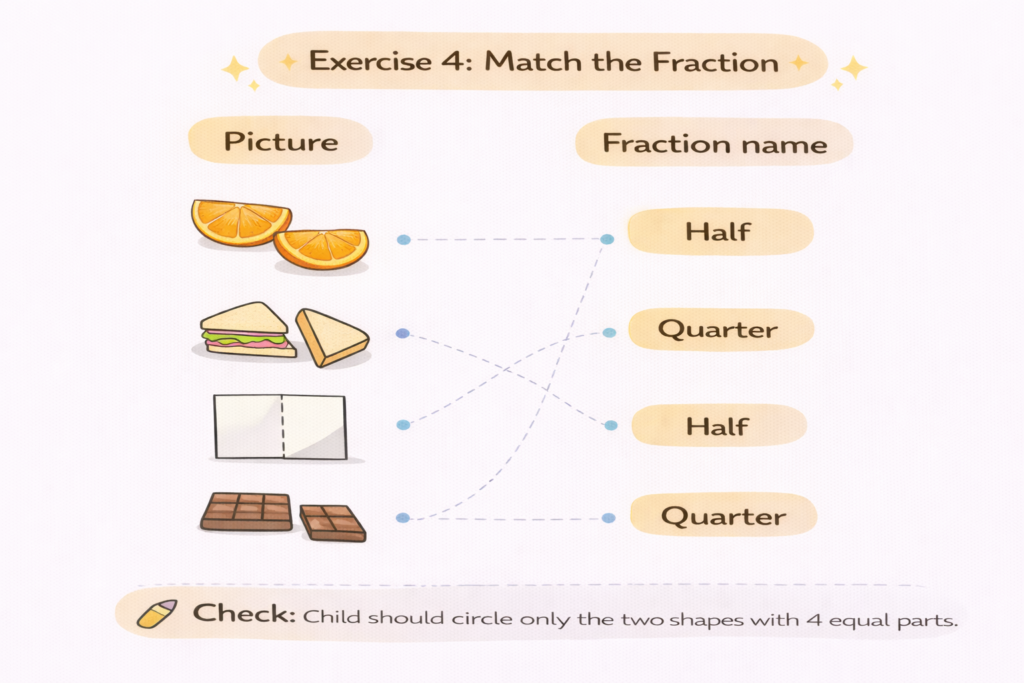
Check: Child should circle only the two shapes with 4 equal parts.
Exercise 3: True or False
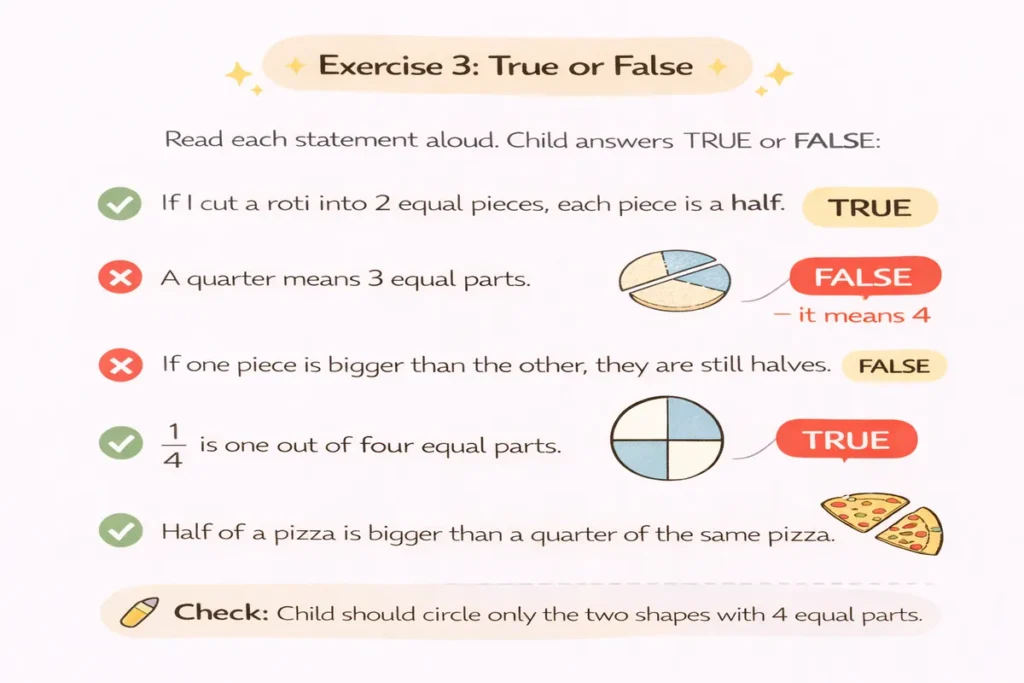
Read each statement aloud. Child answers TRUE or FALSE:
- If I cut a roti into 2 equal pieces, each piece is a half. (TRUE)
- A quarter means 3 equal parts. (FALSE — it means 4)
- If one piece is bigger than the other, they are still halves. (FALSE)
- 1/4 is one out of four equal parts. (TRUE)
- Half of a pizza is bigger than a quarter of the same pizza. (TRUE)
Exercise 4: Match the Fraction
| Picture | Fraction name |
| Orange cut into 4 equal pieces | Half |
| Sandwich cut into 2 equal pieces | Quarter |
| Paper folded to show 2 equal parts | Half |
| Chocolate bar with 4 equal sections, 1 taken | Quarter |
These worksheet exercises follow the same short, focused format recommended in a lesson plan on skip counting for Class 1, where brief, purposeful tasks build understanding more effectively than long, repetitive drills.
Common Mistakes Children Make with Fractions
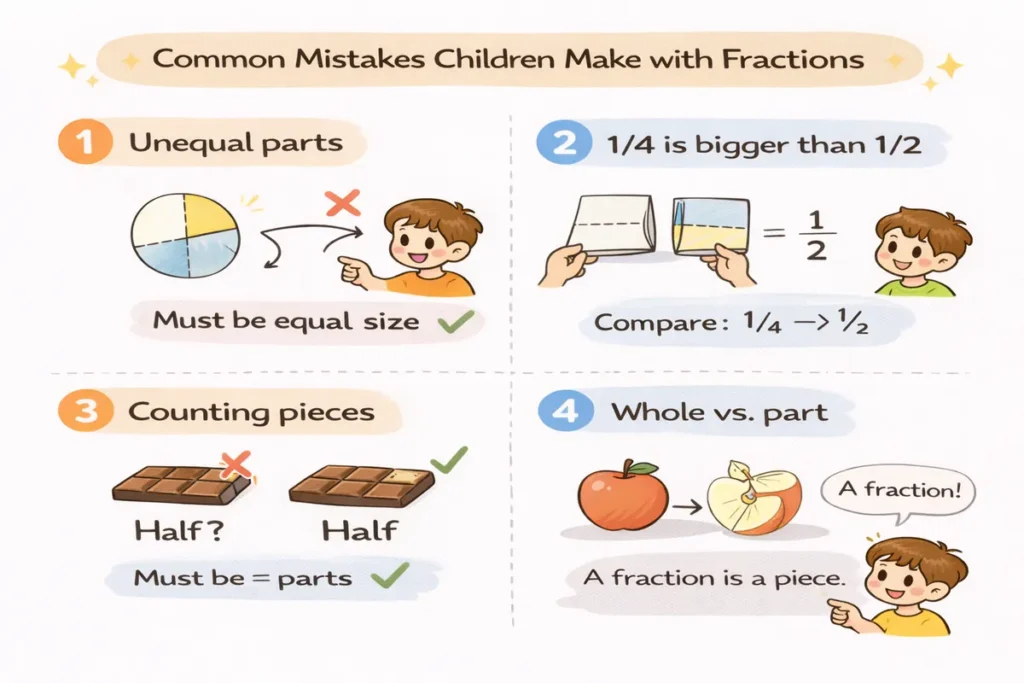
Mistake 1: Unequal parts confusion. A child cuts a circle into two unequal pieces and calls both ‘halves.’ Redirect gently: ‘Are these the same size? They need to be equal.’
This is similar to the confusion children experience when learning ascending and descending order, where they sometimes arrange numbers without checking whether the order is truly consistent.
Mistake 2: Thinking 1/4 is bigger than 1/2. Very common. A child hears ‘four’ and thinks more = bigger. Use paper: fold one into halves, another into quarters. Hold them up and compare.
Understanding number ordering for Class 1 helps these children, who can confidently compare values, find it easier to reason about which fraction is larger.
Mistake 3: Counting pieces instead of checking equality. A child sees 2 parts and calls it ‘a half’ regardless of size. Reinforce: ‘Two parts isn’t enough — they must be two equal parts.’
Mistake 4: Mixing up whole and part. Some children call the full object ‘a fraction.’ Clarify: ‘When the apple is whole, it’s not a fraction. When we cut it equally, each piece becomes a fraction.’
Understanding what number sequences are in Class 1 maths can help reinforce the distinction between a complete set and its individual parts.
How to Assess Fraction Understanding (Without Formal Tests)
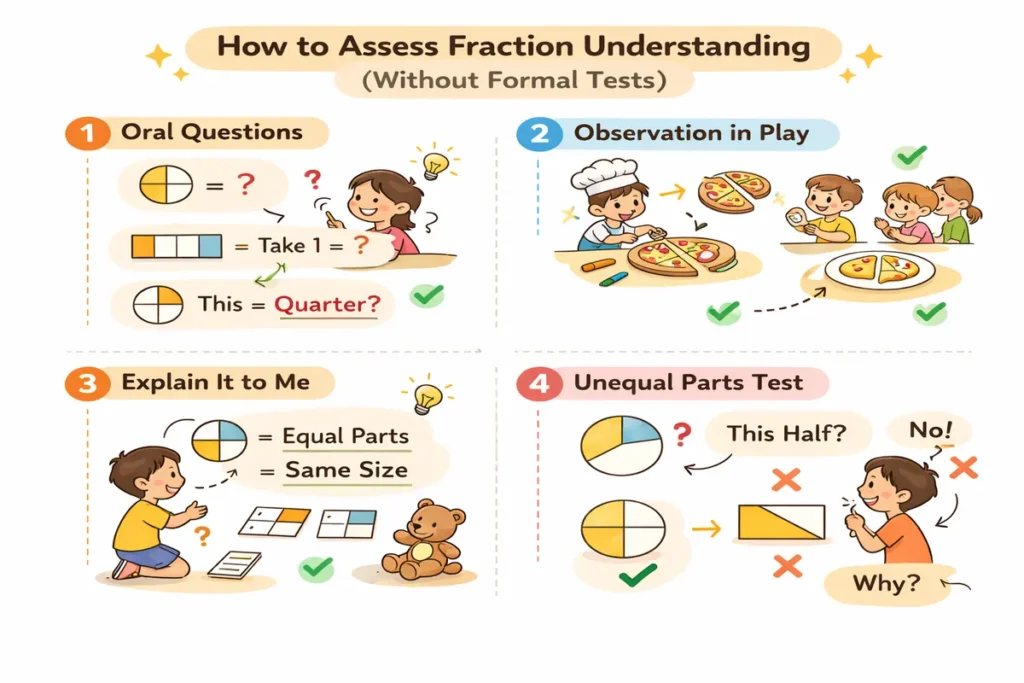
Oral questions during activities
- ‘How many equal parts do we need to make a half?’
- ‘If I cut this into 4 equal pieces and take one, what have I taken?’
- ‘Is this a quarter — how do you know?’
Observation during play
Watch how a child cuts or divides things during role play or snack time. Are they naturally trying to make equal parts? That’s a strong sign of understanding.
The number sense teaching strategies for first graders offer a broader framework for this kind of observational assessment across all early maths topics, including fractions.
The ‘explain it to me’ check
Ask your child to explain what a fraction is to a toy or younger sibling. If they can ‘a fraction is a part of something, but all the parts have to be the same size’ they’ve got it.
The unequal parts test
Show a shape divided unequally. Ask: ‘Is this half?’ A child who says no and explains why is exactly where they need to be.
What is a fraction in maths for class 1?
A fraction in maths for class 1 is a part of a whole that has been divided into equal pieces. At Class 1 level, children learn only two fractions: half (1/2), which means 1 of 2 equal parts, and quarter (1/4), which means 1 of 4 equal parts.
What fractions should a Class 1 child know?
Class 1 children need to understand just two fractions: half and quarter. Deep understanding of these two is far more valuable than a surface-level introduction to many fractions.
How do I explain half and quarter to a child?
Class 1 children need to understand just two fractions: half and quarter. Deep understanding of these two is far more valuable than a surface-level introduction to many fractions.
How do I explain half and quarter to a child?
Use food or paper. Cut a chapati into 2 equal pieces and say each piece is one half. Then cut another into 4 equal pieces and say each piece is one quarter. Let your child hold the pieces and compare their sizes.
Why do equal parts matter in fractions?
Equal parts are the foundation of what a fraction is. If the parts aren’t equal, the pieces don’t have a fraction name. A fraction always describes equal sharing — so the equal part isn’t optional, it’s the whole point.
Is 1/4 bigger or smaller than 1/2?
1/4 is smaller than 1/2. When you divide something into 4 equal parts, each piece is smaller than when you divide it into just 2. A quarter of a pizza is smaller than half of the same pizza.
Should I teach numerator and denominator to a Class 1 child?
Not formally. At Class 1 level, the focus is on understanding the concept of equal parts. If a child is curious, briefly explain: the bottom number shows how many equal parts, the top shows how many we’re counting.
What are the best fraction activities for Class 1?
Paper folding, cutting food into halves and quarters, role-play sharing games, and drawing fractions. Hands-on experiences build lasting understanding far more effectively than worksheets alone.
How do I know if my child understands fractions?
Ask them to explain what a fraction is, or show a shape divided unequally and ask if it’s a half. A child who says no and explains why has a solid grasp of the concept.
What if my child keeps getting fractions wrong?
Go back to physical objects and slow down. Most fraction confusion at this age comes from skipping the equal parts concept too quickly. Revisit paper folding and food sharing before written exercises.
What comes after half and quarter in maths?
After half and quarter, children typically explore thirds and other unit fractions in later grades. All of that builds on a solid understanding of equal parts — which is exactly what you’re building now.
Make Preparing for Math Olympiad Simple!



Conclusion
Fractions don’t have to be confusing, not for your child, and not for you. At Class 1 level, everything comes down to half and quarter, built on the foundation of equal parts.
Start with real objects, move to pictures, and only introduce written numbers once the concept is solid.
To see how they connect to the full range of Class 1 maths topics from counting and sequences to shapes and ordering, exploring what the number sequence for Class 1 maths covers gives a clear picture of how each concept builds on the last.
If you’d like more structured maths practice for your child, including concept-based problems that build on exactly these foundations, explore what the Gonit App offers for primary school learners.