May 6, 2026
 13 min. read

SOF vs SilverZone is one of the most-searched and debated comparisons among students and parents preparing for Olympiad exams.
SOF (Science Olympiad Foundation) and SilverZone are both popular, reputable organizations that conduct school-level olympiads in India.
SOF is generally more widespread, offering high-participation exams like NSO, IMO, and IEO focused on school curriculum. SilverZone often features a slightly more challenging, applied-knowledge focus.
Choose based on your goals: SOF for broader competition, SilverZone for deeper conceptual application.
In this guide, we compare every major factor, exam pattern, syllabus, awards, registration, and difficulty so you can make a confident, informed decision.
What is SOF? (Science Olympiad Foundation)
SOF, or the Science Olympiad Foundation, was established in 1996 and is one of India’s oldest Olympiad organisations.
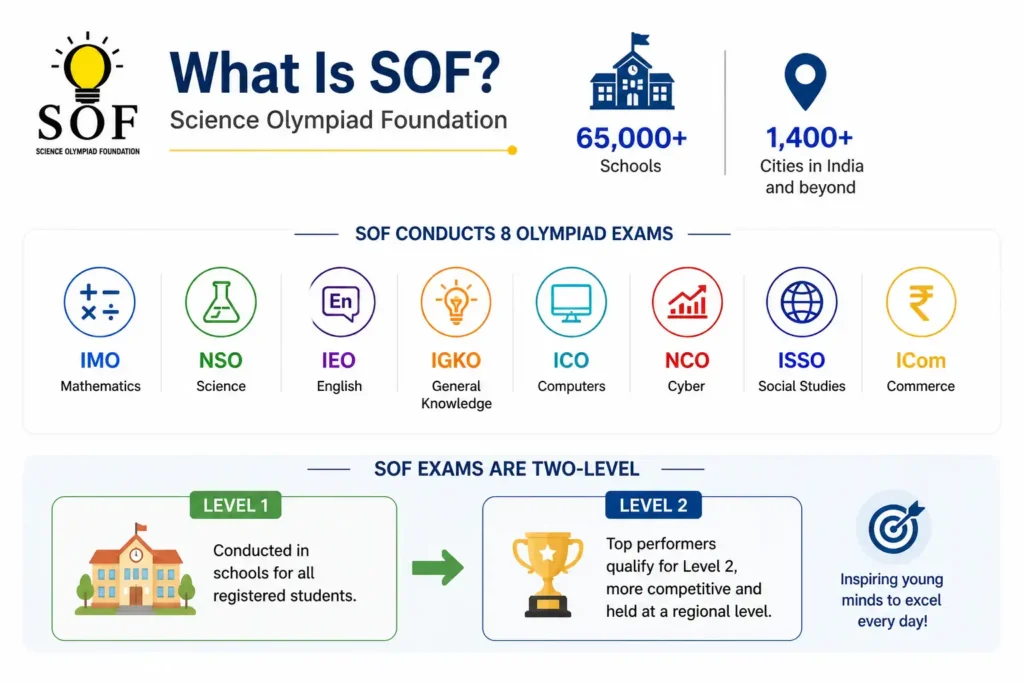
It currently reaches over 65,000 schools across 1,400+ cities in India, as well as schools in several other countries.
SOF conducts eight Olympiad examinations covering subjects ranging from Mathematics and Science to General Knowledge, Computers, and Commerce.
Its best-known exams are the International Mathematics Olympiad (IMO), the National Science Olympiad (NSO), and the International English Olympiad (IEO).
SOF exams are two-level: all registered students appear in Level 1 at their school. Top performers qualify for Level 2, which is more competitive and held at a regional level.
What is SilverZone?
SilverZone Foundation is a growing Olympiad organisation that conducts over 11 subject competitions for students in Classes 1–12.
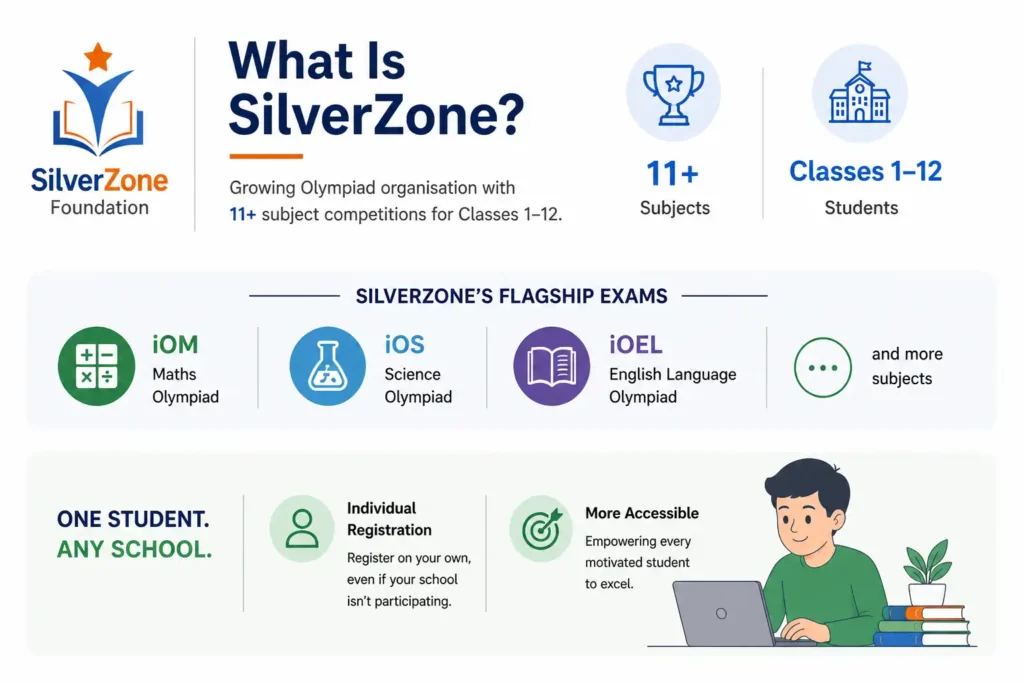
It’s known for offering a broader range of subjects than most Olympiad bodies including unique exams in Hindi, French, and Sanskrit.
SilverZone’s flagship Maths exam is the International Olympiad of Mathematics (iOM).
It also conducts the International Olympiad of Science (iOS) and the International Olympiad of English Language (iOEL), among others.
One standout feature of SilverZone is that it offers individual student registration meaning a student can register even if their school isn’t officially participating.
This makes it significantly more accessible than SOF for motivated self-starters.
SOF vs SilverZone: Full Comparison at a Glance
| Feature | SOF | SilverZone |
| Founded | 1996 | Early 2000s |
| Flagship Maths exam | IMO (International Maths Olympiad) | iOM (International Olympiad of Mathematics) |
| Exams offered | 8 subjects | 11+ subjects |
| Class eligibility | 1–12 | 1–12 |
| Exam levels | 2 (Level 1 and Level 2) | 1 (single level) |
| Registration | School only | School + individual |
| Approximate fee | Rs. 125–150 per exam | Rs. 120–150 per exam |
| Top cash prize (Maths) | Rs. 50,000 (Rank 1 international) | Lower (varies) |
| Unique subject exams | Commerce, Reasoning, GK, Cyber | Hindi, French, Sanskrit, Sports GK |
| School reach | 65,000+ schools | Growing, smaller network |
| Recognition level | Very high (nationwide) | High (growing) |
Subjects and Exams: What Each Organisation Offers
SOF Exam List
SOF conducts eight annual exams:
- IMO — International Mathematics Olympiad (Classes 1–12)
- NSO — National Science Olympiad (Classes 1–12)
- IEO — International English Olympiad (Classes 1–12)
- IGKO — International General Knowledge Olympiad (Classes 1–8)
- NCO — National Cyber Olympiad (Classes 1–12)
- ICO — International Commerce Olympiad (Classes 11–12)
- ISSO — International Social Studies Olympiad (Classes 3–10)
- NRAA — National Reasoning and Aptitude Assessment (Classes 2–12)
SilverZone Exam List
SilverZone conducts 11+ annual exams:
- iOM — International Olympiad of Mathematics (Classes 1–12)
- iOS — International Olympiad of Science (Classes 1–12)
- iOEL — International Olympiad of English Language (Classes 1–12)
- SKGKO — Smart Kid General Knowledge Olympiad (Classes 1–12)
- iOCS — International Olympiad of Cyber Security & IT (Classes 1–12)
- iOSS — International Olympiad of Social Studies (Classes 1–12)
- iFO — International French Olympiad (Classes 1–12)
- iOH — International Olympiad of Hindi (Classes 1–12)
- iRAO — International Reasoning and Aptitude Olympiad (Classes 1–12)
- iSKO — International Sports Knowledge Olympiad (Classes 1–12)
- iOs-SK — International Olympiad of Sanskrit
Unique Subject Coverage
SilverZone is the clear winner for subject variety.
If your child studies French, wants to compete in Hindi, or is interested in Sports GK, SilverZone offers exams that SOF simply doesn’t.
On the other hand, SOF’s Commerce Olympiad (ICO) is a useful option for Classes 11–12 students pursuing a commerce stream that SilverZone doesn’t match.
SOF IMO vs SilverZone iOM: Maths Olympiad Deep-Dive
For students focused on Maths, this comparison matters most.
The IMO and iOM test different skills in subtly different ways.
Exam Pattern Comparison
| Feature | SOF IMO | SilverZone iOM |
| Classes eligible | 1–12 | 1–12 |
| Level structure | 2 levels (Level 1 + Level 2 for top performers) | 1 level (single exam) |
| Questions (Classes 1–4) | 35 MCQs | 40 MCQs |
| Questions (Classes 5–12) | 50 MCQs | 50 MCQs |
| Duration | 60 minutes | 45–60 minutes |
| Sections (Classes 5–12) | Logical Reasoning, Mathematical Reasoning, Everyday Maths, Achievers Section | Mental Ability, Achievers Section, Scholar Section |
| Achievers Section marks | 3 marks per question | Higher per-question marks in Achievers/Scholar sections |
| Negative marking | None | None |
Syllabus Alignment
Both the IMO and iOM are aligned with the CBSE/ICSE curriculum for each class.
Questions in both exams test concept application rather than rote recall, with an emphasis on problem-solving and logical thinking.
The IMO has a stronger emphasis on reasoning at the lower classes (Classes 1–4), while the iOM incorporates a dedicated Mental Ability section across all classes.
Want a topic-by-topic breakdown of what’s tested? Read our complete class-wise SOF IMO syllabus for 2026–27 before you start planning your preparation.
Level Structure and Challenge
The IMO’s two-level structure means serious Maths students get an extra competitive challenge. Level 2 is significantly harder than Level 1, and qualifying for it is itself an achievement.
If your child is aiming for national and international rankings, the IMO offers a richer competitive pathway.
The iOM’s single-level structure means everyone gets a clear final result. This is less intimidating for students participating in their first Olympiad.
For structured IMO preparation, check out our IMO Exam Pattern Guide and IMO Sample Papers on the Gonit Blog.
Already qualified for the next round? Our SOF IMO Level 2 preparation guide covers the advanced strategies that separate qualifiers from rank holders.
SOF NSO vs SilverZone iOS: Science Olympiad
| Feature | SOF NSO | SilverZone iOS |
| Classes eligible | 1–12 | 1–12 |
| Levels | 2 (Level 1 + Level 2) | 1 |
| Sections | Science, Logical Reasoning, Achievers Section | Science-based questions, Achievers, Scholar |
| Syllabus alignment | CBSE/ICSE/State board | CBSE/ICSE |
| Recognition | Very high nationally | Growing |
Both exams cover Physics, Chemistry, and Biology topics as appropriate to the class level.
SOF NSO’s two-level structure again gives it a competitive edge for advanced students seeking national ranking.
SOF IEO vs SilverZone iOEL: English Olympiad
| Feature | SOF IEO | SilverZone iOEL |
| Classes eligible | 1–12 | 1–12 |
| Levels | 2 | 1 |
| Sections | Word and Structure Knowledge, Reading, Spoken and Written, Achievers | Grammar, Reading, Writing, Achievers |
| Focus | Grammar, comprehension, vocabulary | Grammar, comprehension, creative writing |
For English Olympiad preparation, both exams test similar skills.
The IEO’s Level 2 is particularly useful for students who want to develop strong English skills beyond board exams.
Exam Pattern and Syllabus Comparison
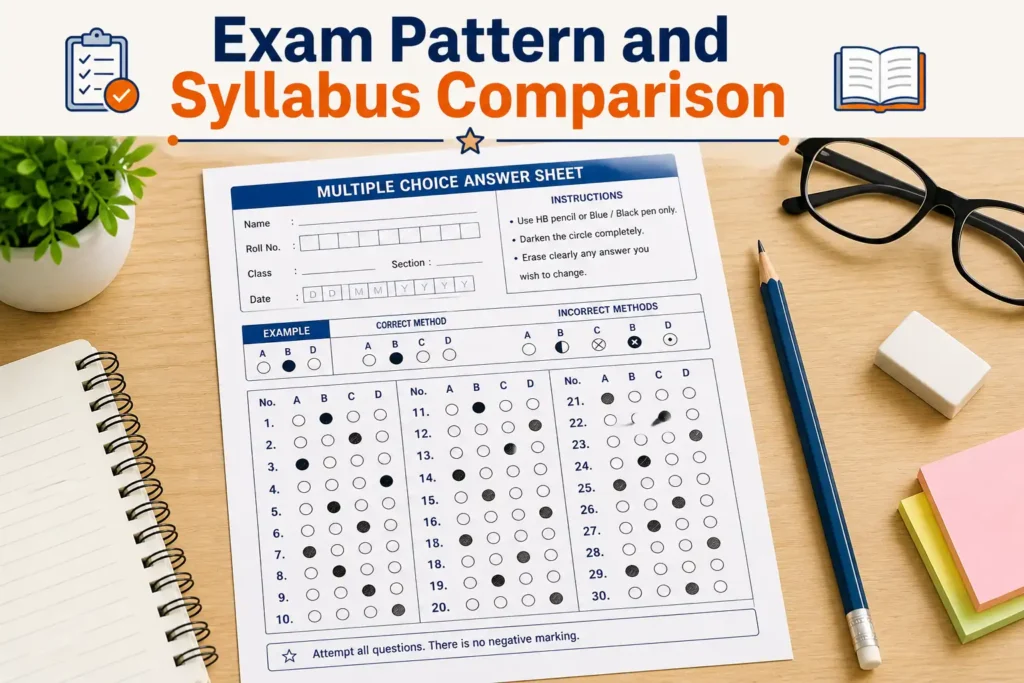
Number of Questions and Marking
Neither SOF nor SilverZone uses negative marking, which makes both accessible to students who are still building exam confidence.
SOF IMO (Classes 5–12) has four sections in Level 1: Logical Reasoning (10 questions, 1 mark each), Mathematical Reasoning (20 questions, 1 mark each),
Everyday Mathematics (10 questions, 1 mark each), and Achievers Section (5 questions, 3 marks each). Total: 60 marks.
SilverZone iOM (Classes 6–10) has three sections with varying marks per question.
The Scholar Section and Achievers Section carry more weight, rewarding students who attempt higher-difficulty questions.
For a complete section-by-section breakdown of marks, time distribution, and question types, see our SOF IMO exam pattern guide for 2026–27.
Level Structure
This is one of the most important differences. SOF’s two-level system means:
- Level 1 acts as a qualifier.
- Top performers from each class per school, zone, and state move to Level 2.
- Level 2 determines final international rankings.
SilverZone uses a single level. Results are declared based on the one exam, with rankings assigned at school, city, state, and international levels.
For students targeting national-level medals, SOF’s Level 2 offers a more robust competition structure.
Difficulty Level Comparison
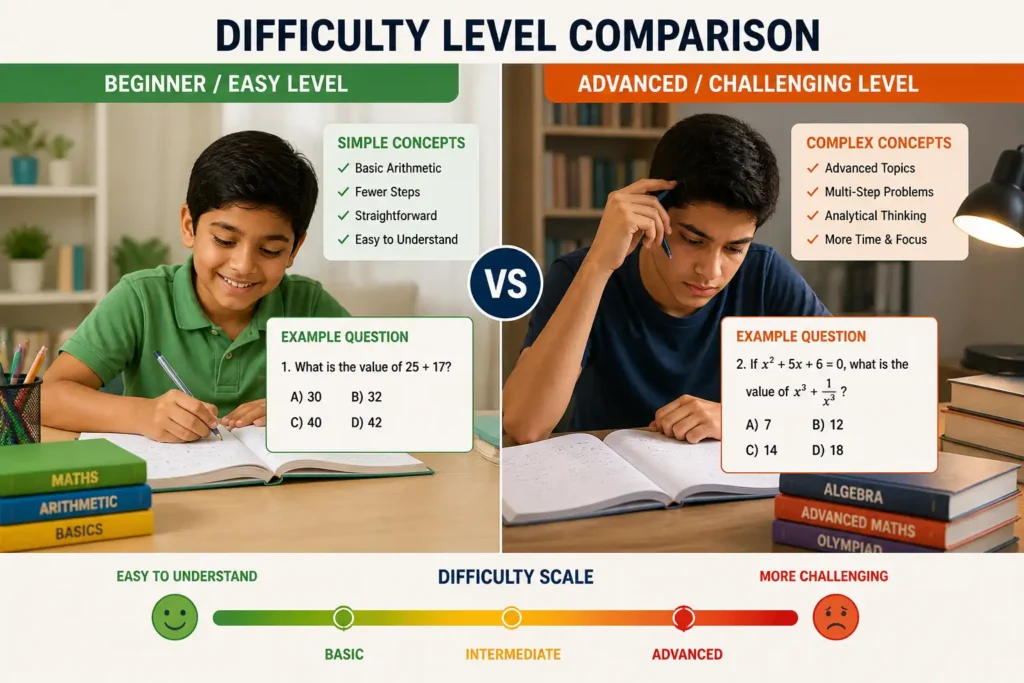
Students and teachers who have appeared in both exams consistently rate SOF as slightly more challenging, particularly at Level 2.
SOF’s Achievers Section questions are known to be conceptually demanding and time-sensitive.
SilverZone is generally considered more approachable, especially for Classes 1–5. Its Scholar Section allows strong students to score higher, but the base difficulty is manageable for students with regular school preparation.
For students in Classes 1–4 taking their first Olympiad, SilverZone is a gentler starting point. For students in Classes 6–12 who want a real competitive challenge, SOF’s Level 2 is hard to beat.
If you’re planning to attempt SOF IMO this year, our 60-day SOF IMO preparation strategy gives you a structured, class-wise study plan that covers both levels.
Registration Process Comparison
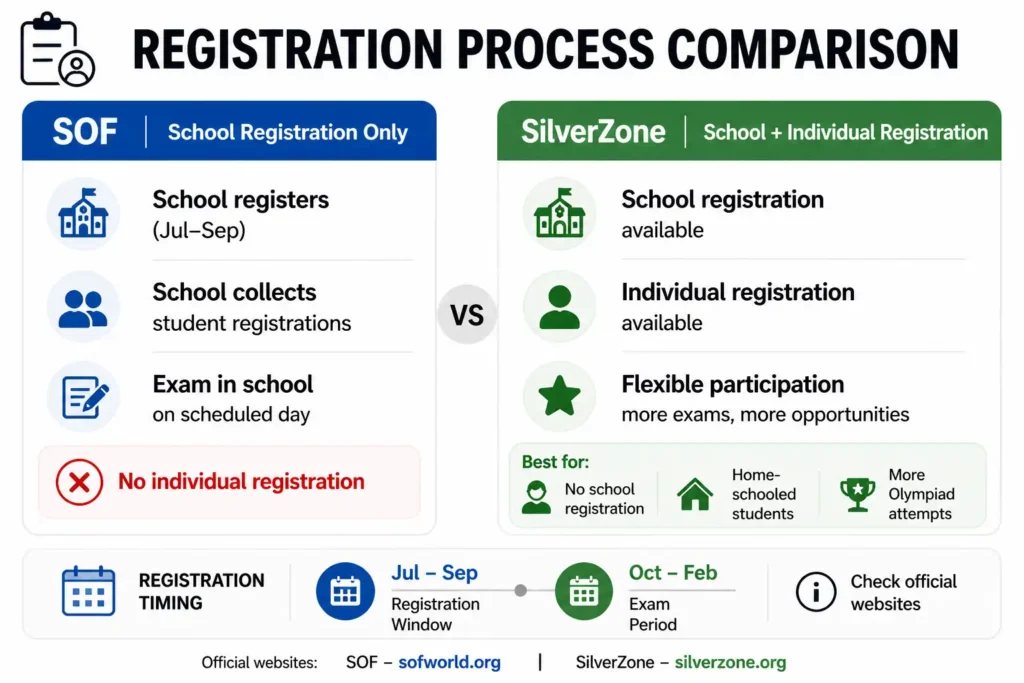
SOF — School Registration Only
SOF exams are conducted exclusively through registered schools. Your school must:
- Register with SOF (usually between July and September).
- Collect individual student registrations.
- Conduct the exam on the designated school exam day.
If your school is not registered with SOF, you cannot independently register.
In that case, it’s worth checking with your school administration to request registration, or switching to SilverZone.
SilverZone — School + Individual Registration
SilverZone accepts both school-based and individual student registrations. Individual students can register directly at the SilverZone website.
This is a significant advantage for:
- Students whose schools haven’t registered.
- Home-schooled students.
- Students who want to attempt multiple Olympiad exams beyond what their school offers.
Registration Timing
Both organisations typically open registrations between July and September, with exams scheduled between October and February.
Exact dates are announced on the official SOF (sofworld.org) and SilverZone (silverzone.org) websites.
Always verify current year dates and fees directly with the official source.
Awards, Certificates, Medals, and Recognition

SOF Awards and Prize Money
SOF’s prize structure for the IMO (and similar for NSO, IEO):
- International Rank 1: Rs. 50,000 cash + gold medal + certificate of distinction
- International Ranks 2–3: Rs. 25,000 + gold medal
- International Ranks 4–10: Rs. 10,000 + silver medal
- International Ranks 11–25: Rs. 5,000 + bronze medal
- Class toppers (zonal): Medals and certificates
- School toppers: Certificate of excellence
- All participants: Digital participation certificate
SOF certificates are well-recognised and widely used in school portfolios, national entrance applications, and extracurricular sections on college forms.
For a full breakdown of prize tiers, medal criteria, and rank cutoffs, read our SOF IMO awards and prizes guide.
SilverZone Awards and Prize Money
- International top rank holders: Cash prizes (amount varies by year and subject)
- Gold, silver, bronze medals based on performance percentile bands
- Certificates for all participants
- Merit certificates for top performers per school, city, and state
SilverZone’s prizes are generally lower in cash value than SOF’s, but medals and certificates are equally meaningful for a student’s academic profile.
Which Certificates Matter More?
At the school and board exam level, certificates from both organisations carry similar value.
SOF’s larger scale means more teachers, counselors, and admissions officers are familiar with it but a SilverZone medal is equally legitimate.
For students targeting IIT-JEE or other highly competitive exams, state and international-level SOF ranks carry slightly more prestige simply due to the larger candidate pool.
Pros and Cons: SOF
Pros:
- Largest Olympiad body in India; very high recognition among schools and colleges
- Two-level exam structure provides a genuine competitive challenge
- Higher cash prizes at the top
- Aligns well with CBSE, ICSE, and most state board syllabi
- Extensive preparation materials (sample papers, previous year papers) available
Cons:
- School registration only no individual registration option
- Fewer subject options compared to SilverZone
- Level 2 can be very challenging without structured preparation
- School must already be a registered SOF centre
Pros and Cons: SilverZone
Pros:
- Individual registration available no school dependency
- Broader subject coverage, including Hindi, French, and Sanskrit Olympiads
- Single-level exam is less intimidating for first-time participants
- Good starting point for Classes 1–5 students building confidence
- More accessible for home-schooled or non-affiliated students
Cons:
- Smaller school network and lower brand recognition compared to SOF
- Cash prizes generally lower than SOF
- No Level 2 exam less depth for top performers seeking competitive ranking
- Less widely referenced in competitive exam contexts
Which is Better? Best for Whom
There’s no single answer but there is a right answer for your situation.

Best for Beginners (Classes 1–5)
SilverZone is a better starting point. Its single-level format is less stressful, and its base difficulty is appropriate for students who are new to Olympiad-style questions.
Starting here builds confidence before moving to SOF’s two-level structure.
Best for Advanced and Competitive Students (Classes 6–12)
SOF is the stronger choice. The IMO’s Level 2, NSO Level 2, and IEO Level 2 offer a rigorous competition structure that genuinely prepares students for high-stakes exams.
The larger candidate pool also makes national and international rankings more meaningful.
Best for Maths Preparation
SOF IMO edges ahead for students with serious Maths ambitions.
The two-level structure, the depth of the Achievers Section, and the large national pool make it the better choice for students aiming to build competitive Math skills over time.
Start with our SOF IMO sample papers for 2026–27 to get a feel for the question style and difficulty before committing to a prep plan.
Best for School Recognition
SOF wins on familiarity. In most schools across India, SOF rank certificates are more commonly displayed and recognised in student profiles.
That said, SilverZone certificates are completely valid and well-regarded particularly for unique subjects like Hindi or French where no SOF equivalent exists.
What’s the main difference between SOF and SilverZone?
SOF (Science Olympiad Foundation) has been around since 1996 and offers 8 exams across a large school network, with a two-level exam structure. SilverZone is newer, offers 11+ subjects including Hindi and French, and allows individual registration. SOF has stronger nationwide recognition; SilverZone has more subject diversity and easier access.
Can I register for SOF without my school’s participation?
No. SOF requires school-based registration. Your school must be a registered SOF centre for you to appear in any SOF exam. If your school isn’t registered, you can request them to do so, or consider SilverZone, which allows individual registration directly on their website.
Which is harder — SOF IMO or SilverZone iOM?
SOF IMO is generally considered harder, especially at Level 2 where the questions are conceptually demanding. The iOM is slightly more accessible and well-suited for students who are new to Maths Olympiad preparation. For both, consistent practice with class-appropriate questions is the most reliable preparation strategy.
Which Olympiad is best for Class 1 to 12 students?
It depends on the class and goal. For Classes 1–5 beginners, SilverZone’s iOM is a gentler first experience. For Classes 6–12 competitive students, SOF IMO offers a stronger challenge and more competitive ranking. Many students participate in both attempting iOM for confidence-building and IMO for competitive ranking.
Is SilverZone recognised internationally?
SilverZone exams are open to Indian students and some international participants, and the “International” in exam names reflects cross-school ranking rather than multi-country competition in the traditional sense, similar to SOF. Neither SOF nor SilverZone is affiliated with the International Mathematical Olympiad (IMO) run by the government. Both are privately run, legitimate educational Olympiads widely accepted by Indian schools.
Can a student appear in both SOF and SilverZone in the same year?
Yes. There’s no rule preventing a student from registering for both. Many students appear in SOF IMO and SilverZone iOM in the same academic year. It requires additional preparation time, but the overlapping syllabus (CBSE/ICSE-aligned) means preparing for one largely helps with the other.
Make Preparing for Math Olympiad Simple!



Conclusion
The SOF vs SilverZone comparison doesn’t have a single winner, it has the right answer for your child.
If your child is in Classes 1–5 and trying their first Olympiad, SilverZone’s accessible format and individual registration make it the easier entry point.
If they’re in Classes 6–12 and aiming for a genuine competitive challenge with national recognition, SOF IMO is the stronger choice.
Start your preparation today with the Gonit App.
We offer class-wise practice questions, concept walkthroughs, mock tests, and SOF IMO sample papers for both SOF IMO and SilverZone iOM structured for every class from 1 to 12. Don’t just participate. Prepare to rank.