June 23, 2026
 19 min. read

To teach telling time to Grade 1 kids, start with the basics of duration before looking at a clock. Once they grasp the concept of time, focus on the analog clock.
Then introduce the analog clock step by step: identifying the clock hands, reading “o’clock,” and learning “half-past.”
Building this sense of measurement for Class 1 lays the groundwork for everything that follows.
A half hour is literally half the clock. A quarter hour is a quarter of the face. Children can see time moving, not just read it as a frozen number.
This guide explains how to teach telling time to Grade 1 kids with simple activities, practical tips, and common mistakes to avoid.
Understanding the Analog Clock
Before you teach any times at all, spend real time, maybe a full lesson, just getting to know the clock. Don’t rush this step.
The Parts of the Clock
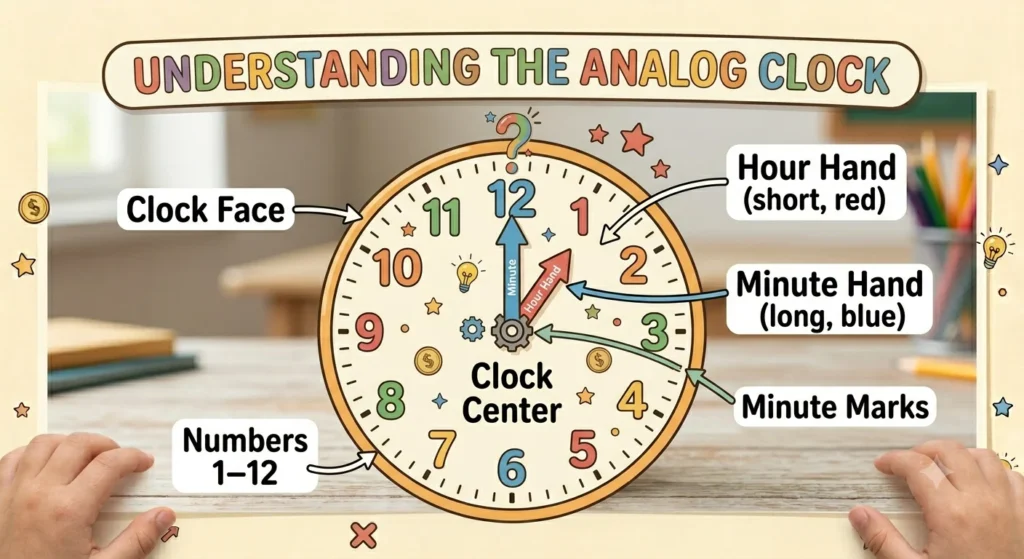
The clock face is the round surface with numbers 1 through 12 arranged in a circle. The numbers go clockwise, meaning they run in the same direction clock hands always move.
The hour hand is the short, stubby hand. It moves slowly; it takes a full hour to travel from one number to the next. A helpful memory trick for kids: “The hour hand is short because hours are slow.”
The minute hand is the long, thin hand. It completes one full trip around the clock every hour. As it passes each number (1 through 12), it marks another five minutes. This is also why skip counting by 5s is such a useful foundation before tackling the minute hand.
Here’s a quick reference vocabulary list to use with students throughout your lessons:
| Term | Meaning |
| O’clock | The minute hand points exactly to the 12 |
| Half past | The minute hand points exactly to the 6 (30 minutes) |
| Quarter past | The minute hand points exactly to the 3 (15 minutes) |
| Quarter to | The minute hand points exactly to the 9 (45 minutes) |
Teaching Tip: Use two different colors when making or labeling a practice clock, one for the hour hand, one for the minute hand. Color-coding reduces confusion dramatically, especially for visual learners.
Why Teach the Hour Hand First
One of the most important insights from experienced teachers: introduce the hour hand only to start. Cover the minute hand or remove it entirely from a practice clock.
Children who try to process both hands at once get overwhelmed.
Once they can reliably read the hour hand, knowing whether it’s “in the 3 room” or “in the 7 room”, add the minute hand. This staged approach makes a huge difference.
Teaching Full Hours (O’Clock)
This is where all clock lessons for grade 1 begin.
Full hours, or “o’clock” times, are the simplest because both hands have clear, easy-to-remember positions.
What O’Clock Looks Like
At any o’clock time:
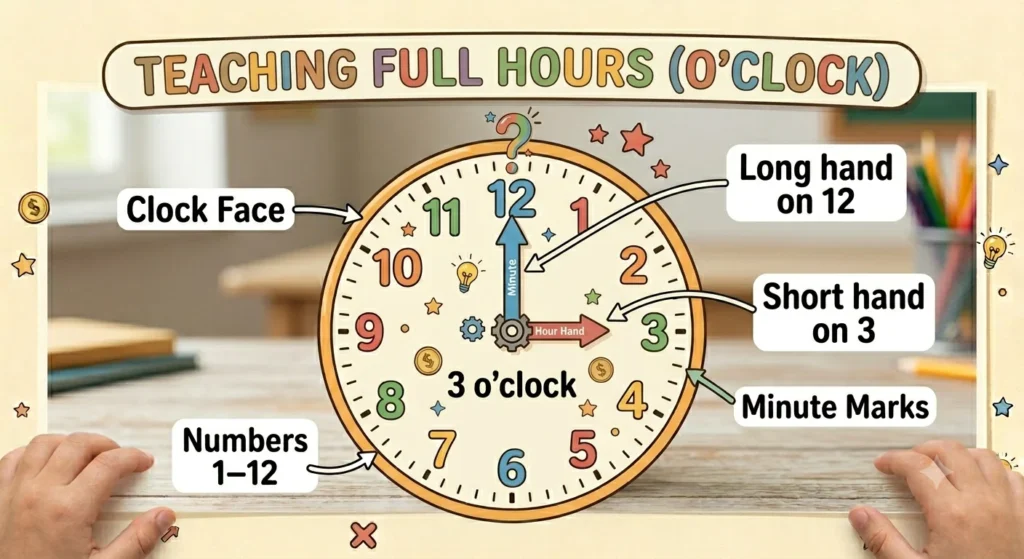
- The minute hand points straight up to the 12.
- The hour hand points directly at one of the numbers 1–12.
So 3 o’clock means the minute hand is at 12 and the hour hand is at 3. Simple.
How to Teach It Step by Step
Step 1: Use a large demo clock. Show children an analog clock with the hands set to 3:00. Say: “When the long hand is at the top, at 12, we say it’s ‘o’clock.’ The short hand tells us which o’clock. It’s pointing at 3, so it’s 3 o’clock.”
Step 2: Introduce the “rooms” concept. Each number on the clock has a “room”, the space that follows it as you move clockwise. When the hour hand is inside the 3’s room (not yet in the 4’s room), it is the 3 o’clock hour. This prevents the common error of children reading 3:55 as 4 o’clock because the hour hand is near the 4.
Step 3: Connect to daily life. “School starts at 9 o’clock. Show me 9 o’clock on your clock.” Children instantly feel the relevance.
Step 4: Practice writing the time. After reading a clock, have children write the time in digital format: 3:00, 7:00, 11:00. The colon and two zeros are part of the vocabulary.
Practice Questions: O’Clock
Try these with your child or class. Once clock-reading feels comfortable, you can also weave time into word problems for Grade 1 to deepen the application.
- The hour hand is at 5 and the minute hand is at 12. What time is it? (Answer: 5 o’clock / 5:00)
- Show me 8 o’clock on your clock. (Hour hand on 8, minute hand on 12)
- What time do you wake up in the morning? Show it on the clock. (Varies, great for discussion)
Teaching Half Hours (Half Past)
Once children are solid on o’clock, introduce half past.
Don’t move on until they’re genuinely confident with full hours, this progression matters.
What Half Past Looks Like
At any half-past time:
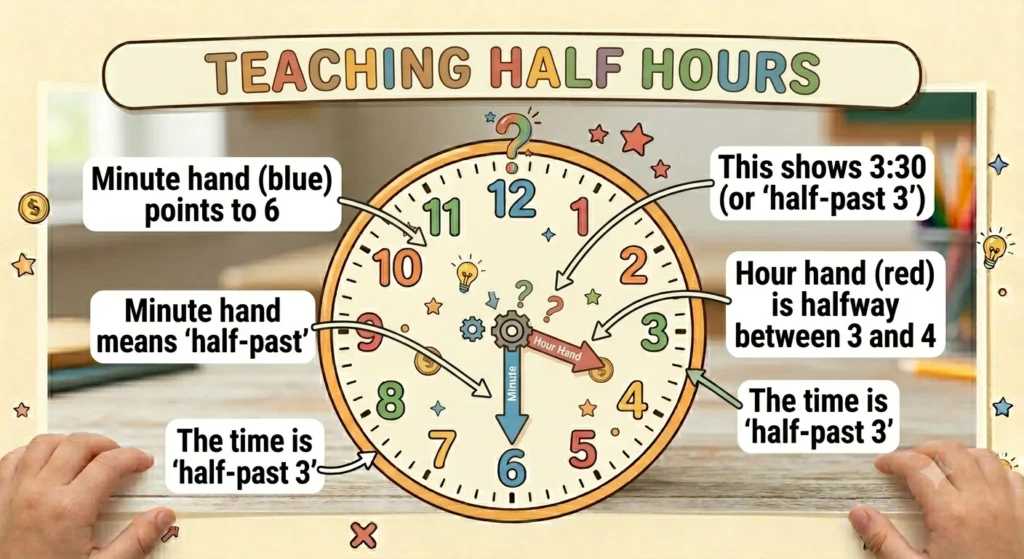
- The minute hand points straight down to the 6.
- The hour hand is halfway between two numbers, it’s passed the first number but hasn’t reached the next.
So “half past 3” (3:30) has the minute hand on 6 and the hour hand halfway between 3 and 4.
Why “Half Past” Can Trip Kids Up
The tricky part is the hour hand. Children who learned that “2 o’clock means the short hand is ON the 2” now have to understand that at 2:30, the short hand has moved past the 2.
It’s no longer sitting on it. If you ask them “what time is it?” at 2:30, many will say either 2:30 or 3:30 depending on which number they look at.
The fix: keep reinforcing the “rooms” idea. The hour hand is still inside the 2’s room, it hasn’t entered the 3’s room yet. So it’s still the 2 o’clock hour, just thirty minutes in.
How to Teach It Step by Step
Step 1: Start with the minute hand. “When the long hand travels halfway around the clock and reaches the 6, 30 minutes have passed. We say ‘half past.'”
Step 2: Use a fraction visual. Draw a circle (clock). Shade the top half. If your child is also learning about fractions for Class 1, this is a great moment to connect the two ideas.
“The minute hand has traveled this much of the clock, half of it. That’s why we call it half past.”
Step 3: Identify the hour. “Now look at the short hand. It’s past the 3 but before the 4. That means it’s the 3 o’clock hour. So together, it’s half past 3, or 3:30.”
Step 4: Let children set the time. Give them a paper clock and call out half-past times. Watch where they place the hour hand, many will put it directly on the number.
Gently redirect: “Not quite on the 3, it’s moved a little past it.”
Pro Tip: Teach children to say “half past ” AND “:30″ interchangeably. “Half past 7” and “7:30” mean the same thing. Real-world fluency means knowing both.
Practice Questions: Half Past
- The minute hand is on the 6 and the hour hand is halfway between 9 and 10. What time is it? (Answer: half past 9 / 9:30)
- Show me half past 1 on your clock. (Minute hand on 6, hour hand just past the 1)
- What time is half past 12? (12:30)
Teaching Quarter Hours (Quarter Past & Quarter To)
Quarter hours come last in the learning progression.
They require children to understand that the clock face can be divided into four equal pieces, quarters, and to count with those quarters in mind. Take your time here.
The Clock as a Pie
A great visual: draw a clock and divide it into four equal quarters like a pie. Label the top quarter (12 to 3) as the first quarter, the second quarter goes to the 6, the third quarter to the 9, and the fourth returns to the 12.
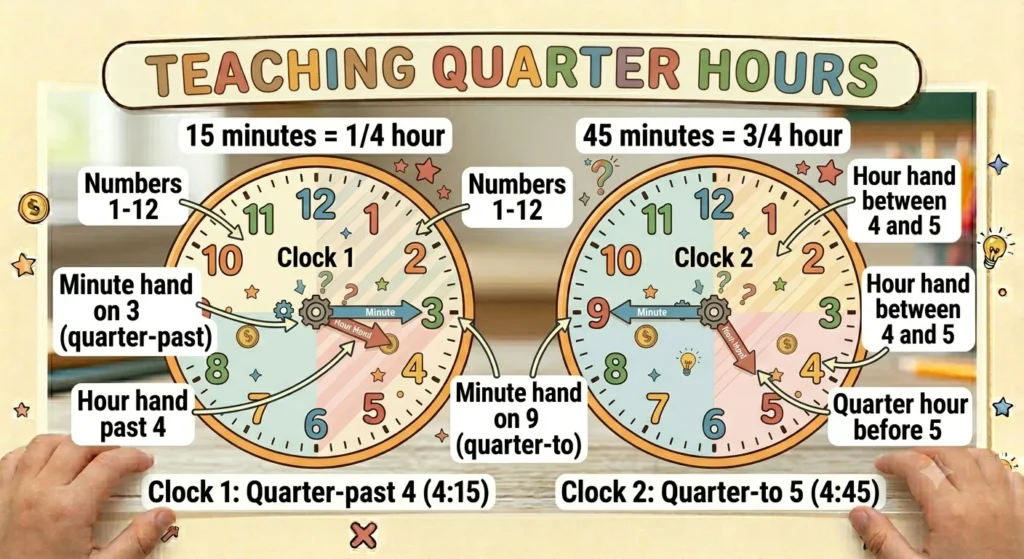
- Quarter past = the minute hand has moved through the first quarter and is sitting on the 3. That’s 15 minutes past the hour.
- Quarter to = the minute hand is on the 9, meaning it’s 45 minutes past the hour, or 15 minutes before the next hour.
Teaching Quarter Past
Step 1: “The minute hand has traveled one quarter of the way around the clock and is now on the 3. That means 15 minutes have passed. We call this quarter past.“
Step 2: Identify the hour from the hour hand. The hour hand will be slightly past its number, since 15 minutes have elapsed.
Step 3: “So if the hour hand passes the 4, and the minute hand is on the 3, it’s quarter past 4, or 4:15.”
Teaching Tip: Some children find it easier to think of the 3 as the “quarter past marker.” Put a small sticker or draw a special mark next to the 3 on their practice clocks as a visual anchor.
Teaching Quarter To
Quarter to is harder because it asks children to think ahead to the next hour. This is conceptually new.
Step 1: “The minute hand is on the 9, which means 45 minutes have gone by. We’re getting close to the next hour, only 15 minutes away. We say it’s quarter to the next hour.”
Step 2: Identify the upcoming hour. If the hour hand is between 6 and 7 and moving toward 7, it’s quarter to 7 (6:45).
Step 3: Practice naming both ways: “Quarter to 7 is the same as 6:45.” Give children both formats to work with.
A Visual Shortcut for Quarter To
Draw an arrow pointing counterclockwise from the 9 to the 12. Explain: “The minute hand is on the 9. It still needs to travel this much (pointing to the quarter arc) to reach the 12.
That little bit left? That’s 15 minutes, a quarter of an hour. So we say quarter to [next hour].”
Practice Questions: Quarter Hours
- The minute hand is on the 3 and the hour hand just passed the 2. What time is it? (Answer: quarter past 2 / 2:15)
- The minute hand is on the 9 and the hour hand is between 10 and 11. What time is it? (Answer: quarter to 11 / 10:45)
- Show me quarter past 6 on your clock. (Minute hand on 3, hour hand slightly past 6)
- What’s another way to say quarter to 8? (7:45)
Hands-On Activities and Games
Worksheets have their place, but research and classroom experience consistently show that children learn time faster through touching, moving, and playing.
These activities pair well with broader critical thinking activities for Grade 1 that develop reasoning alongside number skills. Here are five that work well both at home and in the classroom.
Activity 1: Make a Paper Clock (Craft + Learning Tool)
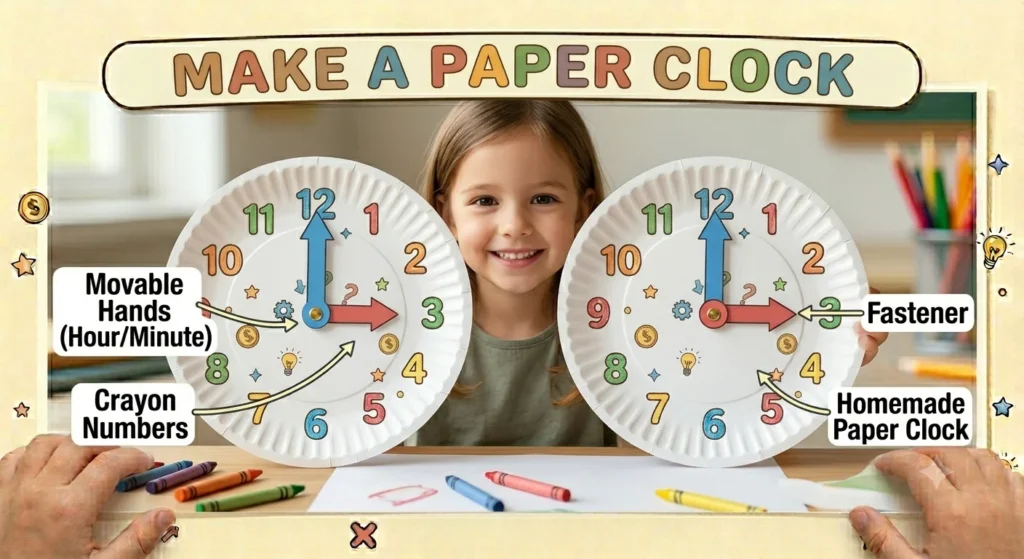
What you need: Two paper plates (or cardboard circles), a brass paper fastener, scissors, a marker.
How to do it:
- Label the top circle 1–12, spacing the numbers evenly like a real clock.
- Cut two arrows from leftover cardboard, one short (hour hand) and one long (minute hand).
- Poke the fastener through the center of both arrows and then both circles, so the hands can rotate.
- Optionally, color the hour hand in one color and the minute hand in another.
Now children have a clock they made themselves. Use it throughout all your lessons. Research shows that the act of building the tool deepens engagement with the concept.
Classroom version: Have every child make their own at the start of the unit. Store them in a zipper bag. They become personal practice tools at their desks.
Home version: Make one on a rainy afternoon. Leave it on the kitchen table. Ask kids to set the time to “whatever time it is right now” as you go about your day.
Activity 2: “What Time Is It, Mr. Fox?” Movement Game
This classic game gets kids on their feet while drilling o’clock times.
How to play:
- One child (or the teacher) is “Mr. Fox” and stands at one end of a large space.
- All other children stand at the opposite end.
- Children call out: “What time is it, Mr. Fox?”
- Mr. Fox calls back an o’clock time: “It’s 3 o’clock!”
- Children take that many steps forward (3 steps for 3 o’clock).
- When Mr. Fox says “It’s DINNER TIME!” Everyone runs back to the start line. The first one caught becomes the new fox.
Why it works: Children hear and repeat o’clock dozens of times in a few minutes without feeling like they’re drilling.
Adapt it: Use half-past times for older groups (“Half past 4, take 4½ steps!”). Even the silliness of a half-step gets children thinking about what “half” means.
Activity 3: Daily Schedule Matching
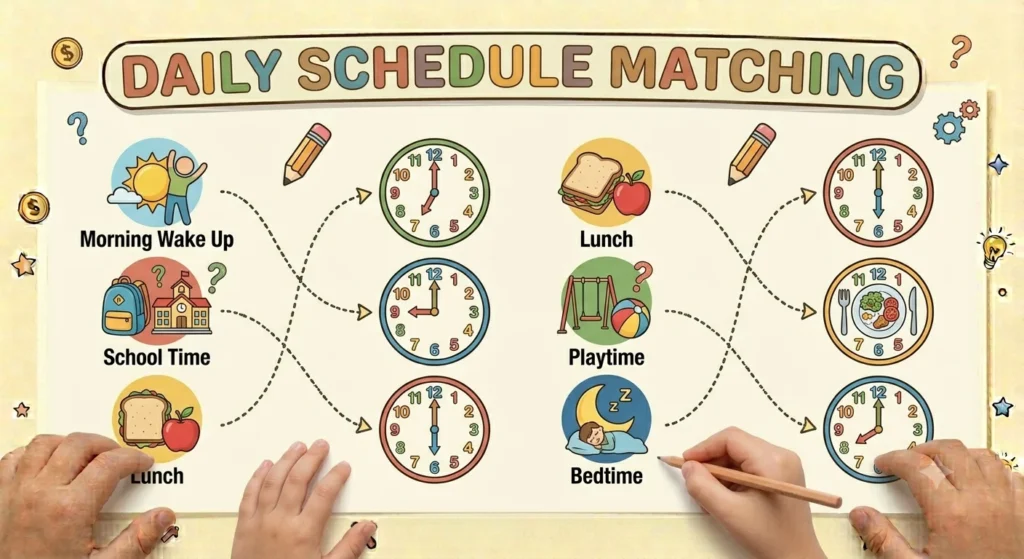
What you need: A list of daily events + blank clock printouts (or paper clocks).
How to do it:
- Write out 5–6 daily events with their times: wake up at 7:00, school starts at 9:00, lunch at 12:30, reading time at 2:15, dinner at 6:00, bedtime at 8:00.
- Provide blank clock faces. Children draw the hands to show each time.
- Or reverse it: show clocks with times drawn and have children match them to the correct daily event.
Why it works: It grounds abstract clock-reading in the child’s own life. Learning time for first grade sticks best when children can see why it matters.
Activity 4: Clock Freeze Dance
What you need: Music, blank clock worksheets or whiteboards, markers.
How to play:
- Students dance while music plays.
- When the music stops, call out a time (e.g., “half past 6!”).
- Children have 30 seconds to draw the clock hands showing that time on their whiteboard or sheet.
- Check answers together before the music starts again.
Why it works: The brief burst of movement followed by a focused task helps maintain attention, especially for kinesthetic learners who struggle with long sit-down sessions.
Activity 5: Clock Bingo
What you need: Bingo cards with clock faces instead of numbers (one time drawn on each square), small counters or coins.
How to play: The teacher calls out times (“quarter past 9!”) and children cover the matching clock on their card. First to get five in a row wins.
Classroom version: Make 5–6 different card layouts so multiple students don’t win simultaneously.
Home version: Make two cards, one for the child, one for the parent. Takes about 15 minutes to play, requires zero prep once cards are made.
Connecting Time to Daily Routines
One of the biggest gaps in most telling-time instruction is this: the lessons stay abstract.
Children practice clocks during math time… and then never think about them again until the next math lesson.
The most effective teachers weave time into the fabric of the day. Here’s how to do that naturally:
At home:
- Point to the clock before transitions: “It’s quarter past 7. We leave at half past. That’s 15 minutes.”
- Let children be the “time keeper.” Give them a job: “Tell me when it’s 5 o’clock, that’s when we start dinner.”
- When setting timers, say the time out loud: “I’m setting this for 20 minutes. It’s 4:10 now, so it’ll go off at 4:30, half past 4.”
In the classroom:
- Keep an analog clock at eye level and reference it throughout the day.
- At transitions, pause and ask: “Look at the clock. What time is it? What time does reading end? How many minutes do we have left?”
- Use “time vocabulary” naturally in instructions: “In half an hour, we’ll clean up.”
When children connect the clock to breakfast, school, playtime, and bedtime, the numbers stop being abstract. They become part of how the day feels.
Common Mistakes Children Make, and How to Fix Them
Understanding where children go wrong makes it much easier to help them get it right.
Mistake 1: Confusing the Hour and Minute Hands
What it looks like: A child sees 6:30 and reads it as “half past 12” (because the long hand is at 6).
Why it happens: They’ve mixed up which hand is which.
Fix: Color-code your practice clock. Use red for the hour (short) hand and blue for the minute (long) hand. Every time you introduce a new time concept, remind them: “Short hand = hours. Long hand = minutes.”
Mistake 2: Reading the Wrong Hour at Half Past
What it looks like: At 2:30, the child says “3:30” because the hour hand is close to the 3.
Why it happens: They learned that “the short hand points AT the number” and are applying that rule incorrectly.
Fix: Revisit the “rooms” concept. The hour hand is still in the 2’s room, it hasn’t crossed into the 3’s room yet. You can even draw the rooms on a clock with different color pencils.
Mistake 3: Reading Quarter To Incorrectly
What it looks like: At 4:45, the child says “quarter past 9” (because the minute hand is on the 9, and “quarter past” is the phrase they remember).
Why it happens: “Quarter to” is a more abstract concept than “quarter past”, it requires thinking ahead to the next hour.
Fix: Introduce a clear visual rule: “When the minute hand is on the 9, count forward, there are 15 minutes left until the next hour. So it’s 15 minutes TO the next hour.” Practice this direction explicitly before mixing quarter past and quarter to.
Mistake 4: Writing Time Without the Colon
What it looks like: “300” instead of “3:00.”
Fix: Practice the format explicitly. A clock shows 3:00 with a colon between the hour and the minutes. Make writing the colon part of every practice activity.
Mistake 5: Thinking Digital and Analog Are Completely Different Things
What it looks like: A child reads 3:30 on a digital clock easily, but cannot read it on an analog clock, or vice versa.
Fix: Show both representations together constantly. Draw an analog clock and write the digital time below it. When children see them paired, they start to build the bridge between formats on their own.
Tips for Parents and Teachers
Here are the most practical insights from experienced early childhood educators.
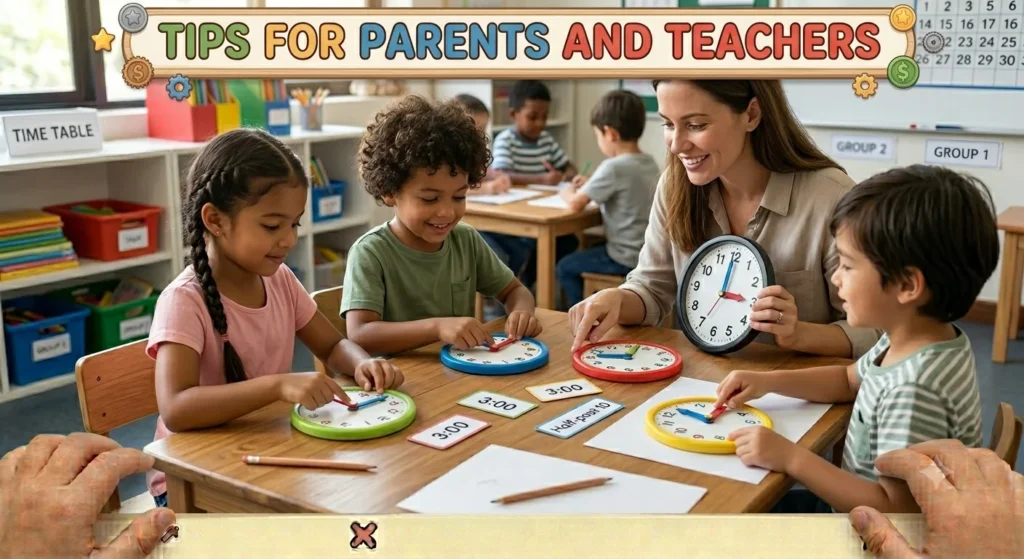
For teachers:
- Allocate more time than you think you need. An hour on o’clock, two weeks on half past, more on quarter hours, that’s not unusual, and it’s appropriate.
- Start with hour-hand-only practice. Covering the minute hand removes half the confusion.
- Build time vocabulary into every transition of the school day, not just math time.
- Keep a large, clearly visible analog clock in your classroom. Digital displays alone don’t reinforce the concepts children are learning.
- Guided math centers (small groups) are ideal for telling time work. You can observe where individual children are struggling and address misconceptions in real time.
For parents:
- Don’t quiz your child the same way every time. Mix up the format: sometimes read the clock together, sometimes ask them to set a time on a paper clock, sometimes ask what time it will be in an hour.
- Resist correcting immediately. Give children five seconds to think before jumping in.
- Make analog clocks visible at home. A clock on the kitchen wall, referenced daily, does more than any worksheet.
- Celebrating specific progress: “You read that half-past time so fast!” is more useful feedback than “Great job!”
- If your child struggles, go back one step. Confusion about half past often means o’clock isn’t fully solid yet.
Pro Tip: The very best practice for telling time is also the simplest: ask your child what time it is, every day, multiple times a day. Real clocks, real context, real practice.
At what age should children learn to tell time?
Most children begin formal instruction in telling time around age 6–7, which aligns with Grade 1. However, time awareness, understanding concepts like before/after, morning/afternoon, and how long activities take, begins much earlier. By the end of Grade 1, the typical expectation (under Common Core and most state standards) is that children can tell time to the hour and half hour on both analog and digital clocks. Quarter hours are often introduced in Grade 1 as well, depending on the curriculum, and are solidified in Grade 2.
Why do we teach analog clocks when digital clocks are everywhere?
Digital clocks display time as a number, which is easy to read, but they don’t show what time means. An analog clock makes the concept of time visible: you can see that half an hour is half the clock, that a quarter hour is a quarter of the clock, and that time moves in a continuous circle. This visual grounding supports deeper understanding of fractions, elapsed time, and time estimation. Learning analog first makes digital completely straightforward.
My child can read o’clock times but struggles with half past. What should I do?
This is very common! The jump from o’clock to half past introduces a new challenge: the hour hand is no longer pointing at a number. Go back to basics with the hour hand only, no minute hand. Show your child that at half past, the short hand has moved past the number and is halfway to the next one. Use a paper clock and physically rotate the hands together slowly so children can watch the movement happen. The “hour rooms” visual helps enormously here.
How do I teach the difference between quarter past and quarter to?
Teach them separately, weeks apart if needed. Master quarter past completely before introducing quarter to. For quarter past, anchor on the simple rule: “Minute hand on the 3 = 15 minutes past the hour.” For quarter to, explain it as counting forward: “The minute hand is on the 9, which means there are 15 minutes left before the next hour starts.” Use a color-coded clock where the first quarter (12 to 3) is one color and the last quarter (9 to 12) is another to make the difference visual.
How long does it take for a Grade 1 child to master telling time?
There’s significant variation, but here’s a realistic guide:
O’clock times: 1–2 weeks of practice for most children
Half past: 2–3 more weeks, with continued daily reinforcement
Quarter hours: 2–4 additional weeks, often firmed up in Grade 2
The key is daily, low-pressure exposure, not intensive cramming. A child who hears “it’s quarter past 8, time to leave!” every morning will master telling time faster than one who only encounters clocks during a 30-minute math lesson.
Should I teach digital time alongside analog time?
At Grade 1 level, introduce them together but keep the emphasis on analog. When you show a clock reading 3:00, also write “3:00” and say “three o’clock.” This helps children see that the two representations are describing the same moment. However, don’t use digital-only practice as a substitute, it skips the conceptual understanding that analog clocks build so well.
Are there any fun ways to practice at home without worksheets?
Absolutely. Some of the most effective home practice involves no paper at all:
Reference the kitchen or living room clock constantly throughout the day.
Play “What Time Is It, Mr. Fox?” in the backyard.
Let your child be the official timekeeper for after-school activities.
Make a paper plate clock together and keep it on the fridge.
Use cooking and baking: “The timer is set for 20 minutes. What time will it go off?”
Children who connect clock-reading to real moments in their day internalize the skill faster and retain it longer.
Make Preparing for Math Olympiad Simple!



Conclusion
Teaching time to Grade 1 kids is most effective when done step by step: first understanding duration, then learning the analog clock, followed by o’clock and half-past times.
Keep lessons short, practice daily, and connect time concepts to real-life routines. With patience and consistent practice, children can build lasting confidence in reading clocks.
Start with duration. Build to the clock. Take it one step at a time, and watch it click.