


Before children start counting pennies, nickels, and dimes, they need to recognize each coin and understand its value.
- What Are Pennies, Nickels, and Dimes?
- Why Coin Counting Is an Important Skill
- Step 1: How to Count Pennies
- Step 2: How to Count Nickels Using Skip Counting by 5s
- Step 3: How to Count Dimes Using Skip Counting by 10s
- Step 4: How to Count Mixed Groups of Pennies, Nickels, and Dimes
- Common Mistakes Children Make When Counting Coins and How to Fix Them
- Fun Games and Hands-On Activities for Counting Coins at Home
- Tips for Parents and Teachers
- Connecting Coin Counting to Financial Literacy
- Conclusion
Learning to count coins becomes easier when children first master coin values, practice skip counting by 1s, 5s, and 10s, and learn to organize mixed coins from highest value to lowest before counting.
If your child is still building that foundation, our guide to counting money for Grade 1 is a good starting point before working through the steps here.
This guide teaches counting pennies, nickels, and dimes step by step, from identifying coins and learning their values to using skip counting and counting mixed groups with confidence, through practical examples and fun activities.
What Are Pennies, Nickels, and Dimes?
Before a child can count coins, they need to recognize them reliably.
Coin recognition is the foundation, and it’s worth spending a few minutes on this step even if your child seems to know already which coin is which, because knowing the name and knowing the value are two different things.
How to Identify Each Coin
Here are the key features to teach for each coin:
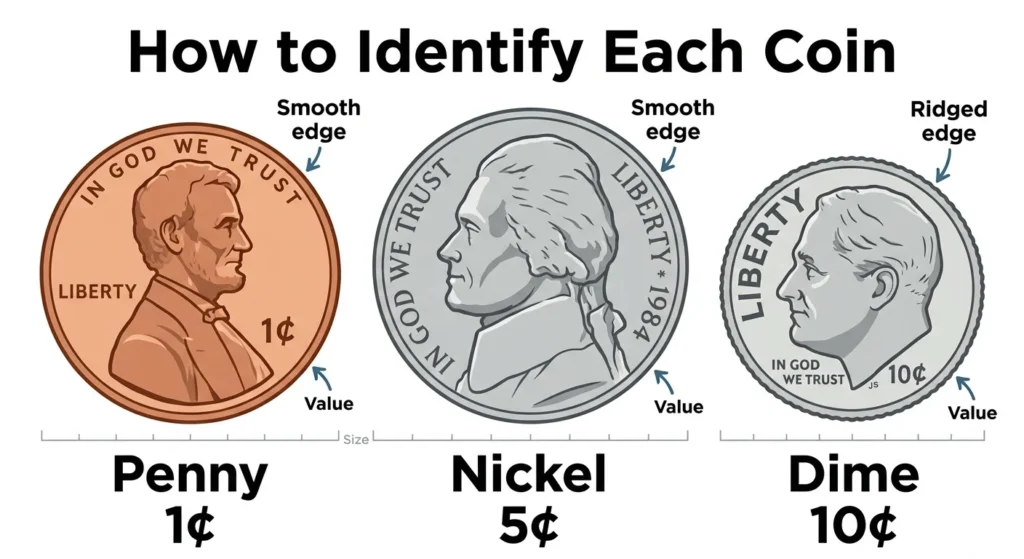
Penny
- Color: Copper (reddish-brown)
- Size: Medium; not the smallest, not the largest
- Front: Abraham Lincoln
- Back: Lincoln Memorial or Union Shield (depending on year)
- Edge: Smooth
Nickel
- Color: Silver (gray)
- Size: The largest of the three coins
- Front: Thomas Jefferson
- Back: Monticello (Jefferson’s home) or Westward Journey designs
- Edge: Smooth
Dime
- Color: Silver (gray)
- Size: The smallest of the three; smaller than a penny
- Front: Franklin D. Roosevelt
- Back: A torch with olive and oak branches
- Edge: Ridged (has tiny lines around the edge)
A helpful tip for children: the dime seems like it should be worth less because it is so small, but it is actually worth the most of the three. This is one of the most common misconceptions, and pointing it out early saves confusion later.
Coin Values at a Glance
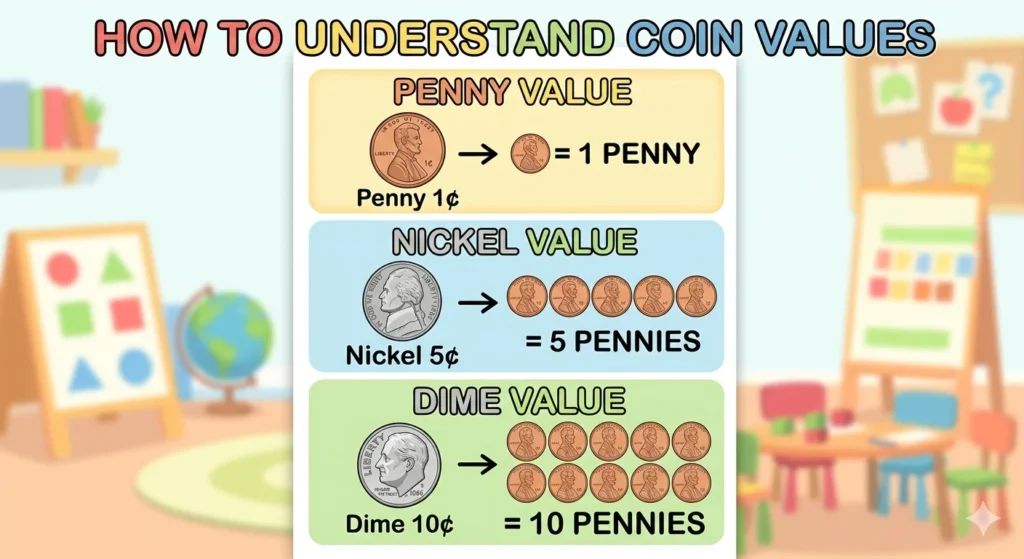
| Coin | Color | Size | Value |
| Penny | Copper | Medium | 1 cent (1¢) |
| Nickel | Silver | Large | 5 cents (5¢) |
| Dime | Silver | Small | 10 cents (10¢) |
A quick way to remember:
- 1 penny = 1¢
- 1 nickel = 5 pennies = 5¢
- 1 dime = 10 pennies = 10¢
- 1 dime = 2 nickels
Why Coin Counting Is an Important Skill
You might wonder whether coin counting still matters in a world of tap-to-pay and digital wallets.
It does, and for reasons that go well beyond buying a snack at the school cafeteria.
The Real-World Connection
When children learn to count coins, they are building the same mental muscles they will use for budgeting, comparing prices, and understanding value.
A child who can figure out that three dimes and two nickels make 40 cents is practicing estimation, addition, and logical sequencing, all at once.
Real-life moments where coin counting matters include paying for something at a school fair, counting savings in a piggy bank, deciding if they have enough for a small toy, and making change.
This skill also connects directly to skip counting, which is a topic your child is likely already practicing. If you want a deeper look at how skip counting develops across Grade 1, our guide to skip counting for Class 1 covers the full progression from 2s and 5s through to 10s and beyond.
How Coin Counting Builds Math Skills
Counting coins connects directly to several foundational math concepts.
Skip counting: Counting nickels by 5s and dimes by 10s reinforces one of the most important number patterns in early math. Children who are fluent in skip counting find multiplication far easier later on.
Addition: Combining coin totals is real-world addition practice with a concrete payoff. The child wants to know the answer.
Place value: Understanding that a dime is worth ten pennies is a hands-on introduction to the idea that one unit can represent many smaller units; a core concept behind place value.
Step 1: How to Count Pennies
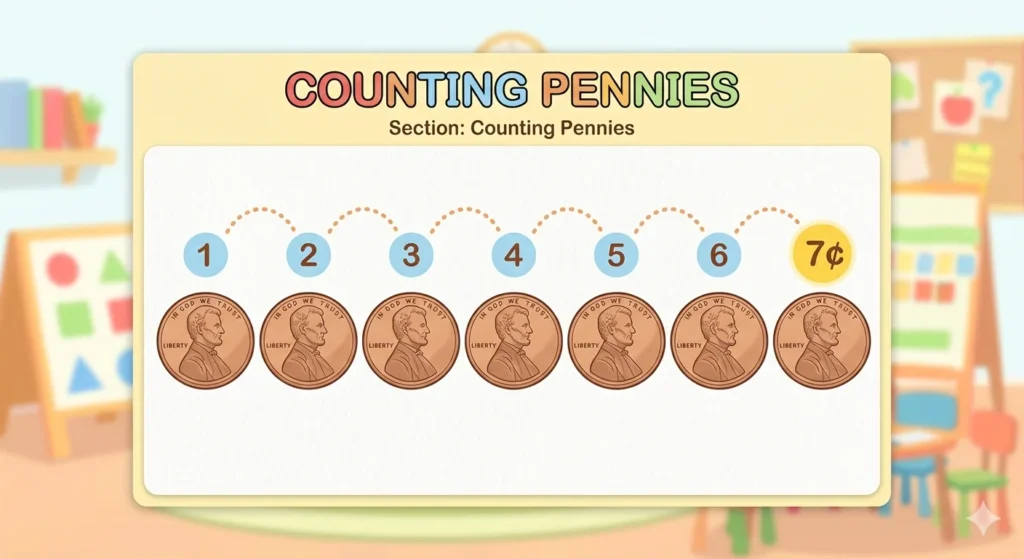
Pennies are the best starting point because each one is worth exactly 1 cent. There is no skip counting involved; just regular counting up from 1.
For a child who is still building confidence with numbers, this is a solid foundation.
What to Say to Your Child
“Each penny is worth 1 cent. When you count pennies, you just count them one at a time: 1, 2, 3, 4, 5. If you have 5 pennies, you have 5 cents.”
Keep it that simple at first. Once they have got the idea, you can extend: “Now, can you count out 8 pennies for me? How many cents is that?”
Worked Example
Question: You have 7 pennies in your hand. How much money is that?
Step 1: Count the pennies one at a time. 1, 2, 3, 4, 5, 6, 7
Step 2: The last number you said is the total in cents.
Answer: 7 cents (7¢)
Practice Questions: Pennies
- You have 4 pennies. How much money is that? (Answer: 4¢)
- You have 9 pennies. How much money is that? (Answer: 9¢)
- You want to buy something that costs 6¢. Do 6 pennies cover it? (Answer: Yes; 6 pennies = 6¢)
Step 2: How to Count Nickels Using Skip Counting by 5s
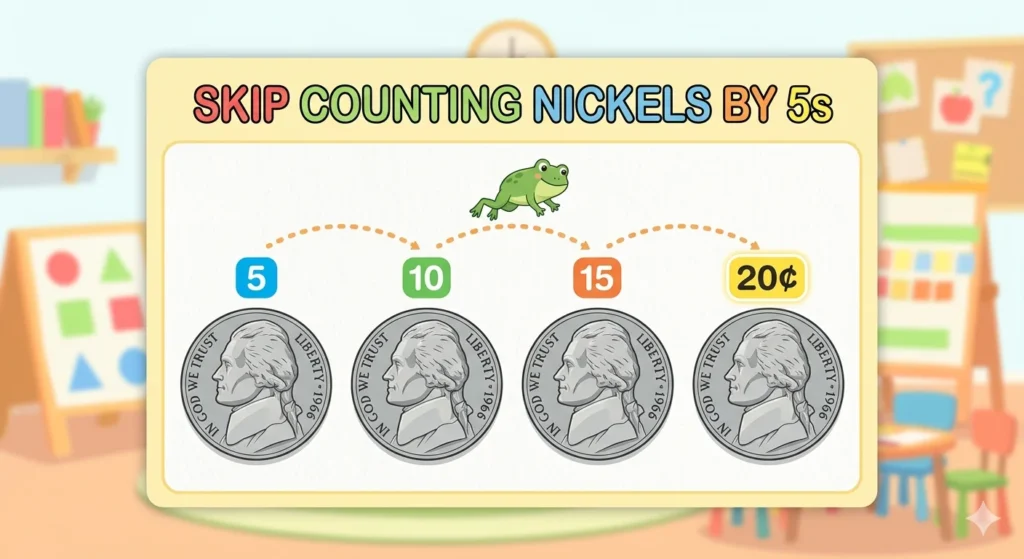
Once your child is comfortable with pennies, move to nickels. Each nickel is worth 5 cents, so counting nickels means skip counting by 5s: 5, 10, 15, 20, and so on.
Teaching Skip Counting by 5s
Skip counting by 5s is one of the most useful math patterns to learn, and it comes up everywhere, not just in coin counting. A few ways to make it stick:
Clap and count. Clap once for every five: clap “5,” clap “10,” clap “15.” The rhythm helps the pattern land in memory.
Count fingers. Each hand has 5 fingers. One hand = 5¢, two hands = 10¢. This is a physical anchor that young children find intuitive.
The 5s chant. Have your child say “5, 10, 15, 20, 25, 30” out loud every day for a week. Familiarity with the sequence removes the mental effort later.
For more structured skip counting activities you can use alongside coin practice, see our collection of easy skip counting activities for Class 1.
Worked Example
Question: You have 4 nickels. How much money is that?
Step 1: Remember; each nickel = 5¢.
Step 2: Count by 5s, once for each nickel.
| Nickel | Running total |
| 1st nickel | 5¢ |
| 2nd nickel | 10¢ |
| 3rd nickel | 15¢ |
| 4th nickel | 20¢ |
Answer: 20 cents (20¢)
Practice Questions: Nickels
- You have 3 nickels. How much money is that? (Answer: 15¢)
- You have 6 nickels. How much money? (Answer: 30¢)
- Does 4 nickels equal more or less than 15 cents? (Answer: More; 4 nickels = 20¢)
Step 3: How to Count Dimes Using Skip Counting by 10s
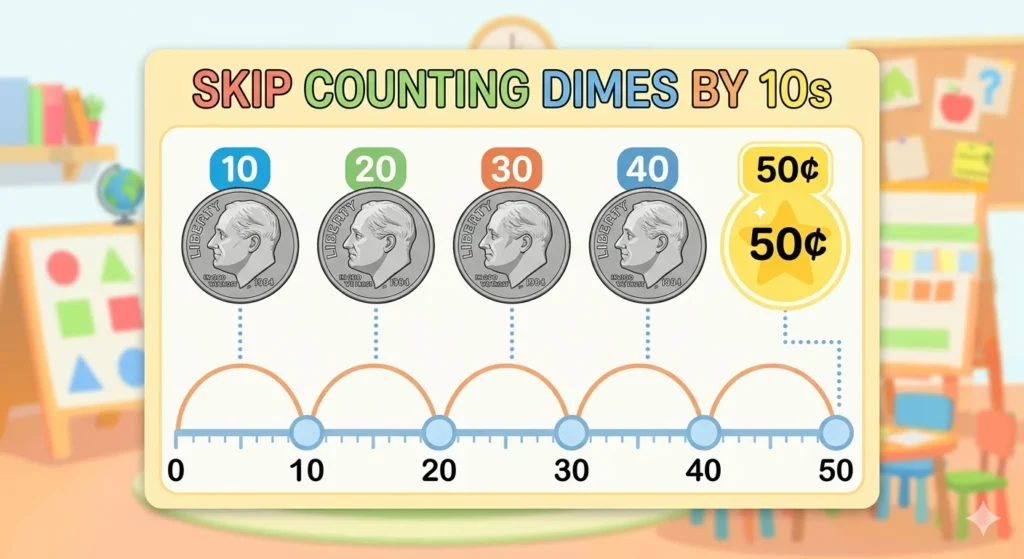
Dimes are worth 10 cents each, so counting dimes means skip counting by 10s: 10, 20, 30, 40.
Children who already know how to count to 100 by 10s, which most first graders do, often find dimes the easiest coin to count.
Teaching Skip Counting by 10s
Most children learn to count by 10s before they formally study coins. “10, 20, 30, 40, 50, 60, 70, 80, 90, 100” is a standard kindergarten milestone.
If your child already knows this sequence, link it directly to dimes: “Remember how we count by 10s? Each dime is one of those jumps.”
If your child needs more practice with 10s first, try these:
Tally marks by 10. Draw a group of 10 tally marks, then another group of 10, and so on. Count the groups: “One group of ten is 10, two groups of ten is 20…”
Number line jumps. On a number line from 0 to 100, take jumps of 10 and land on each multiple. Each landing = one dime. Our guide on how to teach number line maths for Class 1 has number line activities that work perfectly alongside this.
Worked Example
Question: You have 5 dimes. How much money is that?
Step 1: Remember; each dime = 10¢.
Step 2: Count by 10s, once for each dime.
| Dime | Running total |
| 1st dime | 10¢ |
| 2nd dime | 20¢ |
| 3rd dime | 30¢ |
| 4th dime | 40¢ |
| 5th dime | 50¢ |
Answer: 50 cents (50¢)
Practice Questions: Dimes
- You have 4 dimes. How much money? (Answer: 40¢)
- You have 7 dimes. How much money? (Answer: 70¢)
- Which is more: 6 dimes or 5 nickels? (Answer: 6 dimes = 60¢; 5 nickels = 25¢. Six dimes is more.)
Step 4: How to Count Mixed Groups of Pennies, Nickels, and Dimes
This is where children often get tripped up, and where most worksheets just throw a jumbled picture of coins and say “count these.”
The key is teaching a method, not just showing examples.
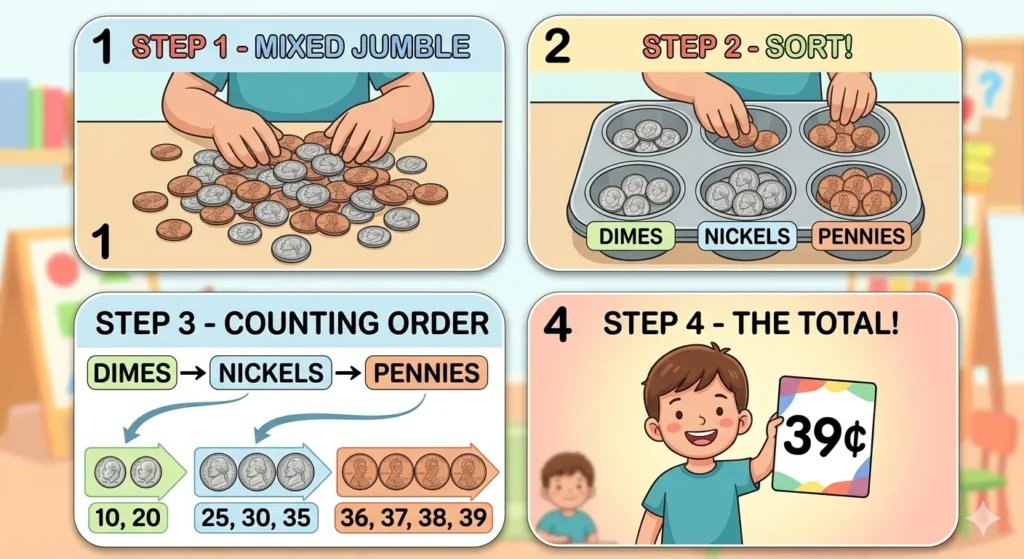
The method is called Sort, Then Count, and once a child has it, counting mixed coins becomes manageable even for younger learners.
The Sort-Then-Count Method
Step 1: Sort the coins. Separate the coins into three groups: dimes in one pile, nickels in another, pennies in a third.
Step 2: Start with the highest-value coins; dimes first. Count the dimes by 10s. Keep a running total in your head (or say it out loud).
Step 3: Count the nickels by 5s. Continue the running total from where the dimes left off.
Step 4: Count the pennies by 1s. Add each penny to the running total.
Step 5: The final number is your total.
This method works because it reduces the number of “switches” a child has to make mid-count. Instead of jumping between coin types randomly, they build the total in an organized way.
Worked Example: Mixed Coins (Step by Step)
Question: Count these coins: 2 dimes, 3 nickels, 4 pennies. How much money is that?
Step 1: Sort.
- Dimes: 2
- Nickels: 3
- Pennies: 4
Step 2: Count the dimes by 10s.
- 1st dime: 10¢
- 2nd dime: 20¢
- Running total so far: 20¢
Step 3: Count the nickels by 5s, continuing from 20.
- 1st nickel: 25¢
- 2nd nickel: 30¢
- 3rd nickel: 35¢
- Running total so far: 35¢
Step 4: Count the pennies by 1s, continuing from 35.
- 1st penny: 36¢
- 2nd penny: 37¢
- 3rd penny: 38¢
- 4th penny: 39¢
- Running total: 39¢
Answer: 39 cents (39¢)
Practice Questions: Mixed Coins
- 1 dime, 2 nickels, 3 pennies. How much? (10 + 10 + 3 = 23¢)
- 3 dimes, 1 nickel, 2 pennies. How much? (30 + 5 + 2 = 37¢)
- 2 dimes, 4 nickels, 1 penny. How much? (20 + 20 + 1 = 41¢)
- 4 dimes, 2 nickels, 5 pennies. How much? (40 + 10 + 5 = 55¢)
- 1 dime, 3 nickels, 7 pennies. How much? (10 + 15 + 7 = 32¢)
Common Mistakes Children Make When Counting Coins and How to Fix Them
Even children who understand the values of individual coins can stumble when counting.
Here are the three mistakes that come up most often, and what to do about each one.
Mistake 1: Bigger Coin = More Value
What it looks like: Your child picks up a nickel and a dime and says the nickel is worth more because it is bigger.
Why it happens: Children are used to “bigger = more” in almost every other context; more food on a plate, a taller glass of milk. The idea that a smaller coin (the dime) is worth twice as much as a larger one (the nickel) runs counter to this instinct.
How to fix it: Make the connection physical and memorable. Line up ten pennies. Now replace them with a dime. “See? One small dime equals all of these pennies.” Do the same with a nickel and five pennies. Seeing the equivalence with their own eyes is far more convincing than being told the value.
Mistake 2: Forgetting to Sort Before Counting Mixed Coins
What it looks like: Your child starts counting from left to right across a pile of mixed coins, switching between coin types mid-stream and losing track.
Why it happens: No one told them not to. Worksheets typically show a row of mixed coins and say “count these,” without suggesting any strategy for handling the switch between values.
How to fix it: Teach the Sort-Then-Count method explicitly (see Step 4 above) before presenting mixed coin problems. Make sorting a habit, not an afterthought. Give your child a pile of mixed coins and ask them to sort into cups or sections of a muffin tin before they count anything.
Mistake 3: Losing Track When Switching Coin Types
What it looks like: Your child counts the dimes correctly, then forgets the running total when they start the nickels. They restart from zero or repeat a number.
Why it happens: Keeping a running total in working memory while simultaneously skip counting in a new increment is genuinely difficult for young children.
How to fix it: Encourage them to say the running total out loud after each coin type. “Two dimes; that’s 20. Now the nickels: 25, 30, 35. Thirty-five cents. Now the pennies: 36, 37.” Verbalizing each step externalizes the working memory load. You can also use physical markers; move each counted coin to a separate spot so there is a visible record of progress.
Fun Games and Hands-On Activities for Counting Coins at Home
Worksheets have their place, but children learn money concepts best through activities that feel real or playful.
These three activities use nothing more than real coins and everyday objects you already have at home.
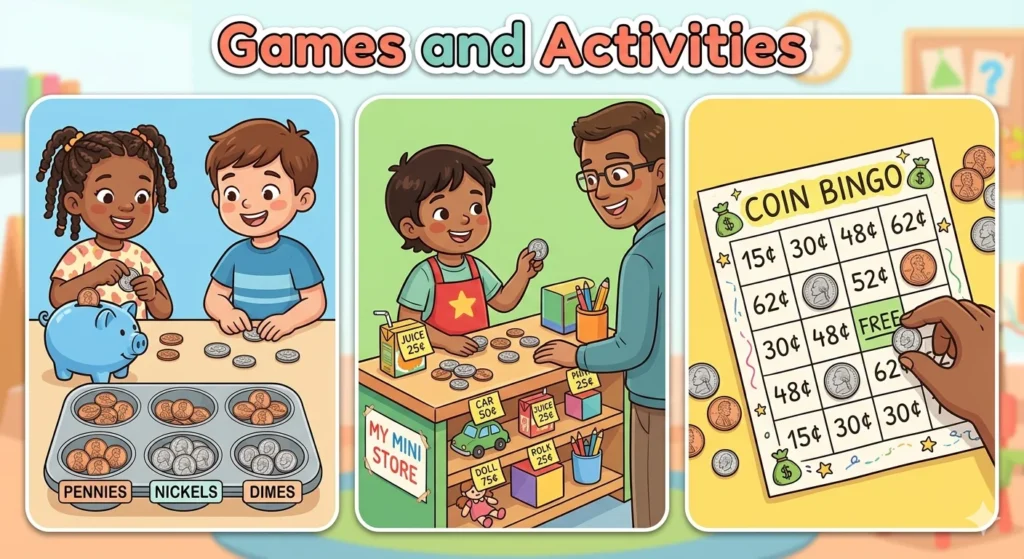
The Piggy Bank Sort Game
What you need: A small container (or actual piggy bank), a mix of pennies, nickels, and dimes.
How to play:
- Pour the coins onto a flat surface.
- Ask your child to sort them into three piles: pennies, nickels, dimes.
- Together, count each pile and write down the total for each coin type.
- Add the totals together to find the grand total.
- Challenge: “If you had to put 25 cents in the piggy bank using only these coins, how would you do it?”
This activity builds sorting, counting, and basic addition, and it works with as few as 10 to 15 coins.
Store Roleplay Activity
What you need: A few household items with price tags (made from sticky notes), a mix of coins totaling under 99¢.
How to play:
- Set up a “store” with 5 to 6 items, each priced at amounts under 50¢ (e.g., eraser = 15¢, pencil = 25¢, sticker = 10¢).
- Give your child a “wallet” of mixed coins.
- They choose an item to “buy” and count out the exact coins to pay for it.
- You play the shopkeeper and check their count.
- Switch roles: your child runs the store and checks your coin counting.
This activity is especially powerful because the motivation is real. The math becomes purposeful.
Coin Bingo
What you need: A simple 3×3 or 4×4 bingo grid with coin amounts in each square (e.g., 5¢, 12¢, 30¢, 17¢), and a set of mixed coins.
How to play:
- Call out a combination of coins: “One dime and two pennies.”
- Your child counts the value and covers the matching square on their bingo card.
- First to get a row wins.
You can make the grid on paper in five minutes. The game reinforces both coin counting and number recognition in a low-pressure, game-like format.
Tips for Parents and Teachers
The most effective coin-counting instruction does not happen in a single sitting. It is woven into everyday moments and built incrementally over weeks.
Here are the approaches that make the biggest difference.
Making It Part of Daily Life
At the checkout. When you are paying for something small, let your child count out the coins. Even if it takes a little longer, the real-world practice is worth more than ten worksheets.
With a clear jar. Keep a transparent jar for loose change. Periodically sit down together and count what is in it. This is motivating because the total is usually higher than children expect.
“How many nickels?” When your child has a handful of pennies, ask them: “Can you figure out how many nickels that is worth?” This bridges coin types and builds flexible thinking about value.
Start with one coin type. Do not introduce mixed coins until your child is consistently accurate counting each type alone. Rushing the progression is the single most common reason children get stuck.
What to Do When a Child Gets Stuck
If your child is struggling with a step, go back one level. If they are lost on mixed coins, return to single-coin counting. If they are shaky on nickels, work on skip counting by 5s independently before returning to coins.
Avoid drilling errors. If a child gets the same question wrong three times in a row, set it aside and return to it tomorrow. Frustration shuts down learning faster than almost anything else.
Praise the process, not just the result. “I like how you sorted the coins first” is more useful feedback than “good job,” because it tells the child exactly what they did right and reinforces the strategy.
If your child’s school uses word problems to test money skills, our guide on how to solve math word problems walks through the exact strategies children need to handle these with confidence.
Connecting Coin Counting to Financial Literacy
Coin counting is the entry point to financial literacy; the set of real-world money skills that children will use for the rest of their lives.
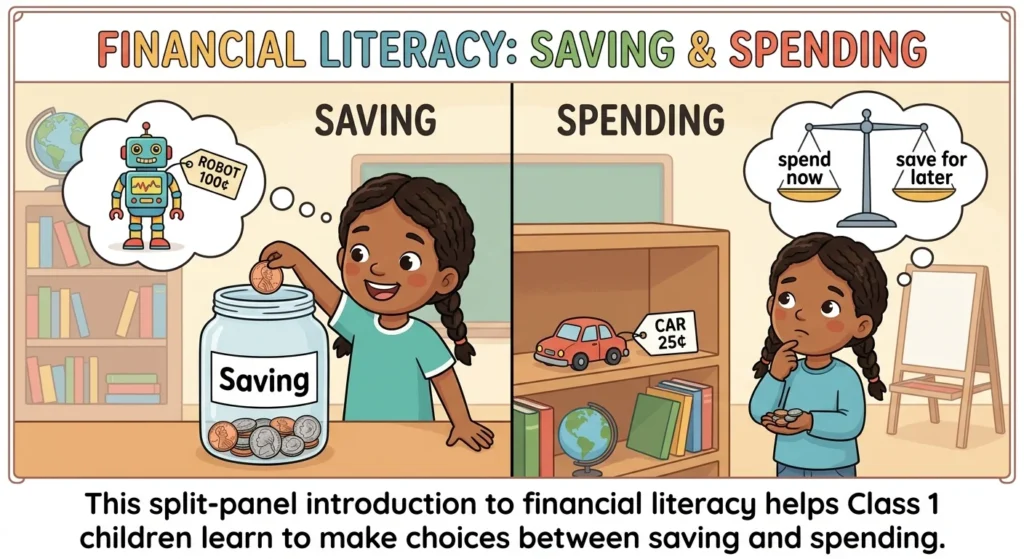
You do not need to teach formal personal finance to a seven-year-old, but you can plant seeds that matter.
Saving vs. Spending
The simplest financial concept to introduce alongside coin counting is the difference between saving and spending. When your child counts coins, ask: “If you had 35 cents, what would you do; spend it on something now, or save it toward something bigger?”
This question, without a right or wrong answer, is the beginning of every financial decision an adult makes. Children who get practice making it early develop a more intuitive relationship with money than those who only ever see it as an abstract math topic.
Making Change: A First Look
Once your child can reliably count mixed coins to 99¢, you can introduce the concept of making change at the most basic level: “If something costs 20¢ and you give 25¢, how much change do you get back?”
Do not push this concept before coin counting is solid. But when it is time, the Store Roleplay Activity (above) is a natural setting to introduce it.
For children ready to go further with addition and subtraction in practical contexts, our addition and subtraction guide for Class 1 is a great next step.
What age should children start learning to count pennies, nickels, and dimes?
Most children are ready to begin identifying coins and learning their values around age 5 to 6 (kindergarten to Grade 1). Counting single coin types typically fits Grade 1. Counting mixed groups of coins is a Grade 2 skill for most learners, though children who are strong in skip counting often pick it up earlier.
What are the values of pennies, nickels, and dimes?
A penny is worth 1 cent (1¢). A nickel is worth 5 cents (5¢). A dime is worth 10 cents (10¢). That means one dime equals two nickels, or ten pennies, or one nickel and five pennies.
How do you count pennies, nickels, and dimes together?
Use the Sort-Then-Count method: separate the coins by type, then count dimes by 10s, nickels by 5s, and pennies by 1s; always starting with the highest-value coin and building up a running total.
Why does my child think the nickel is worth more than the dime?
Because nickels are physically larger than dimes, and children instinctively link size to value. This is one of the most common misconceptions in early money education. The best fix is showing them the equivalence physically: line up five pennies next to a nickel, then ten pennies next to a dime.
What’s the best way to practice counting coins at home?
Use real coins rather than worksheets whenever possible. The Store Roleplay Activity and the Piggy Bank Sort Game (described above) are two of the most effective at-home options. Short, frequent practice sessions of 5 to 10 minutes a few times a week are more effective than long, infrequent ones.
Make Preparing for Math Olympiad Simple!



Conclusion
Counting pennies, nickels, and dimes becomes much easier when children learn a clear method.
By mastering coin identification, coin values, skip counting, and mixed coin counting, they build confidence and practical money skills.
Use real-life practice and simple activities to make learning stick and strengthen their overall math foundation.
If you want to go deeper on the foundational number skills that support coin counting, explore our guides on skip counting for Class 1 and how to teach number sequences to Class 1.

Mikha Piregu is a Content Writer with experience spanning educational content, including math and math olympiad topics, as well as advocacy writing, research-based articles, and SEO-driven web content. He creates high-quality blog content, web copy, and feature articles that support brand visibility, audience engagement, and long-term organic growth through data-informed storytelling. Skilled in WordPress, WooCommerce, and modern digital tools, Mikha adapts content across various platforms, including blogs, websites, campaigns, and advocacy initiatives, with clarity and purpose.


There are no comments posted here yet.
Sign in to leave a comment