


The absolute best free American Mathematics Competitions (AMC) practice resources include official past papers and comprehensive community-driven archives. They offer complete problem statements, detailed text-based solutions, and step-by-step video explanations to boost your score.
- The free AMC resources worth your time
- Free AMC practice problems and past papers by level
- Comparison table
- Free vs paid AMC prep: what is worth paying for
- Free AMC 8 vs AMC 10 vs AMC 12 resources: what changes by level
- Where to start if your child has never seen AMC-style problems
- AMC practice by topic
- Mock tests and timed AMC practice
- The honest argument: free resources give you problems, not a sequence
- Where a structured app fits in
- How to actually use these resources
- How to review mistakes so practice actually sticks
- Common mistakes when practicing for the AMC
- Conclusion
- Related guides
The best free AMC practice resources are the AoPS Wiki (every past AMC 8, 10 and 12 paper with solutions), AoPS Alcumus (a free adaptive AMC problem generator), the AoPS video library, OmegaLearn’s free books, and the official MAA site for rules and dates.
The four core free AMC resources are the Art of Problem Solving (AoPS) Wiki (every past AMC problem with solutions), AoPS Alcumus (an adaptive free problem generator), the official MAA AMC site (registration, dates, official rules), and the AoPS video library (hundreds of free Richard Rusczyk walkthroughs of past problems).
In this guide, we will cover what each of these free AMC resources is actually good for, where they fall short by contest level, how to find past papers with answers, and how to combine everything into a daily practice routine that gets you to AIME.
The free AMC resources worth your time
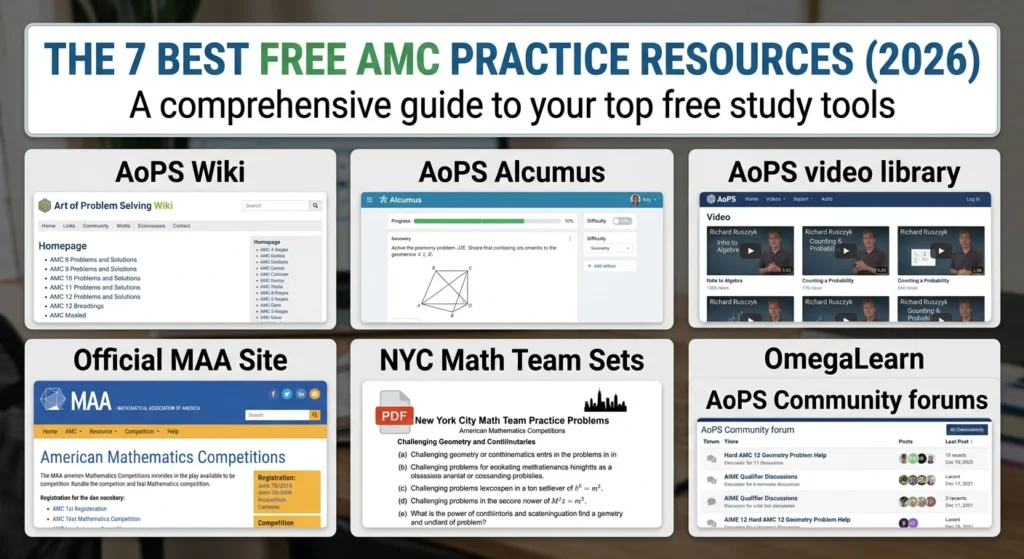
1. Art of Problem Solving (AoPS) Wiki
Link: artofproblemsolving.com/wiki
The single most valuable free AMC practice resource on the internet. AoPS hosts every AMC 8, AMC 10, AMC 12, and AIME problem ever administered, along with multiple community written solutions for each. Browse to the AMC 8 archive, the AMC 10 archive, or the AMC 12 archive, pick a year, and dive in. If you are still working out which contest fits your child, our guide on the AMC syllabus breaks down what each level actually tests.
What it is great for: unlimited timed past papers, comparing your approach to multiple expert solutions, learning elegant tricks from problem 23 to 25 write ups.
What it is not great for: beginners. The wiki throws you in the deep end with no curriculum. There is no “start here if you are new” path, you have to know what year and level you are capable of attempting, which most first timers do not.
2. AoPS Alcumus
Is AoPS Alcumus free? Yes. Alcumus is free to use with a free AoPS account. It works like an AMC problem generator: it picks problems that match your level and gets harder as you improve.
Link: artofproblemsolving.com/alcumus
A free adaptive problem generator from AoPS. Pick a topic (algebra, counting, geometry, number theory), and Alcumus serves problems calibrated to your skill, adjusting up or down as you solve them. It is one of the best free tools ever built for math competition prep.
What it is great for: sustained topic by topic practice, especially for AMC 8 and early AMC 10 difficulty. The adaptive engine actually works.
What it is not great for: AMC 12 or AIME hard tier problems (Alcumus tops out around AMC 10 medium difficulty), and pacing practice, since it is untimed by design.
3. AoPS video library (Richard Rusczyk walkthroughs)
Link: artofproblemsolving.com/videos
AoPS hosts hundreds of free videos featuring founder Richard Rusczyk, including walkthroughs of past AMC 10, AMC 12, and AIME problems, plus videos aligned to the Prealgebra, Introduction to Algebra, and Introduction to Counting and Probability books. The step by step thinking out loud is hard to get from written solutions. Khan Academy also has a small AMC 10 playlist of a handful of videos, but the AoPS library is far deeper.
What it is great for: seeing how a strong problem solver approaches a hard problem, the inner monologue, the false starts, the reset to a different technique. Invaluable for students who learn better from watching than reading.
What it is not great for: breadth as a standalone curriculum. These are individual problem walkthroughs and topic videos, not a complete sequenced AMC course. You will need to combine them with past papers and structured practice.
4. Official MAA AMC site
Link: maa.org/student-programs/amc
The authoritative source for current rules, contest dates, AIME cutoffs, and official answer keys. Not a practice resource on its own, but you should check it at least monthly during prep season. For deadlines and how the registration process actually works, see our AMC registration guide, and for eligibility questions by grade, see the AMC age limit guide.
What it is great for: confirming dates, registration deadlines, and rule changes. The official AMC policies page is where current eligibility rules live, for example the AMC 8 age limit, which some third party sites still list incorrectly. Also publishes the official Teacher’s Manual each year with proctoring rules.
What it is not great for: practice problems. MAA does not host its own problem archive, the AoPS Wiki has effectively become the de facto archive.
5. NYC Math Team problem sets
Link: nycmathteam.org
The New York City Math Team publishes free PDF problem sets at AMC and above difficulty. Their handouts are dense, well organized by topic, and pitched at the level of strong AMC 10 and AMC 12 students aiming for AIME.
What it is great for: advanced students who have exhausted past papers and want curated topic drills.
What it is not great for: beginners or AMC 8 students, most of NYCMT’s material is too hard. Start here only after you are comfortable with AMC 10 problems 1 through 18.
6. OmegaLearn (free books plus video lectures)
Link: omegalearn.org
A collection of free books, Mastering AMC 8, Mastering AMC 10/12, The Book of Formulas, paired with video lectures for each chapter. Genuinely impressive output for a free resource, with clear topic coverage and worked examples.
What it is great for: students who like learning from a textbook plus video pairing. The AMC 8 book is one of the best free introductions in existence.
What it is not great for: active problem solving practice. The books are reference and instruction, you still need a separate problem source.
7. AoPS Community forums
Link: artofproblemsolving.com/community
The largest active community of US competition math students and coaches on the internet. Ask a hard problem, get five solutions in two hours.
What it is great for: getting unstuck on specific problems, learning from older students’ explanations, picking up culture and motivation.
What it is not great for: structured practice. The forums are reactive, you go there when you are stuck, not as a daily routine.
Free AMC practice problems and past papers by level
Where can I find free AMC past papers? The AoPS Wiki has every past AMC 8, AMC 10 and AMC 12 paper with solutions and answer keys, free to read online, with no account needed. The AoPS Wiki keeps every past AMC problem free to read, with solutions. Start with the hub for your level:
| Level | Free problem archive | Best for |
|---|---|---|
| AMC 8 | AMC 8 problems and solutions | Grades 5 to 8, first contest practice |
| AMC 10 | AMC 10 problems and solutions | Grades 8 to 10, AIME goal |
| AMC 12 | AMC 12 problems and solutions | Grades 10 to 12, advanced topics |
If you want a printable PDF of an old paper, the MAA publishes official past contests on its AMC resources page, and our AMC past papers guide explains how to find each year as a PDF. For year-by-year paper lists, see our AMC 10 past papers and AMC 12 past papers pages.
Two tips that save time. First, each wiki page lists the A and B versions of the AMC 10 and AMC 12 separately, so you can do one as practice and save the other as a timed test. Second, the answer key sits at the bottom of each paper page, so you can check your work before reading any solution.
Comparison table
| Resource | Cost | Best for | Topic coverage | Adaptive | Tracks progress | Solutions provided |
|---|---|---|---|---|---|---|
| AoPS Wiki | Free | Past paper drilling | Every AMC year | No | No | Yes (community) |
| AoPS Alcumus | Free | Daily topic practice | AMC 8 to early AMC 10 | Yes | Yes (basic) | Yes |
| AoPS video library (Rusczyk) | Free | Watching problem solving | AMC 10/12, AIME plus intro topics | No | No | Yes (video) |
| MAA AMC site | Free | Rules, dates, registration | N/A | No | No | Official keys only |
| NYCMT problem sets | Free | Advanced topic drills | AMC 10/12 to AIME | No | No | Some PDFs |
| OmegaLearn | Free | Textbook plus video learning | AMC 8 / 10 / 12 | No | No | Yes |
| AoPS Community forums | Free | Getting unstuck | Everything | No | No | Crowdsourced |
Free vs paid AMC prep: what is worth paying for
Do you need to pay for AMC prep? No. A motivated student can reach AIME with free resources alone, but paid options add structure, feedback, and accountability that free tools cannot.
If you are comparing the best free and paid resources for self studying AMC 8 or AMC 10, weigh them on the things that actually decide results: cost, structure, feedback on mistakes, and how much a parent has to manage.
| Criteria | Free resources (AoPS Wiki, Alcumus, OmegaLearn) | Paid AoPS classes | Structured practice app | Private tutor or coached course |
|---|---|---|---|---|
| Cost | $0 | Paid per course | Free to start, then varies | Highest |
| Daily plan | You build it | Set by the class | Built in | Set by the coach |
| Feedback on mistakes | Self review and forums | Instructor and teaching assistants | Weak topic tracking | Personal and detailed |
| Parent effort | High | Medium | Low | Low |
| Best for | Self starters | Students aiming past AIME | Daily consistency | Students who need accountability |
If your child is on a waitlist for an AoPS class, do not wait idle. Start with OmegaLearn’s book for your level, add 20 to 30 minutes of Alcumus a day, and do one timed paper a week from the AoPS Wiki. That mix covers most of what a first course would teach. For a wider view of free training options, see our guide to free math olympiad training online.
Free AMC 8 vs AMC 10 vs AMC 12 resources: what changes by level
Not every free AMC resource fits every contest level, and this is where a lot of families waste time on the wrong tool.
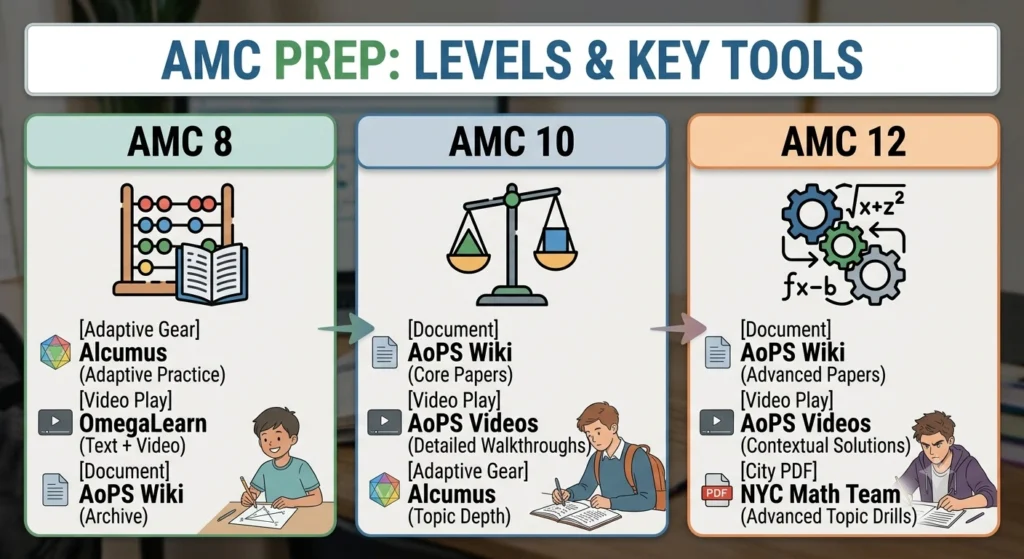
For AMC 8 practice, OmegaLearn’s Mastering AMC 8 book and Alcumus cover almost everything a middle schooler needs, since the difficulty ceiling on both matches AMC 8 well.
The AoPS Wiki’s AMC 8 archive is the natural next step once a student wants full-timed papers. For context on what the contest actually rewards, see our guide on the benefits of AMC math. If your student is choosing between contests, compare AMC 8 vs AMC 10 before you commit prep time.
For AMC 10 practice, Alcumus is strong through the early and medium difficulty range, but strong AMC 10 students will outgrow it and need the AoPS Wiki’s AMC 10 archive plus the video library for problems 20 to 25.
For AMC 12 practice, free resources get thinner. Alcumus is not built for AMC 12 difficulty, so the AoPS Wiki archive, the video library, and NYC Math Team handouts carry most of the load. If you are unsure whether to move up, our AMC 10 vs AMC 12 comparison covers the differences.
Students at this level are usually also AIME qualifiers, so awards and scoring context matter. Our guides on AMC awards and what counts as a good AMC score are useful reference points here. Once you are working on AIME level problems, see our AIME problems guide.
Where to start if your child has never seen AMC-style problems
What is a good starting point for a beginner? Start with OmegaLearn’s Mastering AMC 8 and Alcumus at the lowest level, not with a full past paper. AMC problems reward specific tricks, and a cold first paper usually just feels discouraging.
- Pick one topic your child already likes (counting, geometry, or number sense) and read the matching chapter in Mastering AMC 8.
- Do 15 to 20 minutes of Alcumus on that topic for a week.
- Try the first 10 problems of an older AMC 8 paper, untimed.
- Read the wiki solutions for every problem, including the ones you got right.
- Move to a full timed paper only after you can finish the first 15 problems comfortably.
For younger students who are new to competition style thinking, our math olympiad questions page and our guide on how to solve math olympiad problems are a gentle bridge.
AMC practice by topic
Where can I find AMC practice problems by topic? Alcumus and OmegaLearn are the best free sources for topic based practice. The AoPS Wiki archive is organized by year, not topic, so use it for full papers rather than topic drills.
The AMC covers four main knowledge areas: algebra, geometry, number theory, and counting and probability. Here is where to practice each one for free.
| Topic | Best free practice | Then try |
|---|---|---|
| Algebra | Alcumus (Algebra and Intermediate Algebra topics), OmegaLearn algebra chapters | Wiki problems 10 to 20 from recent AMC 10 papers |
| Geometry | Alcumus (Geometry), OmegaLearn geometry chapters | AMC 8 geometry problems, then NYCMT handouts |
| Number theory | Alcumus (Number Theory), AoPS video library | Divisibility and prime problems from older AMC 10 papers |
| Counting and probability | Alcumus (Counting and Probability) | Wiki problems 15 to 25 from AMC 10 and 12 |
If a topic keeps costing points, go back to the prerequisites first. Our guides on divisibility rules, prime and composite numbers, area and perimeter, and types of triangles cover the building blocks that many AMC problems quietly assume. For middle schoolers, MATHCOUNTS practice problems are a good companion to AMC 8 prep.
Mock tests and timed AMC practice
How do I take a free AMC mock test? Print or open a past paper from the AoPS Wiki, set a timer for the real contest length, and work without notes or a calculator. Then check your answers against the key and review every miss.
A few free mock test options:
- AoPS Wiki past papers: the closest thing to the real contest, since the problems are the real ones.
- AoPS community mock AMCs: volunteers post practice contests on the AoPS forums and wiki. Quality varies, so use them as extra practice after you finish real papers.
- Our practice test pages: see the AMC 8 practice test, AMC 10 practice test, and AMC 12 practice test guides for paper lists and timing advice.
Treat every timed paper like the real thing. Use only what the contest allows, and write down your score and your unfinished problems straight away.
The honest argument: free resources give you problems, not a sequence
Here is what a stack of free AMC resources looks like in practice for a typical student:
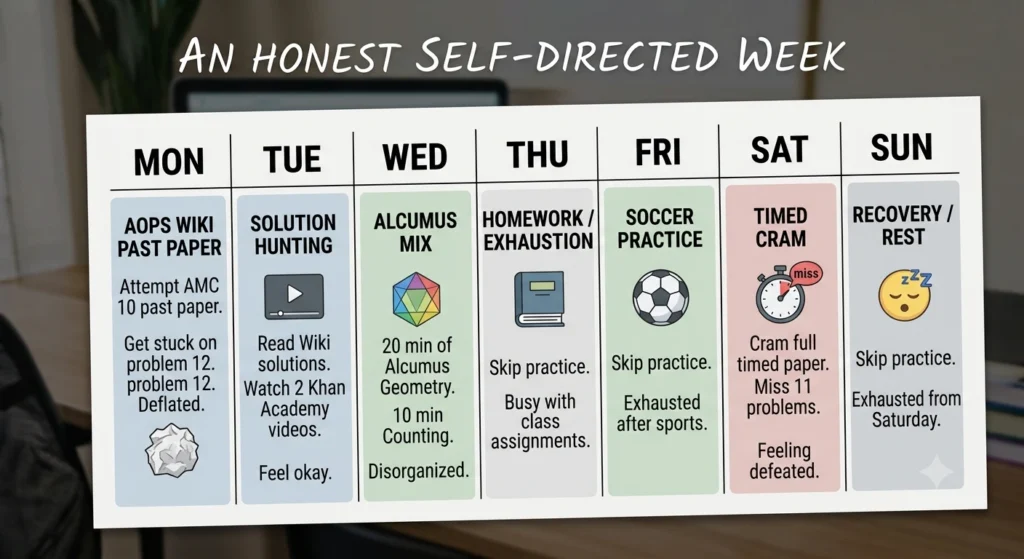
Monday: pull a past AMC 10 from the AoPS wiki, get to problem 12, get stuck.
Tuesday: read a few wiki solutions, watch a Khan Academy video on the problem, feel a bit better.
Wednesday: open Alcumus, do 20 minutes of geometry, switch to counting, do 10 more.
Thursday: skip practice, homework.
Friday: skip practice, soccer.
Saturday: cram a full timed paper, miss 11 problems, feel deflated.
Sunday: skip practice, exhausted from Saturday.
This is not a bad week; it is how a lot of self-directed AMC prep actually goes. The problem is not laziness. It is that free resources are a library, not a curriculum.
You are the one deciding every day what topic to work on, what difficulty to attempt, and when to switch from learning to timed practice. That is a lot of decisions for a 14-year-old, or a parent, to make correctly week after week.
What free resources do not give you:
- A daily plan: “today is 30 minutes of probability at AMC 10 medium difficulty”
- A weak topic tracker: “you have missed 4 number theory problems this week, here are 8 targeted reps”
- Pacing drills: “answer these 8 problems in 12 minutes total”
- Spaced repetition: “you got this one wrong 3 weeks ago, here it is again with a twist”
- A graded progression from intro examples to AIME floor problems on the same topic
Where a structured app fits in
This is the honest pitch for Gonit, and it is narrower than most app pitches: use free resources for breadth and depth.
Use a structured app for daily consistency.
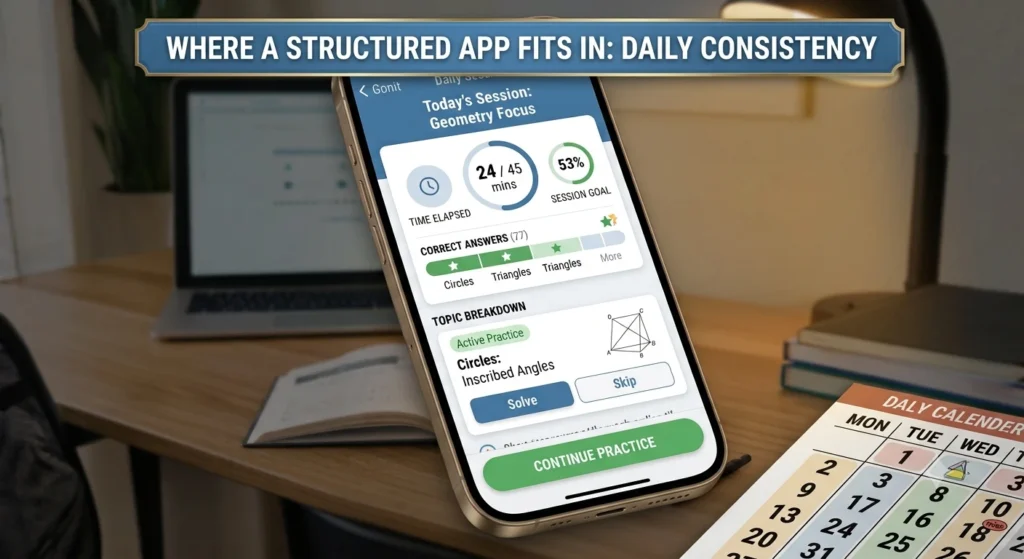
Use a structured app for daily consistency.
[Keep existing image: Gonit app showing a daily AMC practice session]
The pattern that works for most students:
- Daily reps: structured app (Gonit), 25 to 45 minutes
- Weekly full paper: AoPS Wiki past papers, timed under contest conditions
- Getting unstuck: AoPS forums, Khan Academy videos
- Topic reference: OmegaLearn books, NYCMT handouts
- Rules and dates: official MAA site
You do not need to pick one. The mix is what works.
A library is not a curriculum. Gonit gives your child a daily plan across every AMC topic, 25 to 45 minute sessions, pacing drills, weak topic targeting, and progress tracking.Free to start, works alongside every other resource on this list. The problems are everywhere; the sequence is not. Start free on iOS and Android.
How to actually use these resources
A practical workflow if you are starting from scratch:
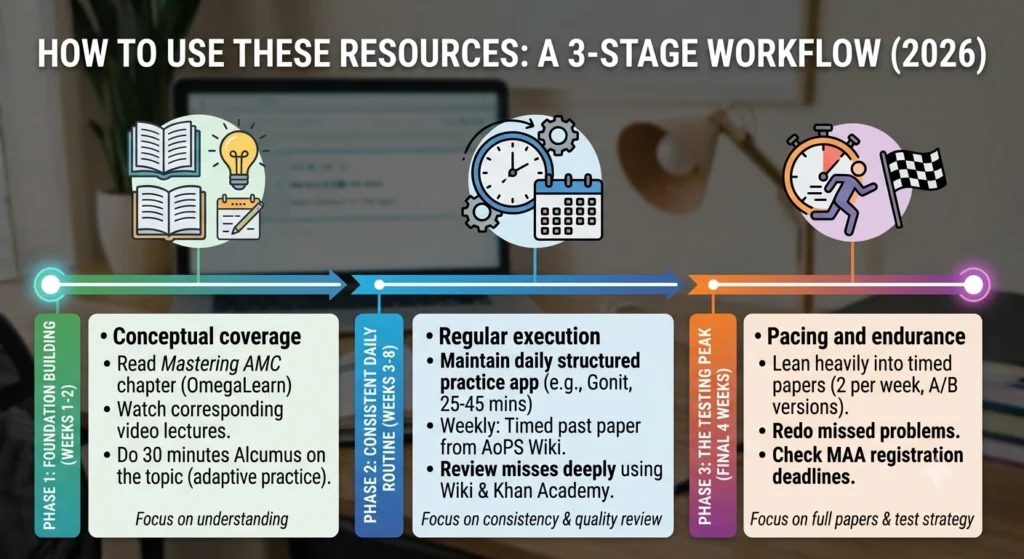
First two weeks: read OmegaLearn’s Mastering AMC 8 or Mastering AMC 10/12 chapter on whichever topic feels most intimidating. Watch the corresponding video lectures. Do 30 minutes of Alcumus on that topic.
Weeks 3 to 8: pick a daily 30 minute structured practice app. Gonit’s daily sequence is built for exactly this, but the principle stands even if you use something else, pick one and stick with it. Every weekend, take one full timed past paper from the AoPS wiki, then spend an hour reviewing your misses with help from the wiki solutions and Khan Academy videos.
Final 4 weeks: lean into timed past papers. Two per week, alternating A and B versions for the AMC 10/12. Redo problems you previously missed. If you have not registered yet, check deadlines on our AMC registration page well before this stage.
If you have a longer runway, such as a 6 month plan for AMC 8, split it into three blocks: two months of topic learning, two months of mixed practice, and two months of timed papers. Keep one rest day a week so motivation lasts.
For more detailed prep timelines by contest, see our pillars on how to prepare for the AMC, the AMC 8 practice test, the AMC 10 practice test, and the AMC 12 practice test.
How to review mistakes so practice actually sticks
How should I review mistakes after an AMC practice test? Sort every missed problem by cause, redo it a few days later without looking at the solution, and track which causes repeat. Review is where most of the score gain comes from.
- Sort each miss. Label it as a concept gap, a careless error, a time problem, or “never saw this type before.”
- Read the wiki solutions. Read at least two, since the second often shows a faster method.
- Write a one line lesson. For example, “check for symmetry before expanding.”
- Redo it cold. Retry the problem after 2 to 3 days, then again after about 2 weeks. This simple spaced repetition habit beats rereading.
- Watch the pattern. If three misses share a topic, spend the next week on that topic in Alcumus.
A plain notebook or spreadsheet works fine as an error log. Doing 8 papers with deep review beats 20 papers with none.
Common mistakes when practicing for the AMC
- Starting with full papers too early. Build topic skills first, then move to timed tests.
- Reading solutions too fast. Give each problem a real 10 to 15 minute attempt before checking.
- Only doing problems the student likes. Weak topics are where the points are.
- Skipping the timer. Pacing is a skill. Alcumus is untimed, so add timed papers each week.
- Never reviewing misses. A paper without review is mostly wasted time.
- Using AMC 12 problems too early. Frustration kills motivation. Match the level to the student.
- Trusting outdated rules. Always check dates and eligibility on the official MAA site.
Can my child qualify for AIME using only free resources?
Yes, many do every year. The constraint isn’t material; it’s discipline. Free resources work if you can self-direct a daily 30 to 45-minute practice routine for 4+ months. If that’s a challenge, a structured app (paid or free-to-start) closes the gap.
Should we pay for AoPS courses?
AoPS’s paid courses (Intermediate Algebra, Intermediate Counting & Probability, etc.) are excellent and worth the cost if you can afford them, but they’re not essential. Their free Alcumus tool alone can take a student a long way. Save the paid courses for students aiming for AIME qualification into USAMO territory.
Are free videos enough for AMC 10 prep?
Not on their own. The AoPS video library (and Khan Academy’s smaller AMC playlist) is a useful supplement fantastic for seeing problem-solving in action, but it’s not a curriculum. Combine the videos with past papers from the AoPS wiki and a structured daily practice routine.
How many past papers should we actually do?
For a 4-month preparation window: aim for 6 to 10 full-time past papers in the final 6 weeks, with detailed review of every miss. Doing 20 past papers in a month with no review is worse than doing 8 with deep review. Quality of review beats quantity of papers.
What is considered a good AMC score?
It depends on the contest level and your goal (AIME qualification versus a strong personal score). Our guide on what a good AMC score is breaks this down by contest, alongside typical average AMC scores by grade level.
Do free resources cover the full AMC syllabus?
Mostly yes for AMC 8 and AMC 10, less completely for AMC 12 hard tier and AIME level content. See our AMC syllabus guide for the full topic breakdown so you can check coverage against whichever free resource you are using.
Is AoPS Alcumus free?
Yes. Alcumus is free with a free AoPS account, and it adapts the difficulty of its problems to your level, which makes it useful daily AMC practice.
Where can I find free AMC past papers?
The AoPS Wiki has every past AMC 8, AMC 10 and AMC 12 paper with solutions and answer keys, free to read online.
Is AMC prep different from Math Kangaroo prep?
Yes. The AMC is more algebra and counting heavy and has a clear path to AIME. See our comparison of Math Kangaroo vs AMC to choose where to focus.
Make Preparing for Math Olympiad Simple!



Conclusion
Free AMC practice resources can absolutely get a student to AIME. The AoPS Wiki, Alcumus, the video library, and the official MAA site cover more ground than most families realize, and none of it costs a dollar. What they will not do is tell you what to work on today or track your weak topics for you.
Treat this list as a toolkit, not a checklist. Pull AMC past papers from the AoPS Wiki, use Alcumus for daily AMC practice problems, and lean on the video library when a solution does not click. Review every miss, because that is where the score gains come from.
If you would rather not build that schedule yourself, Gonit fills that one gap with a daily sequence across every AMC topic.
Related guides
- How to prepare for the AMC: a complete roadmap
- AMC past papers: AMC 8, 10 and 12 PDF free download
- AMC registration: deadlines and how to sign up
- AMC test dates
- AMC age limit: eligibility by grade
- AMC syllabus: what each contest level tests
- AMC 8 vs AMC 10 and AMC 10 vs AMC 12
- Benefits of AMC math for students
- AMC math competition awards explained
- What is a good AMC score

Mikha Piregu is a Content Writer with experience spanning educational content, including math and math olympiad topics, as well as advocacy writing, research-based articles, and SEO-driven web content. He creates high-quality blog content, web copy, and feature articles that support brand visibility, audience engagement, and long-term organic growth through data-informed storytelling. Skilled in WordPress, WooCommerce, and modern digital tools, Mikha adapts content across various platforms, including blogs, websites, campaigns, and advocacy initiatives, with clarity and purpose.



There are no comments posted here yet.
Sign in to leave a comment