


If you are in grade 8 or below and under 15.5 years old, take the AMC 8. Grades 9 or 10 (or a precocious 7th- to 8th-grader who has outgrown AMC 8), take the AMC 10.
- What Grade Is AMC 8 For, and What Grade Is AMC 10 For?
- Eligibility: who can take each contest
- Side-by-side: AMC 8 vs AMC 10
- AMC 8 vs AMC 10: Which One Is Harder?
- What the scores mean at each level
- The progression: AMC 8 to AMC 10 to AIME and beyond
- How to decide based on grade and readiness
- How to register for AMC 8 or AMC 10
- Practice for whichever they choose
- Conclusion
- Related guides
They’re not competitors; they’re sequential rungs on the same AMC math competition ladder. Choose the AMC 8 if your child is in middle school (grades 6 to 8) and is building foundational problem-solving skills.
Choose the AMC 10 if they’re in grade 10 or below, have completed Algebra I, and want to qualify for the AIME (American Invitational Mathematics Examination), the next rung up.
This guide lays out the eligibility rules, the real differences between the two contests, and a clear framework for choosing.
What Grade Is AMC 8 For, and What Grade Is AMC 10 For?
The AMC 8 is for students in grade 8 or below (under 15.5 years old), and the AMC 10 is for students in grade 10 or below (under 17.5). Students in grades 6 to 8 are eligible for both, and because the AMC 10 is in November and the AMC 8 is in January, a strong middle schooler can take both in the same school year.
| Grade | Usual choice |
|---|---|
| Grade 5 or below | AMC 8 for experience |
| Grades 6 to 7 | AMC 8, plus AMC 10 if already near Honor Roll |
| Grade 8 | AMC 8 and AMC 10 in the same year |
| Grades 9 to 10 | AMC 10 (AMC 8 no longer allowed) |
Eligibility: who can take each contest
This is the rule that resolves most decisions for AMC 8 vs AMC 10 eligibility. Both rules are checked on competition day, not when you register.
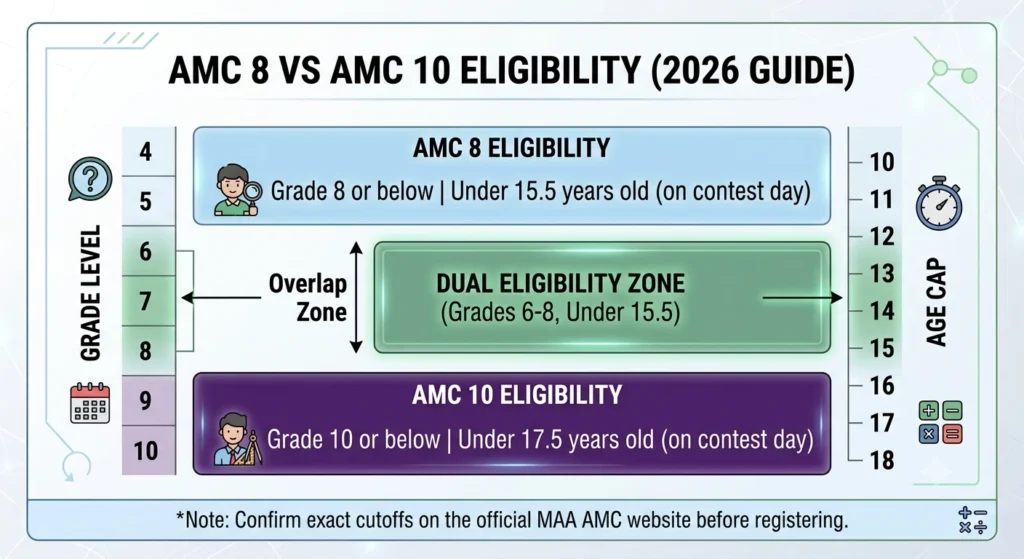
AMC 8: Grade 8 or below, under 15.5 years old on contest day, per the official MAA AMC page. (Note: the long-standing limit was 14.5; MAA’s most current official guidance lists 15.5. Confirm directly on the MAA site before relying on it for an edge case.)
AMC 10: Grade 10 or below, under 17.5 years old on contest day.
What this means in practice:
- A 6th, 7th, or 8th grader who’s under 15.5 is eligible for both contests, they can technically choose. (More on which to choose below.)
- A 9th or 10th grader is only eligible for the AMC 10.
- A precocious 4th or 5th grader can take the AMC 8 if their teacher or parent thinks they’re ready. There’s no minimum age.
For a one-page reference of every AMC age and grade rule, see our AMC age limit guide. If your child is registering for the first time, our AMC registration guide walks through the process step by step.
Side-by-side: AMC 8 vs AMC 10
| Feature | AMC 8 | AMC 10 |
| Eligibility | Grade 8 and below, under 15.5 | Grade 10 and below, under 17.5 |
| When | January (week-long window) | November (A and B versions) |
| Questions | 25 | 25 |
| Time | 40 minutes | 75 minutes |
| Format | Multiple choice (5 options) | Multiple choice (5 options) |
| Scoring | 1 point per correct, 0 otherwise (max 25) | 6 correct / 0 wrong / 1.5 blank (max 150) |
| Calculator | Not allowed | Not allowed |
| Topic ceiling | Pre-algebra, basic geometry, counting | Algebra 2, full geometry, intro number theory and combinatorics |
| Penalty for blanks | None | None, but blanks earn 1.5, strategic |
| Awards | Honor Roll (top 5%), Distinguished Honor Roll (top 1%) | AIME qualification (top ~2.5%), Distinction, Honor Roll of Distinction |
| Qualifies for AIME? | No | Yes |
| Repeats per year | One sitting | Can take both A and B versions |
The most important rows are the last three. The AMC 8 is terminal, a fantastic experience, but it does not feed into the AIME.
The AMC 10 is the first rung of the AMC to AIME to USAMO ladder that culminates in the International Math Olympiad team. That distinction shapes how you should think about both contests.
AMC 8 vs AMC 10: Which One Is Harder?
Question by question, the AMC 10 is the harder exam.
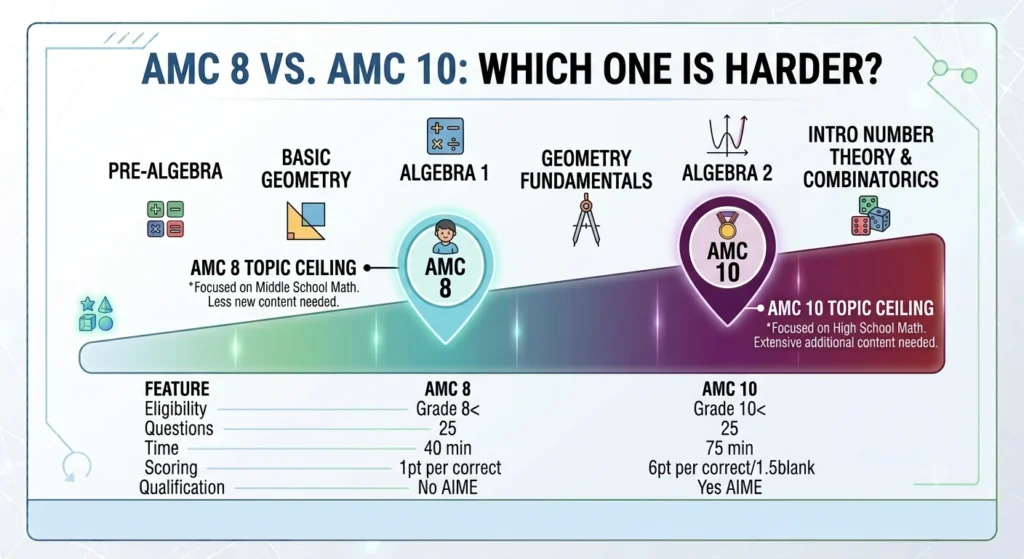
It draws on a wider topic ceiling (full algebra 2, geometry, and introductory number theory and combinatorics), gives students 75 minutes instead of 40, and is scored out of 150 instead of 25. But ‘harder’ depends on what you’re comparing.
- For a typical 6th or 7th grader, the AMC 8 is already appropriately challenging. Putting that same student in front of an AMC 10 too early usually just measures which topics they haven’t learned yet, not their problem-solving ability.
- For a strong 8th, 9th, or 10th grader with a solid algebra and geometry foundation, the AMC 10 is the harder but more appropriate test, since it matches their actual coursework.
- Difficulty within each contest also varies year to year. Some AMC 8 papers run harder than others, and the same is true for AMC 10 A versus AMC 10 B.
If you want a closer look at what separates AMC 10 from its older sibling, see our AMC 10 vs AMC 12 comparison, and for the full topic list at each level, our AMC syllabus guide breaks down exactly what’s tested.
What the scores mean at each level
AMC 8 scores are simple integers from 0 to 25. A score around 13 to 15 is a solid result for a strong middle schooler in their first attempt.
Honor Roll (top 5%) needed 21 in 2026; Distinguished Honor Roll (top 1%) needed 24. There’s no qualification tier, every participant gets a certificate, and high scorers get recognition.
AMC 10 scores range from 0 to 150. The number every serious AMC 10 student watches is the AIME cutoff, the threshold to qualify for the American Invitational Mathematics Examination, the next round.
In recent years the AMC 10 AIME cutoff has landed in roughly the 94.5 to 105 range, with meaningful year-to-year swings driven by exam difficulty. AMC 10 Distinction (about top 5%) and Honor Roll of Distinction (about top 1%) are meaningful credentials too.
For a broader look at what counts as a competitive result, see our guides on what is a good AMC score and average AMC math scores. For the full topic-by-topic breakdown of both contests, see our AMC syllabus guide.
The progression: AMC 8 to AMC 10 to AIME and beyond
For a month-by-month plan to move from AMC 8 to AMC 10 preparation, see how to prepare for the AMC.
Here’s how the AMC family stacks for a student who sticks with it:
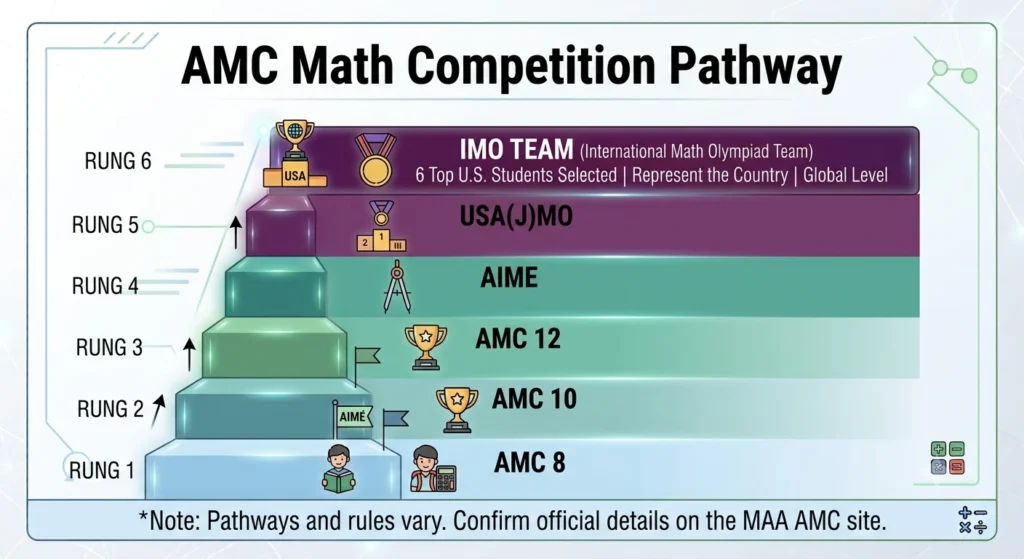
- Grades 5 to 8 (AMC 8 era): introduce competition math, build pattern recognition, develop a taste for problem-solving without the pressure of qualification stakes.
- Grades 8 to 10 (AMC 10 era): start taking the AMC 10, work toward AIME qualification. A strong 8th grader can absolutely sit AMC 10.
- Grades 11 to 12 (AMC 12 era): move to the AMC 12, where the topic ceiling rises to include trig, logs, complex numbers, and richer combinatorics.
- AIME (top ~2.5 to 5% of AMC 10/12 scorers): 15 short-answer integer questions, 3 hours.
- USAJMO / USAMO (top scorers selected from a combined AMC + AIME index): proof-based, two days, six problems total, the gateway to the USA team selection process.
Most kids stop somewhere on this ladder, and that’s fine. The path itself is the value, the problem-solving habits transfer to school math and to anything that asks how would you approach this.
Once your child is ready to move up, our AMC 12 practice test guide and AMC 10 vs AMC 12 breakdown lay out exactly what changes at the next level.
How to decide based on grade and readiness
Use this as a starting framework, adjusted for your child’s actual experience with problem-solving.
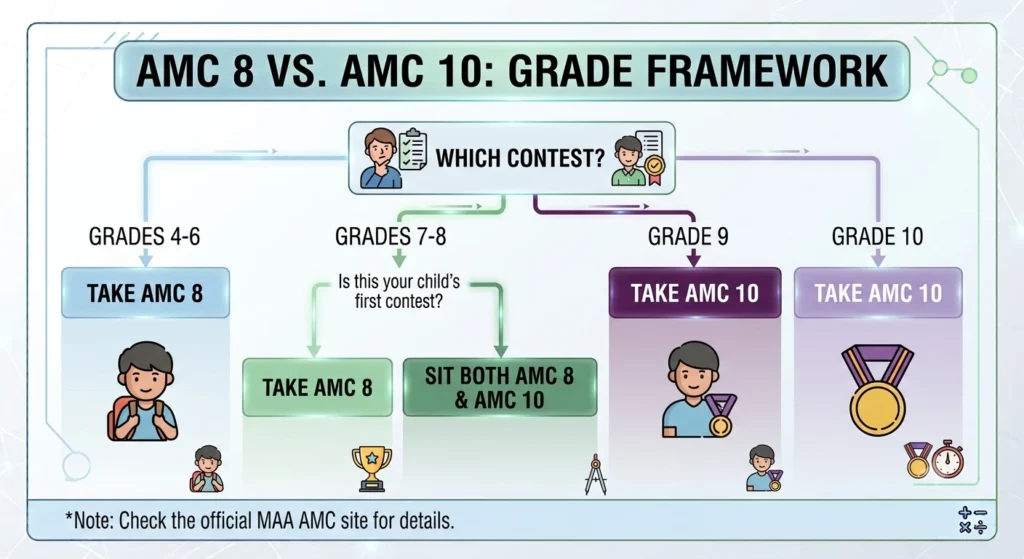
- Grades 4 to 6: Take the AMC 8. The problems are calibrated for this range, and the goal at this age is exposure, not stakes.
- Grades 7 to 8: Take the AMC 8 if it’s your child’s first contest. If they’ve taken AMC 8 once already and scored above 20, consider adding the AMC 10 in the same school year (different month, different test). Both is fine.
- Grade 9: Take the AMC 10. AMC 8 is no longer an option.
- Grade 10: Take the AMC 10. This is your child’s last year of AMC 10 eligibility, so it’s the year that matters most for AIME qualification.
A useful readiness check before sitting the AMC 10: have your child do 10 sample problems from a past AMC 10 (problems 1 to 15).
If they can comfortably solve 6 or more in 30 minutes, they’re ready. If they’re stuck on 3 or more, spend a few months on the AMC 10 prep pillar first.
For 7th and 8th graders sitting both, schedule them on different months (AMC 8 in January, AMC 10 in November), they don’t conflict, and the AMC 10 will sharpen their AMC 8 performance.
How to register for AMC 8 or AMC 10
Both contests are administered through a registered school or approved competition center rather than directly by families, so the first step is confirming your child’s school participates or finding a local testing center that offers it.
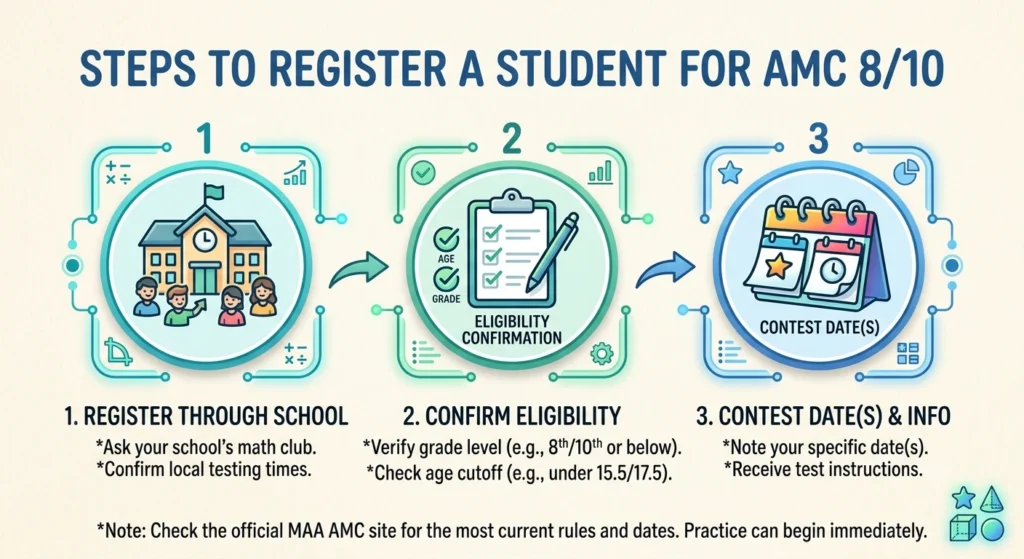
- Confirm your child meets the grade and age cutoff for the contest date, since eligibility is checked on competition day.
- Register through your school’s math department or an approved AMC competition center well before the contest window opens.
- Homeschool families and students at non-participating schools can typically register through an approved local center; check the official MAA site for current options.
Our full AMC registration guide covers deadlines, fees, and what to do if your school doesn’t already offer the AMC.
Practice for whichever they choose
Regardless of which contest your child sits, the practice shape is the same: short, daily problem-solving sessions across all topics, with timed past papers in the final weeks.
That’s the pattern that builds real fluency, and it’s what differentiates students who plateau from students who keep climbing.
For contest-specific practice, see our AMC 10 practice test guide, our AMC 12 practice test guide, and our roundup of free AMC practice resources.
If you’re weighing AMC against other contests, our Math Kangaroo vs AMC comparison and our piece on the benefits of AMC math may help too.
My child is in 7th grade and very strong at math. Should they skip AMC 8 and go straight to AMC 10?
No, let them sit both. The AMC 8 in January is a confidence-building first contest; the AMC 10 in November is the higher-stakes one. They don’t compete for time, and the AMC 8 experience makes the AMC 10 less intimidating. Only skip AMC 8 if your child has already AIME-qualified.
My child got Honor Roll on AMC 8. Are they ready for AMC 10?
Almost certainly. Honor Roll on AMC 8 (roughly the top 5%) indicates strong problem-solving fundamentals. Spend the spring and summer on AMC 10-specific topics, combinatorics, number theory, and more sophisticated geometry, and sit the AMC 10 the following November. See our AMC 10 practice test guide for a structured plan.
Why did the AMC 8 age limit change from 14.5 to 15.5?
The most current official MAA materials (the 2025-26 Student Enrollment Guide and the MAA AMC program page) list the limit as under 15.5. Older sources, including some MAA documents from prior years, list 14.5. The functional rule is “grade 8 or below,” and the age cap mainly affects students who started school late or repeated a grade. If your child is borderline, confirm directly with the MAA AMC office before registering.
Can my child take both AMC 8 and AMC 10 in the same school year?
Yes, and it’s a great strategy for strong 7th and 8th graders. AMC 10 is in November; AMC 8 is in late January. They’re two months apart and don’t conflict. Many ambitious middle schoolers do both, which spreads the prep across the school year and reduces the pressure on either single contest.
What awards can my child earn from AMC 8 or AMC 10?
Both contests recognize top performers with Honor Roll and Distinguished Honor Roll or Distinction tiers, and the AMC 10 additionally opens the door to AIME qualification. For the complete list of certificates, medals, and recognition levels, see our AMC math competition awards guide.
Is the AMC 10 harder than the AMC 8?
Yes, in terms of topic ceiling and time pressure, the AMC 10 is harder. It covers algebra 2, full geometry, and introductory number theory and combinatorics, compared to the pre-algebra and basic geometry ceiling of the AMC 8. That said, difficulty is relative to preparation: a well-prepared 9th grader typically finds the AMC 10 appropriately challenging rather than overwhelming.
What grade is AMC 8 for?
The AMC 8 is for students in grade 8 or below who are under 15.5 years old on the contest day.
What grade is AMC 10 for?
The AMC 10 is for students in grade 10 or below who are under 17.5 years old on the contest day.
Make Preparing for Math Olympiad Simple!



Conclusion
The AMC 8 vs AMC 10 decision comes down to your child’s grade.
Grade 8 or below and under 15.5, start with the AMC 8. In grades 9 or 10, the AMC 10 is your only option, and the one that opens the door to AIME. Strong 7th and 8th graders can sit for both, since the two contests fall in different months.
Whichever test fits, consistent practice beats last-minute cramming. Gonit turns that into short daily sessions matched to your child’s level, across every topic on the syllabus. Start free on iOS and Android →
Related guides
- AMC syllabus: AMC 8, AMC 10, AMC 12 topics explained
- AMC age limit: quick reference table
- AMC 8 practice test: complete guide for middle schoolers
- AMC 10 practice test: past papers and prep strategy
- AMC 10 vs AMC 12: how the two contests differ
- AMC registration: deadlines and how to sign up
- What is a good AMC score?
- Average AMC math scores by grade
- Benefits of AMC math competitions
- How to prepare for AMC
- Math Kangaroo vs AMC: which contest fits your child
- Free AMC practice resources

Mikha Piregu is a Content Writer with experience spanning educational content, including math and math olympiad topics, as well as advocacy writing, research-based articles, and SEO-driven web content. He creates high-quality blog content, web copy, and feature articles that support brand visibility, audience engagement, and long-term organic growth through data-informed storytelling. Skilled in WordPress, WooCommerce, and modern digital tools, Mikha adapts content across various platforms, including blogs, websites, campaigns, and advocacy initiatives, with clarity and purpose.




There are no comments posted here yet.
Sign in to leave a comment