

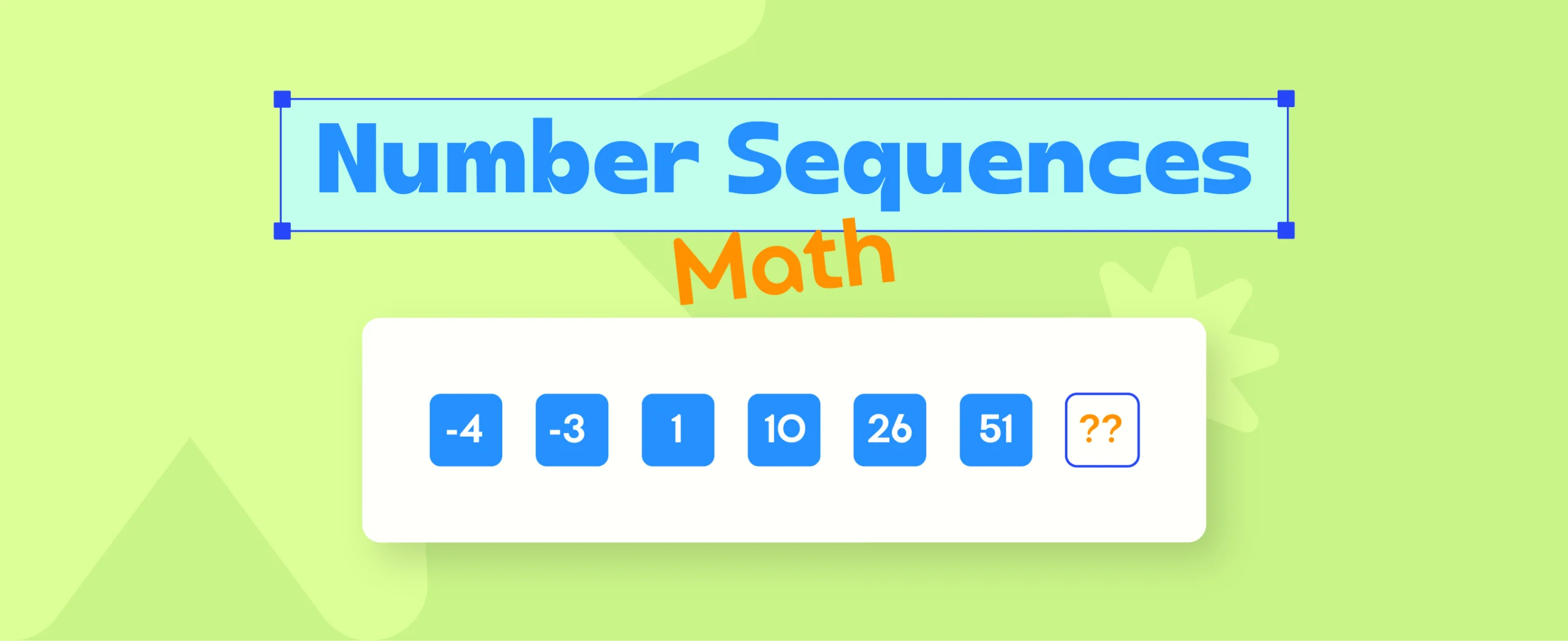
A number sequence is the correct order that numbers follow: 1, 2, 3, 4, 5. The number sequence for Class 1 teaches children where every number belongs, what comes next, and what comes before, building a strong foundation for addition, subtraction, and all math that follows.
- What is a Number Sequence in Simple Terms?
- Types of Number Sequences for Class 1
- Number Sequence 1 to 10, 1 to 20, 1 to 50 and 1 to 100
- What Comes Before, After and Between
- Why Number Sequences Matter for Class 1 Students
- Number Sequence Examples for Class 1
- Complete the Sequence: Practice Questions with Answers
- Write Down the Numbers: Practical Exercises
- What Is the Right Sequence to Teach Numbers?
- Number Sequences by Grade: Nursery, Class 1 and Class 2
- Number Sequence vs Number Pattern vs Skip Counting
- Fun Activities to Learn Number Sequences
- Common Mistakes Children Make with Number Sequences
- Tips for Parents: Practise Number Sequences at Home
- Number Sequence Worksheets for Class 1: Simple Practice Ideas
- Printable Worksheets or App Practice: Which Works Better?
- Conclusion
This guide covers every type of sequence a Class 1 child meets at school, with worked examples and answers, practice sets you can use straight away, and simple ways to help when your child is asked to complete the sequence or write down the numbers in sequence on a worksheet.
For Class 1 students, mastering number sequences is not optional. Children use them daily when counting toys, climbing stairs, reading calendars, and playing games that use ordinal terms like first, second, and third.
This skill directly supports number sense, mental arithmetic, and logical thinking.
A quick note on names: “number sequence Grade 1” and “number sequence Class 1” describe exactly the same skill. Schools following CBSE and most Indian boards say Class 1; schools in the US, UK and much of Africa say Grade 1 or Year 1. Everything on this page applies to both, and to any child aged roughly 5 to 6
What is a Number Sequence in Simple Terms?
A number sequence is a group of numbers that follow one after another in a fixed, correct order. Each number has its own place, and changing that order breaks the sequence.
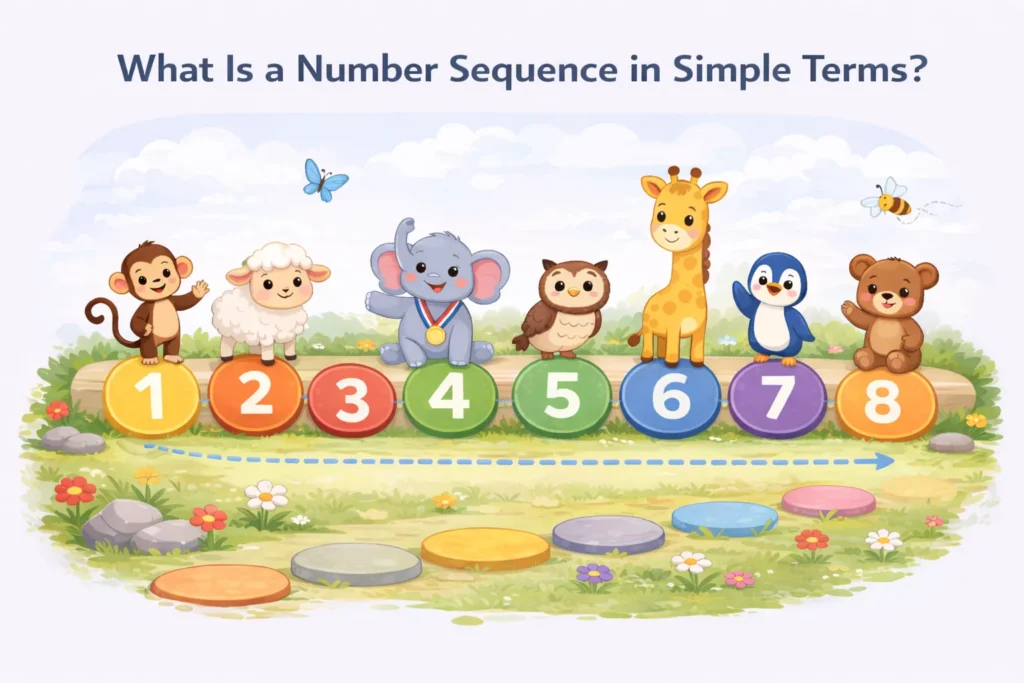
Think of it this way: “Numbers are like children standing in a queue: 1 is first, then 2, then 3. If 3 steps in front of 2, the line is mixed up.”
In Class 1, children learn two key directions for sequences:
Forward sequences (counting up): 1, 2, 3, 4, 5 Backward sequences (counting down): 5, 4, 3, 2, 1
Both are equally important. Understanding both directions gives children a mental map of where every number sits when using a number line for Class 1, which shows the visual position of each number in correct order.
What Each Number in a Sequence Is Called
Each number in a sequence is called a term. The first number is the first term, the next one is the second term, and so on.
So in the sequence 4, 5, 6, 7:
- 4 is the first term
- 5 is the second term
- 6 is the third term
- 7 is the fourth term
This is where sequences meet ordinal numbers for Class 1, the words first, second, third and fourth. Class 1 children do not need the word “term” to pass a test, but hearing it early makes later maths lessons feel familiar. If first, second and third are still shaky, start with how to teach ordinal numbers to Class 1 students.
Other Names for a Number Sequence
Worksheets, teachers and textbooks use several different names for the same thing. If your child’s homework uses a word you do not recognise, it is almost certainly one of these:
- Sequential numbers: numbers that follow each other in order, such as 12, 13, 14, 15
- Counting sequence: the order you say numbers in when you count
- Number series: an older textbook word for the same list of numbers
- Numeric sequence: the same idea written in more formal language
- Number order: what the sequence shows, from smallest to largest or largest to smallest
So “write the sequential numbers from 6 to 12” and “write down the numbers in sequence from 6 to 12” are asking for exactly the same answer: 6, 7, 8, 9, 10, 11, 12.
Types of Number Sequences for Class 1
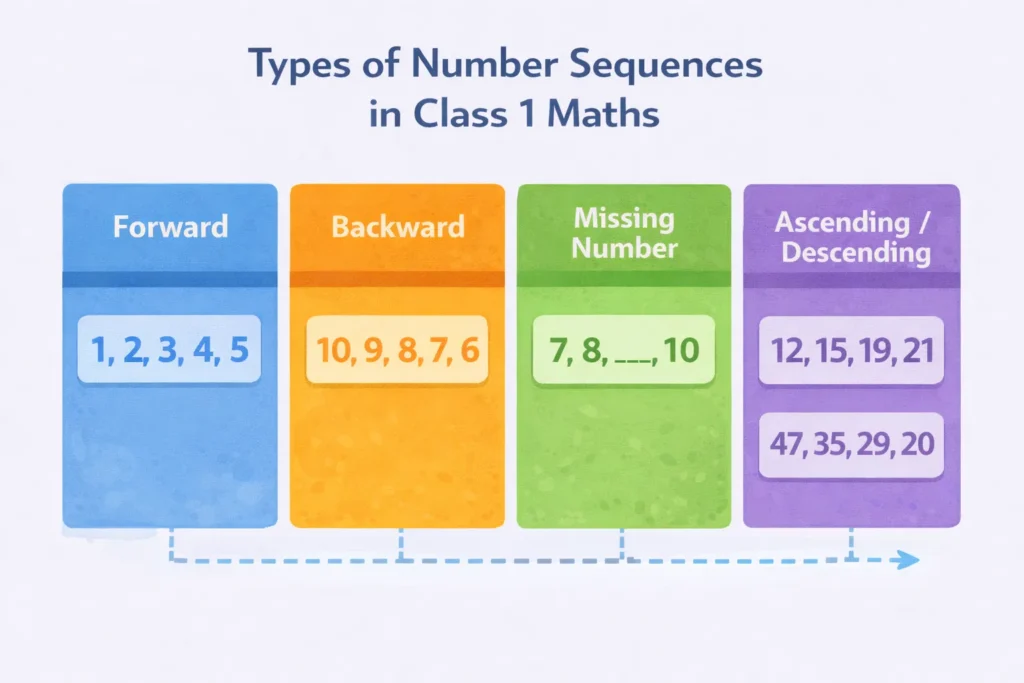
Class 1 covers four main types of number sequences. Together, they build a complete picture of how numbers relate to each other.Types of Number Sequences for Class 1
Class 1 covers four main types of number sequences. Together, they build a complete picture of how numbers relate to each other.
1. Forward Number Sequence
Counting up, where each number is one more than the one before: 1, 2, 3, 4, 5.
In Class 1, children typically start with 1 to 20, then extend to 1 to 50 and 1 to 100. A key skill is learning to start from any point, for example 23, 24, 25, 26, not just from 1.
Why it matters: Forward counting is the foundation for addition. When children add 7 + 2, they mentally count forward two steps from 7 to reach 9.
2. Backward Number Sequence
Counting in reverse: 10, 9, 8, 7, 6. This is critical because understanding why backward counting is important for Class 1 directly prepares children for subtraction.
Short countdowns (10 to 1, or 20 to 1) are an excellent starting point. When children learn what backward counting means for Class 1 math, they begin to grasp how subtraction works, moving backward along the number sequence.
Why it matters: Backward sequences teach how numbers decrease. When children subtract 9 − 2, they mentally count backward two steps from 9 to reach 7.
3. Missing Number Sequence
One or more numbers are hidden, and children must figure out what belongs in the gap:
- 7, 8, __, 10 → Answer: 9
- 10, 9, __, 7 → Answer: 8
- 15, 14, 13, __, 11 → Answer: 12
This type builds logical thinking and pattern recognition. Children learn to spot the rule and apply it consistently. Missing numbers are part of building strong number sense for Class 1.
4. Ascending and Descending Order
Ascending (smallest to largest): 12, 15, 19, 21 Descending (largest to smallest): 47, 35, 29, 20
Ordering numbers from small to big or big to small teaches comparison and helps children see the relationship between numbers at a glance. Learning ascending and descending order for Class 1 is closely linked to number sense and number ordering, both critical foundational skills. For more practice on this type, see these ascending and descending order examples for Class 1.
Number Sequence 1 to 10, 1 to 20, 1 to 50 and 1 to 100
Most Class 1 worksheets ask children to write a sequence inside a fixed range. These are the four ranges that come up again and again, in the order schools usually teach them.
Number Sequence 1 to 10 and 1 to 20
The 1 to 10 sequence is the first one every child memorises:
1, 2, 3, 4, 5, 6, 7, 8, 9, 10
Backward: 10, 9, 8, 7, 6, 5, 4, 3, 2, 1
Once that is secure, extend to 20. The 11 to 20 stretch is where most children slow down, because the number names stop following a neat pattern. Eleven and twelve sound nothing like one and two, and thirteen to nineteen say the ones digit first.
1 to 20 forward: 1, 2, 3, 4, 5, 6, 7, 8, 9, 10, 11, 12, 13, 14, 15, 16, 17, 18, 19, 20
20 to 1 backward: 20, 19, 18, 17, 16, 15, 14, 13, 12, 11, 10, 9, 8, 7, 6, 5, 4, 3, 2, 1
Writing 1 to 50 and 1 to 100 in Sequence
From 21 onward the pattern becomes predictable, which is good news. Every row of ten repeats the same ones digits: 21, 22, 23 behaves exactly like 31, 32, 33.
Teach it in rows of ten rather than one long line:
- 1 to 10
- 11 to 20
- 21 to 30
- 31 to 40
- 41 to 50
The tricky moments are always the “bridge” numbers, the jump from 29 to 30, 39 to 40, 49 to 50. Practise those crossings on their own: “What comes after 29?” “What comes after 39?”
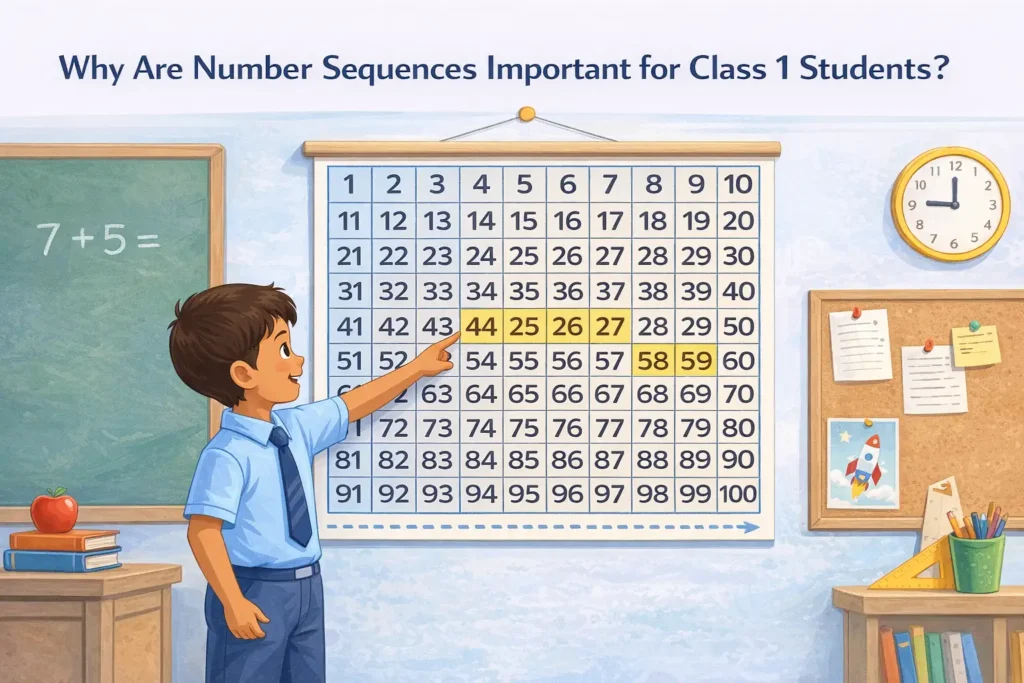
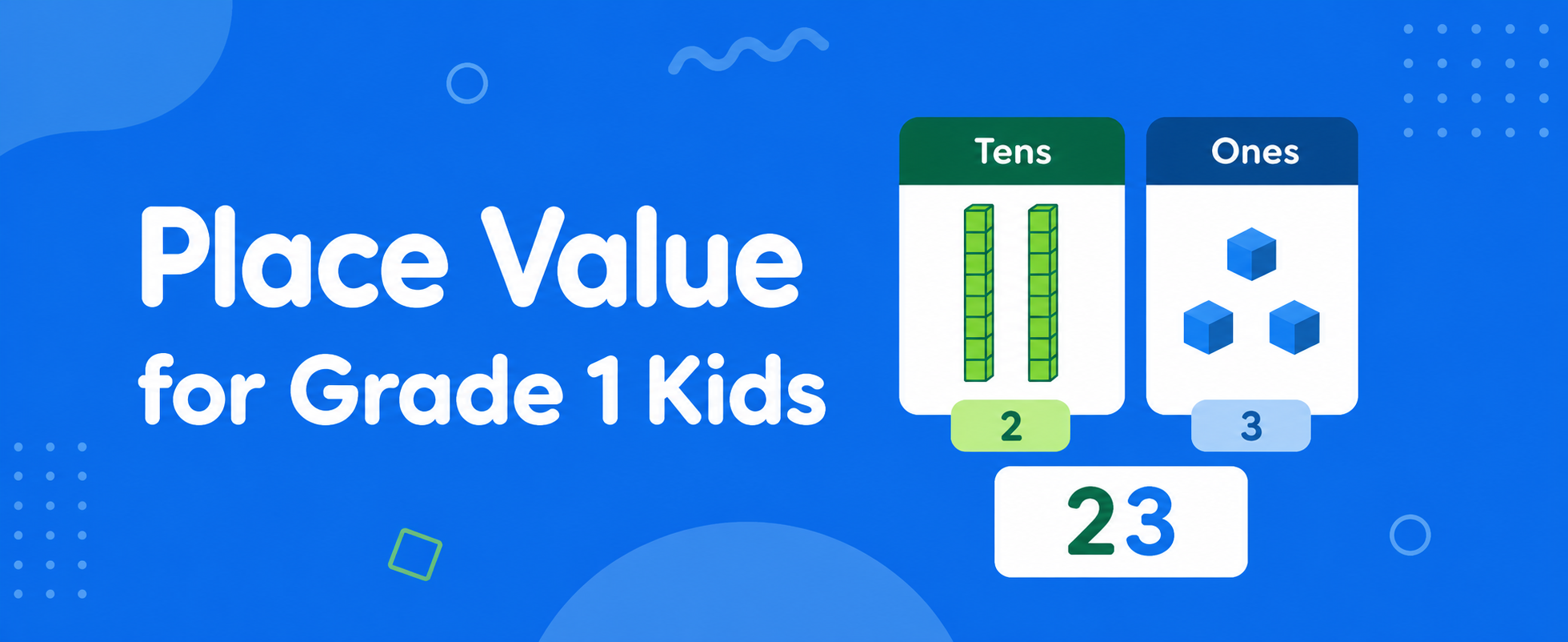
A printed number chart is the single most useful tool here. A 1 to 100 chart laid out in ten rows of ten lets a child see the whole number sequence at once, and the column pattern (1, 11, 21, 31) makes place value visible long before it is formally taught. Once your child is comfortable with sequences to 100, place value for Grade 1 is the natural next topic.
What Comes Before, After and Between
Almost every Class 1 maths paper includes a “before, after and between” question. It is a number sequence question in disguise, and children find the vocabulary harder than the maths.
What comes after means the next number, one step forward:
- What comes after 7? → 8
- What comes after 14? → 15
- What comes after 29? → 30
What comes before means the previous number, one step backward:
- What comes before 7? → 6
- What comes before 5? → 4
- What comes before 50? → 49
What comes between means the number that fits in the gap:
- What comes between 17 and 19? → 18
- What number comes before and after 27? → 26 and 28
These questions are the entry point to number ordering for Class 1, where children arrange several numbers rather than just one.
The classic mix-up: children answer “what comes before 7” with 8, because forward counting is more automatic. Fix it physically, not verbally. Point at a number line: before is to the left, after is to the right. Say it the same way every single time and it sticks within a week.
Why Number Sequences Matter for Class 1 Students
Number sequences aren’t just counting exercises—they underpin almost every math concept that follows.
They Build Number Sense
Lining numbers from smallest to largest or largest to smallest helps children spot patterns of increase and decrease. Understanding “before,” “after,” and “between” teaches comparison: why 18 is greater than 12, for instance. Strong number sense for Class 1 is built step by step through sequences.
They Support Addition and Subtraction
A strong grasp of sequences lets children use a mental number line to count on and count back. For example:
- 7 + 1 = ? → Move one step forward from 7 → 8
- 9 − 1 = ? → Move one step backward from 9 → 8
These are the first steps toward mental arithmetic, where children no longer need to use fingers or objects. The same mental number line is doing the work later in addition and subtraction for Class 1. Learning how to explain number positions on a number line for Class 1 helps children visualize these movements.
They Develop Logical Thinking
Finding missing numbers, identifying mistakes in sequences, and arranging numbers in order all teach children to recognize rules, verify answers, and think systematically. These habits of mind serve them far beyond Class 1, and they overlap directly with critical thinking activities for Grade 1.
Number Sequence Examples for Class 1
Using a mix of written, oral, and visual examples is the most effective approach for young learners.
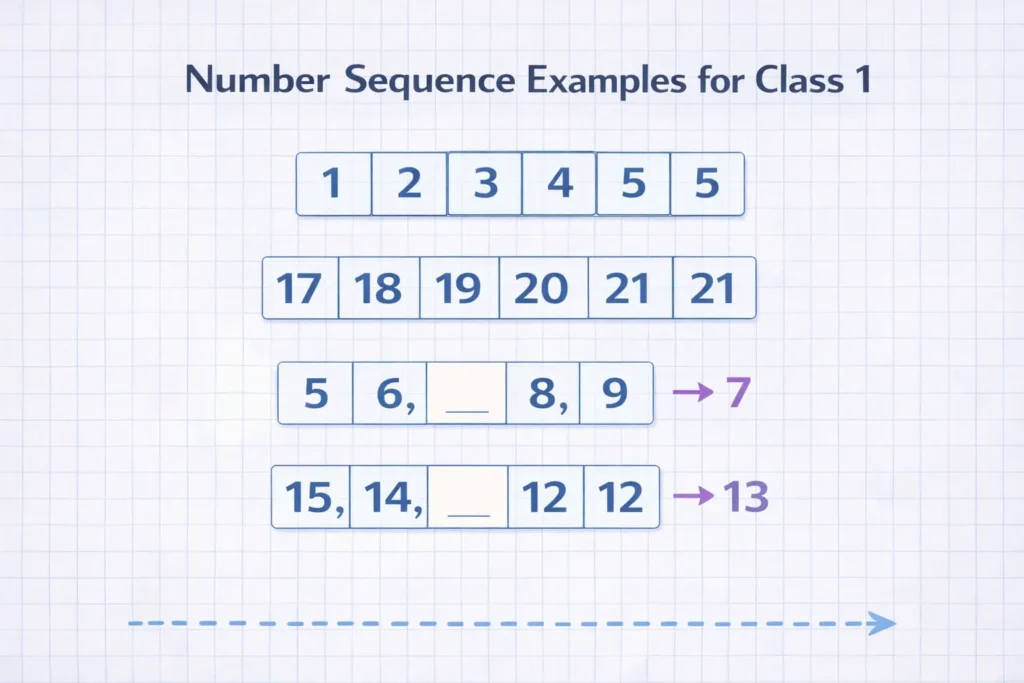
Written Examples
| Sequence Type | Example 1 | Example 2 |
|---|---|---|
| Forward | 1, 2, 3, 4, 5 | 17, 18, 19, 20, 21 |
| Backward | 10, 9, 8, 7, 6 | 20, 19, 18, 17, 16 |
| Missing Number (Forward) | 5, 6, __, 8, 9 (Answer: 7) | 23, 24, __, 26 (Answer: 25) |
| Missing Number (Backward) | 15, 14, __, 12 (Answer: 13) | 50, 49, __, 47 (Answer: 48) |
Oral Practice
Spoken counting builds fluency and is easy to do anywhere:
- Choral counting: “Let’s count from 1 to 20 together, now backwards from 10!”
- Start in the middle: “Start at 9 and count up to 15.”
- Quick-fire questions: “What comes after 29?” / “What comes before 50?” / “What’s between 17 and 19?”
Visual Practice with Number Charts
- Colour squares 11 to 15 on a 1 to 50 chart and read them aloud.
- Cover one number: “24, 25, __, 27, what’s missing?”
- Trace a full row (1 to 10) forwards, then backwards.
Complete the Sequence: Practice Questions with Answers
“Complete the sequence” is the single most common instruction on a Class 1 maths worksheet. It simply means: work out the rule, then fill the gap. Here is a full practice set with answers, grouped by the exact question style your child will see.
The three-step method, every time:
- Read the numbers you can see, out loud.
- Decide which way the sequence is going, up or down.
- Count one step from the number just before the gap.
Complete the Number Sequence (Forward)
| Question | Answer |
|---|---|
| 3, 4, __, 6, 7 | 5 |
| 18, 19, __, 21 | 20 |
| 45, 46, __, 48 | 47 |
| 8, 9, 10, __ | 11 |
| 25, 26, 27, __ | 28 |
| 99, 100, __ | 101 |
| 36, __, 38, 39 | 37 |
| __, 62, 63, 64 | 61 |
Complete the Backward Sequence
| Question | Answer |
|---|---|
| 10, 9, __, 7 | 8 |
| 15, 14, 13, __, 11 | 12 |
| 20, 19, 18, __ | 17 |
| 32, 31, __, 29 | 30 |
| 50, 49, __, 47 | 48 |
| __, 7, 6, 5 | 8 |
Which Sequence Is Correct?
Children are often asked to spot the correct sequence rather than write one. Look at each option and check whether every step changes by exactly one.
| Sequence | Correct? | Why |
|---|---|---|
| 1, 3, 2, 4 | ❌ | 3 and 2 are swapped |
| 5, 4, 3, 2 | ✅ | A correct backward sequence |
| 12, 13, 14, 15 | ✅ | A correct forward sequence |
| 20, 19, 17, 16 | ❌ | 18 is missing |
| 7, 8, 9, 10 | ✅ | A correct forward sequence |
Circle the Incorrect Number in the Sequence
Here the sequence is almost right, and one number is wrong. Ask your child to say the sequence aloud, because the ear usually catches the error before the eye does. This is the same spot-the-error skill used in odd one out for Class 1.
- 11, 12, 14, 14, 15 → the wrong number is 14 in third place, it should be 13
- 28, 29, 30, 32 → the wrong number is 32, it should be 31
- 9, 8, 7, 5 → the wrong number is 5, it should be 6
Write Down the Numbers: Practical Exercises
Many Class 1 worksheets ask children to “write down the numbers in sequence.” This is one of the most common tasks in early maths, and children need explicit practice to master it. Here are worked examples to show your child how to approach these tasks.
Exercise 1: Write the Number Sequence Forward
Instruction: Write down the numbers from 1 to 10 in the correct order.
Answer: 1, 2, 3, 4, 5, 6, 7, 8, 9, 10
Tip for parents: Have your child point to each number on a number line, then write it down. This links the visual and tactile experience to writing, making the sequence stick in memory.
Exercise 2: Write the Backward Sequence
Instruction: Write down the numbers from 10 to 1 in the correct order (backwards).
Answer: 10, 9, 8, 7, 6, 5, 4, 3, 2, 1
Tip for parents: Use a countdown game. “Let’s blast off! 10, 9, 8…” This makes backward sequences memorable and fun.
Exercise 3: Complete the Sequence
Instruction: Write the missing number.
- 3, 4, __, 6, 7 → Answer: 5
- 18, 19, __, 21 → Answer: 20
- 45, 46, __, 48 → Answer: 47
Exercise 4: Write the Next Number in Sequence
Instruction: What comes next?
- 8, 9, 10, __ → Answer: 11
- 25, 26, 27, __ → Answer: 28
- 99, 100, __ → Answer: 101
Exercise 5: Write a Sequence of 5 Numbers
Instruction: Starting at 6, write a sequence of 5 numbers.
Answer: 6, 7, 8, 9, 10
Try it starting from different numbers: start at 14 and the answer is 14, 15, 16, 17, 18. Start at 23 and it is 23, 24, 25, 26, 27. The starting point changes; the rule of “one more each time” does not.
Exercise 6: Write the Numbers in the Correct Order
Instruction: These numbers are jumbled. Write them in sequence.
- 4, 2, 5, 1, 3 → 1, 2, 3, 4, 5
- 19, 16, 20, 17, 18 → 16, 17, 18, 19, 20
- 33, 31, 35, 34, 32 → 31, 32, 33, 34, 35
If your child finds this harder than filling a gap, work through the rules for ordering numbers in Class 1 first, then come back to this exercise.
What Is the Right Sequence to Teach Numbers?
Parents often ask which order to teach things in, and it matters more than most people expect. Teaching ordering before a child can reliably count to 20 produces frustration on both sides. This is the sequence that works, and roughly when each stage lands.
- Count aloud from 1 to 10. Pure rote, no writing, no symbols. Chant it during stairs, bath time and car journeys until it is automatic.
- Match numbers to quantities. Three claps, three spoons, three fingers. A child who can recite to 10 but cannot hand you four blocks has learned a song, not a number sequence.
- Recognise and write the digits 1 to 10. Now connect the spoken word to the written symbol.
- Extend counting to 20, then 50, then 100. Keep the spoken sequence ahead of the written one. Children can always say more numbers than they can write.
- Teach “what comes after.” Start from any number, not just 1. “Start at 6 and keep going.”
- Teach “what comes before.” This is harder and should come after forward counting is comfortable.
- Teach backward counting. Countdowns from 10, then 20. This is the doorway to subtraction.
- Fill missing numbers. Now the child has enough fluency to reason about a gap rather than guess.
- Order jumbled numbers. Ascending first, then descending.
- Move on to skip counting. Twos, fives and tens, once single-step sequencing is solid.
For a fuller classroom version of this progression, see how to teach number sequences to Class 1 students. Teachers working through the earlier stages will find more in these number sense teaching strategies for first graders. If you want the number line method specifically, how to teach number line maths for Class 1 covers it step by step.
The rule of thumb: move to the next stage only when the current one is boring for your child. Boredom means mastery.
Number Sequences by Grade: Nursery, Class 1 and Class 2
Children meet number sequences well before Class 1 and keep building on them afterwards. Knowing where your child sits removes a lot of anxiety about whether they are “behind.”
| Stage | Typical age | What a child can usually do | Typical sequence range |
|---|---|---|---|
| Nursery / Kindergarten | 4 to 5 | Recite numbers in order, match small quantities to numbers | 1 to 10 |
| Class 1 / Grade 1 | 5 to 6 | Forward and backward counting, missing numbers, before and after, ascending and descending order | 1 to 50, extending to 1 to 100 |
| Class 2 / Grade 2 | 6 to 7 | Skip counting by 2s, 5s and 10s, number patterns, counting on from any point to 200 | 1 to 200 and beyond |
Starting earlier? Our guide on how to teach forward and backward counting to kindergarten covers the nursery stage. Moving on? Skip counting for Grade 2 picks up where this page ends.
If your child is in Grade 2 and still unsteady on single-step sequences, there is no need to rush ahead to skip counting. Go back to the 1 to 100 chart for two weeks. Second-grade number sequence work rests entirely on the Grade 1 foundation, and patching the foundation is faster than patching everything built on it.
Number Sequence vs Number Pattern vs Skip Counting
These three terms appear on worksheets interchangeably, which confuses parents more than children. They are related but not the same.
| Number sequence | Number pattern | Skip counting | |
|---|---|---|---|
| The rule | Add or subtract 1 each time | Any repeating rule | Add the same number greater than 1 |
| Example | 12, 13, 14, 15 | 2, 4, 2, 4, 2 or 1, 4, 9, 16 | 5, 10, 15, 20 |
| When taught | Class 1, first term | Late Class 1 into Class 2 | Class 1 end, mainly Class 2 |
| What it builds | Number order and number sense | Rule spotting and logic | Multiplication readiness |
| Child’s question | “What comes next?” | “What is the rule?” | “How big is each jump?” |
In short: every skip count is a pattern, and every basic number sequence is the simplest pattern of all, the one where the jump is exactly 1.
Once your child is confident here, skip counting for Class 1 is the natural next step, and how to teach skip counting to Class 1 kids shows how to introduce it without losing the single-step habit.
Fun Activities to Learn Number Sequences
Play-based activities make number sequences memorable. Children learn best when they are moving, talking, and playing.
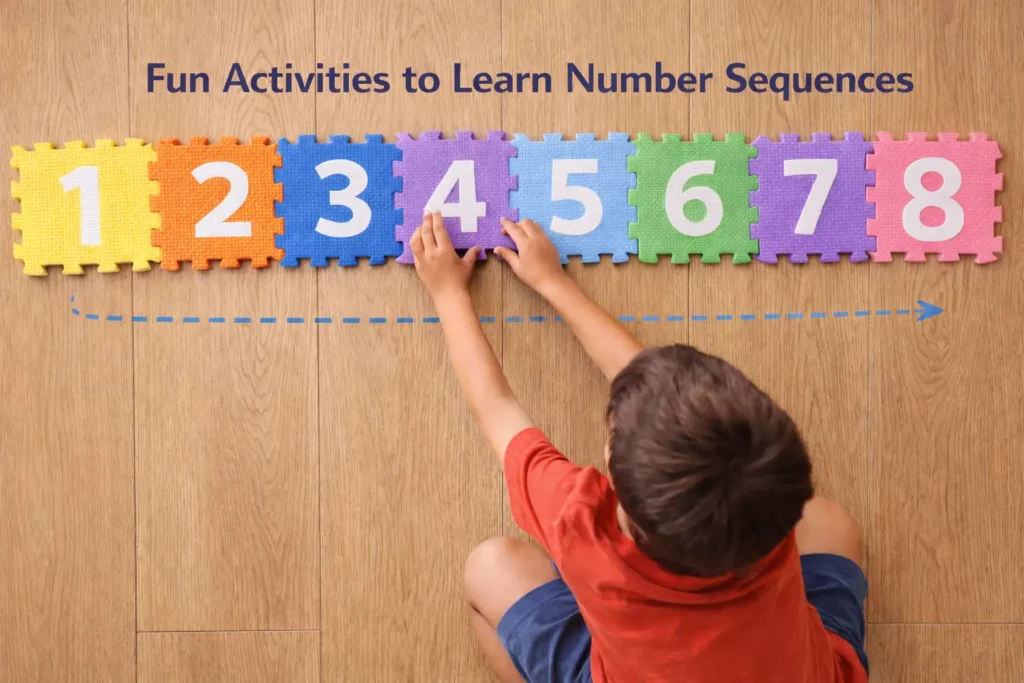
Number Line Games
Lay a number line on the floor using tape or cards, following the same layout as these steps to draw a number line for Class 1 maths. Children:
- Start at one number (e.g., 7) and jump to another (e.g., 12), counting aloud as they go.
- Jump backward for reverse sequences.
- Find the “missing stop” when one number is covered.
When you learn how to teach number line maths for Class 1, you’ll discover that physical games like floor jumping anchor sequences in the child’s body memory, not just their mind. The combination of movement and counting makes learning stick.
Classroom and Home Games
- Pass-the-Count: One child says a number; the next child continues. Try starting from different points or going backwards.
- Stand-Sit: Children stand only when a number from a specific range is called.
- Number Card Ordering: Shuffle cards and arrange them from smallest to biggest.
- Fill the Chart: Complete blank sections of a 1 to 50 or 1 to 100 number chart.
- Dot-to-Dot: Connect the numbers in sequence to reveal a picture. This is sequencing practice disguised as colouring, and it is the one most children ask to do twice.
Learning Through Play
- Connect blocks while counting up or down.
- Count stairs going up (forward) and down (backward).
- Use meal times: “Can you get me 5 spoons? Count them out loud!”
Common Mistakes Children Make with Number Sequences
These mistakes are normal; they signal that a child is actively building number understanding. With consistent practice, they fade.
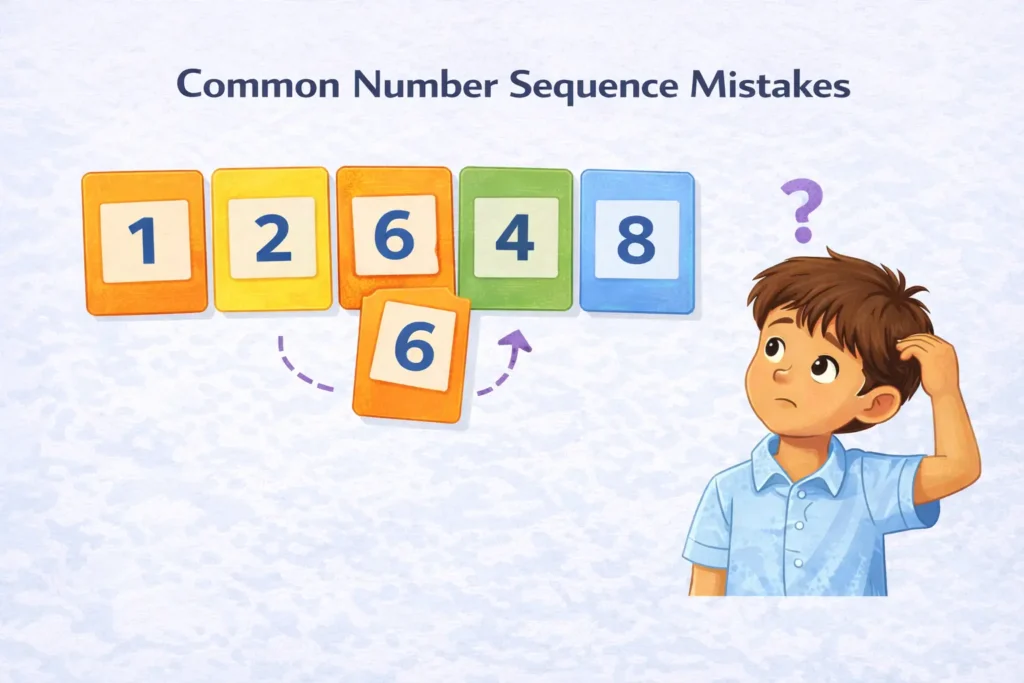
Skipping Numbers
Mistake: Writing 1, 2, 4, 5 instead of 1, 2, 3, 4, 5 (skipping 3).
Why it happens: Rushing or not checking each number carefully.
Fix: Slow down and count with physical objects, one touch per number, to reinforce each step.
Mixing Up the Order
Mistake: Placing numbers out of position (e.g., 3 before 2).
Why it happens: Especially common with backward or mixed sequences; children haven’t anchored the mental map yet.
Fix: Regular practice with number lines, spoken aloud, helps anchor position naturally.
Confusing “Before” and “After”
Mistake: Mixing up “What comes before 7?” with “What comes after 7?”
Why it happens: The language is easily confused by young learners.
Fix: Use a physical number line and point. “Before is here (left),” “After is here (right).” Repeat this language daily.
Reverse Sequence Confusion
Mistake: Writing 5, 4, 3, 2, 1 as 1, 2, 3, 4, 5 when asked to count backward.
Why it happens: Children default to forward counting because it’s more familiar.
Fix: Use countdown games (“5, 4, 3, 2, 1, blast off!”) to make backward sequences feel different and exciting.
Getting Stuck at the Tens Bridge
Mistake: Counting 28, 29, 20 or 38, 39, 30.
Why it happens: The ones digit resets at every ten, and the child carries the old tens digit forward out of habit.
Fix: Drill the crossings on their own, away from the full sequence. “What comes after 29?” “After 39?” “After 49?” Five of these a day clears it quickly.
Tips for Parents: Practise Number Sequences at Home
You don’t need worksheets or special materials. A few minutes of relaxed, regular practice makes an enormous difference.
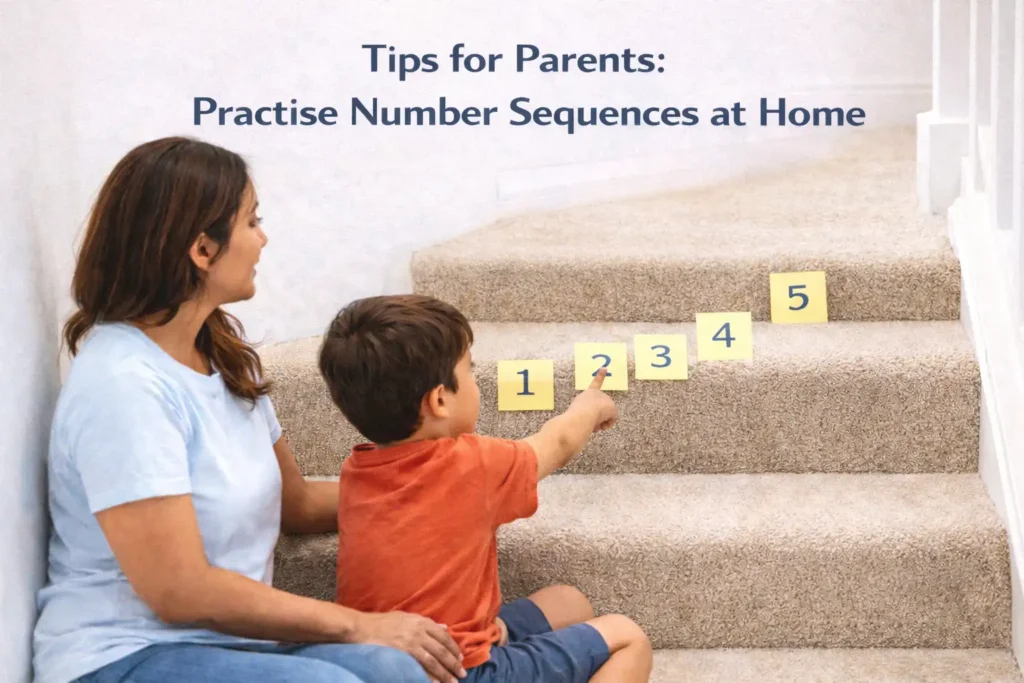
Build It Into Daily Routines
- Stairs: Count forward going up (1, 2, 3…), backward coming down (10, 9, 8…).
- Calendar: Point to today’s date and ask, “What comes after 15?” or “What comes before 10?”
- Meals: Count fruit, spoons, or bites and say the sequence out loud.
- Shopping: Count items as you put them in the trolley.
Use Toys and Objects
- Arrange toy cars or blocks from smallest group to biggest.
- Lay out 10 objects and remove one: “What number is missing?”
- Play card games where children arrange numbers in order.
- Make a hopscotch grid and count as you jump.
Key: Turning everyday moments into number games keeps practice light, fun, and stress-free. Consistency beats intensity. For more ideas you can use without any preparation, browse these number sense resources for parents of Class 1 children.
Number Sequence Worksheets for Class 1: Simple Practice Ideas
Short, focused worksheet tasks reinforce number sequences without overwhelming young learners.
Each of the four task types below appears on almost every Grade 1 number sequence worksheet, so practising them at home means nothing on the page is a surprise.
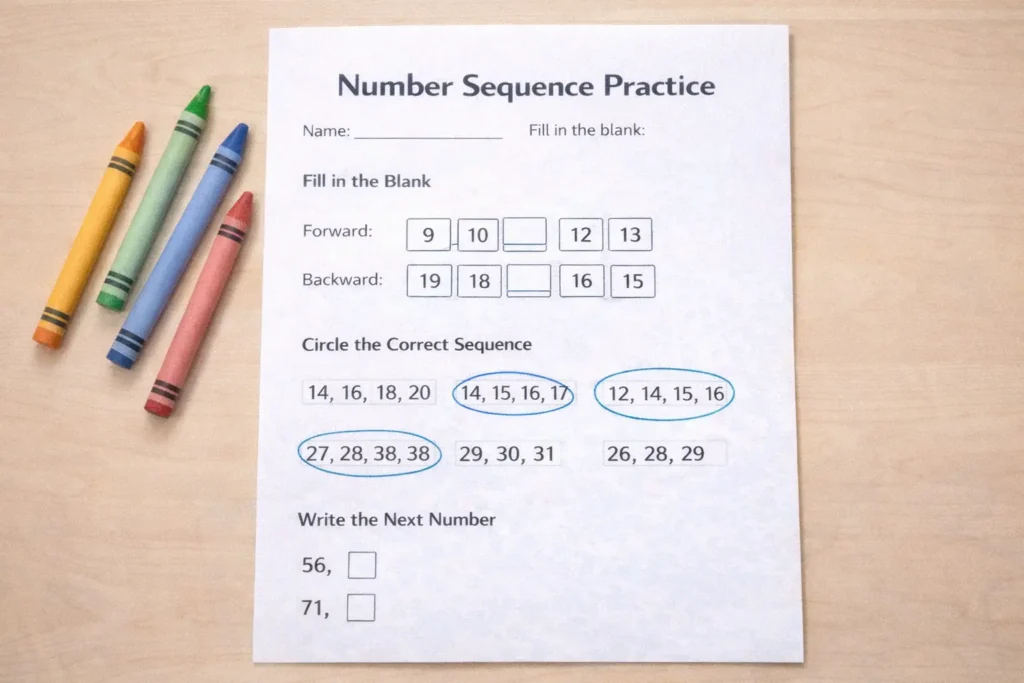
Complete the Sequence
Fill in the missing number:
- 3, 4, __, 6, 7 → 5
- 10, 9, __, 7 → 8
- 15, 14, 13, __, 11 → 12
- 28, 29, __, 31 → 30
Circle the Correct Order
Which sequence is correct?
- 1, 3, 2, 4 → ❌ (incorrect)
- 5, 4, 3, 2 → ✅ (correct, backward counting)
- What comes next after 8, 9, 10? → ✅ 11
Write the Next Number
- What comes after 12? → 13
- Count back: 20, 19, 18, __ → 17
- Pattern: 35, 36, 37, __ → 38
Ordering Numbers
Arrange these numbers from smallest to largest:
42, 28, 35, 50, 19 → 19, 28, 35, 42, 50
7, 3, 9, 1, 5 → 1, 3, 5, 7, 9
Printable Worksheets or App Practice: Which Works Better?
Most parents end up using both, but they are not interchangeable. Here is an honest comparison on the things that actually matter at this age.
| Printable worksheets | App-based practice | |
|---|---|---|
| Handwriting practice | Yes, children form the digits themselves | No, usually tap or drag |
| Instant feedback | No, a wrong answer can be repeated ten times | Yes, corrected on the spot |
| Difficulty adjustment | Manual, you pick the next sheet | Automatic, adapts to the child |
| Screen time | None | Needs limits for this age group |
| Cost and setup | Printer, paper, time to choose sheets | Download once |
| Best for | Exam-style writing practice, quiet focused work | Daily 5 minute drills, instant correction of before and after mix-ups |
A practical mix: apps for short daily reps during the week, printed worksheets at the weekend for writing practice. The writing matters, because exams are written. The instant feedback matters, because an uncorrected mistake practised ten times becomes a habit.
What is a number sequence for Class 1?
A number sequence is a group of numbers arranged in a fixed order, where each number has its own place. In Class 1, children learn to count forward (1, 2, 3…), backward (10, 9, 8…), and find missing numbers in a sequence.
What are the types of number sequences taught in Class 1 maths?
Class 1 covers four main types: forward sequences (counting up), backward sequences (counting down), missing number sequences (finding the gap), and ascending/descending order (arranging numbers from smallest to largest or largest to smallest).
What is an example of a number sequence for Class 1?
Some simple examples are:
Forward: 5, 6, 7, 8, 9
Backward: 10, 9, 8, 7, 6
Missing number: 12, 13, __, 15 → 14
Ascending: 11, 14, 17, 20
Why is learning number sequences important for Class 1 students?
Number sequences build number sense, help children understand the relationship between numbers, and lay the groundwork for addition and subtraction. They also develop logical thinking and pattern recognition skills.
How can parents help their child practise number sequences at home?
Parents can use everyday moments, counting stairs, reading a calendar, or arranging toys — to practise sequences. Short 2–3 minute sessions daily are more effective than long, infrequent practice.
What is a missing number sequence in Class 1 maths?
A missing number sequence is when one or more numbers are left out and the child must identify what belongs in the gap. For example: 7, 8, __, 10 — the missing number is 9. This activity builds logical thinking and counting fluency.
How is a number sequence different from skip counting?
A standard number sequence goes up or down by 1 each time (1, 2, 3 or 10, 9, 8). Skip counting jumps by a fixed number greater than 1, like counting by 2s (2, 4, 6, 8) or by 5s (5, 10, 15). Skip counting is an extension of number sequences introduced after basic sequencing is mastered.
At what age do children learn number sequences?
Children typically begin learning number sequences around age 5–6, which corresponds to Class 1 or Grade 1. They start with sequences within 1–20, then gradually extend to 1–50 and 1–100 as their confidence grows.
What common mistakes do Class 1 students make with number sequences?
The three most common mistakes are: skipping numbers (writing 1, 2, 4 instead of 1, 2, 3), mixing up the order of numbers, and confusing “what comes before” with “what comes after.” All of these improve naturally with regular, guided practice.
How do number sequences help with addition and subtraction?
When children know the order of numbers, they can count on (for addition) and count back (for subtraction) using a mental number line. For example, solving 6 + 2 becomes “start at 6, count forward 2 steps → 8.” This is one of the first mental maths strategies children develop.
At what age do children learn number sequences?
Most children begin learning number sequences around ages 4–5 (nursery/kindergarten) with simple 1–10 sequences. Class 1 (ages 5–6) deepens this with types like backward, missing, and ordering.
What worksheets or practice materials exist for Class 1 number sequences?
Standard practice includes completion tasks (fill the missing number), ordering exercises (arrange numbers smallest to largest), quick-fire verbal drills, and game-based learning (number lines, card games). Many schools provide printable worksheets.
Make Preparing for Math Olympiad Simple!



Conclusion
The number sequence for Class 1 is one of the most important concepts in early maths and one of the most accessible.
Through simple daily practice, children learn where every number belongs, what comes before and after, and how numbers grow or shrink. Whether the worksheet says “complete the sequence,” “write down the numbers in sequence,” or “what comes next,” it is asking for the same underlying skill.
This builds the number sense that underpins addition, subtraction, and all the maths to come. The key is consistency: short, playful practice every day is far more effective than long, infrequent sessions.
To take this further, explore how to teach number sequences to Class 1 students with proven classroom strategies. For related topics, also check out our guides on ordinal numbers, the number line, place value, and skip counting to continue building your child’s maths confidence.

Mikha Piregu is a Content Writer with experience spanning educational content, including math and math olympiad topics, as well as advocacy writing, research-based articles, and SEO-driven web content. He creates high-quality blog content, web copy, and feature articles that support brand visibility, audience engagement, and long-term organic growth through data-informed storytelling. Skilled in WordPress, WooCommerce, and modern digital tools, Mikha adapts content across various platforms, including blogs, websites, campaigns, and advocacy initiatives, with clarity and purpose.

There are no comments posted here yet.
Sign in to leave a comment