

Skip counting for Grade 2 is the method of counting forward or backward by a number other than 1, such as by 2s, 5s, or 10s, rather than one at a time.
- What is Skip Counting for Grade 2?
- How Kids Learn to Skip Count
- Skip Counting for Grade 2: Learning 2s, 3s, 4s, 5s, and 10s
- Number Lines and Hundreds Charts
- From Skip Counting to Multiplication
- Real-Life Examples
- Hands-On Activities and Games
- Common Mistakes and How to Fix Them
- Helping a Struggling Learner
- Practice Questions
- Is Your Child Ready? Simple Ways to Check
- Final Thought
It serves as a vital foundation for addition, number-pattern recognition, and, eventually, multiplication. If your child can count to 100 but freezes the moment you ask them to count by 3s, that’s normal, not a sign they’re behind.
Skip counting is its own skill, separate from regular counting, and mastering it now makes multiplication, fractions, and telling time far easier later on.
This guide to skip counting for Grade 2 walks you through what skip counting is, how to teach it patiently by 2s, 3s, 4s, 5s, and 10s, and how to spot and fix the small misunderstandings that trip kids up.
What is Skip Counting for Grade 2?
Understanding skip counting for Grade 2 starts with a simple idea: counting forward by a number other than one.
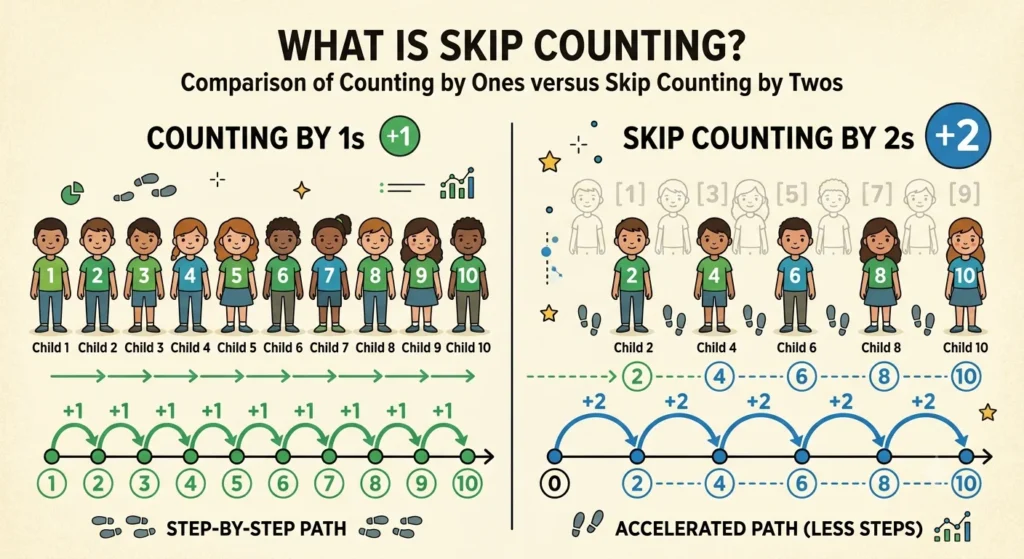
Skip counting means counting forward by a number other than one, jumping from 2 to 4 to 6, or from 5 to 10 to 15, instead of counting every single number in between.
It’s the same idea as counting a pile of coins two at a time instead of one at a time: faster, and it teaches your child to see numbers in groups, not just as a list to memorize.
This “seeing in groups” skill is exactly what your child will need for multiplication, fractions, and telling time, so a little patience here pays off many times over.
How Kids Learn to Skip Count
The best approach to skip counting for Grade 2 isn’t memorization; it’s pattern recognition.
Rather than having your child memorize a chant, we recommend a simple four-step progression:
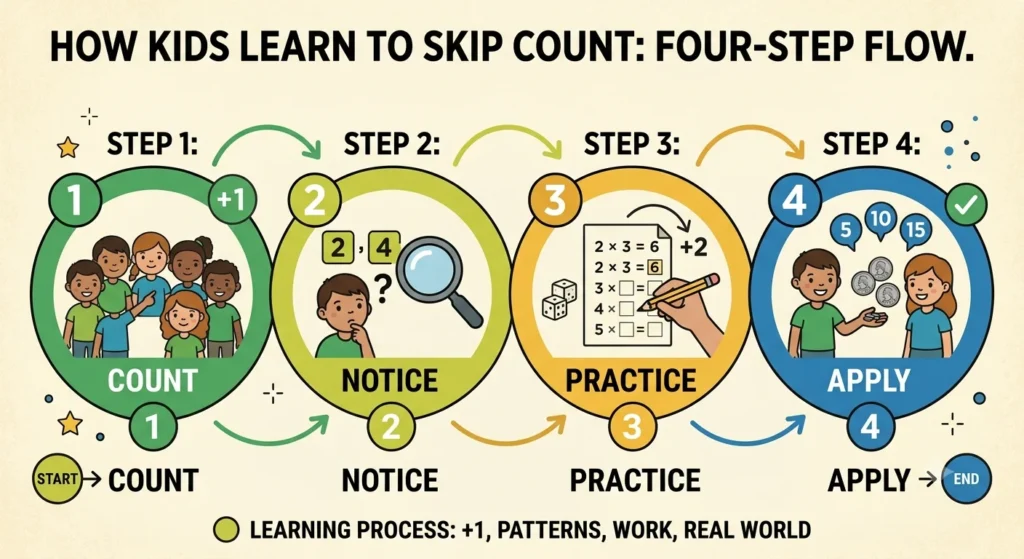
- Count, practice the sequence out loud with objects in front of them.
- Notice, ask, “What’s happening to the numbers each time?” Let them spot the pattern themselves.
- Practice, repeat the pattern in different starting points and directions (forward, and eventually backward).
- Apply, use the pattern to solve a small real problem, like counting a group of toys.
This “count → notice → practice → apply” loop works for every number below, and it’s worth returning to each time you introduce a new pattern.
Skip Counting for Grade 2: Learning 2s, 3s, 4s, 5s, and 10s
Skip Counting by 2s
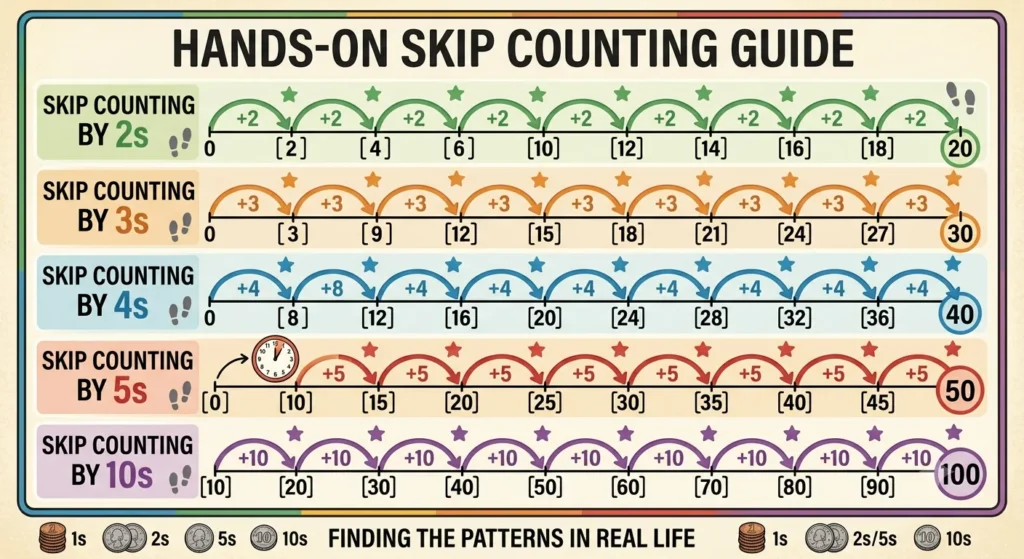
2, 4, 6, 8, 10, 12, 14… Every number in this pattern is even, and the last digit repeats in a simple 2-4-6-8-0 cycle. A great starting point: have your child count their own fingers, two at a time, or count shoes in pairs.
Skip Counting by 3s
3, 6, 9, 12, 15, 18… This is the pattern most guides skip, but it’s not harder, it just needs a slower first pass. Try grouping small objects (crayons, blocks) into sets of three and counting the sets.
Skip Counting by 4s
4, 8, 12, 16, 20, 24… Point out that this is “double the 2s pattern”, if your child already knows 2s well, 4s becomes two hops of 2 at a time, which builds confidence quickly.
Skip Counting by 5s
5, 10, 15, 20, 25, 30… The last digit alternates neatly between 5 and 0. Clocks are a perfect real-world hook here, since each minute mark is five minutes apart.
Skip Counting by 10s
10, 20, 30, 40, 50… The ones digit never changes, only the tens digit goes up by one each time. This is usually the easiest pattern for kids because it connects directly to place value they’re already learning.
Number Lines and Hundreds Charts
A number line turns skip counting into a visual “jumping” activity, literally draw arcs from one number to the next so your child can see the equal-sized jumps.
A hundreds chart (a 10×10 grid of numbers 1-100, see how to use one for counting) is even more powerful for spotting patterns: when a child colors in every 5th number, a clear vertical or diagonal stripe appears. That visual “aha” moment does more for pattern recognition than repeating the numbers aloud ever will.
From Skip Counting to Multiplication
Skip counting is repeated addition wearing a disguise. When your child counts “3, 6, 9, 12,” they’re really doing 3+3+3+3, and that’s exactly what 3×4 means.
Arrays make this connection visible: arrange 12 objects into 4 rows of 3, and your child can see the same 12 appear whether they count by 3s down the rows or multiply rows by columns.
Introducing this link gently in Grade 2, without formal multiplication facts or worksheets, builds the number sense that makes multiplication click quickly in Grade 3.
Real-Life Examples
- Counting money in nickels (5s) or dimes (10s)
- Counting stairs two at a time
- Counting eggs in a carton by groups of 3 or 4
- Counting fingers and toes by 2s and 5s
- Reading a clock face by 5s
Pointing these out during everyday moments (in the car, at the store, on the stairs) reinforces skip counting without it ever feeling like a lesson.
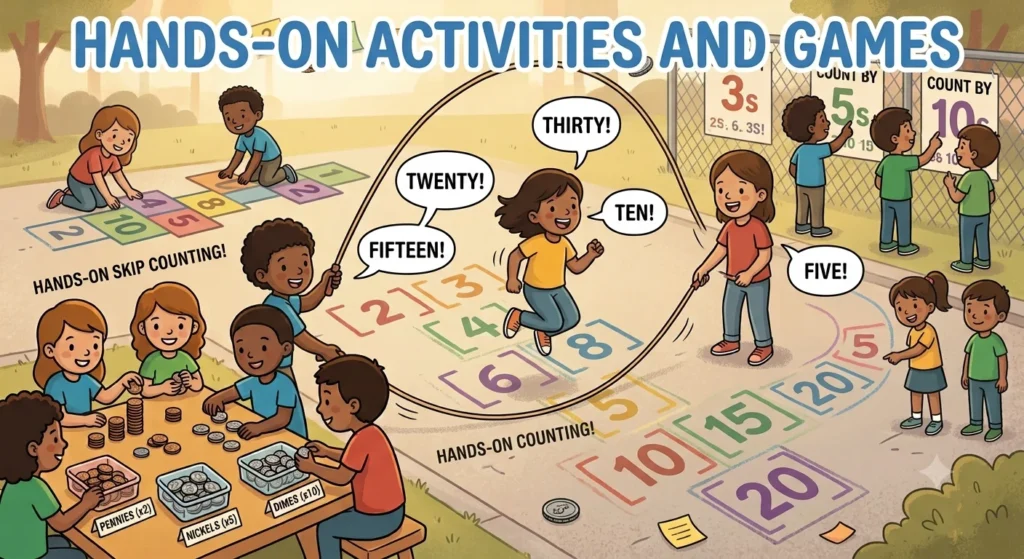
Hands-On Activities and Games
These skip counting for Grade 2 activities work equally well at home or in the classroom.
For even more ready-to-use ideas, see our easy skip counting activities guide alongside the ones below.
Classroom Ideas
- Skip-counting hopscotch: write the pattern numbers on the ground and have students hop only on the correct ones.
- Human number line: students hold number cards and step forward only if their number belongs in the pattern.
- Pattern bingo: call out numbers; students mark only ones that fit the chosen skip-counting rule.
Homeschool/Home Ideas
- Jump-rope counting: count out loud by the chosen number with each rope turn.
- Coin sorting: sort and count nickels, dimes, and pairs of pennies.
- Sticky-note trail: stick numbered notes around the house and have your child collect them in the correct skip-counting order.
- Clap-and-count: clap on the “skipped” numbers and stay silent on the ones in between, out loud together.
Common Mistakes and How to Fix Them
- Reverting to counting by 1s under pressure, slow down and go back to counting with physical objects before returning to the abstract sequence.
- Losing the pattern mid-count, pause and ask, “What did we add last time?” instead of correcting the number directly.
- Confusing similar patterns (like 3s and 4s), practice one pattern at a time until it’s solid before introducing the next.
- Starting from a number other than zero and getting stuck, practice “start anywhere” counting only after the basic 0-start pattern is comfortable.
Helping a Struggling Learner
If a pattern still isn’t sticking after a few sessions, go back one step rather than pushing forward: return to physical objects, slow the pace, and celebrate small wins (getting three numbers right in a row) rather than expecting the whole sequence at once.
Short, frequent, low-pressure practice (five minutes a day) beats one long, frustrating session.
Practice Questions
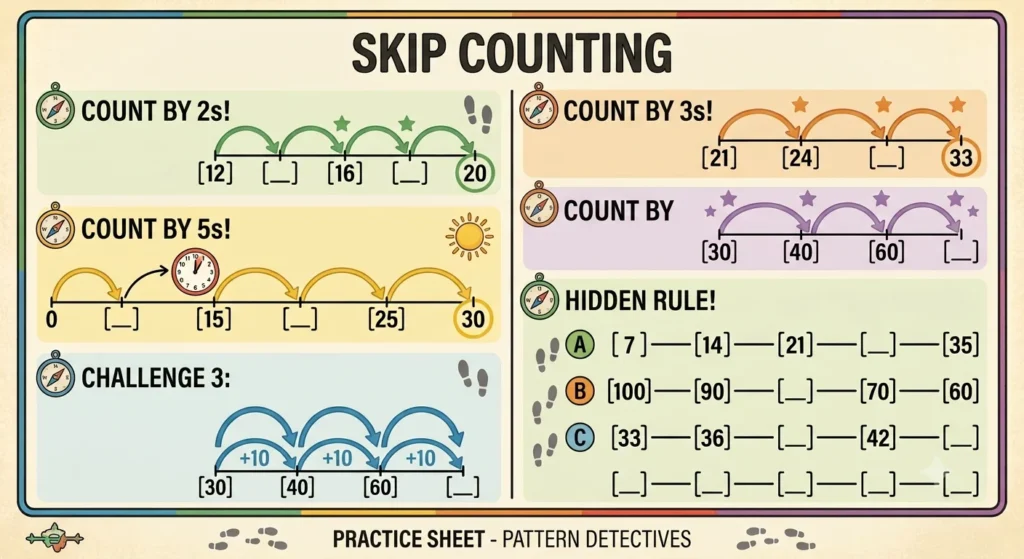
- Skip count by 2s: 2, 4, ___, 8, ___
- Skip count by 5s: 5, 10, 15, ___, 25
- Fill in the missing number: 3, ___, 9, 12
- What number comes next? 40, 30, 20, ___ (counting backward by 10s)
- If you count by 4s starting at 4, what is the 5th number in the pattern?
Answers: 1) 6, 10 2) 20 3) 6 4) 10 5) 20
Is Your Child Ready? Simple Ways to Check
- Can they continue a pattern out loud without objects in front of them?
- Can they fill in a missing number in the middle of a sequence, not just at the end?
- Can they start the pattern from a number other than zero?
- Can they explain, in their own words, what’s happening to the numbers each time?
If they can do most of these comfortably, they’ve moved from memorizing to understanding, which is the real goal.
What age or grade should skip counting be mastered by?
Most children build solid skip-counting skills by the end of Grade 2, though 2s and 10s often come earlier and 3s and 4s may take a bit longer.
Do Grade 2 students need to skip count by 3s and 4s?
Officially, the Grade 2 standard focuses on 5s, 10s, and 100s, but practicing 2s, 3s, and 4s alongside these gives your child a head start on multiplication.
How is skip counting different from multiplication?
Skip counting is the counting process; multiplication is the shortcut for finding a total without counting each group individually. Skip counting is how kids discover that multiplication makes sense.
My child skip counts fine out loud but freezes on paper, why?
This is common and usually means the pattern is memorized as a chant rather than understood visually. Go back to a number line or hundreds chart to rebuild the visual connection.
How much practice does skip counting need per day?
Five to ten minutes of focused, playful practice most days is more effective than one long session per week.
Do Grade 2 students need to skip count by 3s and 4s?
When teaching skip counting for Grade 2, most curricula focus on 5s, 10s, and 100s, but practicing 2s, 3s, and 4s alongside these gives children a head start on multiplication.
Make Preparing for Math Olympiad Simple!



Final Thought
Skip counting for grade 2 is more than a counting trick; it’s the pattern-recognition skill that quietly prepares your child for multiplication, fractions, and telling time.
With steady practice by 2s, 3s, 4s, 5s, and 10s, using number lines, hundreds charts, games, and everyday moments like counting coins or stairs, your child moves from memorizing a chant to truly understanding how numbers work together.
Progress here doesn’t need to be fast. A few minutes of playful practice most days, paired with patience when a pattern doesn’t stick right away, is what builds the kind of number sense that lasts.
If you’d like structured, concept-based practice that keeps building this kind of thinking, including toward Math Olympiad-style problem-solving, explore Gonit App for more Grade 2 math resources.

Mikha Piregu is a Content Writer with experience spanning educational content, including math and math olympiad topics, as well as advocacy writing, research-based articles, and SEO-driven web content. He creates high-quality blog content, web copy, and feature articles that support brand visibility, audience engagement, and long-term organic growth through data-informed storytelling. Skilled in WordPress, WooCommerce, and modern digital tools, Mikha adapts content across various platforms, including blogs, websites, campaigns, and advocacy initiatives, with clarity and purpose.

There are no comments posted here yet.
Sign in to leave a comment