This page is a practice resource: ascending and descending order examples for class 1 come with step-by-step answers.
- Level 1: Ascending Order Examples — Single-Digit Numbers Within 10
- More Ascending Order Examples for Class 1
- Level 1: Descending Order Examples Single-Digit Numbers Within 10
- More Descending Order Examples for Class 1
- Level 2: Ascending and Descending Order Examples With Numbers to 20
- Level 3: Mixed Practice — Identify the Order First
- Level 4: Missing Number Examples
- Level 5: Real-Life Word Problems
- Worksheet-Style Practice: Try These Yourself
- Worksheet Answers
- Common Mistakes in Ascending and Descending Order Examples
- Conclusion
If you need the full definitions, symbol explanations, and teaching method before working through these, start with ascending and descending order in Maths Class 1, then return here.
There are 50+ solved examples across five difficulty levels, progressing from single-digit numbers to real-life word problems. Work through each level until it feels effortless before moving to the next.
Level 1: Ascending Order Examples — Single-Digit Numbers Within 10
Ascending order means arranging numbers from smallest to largest.
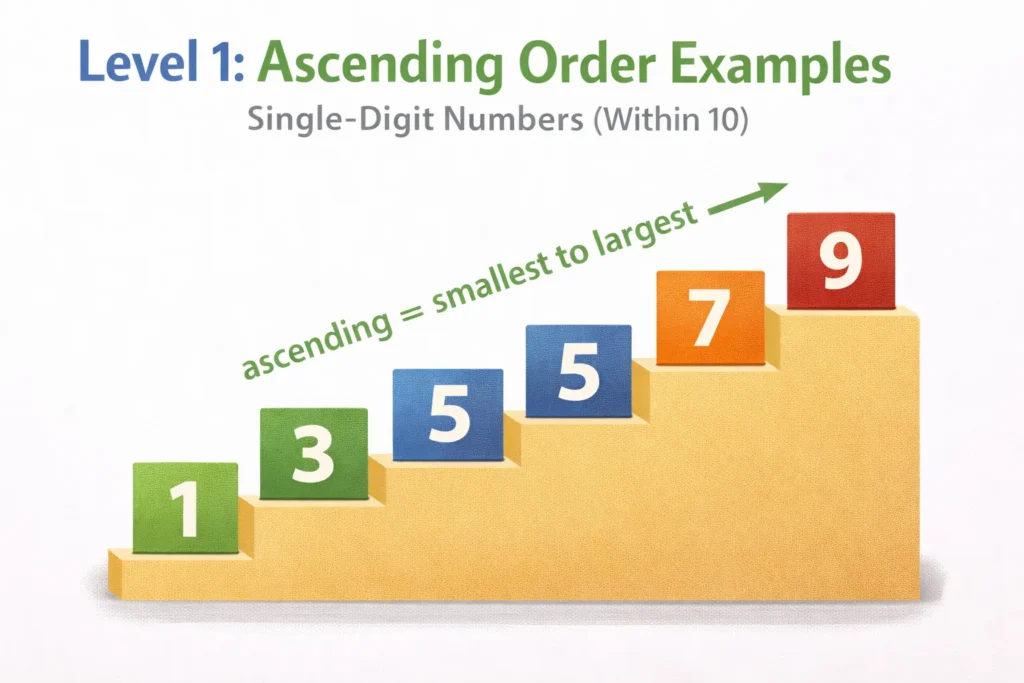
How to solve every ascending order example one method, always works:
Find the smallest number → place it first → find the smallest of what remains → place it second → repeat until all numbers are placed → check every pair from left to right.
| Set | Step-by-Step | Answer |
|---|---|---|
| 3, 1, 5 | Smallest: 1 → Next: 3 → Last: 5 | 1, 3, 5 ✅ |
| 7, 2, 9 | Smallest: 2 → Next: 7 → Last: 9 | 2, 7, 9 ✅ |
| 6, 4, 8 | Smallest: 4 → Next: 6 → Last: 8 | 4, 6, 8 ✅ |
| 5, 1, 3, 8 | Smallest: 1 → Next: 3 → Next: 5 → Last: 8 | 1, 3, 5, 8 ✅ |
| 9, 4, 6, 2 | Smallest: 2 → Next: 4 → Next: 6 → Last: 9 | 2, 4, 6, 9 ✅ |
Self-check question after every example: Is each number bigger than the one before it? Check every pair, not just the first and last.
More Ascending Order Examples for Class 1
Use these when the child needs more single-digit practice before moving forward.
| Question | Answer |
|---|---|
| Arrange 4, 1, 7 in ascending order | 1, 4, 7 ✅ |
| Arrange 8, 3, 6 in ascending order | 3, 6, 8 ✅ |
| Arrange 2, 9, 5 in ascending order | 2, 5, 9 ✅ |
| Arrange 10, 6, 1 in ascending order | 1, 6, 10 ✅ |
| Arrange 7, 5, 2, 9 in ascending order | 2, 5, 7, 9 ✅ |
| Arrange 3, 8, 1, 6 in ascending order | 1, 3, 6, 8 ✅ |
| Arrange 5, 9, 2, 7 in ascending order | 2, 5, 7, 9 ✅ |
| Arrange 10, 4, 7, 1 in ascending order | 1, 4, 7, 10 ✅ |
Level 1: Descending Order Examples Single-Digit Numbers Within 10
Descending order means arranging numbers from largest to smallest.
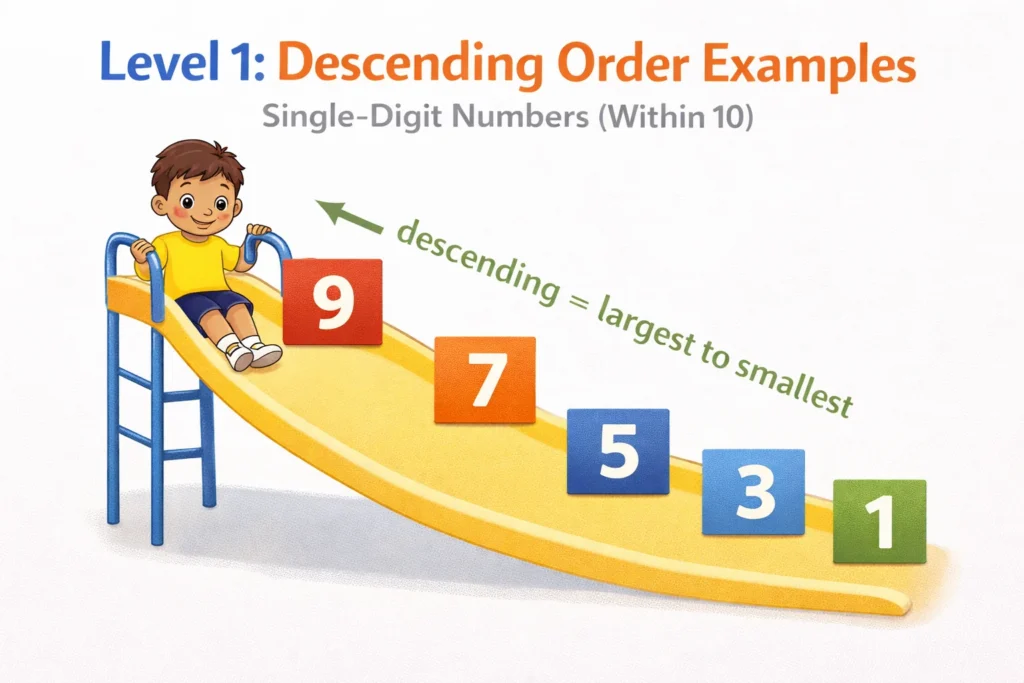
How to solve every descending order example same method, opposite direction:
Find the largest number → place it first → find the largest of what remains → place it second → repeat until all numbers are placed → check every pair from left to right.
| Set | Step-by-Step | Answer |
|---|---|---|
| 8, 3, 6 | Largest: 8 → Next: 6 → Last: 3 | 8, 6, 3 ✅ |
| 9, 4, 7 | Largest: 9 → Next: 7 → Last: 4 | 9, 7, 4 ✅ |
| 5, 1, 3 | Largest: 5 → Next: 3 → Last: 1 | 5, 3, 1 ✅ |
| 8, 2, 5, 1 | Largest: 8 → Next: 5 → Next: 2 → Last: 1 | 8, 5, 2, 1 ✅ |
| 10, 4, 7, 2 | Largest: 10 → Next: 7 → Next: 4 → Last: 2 | 10, 7, 4, 2 ✅ |
Self-check question after every example: Is each number smaller than the one before it? Check every pair.
More Descending Order Examples for Class 1
| Question | Answer |
|---|---|
| Arrange 6, 2, 9 in descending order | 9, 6, 2 ✅ |
| Arrange 3, 8, 5 in descending order | 8, 5, 3 ✅ |
| Arrange 10, 4, 7 in descending order | 10, 7, 4 ✅ |
| Arrange 2, 5, 1, 9 in descending order | 9, 5, 2, 1 ✅ |
| Arrange 6, 10, 3, 8 in descending order | 10, 8, 6, 3 ✅ |
| Arrange 4, 9, 1, 7 in descending order | 9, 7, 4, 1 ✅ |
| Arrange 8, 3, 6, 1 in descending order | 8, 6, 3, 1 ✅ |
| Arrange 5, 10, 2, 7 in descending order | 10, 7, 5, 2 ✅ |
Level 2: Ascending and Descending Order Examples With Numbers to 20
The same step-by-step rules apply. Only the number range changes. When comparing two-digit numbers feels uncertain, use a number line to confirm which is larger numbers are always further right.
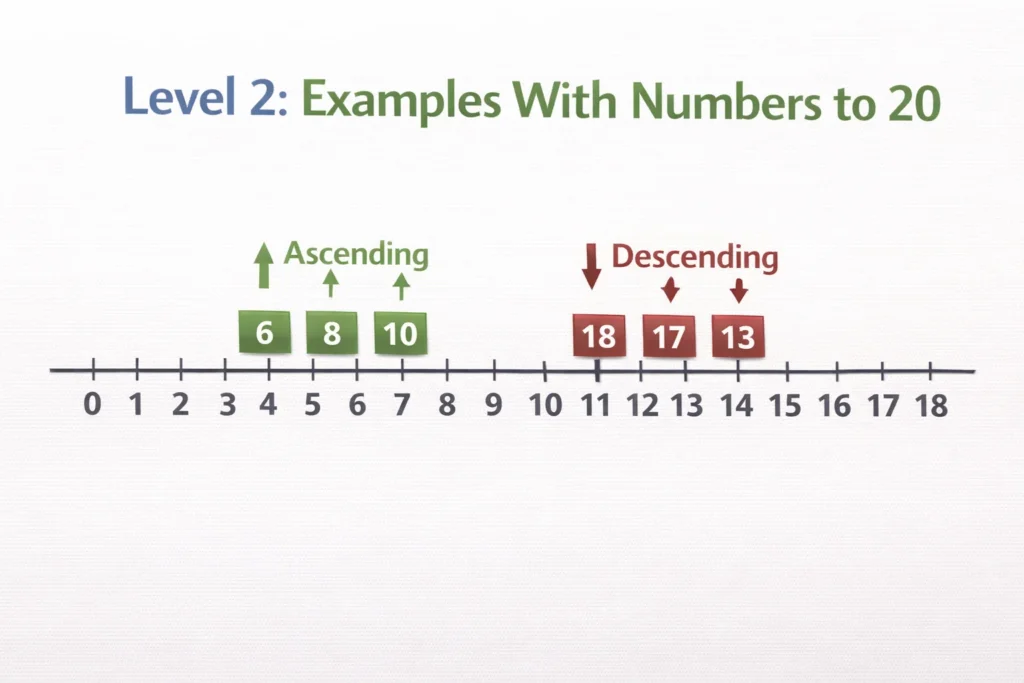
Ascending Order — Numbers to 20
| Set | Answer |
|---|---|
| 11, 7, 15 | 7, 11, 15 ✅ |
| 14, 9, 18 | 9, 14, 18 ✅ |
| 6, 13, 10, 17 | 6, 10, 13, 17 ✅ |
| 20, 12, 8, 16 | 8, 12, 16, 20 ✅ |
| 19, 4, 11, 7 | 4, 7, 11, 19 ✅ |
| 15, 3, 9, 12 | 3, 9, 12, 15 ✅ |
| 18, 6, 14, 10 | 6, 10, 14, 18 ✅ |
Descending Order — Numbers to 20
| Set | Answer |
|---|---|
| 15, 8, 12 | 15, 12, 8 ✅ |
| 19, 11, 14 | 19, 14, 11 ✅ |
| 20, 13, 17, 9 | 20, 17, 13, 9 ✅ |
| 18, 5, 14, 10 | 18, 14, 10, 5 ✅ |
| 16, 7, 12, 3 | 16, 12, 7, 3 ✅ |
| 20, 4, 16, 8 | 20, 16, 8, 4 ✅ |
| 17, 9, 13, 5 | 17, 13, 9, 5 ✅ |
Level 3: Mixed Practice — Identify the Order First
Before ordering numbers confidently, children must recognise which type of order a sequence is already in.
,This is the reverse skill, reading an existing sequence and naming its direction and it builds deeper understanding than ordering alone.
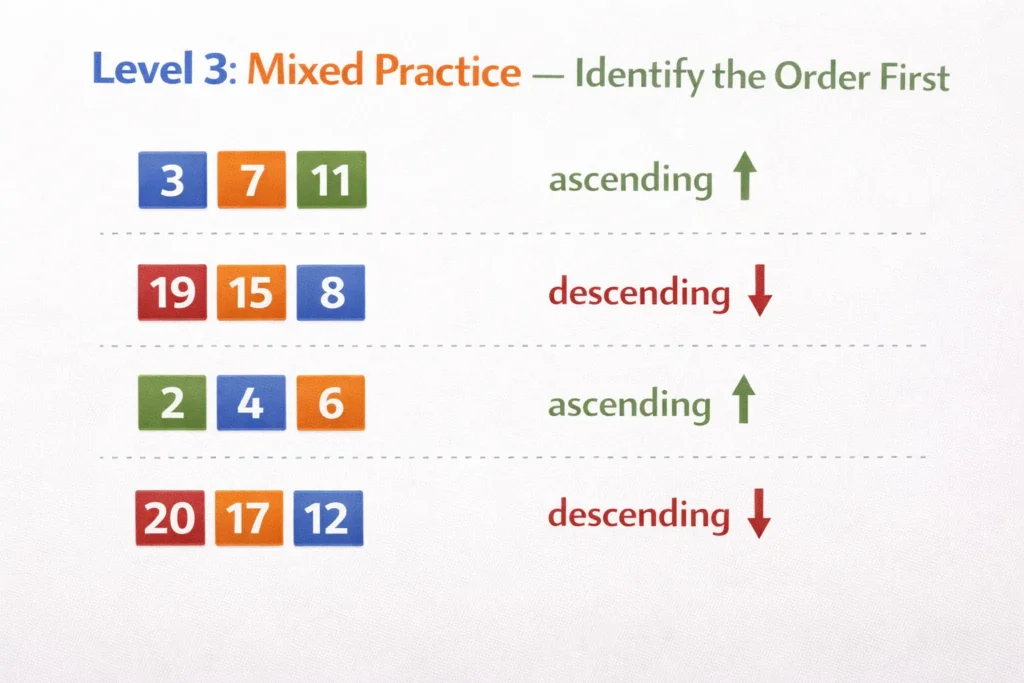
Part A: Identify Whether Each Sequence is Ascending or Descending
| Sequence | Answer |
|---|---|
| 2, 5, 8, 11 | Ascending ✅ |
| 14, 10, 6, 2 | Descending ✅ |
| 3, 9, 15 | Ascending ✅ |
| 20, 16, 12, 8 | Descending ✅ |
| 1, 4, 7, 10 | Ascending ✅ |
| 18, 13, 9, 4 | Descending ✅ |
| 5, 10, 15, 20 | Ascending ✅ |
| 12, 8, 4 | Descending ✅ |
Part B: Arrange These Mixed Sets in the Stated Direction
| Set | Direction | Answer |
|---|---|---|
| 7, 3, 9, 1 | Ascending | 1, 3, 7, 9 ✅ |
| 8, 14, 5, 11 | Descending | 14, 11, 8, 5 ✅ |
| 16, 4, 10, 7 | Ascending | 4, 7, 10, 16 ✅ |
| 20, 9, 15, 3 | Descending | 20, 15, 9, 3 ✅ |
| 12, 6, 18, 4 | Ascending | 4, 6, 12, 18 ✅ |
| 5, 17, 9, 14 | Descending | 17, 14, 9, 5 ✅ |
| 2, 14, 8, 20 | Ascending | 2, 8, 14, 20 ✅ |
| 19, 7, 13, 1 | Descending | 19, 13, 7, 1 ✅ |
Level 4: Missing Number Examples
Missing number examples are the most demanding ordering exercise at the Class 1 level.
They require children to understand both the direction of the sequence and the size relationship between the numbers on either side of the blank.
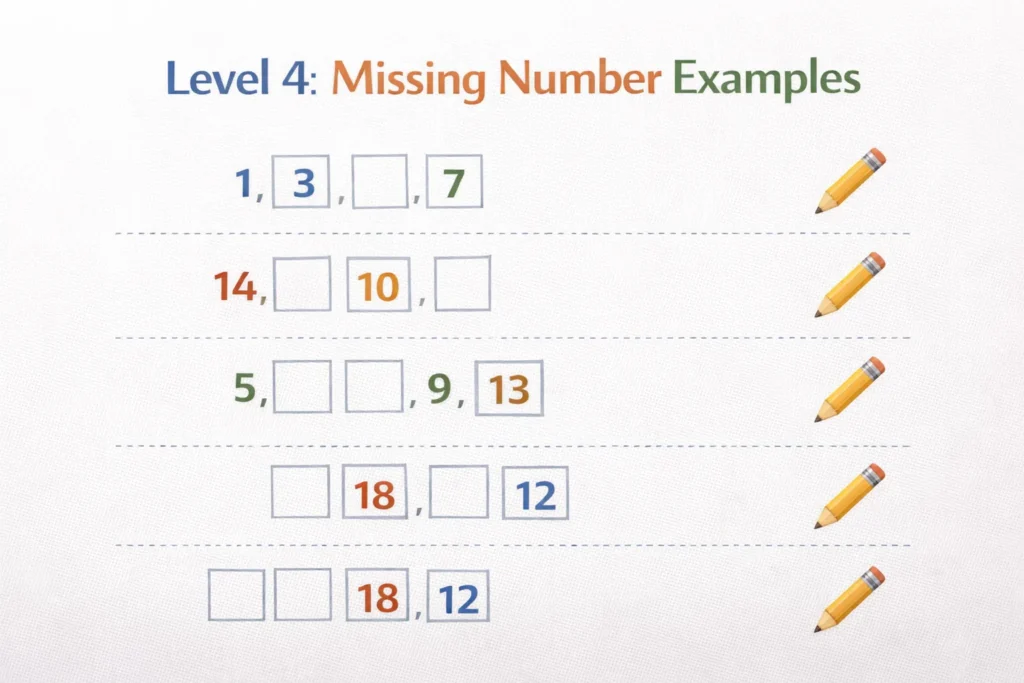
How to solve missing number examples:
- Look at the numbers on either side of the blank.
- Check the gap between the known numbers.
- Ask: “What number fits between them and keeps the same gap?”
- Write the answer, then verify: does the full sequence read correctly in its stated direction?
Worked example: Sequence: 2, 4, __, 8 (ascending) Gap between 2 and 4 = 2. So missing number = 4 + 2 = 6. Check: 2, 4, 6, 8 — each number is 2 more than the one before. ✅
Missing Numbers — Ascending Sequences
| Sequence | Answer |
|---|---|
| 2, 4, __, 8 | 6 ✅ |
| __, 6, 9, 12 | 3 ✅ |
| 5, __, 11, 14 | 8 ✅ |
| 10, 13, __, 19 | 16 ✅ |
| 1, 3, __, 7 | 5 ✅ |
| 4, __, 12, 16 | 8 ✅ |
| __, 9, 12, 15 | 6 ✅ |
| 2, 6, __, 14 | 10 ✅ |
Missing Numbers — Descending Sequences
| Sequence | Answer |
|---|---|
| 10, 8, __, 4 | 6 ✅ |
| 18, __, 12, 9 | 15 ✅ |
| 20, 16, __, 8 | 12 ✅ |
| __, 14, 10, 6 | 18 ✅ |
| 15, 12, __, 6 | 9 ✅ |
| 20, __, 12, 8 | 16 ✅ |
| __, 13, 9, 5 | 17 ✅ |
| 16, 12, __, 4 | 8 ✅ |
Level 5: Real-Life Word Problems
Real-life word problems make ordering feel purposeful.
When children see that ordering numbers is something they already do naturally, and sorting objects by size, comparing ages, counting steps, the concept becomes memorable and meaningful.
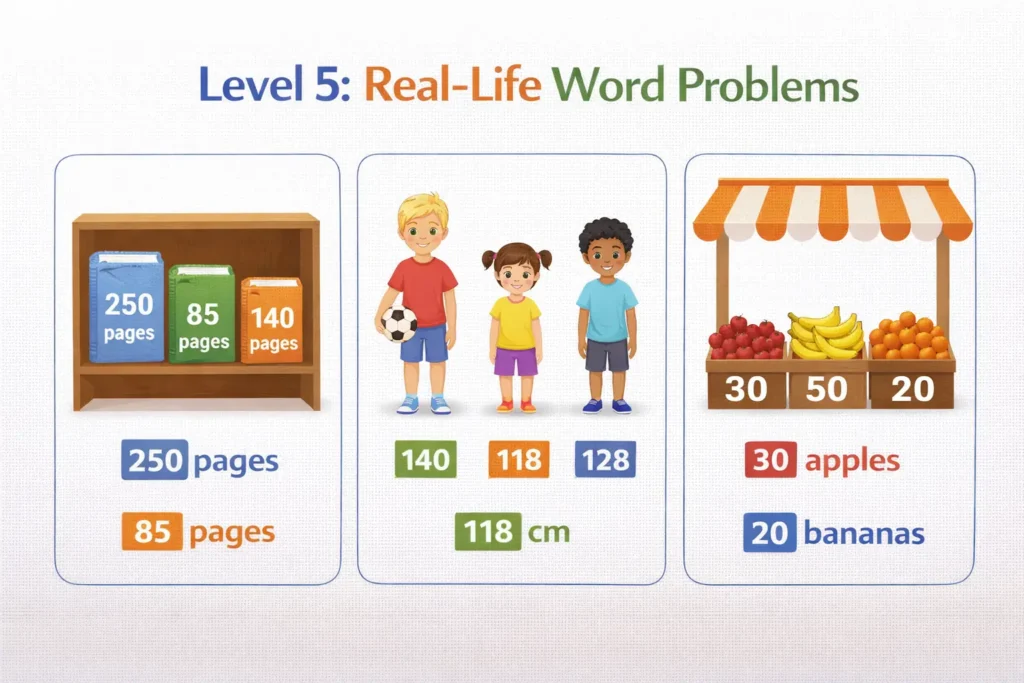
How to solve ordering word problems:
- Read the problem and identify the numbers.
- Read the question — it will tell you the direction (ascending or descending).
- Apply the same step-by-step method used in Levels 1–4.
- Write the answer using the original context (not just numbers).
Word Problem 1 — Toy Cars
Amir has 4 toy cars. His friend has 9. His sister has 6. Arrange the number of toys in ascending order.
Numbers: 4, 9, 6 Smallest first: 4 → Next: 6 → Last: 9
Answer: 4, 6, 9 ✅
Word Problem 2 — Balloons
A shop has 12 red balloons, 5 blue balloons, and 8 yellow balloons. Arrange the numbers in descending order.
Numbers: 12, 5, 8 Largest first: 12 → Next: 8 → Last: 5
Answer: 12, 8, 5 ✅
Word Problem 3 — Ages
Priya is 6 years old. Her cousin is 9. Her brother is 7. Arrange their ages in ascending order.
Numbers: 6, 9, 7 Smallest first: 6 → Next: 7 → Last: 9
Answer: 6, 7, 9 ✅
Word Problem 4 — Steps Climbed
Three children climb steps. Rohan climbs 15 steps, Sara climbs 8, and Dev climbs 11. Arrange the steps in descending order.
Numbers: 15, 8, 11 Largest first: 15 → Next: 11 → Last: 8
Answer: 15, 11, 8 ✅
Word Problem 5 — Books on a Shelf
Three books have 10 pages, 18 pages, and 12 pages. Arrange the page numbers in ascending order.
Numbers: 10, 18, 12 Smallest first: 10 → Next: 12 → Last: 18
Answer: 10, 12, 18 ✅
Word Problem 6 — Marbles
Kemi has 17 marbles. Raj has 11. Lena has 14. Arrange the number of marbles in descending order.
Numbers: 17, 11, 14 Largest first: 17 → Next: 14 → Last: 11
Answer: 17, 14, 11 ✅
Word Problem 7 — Points in a Game
Three players score 8 points, 20 points, and 13 points. Arrange the scores in ascending order.
Numbers: 8, 20, 13 Smallest first: 8 → Next: 13 → Last: 20
Answer: 8, 13, 20 ✅
Worksheet-Style Practice: Try These Yourself
Work through these independently before checking the answers in the next section.
Use the step-by-step method from Level 1.
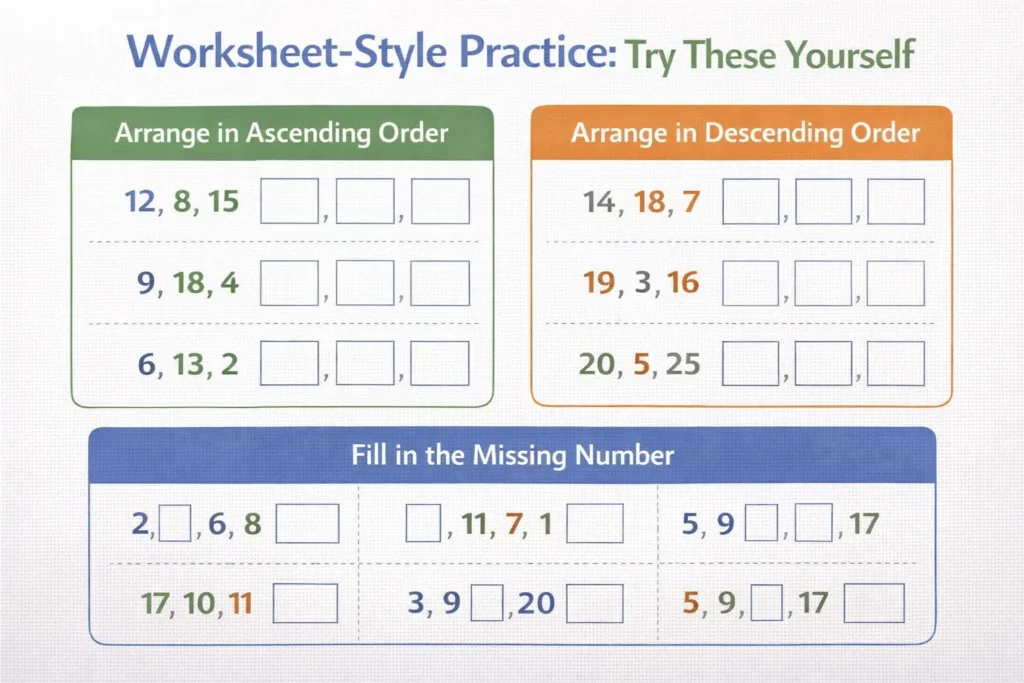
Section A: Arrange in Ascending Order
- 7, 2, 5 → __, __, __
- 14, 6, 10, 3 → __, __, __, __
- 18, 9, 13 → __, __, __
- 4, 12, 8, 16 → __, __, __, __
- 20, 5, 11, 7 → __, __, __, __
- 3, 17, 9, 14 → __, __, __, __
- 16, 2, 10, 8 → __, __, __, __
Section B: Arrange in Descending Order
- 4, 9, 6 → __, __, __
- 20, 11, 16, 8 → __, __, __, __
- 7, 15, 12 → __, __, __
- 18, 10, 14, 6 → __, __, __, __
- 13, 3, 19, 9 → __, __, __, __
- 5, 20, 12, 8 → __, __, __, __
- 17, 4, 11, 9 → __, __, __, __
Section C: Fill in the Missing Number
- 3, __, 9, 12 (ascending)
- 16, __, 8, 4 (descending)
- 5, 10, __, 20 (ascending)
- 20, 15, __, 5 (descending)
- 2, 4, __, 8 (ascending)
- __, 12, 8, 4 (descending)
- 6, 9, __, 15 (ascending)
Section D: Word Problems
- Sona has 3 stickers. Ben has 9. Tia has 6. Arrange in ascending order.
- A tree is 14 cm tall. A flower is 8 cm. A bush is 11 cm. Arrange in descending order.
- Three jars hold 15 sweets, 7 sweets, and 12 sweets. Arrange in ascending order.
Worksheet Answers
Section A — Ascending Order Answers
- 2, 5, 7 ✅
- 3, 6, 10, 14 ✅
- 9, 13, 18 ✅
- 4, 8, 12, 16 ✅
- 5, 7, 11, 20 ✅
- 3, 9, 14, 17 ✅
- 2, 8, 10, 16 ✅
Section B — Descending Order Answers
- 9, 6, 4 ✅
- 20, 16, 11, 8 ✅
- 15, 12, 7 ✅
- 18, 14, 10, 6 ✅
- 19, 13, 9, 3 ✅
- 20, 12, 8, 5 ✅
- 17, 11, 9, 4 ✅
Section C — Missing Number Answers
- 6 ✅
- 12 ✅
- 15 ✅
- 10 ✅
- 6 ✅
- 16 ✅
- 12 ✅
Section D — Word Problem Answers
7, 12, 15 ✅
3, 6, 9 ✅
14, 11, 8 ✅
Common Mistakes in Ascending and Descending Order Examples
| Mistake | What It Looks Like | How to Fix It |
|---|---|---|
| Starting with the wrong number | Starts ascending with 5 instead of the smallest | Ask: “Which number is the smallest?” before writing anything |
| Mixing the direction | Writes 1, 5, 3, 8 | Check every pair from left to right before finishing |
| Confusing ascending and descending | Calls 9, 6, 3 ascending | Ask: “Are the numbers going up or down?” |
| Missing one number from the set | Orders 2, 5, 9 but leaves out 7 | Cross out each number after placing it |
| Guessing the missing number | Fills the blank without checking the gap | Compare the numbers on both sides and measure the gap |
The best single habit: state the direction out loud first, then place the numbers, then check every consecutive pair.
How many examples does a Class 1 child need before ordering feels automatic?
Research on early mathematics learning suggests that most children need 15–25 successful ordering experiences across varied contexts before a skill becomes genuinely automatic. This does not need to happen in one sitting short daily practice (5 minutes, 3–4 examples) across 2–3 weeks builds the fluency that occasional longer sessions cannot match.
Should I show my child the answers while they practise?
For the first few examples at each level, work through the step-by-step process together — saying each step aloud. Once the process is familiar, let the child work independently and reveal the answer only after they have committed to a response. This builds the reasoning habit rather than the checking habit.
What if my child can do ascending order but consistently struggles with descending?
This is very common. Descending order is the harder direction for most Class 1 children because forward counting (ascending) is already habitual, while backward counting is less practised. Spend 5 minutes daily on backward counting from varied starting points “count down from 15, count down from 12, count down from 20” before returning to descending order examples. The number sense for class 1 guide covers the counting foundations that support this.
Are decreasing order and descending order the same?
Yes. Decreasing order and descending order mean the same thing. Both arrange numbers from largest to smallest.
Are increasing order and ascending order the same?
Yes. Increasing order and ascending order mean the same thing. Both arrange numbers from smallest to largest.
What is the easiest way to check ascending and descending order answers?
Check every pair from left to right. In ascending order, each number should be bigger than the one before it. In descending order, each number should be smaller than the one before it.
What is an example of ascending order for Class 1?
An example of ascending order for Class 1 is 2, 5, 7, 9. The numbers start with the smallest and move to the largest.
What is an example of descending order for Class 1?
An example of descending order for Class 1 is 9, 7, 5, 2. The numbers start with the largest and move to the smallest.
Make Preparing for Math Olympiad Simple!



Conclusion
Worked examples at graduated difficulty levels with step-by-step solutions, missing number challenges, and real-life contexts turn a familiar concept into an independently applied skill.
Work through each level until it feels effortless before moving to the next. Return to earlier levels whenever needed fluency at the previous level is always the right foundation first.
For the complete conceptual framework behind these examples, including definitions, symbols, and the full teaching method, see ascending and descending order in Maths Class 1.
For the step-by-step rules each example applies, see rules for ordering numbers Class 1.