


The main rules for ordering numbers involve arranging them either from smallest to largest or from largest to smallest.
Rules for ordering numbers class 1 give children the structured approach they need to move from guessing to reasoning systematically.
This guide explains the rules slowly and clearly, from a parent’s and teacher’s point of view.
For the conceptual foundations, see number ordering for Class 1 and ascending and descending order in maths.
For examples in practice, see examples of ascending and descending order and how to teach ascending and descending order to kids.
The 5 Rules for Ordering Numbers in Class 1
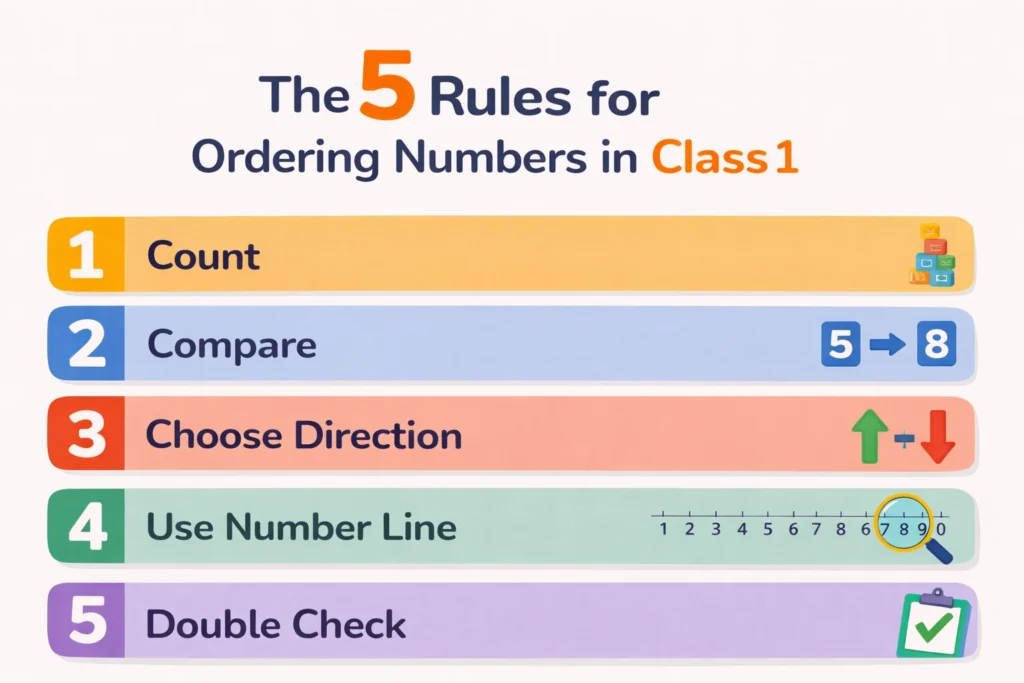
Rule 1: Count the Numbers First
Before placing a single number in order, count how many numbers are in the set.
This step takes under five seconds and prevents one of the most common ordering errors, losing track of a number and producing an incomplete answer.
Why this rule matters: Children who skip this step frequently miss one number in their final ordering.
Once they know the set contains four numbers, they can check at the end: “Do I have four numbers in my answer?” If not, something was missed.
How to apply it: Point to each number in the original set, counting aloud as you go. Hold up one finger per number.
Example: 7, 2, 9, 4 → child counts “one, two, three, four” → knows the answer must also have four numbers.
What to say: “Good — there are four numbers. So your answer needs four numbers too. Let’s check at the end.”
Rule 2: Compare Every Number — Find the Smallest or Largest First
Once the count is confirmed, the next step is comparison. Children must look at every number in the set and identify either the smallest (for ascending order) or the largest (for descending order).
This is where ordering actually begins — with one correct placement.
Why this rule matters: Many children grab the first number that “looks small” without checking all the others. Systematic comparison, looking at every number before deciding, prevents misplaced values in the final answer.
How to apply it: Ask the child to read every number in the set aloud, then answer: “Which is the tiniest?” or “Which is the biggest?” Circle or underline that number before placing it.
Example (ascending): 5, 3, 8, 1 → read all four → “Which is smallest?” → 1 → circle 1 → place it first.
The comparison skill that this rule builds connects to the number magnitude understanding developed through number sense for class 1 — genuine number sense makes comparison intuitive rather than laborious.
Rule 3: Work Through the Remaining Numbers One at a Time
After placing the first number, the child returns to the remaining numbers and repeats Rule 2 — find the smallest (or largest) of what is left, place it next, and continue until all numbers are placed.
Why this rule matters: This systematic, one-at-a-time approach guarantees correct ordering regardless of how many numbers are in the set or how unfamiliar they are. It removes the need to hold all numbers in mind simultaneously.
How to apply it: After each placement, physically cross off or remove the number just placed. The remaining numbers are the only ones to consider for the next position. Repeat until nothing remains.
Worked example — ascending order: Set: 6, 1, 8, 3
- Step 1: Count → 4 numbers
- Step 2: Smallest of 6, 1, 8, 3 → 1 → place first → cross off 1
- Step 3: Smallest of 6, 8, 3 → 3 → place second → cross off 3
- Step 4: Smallest of 6, 8 → 6 → place third → cross off 6
- Step 5: Only 8 remains → place fourth
Answer: 1, 3, 6, 8 ✅
Worked example — descending order: Set: 4, 9, 2, 7
- Step 1: Count → 4 numbers
- Step 2: Largest of 4, 9, 2, 7 → 9 → place first → cross off 9
- Step 3: Largest of 4, 2, 7 → 7 → place second → cross off 7
- Step 4: Largest of 4, 2 → 4 → place third → cross off 4
- Step 5: Only 2 remains → place fourth
Answer: 9, 7, 4, 2 ✅
This rule applies identically to two-digit numbers; just apply the same process to larger values.
The number sequence understanding that supports comparison with two-digit numbers is developed in what is the number sequence for class 1 maths.
Rule 4: Use a Number Line When Unsure
Whenever a child is uncertain about the relative size of two numbers, a number line resolves the question immediately and visually. Numbers to the right are always larger; numbers to the left are always smaller.
No comparison error is possible once a child locates both numbers on the line.
Why this rule matters: Rather than guessing when comparison feels difficult, children have a reliable tool to check. Using the number line builds accuracy and confidence simultaneously, and it is always available.
How to apply it: Keep a desk number line accessible during all ordering activities. When two numbers feel similar in size, for example, 7 and 9, both are located on the line.
Whichever is further right is the larger value.
Example: Child is unsure whether 7 or 9 is larger → locates both on number line → 9 is further right → 9 is larger.
The number line’s role as a checking and reasoning tool is explored fully in how to teach number line maths class 1.
And the positional understanding that makes it effective is covered in the number positions on a number line class 1.
Rule 5: Double-Check the Completed Order
Once all numbers are placed, the child checks the answer before declaring it finished.
This is the habit that catches errors before they are submitted, and it is a habit that serves children in all areas of academic work for the rest of their schooling.
Why this rule matters: Children frequently make a correct ordering error that they would catch immediately on review a number slightly out of place, a skipped value, or a direction reversal near the end.
A 10-second check prevents these from becoming wrong answers.
How to double-check:
- Count the numbers in the answer — does it match the original count?
- Read the answer aloud and ask: “Is each number bigger than the one before it?” (ascending) or “Is each number smaller than the one before it?” (descending)
- If any pair fails the check, find the error and correct it.
Example check (ascending): Answer is 1, 3, 6, 8 → “Is 3 bigger than 1? Yes. Is 6 bigger than 3? Yes. Is 8 bigger than 6? Yes.” → All pairs pass → answer confirmed ✅
Applying the 5 Rules: Practice Examples
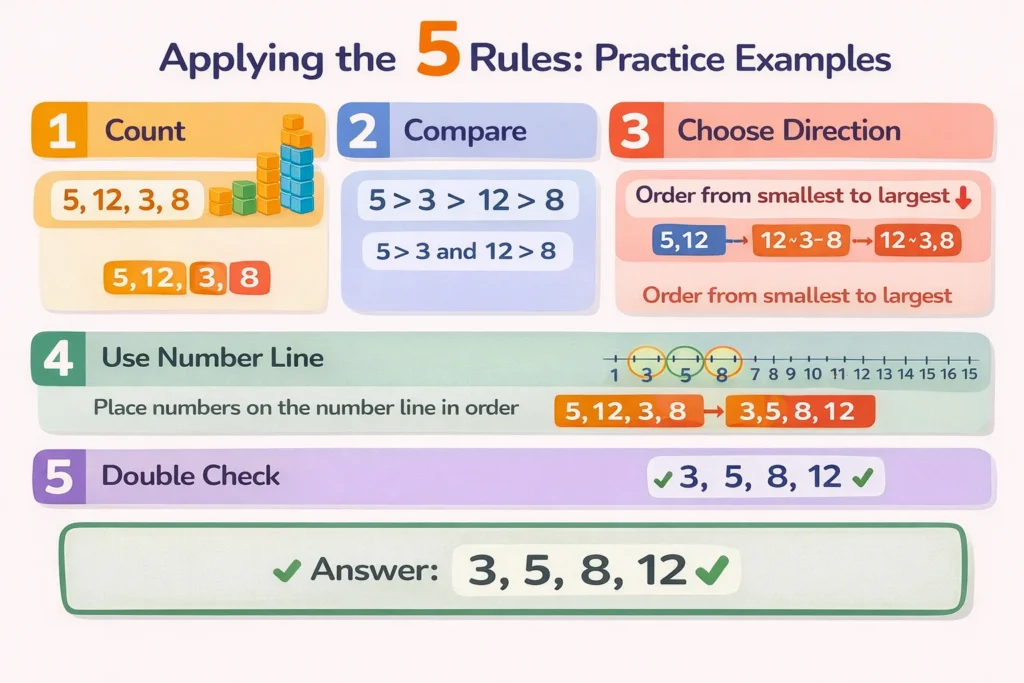
Practice 1 (ascending, within 10): Set: 8, 3, 6, 1 → Count: 4 → Smallest first: 1 → Next: 3 → Next: 6 → Last: 8 Answer: 1, 3, 6, 8 ✅
Practice 2 (descending, within 10): Set: 5, 9, 2, 7 → Count: 4 → Largest first: 9 → Next: 7 → Next: 5 → Last: 2 Answer: 9, 7, 5, 2 ✅
Practice 3 (ascending, two-digit numbers): Set: 24, 8, 17, 31 → Count: 4 → Smallest first: 8 → Next: 17 → Next: 24 → Last: 31 Answer: 8, 17, 24, 31 ✅
Practice 4 (descending, two-digit numbers): Set: 15, 42, 7, 29 → Count: 4 → Largest first: 42 → Next: 29 → Next: 15 → Last: 7 Answer: 42, 29, 15, 7 ✅
Common Mistakes and How to Fix Them
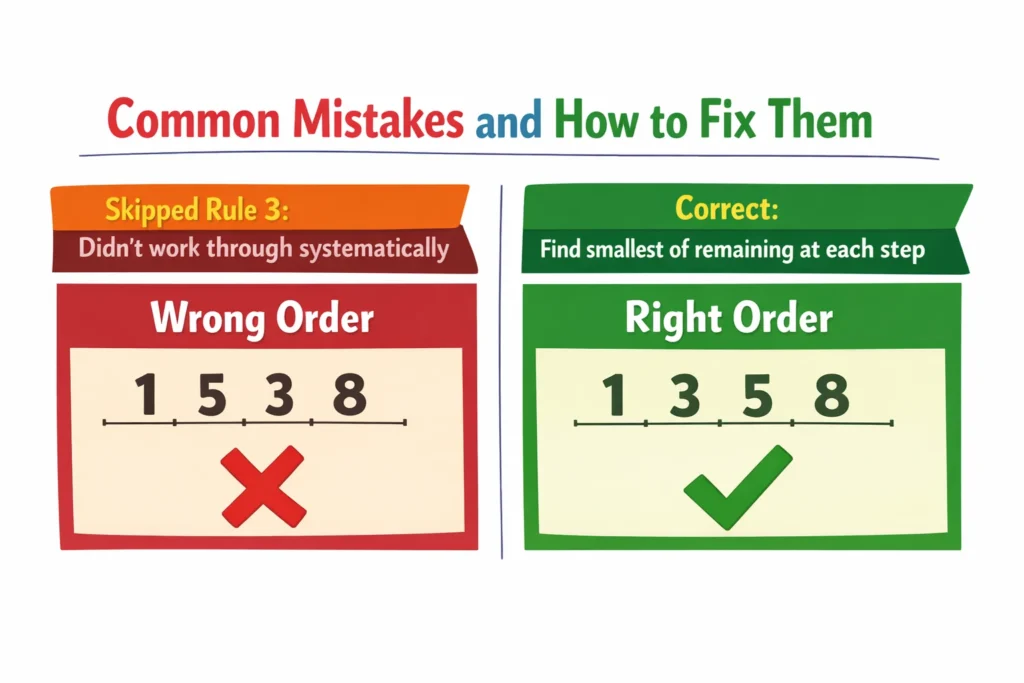
| Mistake | Which Rule Was Skipped | Fix |
|---|---|---|
| Answer has fewer numbers than the set | Rule 1 — did not count first | Count original set, count answer — numbers must match |
| Middle numbers misplaced | Rule 3 — did not work one at a time | Cross off each placed number and only compare what remains |
| Started with wrong end number | Rule 3 — confusion about direction | Ask: “Are we going up or down?” before starting — ascending = smallest first, descending = largest first |
| Two numbers swapped in final answer | Rule 5 — did not double-check | Read answer aloud: “Is each number bigger/smaller than the one before?” Fix any pair that fails |
| Unsure which of two numbers is larger | Rule 4 — number line not used | Locate both numbers on the number line — further right = larger |
Activities to Reinforce the Rules
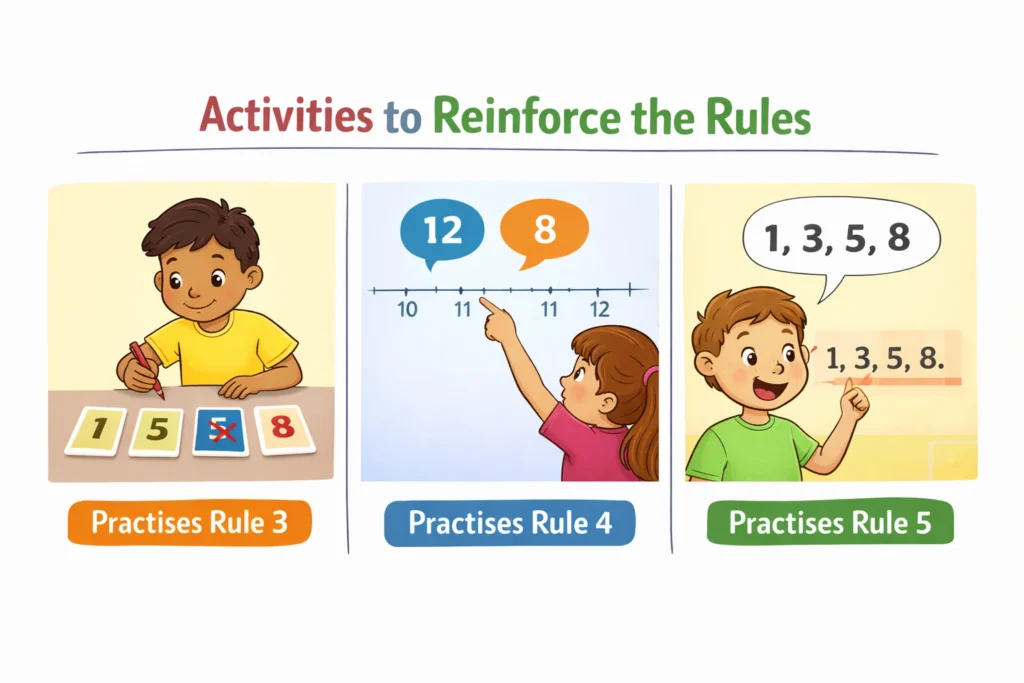
Cross-Off Card Sort: Write a set of 5 numbers on a whiteboard. Give a child a marker. As they identify and place each number, they physically cross it off the board.
This makes Rule 3 (work through remaining numbers one at a time) visible and kinesthetic. The crossed-off numbers provide instant feedback that every placed number is accounted for.
Rule 4 Number Line Check: During any ordering activity, pause when a child looks uncertain about two numbers. Ask: “Which rule do we use when we’re not sure?”
Have them locate both numbers on their desk number line and confirm the answer themselves. Reinforcing Rule 4 as the automatic response to uncertainty builds independence.
Read and Check Routine: After any ordering exercise, establish the rule 5 routine as a non-negotiable: read the answer aloud, one number at a time, asking the comparison question at each step.
Turn this into a verbal rhythm: “Is 3 bigger than 1? Yes. Is 5 bigger than 3? Yes.” Making it a spoken routine embeds the self-checking habit.
This connects to the ordered sequence understanding in teaching number sequences to class 1 students.
Do Class 1 children really need explicit rules, or will they just pick it up?
Some children with strong number sense will independently develop informal ordering strategies. But explicit rules benefit every child, including strong ones, because they provide a reliable method that works consistently, even when numbers are unfamiliar or sets are large. Rules also give weaker students a concrete procedure to follow rather than leaving them to guess.
What if my child knows the right answer but cannot explain how they got it?
This is common and worth addressing. Being able to apply a rule without being able to articulate it means the understanding is not yet fully internalized. Ask: “How did you know 3 comes before 7?” Prompting explanation develops metacognitive awareness, the ability to think about one’s own thinking, which is one of the most valuable mathematical habits to build in Class 1.
How do these rules apply to the maths olympiad for Class 1?
Ordering and sequencing problems appear consistently in early competition mathematics — completing missing number sequences, identifying the largest or smallest value in a set, and arranging numbers under constraints. Children who have internalized the five rules approach these problems methodically and confidently rather than randomly. The IMO syllabus for class 1 maps all the number topics where ordering rules apply at competition level
Make Preparing for Math Olympiad Simple!



Conclusion
Rules for ordering numbers for Class 1 count first, compare every number, work through remaining numbers one at a time, use the number line when unsure, and double-check.
These rules do more than produce correct answers.
They build systematic thinking habits that serve children across all areas of mathematics, practising careful comparison, logical sequencing, and self-checking every time they are applied.
For the conceptual foundations, see number ordering for Class 1 and ascending and descending order in maths.
For the number sense that makes comparison fluent, see number sense for Class 1 and number positions on a number line.

Mikha Piregu is a Content Writer with experience spanning educational content, including math and math olympiad topics, as well as advocacy writing, research-based articles, and SEO-driven web content. He creates high-quality blog content, web copy, and feature articles that support brand visibility, audience engagement, and long-term organic growth through data-informed storytelling. Skilled in WordPress, WooCommerce, and modern digital tools, Mikha adapts content across various platforms, including blogs, websites, campaigns, and advocacy initiatives, with clarity and purpose. You can reach out to him at [email protected].



There are no comments posted here yet.
Sign in to leave a comment