 December 23, 2025
 8 min. read

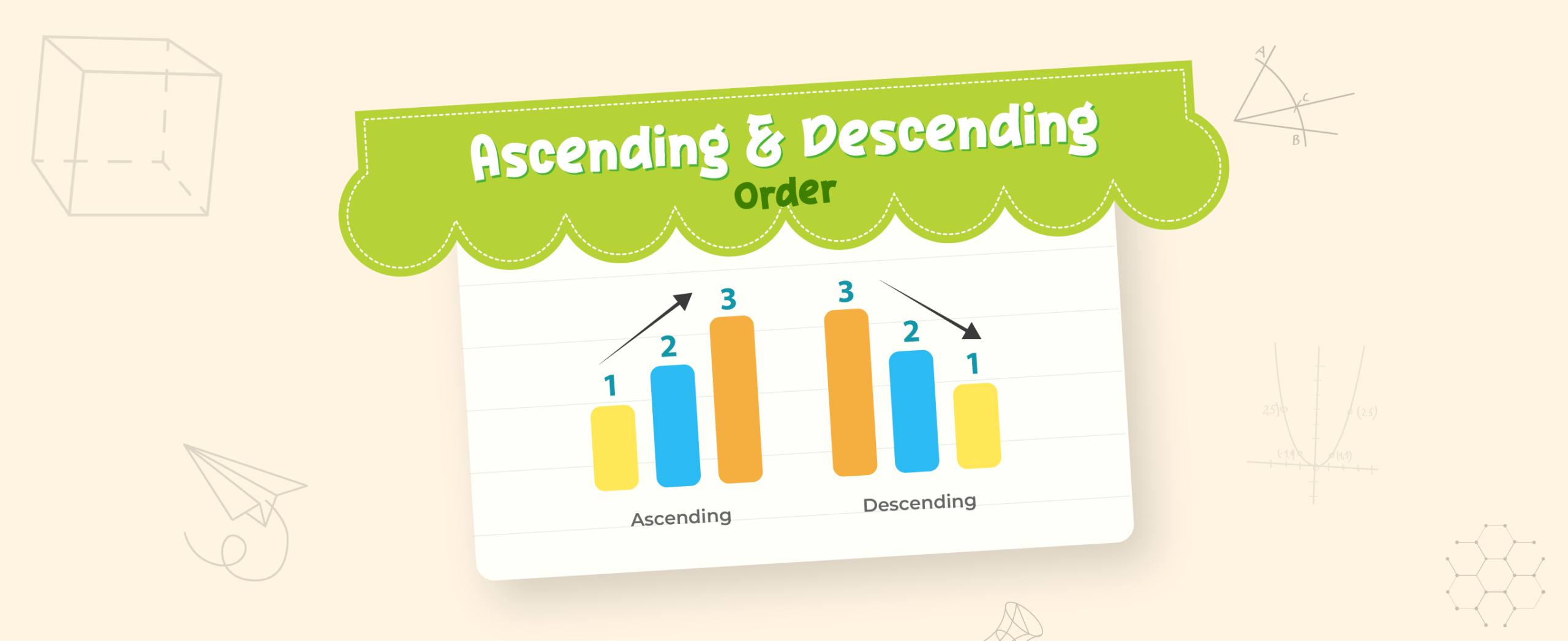
Ascending and descending order in Maths class 1 is one of the first big mathematical ideas that children encounter the understanding that numbers are not just labels but have size, direction, and sequence.
Ascending means smallest to largest. Descending means largest to smallest. Simple definitions, but a profound shift: numbers stop being names children recite and start becoming ideas they reason about.
This guide explains both concepts slowly and clearly, keeping the thinking level of Class 1 children in mind.
For the foundations this builds on, see number sense for Class 1 and number ordering for Class 1.
For the comparison skills that connect directly, see number positions on a number line and rules for ordering numbers.
What Does Ordering Numbers Mean?
Ordering numbers means arranging a set of numbers into a sequence that follows a clear rule, either from smallest to largest or from largest to smallest.
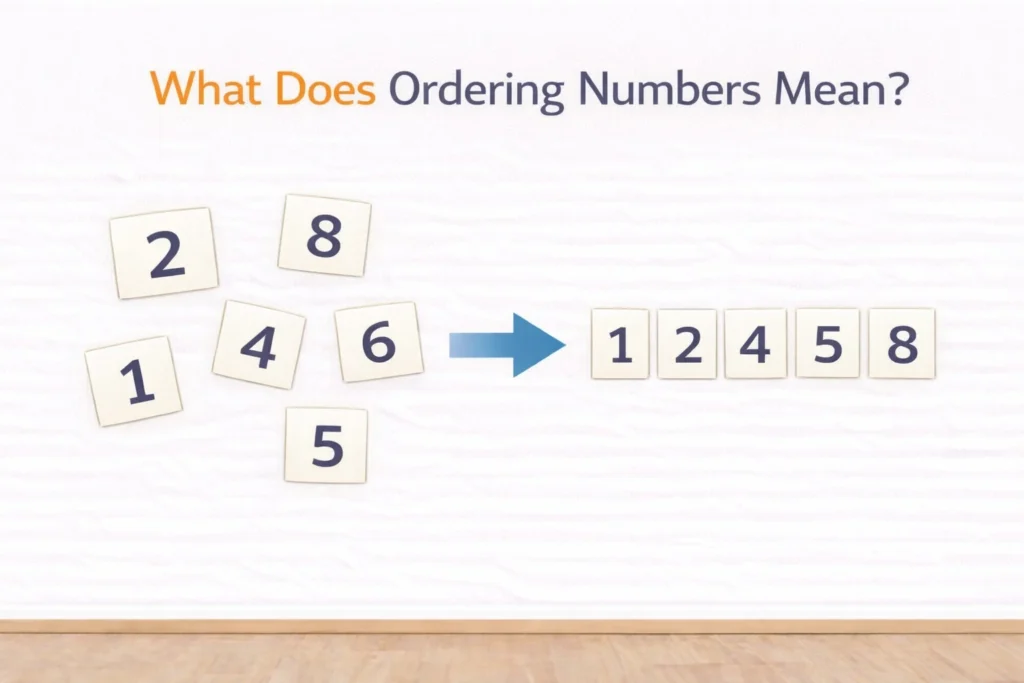
Instead of placing numbers randomly, children compare each number, decide which is greater or smaller, and arrange them accordingly.
There are exactly two ways to order numbers:
- Ascending order — smallest to largest
- Descending order — largest to smallest
Both directions matter and both appear throughout the Class 1 curriculum, in counting, number lines, comparison, and everyday life.
Children who understand both directions can navigate numbers flexibly, a key marker of genuine number sense for class 1.
What is Ascending Order?
Ascending order means arranging numbers from the smallest to the largest, just like climbing stairs.
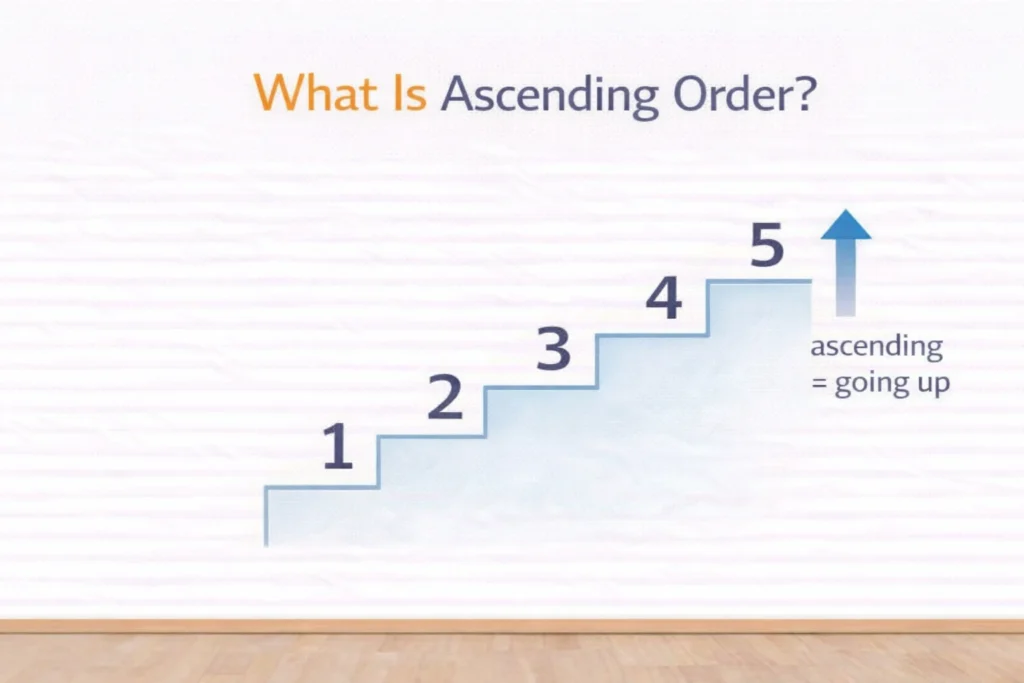
The simplest way to explain it to a Class 1 child: “We start with the tiniest number and keep going until we reach the biggest one.”
Simple examples:
- 1, 2, 3, 4, 5
- 3, 6, 9, 12
Mixed number examples (arrange these):
- 4, 1, 3 → 1, 3, 4 ✅
- 9, 2, 6 → 2, 6, 9 ✅
- 7, 3, 5, 1 → 1, 3, 5, 7 ✅
Real-life comparison: Climbing stairs, each step takes you higher, just as ascending order takes you to a bigger number. Counting forward (1, 2, 3, 4…) is always ascending order in action.
Encourage children to say aloud: “This number is smaller, so it comes first.” Verbalizing the reasoning builds the comparative thinking that ordering requires.
The counting sequence that follows ascending order connects directly to what the number sequence is for class 1 maths. Ascending order is simply the counting sequence applied to any set of numbers.
What is Descending Order?
Descending order means arranging numbers from the largest to the smallest numbers go down, just like sliding down a slide or counting down before a race.
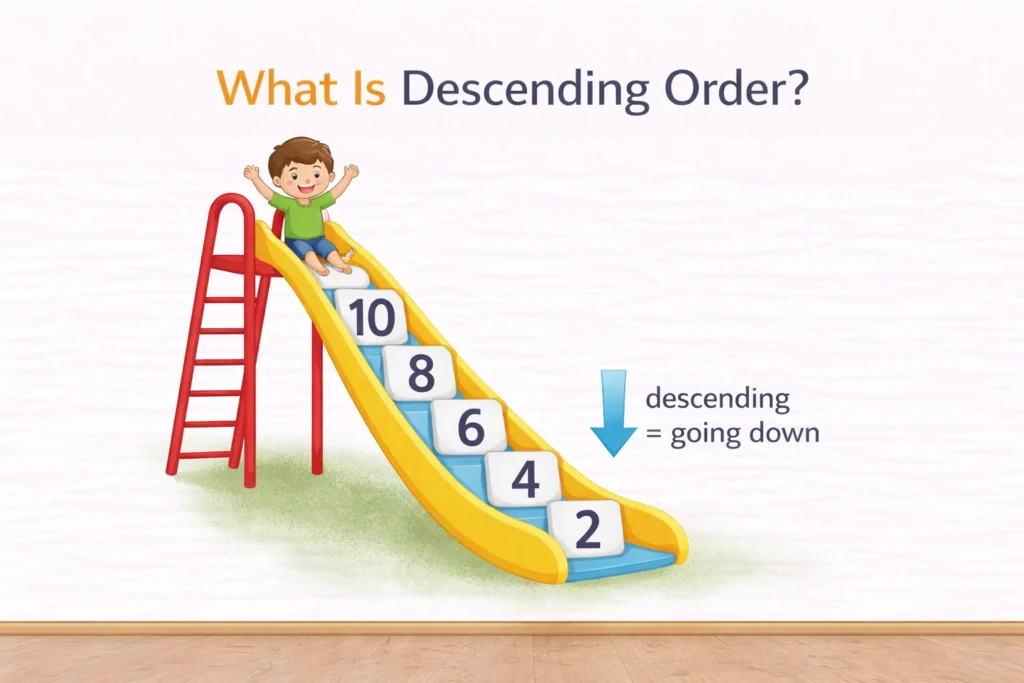
The simplest explanation for Class 1: “We start with the biggest number and keep going until we reach the smallest.”
Simple examples:
- 5, 4, 3, 2, 1
- 10, 7, 4, 1
Mixed number examples (arrange these):
- 6, 2, 5 → 6, 5, 2 ✅
- 15, 9, 12 → 15, 12, 9 ✅
- 8, 3, 6, 1 → 8, 6, 3, 1 ✅
Real-life comparison: Counting down — “10, 9, 8, 7…” before a race starts is descending order. Coming down stairs takes you lower, just as descending order moves you to a smaller number.
Backward counting practice is the most natural way to build descending order fluency.
Children who can count backward from 20 confidently find descending ordering far more intuitive than those who have only practised forward counting.
The sequence work that supports this is covered in teaching number sequences to class 1 students.
The Symbols: Less Than and Greater Than
When children learn to order numbers, they also begin using the comparison symbols that describe ordering relationships precisely.
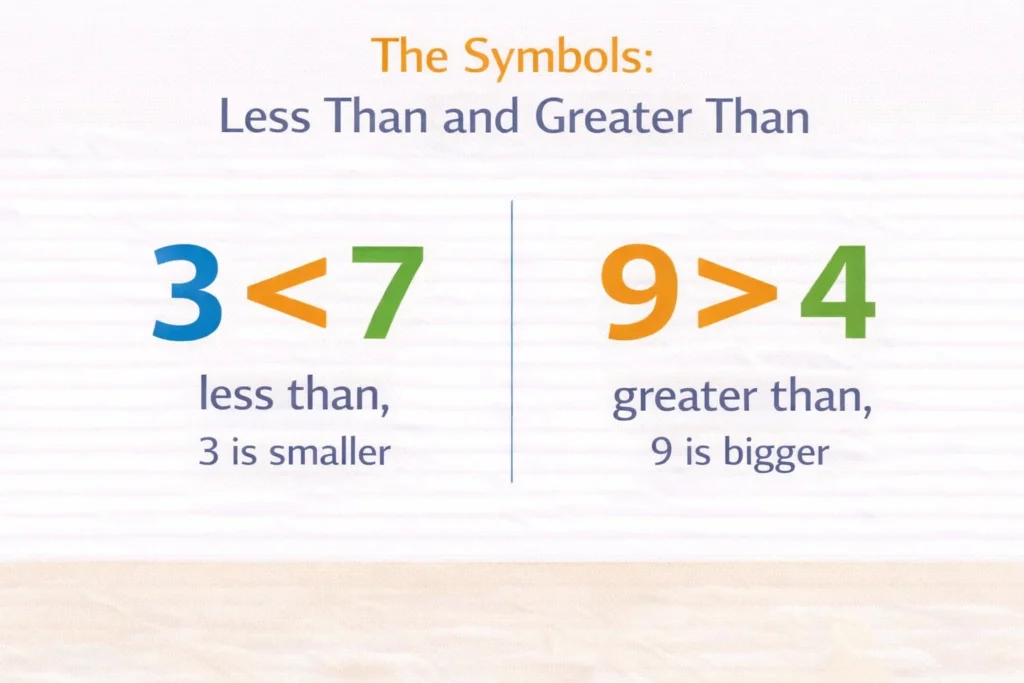
Less than (<): The symbol < means one number is smaller than another.
- 3 < 7 means 3 is smaller than 7.
Greater than (>): The symbol > means one number is larger than another.
- 9 > 4 means 9 is bigger than 4.
The open mouth trick: The symbol always opens toward — “eats” — the bigger number. This child-friendly memory aid works reliably and helps children apply the symbols correctly from the very first introduction.
These symbols directly describe the result of ordering: in ascending order, every number is greater than the one before it.
In descending order, every number is less than the one before it. Understanding this connection between ordering and comparison deepens both concepts simultaneously.
The number line makes these comparisons visually obvious: numbers to the right are always greater, numbers to the left are always less. This visual grounding is covered in number positions on a number line, class 1.
Why Ordering Matters: The Connections It Builds
Understanding ascending and descending order in Class 1 is not a standalone skill; it is a hub that connects to multiple other mathematical concepts.
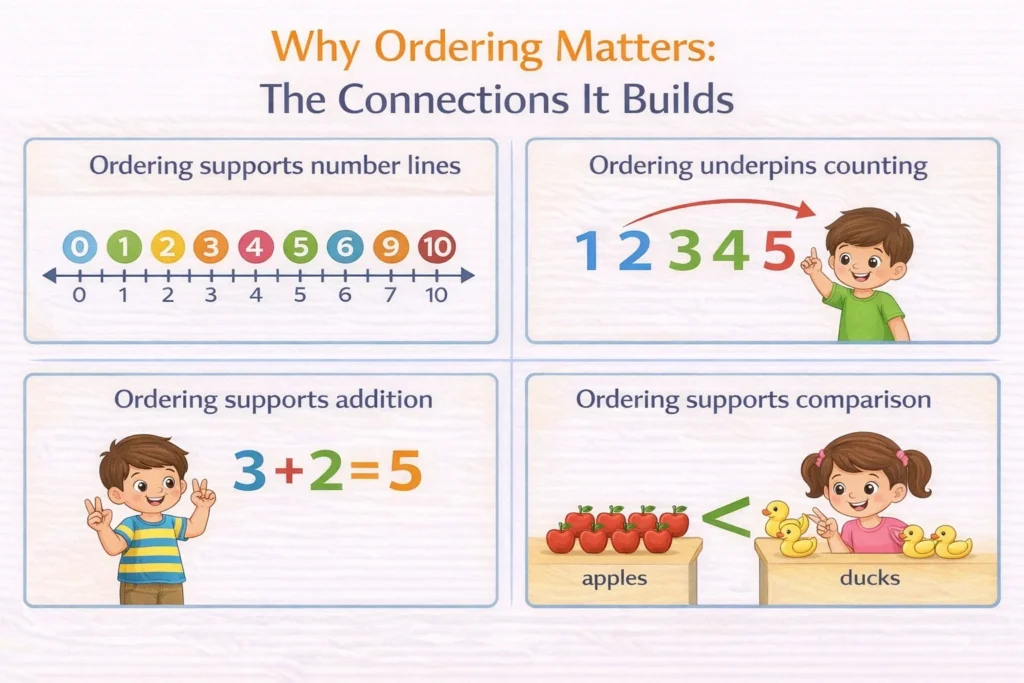
Number lines: A number line is an ascending order made visual numbers that increase consistently from left to right. Children who understand ascending and descending order find number line navigation immediately intuitive.
The full picture is in how to teach number line maths class 1.
Counting: Forward counting is in ascending order. Backward counting is descending order. Every time a child counts, they are using ordering, making ordering practice and counting practice mutually reinforcing.
Addition and subtraction: Adding moves you up the ascending order (forward along the number line). Subtracting moves you down the descending order (backward along the number line).
Children who internalize ordering direction find the meaning of these operations clearer and more intuitive.
Comparison: Ordering requires comparing each number to decide its position. This comparison habit “is this one bigger or smaller?” — is the same skill that < and > symbols use, and all number magnitude work requires.
The ordinal thinking that connects to position and sequence is explored in ordinal numbers for class 1 math.
Activities to Practise Ordering
Number Card Sort: Write numbers 1–10 on individual cards. Shuffle them and ask your child to arrange them in ascending order, then shuffle again and arrange in descending order.
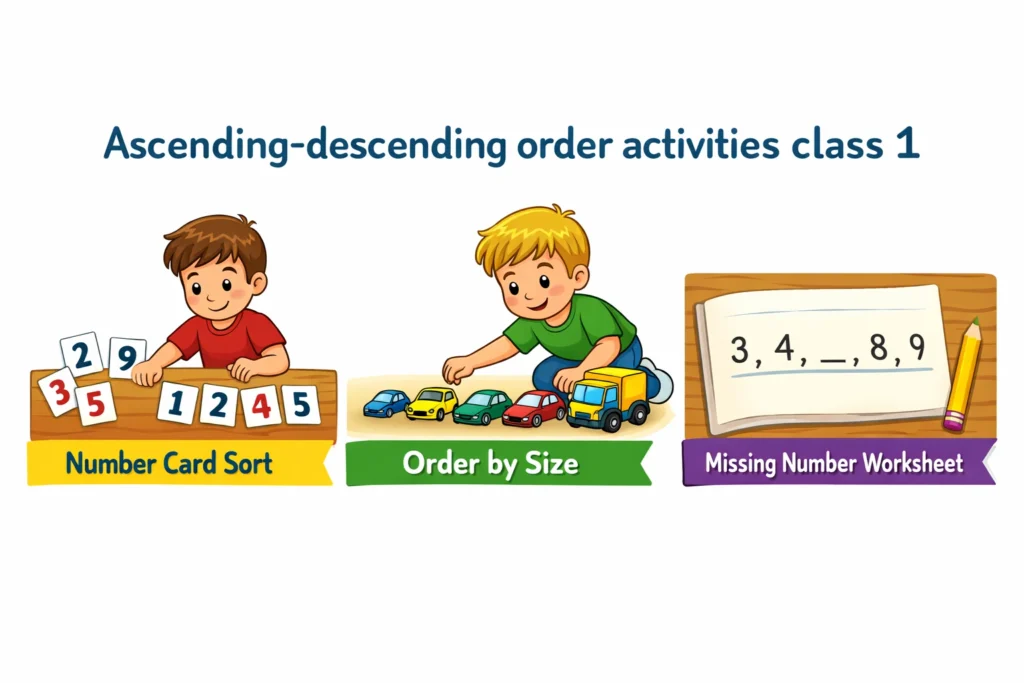
The time the activity takes as children become fluent in card sorting indicates internalized ordering rather than laboured comparison.
Object Ordering: Gather 5 household objects of clearly different sizes: spoons, bottles, books, toy cars. Ask your child to arrange them from smallest to largest (ascending), then largest to smallest (descending).
Connecting ordering to physical objects makes the abstract concept concrete and memorable.
Missing Number Sequences: Write a partial sequence with gaps — “2, __, 6, 8, __” — and ask children to fill in the missing numbers. Extend to descending sequences: “10, __, 6, __, 2.”
This activity develops both ordering fluency and the number sequence understanding in what is the number sequence for class 1 maths.
Human Number Line: Give children number cards and ask them to stand in ascending order. Then call “descending!” and have them reverse their position.
The physical, social activity makes the direction switch memorable and enjoyable.
Common Mistakes and How to Fix Them
Ordering only the first and last number: Many children correctly identify the smallest and largest but place middle numbers randomly.
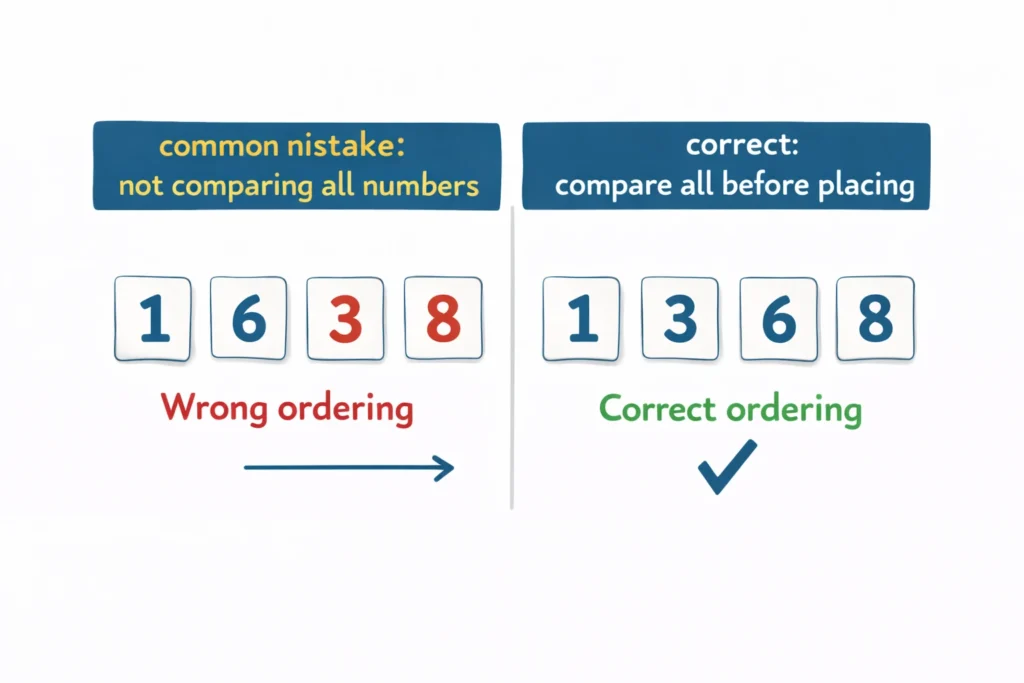
Fix by teaching a systematic approach to find the smallest first, set it aside, then find the smallest of what remains, and repeat.
Confusing ascending with descending: Children sometimes reverse the direction, particularly under mild time pressure. A reliable fix is the staircase/slide analogy:
“Ascending goes up like stairs. Descending goes down like a slide.” Return to this language every time confusion occurs.
Stopping after partial ordering: Some children correctly order part of a set and then lose track.
Fix by having children cross off or physically remove each number once it is placed, so they only consider unplaced numbers at each step.
What is the easiest way to remember ascending vs descending?
Ascending = going up (like climbing stairs, counting up). Descending = going down (like sliding down, counting down). The words themselves contain the clue — “ascend” means to rise, “descend” means to fall.
Should Class 1 children use the < and > symbols?
Introduction to the symbols is appropriate in Class 1, but only after the verbal concept of “greater than” and “less than” is secure. Symbols are shorthand; they should follow understanding, not replace it. Start with words, add symbols once the child uses comparison language confidently.
How does ordering connect to the maths olympiad for Class 1?
Ordering and comparison problems appear regularly in early competition mathematics, such as arranging sets of numbers, identifying the largest or smallest value, and reasoning about which number belongs in a given position. Children with fluent ordering ability approach these problems quickly and confidently. The IMO syllabus for class 1 maps all the number topics assessed at this level.
Make Preparing for Math Olympiad Simple!



Conclusion
Ascending and descending order, smallest to largest, largest to smallest, is a foundational concept that threads through counting, number lines, comparison, and arithmetic.
When children genuinely understand ordering rather than just memorizing it as a procedure, they gain a flexible number sense that makes every subsequent concept more accessible.
Teach it with concrete objects first, connect it to real-life experiences, and reinforce it through short, regular activities.
For the foundations, see number sense for Class 1 and rules for ordering numbers.
For direct applications, see examples of ascending and descending order and how to teach ascending and descending order to kids.