 December 23, 2025
 10 min. read

How to teach ascending and descending order to kids is a question every Class 1 teacher and parent faces and the answer matters more than most people realise.
The difference between children who truly understand ordering and those who simply memorise a procedure almost always comes down to how the concept was first introduced.
Teaching ascending and descending order works best when children can see, touch, and move while learning not through worksheets alone.
If your child is new to the topic, start with the difference between ascending and descending order before focusing on teaching methods.
This guide covers the full teaching sequence, a practical activity bank, and the most common mistakes to avoid.
The Teaching Principle: Concrete Before Abstract
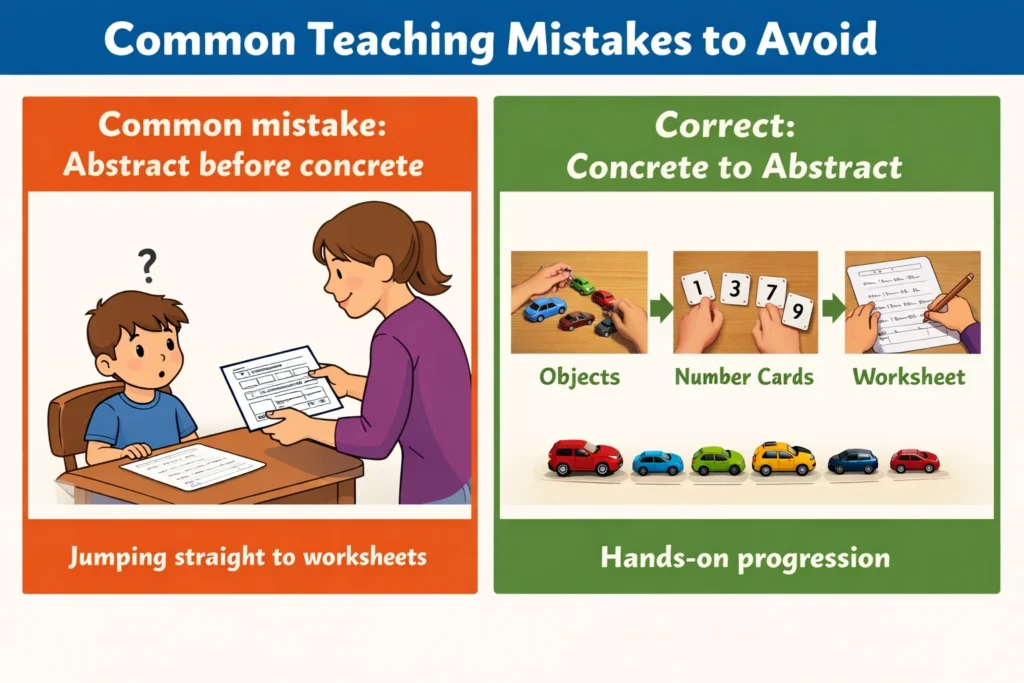
Every effective lesson on ascending and descending order follows the same progression: concrete → representational → abstract.
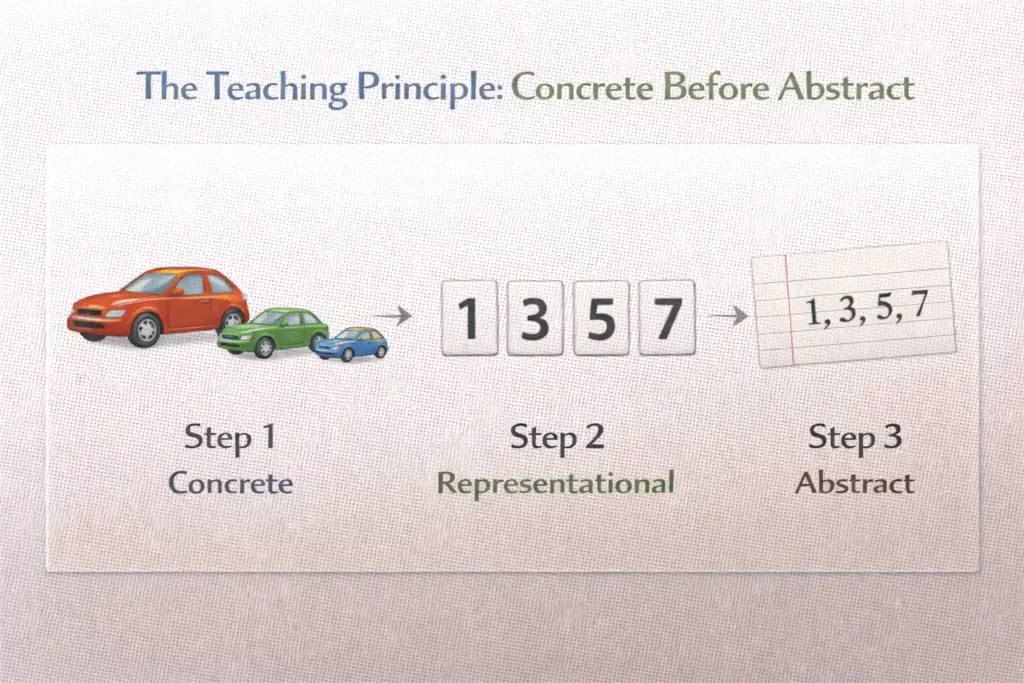
This is not optional enrichment; it is the pedagogical foundation of how Class 1 children build genuine mathematical understanding rather than surface-level compliance.
Concrete means physical objects that children can touch, move, and arrange. Start here — always.
Representational means number cards, pictures, or number lines that visually represent quantities. Abstract means written numerals on a page, arranged or completed in exercises.
The most common teaching mistake at the Class 1 level is jumping straight to abstract written exercises before children have sufficient concrete and representational experience.
Children who practise this way learn to follow a procedure without understanding what ordering means — and this gap shows up in errors, confusion, and lack of flexibility when problem types change.
The same CRA approach that applies here applies across all Class 1 mathematics; the full methodology is covered in Number Sense Teaching Strategies for first graders.
Step 1: Build Counting Foundations First
Before introducing any ordering concept, children must be fluent in both forward and backward counting. This is not optional preparation, it is the essential prerequisite.
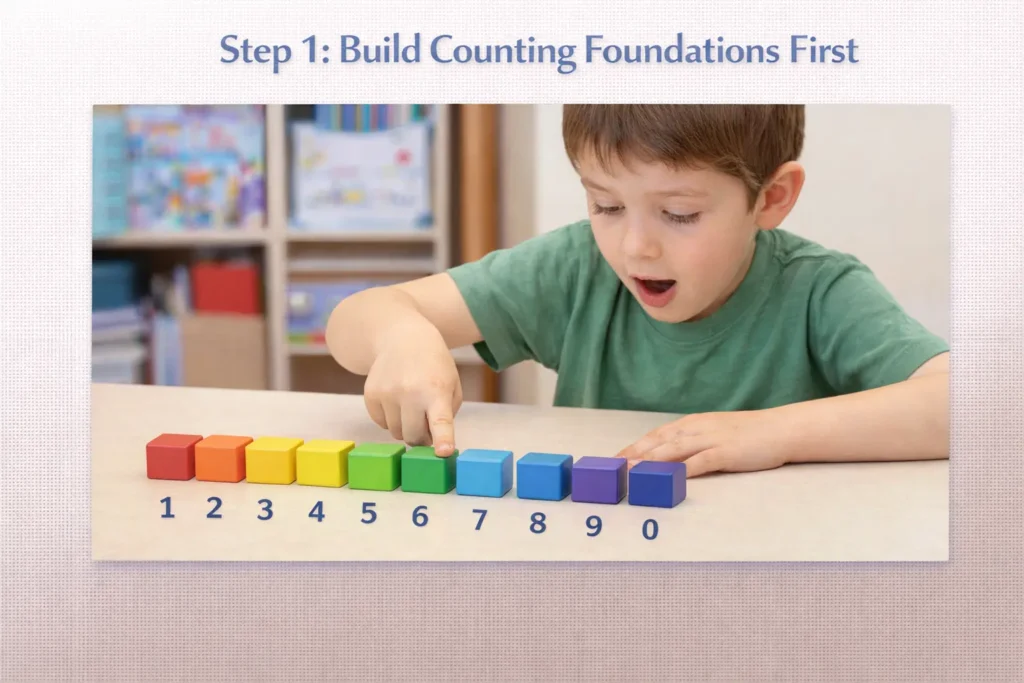
Forward counting builds ascending order readiness. A child who can count forward fluently from any starting point (not just from 1) already understands that each next number is bigger than the previous one.
This is the core concept of ascending order, already internalized through counting practice.
Backward counting builds descending order readiness. A child who can count backward from 10, from 15, or from 20 understands that each next number is smaller.
This is the core concept of descending order, and it is the harder skill — most children need significantly more backward counting practice than forward.
Daily practice activities:
- Count forward from a random number: “Start at 6 and count to 15.”
- Count backward from a random number: “Count down from 12.”
- Physical backward counting: count down while descending stairs, while a rocket “launches,” or while clapping out each number.
The number sequence skills this step develops connect directly to what is the number sequence for class 1 maths and teach number sequences to class 1 students.
Do not move to Step 2 until: the child can count forward to 20 from any starting point without hesitation, and backward from 10 (progressing to 20) without losing track.
Step 2: Teach Ascending Order With Physical Objects
Introduce ascending order using physical objects before any numbers are shown. The concept of “smallest to largest” is most naturally understood through real, touchable things that have visible size differences.
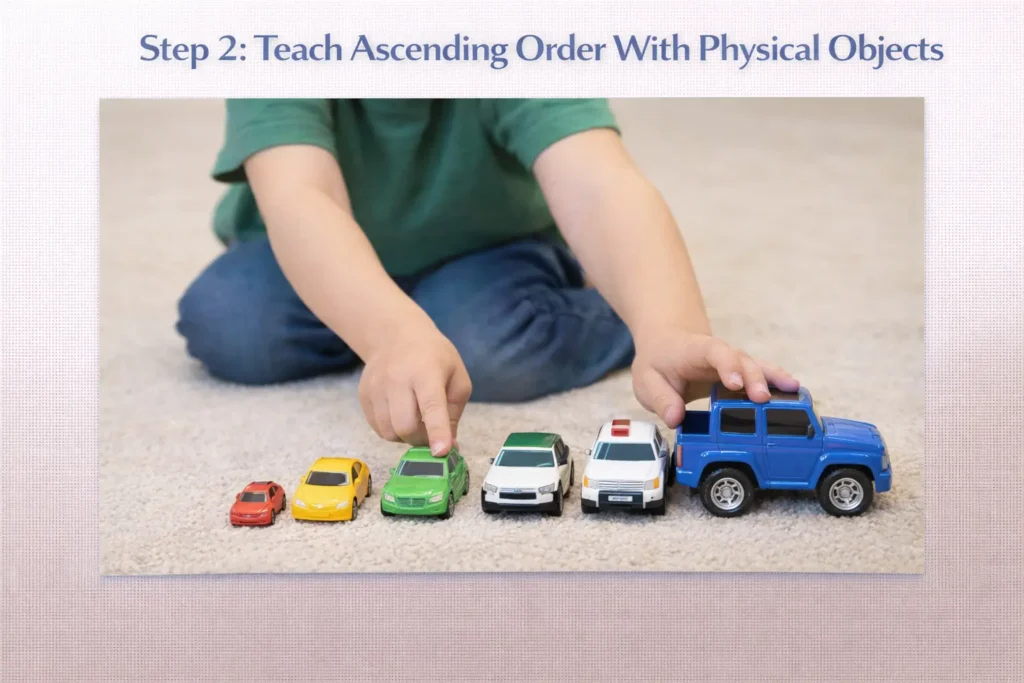
Lesson script: Gather 3–5 objects of clearly different sizes: toy cars, blocks, bottles, books. Place them in a random arrangement. Say: “Can you put these in order from the tiniest to the biggest? The smallest goes first.”
Once the child arranges the objects, narrate what they have done: “You put the smallest first, then the next bigger one, then the next, and the biggest last. That is ascending order, going up from small to big.”
Key practice points:
- Use the language “ascending order” and “small to big” interchangeably from the first lesson
- Ask the child to explain their arrangement: “Why did you put this one first?”
- Verbalizing the reasoning reinforces the concept far more effectively than silent practice
Progression: Once 3-object ascending arrangements are fluent, extend to 4 objects, then 5. Introduce size-comparable numbers (e.g., groups of counters of different sizes) before using numeral cards.
Step 3: Teach Descending Order With Physical Objects
Introduce descending order only after the ascending order with physical objects is secure. Use the same objects from Step 2 to contrast maximally clear, same objects, opposite arrangement.
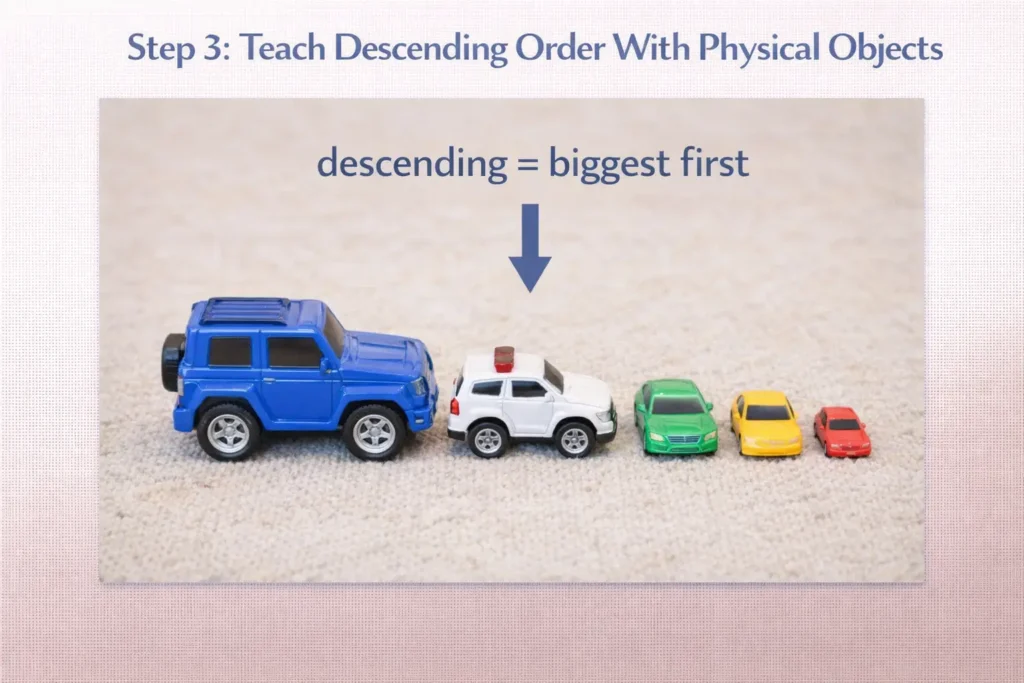
Lesson script: Take the ascending arrangement and say, “Now let’s reverse it. This time, the biggest goes first and we go down to the smallest. That is descending order, going down from big to small.”
The fact that the same objects produce two opposite arrangements makes the directional distinction concrete and memorable.
Children who see this contrast with physical objects first rarely confuse the directions because they have a physical memory to anchor the abstract concept.
Descending order memory anchor: “Descending means going down like coming down stairs, like sliding down, like counting down before a rocket launches.”
Repeat this language in every descending order session until it becomes automatic.
Step 4: Move to Number Cards
Once physical object ordering is fluent in both directions, introduce number cards. This is the representational stage children are now working with symbols that represent quantities rather than the quantities themselves.
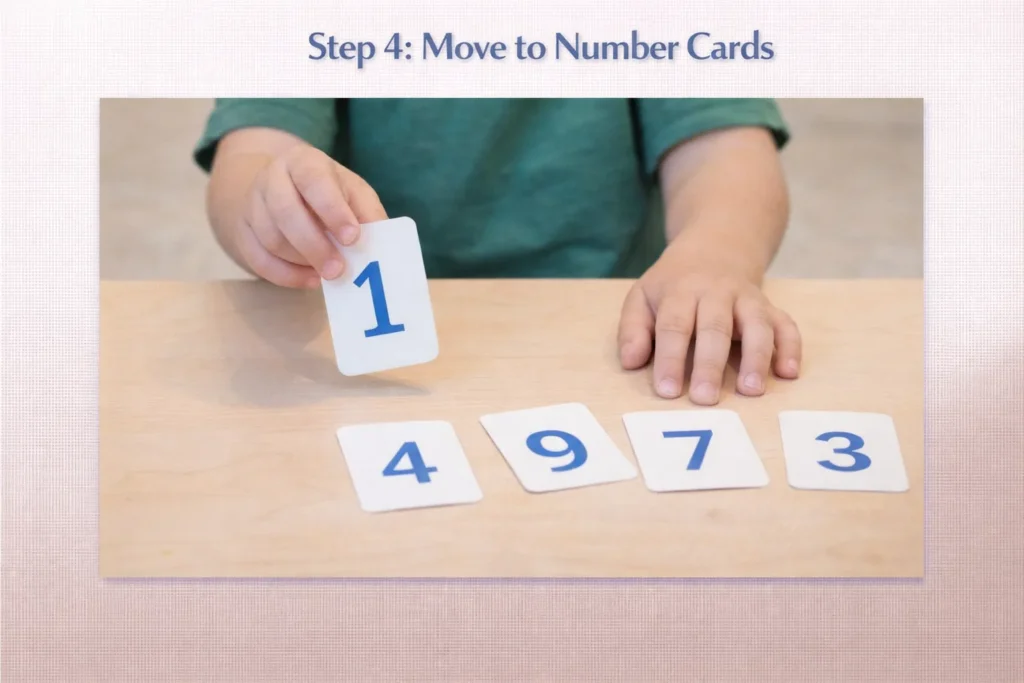
Why number cards before written exercises: Cards are physical and reversible. A child who places a number incorrectly can pick it up and move it without the frustration of erasing.
This low-stakes interaction with numbers builds confidence that written practice alone cannot replicate.
How to introduce number cards: Start with three cards (e.g., 3, 7, 1). Shuffle them and place them face up. Ask: “Can you arrange these in ascending order? Remember — smallest first.”
Once three-card ascending work is fluent, add a fourth card, then a fifth. Alternate between ascending and descending always ask the direction question first: “Are we going up or down today?”
Connect card sort practice to the step-by-step ordering rules in the rules for ordering numbers class 1. The rules give children a reliable procedure to follow when the card sort becomes more demanding.
Step 5: Introduce Written Exercises Last
Written exercises are the abstract stage, the final step in the progression, not the starting point. By the time children reach written ordering exercises, they should already be fluent with physical objects and number cards.
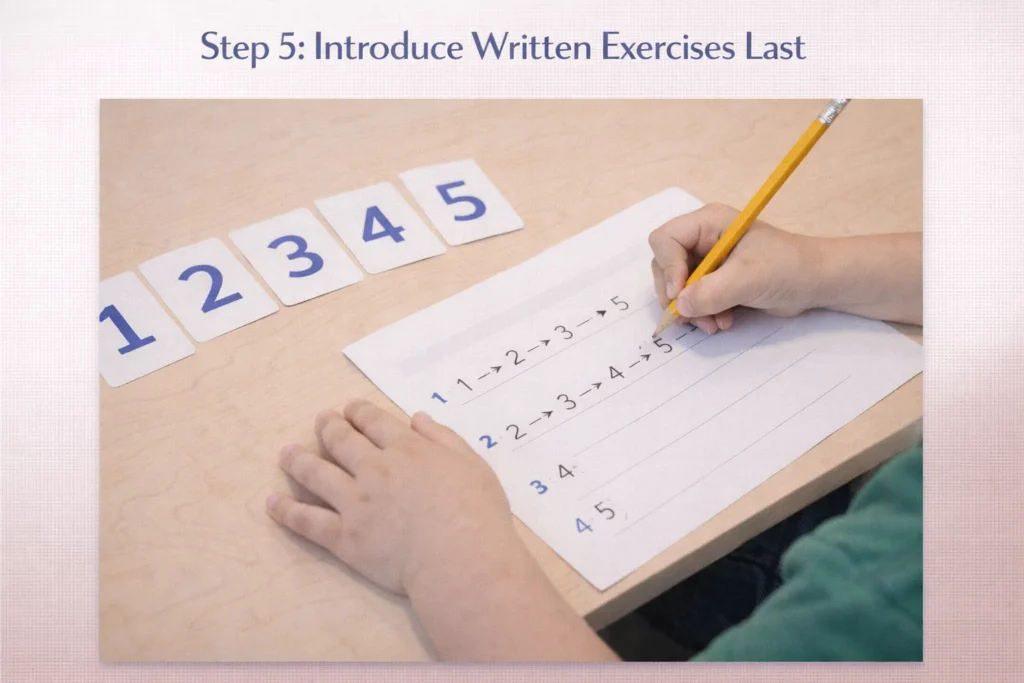
Written practice consolidates what has been learned; it does not build understanding.
Effective written exercise types:
- Arrange a given set in ascending order
- Arrange a given set in descending order
- Identify whether a given sequence is ascending or descending
- Fill in missing numbers in a sequence
For a complete bank of graduated written examples ready to use, examples of ascending and descending order class 1 provides exercises from single-digit through two-digit numbers with full worked solutions.
One critical rule: Keep the desk number line accessible during all written exercises.
Children who are uncertain about the relative size of two numbers should check the number line before placing this is Rule 4 from the rules for ordering numbers class 1 in action.
6 Activities to Reinforce Both Directions
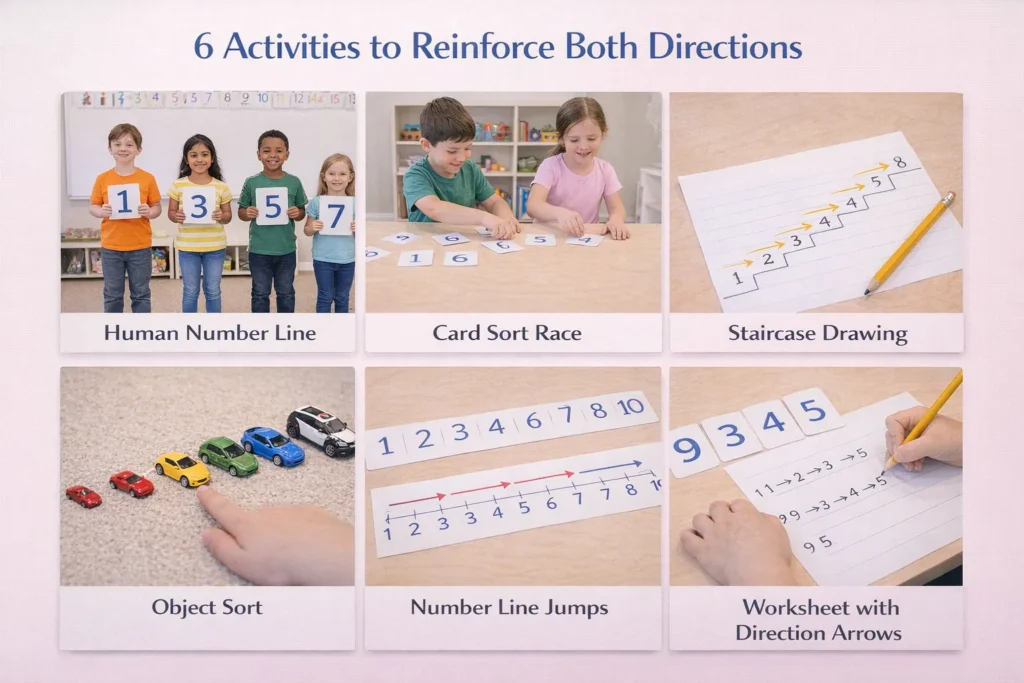
1. Human Number Line (Ascending and Descending): Give children number cards 1–10. Ask them to arrange themselves in ascending order. Call “Reverse!” and have them rearrange in descending order.
The physical, social activity makes direction switching memorable and enjoyable. Connects to the spatial number understanding in spatial understanding for class 1.
2. Card Sort Race: Give two children identical shuffled sets (e.g., 1, 3, 5, 7, 9). Call “Ascending!” or “Descending!” — first to arrange correctly wins.
The direction-calling element forces children to consciously choose before starting, building the direction-first habit.
3. Staircase Drawing: Ask children to draw a staircase with five steps. Write a number on each step from smallest (bottom) to largest (top) for ascending, or largest (bottom) to smallest (top) for descending.
The visual reinforces the “going up / going down” direction analogy every time children draw it.
4. Object Sort and Label: Arrange 4 household objects in ascending or descending order by size. Write the corresponding numbers underneath each object.
This bridges the concrete (physical objects) and representational (numbers) stages simultaneously.
5. Number Line Jump: Use a floor number line or desk number line. Call a starting number and a direction — “Start at 3, jump ascending to 8.” Children jump or point along the line in the correct direction.
Reinforces both the left/right direction convention and the connection between ordering and how to teach number line maths class 1.
6. Arrow Worksheet: On any written ordering exercise, ask children to draw a small arrow above the answer space before writing any numbers — ↑ for ascending, ↓ for descending.
This one habit prevents the most common ordering error (direction change mid-sequence) with minimal effort.
Common Teaching Mistakes to Avoid
| Mistake | Why It Causes Problems | Fix |
|---|---|---|
| Starting with written worksheets | Children learn procedures without understanding direction | Always start with physical objects — cards or worksheets come later |
| Teaching both directions simultaneously | Direction confusion before either is secure | Establish ascending order fluency over 2–3 weeks before introducing descending |
| Not asking children to state direction first | Children begin ordering without deciding up or down | Ask every time: “Are we going up or down?” before any ordering begins |
| Correcting errors without diagnosing them | Child does not understand why they were wrong | Ask “how did you decide which came first?” before providing the correction |
| Using worksheets as the primary learning tool | Procedure without understanding — errors compound | Worksheets consolidate; they do not build understanding |
How long should each teaching session be?
For Class 1 children, 10–15 minutes of focused ordering activity is optimal. Short sessions with full engagement produce faster learning than longer sessions where attention drifts. Daily 10-minute sessions across two weeks will produce far greater fluency than occasional longer lessons.
My child can do ascending but always struggles with descending. What should I do?
Spend 5 minutes daily on backward counting from varied starting points before any descending ordering practice. Backward counting fluency is the specific skill that makes descending order feel natural — it cannot be replaced by more descending ordering practice alone. Once backward counting from 10–20 is fluent, descending ordering typically becomes much easier.
When should I introduce the < and > symbols?
Only after both ascending and descending ordering with numbers is one fluent in both card and written form. The symbols are abstract shorthand for the comparison relationship that ordering develops. They are introduced as shorthand, with explicit connection to the ordering work: “7 > 4 means 7 comes after 4 in ascending order.”
How does this connect to competition mathematics?
Ordering and sequencing problems appear consistently at the Class 1 competition level, arranging sets of numbers, completing sequences, and identifying the correct ordering direction. Children taught through the concrete-to-abstract progression in this guide approach these problems with natural confidence. The IMO syllabus for class 1 covers all number topics assessed at this level.
Make Preparing for Math Olympiad Simple!



Conclusion
Teaching ascending and descending order follows one non-negotiable principle: concrete before abstract, always.
Teach ascending first, then descending. Use the number line as a permanent reference tool. Fix mistakes by diagnosing their source not simply correcting the answer.
The activities in this guide provide the varied, repeated exposure that builds genuine ordering fluency. Use them daily in short sessions, and the concept that once confused children will quickly become second nature.
For the conceptual framework behind this teaching, see ascending and descending order in Maths Class 1.
For the ordering rules children apply, see the rules for ordering numbers class 1.
For graduated practice examples, see examples of ascending and descending order class 1.