


The difference between ascending and descending order is one thing: direction.
- The Core Difference: Side by Side
- Is Ascending Order Smallest to Largest?
- Is Descending Order Largest to Smallest?
- Ascending Order: Definition and Worked Example
- Descending Order: Definition and Worked Example
- Ascending vs Descending: A Direct Comparison
- The Number Line: Seeing the Difference Visually
- Ascending and Descending Order Signs
- Real-Life Connections
- Is It Ascending or Descending? Dates and Sorting?
- How to Remember the Difference
- Common Confusion and How to Fix It
- Difference Between Increasing Order and Decreasing Order
- Conclusion
Ascending order means arranging numbers from the smallest to the largest. Each number in the sequence is bigger than the one before it. It goes up.
Descending order means arranging numbers from the largest to the smallest. Each number in the sequence is smaller than the one before it. It goes down.
That is the complete answer. Everything else on this page, the comparison table, the signs, the real-life examples, the memory tricks, exists to make that single distinction permanent and impossible to confuse again.
Whether the search was for ascending order meaning, descending order meaning, or simply what ascending and descending mean in math, the direction is the only thing that changes. The numbers themselves never change.
For the full concept explanation and step-by-step activities for Class 1 children, see ascending and descending order for Class 1.
The Core Difference: Side by Side
Quick definitions, for anyone who wants the ascending order definition and descending order definition in one line each:
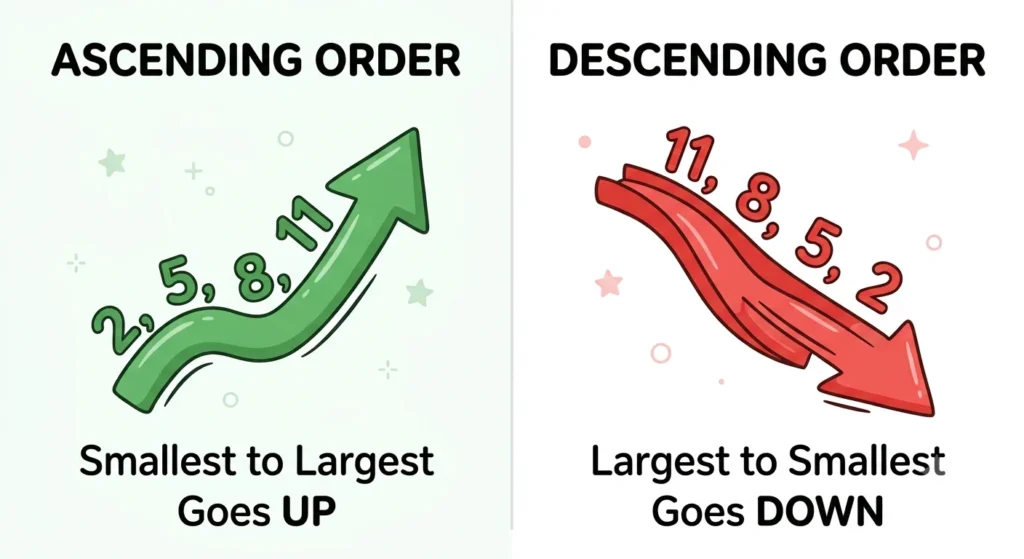
- Ascending order definition: a sequence arranged from the smallest value to the largest.
- Descending order definition: a sequence arranged from the largest value to the smallest.
| Feature | Ascending Order | Descending Order |
| Meaning | Smallest to largest | Largest to smallest |
| Also called | Increasing order | Decreasing order |
| Direction | Goes UP | Goes DOWN |
| Start with | The smallest number | The largest number |
| Counting style | Forward (1, 2, 3…) | Backward (10, 9, 8…) |
| Number line | Moves left to right | Moves right to left |
| Sign used | < (less than) | > (greater than) |
| Real-life | Climbing stairs | Sliding down |
| Example | 2, 5, 8, 11 | 11, 8, 5, 2 |
The two-second check: look at the first and last number in any sequence. If the last number is bigger than the first, it is ascending.
If the last number is smaller than the first, it is descending. This check works for every sequence, every time, with no counting needed.
Is Ascending Order Smallest to Largest?
Yes. Ascending order always means smallest to largest. This is the single most important fact about ascending order and it never changes.
- Is ascending smallest to largest? Yes, always.
- Is ascending order smallest to biggest? Yes, the same thing.
- Is ascending lowest to highest? Yes, ascending moves from lowest to highest.
- Is ascending from least to greatest? Yes, ascending order goes from least to greatest.
- Is ascending A to Z? Yes, alphabetically, A to Z is ascending because A comes before Z.
- Is ascending going up or down? Ascending always goes up.
What Does Ascending Mean?
The word ascend means to rise or climb. Ascending numbers climb upward like stairs, like growing taller each year, like counting forward from 1. In short, ascending means moving from the smallest value to the largest, or in plain terms, going up. The direction never changes.
Is Descending Order Largest to Smallest?
Yes. Descending order always means largest to smallest. This is the single most important fact about descending order and it never changes.
- Is descending order largest to smallest? Yes, always.
- Is descending smallest to largest? No, that is the opposite, ascending.
- Is descending highest to lowest? Yes.
- Is descending order A to Z or Z to A? Descending alphabetical order goes Z to A.
- Is descending largest to smallest? Yes, always.
- Does descending mean up or down? Descending always goes down.
What Does Descending Mean?
The word descend means to fall or come down. Descending numbers fall downward like sliding, like counting down before a race, like arranging from biggest to smallest. In short, descending means moving from the largest value to the smallest, or in plain terms, going down.
Ascending Order: Definition and Worked Example
Ascending order means arranging numbers from the smallest to the largest. Each number is bigger than the one before it.
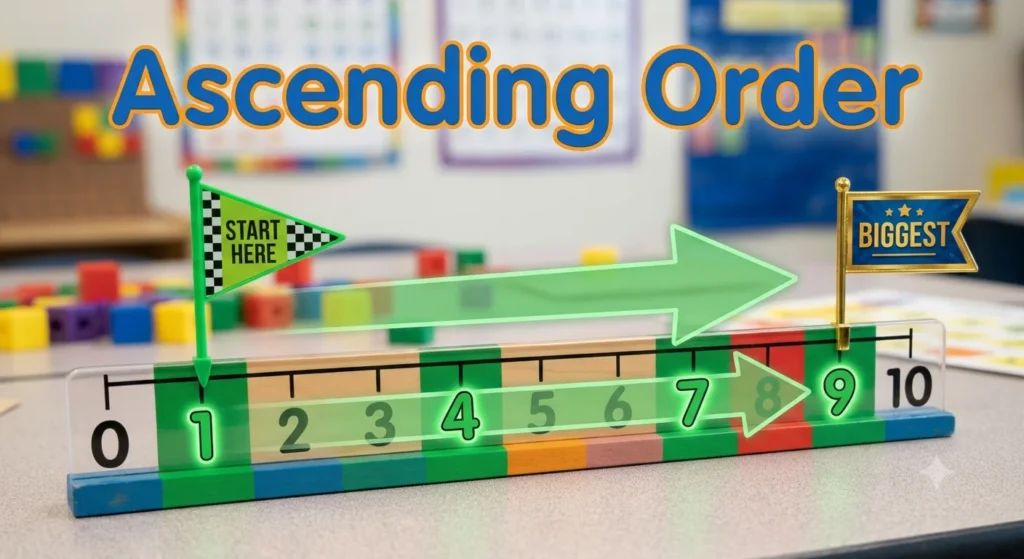
These steps follow the same rules for ordering numbers used throughout Class 1 math.
How to arrange numbers in ascending order, step by step:
- Find the smallest number in the set, place it first
- Find the smallest of the remaining numbers, place it second
- Repeat until all numbers are placed
- Check: is each number bigger than the one before it?
Worked example:
Set: 7, 2, 9, 4
- Smallest: 2, place first
- Smallest of remaining (7, 9, 4): 4, place second
- Smallest of remaining (7, 9): 7, place third
- Last number: 9, place fourth
Answer: 2, 4, 7, 9
Check: 2 < 4, then 4 < 7, then 7 < 9. Correct.
More ascending order examples:
2020, 2022, 2024, 2026: dates oldest to newest (ascending date order)
3, 8, 12, 20, 25: each number increases
A, B, C, D: alphabetical ascending order
Descending Order: Definition and Worked Example
Descending order means arranging numbers from the largest to the smallest. Each number is smaller than the one before it.
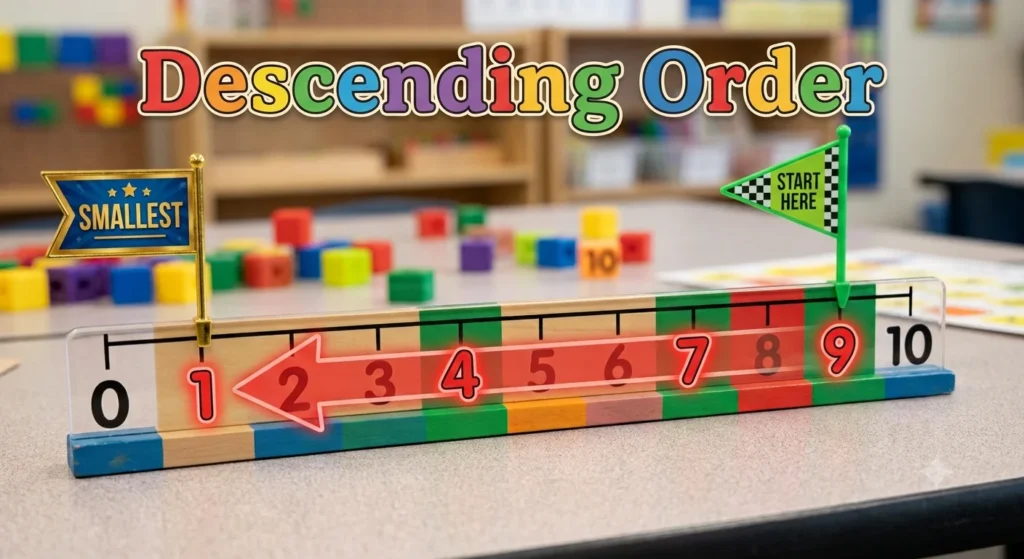
How to arrange numbers in descending order, step by step:
- Find the largest number in the set, place it first
- Find the largest of the remaining numbers, place it second
- Repeat until all numbers are placed
- Check: is each number smaller than the one before it?
Worked example:
Set: 7, 2, 9, 4 (same numbers, opposite direction)
- Largest: 9, place first
- Largest of remaining (7, 2, 4): 7, place second
- Largest of remaining (2, 4): 4, place third
- Last number: 2, place fourth
Answer: 9, 7, 4, 2
Check: 9 > 7, then 7 > 4, then 4 > 2. Correct.
Using the same set in both directions is the clearest way to see the difference: same numbers, completely opposite arrangement.
More descending order examples:
2026, 2024, 2022, 2020: dates newest to oldest (descending date order)
25, 20, 12, 8, 3: each number decreases
Z, Y, X, W: alphabetical descending order
App CTA: “Do you want to win Math Olympiads? Practice daily and learn fast with the Gonit app, anytime, anywhere.” (keep existing banner placement here)
| Feature | Ascending | Descending |
| Direction | Up | Down |
| First number | Smallest | Largest |
| Last number | Largest | Smallest |
| Also means | Increasing | Decreasing |
| Opposite of | Descending | Ascending |
Ascending vs Descending: A Direct Comparison
The most searched phrase on this topic is “ascending vs descending.”
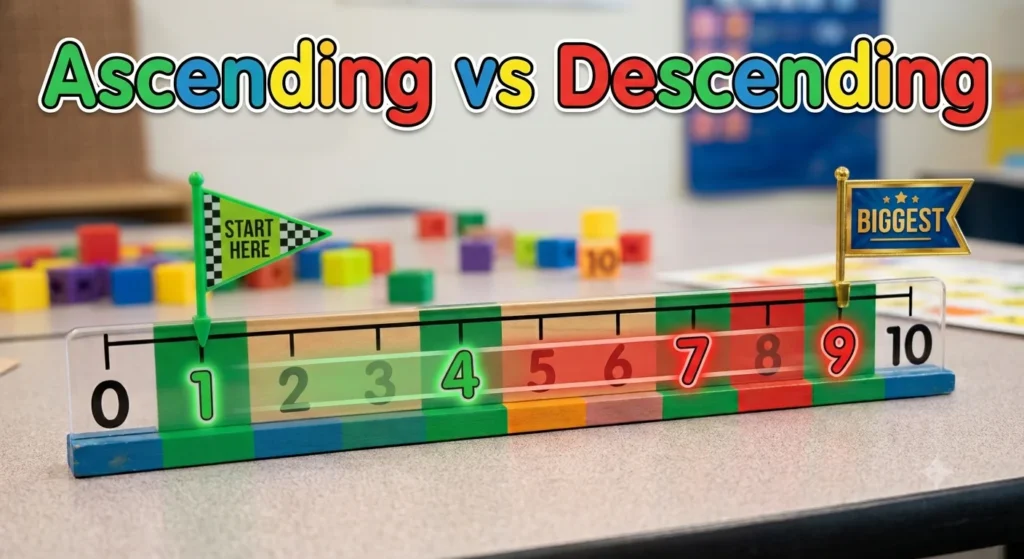
Here is the sharpest possible contrast.
| Question | Ascending | Descending |
| Direction | Up | Down |
| First number | Smallest | Largest |
| Last number | Largest | Smallest |
| Also called | Increasing | Decreasing |
| Opposite of | Descending | Ascending |
| Sign used | < | > |
Is ascending smallest to largest? Yes.
Is descending order largest to smallest? Yes.
Is ascending going up or down? Ascending always goes up.
Is descending going up or down? Descending always goes down.
The fastest single-question check: “Is the sequence going up or going down?” If up, ascending. If down, descending.
Ascending vs Descending: Alphabetical Order
- Ascending alphabetical: A, B, C… Z, standard dictionary order, A to Z
- Descending alphabetical: Z, Y, X… A, reverse alphabetical order, Z to A
Is A to Z ascending or descending? A to Z is ascending. Is Z to A ascending or descending? Z to A is descending.
Reverse alphabetical order is simply another name for descending alphabetical order. If a task asks you to sort words or names in reverse alphabetical order, treat it exactly like descending order: Z to A, biggest letter value first.
Ascending vs Descending: Dates
- Ascending date order: oldest to newest, 2020, 2022, 2024, 2026. This is standard chronological order.
- Descending date order: newest to oldest, 2026, 2024, 2022, 2020. This is reverse chronological order, how news feeds, blog archives, and email inboxes typically sort.
Is ascending date order oldest to newest? Yes. Is chronological order ascending or descending? Standard chronological order (oldest first) is ascending.
Sort Ascending vs Descending in Spreadsheets and Apps
When sorting data in Excel, Google Sheets, or any database:
- Sort ascending = A to Z, smallest number first, oldest date first
- Sort descending = Z to A, largest number first, newest date first
Is ascending order lowest to highest in a spreadsheet? Yes, sorting ascending arranges numbers from lowest to highest and text from A to Z. This is exactly what sort ascending vs descending means in Excel and Google Sheets.
The Number Line: Seeing the Difference Visually
The number line makes the difference between ascending and descending permanently visible.
[Keep existing image: Number line 0 to 10 with green right arrows (ascending) and red left arrows (descending)]
On any number line:
- Numbers increase moving right, this is ascending order
- Numbers decrease moving left, this is descending order
Ascending order on a number line follows the arrow left to right, getting bigger. Descending order goes against the arrow, from right to left, getting smaller.
This is why ascending order is also called increasing order (numbers increase moving right) and descending order is called decreasing order (numbers decrease moving left).
The visual check: place the first and last number of any sequence on a number line. Did you move right? Ascending. Did you move left? Descending. This works every time.
For a closer look at how this is taught, see number line for Class 1.
Ascending and Descending Order Signs
The mathematical signs that describe the direction of a sequence are:
Ascending order sign: < (less than). Each number is less than the one that follows it. Example: 2 < 5 < 8 < 11
Descending order sign: > (greater than). Each number is greater than the one that follows it. Example: 11 > 8 > 5 > 2
The open-mouth rule: the open side of the symbol always faces the larger number. In ascending order, the open side faces right, toward the bigger number ahead. In descending order, the open side faces left, toward the bigger number behind.
- Ascending order sign: < (less than sign)
- Descending order sign: > (greater than sign)
These signs do not just label the sequence, they confirm the direction. A sequence written with < signs throughout is ascending. A sequence written with > signs throughout is descending.
Real-Life Connections
Recognizing ascending and descending order in everyday life makes the abstract concept concrete and lasting.
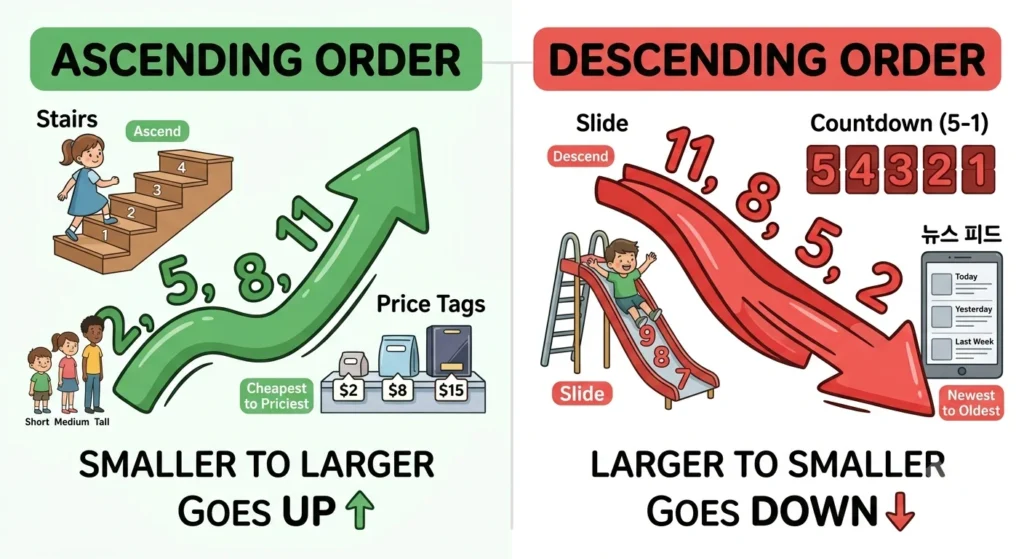
Ascending order in real life:
- Climbing stairs, each step takes you higher
- Lining up from shortest to tallest, the sequence goes up
- A child growing taller each year, each measurement is bigger than the last
- Counting forward: 1, 2, 3, 4, 5…
- Price lists from cheapest to most expensive
- Files sorted oldest to newest
Descending order in real life:
- Sliding down a slide, each moment takes you lower
- Countdown before a race: 5, 4, 3, 2, 1, Go!
- Lining up from tallest to shortest, the sequence goes down
- Counting backward: 10, 9, 8, 7…
- Top 10 lists, highest score first
- News feeds sorted newest to oldest
The countdown connection is particularly powerful. Children who count down before races, games, or launches are already producing descending order, they simply need to connect the vocabulary to the action.
Is It Ascending or Descending? Dates and Sorting?
We covered dates, alphabetical order, and sorting in depth above. Here is a fast-reference summary:
| Question | Answer |
| Is oldest to newest ascending or descending? | Ascending |
| Is newest to oldest ascending or descending? | Descending |
| Is A to Z ascending or descending? | Ascending |
| Is Z to A ascending or descending? | Descending |
| Sort ascending in a spreadsheet = ? | Smallest first, A to Z, oldest first |
| Sort descending in a spreadsheet = ? | Largest first, Z to A, newest first |
| Is chronological order ascending or descending? | Ascending (oldest event first) |
| Is reverse alphabetical order ascending or descending? | Descending (Z to A) |
How to Remember the Difference
The single most searched teaching question on this topic is how to remember which direction is which.
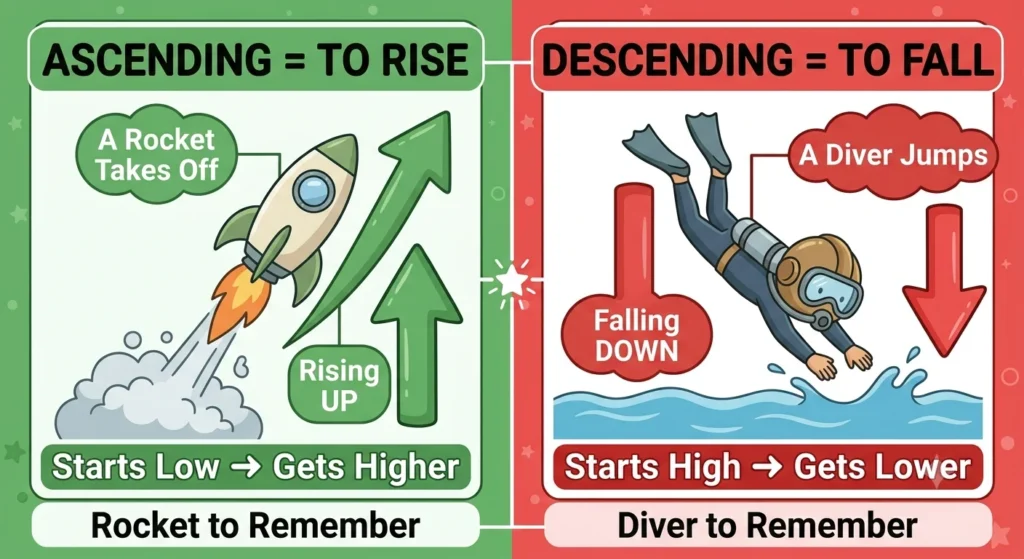
Here are the five most reliable methods.
1. The Staircase and Slide
Ascending means climbing stairs, going up, getting bigger. Descending means sliding down, going down, getting smaller.
Draw a staircase with numbers climbing up, and a slide with numbers falling down. This visual analogy is the most universal fix for direction confusion.
2. The Word Itself
Ascend means to rise, astronauts ascend to space, planes ascend after takeoff. Descend means to fall, planes descend to land, and divers descend into water.
The words carry their own direction. Once a child hears the etymology, it rarely needs repeating.
3. The A-before-D Rule
A (ascending) comes before D (descending) in the alphabet, just as ascending starts from the smaller number, which naturally comes first. D for descend, D for down. A for ascend, A for add (going higher).
4. The Counting Connection
Forward counting (1, 2, 3…) is ascending order. Backward counting (10, 9, 8…) is descending order. Children who can count both directions already understand both concepts, they just need the labels.
5. The Two-Second Check
Look at the first and last number only. Last bigger than first equals ascending. Last smaller than first equals descending. No counting, no middle numbers needed. One comparison, instant answer.
Common Confusion and How to Fix It
The most persistent confusion between ascending and descending order is not about the definitions, it is about failing to decide the direction before starting.
| Confusion | What It Looks Like | Fix |
| Direction changed halfway | 1, 5, 3, 8 called “ascending” | State direction aloud first: “going up” |
| Wrong starting number | Started ascending with 5 instead of smallest | Ask: “Which number is smallest? Start there.” |
| Mixed up ascending and descending | Called 9, 6, 3 “ascending” | Return to staircase/slide analogy |
| Correct order, wrong label | Ordered 9, 6, 3 but called it ascending | Check: “Is each number bigger than before? No, descending.” |
| Confused by alphabetical sorting | Uncertain whether A to Z is ascending | A to Z is always ascending, dictionary order always goes up |
The universal fix: before placing a single number, state the direction aloud. “I am going up, so I start with the smallest.” Or: “I am going down, so I start with the largest.” This one habit prevents every direction error listed above.
Difference Between Increasing Order and Decreasing Order
This is one of the most frequently asked follow-up questions.
Increasing order means the same thing as ascending order: numbers go from small to large, each number is bigger than the one before it.
Decreasing order means the same thing as descending order: numbers go from large to small, each number is smaller than the one before it.
These are simply two different sets of terms for the same two concepts. If a question asks you to arrange numbers in increasing order, treat it exactly like ascending order. If it asks for decreasing order, treat it exactly like descending order.
Is ascending order always used before descending in Class 1?
Yes. Ascending order is typically taught first because it is directly connected to forward counting, which children already know. Descending order follows once ascending is secure, usually 2 to 3 weeks later. Teaching both simultaneously before either is fluent often creates the confusion this guide addresses.
What is the quickest way to tell ascending from descending apart?
Look at the first and last numbers. If the last number is bigger than the first, it is ascending. If the last number is smaller than the first, it is descending. This two-second check works for any sequence and requires no counting or comparison of middle numbers.
Is ascending order smallest to largest?
Yes. Ascending order always means smallest to largest, the numbers increase from left to right.
Is descending order largest to smallest?
Yes. Descending order always means largest to smallest, the numbers decrease from left to right.
Does ascending mean up or down?
Ascending means up. Numbers increase as you move through the sequence.
Is chronological order ascending or descending?
Standard chronological order (oldest event first, newest last) is ascending, the dates increase. Reverse chronological order (newest first) is descending.
What is the difference between increasing order and decreasing order?
Increasing order is the same as ascending order, numbers go from small to large. Decreasing order is the same as descending order, numbers go from large to small.
How does the difference between ascending and descending order connect to competition mathematics?
Both directions appear in Class 1 competition problems: arranging sets of numbers, completing sequences in a specified direction, and identifying whether a given sequence is correctly ordered. Children who have a clear, automatic understanding of the difference approach these problems immediately and confidently. The IMO syllabus for class 1 covers all number topics assessed at this level.
Is ascending going up or down?
Ascending goes up. The word ascend means to rise or climb. In an ascending sequence, each number is larger than the one before it, so the sequence moves upward in value. Ascending order is always from the smallest number to the largest.
What is the difference between increasing order and decreasing order?
Increasing order is the same as ascending order; numbers go from small to large. Decreasing order is the same as descending order numbers go from large to small. These are two sets of terms for the same concepts. If a question asks you to arrange in increasing order, treat it exactly like ascending order.
Is ascending date order oldest to newest?
Yes. Ascending date order means oldest first, newest last, because older dates have smaller year numbers, which come first in ascending order. For example: 2020, 2022, 2024, 2026 is ascending date order. Descending date order (newest first) would be: 2026, 2024, 2022, 2020.
What does ascending order mean?
Ascending order means arranging numbers, letters, or values so each one is larger than the one before it, moving from the smallest to the largest
What does descending order mean?
Descending order means arranging numbers, letters, or values so that each one is smaller than the one before it, from largest to smallest.
What is the definition of ascending order in math?
In math, ascending order is defined as a sequence where every term is greater than the term before it, starting at the smallest value and ending at the largest.
Is reverse alphabetical order the same as descending order?
Yes. Reverse alphabetical order runs from Z to A, which follows the same direction as descending order, since later letters are treated as larger values in alphabetical sorting.
What is the difference between ascending and descending order in one sentence?
Ascending order goes from smallest to largest; descending order goes from largest to smallest. The only difference between the two is direction.
Make Preparing for Math Olympiad Simple!



Conclusion
The difference between ascending and descending order is direction and direction alone.
Ascending is smallest to largest, increasing, going up, using the < sign, following the number line from left to right. Descending is largest to smallest, decreasing, going down, using the > sign, going against the number line from right to left.
The two-second check, comparing the first and last number, confirms the direction of any sequence instantly.
The difference between increasing and decreasing order is the same difference, expressed with different vocabulary.
Whether the goal is ascending order meaning smallest to largest or descending order meaning largest to smallest, the underlying idea never changes: only the direction does.
For complete practice examples at every difficulty level for Class 1, see ascending and descending order examples for Class 1.
For the full teaching method, signs, and classroom activities for Class 1, see teaching ascending and descending order in Class 1.

Mikha Piregu is a Content Writer with experience spanning educational content, including math and math olympiad topics, as well as advocacy writing, research-based articles, and SEO-driven web content. He creates high-quality blog content, web copy, and feature articles that support brand visibility, audience engagement, and long-term organic growth through data-informed storytelling. Skilled in WordPress, WooCommerce, and modern digital tools, Mikha adapts content across various platforms, including blogs, websites, campaigns, and advocacy initiatives, with clarity and purpose.



There are no comments posted here yet.
Sign in to leave a comment