 January 25, 2026
 12 min. read

Many parents and teachers wonder how to teach counting to kindergarten kids. Counting up is easy for them, but counting down can be confusing.
Counting helps build number sense, which supports addition and subtraction later. You can explore this foundation in what is number sense for Class 1, as the same ideas begin developing in kindergarten.
Teaching counting step by step works best. Use visuals, movement, and daily routines for better learning.
Counting in daily routines, like stairs, blocks, or toys, makes learning fun for kindergarten kids.
What are forward and backward counting in simple terms?
Counting forward and backward are two easy ways for kids to learn numbers. They can say numbers as they go up or down.
Both are important early math skills for kindergarten children.
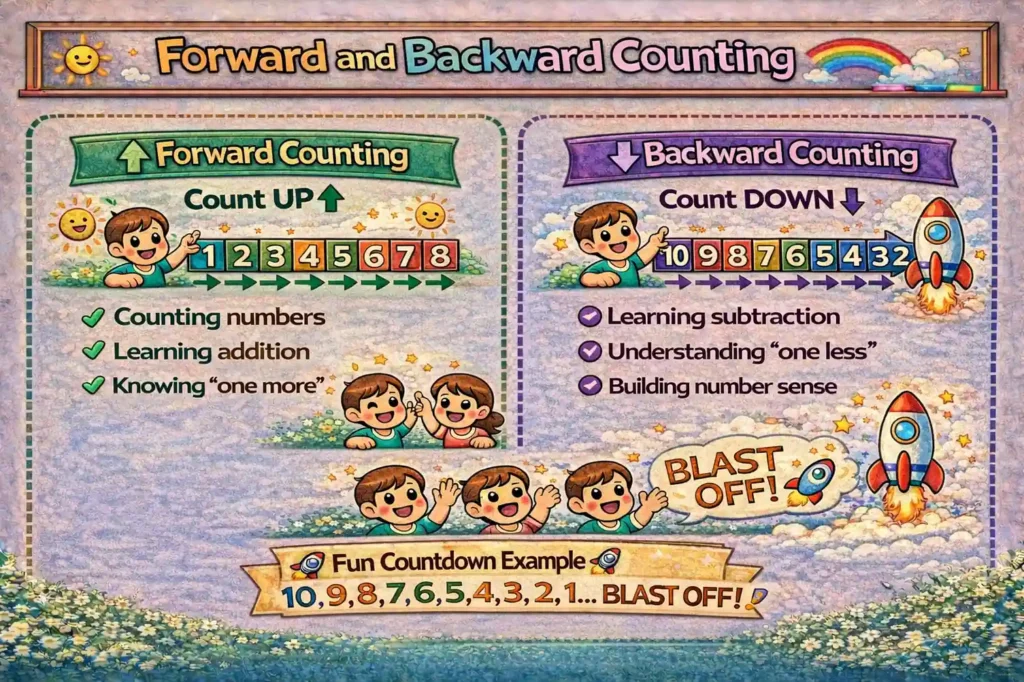
Forward counting in simple words:
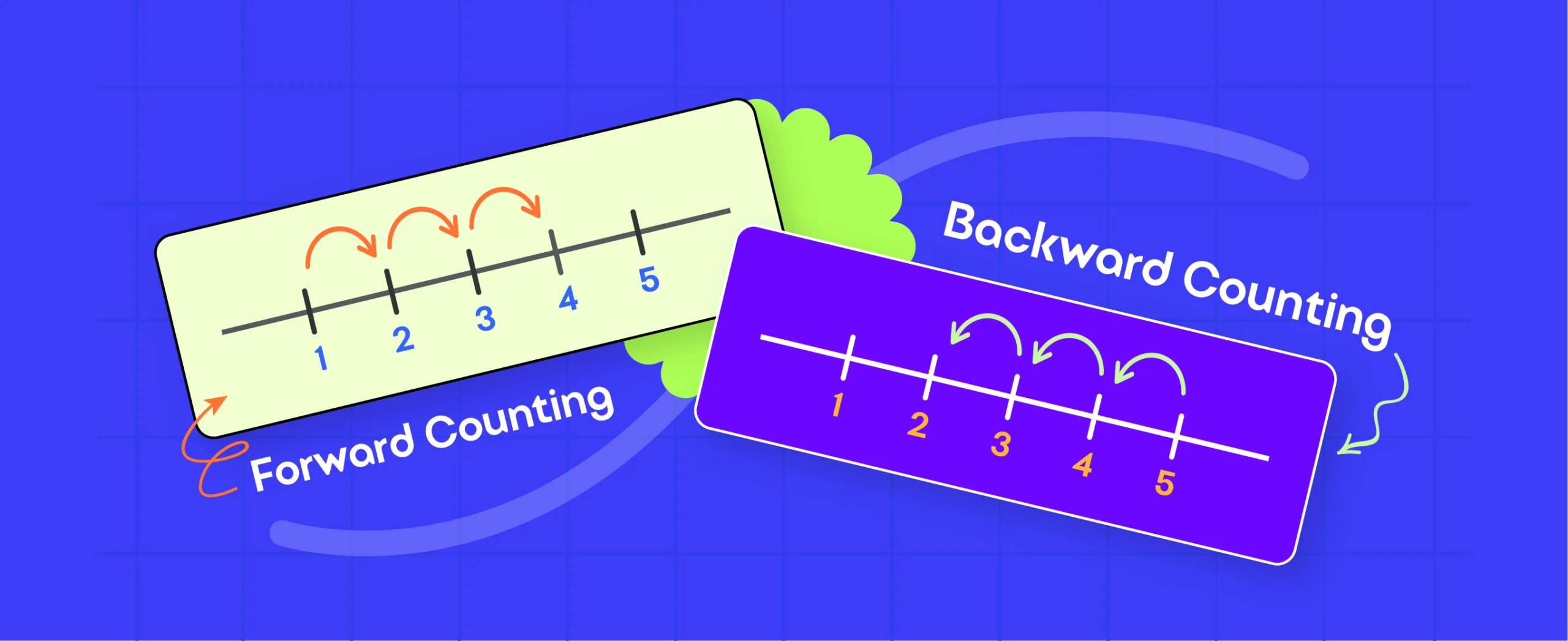
Forward counting means numbers go up by one each time. Children start at a number and keep adding one more.
Counting starts at one and goes up: “1, 2, 3, 4, 5…” This helps kids learn addition and improve their counting skills. These skills later support addition and subtraction for Class 1.
Backward counting as “counting back one step”:
Backward counting means numbers go down by one each time. Children start at a number and count backward, like stepping back on a number line.
Think of it this way: “We begin at a number and slide back—10, 9, 8, 7…”. This idea is explained in detail in what is backward counting for Class 1 math, which builds directly on kindergarten learning.
This fun backward counting journey prepares kids for future subtraction skills. Here are some easy spoken examples:
- Forward counting: “Let’s count together—1, 2, 3, 4, 5, 6, 7, 8, 9, 10.”
- Backward counting: “Let’s do a rocket countdown—10, 9, 8, 7, 6, 5, 4, 3, 2, 1… blast off!”
- key countdown: 10, 9, 8, 7, 6, 5, 4, 3, 2, 1, blast off!”
When are kindergarten kids ready for counting forward and backward?
Kindergarten kids are ready for a counting adventure. When they recognise numbers, their voices become vibrant.
Counting forward and backward transforms into a joyful game. Confidence sparkles in every shout of those numbers.
Readiness usually develops around the ages of 4–5, but it depends more on skills than on age.
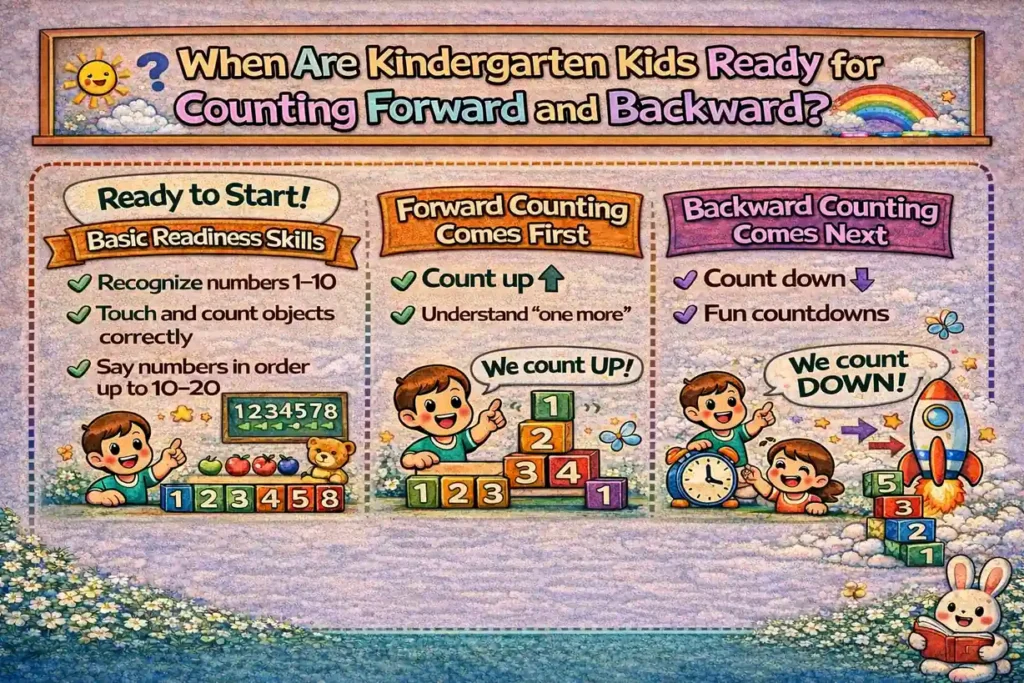
Basic readiness skills:
Children are ready when they can:
- recognise numbers (usually 1–10)
- count objects by touching each one once (one-to-one correspondence)
- Say numbers in order up to 10 or 20.
When a child counts aloud and points to objects, they start to grasp that the last number shows how many there are. This means they’re ready to move on.
These skills show children are building early number order, which is reinforced later in number ordering for Class 1.
Why does forward counting come first?
Forward counting is taught first because it builds a stable number sequence (1, 2, 3…). Children need a solid base to understand concepts like “one more” and to form a mental number line from small to big.
Backward counting is harder because it reverses this familiar order.
When to introduce backward counting:
Backward counting should start once children can reliably count forward to 20. This often happens in the middle or later part of kindergarten.
Start with short, familiar ranges like 5 to 1 or 10 to 1 using games, songs, and visuals. Signs of readiness include answering questions like “What comes before 5?” or joining in countdowns during play.
If counting forward is still shaky, wait before starting backward counting. This helps prevent confusion.
How to Teach Forward Counting to Kindergarten Children?
Teaching kindergarten kids to count works best with short, fun lessons. Hands-on activities help them feel confident while they learn.
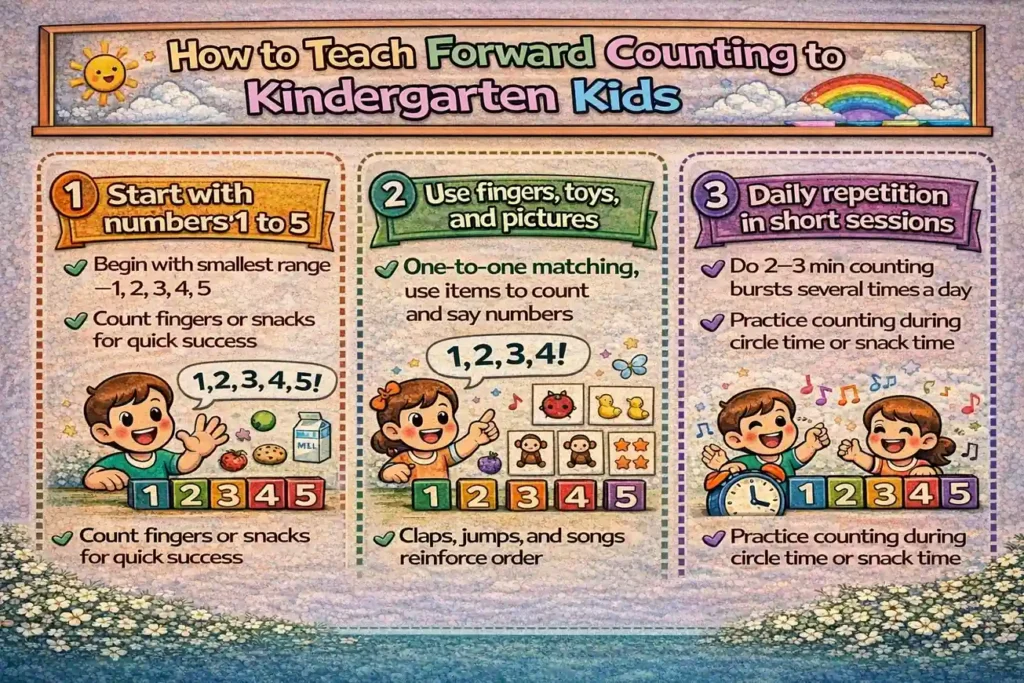
Start with numbers 1 to 5:
Begin with the smallest number range—1, 2, 3, 4, 5—so children experience quick success before moving on to 10.
Use simple moments, like counting fingers on one hand or five snacks. This makes forward counting feel natural and easy to remember.
Use fingers, toys, and pictures:
Support one-to-one matching by holding up fingers and counting out loud. You can also line up toys and count them as you move them forward.
Simple pictures of animals, fruits, or stars on cards help kids see, touch, and say each number. This strengthens their number recognition.
Oral counting before writing:
Focus on saying numbers aloud before asking children to write them.
Count with claps, jumps, songs, or group chants. This way, children can hear and repeat the right order without feeling pressured.
Daily repetition in short sessions:
Use 2–3 minute counting bursts several times a day during circle time, transitions, or snack time.
Using the same number range for a whole week makes the sequence automatic. Then, you can add larger numbers.
This step-by-step approach builds strong forward counting skills, confidence, and a solid foundation for future math learning.
How to Teach Backward Counting to Kindergarten Kids?
Teaching backward counting to kindergarten kids works best when you start small. It should connect clearly to what they already know about forward counting.

Begin with small ranges (5 to 1):
Use short countdowns like 5, 4, 3, 2, 1. This helps children succeed fast and not feel overwhelmed.
Daily practice with simple chants or songs—like “5, 4, 3, 2, 1… ready, go!”—helps kids feel at ease with counting backward.
Short countdowns help children succeed quickly. These early steps lead naturally to Class 1 skills explained in why is backward counting important for Class 1.
Teach “one less” using objects:
Use real objects to show what one less means. Line up 5 blocks, remove one, and say, “5 blocks, take one away—now 4.”
Fingers work well too—hold up fingers and fold one down at a time, asking “How many now?” This links backward counting to early subtraction in a clear, visual way.
Use real-life countdown examples:
Bring backward counting into everyday routines. Count down steps to the door, grapes at snack time, or use playful moments like rocket launches (“3, 2, 1… blast off!”).
These familiar situations make backward counting meaningful and fun.
Gradually move to 10 to 1: Once children can count backward from 5 to 1, extend to 10 to 1. Use number lines, stickers, or activities like hopping backward.
Pausing at each number helps children learn the full sequence step by step.
This fun, gentle method helps kindergarten kids confidently improve their backward counting skills.
Fun and Play-Based Ways to Teach Counting
Fun, play-based counting activities help kindergarten kids learn numbers. They use music, movement, and everyday play.
These methods fit young attention spans. They make counting forward and backward feel fun and easy.
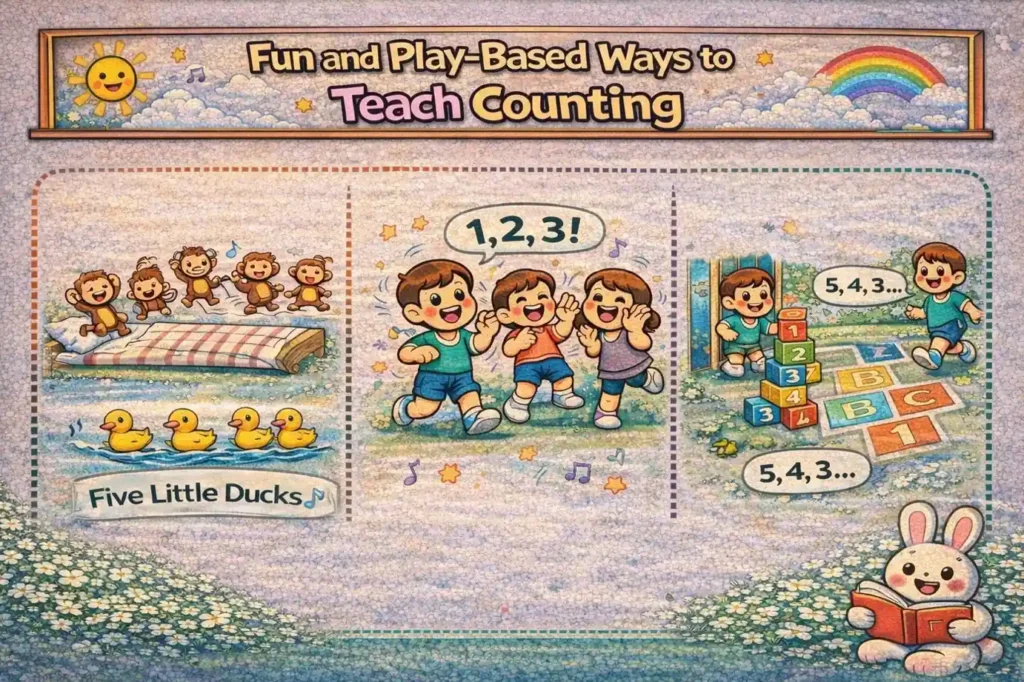
Counting songs and rhymes:
Songs and rhymes make number sequences easy to remember. Sing classics like “Five Little Monkeys Jumping on the Bed” and “The Ants Go Marching.” Act out each number as you sing.
Daily circle-time songs like “1, 2, Buckle My Shoe” and “Ten Little Ducks” are fun ways for kids to practice counting. Adding clapping or actions makes it even more engaging.
Jumping, clapping, and movement games:
Movement brings numbers to life. Children can jump or clap for each number—“Jump 1, jump 2, jump 3!” then count backward to see numbers getting smaller.
Games like “Simon Says Count” make counting fun. For example, you clap four times or hop backward from five. This turns practice into an exciting challenge.
Counting during playtime and outdoor activities:
Playtime offers many chances to count. When children build with blocks, they can count up as the towers get taller and count down as they knock them over.
Counting during playtime, block building, and outdoor activities reinforces number patterns. These patterns later support skip counting, which children explore in what is skip counting for Class 1 math students.
These fun activities help kids improve their counting skills, build confidence, and enjoy math.
Using number lines and visual aids for counting.
Number lines and visual aids help kindergarten children count. They make number order visible, tangible, and interactive.
Children see that numbers increase when moving right and decrease when moving left. This idea is further developed in number line for Class 1.
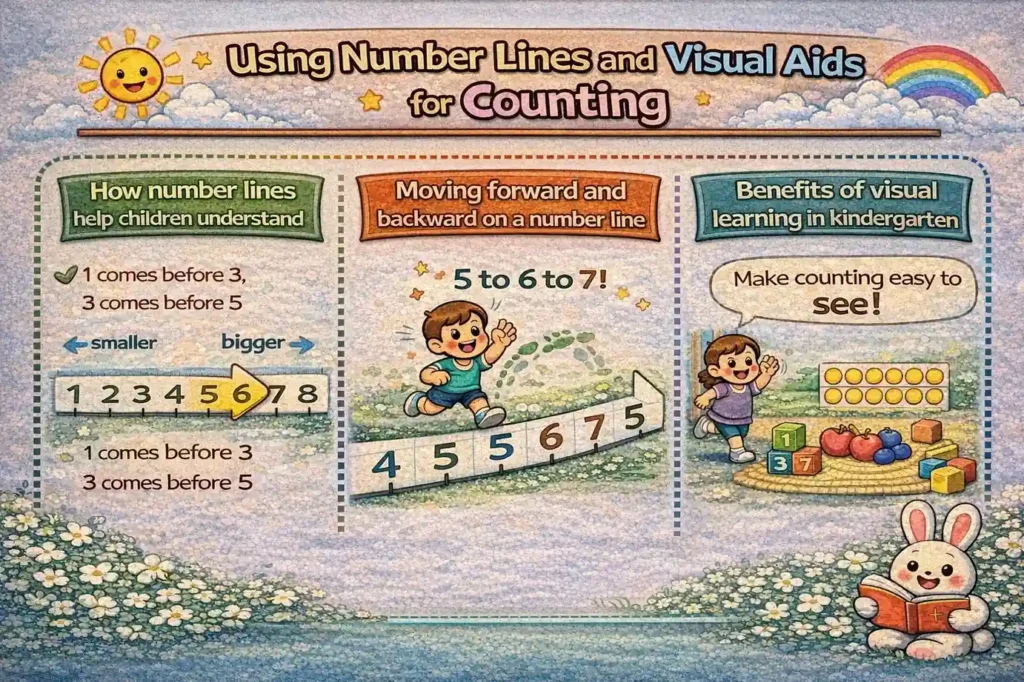
How number lines help children understand order:
A number line displays numbers in a straight line, like a road. Smaller numbers are on the left, while bigger numbers are on the right.
This helps children see that numbers go up when they move forward and go down when they move backward.
They learn number positions too. For example, 3 comes before 5 and after 1. They do this without just memorising.
Moving forward and backward on a number line:
When counting forward, children start at a number and hop to the right, saying the next number aloud: “4 to 5, 5 to 6.”
For backward counting, they hop to the left, such as “7 to 6, then to 5.” These physical jumps connect counting to the idea of one more and one less.
Benefits of visual learning in kindergarten:
Visual tools, like number lines, help kids learn. Young children grasp ideas better with pictures and movement.
They help children who struggle with counting. This builds their confidence and strengthens their number sense. Later, this helps with addition and subtraction.
Common counting mistakes kindergarten kids make
Counting mistakes are common in kindergarten and are a normal part of learning.
These errors show that children are still developing their number sense. They can be gently corrected with practice and support.
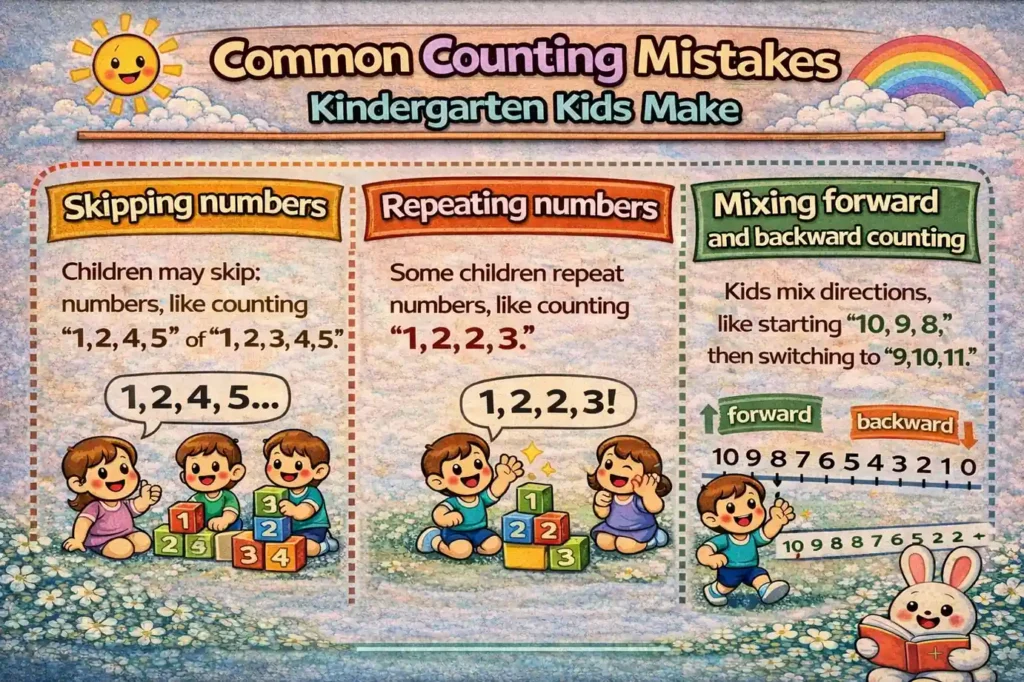
Skipping numbers:
Children may skip numbers, such as saying “1, 2, 4, 5” instead of “1, 2, 3, 4, 5.” This often happens when they rush or have not yet connected each number word to one object.
Counting slowly with fingers, toys, or blocks helps children match numbers correctly. Touch each item once for the best results.
Repeating numbers:
Some children repeat numbers like “1, 2, 2, 3.” This usually happens when they lose track while counting or get excited.
Counting as a group with claps, jumps, or pointing helps kids remember to say each number just once.
Mixing forward and backward counting:
Kindergarten kids may mix directions, starting with “10, 9, 8” and then switching to “9, 10, 11.”
Backward counting is less automatic. Clear cues like “forward means up” and “backward means down” help. Using number line visuals also keeps children on track.
With patient support and fun practice, kids slowly overcome these counting mistakes. They build their confidence along the way.
Tips for Teachers and Parents to Support Counting Effectively
Strong counting skills grow through short, joyful, and consistent practice.
Teachers can use quick activities during transitions. Parents can count toys, snacks, and steps at home.
These strategies support early number sense development, as explained further in number sense teaching strategies for first graders.
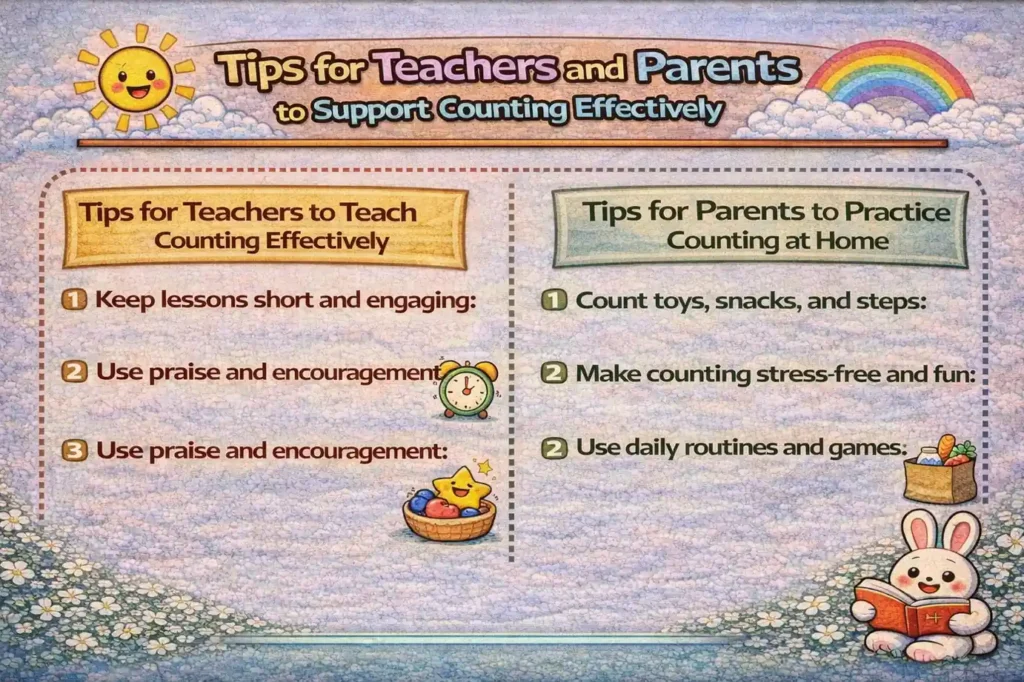
Tips for Teachers to Teach Counting Effectively
Keep lessons short and engaging:
Use 3–5 minute counting activities during circle time, transitions, or warm-ups. Songs, claps, finger counting, or toy-based activities keep children focused and prevent fatigue.
Change activities each day. Use jumping for forward counting and finger countdowns for backward counting. This helps keep kindergarteners engaged.
Teach one concept at a time:
Begin by counting forward from 1 to 5. Then, move on to backward counting or larger number ranges.
Practice each skill out loud and with objects for a few days. This helps children feel secure before moving on. Writing comes later, after understanding is clear.
Use praise and encouragement.
Celebrate effort, not speed. Say things like “You touched each block once—great counting!” or “Last week this was hard, and today you did it!” Positive feedback builds confidence and a love of maths.
Tips for Parents to Practise Counting at Home
Count toys, snacks, and steps:
Turn everyday moments into counting practice. Count toys during play (“1 car, 2 cars”), steps while walking, or snacks at mealtime. These real-life examples make numbers meaningful.
Use daily routines and games:
You can use countdowns in bedtime stories, like “5 pages left: 5, 4, 3…” You can also count items while grocery shopping. Simple rocket countdown games also make learning fun.
Make counting stress-free and fun:
Avoid correcting sharply. Model gently by counting together. Praise their effort: “You remembered what comes after 3—great thinking!” When counting is fun and positive, kids want to practise more.
With steady support at school and home, counting feels natural and fun for young learners. It also helps to build their confidence.
Simple Practice Ideas and Activities to Help Counting Skills
Simple practice activities make counting skills stick. They use repetition, listening, and hands-on play, which fit kindergarten attention spans well.
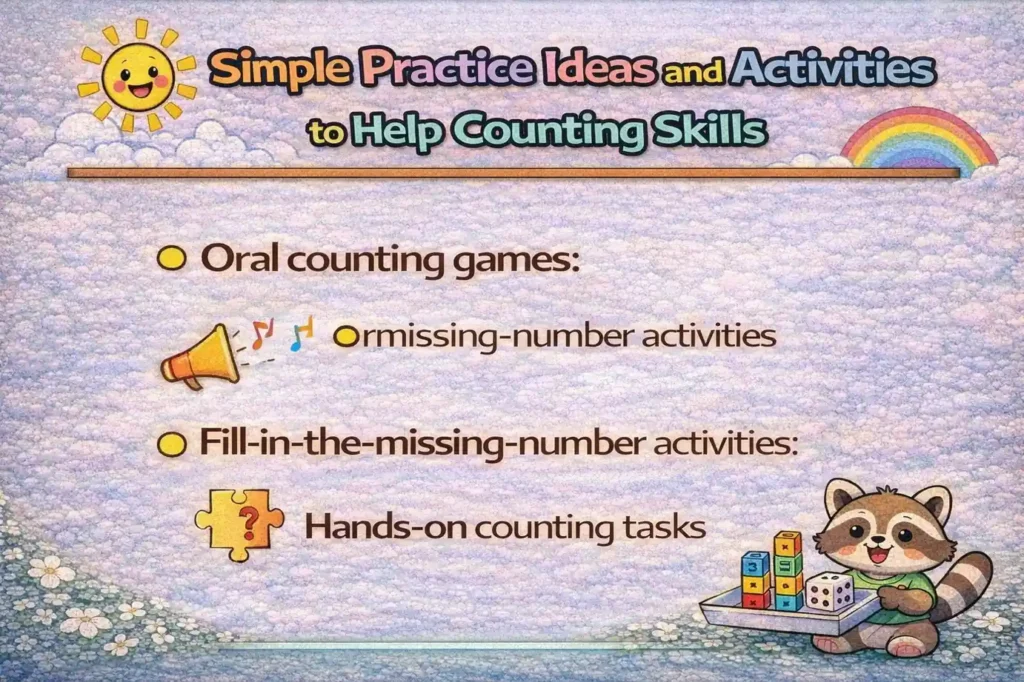
Oral counting games:
Use choral counting where the whole class counts together. Say “1, 2, 3, 4, 5” with claps, then “5, 4, 3, 2, 1” with snaps.
Repeating this a few times each day builds smooth forward and backward counting. Another fun game is Pass the Number—children sit in a circle and take turns saying the next number.
Start from different numbers, like 7, to improve listening and number order.
Fill-in-the-missing-number activities:
Create number gaps to strengthen sequence thinking. Show a number line with a missing number, such as “3, 4, __, 6”, and let children jump to the correct spot and say “5.”
On a chart, hide one number and ask, “What number comes between 7 and 9?” These quick activities build confidence and pattern awareness.
Hands-on counting tasks:
Hands-on play makes numbers real. Children can stack counting bears or blocks and count forward. T
hen, they can knock them down while counting backward. In Roll and Grab, children roll a die, count that many cubes, and build a chain. Comparing chains helps them see more and less visually.
These fun activities keep counting active and enjoyable. They help kindergarten children build a strong sense of numbers.
Make Preparing for Math Olympiad Simple!



Conclusion
Counting forward and backward is an important skill in kindergarten math. It helps develop strong early numeracy and number sense.
Children enjoy numbers through songs, movement games, number lines, and counting toys. These activities make numbers fun and easy, not stressful.
Short, fun practice helps kids see how numbers change. This prepares them for addition, subtraction, and future maths.
With the right support, strong counting skills build lasting math confidence. This helps children succeed after kindergarten.