November 28, 2025
 11 min. read

Number sense resources for parents of Class 1 children are more varied and accessible than most families realize, and the most effective ones cost little or nothing.
The challenge is not finding resources but knowing which ones genuinely build flexible numerical understanding and how to use them without adding structured lessons to an already full week.
This guide covers five resource categories: DIY home tools, print resources, digital tools, learning games, and everyday life opportunities with honest guidance on what each develops and how to use it practically.
Every resource targets the six core components of Class 1 number sense: number recognition, counting, comparing, quantities, patterns, and place value.
For the teaching methodology behind these resources, number sense teaching strategies for first graders cover the complete approach.
Category 1: Home-Based DIY Tools — High Impact, Zero Cost
The most effective early number sense tools are not expensive specialist products. They are simple physical objects that let children touch, move, and arrange quantities.
Every item below can be made at home in under 10 minutes from materials already in the house.
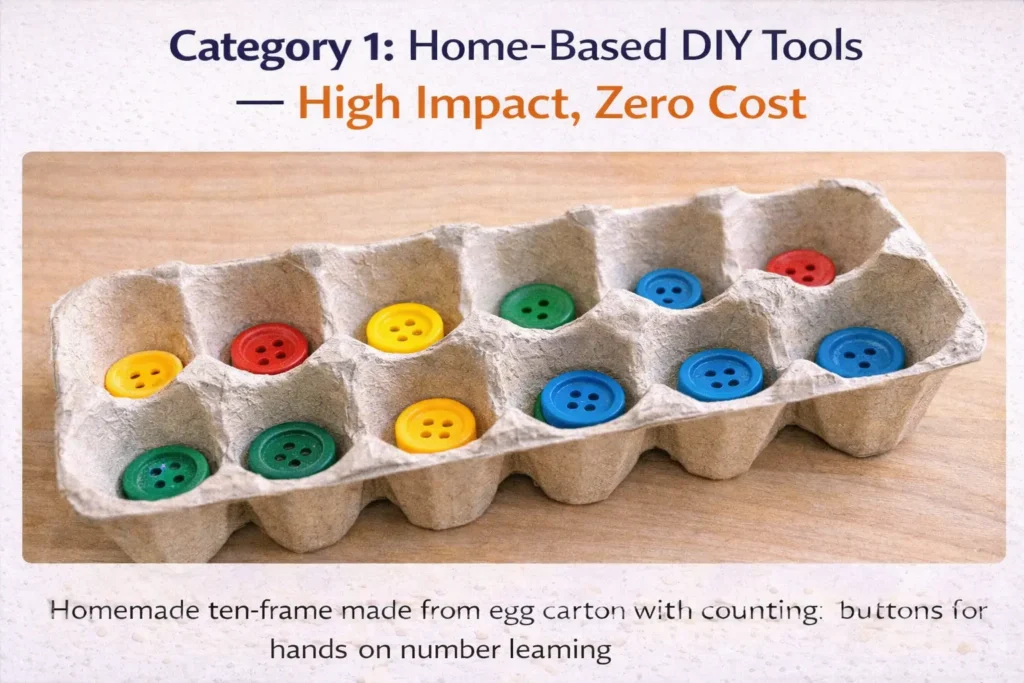
Ten-Frame Mat
What it is: A 2×5 grid drawn on card, used with small counters (buttons, beans, coins) to represent numbers 1–10.
How to make it: Draw 10 equal cells (2 rows × 5 columns) on cardboard. Laminate if possible. Counters can be anything small and consistent, such as dried pasta, bottle caps, or small stones.
What it develops: Quantity recognition, subitizing (instant recognition without counting), make-ten strategies, and the understanding that teen numbers are “ten and some more.”
The ten-frame is the single highest-value DIY resource for Class 1.
How to use it: Ask your child to show you a number by placing that many counters. Then ask: “How many empty spaces are left? How many more would fill it?”
This simple question implicitly develops addition-to-ten fluency. Extend to a double ten-frame (two grids side by side) for numbers 11–20.
Number Line Strip
What it is: A strip of card marked with numbers 0–20, fixed at your child’s eye level where they can touch and point to it.
How to make it: Write numbers 0–20 on a 60cm strip of cardboard. Fix it at child height, a touchable number line is far more effective than a decorative one placed out of reach.
What it develops: Number magnitude, ordering, and comparison the mental number line that underlies all subsequent arithmetic.
How to use it: Play “frog jumps” — place a toy on a starting number and hop forward or backward a given number of spaces. Ask: “What is one more? Ten more? One less?”
These interactions build the number magnitude intuition that ascending and descending order in maths for class 1 formalizes.
Hundred Chart
What it is: A 10×10 grid showing numbers 1–100, printed and displayed where your child can interact with it daily.
How to make it: Print a free hundred chart and laminate it so it can be written on with dry-erase markers. A large floor version using tape and paper squares is even more engaging.
What it develops: Pattern recognition, skip-counting, and place value awareness.
The visual structure makes the organization of the number system immediately visible all numbers in a column share the same ones digit. Moving down adds exactly 10.
How to use it: Cover numbers with sticky notes and ask your child to identify what is hidden. Colour every 2nd number, every 5th, every 10th.
The resulting visual patterns make skip-counting sequences memorable. These patterns connect directly to what is the number sequence for class 1 maths.
Counting Collection Jars
What it is: Small jars or bags filled with household objects in various quantities, used for counting, estimating, sorting, and grouping.
How to make it: Fill containers with buttons, dried beans, coins, or small stones in quantities like 7, 12, 20, and 35.
How to use it: Ask your child to estimate, then count to check. Compare two jars, which has more? By how much?”
For place value, sort a large collection into groups of 10 with leftovers as “ones”, the most concrete way to build tens-and-ones understanding.
Category 2: Print Resources — Books, Workbooks, and Worksheets
Print resources fall into three categories serving different purposes: picture books (introduce concepts through story), workbooks (structured practice), and worksheets (targeted skill practice).
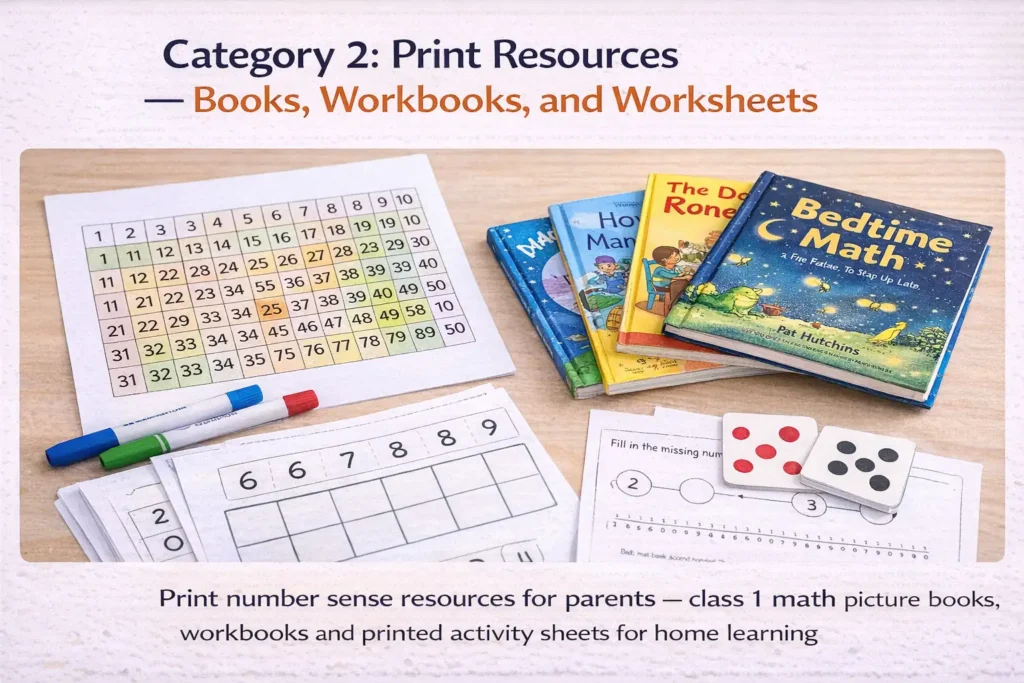
Mathematical Picture Books
Mathematical picture books are among the most underused and most effective resources available to parents.
When a concept is introduced through an engaging story, it attaches to memory more durably than formal practice alone can achieve.
| Book Title | Number Sense Focus |
|---|---|
| How Many Is a Million? by David M. Schwartz | Large number magnitude, counting |
| The Doorbell Rang by Pat Hutchins | Division, fair sharing |
| One Is a Snail, Ten Is a Crab by April Pulley Sayre | Number combinations to 10 |
| Anno’s Counting Book by Mitsumasa Anno | Number recognition, quantities |
| Bedtime Math by Laura Overdeck | Real-world daily arithmetic |
How to use them: Read once for enjoyment. Re-read with mathematical focus, pause to ask “how many are left? How do you know without counting?” After reading, connect the concept to a physical activity.
The story provides context; the hands-on follow-up builds understanding. These naturally introduce the sequencing ideas in teach number sequences to class 1 students.
Recommended Workbooks
| Workbook | Focus | Best Use |
|---|---|---|
| Singapore Math Grade 1 | Number sense, place value, operations | Structured daily 15-min sessions |
| Spectrum Math Grade 1 | Counting, patterns, basic operations | Weekend review |
| Beast Academy Level 2 | Patterns, logic, competition math | Enrichment for strong students |
| Kumon Grade 1 Number Concepts | Number recognition, sequencing | Foundation building |
Use workbooks after a concept is introduced through hands-on experience — not as the primary teaching tool. Sit with your child during workbook time and ask “how did you work that out?” The conversation is more valuable than the written answers.
Free Printable Worksheets
The most useful printable worksheet types for Class 1 number sense are number ordering, missing number sequences, ten-frame representations, and place value charts.
High-quality free sources include Math-Drills.com, K5 Learning (k5learning.com), and Homeschool Math (homeschoolmath.net), which lets you generate custom worksheets matched to your child’s exact current level.
Category 3: Digital Resources — Apps, Websites, and Videos
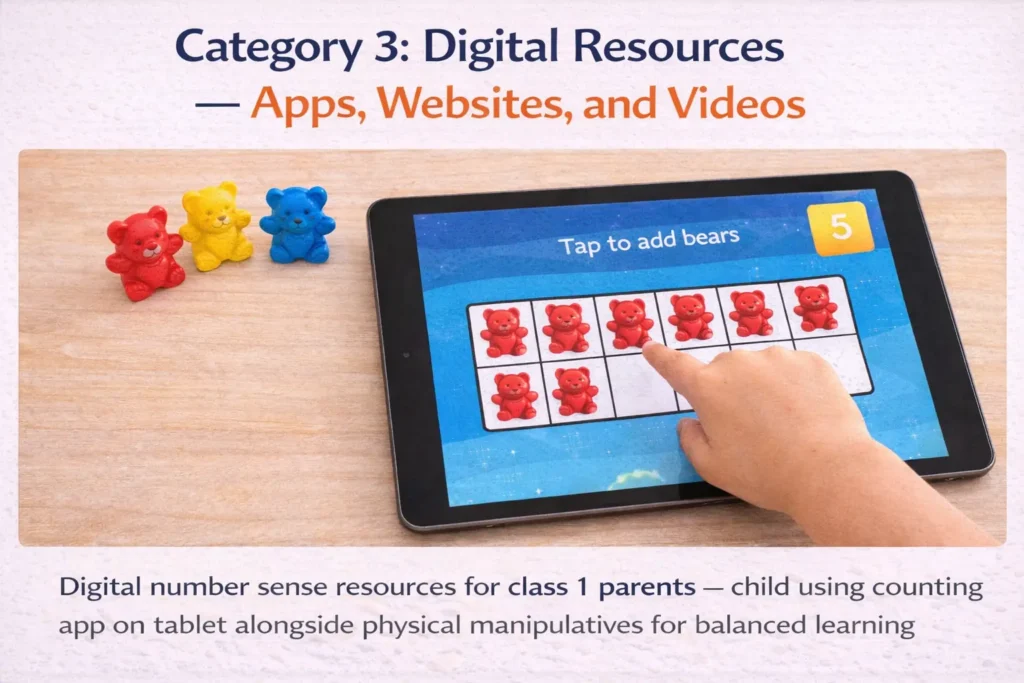
Digital resources work best as a supplement to, not a replacement for, concrete, hands-on learning.
Prioritize apps that develop understanding over those that simply reward fast recall with animations.
Recommended Apps
| App | Cost | Best For |
|---|---|---|
| Gonit App | Free | Competition-aligned practice, logical reasoning |
| Khan Academy Kids | Free | Comprehensive early math, all components |
| Moose Math | Free | Counting, addition, place value |
| Mathseeds | Subscription | Full structured curriculum |
| Splash Math Grade 1 | Free/Premium | Curriculum-aligned practice |
| Bedtime Math App | Free | Daily family number conversations |
Limit digital sessions to 15–20 minutes and follow each with a brief physical version of the same concept.
If your child fills a ten-frame digitally, fill a physical one with buttons immediately after.
Recommended Websites
Khan Academy (khanacademy.org): Free, curriculum-aligned video lessons and practice for every Class 1 number sense topic. The parent dashboard shows exactly which skills are mastered and which need more work.
Math Playground (mathplayground.com): Free Grade 1 number games, recognition, counting, ordering, and patterns — in an engaging, child-friendly interface.
Toy Theater (toytheater.com): Free virtual manipulatives, including ten-frames, number lines, hundred charts, and base-ten blocks ideal for replicating classroom tools digitally at home.
IXL Math (ixl.com): Adaptive practice across all Grade 1 topics with detailed progress tracking. Free tier allows limited daily practice.
YouTube Channels
Numberblocks (CBeebies): Widely regarded as the most mathematically sound early number sense video resource available.
Concepts including composition, subitizing, and place value are introduced with genuine mathematical accuracy — not just entertainment.
Jack Hartmann Kids Music Channel: Movement-based counting songs and skip-counting videos. Particularly effective for children who learn through physical engagement.
Category 4: Learning Games — Fluency Through Play
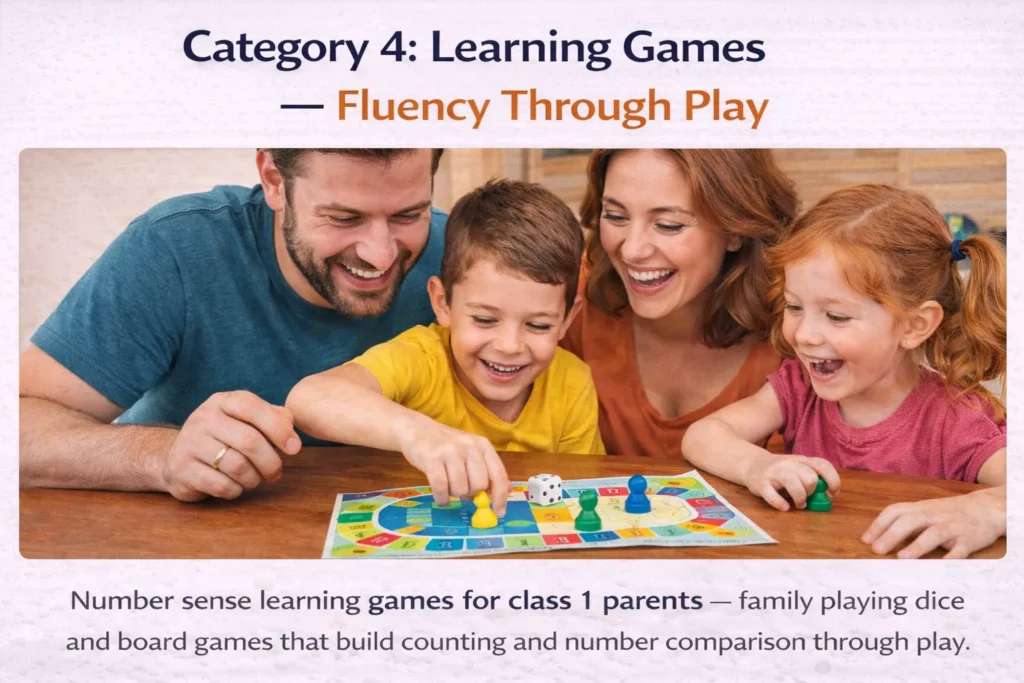
Games provide repeated, varied mathematical practice in a context where children are intrinsically motivated and emotionally safe.
A wrong answer in a game is simply part of the experience, children take mathematical risks they would not take in a formal setting.
High-Value Board and Card Games
| Game | Primary Skill | Why It Works |
|---|---|---|
| War (standard card deck) | Number comparison | 40–80 comparisons per 10-minute session |
| Snakes and Ladders | Counting, number order | Constant forward/backward movement on a number line |
| Dominoes | Counting, subitizing | Quantity recognition from dot arrangements |
| Uno | Number recognition | Fast numeral identification under mild time pressure |
| Zingo Number Bingo | Number recognition | Rapid numeral recognition in game format |
War is the single highest-value free card game: Remove face cards. Each player flips one card higher number takes both.
Extend by asking, “By how much is yours bigger?” before taking the cards, adding subtraction practice to every turn.
Make-Ten Memory (homemade): Create two sets of cards, numerals 1–9 and their complements to 10. Place all face down; players flip pairs looking for combinations that total 10.
These builds make-ten fluency, the most important number bond for Class 1 arithmetic.
Dice Games
Two standard dice provide everything needed for multiple number sense games:
Race to 20: Roll one die. Move that many spaces on a paper number line. First to 20 wins. Extend to Race to 100 with two dice — adding single digits on every turn.
Make the Biggest Number: Roll two dice. Arrange the digits to make the largest possible two-digit number. The player with the bigger number scores a point.
This develops place value intuition naturally, the understanding that 6 and 3 should become 63, not 36.
Any game with a ranking first, second, third to finish provides authentic context for the ordinal language that ordinal numbers for class 1 math addresses formally.
Category 5: Everyday Life — The Free Resource Most Parents Overlook
Research shows that children whose parents regularly discuss numbers in everyday contexts develop stronger number sense than those whose mathematical exposure is limited to formal activities.
Regardless of how much structured practice each group receives. The daily routines below cost nothing and require no preparation.
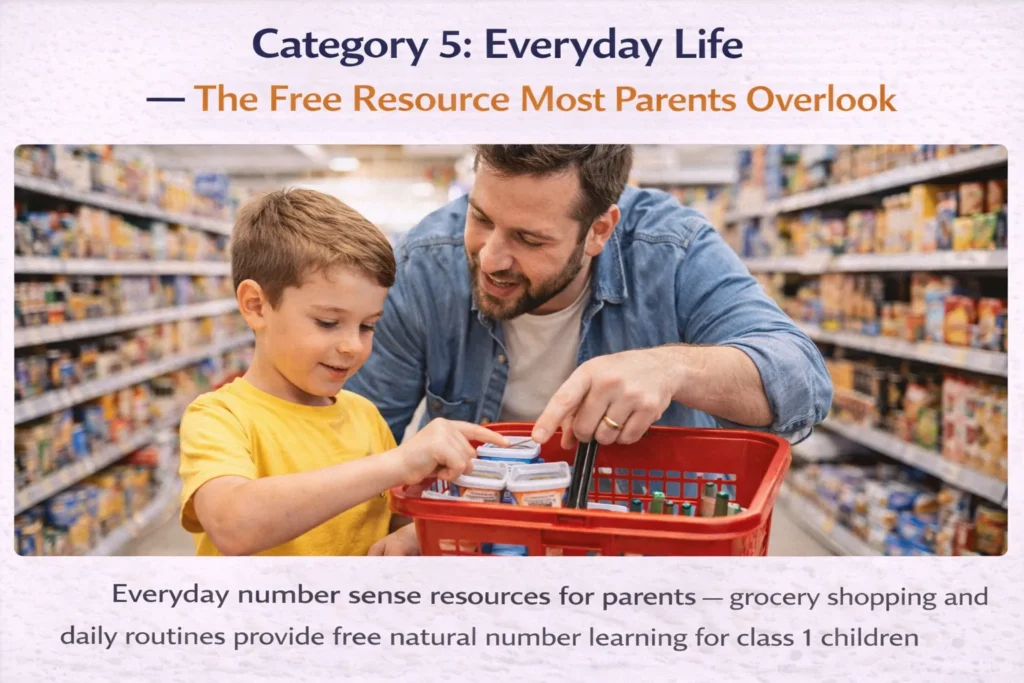
Grocery shopping: Every visit provides authentic number recognition (reading price tags), comparison (“which packet has more 6 biscuits or 8?”), estimation, and simple arithmetic (“we need 4 yoghurts, and we have 1.
How many more?”). Assign a specific task: “Your job today is to count every item we put in the basket.”
Cooking and baking: Measuring ingredients provides purposeful number reading and simple arithmetic. “We need 3 cups of flour and I’ve added 1.
How many more?” Cooking also introduces the equal-sharing understanding that fractions for class 1 builds on formally.
Daily counting rituals: Count stairs going up (backward going down), spoonfuls of cereal, days on the calendar to a special event, steps to the car.
These micro-sessions accumulate to 15–20 minutes of counting practice daily without any dedicated learning time. Consistency matters far more than duration.
Calendar time (5 minutes each morning): Ask your child to find today’s date, say what tomorrow’s date will be, and count how many days until an upcoming event.
The ordinal language embedded in calendar discussion (“today is the third, tomorrow is the fourth”) develops the positional number understanding that connects to the spatial and sequential reasoning in spatial understanding for class 1.
Your Home Number Sense Starter Kit
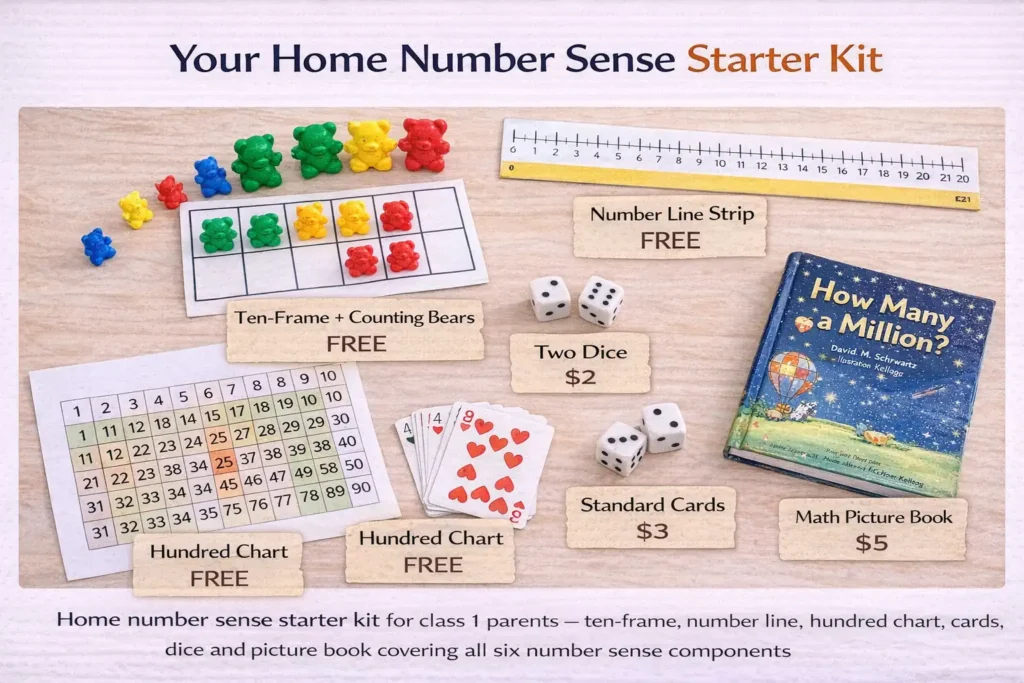
Here is a practical starting kit that covers all six Class 1 number sense components with minimum time and cost:
| Resource | Cost | Prep Time | Components Covered |
|---|---|---|---|
| Homemade ten-frame + counters | Free | 5 min | Quantities, subitizing, place value |
| Number line strip (0–20) | Free | 5 min | Magnitude, ordering, comparison |
| Hundred chart (printed) | Free | 2 min | Patterns, skip-counting, place value |
| Standard card deck | Low | None | Comparison, recognition, operations |
| Two standard dice | Low | None | Recognition, counting, addition |
| One math picture book | Low | None | Varies by book |
| Khan Academy Kids app | Free | 5 min setup | All six components |
This seven-item kit costs almost nothing, takes under 20 minutes to prepare, and covers every core number sense component Class 1 requires.
Start here, add resources as your child’s interests and needs become clear.
For children showing strong mathematical enthusiasm and ready for the next level, the IMO syllabus for class 1 maps what competition mathematics at Class 1 level assesses
Multiplication for class 1 covers the curriculum topic that strong number sense enables next.
How much should I spend on number sense resources?
Almost nothing if you choose wisely. The highest-impact resources are free or near-free: homemade ten-frames, a card deck, two dice, Khan Academy Kids, and daily number conversations. Start with free resources and add paid ones only if your child has specific interests or gaps they don’t address.
Which single resource is most valuable?
A homemade ten-frame with counters. It costs nothing, takes five minutes to make, covers more number sense components than any other single tool, and works across the entire Class 1 year with progressively more demanding questions.
How much time should we spend each day?
Ten to fifteen minutes of varied number activity daily — embedded in routines where possible — produces better results than a one-hour weekend session. The counting rituals, brief games, and calendar conversations described here provide this without any dedicated lesson time.
Should I use the same materials as in the classroom?
Ideally yes. Consistency of language and tools between home and school reduces cognitive load and reinforces classroom learning. Ask your child’s teacher which specific manipulatives they use and adopt the same terminology. The full methodology is explained in Number Sense Teaching Strategies for First Graders.
Make Preparing for Math Olympiad Simple!



Conclusion
The best number sense resources are not the most expensive; they are the ones used consistently, that generate genuine mathematical thinking, and build flexible number understanding.
Start simple: free DIY tools, a picture book, a card game, and daily counting routines.
These four steps, applied consistently, will build stronger number sense than any specialist curriculum used sporadically.
For the full picture, see what number sense consists of, why it matters, and teaching strategies that make every resource work better.