
 June 3, 2026
 12 min. read

Looking for SilverZone Maths Olympiad Sample Papers?
You can download free official iOM sample paper PDFs for Classes 1–12 from the SilverZone Foundation and Gonit Blog website.
In this guide, you’ll find class-wise sample paper links, and learn how the papers reflect the actual exam pattern.
Discover the best ways to use them to improve your score in the SilverZone International Olympiad of Mathematics (iOM).
SilverZone Maths Olympiad Exam Pattern
The iOM is a multiple-choice exam conducted in English.
There is no negative marking, so students should attempt every question. Answers are marked on an OMR bubble sheet.
The exam is held on two separate dates per year; schools select one, and different question sets are used on each date.
Questions and Duration by Class Group
| Class Group | Questions | Duration |
| Classes 1–2 | 25 | 40 minutes |
| Classes 3–5 | 30 | 40 minutes |
| Classes 6–8 | 35 | 40 minutes |
| Classes 9–12 | 40 | 50 minutes |
Total marks: 100 across all classes.
The Four Sections
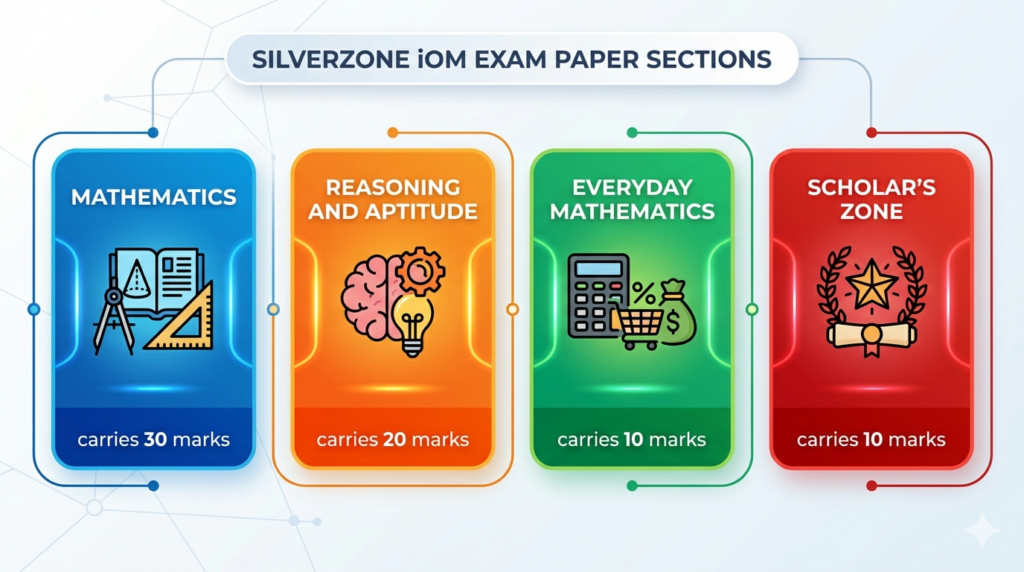
1. Mathematics: Core curriculum questions (CBSE/ICSE/State Board). Familiar content, but framed differently from typical school tests.
2. Reasoning and Aptitude: Logical and analytical thinking: pattern recognition, sequences, analogies, and spatial reasoning.
3. Everyday Mathematics: Real-world word problems involving money, time, measurement, and data interpretation.
4. Scholar’s Zone: The high-difficulty achiever section. Questions carry more marks and require multi-step reasoning. This section separates good scores from outstanding ones.
SilverZone Maths Olympiad Syllabus Overview
The entire iOM syllabus comes from the standard school curriculum: no out-of-syllabus topics, no extra books.
What makes it challenging is how topics are tested: more application, more reasoning, less straightforward recall.
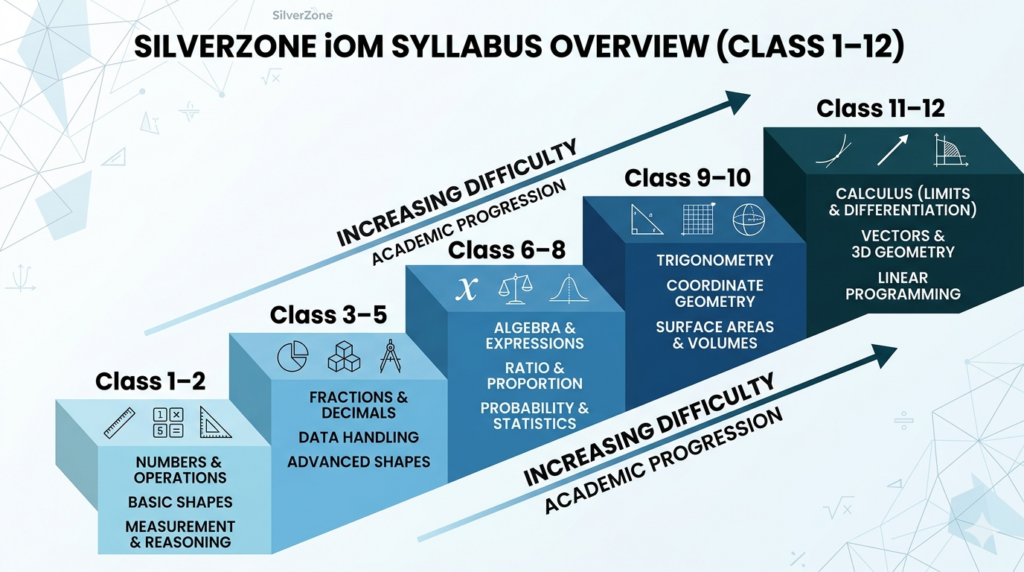
| Class Group | Key Topic Areas |
| Classes 1–2 | Number sense, basic arithmetic, patterns, shapes, measurement, money |
| Classes 3–5 | Fractions, decimals, geometry, LCM/HCF, perimeter, area, data handling |
| Classes 6–8 | Integers, algebra, linear equations, triangles, mensuration, statistics |
| Classes 9–10 | Real numbers, polynomials, quadratic equations, coordinate geometry, probability |
| Classes 11–12 | Sets, calculus, matrices, vectors, 3D geometry, advanced probability |
Sample Papers vs. Previous Year Papers vs. Mock Tests vs. Model Papers
These terms are often used interchangeably but they’re not the same.
Sample Papers are official specimen papers released by SilverZone Foundation. They show exactly how questions are framed and what the paper looks like. Use them at the start of preparation.
Previous Year Papers are actual past exam papers. They reveal which topics appear most frequently over time. Use them mid-to-late in preparation once you’ve understood the format.
Mock Tests are practice papers made by third parties. Quality varies widely. Use them for exam stamina practice, but always verify their format against official sample papers first.
Model Papers are educator-created papers that closely follow the iOM pattern, often with detailed answer keys. Good for topic-focused practice and Scholar’s Zone preparation.
Class-Wise SilverZone Maths Olympiad Sample Papers PDF Download
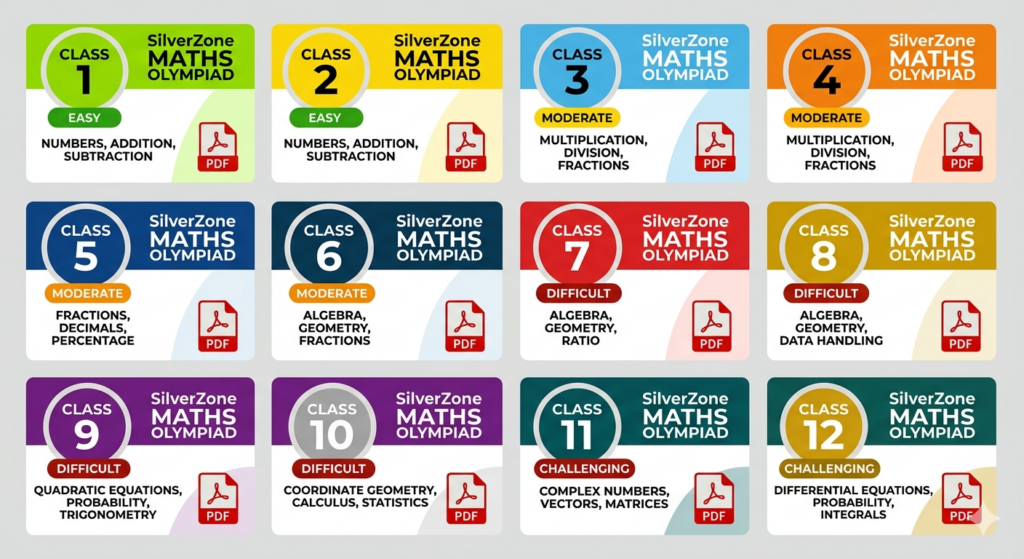
Class 1
Key Topics: Forward and backward counting, ones and tens, addition, subtraction, basic shapes, time, and money.
Difficulty Level: Beginner. Questions are short, visual, and drawn directly from the Class 1 textbook. The Scholar’s Zone introduces simple number puzzles.
What to Expect: Most questions test number recognition and basic operations. The Reasoning section uses picture-based patterns appropriate for young learners.
Preparation Tip: Sit with your child for the first attempt. Reading through the paper together as an activity not a test builds comfort and confidence.
Class 2
Key Topics: Number operations, place value, multiplication introduction, patterns, shapes, measurements, and money.
Difficulty Level: Beginner. Slightly more varied question types than Class 1, with a gentle introduction to logical patterns.
What to Expect: The paper remains visual and activity-based. The Scholar’s Zone may include simple “what comes next?” sequence questions.
Preparation Tip: Encourage the child to read each question aloud before answering. It builds the habit of careful reading early on.
Class 3
Key Topics: Numbers up to large values, multiplication and division, fractions, basic geometry, perimeter, time, and data interpretation.
Difficulty Level: Beginner to moderate. Questions require slightly more multi-step thinking than Classes 1–2.
What to Expect: Word problems begin appearing in the Everyday Mathematics section. Reasoning questions involve simple analogies and odd-one-out patterns.
Preparation Tip: Begin light timing practice not strict, but enough to build awareness of pace.
Class 4
Key Topics: Large numbers, fractions and decimals, factors and multiples, geometry (angles, triangles), area and perimeter, basic data handling.
Difficulty Level: Moderate. School textbook knowledge is necessary but not sufficient. Students need to apply concepts in new ways.
What to Expect: Multi-step word problems in Everyday Mathematics. The Scholar’s Zone introduces logic-based number puzzles that require careful reading.
Preparation Tip: Start timed practice with the 40-minute limit. Identify which section is slowest and work on it specifically.
Class 5
Key Topics: LCM and HCF, decimal operations, percentage basics, simple geometry, area of complex shapes, and basic graphs.
Difficulty Level: Moderate. This is a turning point students who practice application-based questions regularly will see a clear advantage.
What to Expect: A mix of straightforward calculations and reasoning-heavy word problems. Scholar’s Zone questions typically involve pattern completion or multi-operation problems.
Preparation Tip: After solving a paper, focus your review time specifically on Scholar’s Zone questions. Don’t rush past them.
Class 6
Key Topics: Integers, basic algebra, ratio and proportion, geometry (lines, angles, triangles), mensuration, and data handling.
Difficulty Level: Moderate to challenging. The introduction of algebra and negative integers increases complexity.
What to Expect: Reasoning questions become more abstract. Everyday Mathematics involves multi-step scenarios using ratios, percentages, and measurement.
Preparation Tip: Spend extra time on algebra basics before tackling sample papers. Weak algebra foundation affects performance across multiple sections.
Class 7
Key Topics: Rational numbers, algebraic expressions, linear equations, triangles (congruence), mensuration, and data handling.
Difficulty Level: Challenging. Understanding is tested more than recall.
What to Expect: The Scholar’s Zone questions at this level require applying two or more concepts together. Careless errors in algebra are common.
Preparation Tip: After each paper, categorize your errors conceptual vs. careless. They require different fixes. Don’t treat all mistakes the same way.
Class 8
Key Topics: Rational and irrational numbers, squares and cubes, algebraic identities, linear equations in two variables, quadrilaterals, and mensuration.
Difficulty Level: Challenging. Multi-step problems are common, especially in the Scholar’s Zone.
What to Expect: Questions test whether students can work through problems systematically rather than instinctively. Speed and accuracy both matter here.
Preparation Tip: Solve at least 3–4 complete papers under timed conditions. Use a two-pass strategy — attempt confident questions first, return to harder ones.
Class 9
Key Topics: Real numbers, polynomials, coordinate geometry, linear equations in two variables, triangles (Euclid’s geometry), surface areas and volumes, and statistics.
Difficulty Level: High. Topics directly overlap with board exam content but are tested with more analytical depth.
What to Expect: The Scholar’s Zone requires genuine problem-solving not formula application. Word problems in Everyday Mathematics are detailed and multi-layered.
Preparation Tip: Treat iOM preparation as an extension of your board exam revision. Solving sample papers regularly strengthens both simultaneously.
Class 10
Key Topics: Real numbers, polynomials, quadratic equations, arithmetic progressions, triangles (similarity), coordinate geometry, probability, and statistics.
Difficulty Level: High. This is among the most competitive levels of the iOM.
What to Expect: Questions require both conceptual clarity and application skill. The Scholar’s Zone often involves multi-concept problems where missing one step means losing the entire question.
Preparation Tip: Allocate specific preparation time for the Scholar’s Zone don’t leave it as an afterthought. Strong performance here is what drives top rankings.
Class 11
Key Topics: Sets, relations and functions, trigonometry, sequences and series, straight lines, conic sections, limits and derivatives, statistics, and probability.
Difficulty Level: Very high. The transition from Class 10 to Class 11 mathematics is significant, and the iOM paper reflects that.
What to Expect: Calculus-based questions appear for the first time. The Scholar’s Zone rewards students with a strong conceptual foundation and the ability to think flexibly across topics.
Preparation Tip: Don’t rush into sample papers without first consolidating Class 11 concepts. Build your foundation first, then use papers to test and refine it.
Class 12
Key Topics: Relations and functions, inverse trigonometry, matrices and determinants, continuity and differentiability, integrals, vectors, 3D geometry, linear programming, and probability.
Difficulty Level: Very high. The most advanced level of the iOM.
What to Expect: Questions test deep understanding across a wide syllabus. The Scholar’s Zone often involves integration of multiple Class 12 chapters in a single problem.
Preparation Tip: Students in Class 12 are managing board exam pressure simultaneously. Use iOM sample papers as structured revision sessions to reinforce board preparation while building Olympiad-level thinking.
How to Use Sample Papers Effectively
Downloading a paper is the easy part.
Here’s a five-step approach that turns practice into actual improvement.
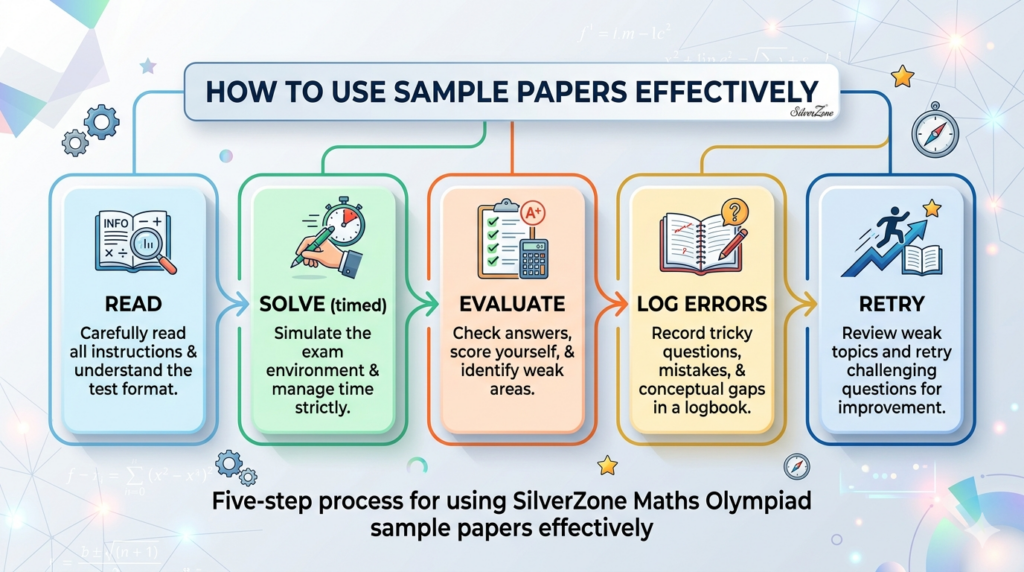
Step 1 — Read one paper without timing yourself. Study how questions are framed, which sections appear, and what Scholar’s Zone questions look like. This is your orientation session.
Step 2 — Solve under exam conditions. From your second paper onward: quiet table, timer set, no books, no calculator. Simulate the real exam exactly.
Step 3 — Evaluate your errors by type. Don’t just mark right or wrong. Categorize each mistake:
- Conceptual error → you didn’t know the topic → needs focused study
- Application error → you knew the concept but applied it incorrectly → needs more practice
- Careless error → silly mistake despite knowing the answer → needs attention to detail
- Time error → ran out of time → needs speed work
Step 4 — Keep an error log. Note every wrong question, its section, the error type, and the correct approach. Over multiple papers, patterns emerge. Recurring topics in your log are your priority areas.
Step 5 — Revisit wrong questions after one week. Try them again cold. If you get them right, you’ve genuinely learned. If not, that topic needs more revision.
How Many Papers to Solve?
- 4–6 weeks before exam: One paper every 5–7 days. Focus on error analysis.
- 2–3 weeks before exam: Two papers per week. Strict timing.
- Final week: One dry run. Review your error log only. No new topics.
Common Mistakes to Avoid
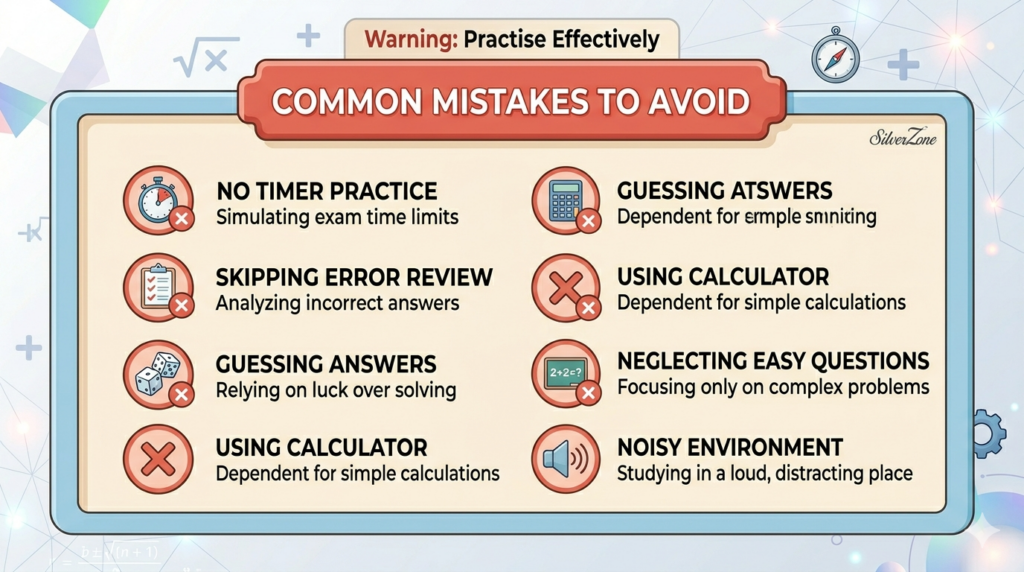
1. Practicing without a timer: Untimed practice doesn’t build the composure you’ll need on exam day. Time yourself from your second paper onward.
2. Checking the answer key while solving: This turns practice into reading. Attempt every question independently first, then check.
3. Skipping the error analysis: Most students check their score and move on. The error analysis is where actual improvement happens. Don’t skip it.
4. Ignoring Reasoning and Scholar’s Zone sections: Students who only revise Mathematics often plateau. All four sections contribute to your final score.
5. Using outdated papers: The syllabus is updated periodically. Always verify that your paper is current before using it.
6. Starting too late: Beginning sample paper practice in the final week leads to panic, not preparation. Start at least four to six weeks before the exam.
Recommended Study Schedule
For Beginners
| Phase | Timeline | Focus |
| Phase 1 | Weeks 1–3 | Revise all class topics. Solve one untimed sample paper. Identify weak sections. |
| Phase 2 | Weeks 4–5 | One timed paper per week. Error analysis after each. Daily reasoning practice. |
| Phase 3 | Week 6 | One dry-run paper. Review error log. Rest and consolidate. |
For Advanced Students
| Phase | Timeline | Focus |
| Phase 1 | Weeks 1–2 | Quick syllabus revision. One timed paper with strict timing discipline. |
| Phase 2 | Weeks 3–4 | Two papers per week. Deep-dive Scholar’s Zone errors. Daily reasoning drills. |
| Phase 3 | Week 5 | Final dry run. Focus on composure and accuracy. No new topics. |
Guidance for Parents
You don’t need to be a maths expert to support your child’s Olympiad preparation effectively.
Create a consistent environment. A regular, quiet study time matters more than long, irregular sessions.
Encourage effort over outcome. Praising the process (“you worked hard on that section”) builds a growth mindset that genuinely improves performance over time.
Review papers together as a detective exercise, not a judgment session. Ask: “What felt easy? What was tricky? What do you want to work on?” This conversation builds metacognitive awareness, a real academic skill.
Don’t compare yourself to other children. The only meaningful comparison is your child’s own progress across papers.
Avoid practice sessions on exhausted days. Tired practice builds negative associations. Consistency on good days is more valuable than forcing sessions on bad ones.
Where can I download official SilverZone Maths Olympiad sample papers?
Official sample papers are available at silverzone.org. Trusted platforms like Gonit, Vedantu, and AglaSem Schools also host class-wise PDF downloads.
Are the sample papers free?
Yes. SilverZone Foundation provides sample papers as free downloads. You don’t need to pay for access.
How many papers should a student solve?
At least 3–5 complete papers before the exam. Beginners should aim for 4–6 weeks of structured practice. Advanced students can target 6–8 papers. Quality and error analysis matter more than quantity.
What’s the difference between a sample paper and a previous year’s paper?
A sample paper is an official specimen released by SilverZone to demonstrate the exam style. A previous year’s paper is an actual past exam. Use sample papers to understand the format, and previous year papers to identify recurring topics.
Are answer keys provided?
Yes. Most official and reputable downloads include answer keys. Official answer keys for the actual exam are released by SilverZone online within a few weeks of the exam date.
When should a student start solving sample papers?
At least 4–6 weeks before the exam. Start with one untimed paper for orientation, then move to timed practice progressively.
Are third-party sample papers reliable?
Quality varies. Use official sample papers from silverzone.org as your primary reference and treat third-party papers as supplementary practice only.
How do I know if I’m improving?
Track your section-wise scores across multiple papers, not just your total. Improvement in your weakest section usually produces the biggest jump in overall score.
Make Preparing for Math Olympiad Simple!



Conclusion
SilverZone Maths Olympiad sample papers are one of the most effective tools for understanding the exam pattern, question types, and difficulty level.
By solving these papers regularly and reviewing mistakes carefully, students can build both confidence and accuracy before the exam.
Download the sample paper for your class, practice under timed conditions, and use the results to identify weak areas.
For the latest sample papers, syllabus updates, and exam information, always refer to the official SilverZone Foundation website.