


Geometry is a branch of mathematics that explores shapes, sizes, positions, and spatial reasoning.
- Geometry Learning by Age: A Complete Progression
- From Shapes to Spatial Thinking: What Geometry Actually Builds
- How to Teach Geometry at Every Stage Without a Teaching Background
- Hands-On Geometry Activities for Kids (Grades 1-4)
- Fun Geometry Games for Kids
- How Geometry Thinking Develops Across Subjects
- How Geometry Builds the Foundation for Olympiad Math
- Conclusion
For kids, it’s a fun, visual way to understand the world; breaking it down into 2D (flat) shapes and 3D (solid) shapes, and helping children build strong problem-solving and visualization skills.
Many parents struggle to teach geometry because worksheets and abstract explanations don’t always make sense to kids.
This guide simplifies geometry for kids with a step-by-step approach using shapes, hands-on activities, and everyday objects to build strong math thinking skills.
Our detailed guide to geometrical shapes for Grade 1 covers the four core shapes, worksheets, projects, and step-by-step classroom methods for kids.
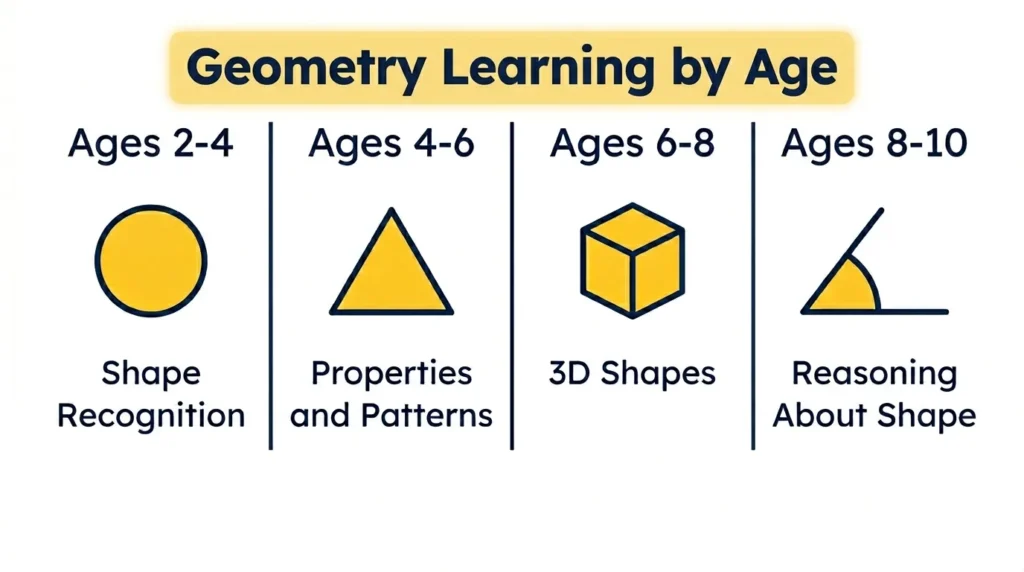
Geometry Learning by Age: A Complete Progression
Research shows that infants as young as three to four months have already formed mental categories for basic shapes like circles, squares, and triangles.
Geometry learning doesn’t start at school; it starts at birth.
What changes across the years isn’t the shapes themselves. It’s the depth of reasoning applied to them.
Ages 2-4: Shape Recognition
Children identify basic shapes by sight: circles, squares, triangles, rectangles.
They sort objects, match shapes by form, and begin using spatial language: “inside,” “on top of,” “next to,” “behind.”
What to do: Point out shapes in daily life. “Your plate is a circle. The door is a rectangle.” No worksheets needed yet.
Ages 4-6 (Preschool and Grade 1): Properties and Patterns
Children move from naming to noticing. They can describe a shape: “it has three sides,” “the corners are pointy.” They begin to see that shapes can be rotated and still keep their identity.
What to do: Ask counting questions. “How many corners does this shape have?” Fold paper to introduce symmetry. For this stage in detail, see our Grade 1 shapes guide.
You can also reinforce this stage through spatial understanding for Class 1, which covers how young children develop awareness of position, direction, and form.
Ages 6-8 (Grades 2-3): 3D Shapes and Measurement Basics
Children are introduced to cubes, cylinders, cones, and spheres. They count faces, edges, and vertices.
Area and perimeter concepts appear in simple form; “how much space does this cover?”
What to do: Use building blocks, tin cans, and dice as hands-on 3D models. Ask: “Does it roll? Does it stack? How many flat faces does it have?”
Ages 8-10 (Grades 4-5): Reasoning About Shape
Children compare shapes by properties, identify congruence (same shape and size), and start thinking about angles, transformations (flips, slides, turns), and coordinate geometry basics.
What to do: Introduce angle language; acute, right, obtuse. Use dot grid paper for drawing and transforming shapes. Connect to measurement: area, perimeter, volume.
The key shift across all stages: geometry moves from “name it” to “describe it” to “reason about it.” Each stage builds on the last.
From Shapes to Spatial Thinking: What Geometry Actually Builds
Most parents think geometry teaches shapes. It does; but that’s the smallest part.
What geometry actually builds is spatial reasoning: the ability to mentally visualize, rotate, compare, and manipulate objects in space.
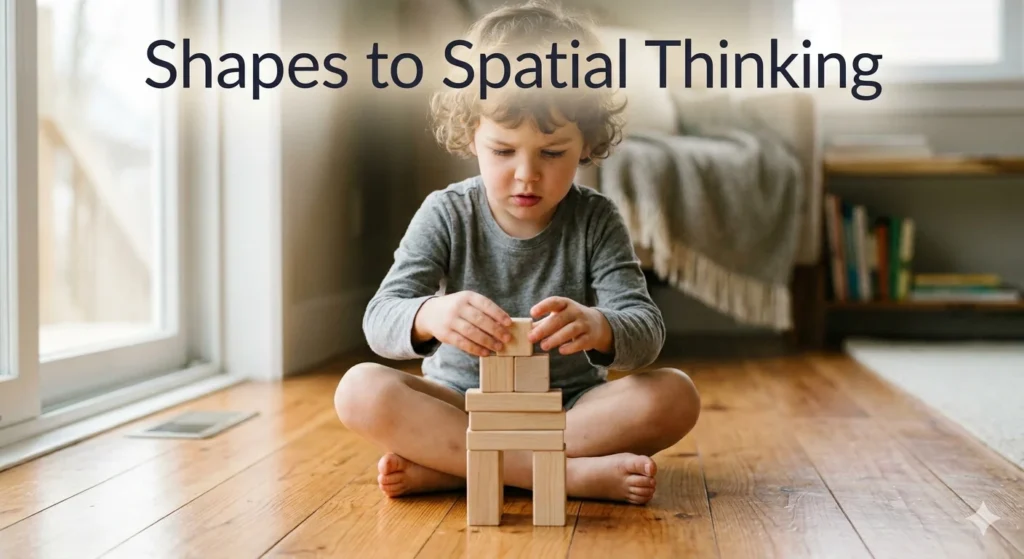
Research from the Royal Society (ACME panel) describes spatial reasoning as “an underutilised route to improving mathematics achievement.”
Studies show that early spatial skills, learned through play, building, and drawing, directly predict later arithmetic performance; not just geometry scores.
This is why number sense for Class 1 and geometry aren’t separate topics; the characteristics of number sense that matter most, like comparison, pattern recognition, and part-whole understanding, are all strengthened by spatial play.
Here’s what that looks like in practice:
Shape recognition leads to classification thinking. A child who sorts shapes by number of sides is learning the same logical structure as sorting numbers into odd/even or words into categories.
The habit of mind transfers. This same skill underlies odd one out activities for Class 1, where children identify which item doesn’t share a property with the others.
3D visualization leads to abstract reasoning. Counting the hidden faces of a cube, predicting how a folded net will look when opened, tracing how a shadow changes; these are not just geometry tasks.
They’re the foundational moves of mathematical proof.
Symmetry leads to pattern recognition. Noticing that both halves of a shape match is structurally the same skill as noticing that both sides of an equation must balance. Children who play with symmetry understand equations more intuitively.
The same visual logic is at work in alphabet patterns for Class 1, where children spot and continue repeating sequences across letters and shapes.
Angle intuition leads to measurement and logic. Before formal angle measurement, children develop a felt sense that some corners are “sharper” than others. That intuition becomes the anchor for degrees, trigonometry, and eventually calculus.
Geometry isn’t a standalone subject. It’s the visual language of mathematical thinking, and it starts the moment a child picks up a building block.
How to Teach Geometry at Every Stage Without a Teaching Background
You don’t need a teaching degree to teach geometry effectively. You need two things: real objects and good questions.
The core teaching sequence for any concept
For any new geometry concept, whether it’s triangles at age 4 or angles at age 9, the most effective teaching order is:
- See it in a real object before you name it.
- Describe it in the child’s own words before introducing the technical term.
- Count or measure it using fingers, hands, or informal units.
- Compare it to something the child already knows.
- Name it formally only after the previous four steps.
This sequence works because children’s misconceptions almost always come from skipping steps 1-4 and jumping straight to step 5.
A child who only memorizes “a triangle has 3 sides” will fail to recognize an upside-down triangle. A child who has felt the three corners and traced the three edges never forgets.
The environment is already a classroom
Your home covers every concept:
- Circles: plates, coins, jar lids, clock faces
- Triangles: sandwich halves, pizza slices, door wedges
- 3D shapes: cereal boxes (cuboid), cans (cylinder), balls (sphere), ice cream cones (cone)
- Symmetry: butterflies, leaves, window panes
Identify one shape per day during breakfast, a walk, or bath time. Consistency matters more than duration.
Questions that deepen understanding
Avoid questions with single-word answers. These work better:
- “How do you know this is a triangle?” (forces property reasoning)
- “Can you find something in this room shaped like that?” (applies learning)
- “How is this shape different from a rectangle?” (develops comparative thinking)
- “If I turn this shape upside down, is it still a triangle?” (tests identity beyond orientation)
Accept non-standard descriptions
A seven-year-old calling an isosceles triangle a “rooftop shape” is not wrong; they’re building a real-world connection.
Accept the analogy, then gently layer in the formal term. Correcting too early shuts down the exploratory thinking geometry depends on.
Hands-On Geometry Activities for Kids (Grades 1-4)
Worksheets have their place. But the fastest way for young children to understand shapes is through doing; touching, building, drawing, and sorting.
All of the activities below require no special materials, work across Grade 1 through Grade 4, and develop different geometry skills.
For broader critical thinking activities that pair well with these, see critical thinking activities for Grade 1.
Activity 1: Shape Hunt (Ages 4-7)
Walk through your home or garden and name every shape you see. Keep a tally on paper. Which shape appears the most? Which is the rarest? Add a challenge layer for older children: “Find five shapes with at least four sides.”
Develops: shape recognition, observation skills, counting, real-world connection.
Activity 2: Draw-a-Shape Challenge (Ages 5-8)
Call out a shape and ask your child to draw it from memory. Then switch; your child names, you draw. Deliberately draw some shapes incorrectly and see if they catch it. “Is this a rectangle? Why not?”
Develops: shape properties, critical observation, visual memory, reasoning under pressure.
Activity 3: Sort and Classify (Ages 5-9)
Gather 10-15 household objects. Ask your child to sort them by a rule they invent: things that roll, things with flat faces, things with sharp corners. Then ask them to sort the same objects by a different rule.
Develops: classification, logical thinking, understanding that properties are independent of each other.
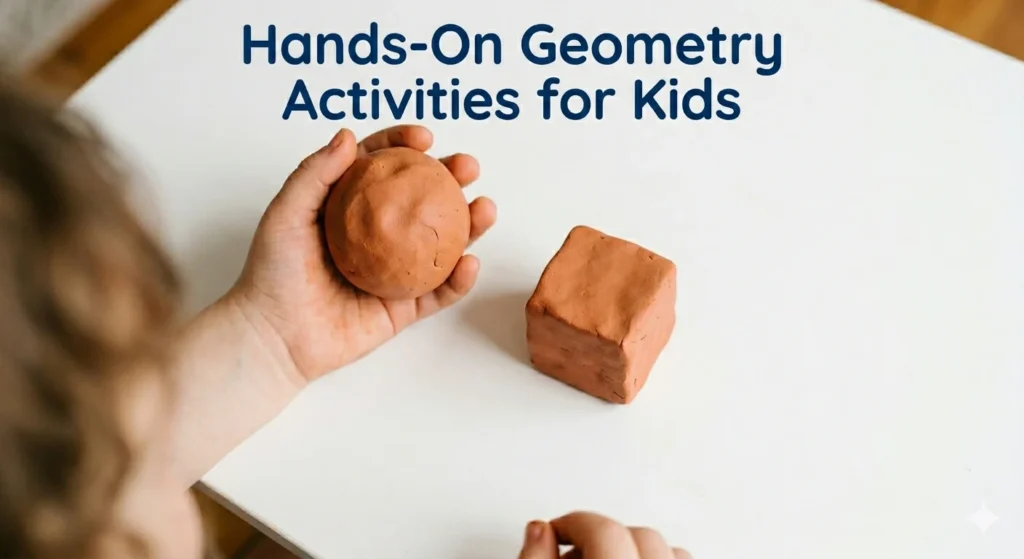
Activity 4: Clay 3D Shapes (Ages 6-9)
Give your child a ball of clay. Ask them to make a cube, a sphere, a cylinder. Then ask: “Can you make a shape with exactly 4 faces? With no flat faces at all?” This pushes past naming into property-based reasoning.
Develops: 3D visualization, faces/edges/vertices understanding, creative problem-solving.
Activity 5: Symmetry Folding (Ages 5-8)
Fold a piece of paper in half and cut a shape. When unfolded, discuss: “Are both sides the same? How do you know? What would happen if we folded it the other way?”
Develops: symmetry, spatial prediction, the concept of reflection.
Activity 6: Shadow Geometry (Ages 7-10)
On a sunny day, trace the shadow of household objects on paper. A cylindrical cup casts a rectangle. A sphere casts a circle. A cone casts a triangle or circle depending on angle. Ask: “Why does a 3D object make a 2D shadow?”
Develops: the relationship between 2D and 3D shapes, observation, early thinking about projection and cross-sections.
Activity 7: Angle Hunting (Ages 8-10)
Give your child a folded piece of card to use as a right-angle checker. Walk around the house and categorize corners: right angles, smaller than a right angle (acute), larger than a right angle (obtuse).
Develops: angle intuition, measurement thinking, classification beyond basic shapes.
Fun Geometry Games for Kids
Learning through play is not a workaround. It’s the most effective method for young learners, backed by decades of research in early childhood education.
Tangrams (Ages 5-10)
Tangrams are ancient Chinese puzzles made of seven flat shapes that fit together to form a square, an animal, or a figure.
They develop spatial reasoning, shape recognition, and problem-solving simultaneously. Start with the simplest silhouettes and increase complexity over weeks.
Shape Bingo (Ages 5-8)
Make a simple 4×4 bingo card with shapes instead of numbers. Call out properties (“I have four equal sides”) rather than names. The child matches the property to the shape.
This teaches children to think about properties rather than just pattern-matching the word “square,” a crucial shift for competition-level geometry.
Geometry Jenga (Modified) (Ages 7-10)
Label wooden blocks with geometry questions.
Before pulling a block, a player must answer: “How many edges does a cube have?” or “What’s the name of a shape with 5 sides?” Simple, high-engagement, zero cost.
Dot-to-Dot with Properties (Ages 6-9)
Classic dot-to-dot puzzles, but instead of following numbers, children follow rules: “Connect only dots that make a right angle.” This turns a simple activity into spatial reasoning practice.
Shadow Tracing Race (Ages 7-10)
A timed game: go outside with chalk and trace as many different shape shadows as possible in 5 minutes. Then identify every shape you traced. Which were 2D representations of 3D objects?
How Geometry Thinking Develops Across Subjects
Geometry doesn’t stay inside mathematics. The thinking it builds shows up everywhere.
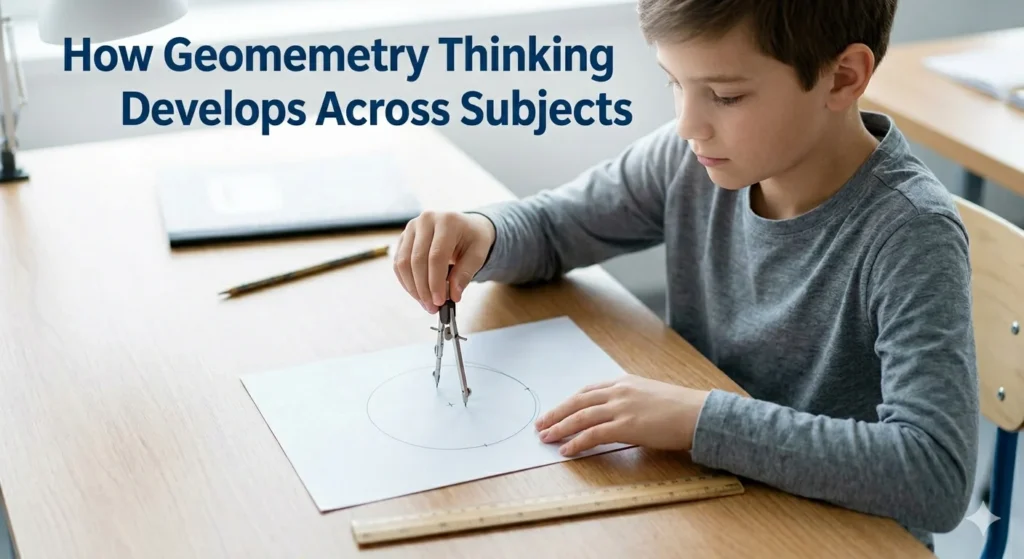
In reading: Visual-spatial reasoning supports the ability to track text directionality (left to right, top to bottom) and to decode letter shapes; particularly important for children learning to distinguish b, d, p, and q.
Understanding how shapes transform helps children see letters as structured objects rather than arbitrary symbols. Math analogies for kids also use this cross-domain pattern thinking, connecting visual relationships to logical ones.
In problem-solving: Geometry trains children to break a situation into visible parts and reason about relationships.
These are exactly the skills needed for word problems for kids and, later, for knowing how to solve math word problems efficiently; the ability to visualize a scenario before writing an equation is a geometry-rooted skill.
In science: Understanding 3D structure is essential for biology (cell shapes, leaf geometry), physics (force diagrams, light reflection), and chemistry (molecular geometry at higher levels). Children who build strong spatial skills early learn these concepts faster.
In art and design: Symmetry, proportion, and spatial layout are directly geometric. Children with strong shape intuition approach drawing, design, and craft more confidently.
In technology: Grid-based coding environments, digital design tools, and game development all rely on coordinate geometry and spatial reasoning.
A child who understands that shapes can be flipped, rotated, and scaled has an immediate advantage in any visual computing context.
In everyday problem-solving: Packing a suitcase, reading a map, assembling furniture, navigating a new place; all of these require spatial reasoning. Geometry in school is preparation for a spatially fluent life.
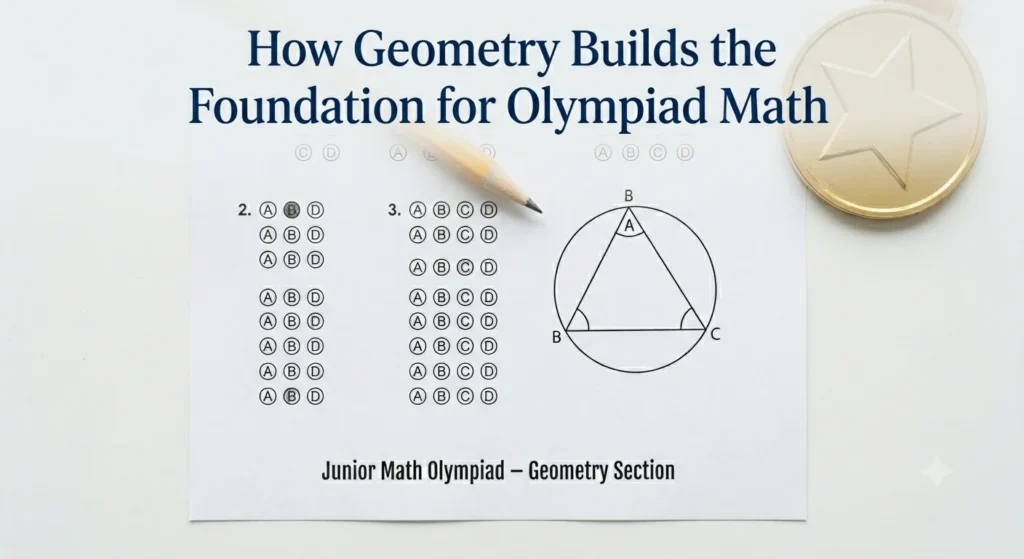
How Geometry Builds the Foundation for Olympiad Math
Most parents think of geometry as a visual subject; shapes, measurement, drawing.
But for students heading toward the best math competitions in the world, geometry is something much more fundamental.
Pattern Recognition
The ability to notice that a pattern of shapes follows a rule, and predict what comes next, is one of the core skills tested in math olympiads at every level. Children who learned to classify and sort shapes early have a significant head start.
This connects directly to the kind of thinking practiced in math olympiad questions at every grade level.
Logical Deduction
Every geometry problem at competition level asks: “What do we know, and what can we conclude?” That structure starts with simple questions like: “If a shape has four equal sides and four equal angles, what must it be?”
Children who learned to reason about shape properties, not just name them, answer these questions fluently. The same skill is central to improving problem-solving skills for the IMO.
Spatial Visualization
Math Kangaroo and similar competitions regularly include problems requiring 3D reasoning; counting hidden faces, visualizing folded nets, predicting shadows.
These are skills built over years. Children who played with 3D objects and explored their properties from early on consistently outperform those who only encountered geometry through flat diagrams.
If you want to understand the full scope of what competitions test, the AMC syllabus is a useful reference for geometry topics that appear from AMC 8 through AMC 12.
Proof Thinking
At higher levels (AMC 10/12, olympiad), students write geometric proofs. But the habit of thinking “how do I know this is true?” starts in early childhood. “
How do you know this is a triangle?” is, structurally, the beginning of proof. Parents preparing children for this path can explore how to get better at solving math olympiad questions and how to prepare for the AMC for structured next steps.
The foundations are simple. The circles, squares, and cubes your child studies at age five are the same objects they’ll reason about at age fifteen; just with more precision, more rigor, and more depth.
Every child who learns to see the world geometrically is building the mindset that competition mathematics demands.
What is geometry for kids?
Geometry for kids is the branch of mathematics that explores shapes, sizes, positions, and spatial reasoning. It starts with recognizing everyday 2D shapes like circles, squares, triangles, and rectangles, and builds toward understanding 3D shapes, symmetry, angles, and spatial thinking. It develops problem-solving and visualization skills from preschool onward.
At what age do children start learning geometry?
Children begin forming mental categories for basic shapes as early as 3 to 4 months old. Formal shape recognition starts around ages 2 to 4, properties and patterns are introduced at ages 4 to 6, 3D shapes appear at ages 6 to 8, and reasoning about angles and transformations begins at ages 8 to 10.
What is the difference between 2D and 3D shapes for kids?
2D shapes are flat and have only length and width. They can be drawn on paper. Examples include circles, squares, triangles, and rectangles. 3D shapes are solid and have length, width, and height. They can be held in your hand. Examples include spheres, cubes, cylinders, and cones.
How do you teach geometry to kids without a teaching background?
Start by showing the shape in a real object before naming it. Let the child describe it in their own words, then count its sides or corners together, compare it to a familiar shape, and only then introduce the formal name. Use household objects as everyday examples and ask open questions like “how do you know this is a triangle?” rather than questions with single-word answers.
What are the best hands-on geometry activities for kids at home?
Effective hands-on activities include shape hunts around the house, drawing shapes from memory, sorting household objects by properties, making 3D shapes from clay, symmetry folding with paper, tracing shadows of objects on sunny days, and angle hunting with a folded card as a right-angle checker. None of these require special materials.
How does geometry connect to math olympiad preparation?
Geometry builds the four core thinking skills tested in math olympiads: pattern recognition, logical deduction, spatial visualization, and proof thinking. Competitions like Math Kangaroo and AMC 8 regularly test 3D reasoning, folded nets, and shape properties. Children who developed strong spatial skills early through play and exploration consistently outperform those who only encountered geometry through diagrams and worksheets.
What is spatial reasoning and why does it matter for kids?
Spatial reasoning is the ability to mentally visualize, rotate, compare, and manipulate objects in space. It matters because early spatial skills directly predict later mathematics achievement, not just in geometry but in arithmetic, algebra, and problem-solving. It is strengthened through play, building, drawing, and any activity that involves thinking about how shapes and objects relate in space.
Make Preparing for Math Olympiad Simple!



Conclusion
Geometry for kids isn’t about memorizing shape names; it’s about teaching children to observe, reason, and see structure in the world around them.
Start with the shapes in your home, ask good questions, and let your child explore before you define. That single shift makes all the difference.
Ready to take the next step? Explore free math olympiad training online to see how early geometry skills build into AMC 8, AMC 10, and Olympiad-level thinking.

Mikha Piregu is a Content Writer with experience spanning educational content, including math and math olympiad topics, as well as advocacy writing, research-based articles, and SEO-driven web content. He creates high-quality blog content, web copy, and feature articles that support brand visibility, audience engagement, and long-term organic growth through data-informed storytelling. Skilled in WordPress, WooCommerce, and modern digital tools, Mikha adapts content across various platforms, including blogs, websites, campaigns, and advocacy initiatives, with clarity and purpose.

There are no comments posted here yet.
Sign in to leave a comment