November 18, 2025
 16 min. read

Kangaroo Math is the largest math competition in the world by participation, reaching over 90 countries and more than 6 million students every year across Grades 1 to 12.
Formally known as the Mathematical Kangaroo or Kangourou Sans Frontières, it was created with one clear mission: to make mathematics genuinely enjoyable for every student, not just those who already love it.
This guide covers everything you need to know about Kangaroo Math: its history and origin, exactly who can participate, and how the six levels are structured, the full competition format, and scoring system.
If you want to understand how Math Kangaroo compares with other competitions before diving in, what is the best math competition in the world gives a broader context for where Kangaroo sits alongside AMC, IMO, and other major contests.
The History and Origin of Kangaroo Math
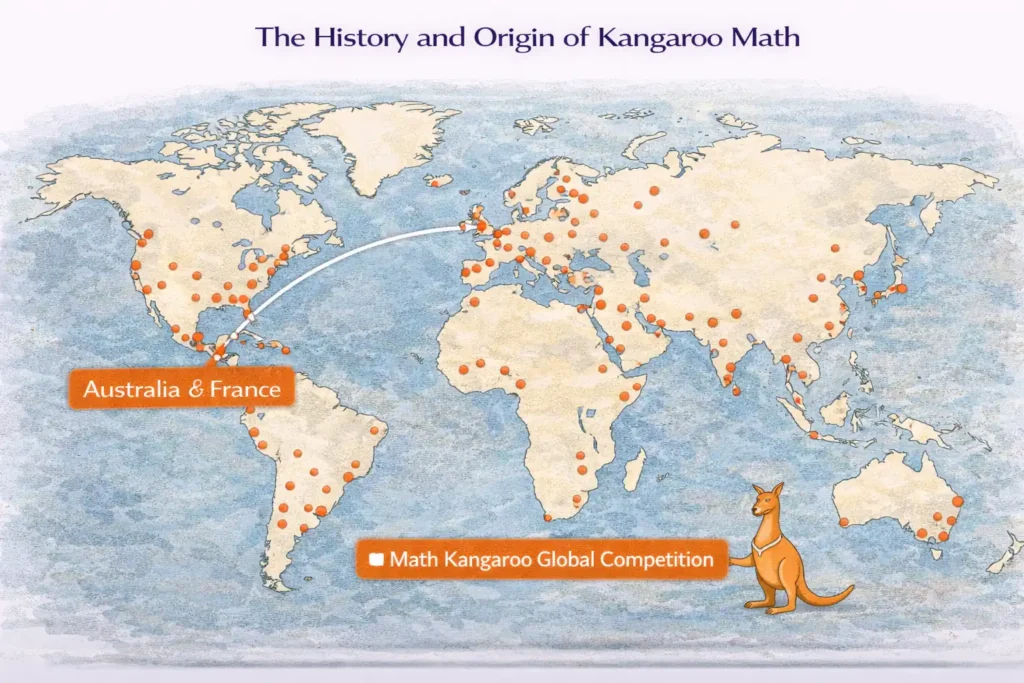
The story of Kangaroo Math begins in Australia in the early 1980s with a teacher named Peter O’Halloran.
His vision was straightforward but genuinely revolutionary for its time: create a fun, accessible math contest that could reach thousands of students who would never see themselves as “math people” under a traditional competition format.
By using carefully crafted multiple-choice questions that rewarded reasoning over recall, O’Halloran built a competition that felt more like an engaging puzzle game than an exam.
The idea crossed the world when two French educators, André Deledicq and Jean-Pierre Boudine, encountered O’Halloran’s work and brought the model to France in 1991.
In tribute to its Australian origins, they named the competition “Kangourou” — the kangaroo becoming a symbol of curiosity, exploration, and the intellectual leaps that good mathematical thinking requires.
The French version expanded rapidly across Europe through the early 1990s, attracting educators from dozens of countries who recognized that its philosophy that mathematics should be joyful and accessible rather than intimidating and exclusive resonated deeply with students and teachers alike.
By 1994, the growth had become international enough to formalize: educators from participating countries established the Association Kangourou Sans Frontières (AKSF), the governing body that coordinates the competition globally to this day.
Today, what began with one teacher’s idea in Australia has grown into a competition that connects students in over 90 countries, making it by a significant margin the world’s largest math competition by participation.
For a full comparison of how this scale places Kangaroo among other major global competitions, see the best math competition in the world.
Who Can Participate in Kangaroo Math
One of the defining features of Kangaroo Math is its inclusivity. The competition is open to all students from Grade 1 through Grade 12, regardless of mathematical background, school type, or prior competition experience.
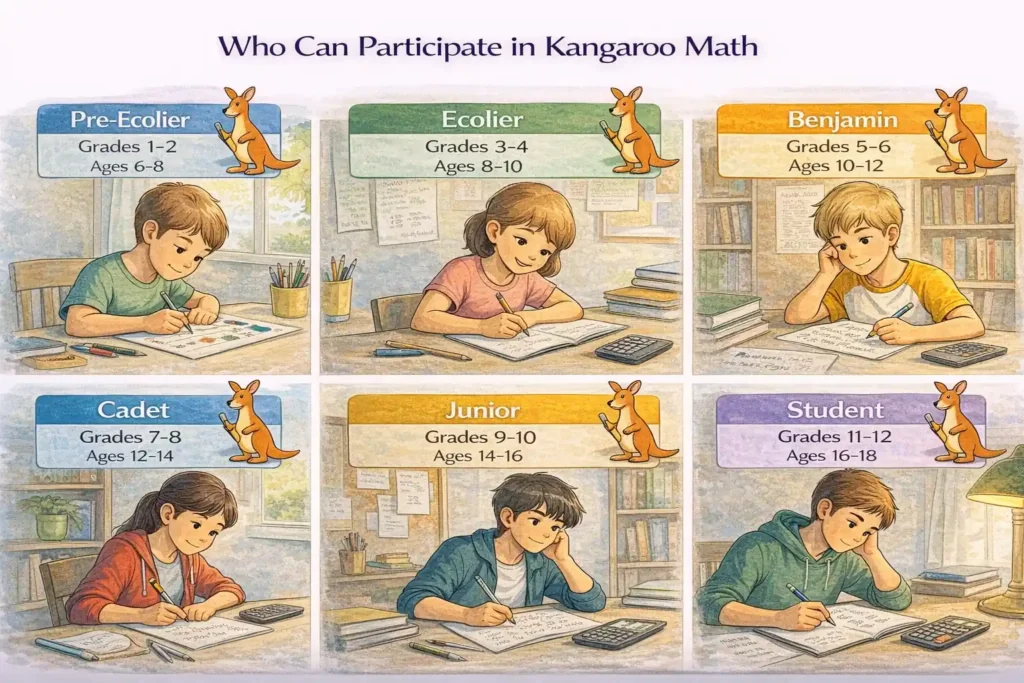
Whether you study in a public school, private school, or homeschool setting, there is a Kangaroo Math level designed for you.
Students are organized into six age-based levels, ensuring that every participant faces questions calibrated to their grade range rather than competing against older or more advanced students:
| Level | Grades | Age Range |
|---|---|---|
| Pre-Ecolier | Grades 1–2 | Ages 6–8 |
| Ecolier | Grades 3–4 | Ages 8–10 |
| Benjamin | Grades 5–6 | Ages 10–12 |
| Cadet | Grades 7–8 | Ages 12–14 |
| Junior | Grades 9–10 | Ages 14–16 |
| Student | Grades 11–12 | Ages 16–18 |
There are no special eligibility requirements based on academic performance or prior competition results. Any student within the appropriate grade range can register and compete.
Registration is handled through your school, a local authorized test center, or your country’s official Kangaroo Math national coordinator. Most countries run both in-person and online participation options.
For detailed participation statistics showing how many students register at each level and how the numbers have grown globally, Math Kangaroo participation covers the full picture.
For students who are new to math competitions entirely, Kangaroo Math is one of the most welcoming entry points available.
The non-penalty scoring system (no deductions for wrong answers) and the playful question style mean that first-time competitors can participate with genuine confidence rather than anxiety.
The benefits of AMC math post also explain why starting early in accessible competitions like Kangaroo builds the foundational confidence that powers later performance in more advanced contests like AMC and IMO.
Competition Format and Structure of Kangaroo Math
Kangaroo Math uses a single-round format; there are no qualifying rounds, no elimination stages, and no multi-day commitments.
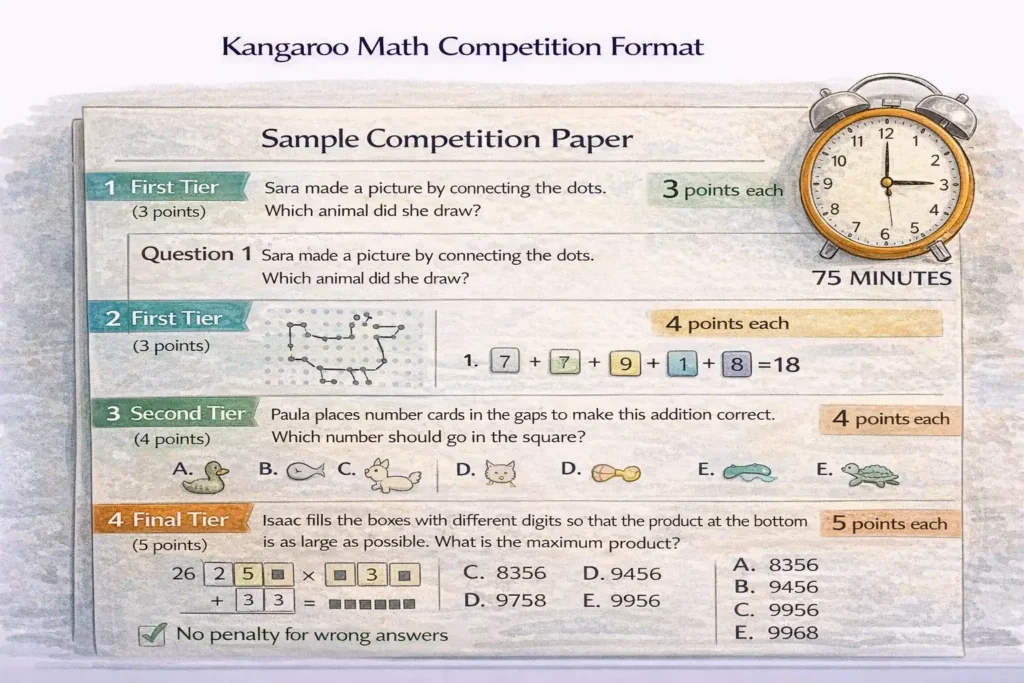
Every registered student at every level sits the same paper on the same day (the third Thursday of March each year for most participating countries), making it a genuinely global simultaneous event.
Number of Questions and Time Limit
The question count varies by grade level:
| Level | Questions | Time |
|---|---|---|
| Pre-Ecolier and Ecolier (Grades 1–4) | 24 questions | 75 minutes |
| Benjamin through Student (Grades 5–12) | 30 questions | 75 minutes |
All questions are multiple choice with five answer options. Scratch paper is permitted for working; calculators and electronic devices are not allowed.
Scoring System
Questions are divided into three tiers of difficulty with different point values:
| Difficulty Tier | Point Value Per Question |
|---|---|
| First tier (easiest) | 3 points each |
| Second tier (medium) | 4 points each |
| Final tier (hardest) | 5 points each |
No penalty for wrong or blank answers. This is one of Kangaroo Math’s most distinctive features — every student is encouraged to attempt every question rather than strategically leaving blanks to avoid deductions.
Maximum possible scores: 96 points for Grades 1–4, and 120 points for Grades 5–12.
Note that a small number of participating countries apply slightly modified scoring rules; always confirm with your country’s national coordinator.
This scoring structure is deliberately different from competitions like AMC 10/12, where wrong answers carry a penalty.
To understand how AMC scoring works by comparison, average AMC math scores explain the AMC scoring system in full, including how score distributions break down across the student population.
Question Types
Kangaroo Math problems span a wide range of mathematical areas and are designed to be engaging rather than intimidating.
Typical question categories include logical puzzles and deductive reasoning, number patterns and sequences, visual and spatial challenges, geometry, arithmetic, combinatorics, and algebra (at higher levels).
What distinguishes Kangaroo questions from typical school exam questions is the playful construction they frequently use, real-world contexts, visual diagrams, and narrative setups that make the mathematical relationship feel like a discovery rather than a calculation.
Students who enjoy what type of questions are asked in math olympiads will recognize that Kangaroo questions share the same emphasis on reasoning and creative thinking, just at a more accessible entry level.
Language and Format Options
The competition paper is available in the official languages of each participating country. In multilingual countries, papers are often available in multiple languages.
Both paper-based and online administration formats are used across different national coordinators.
What Makes Kangaroo Math Unique
Kangaroo Math occupies a distinctive position in the global math competition landscape.
Understanding what makes it different from other competitions helps both students and parents make informed decisions about where it fits in a broader competition preparation strategy.
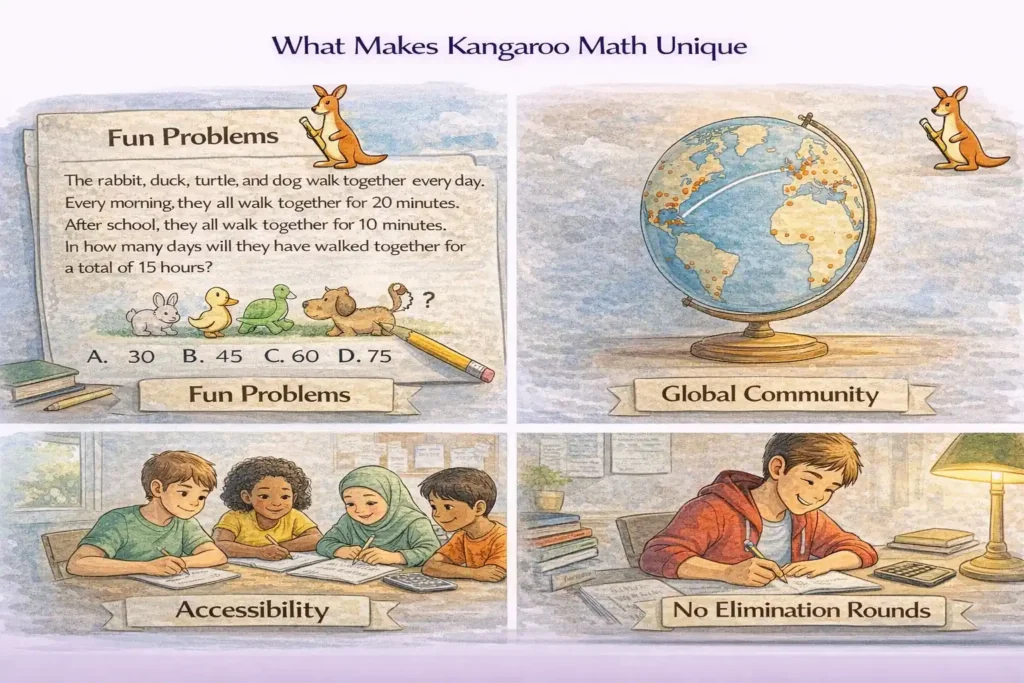
Emphasis on Logic and Creative Reasoning Over Memorization
The most fundamental design principle of Kangaroo Math is that every question should be solvable through logical reasoning alone, without requiring memorized formulas or advanced curriculum knowledge beyond the student’s grade level.
A well-designed Kangaroo problem rewards a student who thinks carefully and creatively over a student who has memorized more content.
This philosophy makes Kangaroo Math valuable beyond competition preparation; the reasoning skills it develops are directly transferable to academic performance across all STEM subjects.
Students who begin with Kangaroo Math regularly report that the logical thinking it demands changes how they approach problems in school math, science, and even language tasks.
Fully Inclusive Design — No Prior Competition Experience Required
Most math competitions create an implicit barrier: students who have not already been preparing for competition math are unlikely to perform well enough to feel motivated to continue.
Kangaroo Math deliberately removes this barrier through its no-penalty scoring, grade-calibrated levels, and question style that rewards curiosity over preparation volume.
A student participating in their first-ever math competition can complete a Kangaroo Math paper and experience genuine engagement with mathematical thinking, even if they score modestly.
This is by design. The competition’s goal is not to identify the top 1% — it is to bring every student one step further into genuine mathematical curiosity.
Single-Round Format With No Elimination Stress
Kangaroo Math is a single event. Students do not need to qualify for a second round, travel to a distant venue, or perform over multiple days.
This makes it logistically accessible for schools and students in all circumstances, and it removes the anxiety of elimination that can make other competitions feel high-stakes.
This contrasts with multi-round competitions like AMC → AIME → USAMO.
For students considering where Kangaroo fits in that pathway, how to prepare for Math Kangaroo explains how Kangaroo preparation builds the foundational skills that feed directly into AMC and beyond.
Genuinely Global — 90+ Countries, 6+ Million Students
No other math competition matches the global scope of Kangaroo Math.
Competing means your paper is being solved by millions of students worldwide on the same day, an experience that connects students across cultural, linguistic, and geographic boundaries through the shared language of mathematical reasoning.
Benefits of Participating in Kangaroo Math
The benefits of Kangaroo Math participation extend well beyond the competition day itself.
Students who participate consistently, even those who do not reach top score tiers, develop a set of skills and dispositions that compound over time.
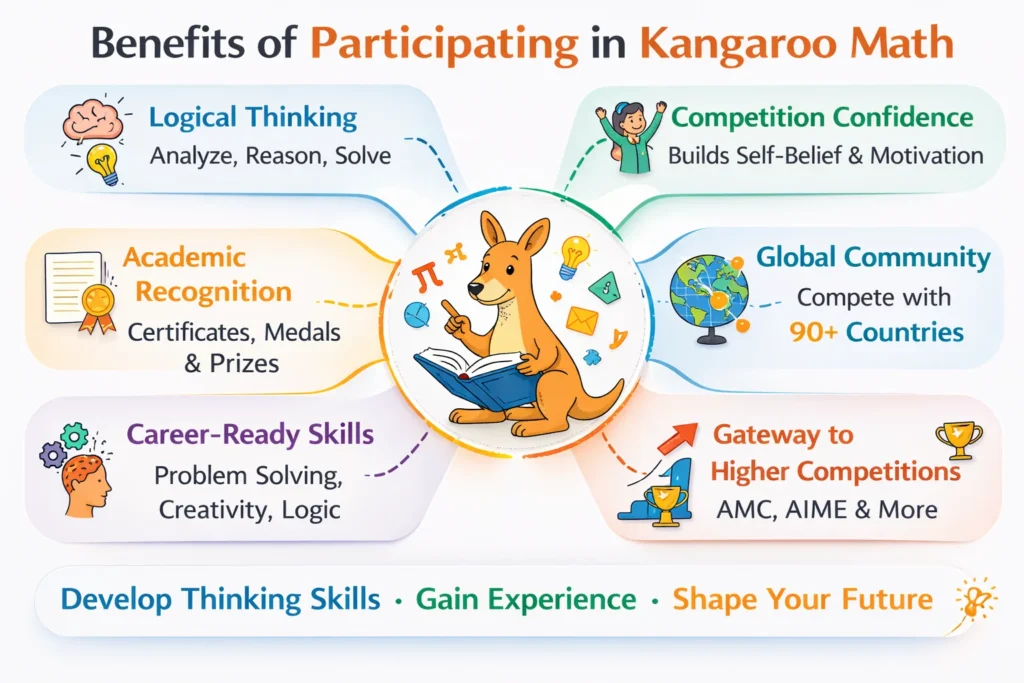
Builds Logical and Analytical Thinking
Every Kangaroo Math problem requires active reasoning rather than passive recall.
Consistent engagement with these problems develops the analytical thinking capacity that supports strong performance across all academic subjects, not just mathematics.
The logical reasoning habits built through Kangaroo Math practice transfer directly to the kind of structured thinking required in how to get better at solving math olympiad questions at more advanced competition levels.
Provides a Confident Entry Point to Competition Mathematics
For many students, Kangaroo Math is their first experience of a math competition. Done well, this first experience builds the belief that competition math is something they can engage with, a belief that is foundational to everything that follows.
Students who develop confidence through Kangaroo Math are significantly more likely to pursue AMC, AIME, and olympiad-level preparation.
For students wondering what those higher competitions involve and what scores matter at AMC level, what is a good AMC math competition score explains the benchmark scores for each recognition tier.
Develops Problem-Solving Skills That Compound Over Time
The skills developed through Kangaroo Math practice pattern recognition, logical deduction, spatial reasoning, and creative problem framing are not competition-specific skills.
They are general cognitive skills that make students better thinkers in all contexts. Students who practice these skills consistently from early grades build a significant cognitive advantage by the time they reach more advanced competition levels.
For younger students, the foundational skills that Kangaroo Math builds on, number sense, pattern recognition, spatial reasoning, are developed through resources like Number Sense for class 1, teaching number sequences to class 1 students, and spatial understanding for Class 1.
Certificates, Prizes, and Academic Recognition
Every participant receives an official participation certificate. Top scorers at national level earn medals, trophies, and prizes — the specific awards vary by country.
Understanding what prizes are available in your country and at what score thresholds motivates targeted preparation.
Math Kangaroo prizes cover the full recognition structure, including what top performers receive nationally and internationally.
Competition achievements in Kangaroo Math are recognized internationally and contribute positively to academic profiles for school applications, scholarship applications, and academic portfolios demonstrating curiosity, initiative, and mathematical ability to evaluators.
Gateway to Higher-Level Math Competitions
Kangaroo Math is an ideal first step on the competition mathematics pathway.
The logical reasoning and creative problem-solving skills it develops are directly applicable to AMC preparation, and many students who begin with Kangaroo Math go on to AMC, AIME, and olympiad-level competitions.
For the full picture of what the competition pathway looks like beyond Kangaroo, how to qualify for the IMO in the USA maps every step from entry-level competitions through international olympiad qualification.
How Kangaroo Math Compares to Other Major Competitions
Understanding where Kangaroo Math sits relative to other competitions helps students and parents plan a coherent competition preparation strategy rather than treating each competition as isolated.
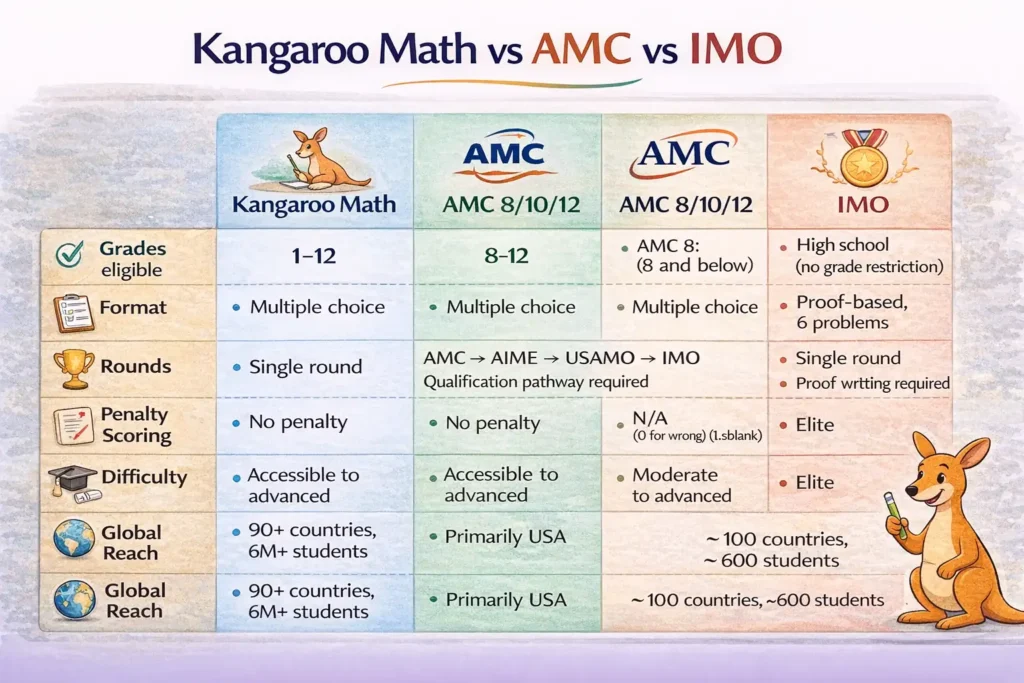
| Feature | Kangaroo Math | AMC 8/10/12 | IMO |
|---|---|---|---|
| Grades eligible | 1–12 | 8–12 (AMC 8: 8 and below) | High school (no grade restriction) |
| Format | Multiple choice | Multiple choice | Proof-based, 6 problems |
| Rounds | Single round | AMC → AIME → USAMO → IMO | Qualification pathway required |
| Penalty scoring | No penalty | AMC 10/12: 0 for wrong (1.5 blank) | N/A (proof scoring) |
| Difficulty | Accessible to advanced | Moderate to advanced | Elite |
| Global reach | 90+ countries, 6M+ students | Primarily USA | ~100 countries, ~600 students |
| Proof writing required | No | No | Yes |
Kangaroo Math and AMC are complementary rather than competing.
Kangaroo builds the reasoning foundations and competition confidence at an accessible level; AMC tests more advanced content and is the formal gateway to the AIME → USAMO → IMO pathway.
For a detailed comparison of these competitions and how the difficulty difference plays out in practice, difference between math olympiad and kangaroo math provides a thorough analysis.
For students considering which competition to focus on or how to sequence their preparation, the AMC maths competition syllabus shows exactly what content is tested at each AMC level helpful context for understanding how Kangaroo Math preparation maps onto AMC readiness.
How to Prepare for Kangaroo Math Effectively
Effective Kangaroo Math preparation is not about drilling formulas or memorizing content.
It is about developing the reasoning habits and problem-familiarity that allow you to engage confidently with novel, creative problems under time pressure.
For a complete, step-by-step Kangaroo preparation guide, including grade-specific study plans, how to prepare for Math Kangaroo covers everything in detail.
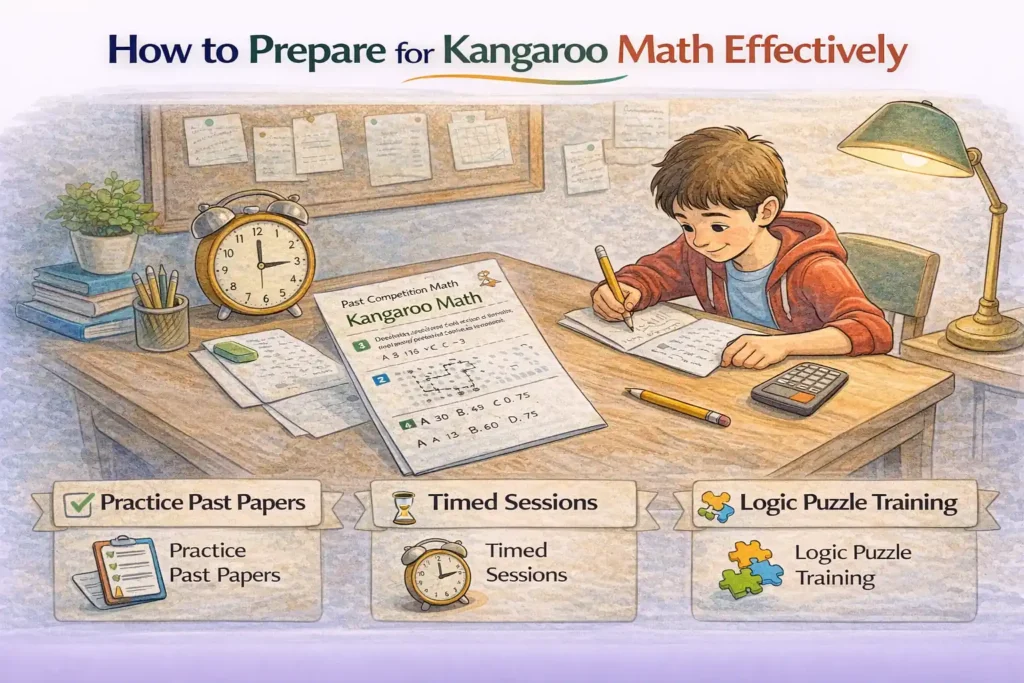
Practice With Official Past Papers
The most effective preparation activity is solving past Kangaroo Math papers at your level under timed conditions.
Past papers are available free from official national Kangaroo Math websites and the international AKSF website. Working through several papers familiarizes you with the question style, the distribution of difficulty tiers, and the time pressure of the 75-minute format.
After completing each paper, analyze every problem you could not solve, not just to find the correct answer, but to understand the reasoning structure of the solution.
This reflective approach is the same system that produces the fastest improvement in all competition math practice, as detailed in how to get better at solving math olympiad questions.
Develop Logical Reasoning Through Puzzles
Logic games, visual puzzles, Sudoku, brain teasers, and spatial reasoning exercises all develop the same cognitive flexibility that Kangaroo Math problems demand. These activities are particularly valuable for younger students (Grades 1–6) where the mathematical content tested is accessible but the logical reasoning required can still be challenging.
For younger students building the foundational skills that Kangaroo Math draws on, number sense for class 1, teach number sequences to class 1 students, spatial understanding for class 1, and geometrical shapes for grade 1 develop the exact spatial, numerical, and pattern-recognition foundations that Kangaroo problems test.
Focus on the Core Mathematical Areas
While Kangaroo Math does not test advanced curriculum content, strengthening your understanding of core areas sharpens your ability to recognize the mathematical relationships each problem is testing:
Number patterns and sequences — understanding how number patterns behave (what is the number sequence for class 1 maths) provides the foundation for a significant proportion of Kangaroo questions at lower levels.
Spatial reasoning and geometry — visual and geometric questions appear across all levels. Students who are comfortable with shapes, transformations, and spatial relationships solve these problems significantly faster.
Counting and basic combinatorics — questions about arrangements, selections, and logical counting appear frequently at Cadet level and above.
Building counting intuition through multiplication for class 1 and ascending and descending order in maths develops the number fluency that these problems require.
Logical deduction — many Kangaroo questions are pure logic problems requiring systematic reasoning rather than mathematical computation.
Practicing these problems regularly is the single most direct preparation for the hardest Kangaroo questions.
Grade-Level Preparation Focus
Different grade levels require different preparation emphases:
Pre-Ecolier and Ecolier (Grades 1–4): Focus on number intuition, simple patterns, picture-based puzzles, and basic spatial reasoning. Make practice playful and interactive.
The primary goal is building curiosity and comfort with mathematical thinking, not drilling problem types.
Benjamin and Cadet (Grades 5–8): Add logical reasoning, number theory basics (divisibility, prime numbers), geometry fundamentals, and introductory combinatorics.
Begin timed practice with full past papers to develop pace awareness.
Junior and Student (Grades 9–12): Practice multi-step reasoning problems, algebraic manipulation, advanced geometry, and strategic problem selection.
At this level, the hardest Kangaroo problems approach lower AMC difficulty, so students preparing for AMC alongside Kangaroo will find significant overlap.
Use Free Online Resources
For students seeking free structured access to olympiad-style practice resources beyond past papers, free math olympiad training online provides a comprehensive guide to every free platform available, including AoPS, Gonit, Brilliant, Khan Academy, and the official Kangaroo Math resources.
When does Kangaroo Math take place?
The competition is held annually on the third Thursday of March in most participating countries. Some countries may schedule it on a slightly different date — confirm with your national coordinator.
Is there a registration fee?
Most countries charge a small registration fee, typically between $3–$15 depending on the country and whether participation is in-person or online. Some schools cover the fee for all participating students. Check with your national coordinator for exact amounts.
Can homeschooled students participate?
Yes. Homeschooled students can register through a local authorized test center or their country’s national coordinator. In many countries, online participation options make registration straightforward for homeschooled students.
Is there a penalty for wrong answers?
No. Unlike competitions such as AMC 10/12 (where blank answers score 1.5 while wrong answers score 0), Kangaroo Math carries no penalty for wrong answers. Students are encouraged to attempt every question.
What prizes do top scorers receive?
All participants receive a participation certificate. Top scorers at national level receive medals, trophies, and country-specific prizes. For the full breakdown of what recognition is available and at what score thresholds, see Math Kangaroo prizes.
How does Kangaroo Math relate to the AMC and IMO pathway?
Kangaroo Math is an excellent starting point for students who may later pursue AMC and the AMC → AIME → USAMO → IMO pathway. The reasoning skills Kangaroo builds are directly applicable to AMC problem-solving. For students ready to take that next step, understanding what is a good AMC math competition score and AMC math competition awards explains what to aim for at the AMC level.
How is Kangaroo Math different from the Math Olympiad?
The core difference is that Math Olympiad competitions (particularly at national and international levels) use proof-based questions requiring complete written justifications, while Kangaroo Math uses multiple-choice questions testing reasoning through answer selection. Kangaroo is also far broader in participation, far more accessible in entry requirements, and organized as a single round rather than a qualification pathway. For a full side-by-side breakdown, difference between math olympiad and kangaroo math covers every dimension in detail.
Make Preparing for Math Olympiad Simple!



Conclusion
Kangaroo Math is the world’s largest math competition by participation.
Whether you are in Grade 1 exploring number puzzles for the first time or in Grade 12 sharpening your reasoning skills before AMC, Kangaroo Math meets you exactly where you are.
Start by downloading an official past paper at your level, sit it under timed conditions, and experience for yourself what mathematical curiosity in competition form feels like.
For complete preparation guidance, see how to prepare for Math Kangaroo.
For where the competition pathway leads from here, how to qualify for the IMO in the USA maps the full journey from accessible entry competitions through international olympiad qualification.