November 28, 2025
 6 min. read

Number Sense for Class 1 is where your child’s math journey truly begins.
It’s the ability to understand numbers, recognize their values, compare them, and use them confidently in everyday situations.
When your Class 1 learner builds a strong number sense, they can count objects, understand quantities, spot patterns, use a number line, and try simple addition or subtraction with confidence.
These skills support early topics like addition and subtraction for Class 1.
Definition of Number Sense
Number Sense is the ability to understand numbers and how they work, and it’s one of the most important early math skills your child will develop in Class 1.
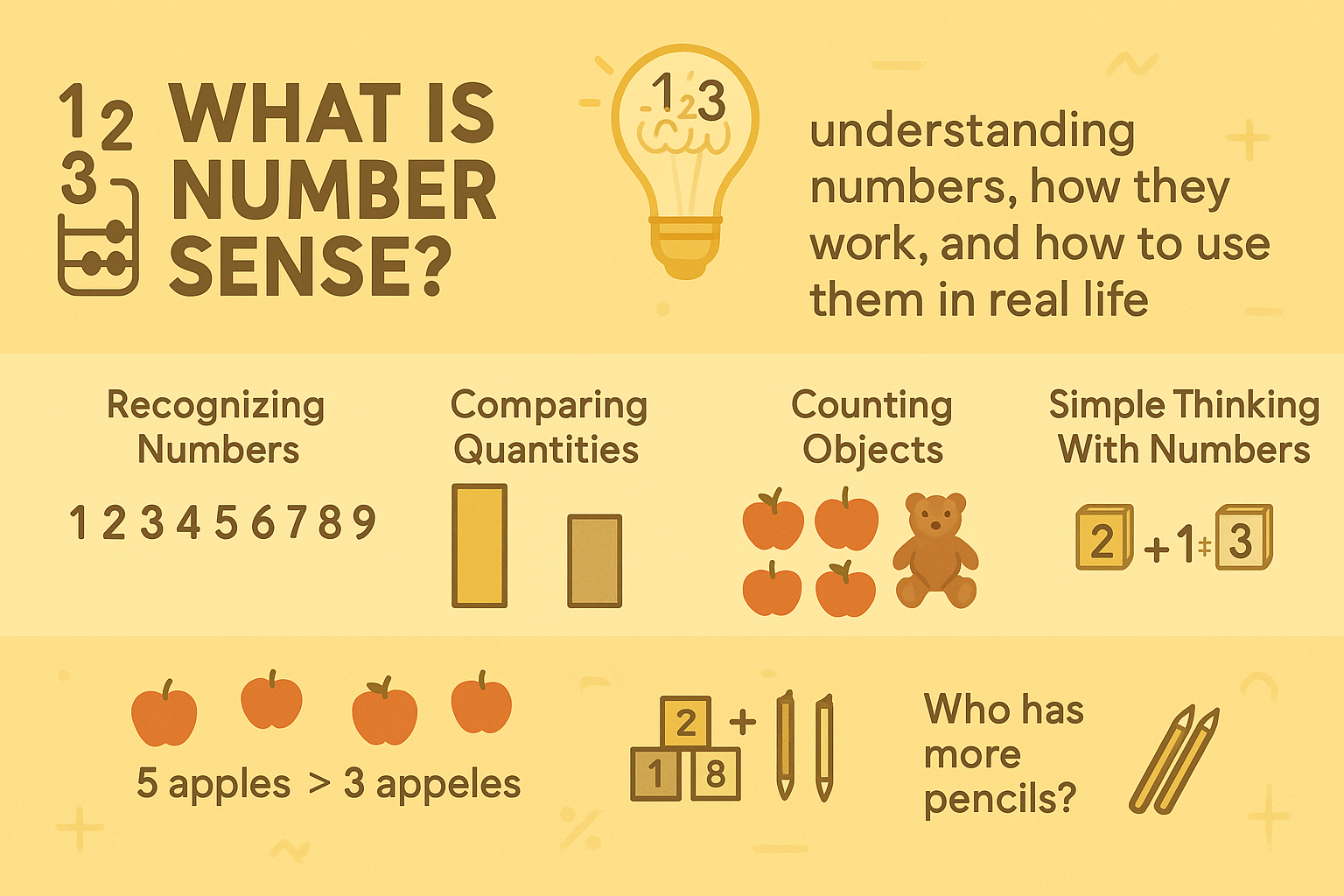
It involves being able to recognize numbers, compare them, and use them confidently in real-life situations not just on worksheets.
For Class 1 students, number sense means your child can count objects, understand quantities, tell what is more or less, and make simple comparisons on their own.
Instead of memorizing, they start to think with numbers.
For example, your child might easily notice that 5 apples are more than 3 apples, or understand that having 2 toys and getting 1 more makes 3 toys.
These small everyday observations show that number sense is growing.
You will see number sense in action when your child:
- counts their snacks before eating,
- compares who has more pencils,
- checks which group of blocks is bigger, or
- notices patterns around them. similar to activities explored in math analogies for kids.
This skill helps your child build confidence, understand math more naturally, and get ready for more advanced concepts later on.
Components of Number Sense
For your Class 1 learner, Number Sense is built through several essential skills that help them understand and use numbers confidently.

Here are the key components that your child develops in first grade:
1. Number Recognition (1–100)
Your child learns to identify numbers from 1 to 100, understand what each digit represents, and read numbers in everyday situations.
This helps them feel more comfortable with larger numbers early on and supports early topics like geometrical shapes for Grade 1 where number and shape recognition work together.
2. Counting Skills
Counting is more than saying numbers in order. Your child practices:
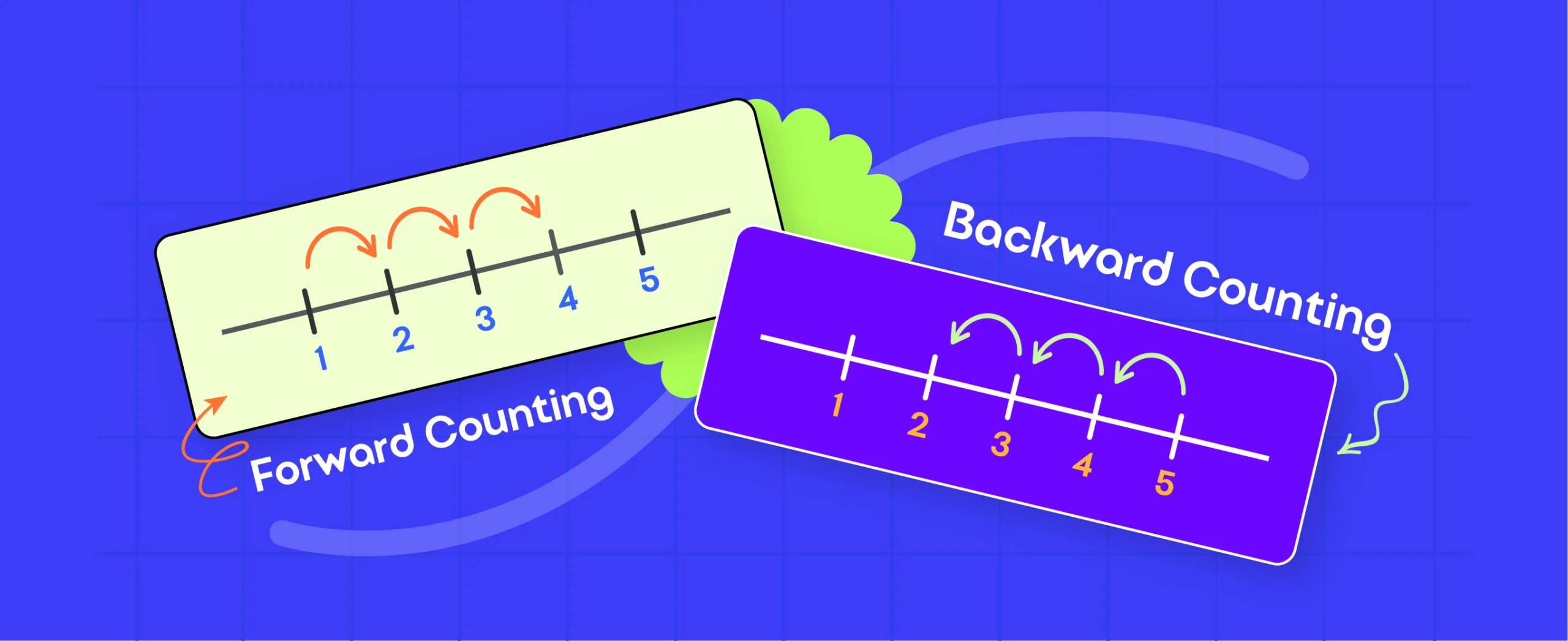
- Forward counting (1, 2, 3…)
- Backward counting
- Skip counting (like counting by 2s, 5s, or 10s)
These skills build strong mental math foundations and prepare them for multiplication concepts covered in multiplication for Class 1.
3. Comparing Numbers
Your child learns to see which number is greater, smaller, or equal, using simple comparisons such as: “Which is bigger, 7 or 9?”
This develops logical thinking and decision-making core skills, also supported by spatial understanding for Class 1.
4. Understanding Quantities
Here, your child connects numbers to real objects; this is called one-to-one correspondence.
For example, understanding that the number 5 means five apples, five toys, or five steps.
This is where counting becomes meaningful and ties into early addition and subtraction skills described in addition and subtraction for Class 1.
5. Number Patterns
Your child begins noticing patterns and sequences in numbers using number lines, hundred charts, or simple patterns like 2, 4, 6…
Pattern recognition is a key early reasoning skill, also strengthened with math analogies for kids.
6. Place Value Basics (Tens and Ones)
Your child gets introduced to the idea that numbers have place values.
For example:
- In 23 → 2 tens and 3 ones
Understanding place value is a major milestone toward addition, subtraction, and bigger numbers.
Through hands-on activities like using ten frames, number lines, counters, and simple charts, your child gradually builds a strong, confident understanding of how numbers work.
These components make math easier, more meaningful, and more enjoyable for them and for you as you support their learning.
Real-Life Applications
Number Sense becomes truly meaningful when your child starts using it in everyday life.
These real-world experiences help them see that numbers are not just for the classroom they are part of everything they do.
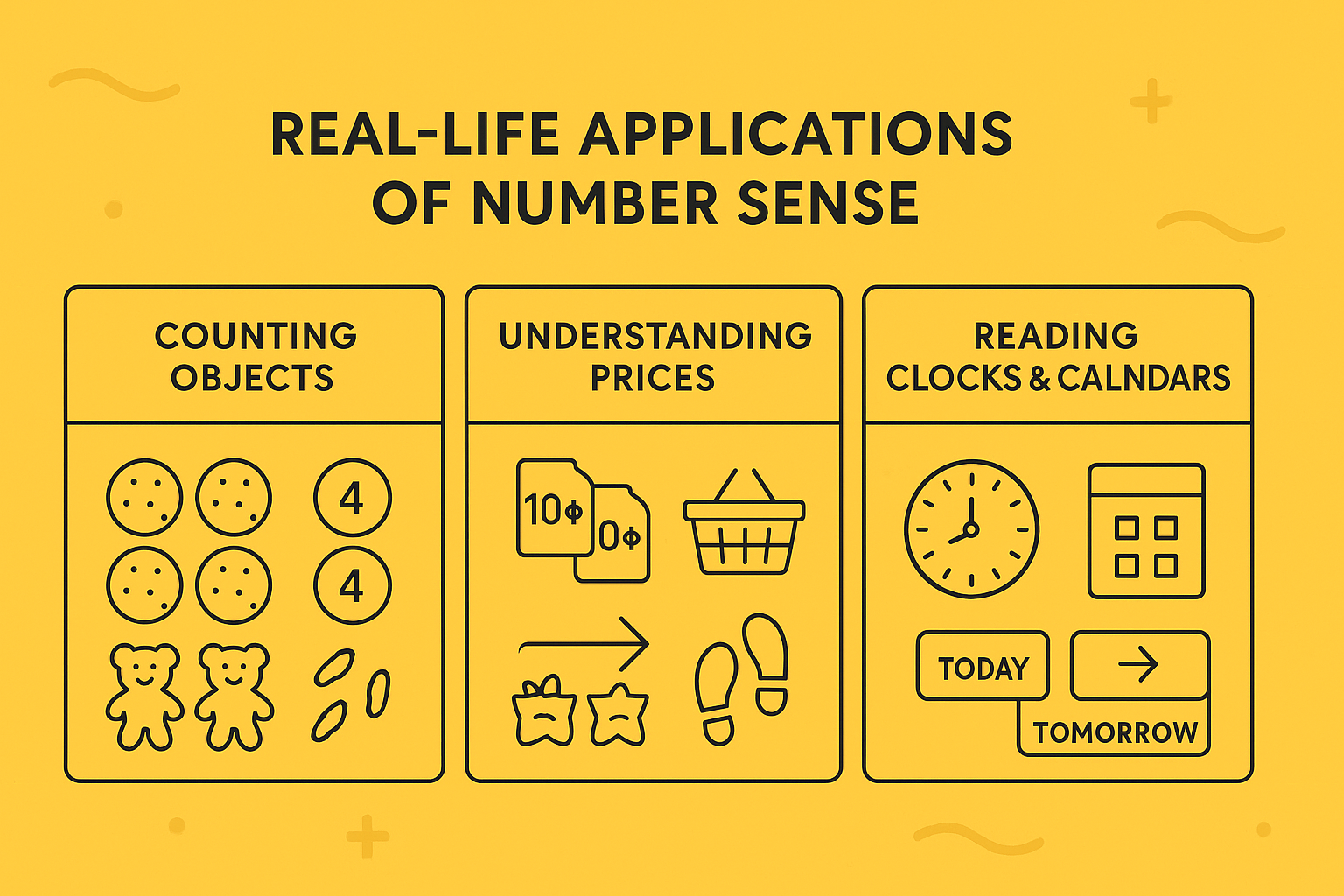
1. Counting Objects
Your child uses number sense whenever they count toys, snacks, steps, pencils, or blocks.
Counting real objects helps them understand quantities, practice one-to-one correspondence, and build accuracy.
For example: “You have 4 cookies—if you take 1, how many are left?”
Real-life counting prepares them for formal topics such as addition and subtraction for Class 1.
2. Understanding Prices
When you involve your child in shopping, they naturally learn to compare prices, recognize numbers on tags, and understand value.
They may notice things like:
- “This costs 10 taka and this costs 20 taka.”
- “Which one is more expensive?”
These small lessons help your child develop early estimation, comparison, and decision-making skills.
3. Reading Clocks and Calendars
Everyday routines give your child plenty of chances to use numbers:
- Reading the numbers on a clock to know the time
- Checking the date on a calendar
- Understanding morning, afternoon, today, and tomorrow
These activities help your child connect numbers to time and daily schedules, making math practical and meaningful.
How Number Sense Grows in Class 1
In Class 1, your child’s number sense develops in a natural, step-by-step way.
This growth moves from recognizing numbers to understanding them deeply, to applying them confidently in real-life situations.

When you see this progression, you’ll notice how quickly your child becomes more comfortable with math.
1. Recognition: Learning to Identify Numbers
Your child begins by recognizing numbers and their symbols, starting with 1–20 and gradually expanding up to 100.
With tools like ten frames, number cards, and counting objects, your child learns to connect the written number to its meaning.
This step supports concepts like shapes and patterns in geometrical shapes for Grade 1.
2. Understanding: Making Sense of Numbers
Once recognition is strong, your child starts to understand how numbers work.
They practice:
- Counting forward and backward on number lines
- Subitizing (instantly recognizing small quantities)
- Exploring number patterns on 100/120 charts
This is where your child begins to understand ordering, comparing, and the size of numbers.
This reasoning overlaps with early mental models developed in spatial understanding for Class 1.
3. Application: Using Numbers in Real Life
Finally, your child begins to apply number sense in daily tasks and simple problem-solving.
They use skills like:
- Skip counting
- Finding missing numbers in sequences
- Noticing patterns
- Connecting numbers to everyday moments
This is also when early addition and subtraction begin, forming the base for future skills covered in multiplication for Class 1.
Make Preparing for Math Olympiad Simple!



Conclusion
Number Sense for Class 1 is more than just learning numbers; it’s the foundation that supports every future math skill your child will develop.
When your child understands numbers deeply, recognizes patterns, and uses numbers flexibly, they build confidence that stays with them throughout their school years.
Strong number sense helps your child approach addition, subtraction, multiplication, and problem-solving with ease, skills that also prepare them for early math challenges like the Maths Olympiad for Class 1.