


Factorisation in maths Class 8 is the process of breaking down a number or algebraic expression into simpler parts called factors that multiply together to give back the original.
- What is Factorisation in Maths?
- Key Factorisation Formulas for Class 8
- Types of Factorisation with Examples
- Methods of Factorisation in Class 8 Maths
- Factorisation Problems for Class 8 (Practice Questions)
- Division of Algebraic Expressions
- Evaluating Algebraic Expressions Using Identities
- Why Factorisation Matters Beyond the Classroom
- How to Prevent Common Errors in Factorisation
- Practice Factorisation with the Gonit App
- Conclusion
In short, factorisation in maths means rewriting an expression as a product of its factors.
It is one of the most important skills in Class 8 algebra and the foundation on which quadratic equations, polynomial simplification, and higher-level maths are built.
This complete guide covers what factorisation is, the key factorisation formulas for Class 8, the four methods of factorisation with worked examples, division of algebraic expressions, common errors to avoid, and real-world applications.
If you are also preparing for competitive maths, see our guide on how to prepare for the Junior Math Olympiad to see how factorisation fits into Olympiad problem-solving.
What is Factorisation in Maths?
Factorisation means expressing a number or algebraic expression as a product of its factors. When those factors are multiplied together, they give back the original expression.
This is the simple definition of factorisation that every Class 8 student should remember.
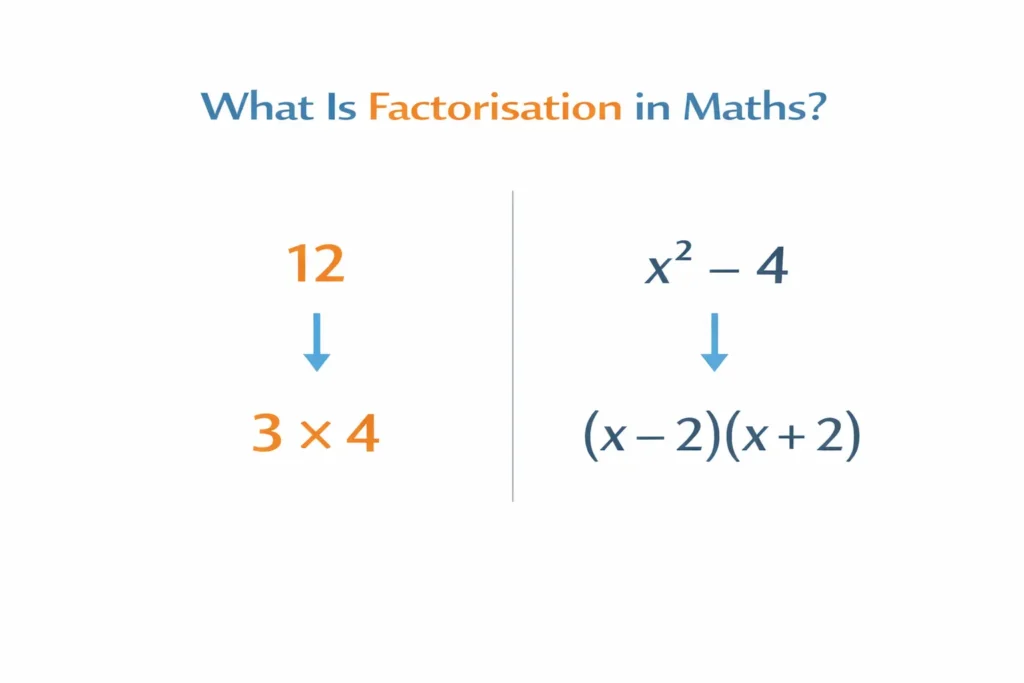
For numbers: Factors are whole numbers that divide the original value exactly.
12 = 3 × 4 (both 3 and 4 divide evenly into 12)
For algebraic expressions: Factors are simpler terms or polynomials.
x² − 4 = (x − 2)(x + 2), applying the identity a² − b² = (a − b)(a + b)
Factorisation plays a central role in prime factorisation, simplifying algebraic expressions, solving quadratic equations, and dividing polynomials.
For Class 8 students, mastering it makes the entire algebra chapter manageable and builds confidence that carries into Class 9 and beyond.
If you are working toward competitive maths, check our guide on what type of questions are asked in Math Olympiads because factorisation appears frequently in Olympiad papers.
Why Factorisation Is Important in Class 8 Maths
Before learning the methods, it helps to know why factorisation matters.
Factorisation is the reverse of multiplication, so it lets you simplify complex algebraic expressions, cancel common factors in algebraic fractions, and solve equations far more quickly.
Once you can factorise confidently, topics like algebraic identities, simplifying fractions, finding the HCF and LCM of polynomials, and solving quadratic equations become much easier. T
hat is why the factorisation chapter sits at the heart of the Class 8 maths algebra section.
Key Factorisation Formulas for Class 8
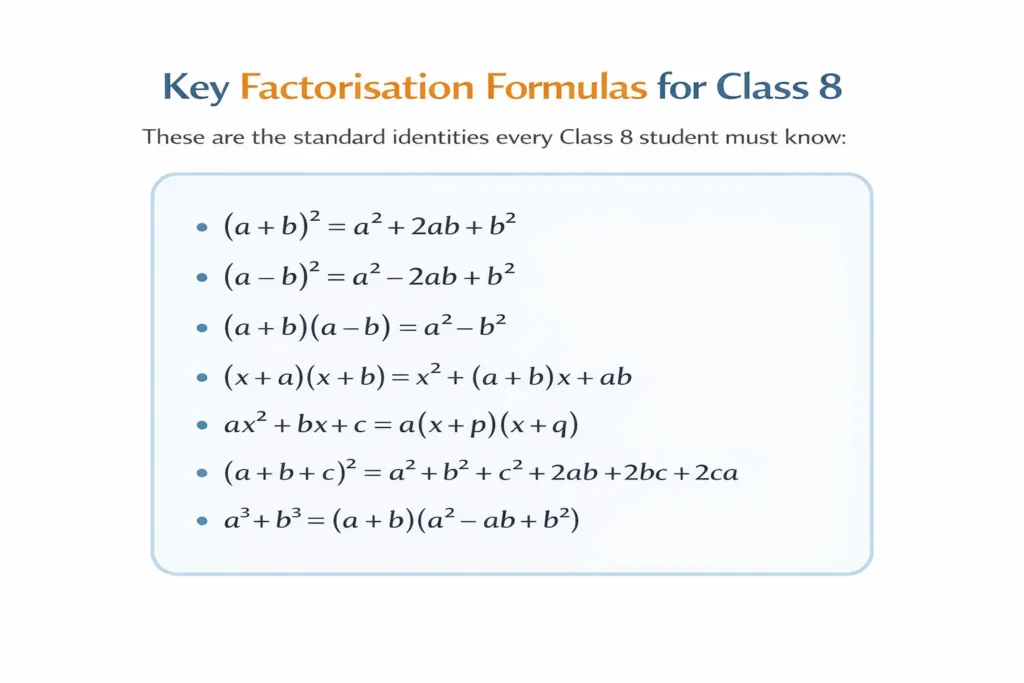
These are the standard identities every Class 8 student must know. Recognising which factorisation formula applies to an expression is the fastest route to the correct answer.
The list below works as a quick factorisation formulas reference card you can revise before exams.
| # | Identity | Factored Form |
|---|---|---|
| 1 | Difference of squares | a² − b² = (a − b)(a + b) |
| 2 | Perfect square (sum) | (a + b)² = a² + 2ab + b² |
| 3 | Perfect square (difference) | (a − b)² = a² − 2ab + b² |
| 4 | Difference of cubes | a³ − b³ = (a − b)(a² + ab + b²) |
| 5 | Sum of cubes | a³ + b³ = (a + b)(a² − ab + b²) |
| 6 | Square of trinomial | (a + b + c)² = a² + b² + c² + 2ab + 2bc + 2ca |
| 7 | Quadratic factorisation | x² + (a + b)x + ab = (x + a)(x + b) |
Memorising these formulas is not enough; practise spotting them inside expressions.
Students who can quickly recognise that an expression matches identity #1 (difference of squares) or #7 (quadratic factorisation) solve factorisation problems significantly faster, especially under exam conditions.
Extra Factorisation Formulas Students Often Search For
Beyond the core list, two higher-power identities sometimes appear in tougher Class 8 and Olympiad questions:
- x³ − y³ formula: x³ − y³ = (x − y)(x² + xy + y²)
- a⁸ + b⁸: this does not factor neatly over rational numbers, so do not force a perfect-square pattern on it. Knowing when an expression cannot be factorised is just as important as knowing the formulas.
Types of Factorisation with Examples
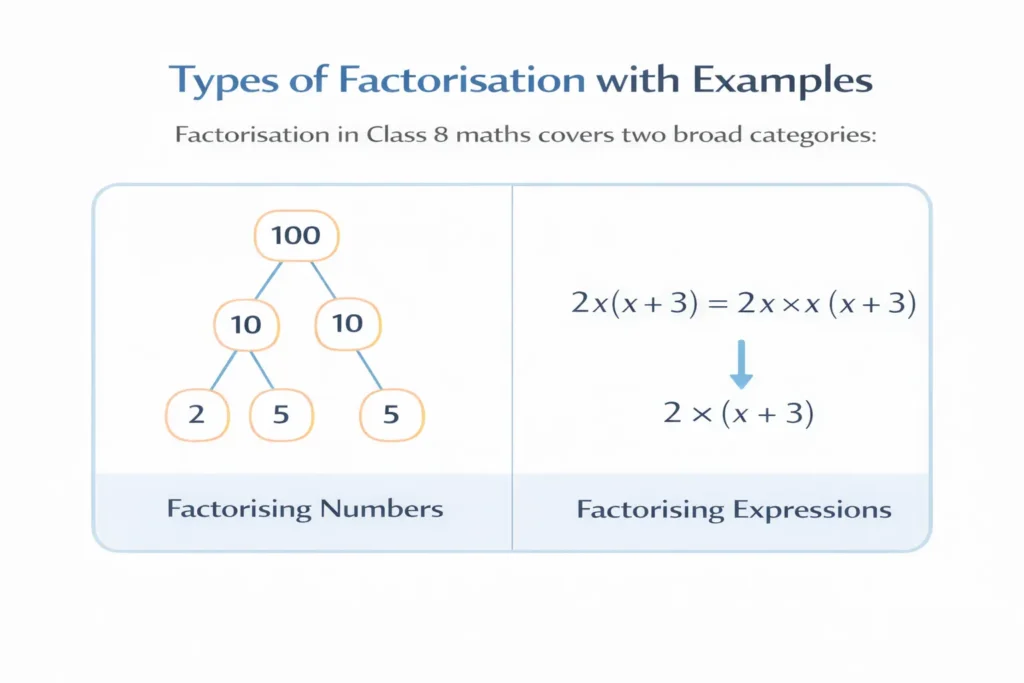
Factorisation in Class 8 maths covers two broad types of factorisation:
1. Factorisation of Numbers (Prime Factorisation)
Factorisation of numbers means expressing a number as a product of its factors, particularly its prime factors.
Example — Factors of 20:
20 = 2 × 10 = 4 × 5 = 1 × 20. Factors: 1, 2, 4, 5, 10, 20. Prime factorisation: 20 = 2 × 2 × 5
Prime factorisation means expressing a number as a product of prime numbers only. Two common methods are used:
- Factor Tree Method: split the number into any two factors, then keep splitting until all branches are prime.
- Division Method (short division): repeatedly divide by the smallest prime that divides evenly.
Example — Prime factorisation of 100:
100 = 10 × 10 = 2 × 5 × 2 × 5 = 2² × 5²
2. Factorisation of Algebraic Expressions
Factorisation of algebraic expressions means expressing an algebraic expression as a product of simpler factors, such as numbers, variables, or smaller expressions.
Examples:
2ab + 3c → factors of 2ab are 2, a, b; factors of 3c are 3, c. 2x(x + 3) = 2 × x × (x + 3). x² + 5x + 6 = (x + 2)(x + 3)
The key difference: numbers can be factorised in straightforward ways, but algebraic expressions often require specific methods such as common factors, regrouping, identities, or splitting the middle term.
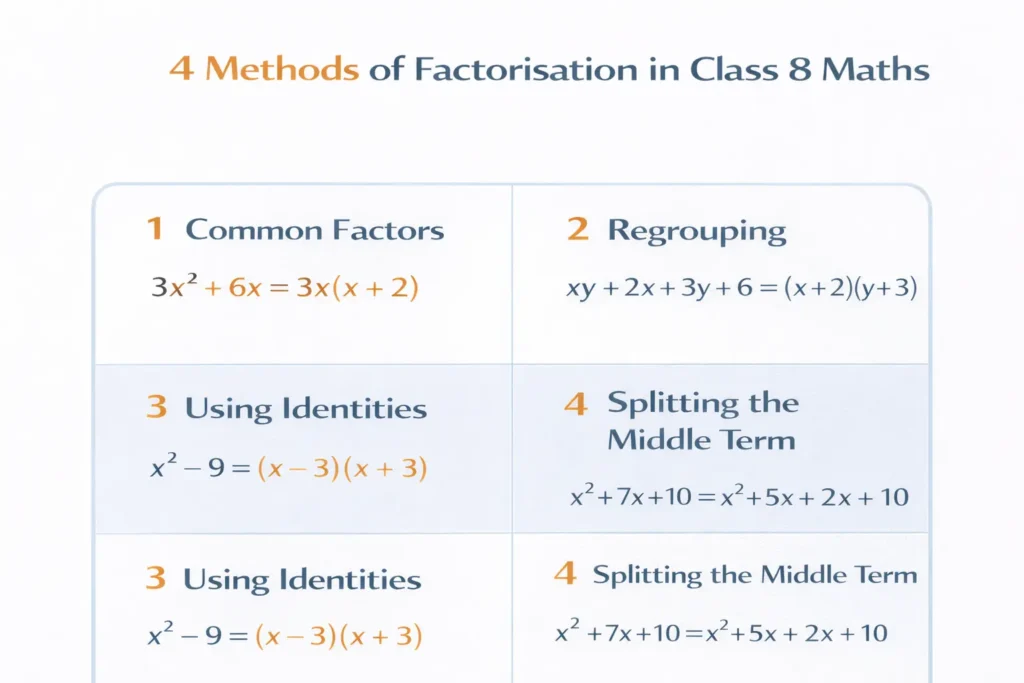
4 Methods of Factorisation in Class 8 Maths
These four methods of factorisation cover every type of algebraic factorisation encountered in Class 8. The real skill is knowing which method to apply, and that develops quickly with practice.
Here is how to do factorisation step by step using each method.
Method 1 — Factorisation by Common Factors
Extract the Highest Common Factor (HCF) from all terms and write the expression as a product. This method of extracting common factors should always be your first step.
Steps:
- Identify the common factor across all terms.
- Factor it out of the expression.
- Write as: HCF × (remaining expression).
Example 1:
3z + 9 = (3 × z) + (3 × 3) = 3(z + 3)
Example 2:
2a + 8b = 2(a + 4b)
The factors 2 and (a + 4b) are irreducible, which means they cannot be broken down further.
Example 3 (fully factorise 8p + 12):
8p + 12 = 4(2p + 3). And 12a²b + 8ab² = 4ab(3a + 2b), since the HCF is 4ab.
Method 2 — Factorisation by Regrouping Terms
Factorisation by regrouping terms is used when there is no single common factor across all terms. Rearrange the terms so that groups of two or three share a common factor.
Steps:
- Check for a common factor; if none, regroup.
- Rearrange so that terms with shared factors are adjacent.
- Extract common factors from each group.
- Identify the common binomial factor across groups.
- Write the result as a product of two binomials.
Example 1:
15ab − 20b + 3a − 4 = (15ab − 20b) + (3a − 4) = 5b(3a − 4) + 1(3a − 4) = (5b + 1)(3a − 4)
Example 2:
21x + 7y − 13y² − 39xy. Grouping A: (21x − 39xy) + (7y − 13y²) = 3x(7 − 13y) + y(7 − 13y) = (3x + y)(7 − 13y). Grouping B gives the same answer, which confirms the factorisation is correct.
Method 3 — Factorisation Using Identities
When an expression matches the form of a standard identity, apply the identity directly to write the factors. Factorisation using identities is the fastest method when it applies.
Key identities to spot:
- a² − b² = (a − b)(a + b)
- a² + 2ab + b² = (a + b)²
- a² − 2ab + b² = (a − b)²
- x² + (a + b)x + ab = (x + a)(x + b)
Example 1:
Factorise 4z² − 12z + 9. Observe: 4z² = (2z)², 12z = 2 × 2z × 3, 9 = 3². Matches a² − 2ab + b² = (a − b)² = (2z − 3)²
Example 2 (difference of squares method):
Factorise x² − 25. Matches a² − b² = (a − b)(a + b), where a = x and b = 5 = (x − 5)(x + 5)
Method 4 — Factorisation by Splitting the Middle Term
Factorisation by splitting the middle term is used for quadratic expressions of the form ax² + bx + c. Find two numbers that multiply to give ac and add to give b. This is the middle term splitting method many Class 8 students search for.
Steps:
- Identify the quadratic: ax² + bx + c.
- Find two numbers p and q such that p × q = ac and p + q = b.
- Split the middle term using p and q.
- Group and factorise.
Example 1:
Factorise x² + 7x + 12. Find two numbers that multiply to 12 and add to 7 → 3 and 4. = x² + 3x + 4x + 12 = x(x + 3) + 4(x + 3) = (x + 3)(x + 4)
Example 2 (factorise x² + 8x):
x² + 8x has a common factor of x, so x² + 8x = x(x + 8). Always check for a common factor before splitting the middle term.
Factorisation Problems for Class 8 (Practice Questions)
Try these factorisation sums for Class 8 on your own, then check your method against the four approaches above. Mixing question types is the best way to build pattern recognition.
- Factorise: 18xy − 24yz (common factor)
- Factorise: ax + ay + bx + by (regrouping)
- Factorise: 49m² − 64 (difference of squares)
- Factorise: p² + 10p + 21 (splitting the middle term)
- Factorise completely: 2x² − 8 (common factor, then identity)
Want fully worked solutions and harder practice? The Gonit app gives step-by-step answers for every problem.
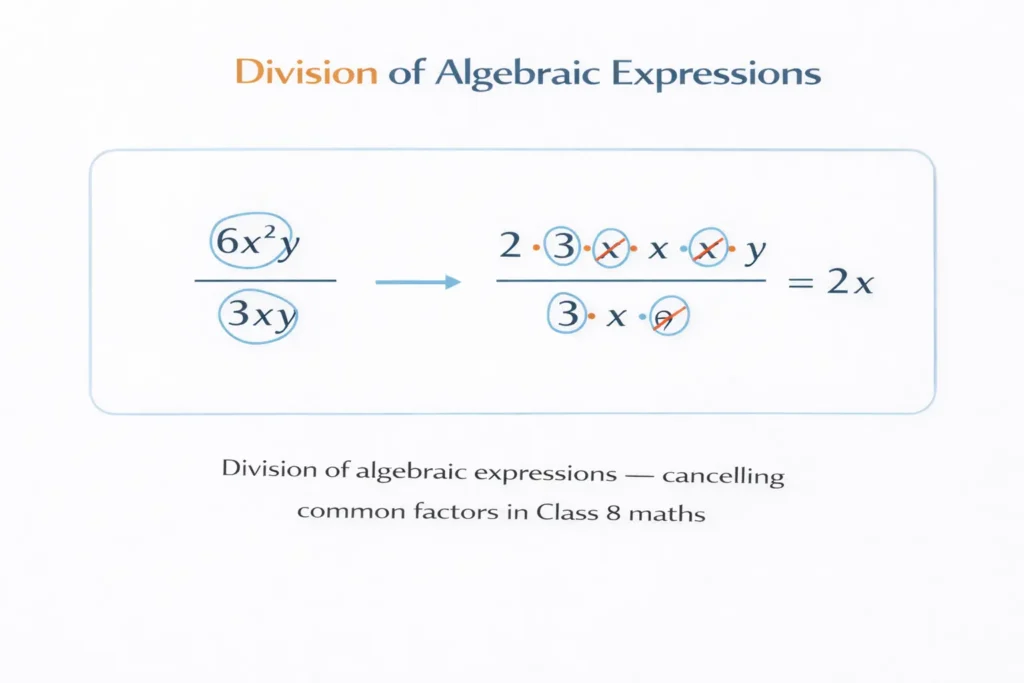
Division of Algebraic Expressions
Division is the reverse of multiplication. If two factors multiply to give an expression, dividing that expression by one factor gives the other.
Dividing a Monomial by a Monomial
32a²b ÷ 4ab = (32 ÷ 4) × (a² ÷ a) × (b ÷ b) = 8a
Dividing a Binomial by a Monomial
(3a² + 9ab) ÷ 3a = (3a² ÷ 3a) + (9ab ÷ 3a) = a + 3b
Dividing a Polynomial by a Monomial
(3x²y² + 6xy³ − 12xy) ÷ 3xy = 3xy(xy + 2y² − 4) ÷ 3xy = xy + 2y² − 4
Dividing a Polynomial by a Polynomial
Factorise both, then cancel common factors.
Example:
(x² + 5x + 6) ÷ (x + 2) = (x + 2)(x + 3) ÷ (x + 2) = (x + 3)
Real-world applications of algebraic division:
- Finding the missing side of a rectangle when area and one side are known
- Finding the base or height of a triangle using area
- Simplifying polynomials to solve equations
Evaluating Algebraic Expressions Using Identities
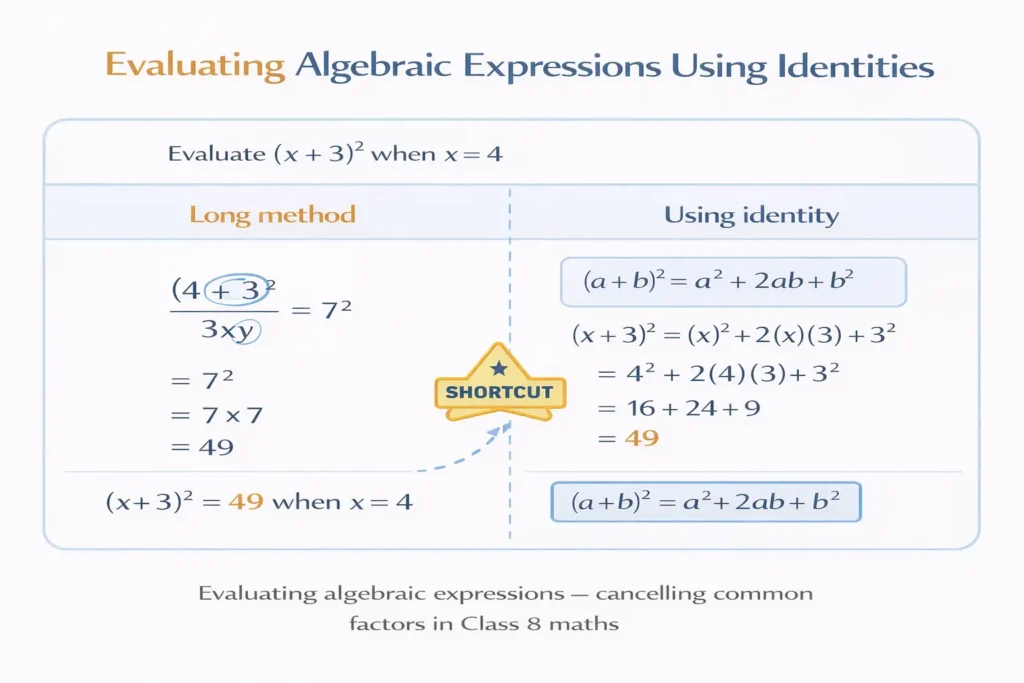
Evaluating means finding the value of an expression given certain conditions. Identities make this faster by eliminating the need to expand everything.
Example 1:
Find m² + n² when m + n = 8 and mn = 15 m² + n² = (m + n)² − 2mn = 8² − 2(15) = 64 − 30 = 34
Example 2:
If x + y = 25 and x² + y² = 225, find xy 2xy = (x + y)² − (x² + y²) = 625 − 225 = 400 xy = 200
Common errors when evaluating:
- Forgetting to multiply every term: 3(2a − 9) = 6a − 27, not 6a − 9
- Ignoring negative signs: 3p − 8p + 11p = 6p, not 22p
- Stopping before full simplification
Key reminders: Apply the correct identity first. Double-check all signs. Distribute across every term in brackets.
Why Factorisation Matters Beyond the Classroom
Factorisation isn’t just an exam topic, it is a problem-solving tool that appears across science, technology, and everyday life.

Everyday uses:
- Fair sharing: Dividing 24 items equally among 6 people uses factorisation (24 = 6 × 4)
- Money: Breaking amounts into smaller units, comparing unit prices
- Time: 60 minutes divides into factors like 12 × 5 or 4 × 15
- GCD & LCM: Simplifying fractions, aligning timetables, synchronising repeating cycles
Science and technology applications:
- Cryptography: RSA encryption relies on the extreme difficulty of factoring very large prime numbers
- Data compression: Identifying repeated patterns through factorisation reduces file sizes
- Error correction: Digital codes use polynomial factorisation to detect and fix transmission errors
- Engineering: Polynomial models of electrical circuits are simplified using factorisation
- Robotics: Polynomial factorisation supports efficient path planning
- Biology: Genetic modelling uses factored polynomial equations
Students aiming for competitive maths can explore how these concepts appear in the best math competitions in the world, or take the next step with American Mathematics Competitions (AMC) practice.
How to Prevent Common Errors in Factorisation
Most factorisation mistakes come from rushing or skipping a basic check. These are the most frequent errors Class 8 students make and exactly how to fix them.
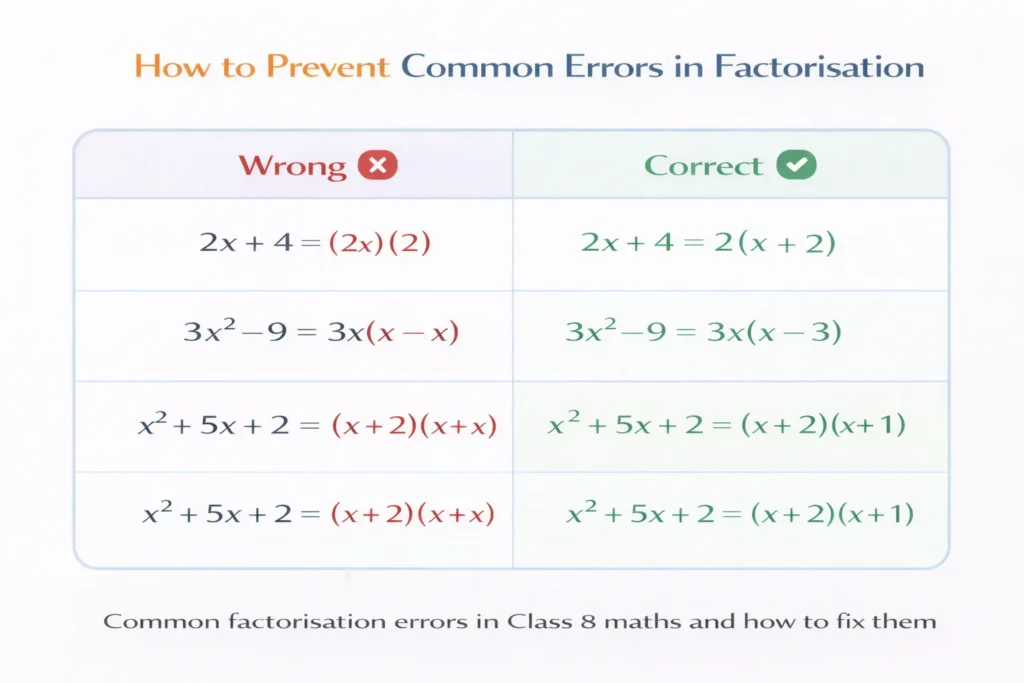
1. Skipping the Common Factor Always check for a GCF before applying any other method. Missing it leaves the answer partially factorised.
6x² + 12x — the GCF is 6x, giving 6x(x + 2), not just (x + 2)
2. Misapplying Identities Using the wrong identity or applying it incorrectly is one of the most common mistakes.
x² + 4 is NOT (x + 2)² — there is no middle term, so it does not factorise using a perfect square identity
3. Wrong Signs in the Middle Term When splitting the middle term, one incorrect sign breaks the entire factorisation.
Always verify: do your two numbers multiply to c and add to b?
4. Stopping Too Early Factorisation is only complete when no factor can be broken down further.
2(x² − 4) is not fully factorised it should be 2(x − 2)(x + 2)
5. Writing 1 as a Factor Technically correct but adds no value and clutters the answer. Leave it out.
6. Not Verifying the Answer Always re-expand your factors to check they give back the original expression.
Quick checklist before finishing:
- ✅ Did I check for a common factor first?
- ✅ Did I recognise and apply the correct identity?
- ✅ Did I check all signs carefully?
- ✅ Is the expression fully factorised no factor reducible further?
- ✅ Did I re-expand to verify?
Practice Factorisation with the Gonit App
Knowing the methods is only half the work; the other half is practice.
The Gonit app offers structured factorisation practice problems tailored to Class 8, with step-by-step solutions that show exactly where and why each method is applied.
With Gonit, students can:
- Access progressive practice from basic to advanced factorisation
- Get instant, step-by-step solutions for every problem
- Prepare specifically for Math Olympiad-level factorisation questions
- Track progress and identify weak areas
Download the Gonit app and start practising factorisation today. The more problems you work through, the faster the method recognition becomes automatic.
Make Preparing for Math Olympiad Simple!



Q1. What is factorisation in maths for Class 8?
Factorisation is the process of breaking a number or algebraic expression into simpler parts — called factors — that multiply together to give back the original. In Class 8, students learn to factorise both numbers (using prime factorisation) and algebraic expressions (using common factors, regrouping, identities, and splitting the middle term).
Q2. What are the four methods of factorisation in Class 8?
The four methods are: (1) factorisation by common factors — extracting the HCF from all terms; (2) factorisation by regrouping — rearranging terms to find shared factors in groups; (3) factorisation using identities — applying standard algebraic formulas; and (4) splitting the middle term — used for quadratic expressions.
Q3. What are the key factorisation formulas for Class 8?
The most important formulas are: a² − b² = (a − b)(a + b), (a + b)² = a² + 2ab + b², (a − b)² = a² − 2ab + b², a³ − b³ = (a − b)(a² + ab + b²), a³ + b³ = (a + b)(a² − ab + b²), and x² + (a + b)x + ab = (x + a)(x + b).
Q4. What is the difference between factorisation of numbers and algebraic expressions?
Factorisation of numbers expresses a number as a product of its prime factors (e.g. 12 = 2 × 2 × 3). Factorisation of algebraic expressions breaks a polynomial into simpler factors that may include variables and binomials (e.g. x² − 9 = (x − 3)(x + 3)).
Q5. What is the easiest method of factorisation for Class 8 students?
Factorisation by common factors is the simplest method and should always be attempted first. If a common factor exists across all terms, extracting it immediately simplifies the expression and often reveals a further factorisable structure.
Q6. How do you avoid mistakes in factorisation?
Always check for a common factor first, know your standard identities, double-check signs when splitting the middle term, ensure the answer is fully factorised, and always re-expand your answer to verify it matches the original expression.
Q7. How is factorisation used in real life?
Factorisation is used in fair sharing (dividing equally), budgeting (breaking amounts into smaller units), time management (60 = 4 × 15), cryptography (RSA encryption), data compression, error correction in digital systems, and engineering calculations.
Q8. How does the Gonit app help with factorisation practice?
The Gonit app provides structured factorisation practice problems for Class 8 with instant step-by-step solutions. Students can practise progressively from basic to advanced, prepare for Olympiad-level questions, and track their improvement over time.
Conclusion
Factorisation in maths Class 8 is the gateway to confident algebra. Once students internalise the four methods, common factors, regrouping, identities, and splitting the middle term, and learn to spot which one applies, problems that once looked difficult become straightforward.
The key habits are simple: always check for a common factor first, know your identities, watch your signs, and always verify by re-expanding. Short, regular practice builds the pattern recognition that makes factorisation feel instinctive rather than effortful.
Ready to test your skills? Download the Gonit app for step-by-step factorisation practice, or explore our guide on how to get full marks in the Maths Olympiad to see how factorisation fits into your broader exam strategy.

Mikha Piregu is a Content Writer with experience spanning educational content, including math and math olympiad topics, as well as advocacy writing, research-based articles, and SEO-driven web content. He creates high-quality blog content, web copy, and feature articles that support brand visibility, audience engagement, and long-term organic growth through data-informed storytelling. Skilled in WordPress, WooCommerce, and modern digital tools, Mikha adapts content across various platforms, including blogs, websites, campaigns, and advocacy initiatives, with clarity and purpose.



There are no comments posted here yet.
Sign in to leave a comment