


The best math competition in the world is the International Mathematical Olympiad (IMO), and it is also the hardest at high school level. For undergraduates the hardest is the Putnam.
- Top 7 Math Competitions in the World at a Glance
- International Mathematical Olympiad (IMO): The Gold Standard
- William Lowell Putnam Mathematical Competition: Hardest University-Level Math Contest
- Asian Pacific Mathematics Olympiad (APMO): Regional Powerhouse
- European Girls' Mathematical Olympiad (EGMO): Top Competition for Girls
- American Mathematics Competitions (AMC 8, 10, 12): Best Entry Point in the USA
- International Kangaroo Mathematics Contest (IKMC): World's Largest Math Competition
- China Girls Math Olympiad (CGMO): Elite Competition for Female Mathematicians
- More Math Competitions Worth Knowing
- Why the IMO Is Still the Best Math Competition in the World
- How the IMO Compares to Other Top Competitions
- Which Math Competition Should YOU Enter?
- Do Math Competitions Help With College Admissions?
- Best Math Competitions for Kids and Middle School Students
- Best Math Competitions for Kids and Middle School Students
- How to Prepare for the World's Best Math Competitions
- How Much Do Math Competitions Cost to Enter?
- What Is the Toughest Olympiad in the World?
- Final Verdict
The biggest by participation is Math Kangaroo, with about 6.5 million entrants across more than 90 countries. Which one is best for you depends entirely on your age and level, and the table below maps that out.
The International Mathematical Olympiad (IMO) has been the gold standard of pre-university mathematics since 1959, drawing top students from over 100 countries every year.
But the IMO is just the summit. Below it sits a rich landscape of elite math competitions, from the Putnam and APMO to the AMC series, Math Kangaroo, MATHCOUNTS, and AIME, each suited to a different age, skill level, and goal.
This guide ranks the top 7 international math competitions by prestige, difficulty, and global reach, compares the IMO and Putnam directly, and lists ten more contests worth entering.
If you are new to competitive math, you may also want to understand what is the purpose of the math olympiad.

What Is the #1 Math Competition in the World?
The International Mathematical Olympiad (IMO) is widely considered the best math competition in the world. Founded in 1959, it is the oldest, most prestigious, and most difficult high school mathematics competition globally, drawing top students from over 100 countries each year
Top 7 Math Competitions in the World at a Glance
Here is a quick comparison of the world’s best math competitions, ranked by prestige, difficulty, and global reach.
| Competition | Founded | Countries | Who Can Enter | Difficulty | Best For |
|---|---|---|---|---|---|
| IMO | 1959 | 100+ | High school (national selection) | Extreme | Elite proof-writers |
| Putnam | 1938 | USA/Canada | Undergraduates | Extreme | University students |
| APMO | 1989 | Asia-Pacific + USA | Top students under 20 | Very High | Asia-Pacific region |
| EGMO | 2012 | Europe + guests | Female high school students | Very High | Girls in math |
| AMC 10/12 | 2000 | USA + international | Grade 10 and below, Grade 12 and below | High | US high school students |
| AMC 8 | 1985 | USA + international | Grade 8 and below | Moderate | Middle schoolers |
| Math Kangaroo (IKMC) | 1991 | 90+ countries, 6.5M entrants | Grades 1 to 12 | Accessible | All students |
| Competition | Founded | Countries | Who Can Enter | Difficulty | Best For |
|---|---|---|---|---|---|
| IMO | 1959 | 100+ | High school (national selection) | Extreme | Elite proof-writers |
| Putnam | 1938 | USA/Canada | Undergraduates | Extreme | University students |
| APMO | 1989 | Asia-Pacific + USA | Top students under 20 | Very High | Asia-Pacific region |
| EGMO | 2012 | Europe + guests | Female high school students | Very High | Girls in math |
| AMC 10/12 | 2000 | USA + international | Grades 10 to 12 | High | US high school students |
| AMC 8 | 1985 | USA + international | Grade 8 and below | Moderate | Middle schoolers |
| Math Kangaroo (IKMC) | 1991 | 80+ countries, 6M+ entrants | Grades 1 to 12 | Accessible | All students |
Three quick answers before the detail, because these are the three questions people actually arrive with:
- Hardest math competition in the world: the IMO for pre-university students, the Putnam for undergraduates.
- Biggest math competition in the world: Math Kangaroo, at roughly 6.5 million students a year.
- Most prestigious math olympiad: the IMO, without serious competition.
1. International Mathematical Olympiad (IMO): The Gold Standard
The IMO is the undisputed best math competition in the world for pre-university students.
No other international math contest comes close in terms of prestige, difficulty, or global reach.
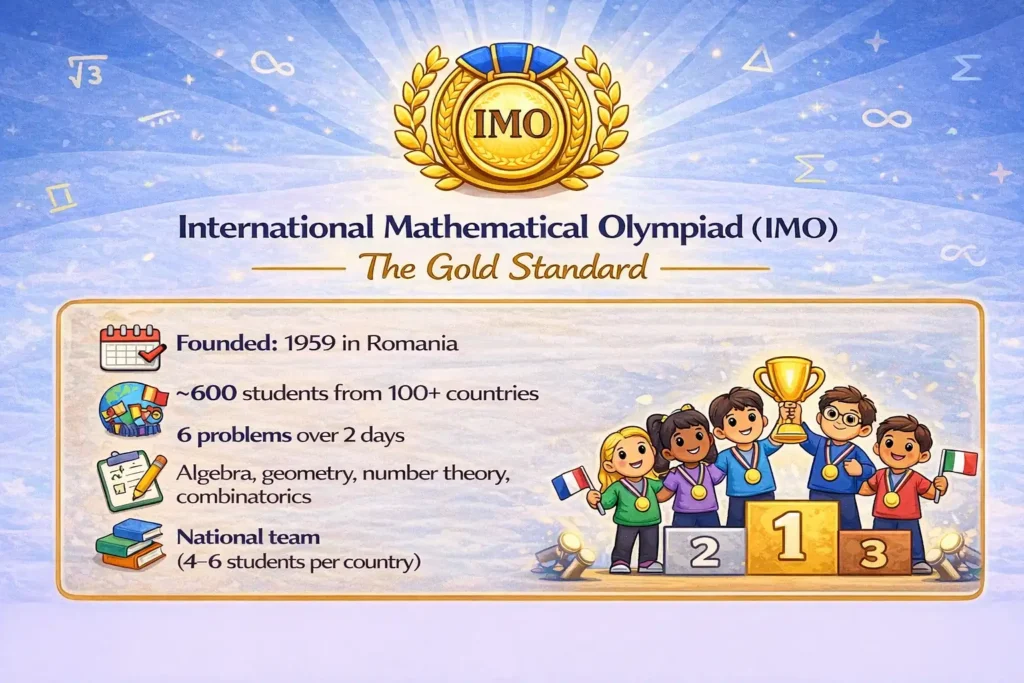
Key Facts About the IMO
- Founded: 1959 in Romania (Brasov)
- Participants: Around 600 students from 100+ countries each year
- Format: 6 proof-based problems over 2 days (4.5 hours per day)
- Scoring: 7 points per problem, 42 maximum per student
- Topics: Algebra, geometry, number theory, combinatorics
- Who qualifies: National team selection, typically 4 to 6 students per country after multi-stage competitions such as USAMO in the United States
- Team size: Each country sends up to 6 students
Eligibility: learn about IMO exam eligibility criteria for students of all classes.
Why the IMO Is the Most Prestigious Math Olympiad
The IMO’s problems are legendary. They require deep creativity, not just knowledge.
There is no formula to memorize. Solutions demand original mathematical insight.
Past participants include Terence Tao (who won a gold medal at age 13), Peter Scholze, and dozens of Fields Medal winners.
A perfect score at the IMO is extraordinarily rare. Even a single medal is a career-defining achievement.
Universities like MIT, Harvard, Stanford, and Cambridge actively recruit IMO medalists.
An IMO gold medal is one of the most recognized achievements on any college application.
IMO History: The Longest-Running International Academic Olympiad
The IMO was first held in 1959 in Brasov, Romania, proposed as a way to bring together the brightest young mathematical minds across borders.
It has run every year since, with the sole exception of 1980. That makes it the longest-running international academic olympiad in the world.
Over 100 countries now participate, sending teams of up to 6 students each who have earned their spot through rigorous national selection processes.
The contest covers four main areas: algebra, number theory, geometry, and combinatorics. No calculus is required, but the problems demand a level of creative reasoning that goes well beyond standard school mathematics.
Learn more: how to qualify for the IMO in the USA | IMO preparation guide. No calculus is required, but the problems demand a level of creative reasoning that goes well beyond standard school mathematics.
2. William Lowell Putnam Mathematical Competition: Hardest University-Level Math Contest
For undergraduate students, the Putnam Competition is the equivalent of the IMO.
Held annually in the USA and Canada, it is widely regarded as the hardest math exam at the university level.

Key Facts About the Putnam
- Founded: 1938
- Participants: Around 4,000 undergraduates annually
- Format: 12 problems over 6 hours (two 3-hour sessions)
- Scoring: 0 to 120 points. The median score is often 0 to 2.
Top scorers on the Putnam, known as Putnam Fellows, gain enormous recognition in the mathematical community. Many go on to distinguished careers in research and academia.
IMO vs Putnam: Which Is Harder?
This is the most searched comparison in competitive mathematics, and it deserves a straight answer rather than a shrug.
Neither is harder in absolute terms, because they test different people. The IMO is the hardest competition a high school student can enter. The Putnam is the hardest a university student can enter. A strong IMO medalist entering the Putnam as a first-year undergraduate typically does well, which tells you the difficulty gap is smaller than the age gap.
| IMO | Putnam | |
|---|---|---|
| Who enters | Pre-university, under 20 | Undergraduates in USA and Canada |
| Founded | 1959 | 1938 |
| Problems | 6 | 12 (A1 to A6, B1 to B6) |
| Duration | 4.5 hours a day over 2 days | Two 3-hour sessions in one day |
| Time per problem | About 90 minutes | About 30 minutes |
| Maximum score | 42 (7 per problem) | 120 (10 per problem) |
| Median score | Varies by year, often around a quarter of the total | Frequently 0 to 2 out of 120 |
| Content assumed | School mathematics only, no calculus | Full undergraduate curriculum, including analysis and linear algebra |
| What it rewards | Deep creative proof over hours | Breadth and speed across many areas |
| Entrants | About 600 | About 4,000 |
The practical difference is time per problem. The IMO gives you 90 minutes per problem and expects a complete, polished proof. The Putnam gives you 30 minutes and expects you to recognise which of a dozen university topics is in play, then execute quickly.
That Putnam median of 0 to 2 out of 120 is the statistic that surprises people most. It means that in a typical year, more than half of the several thousand undergraduates who sit the paper, most of them mathematics majors at strong universities, solve nothing completely.
What About the IMC?
The International Mathematics Competition for University Students (IMC) is the third name in this conversation and the one people most often confuse with the other two.
The IMC is the international equivalent of the Putnam. Where the Putnam is restricted to North American undergraduates, the IMC draws university teams from across the world. It is generally regarded as somewhat more approachable than the Putnam in median score terms, partly because its problems lean less on a specifically American undergraduate curriculum.
For a student mapping the long term: IMO in high school, then Putnam or IMC at university, depending on where you study.
Verdict on Putnam vs IMO: They are not directly comparable. The IMO is harder for pre-university students; the Putnam is the hardest math competition for undergraduates. Both sit at theend of the difficulty spectrum.y students; the Putnam is the hardest math competition for undergraduates. Both sit at the extreme end of the difficulty spectrum.
3. Asian Pacific Mathematics Olympiad (APMO): Regional Powerhouse
The APMO is one of the most prestigious regional math olympiads.
It serves as a key step in the pathway toward the IMO for students across the Asia-Pacific region, including the United States.
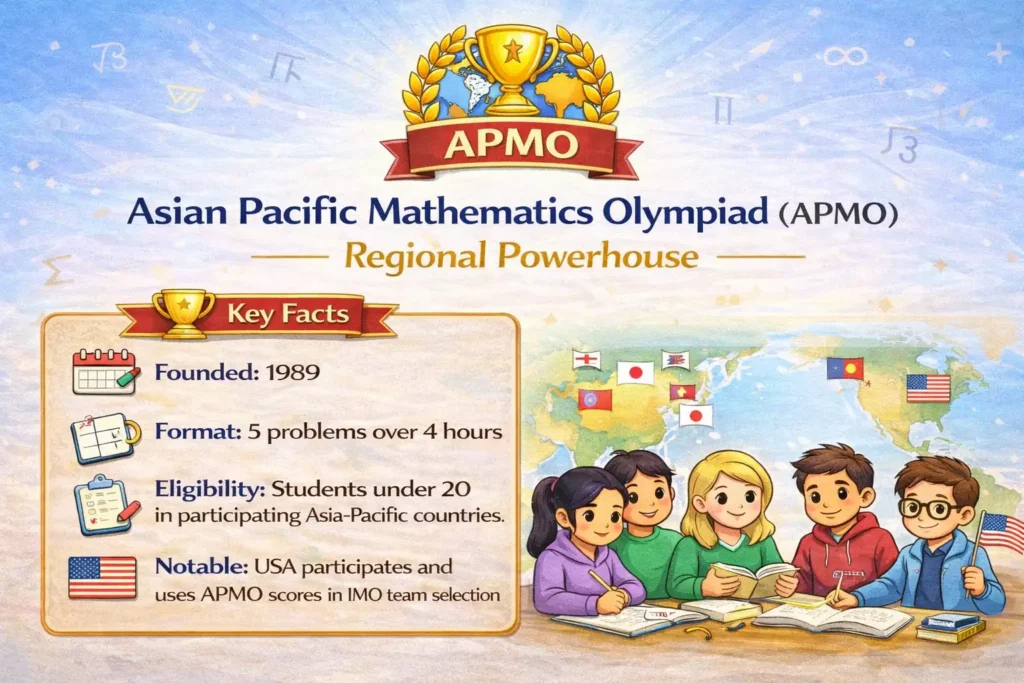
Key Facts About the APMO
- Founded: 1989
- Format: 5 problems over 4 hours
- Eligibility: Students under 20 in participating Asia-Pacific countries
- Notable: The USA participates and uses APMO scores in IMO team selection
The APMO is especially important for countries with strong math olympiad traditions, including China, South Korea, Japan, and Australia.
Performance at the APMO often directly influences which students are selected for the national IMO team. It is easier than the IMO, roughly comparable to a strong national olympiad, which is why it works well as a selection filter rather than a final destination.
4. European Girls’ Mathematical Olympiad (EGMO): Top Competition for Girls
Founded in 2012, EGMO has rapidly become one of the world’s most important math competitions.
It is specifically designed to encourage and celebrate mathematical talent in young women.
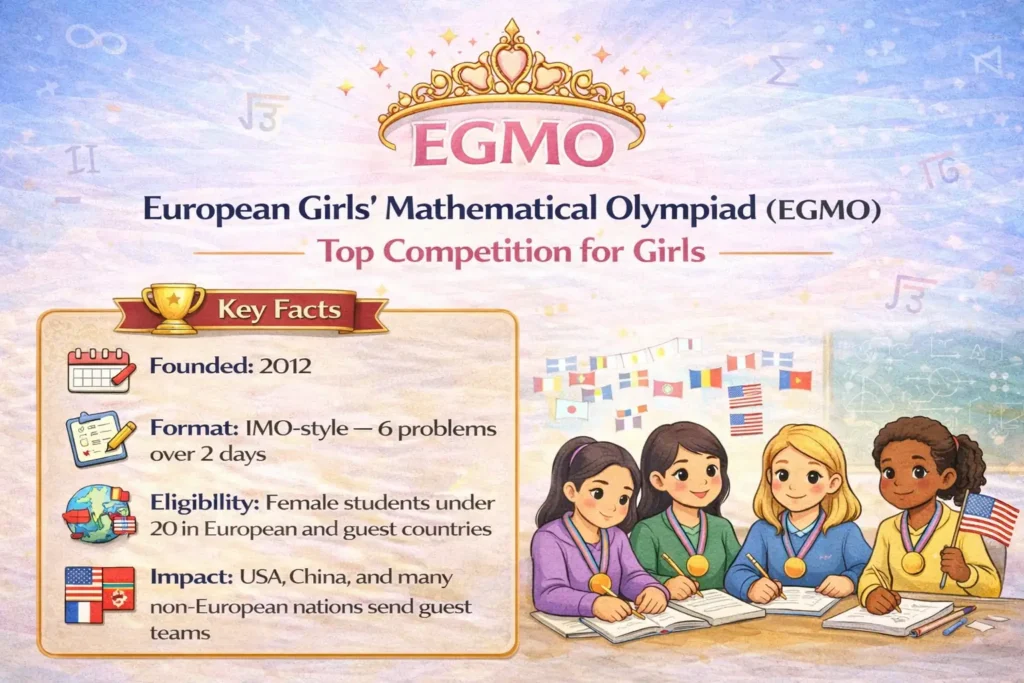
Key Facts About EGMO
- Founded: 2012
- Format: IMO-style, 6 problems over 2 days
- Eligibility: Female students under 20 in European and guest countries
- Impact: USA, China, and many non-European nations send guest teams
EGMO is not only a top-tier competition on its own.
It is also a proven pathway to the IMO for many female mathematicians who go on to represent their countries at the international level.
On difficulty, EGMO sits a step below the IMO. The problems are IMO-style proofs but pitched slightly more accessibly, which makes it an excellent bridge between a national olympiad and the IMO itself.
5. American Mathematics Competitions (AMC 8, 10, 12): Best Entry Point in the USA
The AMC series is the most important math competition pathway in the United States.
It is also the primary route to the IMO for American students and one of the most widely recognized competitions globally.
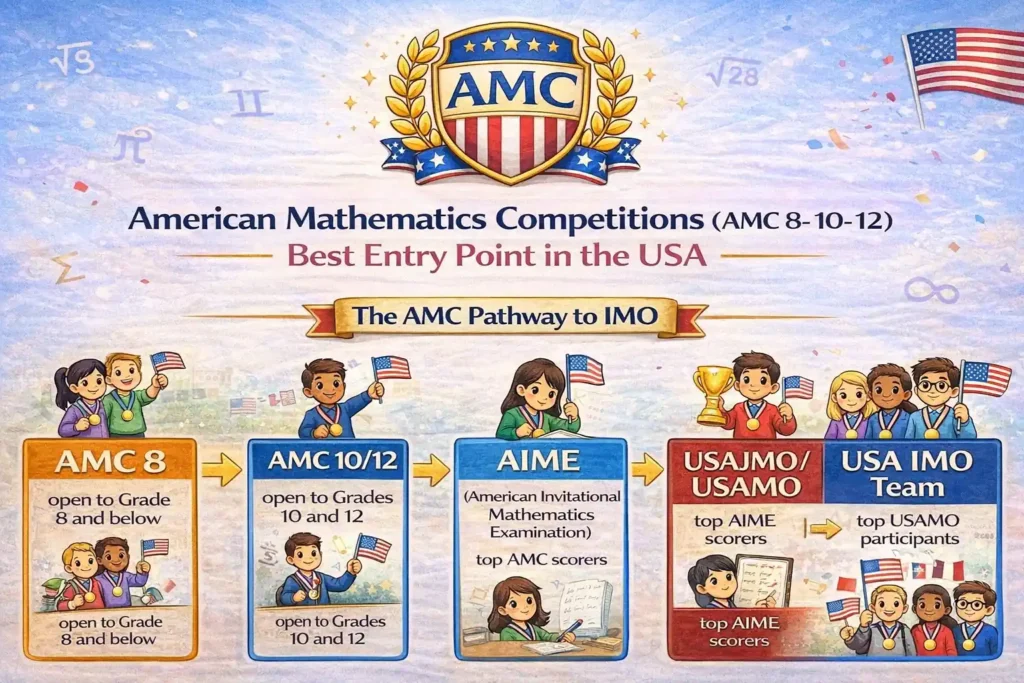
The AMC Pathway to the IMO
- MATHCOUNTS (optional, grades 6 to 8), a separate national coaching program and competition series many middle schoolers take alongside or before the AMC 8
- AMC 8, open to Grade 8 and below
- AMC 10 and AMC 12, open to Grade 10 and below and Grade 12 and below respectively
- AIME (American Invitational Mathematics Examination), which top AMC 10 and 12 scorers qualify for
- USAJMO and USAMO, which top AIME scorers advance to
- USA IMO Team, selected from top USAMO participants after a summer training camp
MATHCOUNTS and AIME: Two Terms Students Often Confuse With the AMC
Two terms come up constantly in AMC-related searches: MATHCOUNTS and AIME.
MATHCOUNTS is a separate national math competition and coaching program for grades 6 to 8 in the United States. It is not part of the AMC pathway, but many strong AMC 8 competitors also compete in MATHCOUNTS, since both test similar problem-solving skills at the middle school level.
AIME is not a stand-alone competition. It is the second step in the AMC pathway, open only to students who score high enough on the AMC 10 or AMC 12. AIME problems use an integer-answer format and are harder than AMC problems, but they are not yet proof-based like the USAMO or the IMO.
In short: MATHCOUNTS runs alongside the AMC 8 for middle schoolers, while AIME sits directly between the AMC 10/12 and USAMO for high schoolers aiming at the IMO.
What Makes the AMC Different
The AMC competitions use multiple-choice and short-answer formats. This makes them more accessible than proof-based olympiads.
However, high AMC scores still require great problem-solving skills well beyond the standard school curriculum.
If you are preparing for the AMC, understanding the AMC syllabus and knowing how to prepare for the AMC are essential first steps.
The AMC is also popular internationally. Schools outside the USA can register for the AMC 8, 10, and 12 exams.
Many students worldwide use the AMC pathway to prepare for their national olympiad and IMO qualification.
Learn about AMC age limits and eligibility, and the benefits of AMC math for academic growth.
Learn more: What is a good AMC score? | AMC awards and honors | Average AMC scores
6. International Kangaroo Mathematics Contest (IKMC): World’s Largest Math Competition
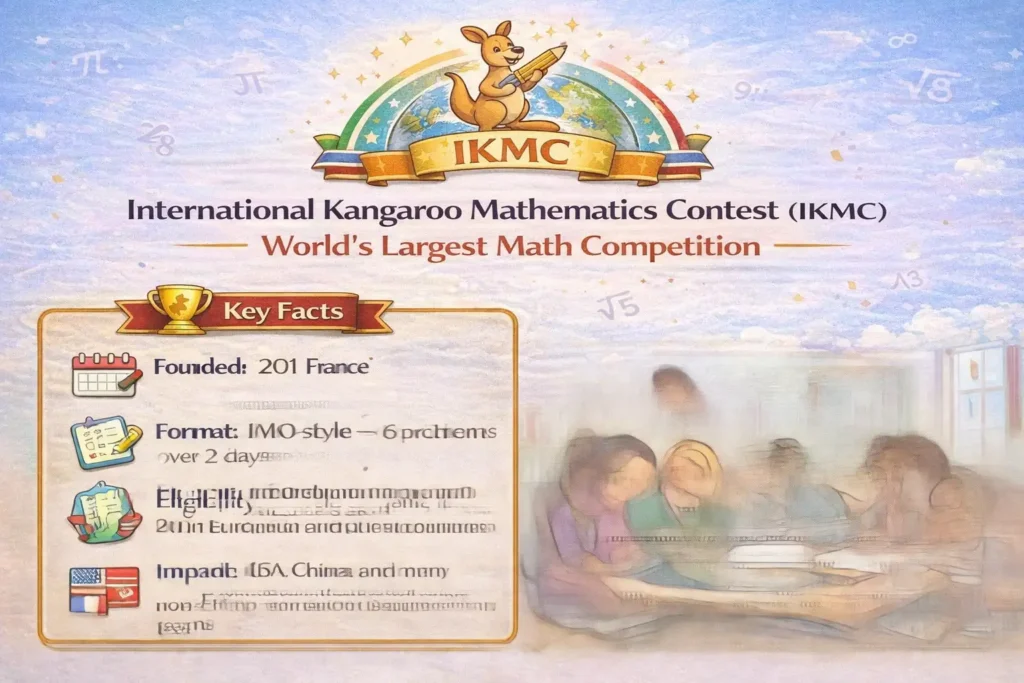
With roughly 6.5 million participants across more than 90 countries, Math Kangaroo is the biggest math competition in the world by participation.
No other contest is close. The IMO fields about 600 students. The AMC series draws over 300,000. Math Kangaroo draws more entrants in a single day than most countries have school-age mathematicians.
It is designed to make mathematics fun and accessible for students at all levels.
Key Facts About Math Kangaroo
- Founded: 1991 in France (originally called Kangourou des Mathematiques), inspired by an Australian contest
- Participants: About 6.5 million students across 90+ countries annually
- Format: Multiple-choice, 75 minutes, 24 or 30 questions depending on grade
- Scoring: No penalty for wrong answers
- Best for: Students of all ages looking for an engaging, low-pressure first competition
- Date: The third Thursday of March in most countries
Is Math Kangaroo Prestigious?
Math Kangaroo is not designed to be an elite olympiad. Its value lies in accessibility and engagement.
It is the ideal starting point for students who want to experience competition math without the extreme intensity of olympiad-level contests.
That said, Math Kangaroo should not be underestimated. Many IMO participants first competed in Kangaroo as younger students.
It builds confidence, sharpens logical thinking, and introduces key concepts in algebra, geometry, number theory, and combinatorics.
Learn more about what Math Kangaroo is, Math Kangaroo participation figures, Math Kangaroo prizes, and how to prepare for Math Kangaroo
7. China Girls Math Olympiad (CGMO): Elite Competition for Female Mathematicians
The CGMO is a prestigious, invitation-only competition for female high school students.
Its format closely mirrors the IMO. Originally focused on China, it has expanded to include top international teams.
Key Facts About the CGMO
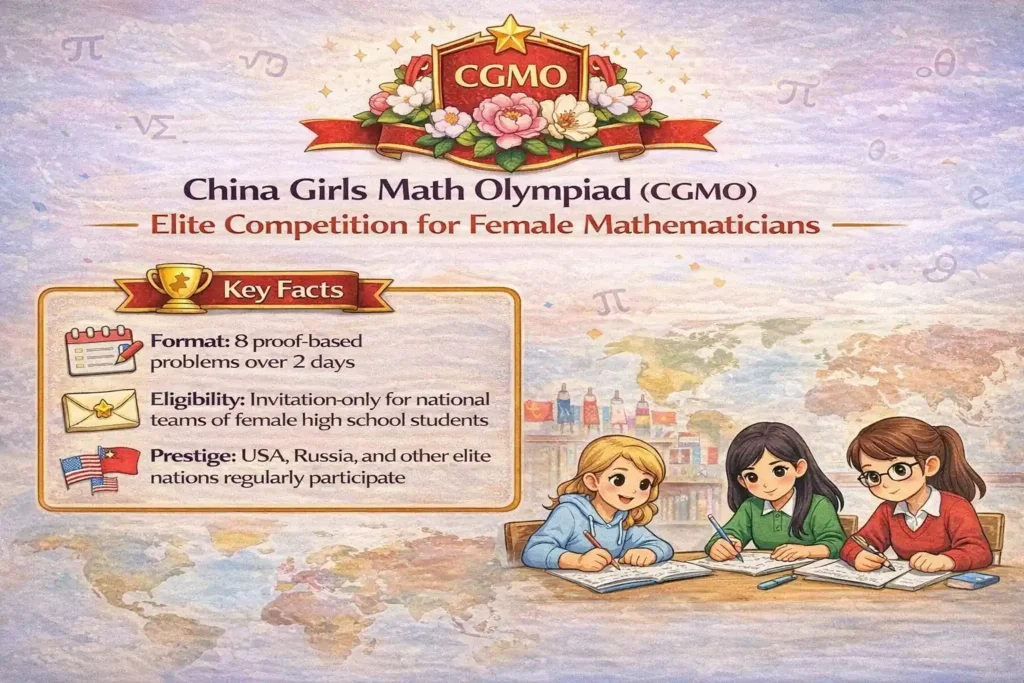
- Format: 8 proof-based problems over 2 days
- Eligibility: Invitation-only for national teams of female high school students
- Prestige: USA, Russia, and other elite nations regularly participate
The CGMO, along with EGMO, plays an important role in encouraging gender diversity in competitive mathematics at the highest level.
10 More Math Competitions Worth Knowing
The seven above are the headline names, but they are not the whole landscape. These are the contests that come up most often once you start looking, grouped by who they are for.
| Competition | Level | Format | Worth entering if |
|---|---|---|---|
| ARML | High school, team | Team and relay rounds, one weekend | You want collaborative competition, not just individual |
| HMMT | High school, team and individual | Mixed rounds, hosted by Harvard and MIT | You are at AIME level and want a harder challenge |
| Stanford Math Tournament | High school | Onsite and online divisions | You want a university-hosted tournament with an online option |
| PUMaC | High school | Individual and team, at Princeton | You want a strong tournament that accepts solo entrants |
| MOEMS | Grades 4 to 8 | Five short contests across the school year | Your school wants a low-barrier series for younger students |
| Continental Math League | Grades 2 to 12 | Short in-school meets | You want regular practice rather than one big day |
| Noetic Learning Math Contest | Grades 2 to 8 | 45-minute in-school contest | You want an elementary-level entry point in the USA |
| MATHCOUNTS | Grades 6 to 8 | Chapter, state and national rounds | Your student is strong at AMC 8 level and enjoys team play |
| USAMTS | High school | Month-long proof rounds, open book | You want to practise proof-writing without time pressure |
| Math Prize for Girls | High school, female | One paper at MIT, large cash prizes | You are a female student at AMC or AIME level in the USA |
Two more deserve a mention for university students. The Simon Marais Mathematical Competition is a newer contest for undergraduates across the Asia-Pacific region, notable for problems with genuinely open endings where the best submitted solution can extend the known result.
The Romanian Master of Mathematics (RMM) is an invitational for national teams that is widely considered harder than the IMO itself, which is why it appears in US Team Selection Test scoring.
Outside the USA, the major national routes are IOQM, RMO and INMO in India, and the SOF and Silverzone school olympiads. See the SOF IMO syllabus and Silverzone sample papers for those.
Why the IMO Is Still the Best Math Competition in the World
Several competitions are elite. But the IMO stands alone.
Here is why.
| Factor | Why the IMO Wins |
|---|---|
| History | 65+ years running. The oldest international math competition. |
| Global scale | 100+ countries. No other olympiad comes close. |
| Difficulty | 6 open-ended proof problems. Creative, original solutions required. |
| Prestige | Fields Medalists and Abel Prize winners began here. |
| Recognition | Top universities worldwide actively recruit IMO medalists. |
| Legacy | Has defined careers and inspired generations of mathematicians. |
How the IMO Compares to Other Top Competitions
Many students and parents ask how the IMO stacks up against other well-known math contests. Here are the most common comparisons.
IMO vs AMC
The AMC series uses multiple-choice and short-answer problems that can be solved in minutes. IMO problems require original mathematical proofs and can take hours.
The two competitions are not directly comparable in difficulty. However, the AMC is the starting gateway for American students who eventually aim for the IMO.
IMO vs USAMO
USAMO is the US national olympiad and the direct qualifying round for the IMO team. Both use six proof problems over two days with identical scoring, so the format is the same.
The difference is the field. USAMO draws around 500 US students. The IMO draws the best six from each of 100 plus countries. USAMO problems are set slightly below IMO difficulty, which is intentional, since USAMO has to separate the top 60 from the top 500 rather than the top 6 from the top 600.
Math Kangaroo vs AMC
Math Kangaroo is designed for accessibility and engagement across all grade levels. The AMC is more competitive and directly feeds into the olympiad pipeline.
For younger students in grades 1 to 6, Math Kangaroo is a better starting point. For students in grades 8 and above who want to pursue competitive math seriously, the AMC is the stronger choice. Math Kangaroo vs AMC compares them in full.
Math Kangaroo vs Math Olympiad
Math Kangaroo focuses on fun, logical thinking, and broad participation. National and international math olympiads focus on deep, proof-based problem solving for elite students.
They serve different purposes but complement each other well. For a detailed breakdown, see the difference between Math Olympiad and Kangaroo Math.
IMO vs MATHCOUNTS vs AIME
MATHCOUNTS and AIME sit much earlier on the difficulty ladder than the IMO. MATHCOUNTS uses grade-appropriate number sense and sprint-round problems aimed at students in grades 6 to 8. AIME uses harder, integer-answer problems that come after the AMC but are still short-answer, not proof-based.
The IMO, by contrast, requires full written proofs on open-ended problems that can take hours to solve. A typical US student’s path runs from MATHCOUNTS or AMC 8, through AMC 10/12, then AIME, then USAMO, before reaching IMO team selection.
Which Math Competition Should YOU Enter?
Choosing the right competition depends on your age, skill level, and goals.
| If you are… | Start with… | Goal |
|---|---|---|
| Grade 1 to 6 | Math Kangaroo | Build love of math, low-pressure experience |
| Grade 6 to 8 | AMC 8, MATHCOUNTS, MOEMS or Math Kangaroo | Develop problem-solving, build competition experience |
| Grade 9 to 12 (USA) | AMC 10/12, then AIME, then USAMO | Pathway toward IMO, college admissions advantage |
| Grade 9 to 12 (Global) | National olympiad, then IMO | Represent your country at the world’s top contest |
| Wanting team competition | ARML, HMMT, PUMaC | Collaborative problem solving and relay rounds |
| Female students | EGMO, CGMO or Math Prize for Girls | IMO-level challenge in an encouraging environment |
| Undergraduates (North America) | Putnam Competition | Hardest university-level math contest |
| Undergraduates (worldwide) | IMC or Simon Marais | Top math competitions for university students |
Example: how to qualify for the IMO from Bangladesh.
Which Math Competition Should YOU Enter?
Choosing the right competition depends on your age, skill level, and goals.
| If you are… | Start with… | Goal |
| Grade 1 to 6 | Math Kangaroo | Build love of math, low-pressure experience |
| Grade 6 to 8 | AMC 8, MATHCOUNTS, or Math Kangaroo | Develop problem-solving, build competition experience |
| Grade 9 to 12 (USA) | AMC 10/12, then AIME, then USAMO | Pathway toward IMO; college admissions advantage |
| Grade 9 to 12 (Global) | National olympiad, then IMO | Represent your country at the world’s top contest |
| Female students | EGMO or CGMO | IMO-level challenge in an encouraging environment |
| Undergraduates | Putnam Competition | Hardest university-level math contest in North America |
| College students (international) | International Mathematics Competition (IMC) | Top math competition for university students worldwide |
Do Math Competitions Help With College Admissions?
Yes, and the effect is larger than most extracurriculars, because competition results are nationally benchmarked and verifiable rather than self-reported.
Several selective universities ask for AMC and AIME scores directly on their application forms. An AIME qualification signals the top few percent of a large national field. A USAMO qualification narrows that to roughly 500 students nationally. An IMO medal is among the strongest credentials a school student can hold in any subject.
Two honest caveats. Admissions decisions are made on the whole application, so no single result carries it. And the students who progress furthest are rarely the ones competing for admissions reasons, because the workload only sustains itself if you enjoy the problems.
The benefits of AMC math covers the longer-term case in detail.
Best Math Competitions for Kids and Middle School Students
If you are a parent or teacher looking for the best math competitions for kids, here are the top options by age group.
Grades 1 to 5: Math Kangaroo is the best starting point. It is available in 90+ countries, uses age-appropriate problems, and makes math feel like a game. In the USA, the Noetic Learning Math Contest is a good in-school alternative.
Grades 6 to 8: The AMC 8 is the most recognized competition for middle school students in the USA. MATHCOUNTS is a strong companion program for the same age group, with its own chapter, state, and national rounds. MOEMS and the Continental Math League run shorter contests across the school year, which suits schools that want regular practice rather than one big day.
Many countries also have junior divisions of their national math olympiad. See how to prepare for the Junior Math Olympiad for more.
The key is to start early and build confidence. Most IMO participants began serious competition math by age 12 to 14.
For students who want to aim high from the start, how to get full marks in a maths olympiad covers proven strategies.
Best Math Competitions for Kids and Middle School Students
If you are a parent or teacher looking for the best math competitions for kids, here are the top options by age group.
Grades 1 to 5: Math Kangaroo is the best starting point. It is available in 80+ countries, uses age-appropriate problems, and makes math feel like a game.
Grades 6 to 8: The AMC 8 is the most recognized competition for middle school students in the USA. MATHCOUNTS is a strong companion program for the same age group, with its own chapter, state, and national rounds. Math Kangaroo remains a great option internationally.
Many countries also have junior divisions of their national math olympiad. See our guide on how to prepare for the Junior Math Olympiad for more tips.
Other popular math competitions for kids include: Noetic Learning Math Contest, Math League, MATHCOUNTS, and the Continental Mathematics League (CML).
The key is to start early and build confidence. Most IMO participants began serious competition math by age 12 to 14.
For students who want to aim high from the start, our guide on how to get full marks in a maths olympiad covers proven strategies.
How to Prepare for the World’s Best Math Competitions
Whether you are aiming for the IMO or just starting out with Math Kangaroo, the preparation principles are the same.
.
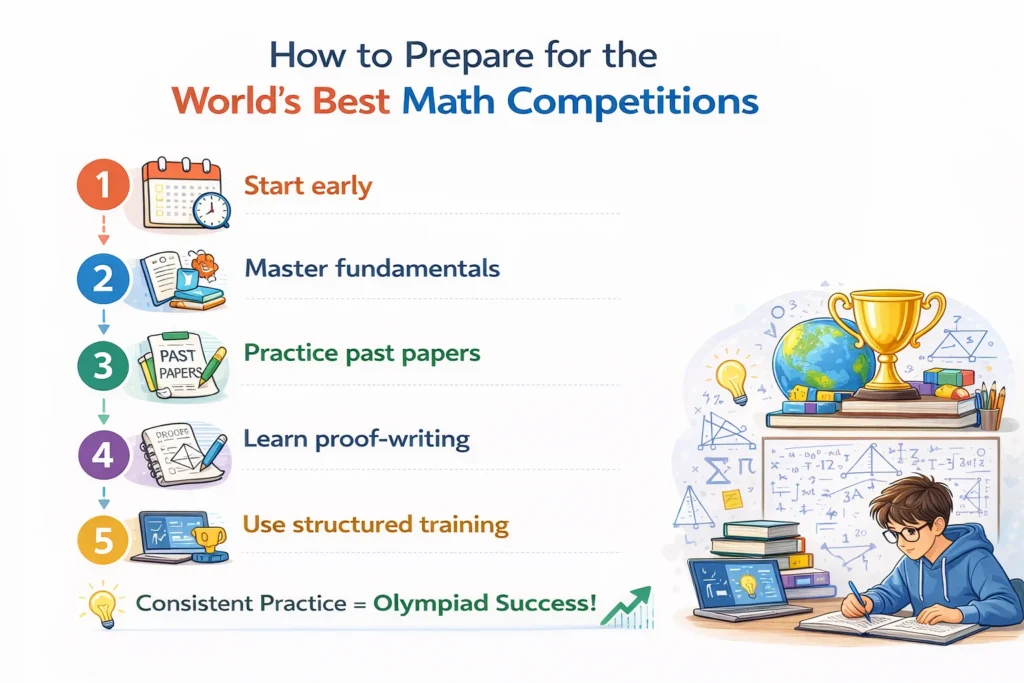
- Start early. Most IMO participants began serious competition math by age 12 to 14.
- Master the fundamentals. Strong skills in algebra, number theory, geometry, and combinatorics are essential at any level. Find out what types of questions are asked in math olympiads to focus your study.
- Practice past papers. Every major competition publishes archives of past problems. Solving these is the single most effective training method. Learn how to solve math olympiad problems with proven strategies.
- Learn proof-writing. For olympiad-level competitions, being able to write rigorous mathematical proofs is non-negotiable. How to improve problem-solving skills for the IMO covers this in depth.
- Use structured training. Online platforms, math circles, and olympiad books such as Art of Problem Solving accelerate growth significantly.
- Join a community. Forums like Art of Problem Solving connect students with peers and mentors who share strategies and motivation.
Learn more: free math olympiad training online.
How Much Do Math Competitions Cost to Enter?
Entry costs vary a lot by competition, and they can change year to year, so always confirm current fees with the official organizer.
Math Kangaroo and the AMC series are generally the most accessible, with modest per-student fees typically collected through a registered school, math club, or coordinating center. MATHCOUNTS is often free for students, since chapter and state competitions are funded through school participation and sponsorships rather than individual entry fees.
Higher-level competitions like the IMO do not charge individual students to compete. Selected national team members are supported by their country’s math olympiad committee, though families sometimes cover costs for earlier training camps or regional qualifying rounds.
Before registering for any competition, check with your school’s math coordinator or the official competition website for the most current fee structure and registration deadlines.
What Is the Toughest Olympiad in the World?
A common question: what is the hardest olympiad in the world across all subjects?
In mathematics specifically, the IMO and Putnam are universally recognized as the two hardest math competitions in existence, for their respective age groups. Among invitational contests, the Romanian Master of Mathematics is often rated harder than the IMO, though it is much smaller and by invitation only.
When comparing across subjects, the International Physics Olympiad (IPhO) and the International Olympiad in Informatics (IOI) are also considered among the most rigorous. But for pure mathematics, no competition rivals the IMO in terms of proof-based difficulty and global prestige.
The IMO’s hardest problems, particularly Problem 3 and Problem 6, have stumped entire national teams. These problems represent the absolute frontier of pre-university mathematical thinking.
What is the hardest math competition in the world?
The IMO and the Putnam Competition are generally considered the two hardest math competitions in the world. The IMO is the hardest at high school level; the Putnam is the hardest for undergraduates. Both have median scores that are extremely low, even among top students.
Is the IMO harder than the AMC?
Yes, significantly. The AMC series uses multiple-choice and short-answer problems that can be solved in minutes. IMO problems require original mathematical proofs and can take hours — or remain unsolved entirely. The two competitions are not directly comparable in difficulty.
What math competitions can middle school students enter?
Middle school students can enter the AMC 8 (USA), Math Kangaroo (worldwide), and many national olympiads that have junior divisions. These competitions are excellent for building the foundations needed for harder Olympiads in high school.
How many countries participate in the IMO?
Over 100 countries participate in the IMO each year, typically sending teams of up to 6 students each. The contest has been held every year since 1959 (with the exception of 1980), making it the longest-running international academic olympiad in the world.
Can students outside the USA enter the AMC?
Yes. While the AMC is organized by the Mathematical Association of America (MAA) and primarily targets US students, international schools can register to take the AMC 8, 10, and 12 exams. Many students worldwide use the AMC pathway to prepare for their national olympiad and IMO qualification.
What is the most prestigious math olympiad in the world?
The International Mathematical Olympiad (IMO) is the most prestigious math olympiad in the world. It has been running since 1959, draws participants from over 100 countries, and is the gold standard for pre-university mathematical excellence.
Is Math Kangaroo a prestigious competition?
Math Kangaroo is the world’s largest math competition by participation, with over 6 million students in 80+ countries. While it is not as difficult as the IMO or national olympiads, it is highly respected as an introductory competition that builds mathematical thinking skills.
What is the biggest math competition in the world?
By number of participants, the International Kangaroo Mathematics Contest (Math Kangaroo) is the biggest math competition in the world, with over 6 million students competing annually. By prestige and difficulty, the International Mathematical Olympiad (IMO) is the top competition.
What are the best math competitions for high school students?
The best math competitions for high school students include the AMC 10/12 (USA), national math olympiads, EGMO (for female students), APMO (Asia-Pacific), and the IMO. The right choice depends on your country, skill level, and long-term goals.
Is there a math olympiad for college students?
Yes. The William Lowell Putnam Mathematical Competition is the premier math olympiad for university students in North America. Internationally, the International Mathematics Competition for University Students (IMC) is the top math competition for college and university students.
What is the toughest olympiad in the world?
In mathematics, the IMO (high school level) and Putnam (university level) are the two hardest math competitions. For the most difficult academic olympiad overall, the IMO is the most widely cited due to its extreme difficulty, global scale, and 65+ year history.
Is the Putnam harder than the IMO?
This is debated. Both are considered the hardest competitions in their respective categories. The Putnam tests more university-level topics across 12 problems in 6 hours; the IMO requires deep creative proofs over two days. Most competitors who have experienced both describe them as equally difficult in different ways.
Is MATHCOUNTS the same as the AMC
No. MATHCOUNTS is a separate competition and coaching program for grades 6 to 8, run independently of the AMC. The MAA organizes the AMC (American Mathematics Competitions) for grades 8 through 12. Many middle schoolers compete in both, since the two test similar problem-solving skills.
Is AIME harder than the AIME?
Yes. The AIME is the qualifying round that follows a high score on the AMC 10 or AMC 12. It uses harder, integer-answer problems and acts as the bridge between the AMC and the proof-based USAMO, which is itself a qualifying step toward the IMO.
Make Preparing for Math Olympiad Simple!



Final Verdict
The International Mathematical Olympiad (IMO) is the best math competition in the world. It has held that position for over 65 years.
No other contest matches its combination of global scale, legendary difficulty, and transformative prestige.
But every competition on this list has value. Math Kangaroo builds a love of math in young students. MATHCOUNTS and the AMC create the strongest middle and high school mathematicians in the USA.
EGMO and CGMO create world-class opportunities for female mathematicians. And the Putnam challenges the sharpest university minds in North America.
The best competition for you is the one that challenges you, excites you, and gives you room to grow. Start where you are and aim for the top.
Explore More on Gonit
- How to qualify for the IMO in the USA
- What is a good AMC score?
- Free math olympiad training online
- How to prepare for Math Kangaroo
- AMC awards and honors explained
- What types of questions are in math olympiads?
- MOEMS Math Olympiad guide
- Continental Math League parent guide
- AMC 2026-27 test dates and deadlines

Mikha Piregu is a Content Writer with experience spanning educational content, including math and math olympiad topics, as well as advocacy writing, research-based articles, and SEO-driven web content. He creates high-quality blog content, web copy, and feature articles that support brand visibility, audience engagement, and long-term organic growth through data-informed storytelling. Skilled in WordPress, WooCommerce, and modern digital tools, Mikha adapts content across various platforms, including blogs, websites, campaigns, and advocacy initiatives, with clarity and purpose.



There are no comments posted here yet.
Sign in to leave a comment