


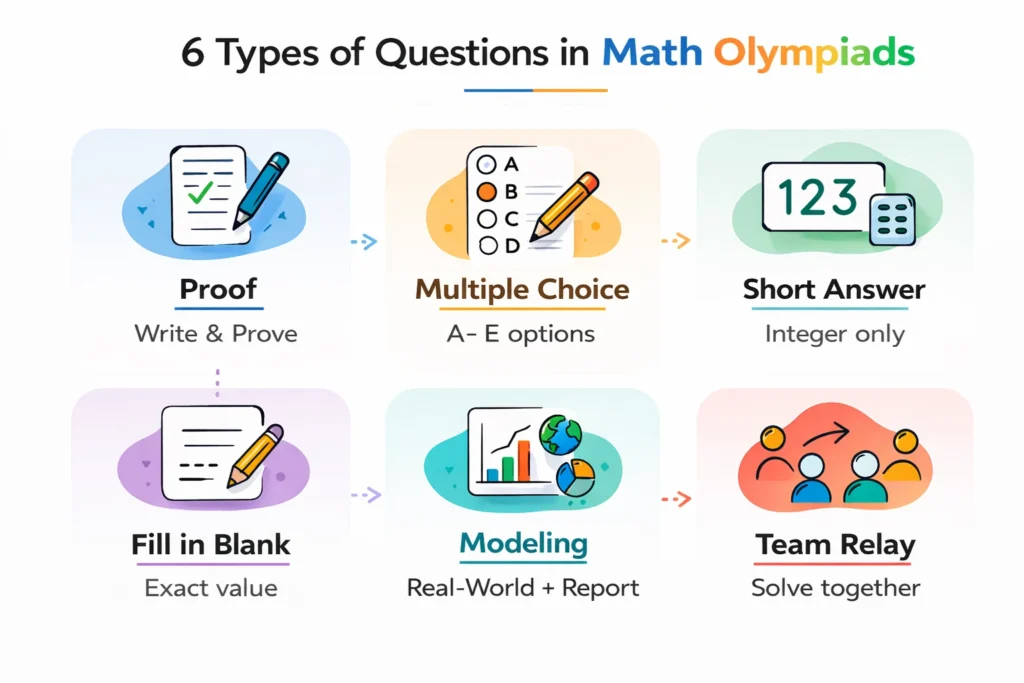
Math olympiad questions come in six formats: proof-based problems, multiple-choice, short answer, fill-in-the-blank, exploratory modelling, and team relay problems.
- Types of Math Olympiad Questions — At a Glance
- The 6 Types of Questions Asked in Math Olympiads
- Math Olympiad Exam Format by Competition
- Math Olympiad Questions by Grade: 30 Samples With Solutions
- Printable Math Olympiad Question Sets by Grade
- Main Topics Covered in Math Olympiad Questions
- Math Olympiad Difficulty Levels Explained
- What Is a Math Olympiad? A Quick Overview
- Hardest Math Olympiad Questions: What Makes Them Difficult?
- Math Olympiad Questions with Solutions: Where to Find Practice Problems
- How to Prepare for Math Olympiad Questions
- Final Thoughts
Which one you face depends on the competition, not the country. Beginner contests like Math Kangaroo use multiple choice. Elite olympiads like the IMO use open-ended proofs.
All of them test creative problem-solving rather than recall, and nearly all draw from four topics: algebra, number theory, geometry, and combinatorics.
Math olympiad questions are fundamentally different from school math.
They test creative problem-solving and rigorous logical reasoning, your ability to apply basic principles in unconventional ways across four core subjects: number theory, algebra, combinatorics, and geometry.
This guide covers 6 major types of math olympiad questions, key topics, difficulty levels, and 30 sample problems with solutions by grade. It also explains how to prepare for competitions from Math Kangaroo to the IMO.

What Types of Questions Are Asked in Math Olympiads?
Math olympiads ask 6 main types of questions: (1) proof-based problems, (2) multiple-choice, (3) short answer/numerical response, (4) fill-in-the-blank, (5) exploratory/modeling problems, and (6) team-based problems. The format depends on the competition level beginner contests use multiple-choice, while advanced olympiads like the IMO use open-ended proofs.
6 Types of Math Olympiad Questions — At a Glance
| Question Type | Used In | Skills Tested | Example Contest |
|---|---|---|---|
| Proof-Based Problems | IMO, USAMO, INMO | Deep reasoning, proof-writing | IMO, APMO |
| Multiple-Choice | AMC 8/10/12, Kangaroo | Speed, accuracy, intuition | AMC, SEAMO |
| Short Answer / Numerical | AIME, regional olympiads | Precision, calculation | AIME, BdMO |
| Fill-in-the-Blank | Junior olympiads | Conceptual understanding | APMOPS, SMO Junior |
| Exploratory / Modeling | HiMCM, IMMC | Creativity, applied math | HiMCM, IMMC |
| Team-Based Problems | ARML, relay rounds | Collaboration, speed | ARML, HMMT |
The 6 Types of Questions Asked in Math Olympiads
1. Proof-Based Problems (Subjective Questions)
Proof-based problems are the defining format of elite math olympiads.
Instead of just calculating an answer, you must construct a rigorous logical argument that proves a statement is true for all cases, not just one example.
These problems are found in the IMO, USAMO, APMO, EGMO, and most national olympiads at the advanced level, including INMO and RMO in India.
They test not just what you know, but how deeply and clearly you can reason.
- Format: Open-ended, written solution required
- Time allowed: Typically 4 to 4.5 hours for 3 problems
- Scoring: 7 points per problem at the IMO (0 to 7 scale)
- Skills needed: Logical deduction, proof-writing, mathematical creativity
Example problem type: Prove that for any positive integers a and b, the expression a² + b² cannot be divisible by 3 unless both a and b are divisible by 3.
Why it matters: A proof-based answer that is elegant and concise often scores higher than a lengthy but clunky one. Olympiad judges reward insight.
IMO problems at positions 3 and 6 are widely considered the hardest math questions given to high school students anywhere in the world.
2. Multiple-Choice Questions (Objective Questions)
Multiple-choice questions appear in the qualifying rounds of major competitions, particularly in the AMC series, Math Kangaroo, and SEAMO.
They test speed, intuition, and the ability to eliminate wrong answers quickly.
The format may look familiar, but the problems are significantly harder than school multiple-choice tests.
A student who has never encountered olympiad-style questions will struggle even with the multiple-choice round.
- Format: 5 answer choices (A to E), one correct
- Time pressure: AMC 10/12 gives 75 minutes for 25 questions, about 3 minutes per question
- Scoring: AMC awards 6 points for a correct answer, 1.5 points for a blank, and 0 for a wrong answer, so a blank is worth more than a guess you cannot narrow down
- Skills needed: Pattern recognition, estimation, elimination strategies
Example problem type: How many integers between 1 and 1000 are divisible by 3 but not by 9?
The AMC awards 6 points for correct answers, but what score do you actually need to advance? See what is a good AMC score.
3. Short Answer / Numerical Response Questions
Short-answer questions ask for a precise numerical answer, no working required, just the final result.
This format is used in the AIME (American Invitational Mathematics Examination) and many regional olympiads, including the Bangladesh Mathematical Olympiad (BdMO) and IOQM in India.
The AIME is the critical bridge between the AMC multiple-choice rounds and the proof-based USAMO.
Its answers are always integers from 000 to 999, which makes guessing nearly impossible.
- Format: Integer answer only (no units, no fractions)
- AIME specifics: 15 questions, answers range from 000 to 999. From 2027 the paper is sat in two 90-minute parts rather than one three-hour block, and you cannot return to Part 1 once it closes
- Skills needed: Careful calculation, number theory, checking for errors
Example problem type: If a + b = 6 and ab = 8, find the value of a³ + b³.
The AIME is the bridge between AMC and USAMO. Want to know how your AMC score compares? See average AMC scores and AIME qualification cutoffs, and work through AIME problems to get a feel for the jump in difficulty.
4. Fill-in-the-Blank Questions
Common in junior-level olympiads and Asian regional competitions, fill-in-the-blank questions require a specific answer, a number, expression, or term, without multiple-choice options as a guide.
This format tests conceptual understanding more directly than multiple-choice.
- Found in: APMOPS, Singapore Mathematical Olympiad (Junior), SOF IMO Level 2, various Asian olympiads
- Skills needed: Clean calculation, conceptual clarity, no room for partial guessing
Example problem type: The sum of the interior angles of a polygon with n sides is 1800°. Find n.
5. Exploratory / Mathematical Modeling Problems
Exploratory and modeling questions appear in team competitions like HiMCM (High School Mathematical Contest in Modeling), the International Mathematical Modeling Challenge (IMMC), and the M3 Challenge.
These problems ask you to use math to analyze and solve a real-world scenario.
Instead of one clean answer, you produce a written report explaining your mathematical model, assumptions, and conclusions.
These competitions are evaluated on both mathematical rigor and clarity of communication.
- Format: Written report, team-based, 14 to 36 hours to complete
- Topics: Traffic optimization, disease spread modeling, resource allocation, social network analysis
- Skills needed: Applied math, data analysis, teamwork, written communication
Example problem type: Model how a viral post spreads through a social network of 10,000 users.
Identify the point at which the spread becomes self-sustaining.
6. Team-Based and Relay Problems
Team rounds appear in competitions like the American Regions Mathematics League (ARML) and the Harvard-MIT Mathematics Tournament (HMMT).
In relay rounds, each team member solves a problem and passes their answer to the next member, whose question depends on it.
- Format: 4 to 15 students per team, relay-style passing of answers
- Skills needed: Speed, accuracy under pressure, trusting teammates
- Found in: ARML, HMMT, NIMO, various state and national team olympiads
Team rounds reward not just individual ability but the ability to work quickly and accurately in a group setting, a valuable skill for mathematical research and collaboration.
Math Olympiad Exam Format by Competition
Different math olympiad competitions use very different exam formats.
Understanding the specific structure before you begin preparing is essential, because training for the wrong format is a major source of underperformance.
| Competition | Question Format | Number of Questions | Time Limit | Level |
|---|---|---|---|---|
| Math Kangaroo | Multiple-choice | 24 (Grades 1 to 4), 30 (Grades 5 to 12) | 75 min | Beginner |
| SOF IMO | Multiple-choice | 35 to 50 by class | 60 min | Beginner to Intermediate |
| AMC 8 | Multiple-choice | 25 | 40 min | Beginner to Intermediate |
| AMC 10/12 | Multiple-choice | 25 | 75 min | Intermediate |
| IOQM | Short answer (integer) | 30 | 3 hours | Intermediate to Advanced |
| AIME | Short answer (integer) | 15 | 2 parts of 90 min | Advanced |
| USAMO/USAJMO | Proof-based | 6 | 2 days x 4.5 hrs | Advanced |
| INMO | Proof-based | 6 | 4 hours | Advanced |
| IMO | Proof-based | 6 | 2 days x 4.5 hrs | Elite |
| HMMT | Mixed (individual + team) | Varies | Varies | Advanced |
Math Olympiad Questions by Grade: 30 Samples With Solutions
The fastest way to understand olympiad math questions is to try some. Below are five sample problems for each grade band, from Grade 1 through Grade 12, with worked solutions.
Try each one before reading the solution. The struggle is where the learning happens.
Math Olympiad Questions for Grades 1 and 2
At this level the arithmetic is simple. The difficulty comes from reading carefully and reasoning in order.
1. The pattern goes 2, 4, 6, 8, and keeps going the same way. What is the tenth number?
Solution: The numbers go up by 2 each time, so the tenth is 2 x 10 = 20.
2. I am a number between 10 and 20. You say my name when you count by 3s. My two digits add up to 3. What number am I?
Solution: Counting by 3s between 10 and 20 gives 12, 15, 18. Their digit sums are 3, 6, and 9. Only 12 has a digit sum of 3. Answer: 12.
3. A square is cut along both of its diagonals. How many triangles can you count in the finished picture?
Solution: There are 4 small triangles, and each pair of neighbouring small triangles forms a bigger one, giving 4 more. Total: 8 triangles.
4. You have three coins worth 1, 2, and 5. Using one or more coins, how many different totals can you make?
Solution: 1, 2, 5, 3 (1+2), 6 (1+5), 7 (2+5), 8 (1+2+5). That is 7 different totals.
5. Seven children stand in a line. Rina is third from the front. What position is she from the back?
Solution: Three children stand from the front up to and including Rina, so 7 − 3 = 4 stand behind her. Counting Rina, she is fifth from the back.
Students at this level benefit most from pattern and ordering practice. Skip counting for class 1, number sequence for class 1 maths, and odd one out for class 1 build exactly the reasoning these questions test.
Math Olympiad Questions for Grades 3 and 4
Multiplication fluency and simple number theory start to appear here, along with the first spatial reasoning questions.
1. What is the smallest number greater than 100 that is divisible by both 4 and 6?
Solution: A number divisible by both is divisible by their lowest common multiple, 12. The multiples of 12 near 100 are 96 and 108. Answer: 108.
2. A 3 x 3 x 3 cube is painted on all six faces, then cut into 27 unit cubes. How many of the small cubes have exactly two painted faces?
Solution: Exactly two faces are painted on the cubes along an edge but not at a corner. A cube has 12 edges, and each edge contributes one such cube here. Answer: 12.
3. Use the digits 1, 2, 3, and 4 once each to form two two-digit numbers. What is the largest product you can make?
Solution: The two largest digits should lead. Testing 41 x 32 = 1312 and 42 x 31 = 1302, the larger is 1312, from 41 x 32.
4. A pencil costs 8 taka more than an eraser. Together they cost 30 taka. What does the pencil cost?
Solution: Remove the 8 taka difference: 30 − 8 = 22, so two erasers cost 22 and one costs 11. The pencil is 11 + 8 = 19 taka.
5. What is the angle between the hands of a clock at 3:30?
Solution: The minute hand points at 6, which is 180° from 12. The hour hand is halfway between 3 and 4, at 90° + 15° = 105°. The angle between them is 180 − 105 = 75°.
Supporting practice: multiplication for class 1, how to tell time on a clock, and math puzzles for 2nd graders.
Math Olympiad Questions for Grades 5 and 6
This is where counting arguments, remainders, and multi-step word problems arrive.
1. Five consecutive whole numbers add up to 2025. What is the largest of them?
Solution: The five numbers average to the middle one, so the middle number is 2025 ÷ 5 = 405. The largest is 405 + 2 = 407.
2. On a 3 x 3 grid of squares, how many shortest paths run from the bottom-left corner to the top-right corner?
Solution: Every shortest path is 3 steps right and 3 steps up in some order, so the count is the number of ways to choose which 3 of the 6 steps go right: C(6,3) = 20.
3. What is the remainder when 2¹⁰⁰ is divided by 7?
Solution: The powers of 2 leave remainders 2, 4, 1, 2, 4, 1 and so on, repeating every 3. Since 100 = 3 x 33 + 1, the remainder matches that of 2¹, which is 2.
4. A rectangle has perimeter 36 and its length is twice its width. What is its area?
Solution: If the width is w, the length is 2w and the perimeter is 6w = 36, so w = 6 and the length is 12. Area = 6 x 12 = 72.
5. A drawer holds 10 black socks and 10 white socks, mixed up in the dark. How many socks must you take out to be certain of a matching pair?
Solution: Two socks might be one of each colour. A third sock must match one of them. Answer: 3 socks. This is the pigeonhole principle in its simplest form.
Math Olympiad Questions for Grades 7 and 8
The AMC 8 and Cadet-level papers sit here. Divisor counting, cyclic patterns, and classic geometry formulas become standard.
1. What is the last digit of 7²⁰²⁶?
Solution: The last digits of powers of 7 cycle 7, 9, 3, 1 with period 4. Since 2026 leaves remainder 2 when divided by 4, the last digit matches that of 7², which is 9.
2. How many positive divisors does 720 have?
Solution: 720 = 2⁴ x 3² x 5. The divisor count is (4+1)(2+1)(1+1) = 30.
3. If x + 1/x = 3, what is x² + 1/x²?
Solution: Square both sides: x² + 2 + 1/x² = 9, so x² + 1/x² = 7.
4. In how many ways can 8 people be seated around a round table, if seatings that differ only by rotation count as the same?
Solution: Fix one person to remove the rotations, then arrange the other 7: 7! = 5040.
5. A triangle has sides 13, 14, and 15. What is its area?
Solution: The semi-perimeter is s = 21. By Heron’s formula the area is √(21 x 8 x 7 x 6) = √7056 = 84.
For the content behind these, see 8th grade math topics and competition math for middle school.
Math Olympiad Questions for Grades 9 and 10
Junior-level olympiad and AMC 10 territory. Expect absolute values, factorial counting, inequalities, and circle theorems.
1. Find all real numbers x with x² − 5|x| + 6 = 0.
Solution: Write it in terms of |x|: |x|² − 5|x| + 6 = 0, so |x| = 2 or |x| = 3. The solutions are x = 2, −2, 3, −3.
2. What is the smallest positive integer n for which n! is divisible by 1000?
Solution: 1000 = 2³ x 5³, so n! needs three factors of 5. Multiples of 5 up to n supply them, and 5, 10, 15 give the third at n = 15. Factors of 2 are plentiful well before that.
3. For a positive real number a, what is the smallest possible value of a + 9/a?
Solution: By AM-GM, a + 9/a ≥ 2√9 = 6, with equality when a = 3.
4. How many four-digit numbers have four different digits?
Solution: The first digit has 9 choices (not 0), the second 9 (any remaining digit including 0), then 8 and 7: 9 x 9 x 8 x 7 = 4536.
5. Two chords AB and CD of a circle meet at a point P inside it. PA = 4, PB = 6, and PC = 3. Find PD.
Solution: By the intersecting chords theorem, PA x PB = PC x PD, so 24 = 3 x PD and PD = 8.
Useful background: factorisation in maths class 8 and the distance formula in geometry. For the competition route at this level, see the junior math olympiad guide.
Math Olympiad Questions for Grades 11 and 12
Senior olympiad level. Two of these ask for proofs, which is the format shift that catches most students moving up from AMC.
1. Prove that n³ − n is divisible by 6 for every integer n.
Solution: Factor it: n³ − n = (n−1)n(n+1), the product of three consecutive integers. Among any three consecutive integers at least one is even and exactly one is a multiple of 3, so the product is divisible by 2 and by 3, and therefore by 6. ∎
2. A function satisfies f(x) + 2f(1/x) = 3x for every non-zero real x. Find f(x).
Solution: Replacing x by 1/x gives f(1/x) + 2f(x) = 3/x. Double that equation and subtract the original: 3f(x) = 6/x − 3x, so f(x) = 2/x − x. Substituting back confirms it works.
3. The equation x³ − 6x² + 11x − 6 = 0 has three roots. What is the sum of their squares?
Solution: By Vieta’s formulas the roots sum to 6 and their pairwise products sum to 11. Then the sum of squares is 6² − 2(11) = 14.
4. In how many ways can 10 be written as an ordered sum of three positive integers?
Solution: Place two dividers in the nine gaps between ten units: C(9,2) = 36.
5. Prove that among any five integers, some two have a difference divisible by 4.
Solution: Every integer leaves a remainder of 0, 1, 2, or 3 on division by 4, which is four possible remainders. With five integers, two must share a remainder, and their difference is then divisible by 4. ∎
These last two are pigeonhole and Vieta arguments, the two techniques that appear most often in national olympiad papers. How to get full marks in maths olympiad covers how to write them up so they actually score.
Printable Math Olympiad Question Sets by Grade
Working on paper under a timer is closer to the real thing than solving on screen. Printable sets for each grade band, with the solutions on a separate page so you cannot peek, are the single most useful preparation resource for younger students in particular.
Gonit publishes free printable practice sets alongside the app. For the official past papers, which should form the backbone of your preparation, see the sources in the next section.
Main Topics Covered in Math Olympiad Questions

Regardless of question format, almost all math olympiad problems draw from the same core topic areas.
Understanding these topics deeply, not just superficially, is the most important part of your preparation.
| Topic | Key Subtopics | Most Common In |
|---|---|---|
| Algebra | Equations, inequalities, polynomials, functional equations, sequences | All levels |
| Number Theory | Divisibility, primes, modular arithmetic, Diophantine equations | IMO, USAMO, AIME |
| Geometry | Euclidean proofs, circles, triangles, transformations, coordinate geometry | IMO, APMO, EGMO |
| Combinatorics | Counting, graph theory, pigeonhole principle, invariants | IMO, AMC, AIME |
| Inequalities | AM-GM, Cauchy-Schwarz, Jensen’s, optimization problems | Advanced olympiads |
| Applied / Real-World | Ratios, percentages, probability, logic puzzles | Junior and beginner levels |
Math Olympiad Topics by Grade Level
The four core topics appear at every level. What changes is the depth.
| Grade band | Number and algebra | Geometry | Counting and logic |
|---|---|---|---|
| Grades 1 to 2 | Patterns, skip counting, place value | Shape recognition, simple symmetry | Ordering, odd one out, simple deduction |
| Grades 3 to 4 | Multiples, factors, two-step word problems | Area, perimeter, cube nets, angles | Systematic listing, simple counting |
| Grades 5 to 6 | Fractions, ratio, remainders, averages | Angle chasing, area of compound shapes | Grid paths, pigeonhole, simple casework |
| Grades 7 to 8 | Divisors, exponents, linear equations | Triangle centres, Pythagoras, Heron | Permutations, combinations, parity |
| Grades 9 to 10 | Quadratics, absolute value, sequences | Circle theorems, similar triangles | Binomial coefficients, inclusion-exclusion |
| Grades 11 to 12 | Functional equations, polynomials, inequalities | Full Euclidean proofs, trigonometry | Graph theory, invariants, bijections |
Calculus is deliberately absent from this table. The IMO explicitly excludes it, and so do almost all national olympiads, which is why a student strong in school calculus can still find olympiad papers unfamiliar.
Algebra, The Foundation of All Olympiad Math
Algebra appears in virtually every math olympiad at every level. At beginner level, you are solving equations.
At the IMO level, you are proving functional equations hold for all real numbers using creative substitutions and logical chains.
Key areas to master: solving and manipulating inequalities, understanding polynomial roots, recognizing patterns in sequences, and working with functional equations that have no obvious solution method.
Number Theory, The Deepest Rabbit Hole
Number theory problems often look deceptively simple and then require two pages of careful logic to solve.
This is one of the most rewarding and challenging areas of olympiad mathematics.
Focus on: modular arithmetic (the foundation of cryptography), prime factorization, properties of divisibility, and Diophantine equations (finding integer solutions to equations like x² + y² = z²).
Number theory is also one of the most heavily tested topics in the AMC series. See the full AMC syllabus breakdown.
Geometry, Visual Reasoning and Elegant Proofs
Geometry is a uniquely visual subject in olympiads. A well-drawn diagram can immediately suggest the proof strategy.
Many students who struggle with algebra-heavy subjects excel in geometry because the problems reward spatial intuition.
Master: circle theorems, angle chasing, similar triangles, power of a point, and the properties of key triangle points (centroid, circumcenter, incenter, orthocenter).
For younger students, that intuition starts with geometry for kids and spatial understanding.
Combinatorics, Counting Creatively
Combinatorics problems are beloved by olympiad coaches because they can be stated simply but require deep insight.
The pigeonhole principle, if you have more pigeons than pigeonholes then at least one hole has two pigeons, leads to some of the most surprising proofs in mathematics.
Study: permutations and combinations, bijections, double counting, graph theory basics, and the principle of inclusion-exclusion.graph theory basics, and the principle of inclusion-exclusion.
The Combinatorics Topics That Matter Most for IMO and USAMO
If you are training for national or international level, combinatorics is where preparation pays off most, because the topic rewards technique rather than accumulated content knowledge. In rough order of how often they carry an olympiad combinatorics problem:
- Pigeonhole principle, including the generalised form and its use in existence proofs
- Invariants and monovariants, the standard tool for “prove this process must stop” problems
- Extremal principle, choosing the largest or smallest object and arguing from it
- Double counting, counting the same set two ways to force an identity
- Bijections, replacing a hard count with an equivalent easy one
- Graph theory basics, degrees, connectivity, colouring, trees
- Colouring and parity arguments, especially for tiling and board problems
- Induction and recursion, both as proof method and as counting technique
A student who has genuinely absorbed these eight can attempt most olympiad combinatorics problems. The same list is why combinatorics tends to appear in the harder positions on the paper.
Distribution of Topics in International Mathematical Olympiad Problems
A common question among serious competitors is which topics appear most often in IMO problems.
Historically, the distribution across algebra, geometry, number theory, and combinatorics has been roughly even, with each appearing in about 25% of problems.
However, combinatorics and number theory tend to appear in the harder positions (problems 3 and 6), while algebra and geometry are more common in positions 1 and 4.
Understanding this distribution helps you allocate your study time effectively. If you are aiming for the IMO, neglecting any of the four core topics is a strategic mistake.
Math Olympiad Difficulty Levels Explained
One of the most common questions from students and parents is: “Is this competition right for my level?”
Here’s a clear breakdown of how difficulty scales across math olympiads:
| Level | Who It’s For | Question Format | Example Competitions |
|---|---|---|---|
| Beginner | Grades 1–6, first-timers | Multiple-choice, fun puzzles | Math Kangaroo, APMOPS Primary |
| Intermediate | Grades 7–10, developing skills | Mixed formats, some proofs | AMC 8/10, SMO Junior, BdMO |
| Advanced | Grades 10–12, serious competitors | Proof-based, 4–9 hours | AMC 12, USAMO, INMO, APMO |
| Elite/International | Top students from 100+ nations | 6 open proofs over 2 days | IMO, EGMO, CGMO |
| University | Undergraduates | Abstract proofs, 6 hours | Putnam, IMC |
The key insight: question difficulty is not just about the math involved, but the format.
A student who is excellent at multiple-choice AMC problems may struggle with open-ended IMO proofs, not because they lack knowledge, but because proof-writing is a completely different skill that must be developed separately.
Not sure which competition sits at your level? See the world’s top math competitions ranked by difficulty and prestige.
What Is a Math Olympiad? A Quick Overview
A math olympiad is a competitive mathematics examination designed to identify and nurture mathematical talent in students.
Unlike regular school exams, olympiad questions go beyond textbook formulas.
They require creative problem-solving, logical reasoning, and, at advanced levels, the ability to construct formal mathematical proofs.
Math olympiads exist at every level: local, regional, national, and international.
Some of the most well-known competitions include the International Mathematical Olympiad (IMO), the American Mathematics Competitions (AMC 8/10/12), Math Kangaroo, the Indian National Mathematical Olympiad (INMO), the SOF International Mathematics Olympiad, and the Bangladesh Mathematical Olympiad (BdMO).
The olympiad meaning, in the context of mathematics, is simply a high-level academic competition.
While the term originated from the ancient Olympic Games, a math olympiad focuses purely on problem-solving skills and mathematical reasoning.
Hardest Math Olympiad Questions: What Makes Them Difficult?
Many students wonder: what is the hardest type of question in math olympiads?
The answer is proof-based problems at the IMO level, specifically problems 3 and 6. These are intentionally designed to challenge even the world’s best mathematical minds.
A single problem may require 4 or more hours of sustained concentration, and most competitors score 0 points on problem 6.
What makes these problems so hard is not the advanced math they require, since the IMO explicitly excludes calculus.
It is the level of insight and creativity needed to find a solution path that does not exist in any textbook. You are essentially doing original mathematical research under time pressure.
Hard math questions in olympiads share these traits:
- they combine multiple topics, for example number theory plus combinatorics,
- they have no obvious starting point, and
- the solution requires an idea you have never seen before.
Math Olympiad Questions with Solutions: Where to Find Practice Problems
One of the best ways to prepare is by studying past math olympiad questions with solutions. Here is where to find them:
- AMC, AIME, USAMO: Art of Problem Solving (artofproblemsolving.com) hosts a complete archive of past papers with community solutions. Start with AMC 8 practice tests or AMC 10 practice tests depending on your level.
- IMO: The official IMO website (imo-official.org) publishes all problems, plus the annual Shortlist with official solutions, from 1959 to the present. The Shortlist is the single best source of olympiad-level practice that most students never open.
- INMO and RMO: Past papers are published by the Homi Bhabha Centre for Science Education, and the IOQM round is the entry point for Indian students.
- SOF IMO: SOF IMO sample papers and Silverzone sample papers cover the Indian school olympiad format.
- Math Kangaroo: Math Kangaroo past papers explains where to find official papers for every level.
- MOEMS and MATHCOUNTS: MOEMS math olympiad and MATHCOUNTS practice problems are the strongest sources for Grades 4 to 8.
If you want problems beyond textbooks and past papers, olympiad training handbooks and the AoPS community threads are where most serious competitors go next. Free math olympiad training online reviews every free platform available.
When practicing, always attempt the problem yourself before reading the solution.
The struggle is where learning happens.
How to Prepare for Math Olympiad Questions
Effective olympiad preparation is different from exam revision.
You are not memorizing content, you are building mathematical instincts through repeated exposure to problems that require genuine thinking.

1. Know Your Competition’s Format Before You Start
The single most overlooked preparation step. Students who train for proof-based problems and then enter an AMC multiple-choice round often underperform, and vice versa.
Before you do anything else, confirm: what format does your target competition use? How long is each session? How is it scored?
Not sure which competition to target first? See best math competition in the world: top 7 ranked.
2. Master the 4 Core Topics, In Order of ROI
Not all topics give equal return on study time. For most competitions, study in this order:
- Algebra, highest frequency across all levels, master this first
- Number Theory, appears heavily in AIME and advanced olympiads
- Combinatorics, often the highest-scoring topic at IMO level
- Geometry, rewarding but requires dedicated diagram practice
3. Practice Past Papers Under Exam Conditions
There is no substitute for timed practice with real past papers. Set a timer. No calculator. No notes.
Review every solution afterward, especially the ones you got right, to find faster methods.
Consistent timed practice is the single most effective way to improve. See how to get better at solving math olympiad problems.
4. Learn Proof-Writing as a Separate Skill
If you are targeting advanced olympiads, proof-writing must be practiced independently of problem-solving.
A correct idea that is poorly communicated will score 0 to 2 points at the IMO. The same idea written with clarity and structure scores 6 or 7.
Practice writing proofs for problems you have already solved. Focus on: clear definitions, logical flow, handling of edge cases, and concise language.
5. Build a Strategy Notebook
Keep a dedicated notebook for techniques you encounter: the substitution that cracked a functional equation, the construction that solved a geometry problem, the counting argument that worked for a combinatorics puzzle.
This becomes your personal problem-solving toolkit.
6. Train Consistently, Not in Bursts
Olympiad mathematics is a skill that degrades without practice. One focused problem per day, every day, is more valuable than a 5-hour session once a week.
Consistency builds the mathematical intuition that competition problems demand.
For structured daily training with olympiad problems at every level, see free math olympiad training platforms online.
What is the hardest type of question in math olympiads?
Proof-based problems are the hardest type of question in math olympiads. Unlike multiple-choice or short-answer questions, proofs require you to construct a complete logical argument from scratch — often for a problem that has no obvious solution path. IMO problems at positions 3 and 6 are considered among the hardest math problems given to high school students anywhere in the world.
Do all math olympiads use the same question format?
No. Question formats vary significantly by competition. Math Kangaroo uses multiple-choice. The AIME uses short-answer integer responses. The IMO uses open-ended proof problems. Knowing your competition’s specific format before you begin preparing is essential — training for the wrong format is a major source of underperformance.
What math topics come up most often in olympiads?
Algebra, number theory, geometry, and combinatorics are the four core topics that appear across virtually all math olympiads. At beginner level, arithmetic and logic puzzles dominate. At advanced level, the four core topics are tested with much greater depth. Calculus is notably absent from most olympiads — the IMO explicitly excludes it.
How long are math olympiad exams?
This varies widely. Math Kangaroo is 75–90 minutes. The AMC 10/12 is 75 minutes for 30 questions. The AIME is 3 hours for 15 questions. The IMO is two consecutive days of 4.5 hours each, for 3 problems per day. Most proof-based national olympiads run 3–5 hours per session.
Can beginners participate in math olympiads?
Yes — and they should. Math Kangaroo is specifically designed for students from Grade 1 upward, with age-appropriate problems that introduce competition math without overwhelming beginners. The AMC 8 is another excellent first competition for middle school students. Starting early, even without strong preparation, builds familiarity with competition problem styles and helps students identify which topics to develop.
Ready to take the next step? → How to prepare for the Junior Math Olympiad
What is the difference between AMC and IMO question types?
AMC questions are multiple-choice, designed to be solved in under 3 minutes each, and reward speed and pattern recognition. IMO questions are open-ended proofs that may take an entire 4.5-hour session to solve, and reward deep mathematical insight and rigorous argumentation. The AMC pathway (AMC → AIME → USAMO) eventually leads to IMO selection for US students, but the question styles become progressively more proof-based at each stage.
→ How to qualify for the IMO in the USA — step by step
What is a math olympiad exam?
A math olympiad exam is a competitive mathematics test that goes beyond school-level problems. It evaluates students on creative problem-solving, logical reasoning, and mathematical insight rather than rote calculation. Olympiad exams are held at school, regional, national, and international levels, with the International Mathematical Olympiad (IMO) being the most prestigious.
How many questions are there in a math olympiad?
The number of questions depends on the specific competition. Math Kangaroo has 24–30 multiple-choice questions. The AMC 10/12 has 30. The AIME has 15 short-answer questions. The IMO has only 6 problem-based problems spread over two days. Generally, fewer questions mean harder problems with more time per question.
What type of questions are asked in a math olympiad?
Six formats: proof-based problems, multiple-choice, short answer with a numerical result, fill-in-the-blank, exploratory modelling reports, and team relay problems. Beginner competitions use multiple choice, advanced olympiads use proofs, and the AIME sits between the two with integer answers.
How hard is the math olympiad?
That depends entirely on which one. Math Kangaroo is designed so that any student in the grade range can attempt every question. The IMO is designed so that the world’s strongest 600 school students will find two of six problems very hard. Difficulty is a property of the competition, not of “olympiad maths” as a whole.
Make Preparing for Math Olympiad Simple!


Final Thoughts
Math olympiads use six main question formats: proof-based problems, multiple-choice, short answer, fill-in-the-blank, exploratory modeling, and team relay problems.
The format you will face depends entirely on which competition you enter and at what level.
Work through the 30 sample questions above at your grade band, then move to official past papers under timed conditions. That sequence, samples first and real papers second, is what turns unfamiliar problems into recognisable ones.
Math olympiads are not just about the medal. Every problem you wrestle with, even unsuccessfully, builds the kind of mathematical thinking that serves you for life.
Explore More on Gonit
- Best math competition in the world, top 7 ranked
- How to qualify for the IMO in the USA
- Free math olympiad training online
- How to get better at solving olympiad problems
- What is a good AMC score?
- How to prepare for the Junior Math Olympiad

Mikha Piregu is a Content Writer with experience spanning educational content, including math and math olympiad topics, as well as advocacy writing, research-based articles, and SEO-driven web content. He creates high-quality blog content, web copy, and feature articles that support brand visibility, audience engagement, and long-term organic growth through data-informed storytelling. Skilled in WordPress, WooCommerce, and modern digital tools, Mikha adapts content across various platforms, including blogs, websites, campaigns, and advocacy initiatives, with clarity and purpose.




There are no comments posted here yet.
Sign in to leave a comment