


The Putnam is harder to score on, and the IMO is harder to reach. In 2025 the median Putnam score was 2 out of 120, so more than half of 4,335 undergraduates solved almost nothing.
The IMO is sat only by about 600 students who have already won national selections, and about half of them take home a medal. Each IMO problem also gets three times as long as a Putnam problem: 90 minutes against 30.
The International Mathematical Olympiad is the world championship for school students, held each July. The William Lowell Putnam Mathematical Competition is the leading contest for undergraduates in the United States, Canada and Mexico, held each December. Both appear on most lists of the hardest math competitions in the world.
This guide compares the two on format, scoring, syllabus and the students who sit them, then shows one problem from each.
IMO vs Putnam at a Glance
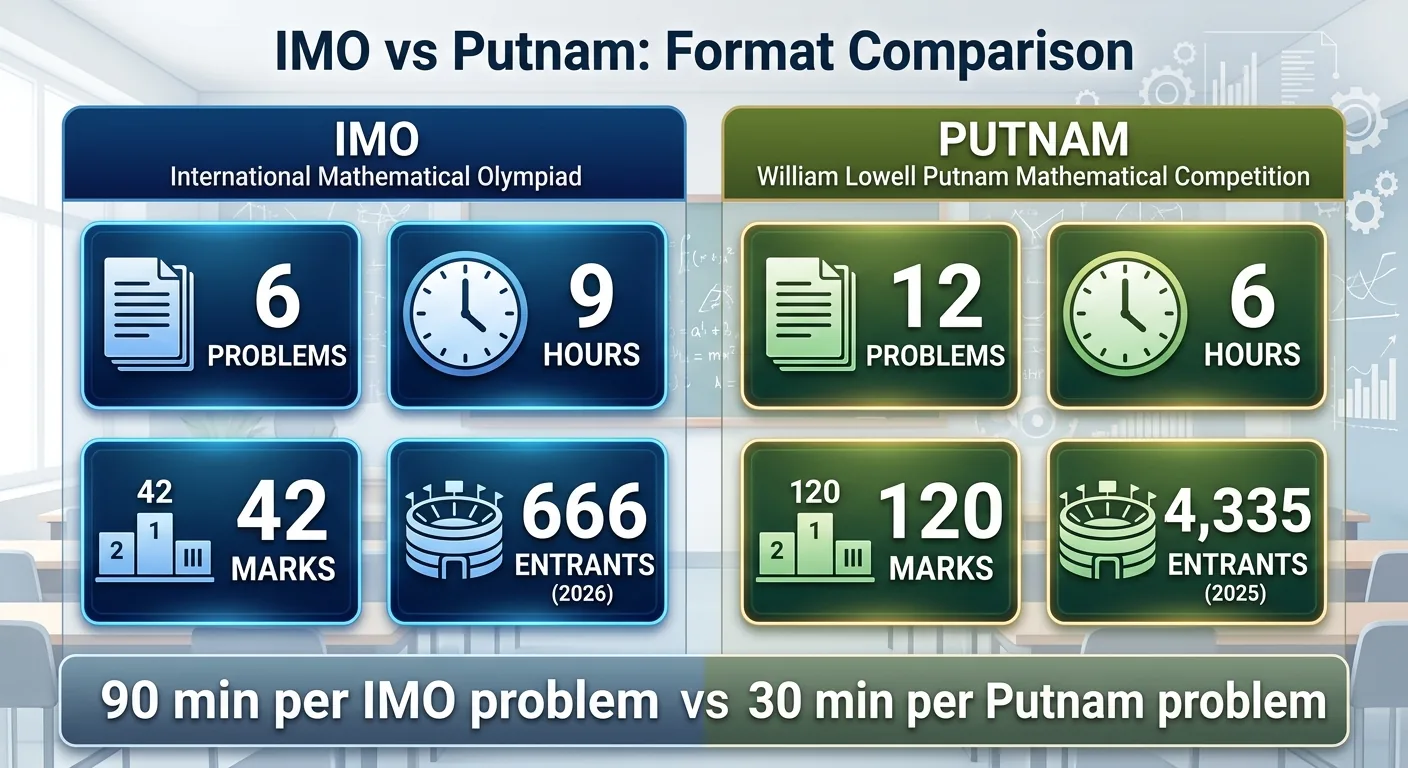
The IMO sets 6 problems over 9 hours for school students chosen by their countries. The Putnam sets 12 problems in 6 hours for any undergraduate who registers. That one difference in who sits the paper explains most of the gap in scores.
| Feature | IMO | Putnam | What it means |
|---|---|---|---|
| Who can enter | Under 20 and not yet at university | Undergraduates without a bachelor’s degree, at colleges in the US, Canada and Mexico; at most four times | IMO comes first in a student’s life, Putnam second |
| How you get in | Win your country’s selection; teams of up to 6 | Register through your university; no limit per school | IMO entrants are pre-selected, Putnam entrants are not |
| Entrants | 666 from 117 countries (2026) | 4,335 from 488 institutions (2025) | The Putnam field is about 6.5 times larger |
| Problems | 6, three per day | 12, six per session (A1 to A6 and B1 to B6) | Twice as many problems on the Putnam |
| Time | Two days of 4 hours 30 minutes | One day, 6 hours in total | 90 minutes per IMO problem, 30 per Putnam problem |
| Marks | 7 per problem, 42 in total | 10 per problem, 120 in total | Both reward full proofs, with partial credit |
| Topics | Algebra, combinatorics, geometry, number theory; no calculus | All of those plus calculus, linear algebra, analysis, abstract algebra and probability | The Putnam assumes a university syllabus |
| Top award | Gold medal: 55 students in 2026, about 1 in 12 | Putnam Fellow: the top 5 scorers | A Putnam Fellowship is far rarer than an IMO gold |
| Held | July, in a different country each year | Usually the first Saturday of December, at each university | The 2026 Putnam falls on 5 December |
For 2026 the Putnam changes shape. Georgia Tech’s mathematics department reports that the six hours are now split into four sessions of 90 minutes, with start times staggered across time zones, a change the Mathematical Association of America (MAA) made with AI-assisted cheating in mind.
Why the Putnam Median Is So Low
The Putnam median is low because almost anyone at university can enter, and most entrants cannot finish a single Putnam problem in 30 minutes. In 2025 the median was 2 out of 120 and the average about 10, with a top score of 110. In 2024 the median was also 2, the average about 8 and the top score 90. Georgia Tech’s mathematics department describes the median as “often zero”.
The IMO has no comparable median problem because no one sits it by accident. Every IMO contestant has already won a national selection, and the rules give medals to about half of them in a gold, silver and bronze ratio of roughly 1 : 2 : 3.
| Measure | IMO 2026 | Putnam 2025 |
|---|---|---|
| Entrants | 666 | 4,335 |
| Highest award | 55 gold medals (8.3% of entrants) | 5 Putnam Fellows (0.1% of entrants) |
| Score needed for the highest award | 29 out of 42 for gold | Top-five finish; the top score was 110 out of 120 |
| Share winning any medal or prize | 349 medallists, 52% of entrants | 20 individual cash prizes, 0.5% of entrants |
| Middle of the field | Bronze cutoff 16 out of 42 | Median 2 out of 120 |
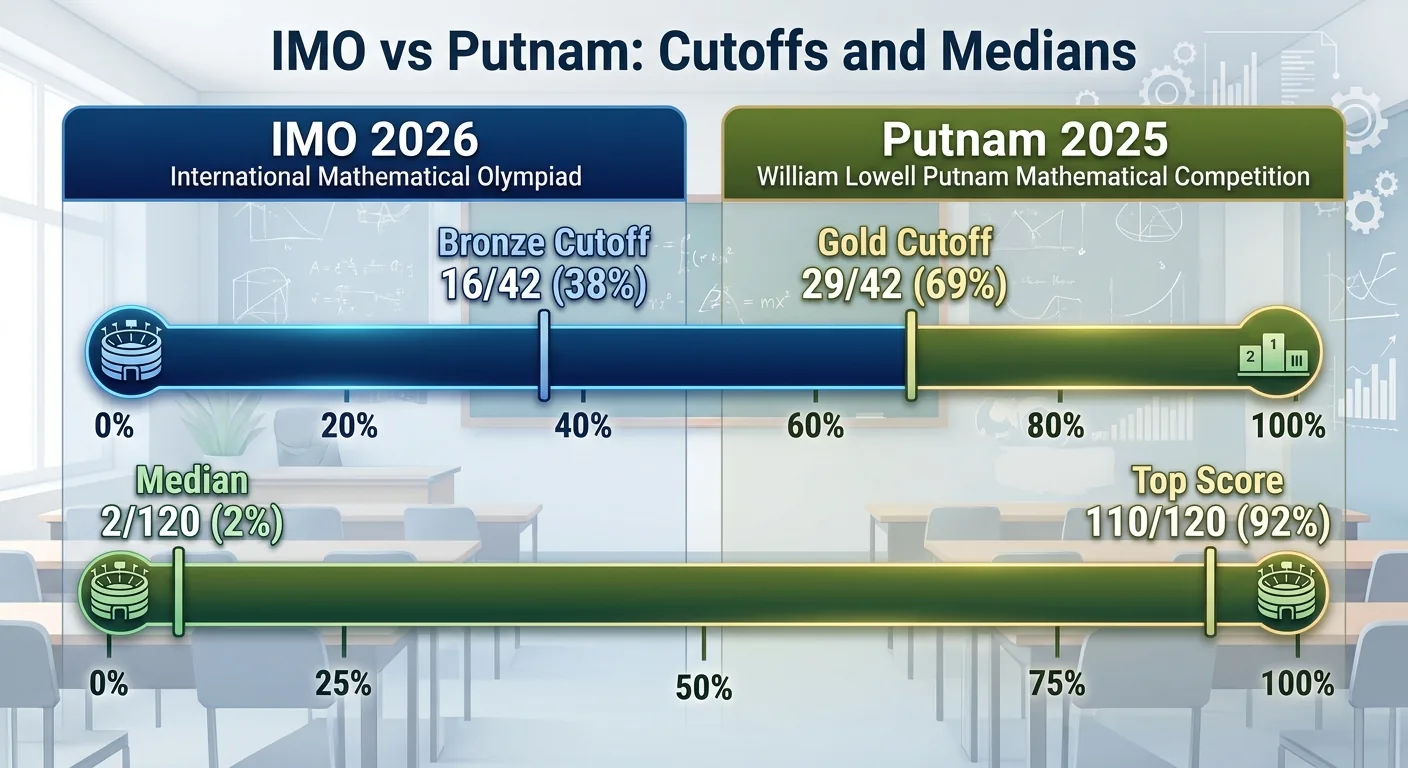
The figures measure different fields, so neither row proves one contest is harder. They show that an IMO medal is common among IMO contestants, while a good Putnam score is rare even among strong mathematics students.
Problem difficulty: a ladder on the Putnam, a two-step climb on the IMO
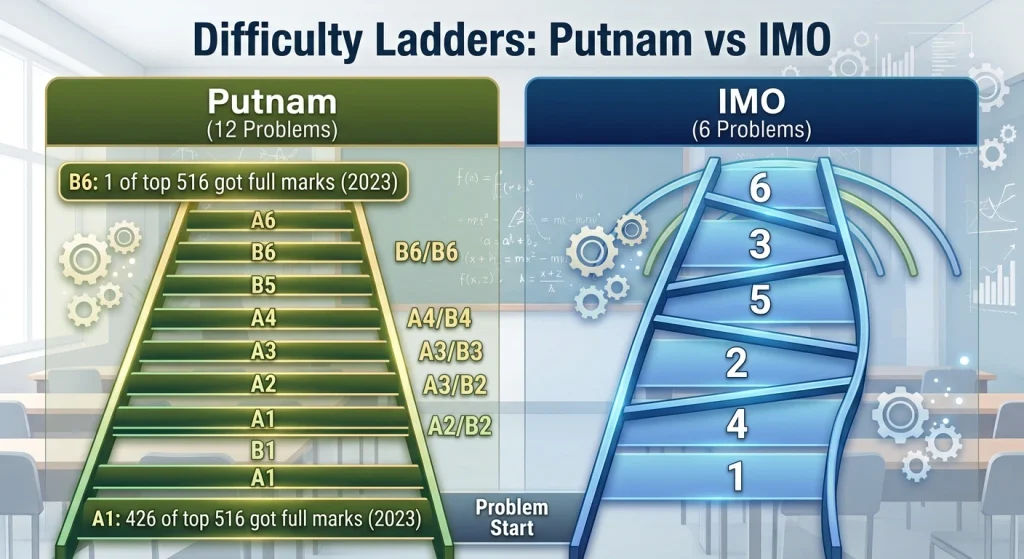
Putnam problems are arranged so that A1 and B1 are the easiest and A6 and B6 the hardest. The scores show how steep that ladder is. Among the top 516 scorers on the 2023 Putnam, 426 earned full marks on A1. Only one of those 516 earned full marks on B6.
The IMO uses a two-day ladder instead. The IMO describes the planned difficulty order as 1, 4, 2, 5, 3, 6, so each day opens with an approachable problem and ends with a very hard one. Gold in 2026 needed 29 points, which is roughly four complete solutions out of six.
Time per problem: 30 minutes against 90
The Putnam allows 30 minutes per problem on average, and the IMO allows 90. Putnam problems are shorter to solve once the right tool is spotted, so speed of recognition matters most. IMO problems usually need one deep idea and a long, careful proof, so persistence matters most.
Syllabus: the IMO has none, the Putnam has a university one
The IMO avoids calculus and university topics on purpose, so a 15-year-old can in principle solve every problem; the IMO has no official syllabus at all. The Putnam assumes the first two years of a university mathematics degree.
A Putnam paper can include integrals, matrices, limits and probability alongside the olympiad topics, which no IMO paper does.
What Happens When One Student Sits Both
The clearest test of difficulty is a student who has taken both, and the record shows IMO champions tend to finish at the very top of the Putnam. Luke Robitaille of the United States won four IMO gold medals, from 2019 to 2022, and was then named a Putnam Fellow four times at MIT, from 2022 to 2025.
Robitaille is not an isolated case. MIT says it has enrolled almost every American IMO medallist of the past decade. MIT students took all five Putnam Fellow places in each of the five competitions from 2020 to 2024, and four of the five places in 2025.
The pattern suggests IMO training carries over well to the Putnam, because the hardest Putnam problems reward the same habit of finding one key idea. It does not mean the Putnam is easy for IMO medallists: Putnam winners still spend their first university years learning the analysis, algebra and linear algebra the Putnam assumes.
Verdict. For a typical strong student, the Putnam is the harder paper to score on, because of its time pressure and university syllabus. For the world’s best young mathematicians, the hardest single problems are found at the IMO, and reaching the IMO at all is the harder achievement.
One Problem from Each, Solved
The two problems below are both first problems on their papers, the easiest slot. The Putnam problem needs a piece of calculus and five minutes of work. The IMO problem needs no syllabus at all, only a clean argument about divisors.
Putnam 2023 A1 (calculus)
Problem, restated. For a positive integer n, let fn(x) be the product cos(x) × cos(2x) × cos(3x) × … × cos(nx). Find the smallest n for which the absolute value of the second derivative fn”(0) is greater than 2023.
Solution.
- Near x = 0, each factor cos(kx) is approximately 1 minus k²x²/2, with the next term of order x⁴.
- Multiply the n factors. Up to the x² term the product is 1 minus (1² + 2² + … + n²) x²/2, because any product of two x² terms is already of order x⁴.
- For a function 1 + ax² + (higher terms), the second derivative at 0 is 2a. So fn”(0) = minus (1² + 2² + … + n²).
- The sum of the first n squares is n(n + 1)(2n + 1)/6.
- For n = 17: 17 × 18 × 35 = 10,710, and 10,710 divided by 6 is 1,785. That is less than 2023.
- For n = 18: 18 × 19 × 37 = 12,654, and 12,654 divided by 6 is 2,109. That is greater than 2023.
Answer: n = 18. The whole problem rests on one fact from a first calculus course, which is exactly what an IMO paper never assumes.
IMO 2023 Problem 1 (number theory)
Problem, restated. Find all composite integers n > 1 with this property: if 1 = d1 < d2 < … < dk = n are all the positive divisors of n, then di divides di+1 + di+2 for every i from 1 to k minus 2.
Solution.
- Prime powers work. If n = pr with r at least 2, the divisors are 1, p, p², …, pr. Each divisor pi divides pi+1 + pi+2, since both terms are multiples of pi.
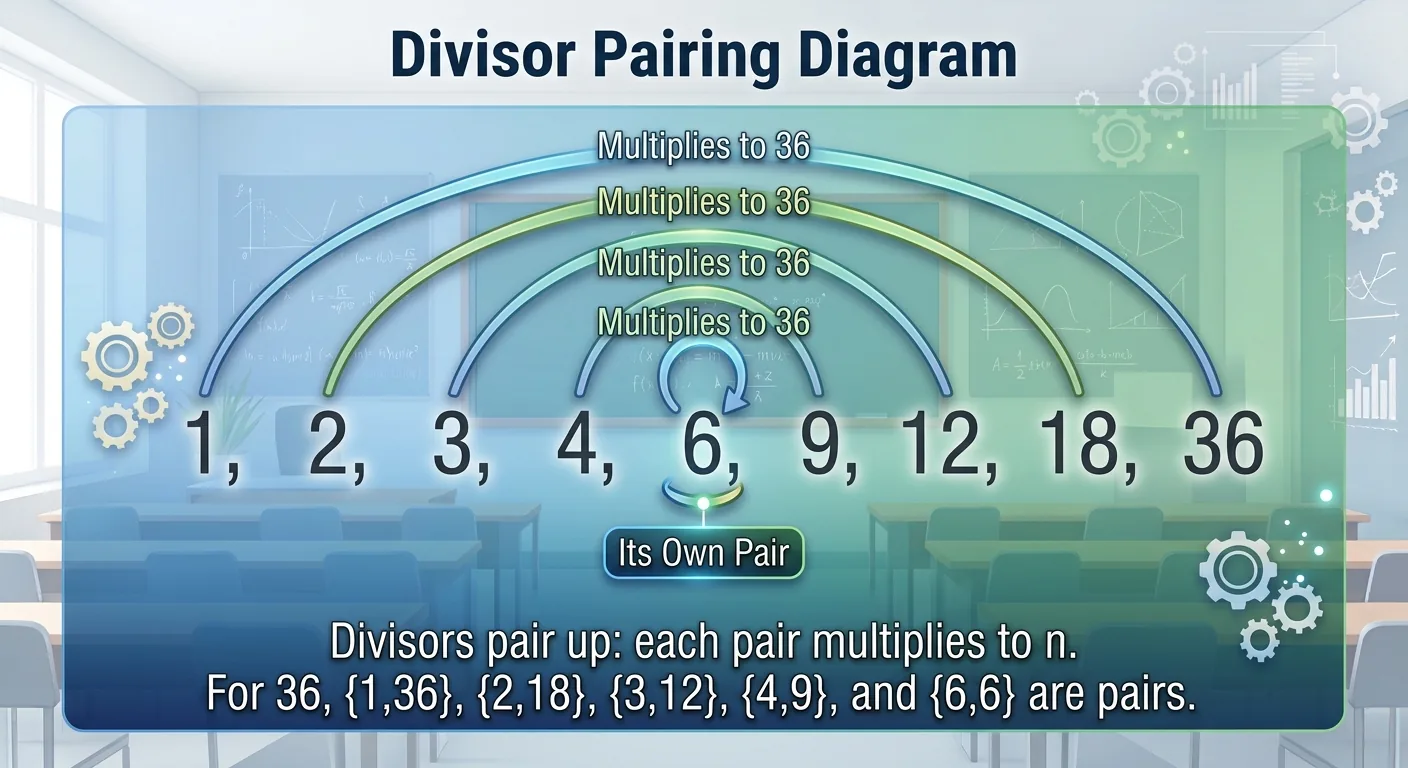
- For the converse, let p = d2, the smallest prime factor of n. Divisors pair up from the two ends, so dk−1 = n/p and dk−2 = n/d3.
- Take i = k minus 2. Then dk−2 divides dk−1 + n. It also divides n, so it divides dk−1. That says n/d3 divides n/p, so p divides d3.
- Now suppose p divides both di and di+1. The condition says di+1 + di+2 is a multiple of di, so it is a multiple of p. Since p divides di+1, p also divides di+2.
- Starting from d2 and d3, step 4 shows that p divides every divisor of n except 1.
- If n had a second prime factor q, then q would be a divisor greater than 1 that p does not divide. That is impossible, so n is a power of p.
Answer: n = pr for a prime p and an integer r of at least 2. No formula from any syllabus is used; the whole proof is the pairing idea in step 2 and a chain of divisibility steps.
More IMO problems of this type, with answers and solution outlines for every paper from 2016 to 2026, are in Gonit’s guide to IMO past papers.
Which One Should You Aim For?
A school student should aim for the IMO, and a university student should aim for the Putnam, because each contest is closed to the other group.
The order is fixed: the IMO comes first, while a student is under 20 and not yet at university, and the Putnam follows during an undergraduate degree.
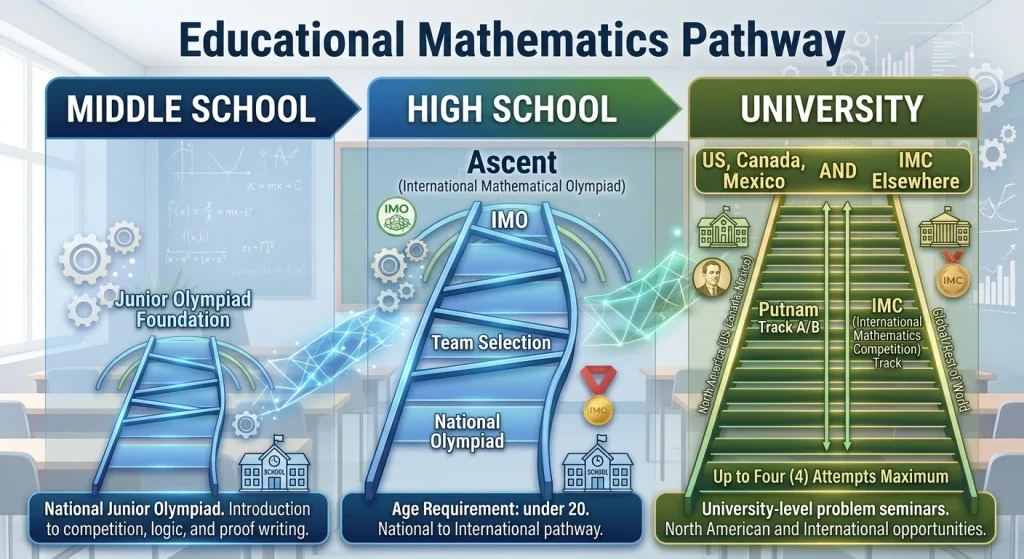
| Your stage | Aim for | Where to start |
|---|---|---|
| Middle school | National olympiads that feed the IMO | Short proof problems and national junior olympiads |
| High school, United States | AMC, AIME, then USAJMO or USAMO, then the IMO team | The route to the IMO in the USA |
| High school, elsewhere | Your national olympiad and team selection test | Past IMO papers, Problems 1 and 4 first |
| First-year undergraduate in the US, Canada or Mexico | The Putnam in December | A1 and B1 from past Putnam papers, then a university problem-solving seminar |
| Undergraduate outside North America | The International Mathematics Competition for University Students (IMC) | IMC past papers |
How preparing for the IMO and the Putnam differs
IMO preparation means working long, single problems without a syllabus. A good routine is one problem for 90 minutes, then a full written proof, then a comparison with a published solution. Gonit’s guide on how to prepare for the IMO sets out that routine month by month.
Putnam preparation adds speed and a university toolkit. Students practise A1, A2, B1 and B2 under a 30-minute limit, and review the calculus, linear algebra and real analysis that most papers use. Many universities run a weekly Putnam seminar in the autumn term for exactly this.
The habit that serves both contests is the same: try a problem honestly before reading anything, then write every step of the proof. Gonit’s guide to solving math olympiad problems covers that habit for younger students.
Make Preparing for Math Olympiad Simple!


Frequently Asked Questions
Is the Putnam harder than the IMO?
The Putnam is harder to score on, and the IMO is harder to qualify for. The Putnam median was 2 out of 120 in 2024 and 2025, while about half of IMO contestants win a medal. The IMO field is smaller and pre-selected, which is why its scores look higher.
What is a good Putnam score?
Any score above the median of 2 out of 120 puts a student in the top half of the field in 2024 and 2025. In 2023, a score of 10 placed a student around 1,600th of more than 3,000 ranked entrants. The top score was 110 in 2025 and 90 in 2024.
Can a high school student take the Putnam?
The Putnam is meant for undergraduates who have not yet earned a bachelor’s degree, and each student may sit it at most four times. Students who are still at school should aim for their national olympiad and the IMO instead.
Is there a Putnam for students outside North America?
The Putnam is open only to students at colleges and universities in the United States, Canada and Mexico. Students elsewhere can sit the International Mathematics Competition for University Students (IMC), which plays the same role for undergraduates worldwide.
Do IMO medallists do well on the Putnam?
IMO gold medallists often finish at the very top of the Putnam. Luke Robitaille won four IMO gold medals from 2019 to 2022 and was then a Putnam Fellow four times, from 2022 to 2025. Strong IMO training still has to be joined by university-level knowledge to do well on the harder Putnam problems.
Why are Putnam scores so low?
Putnam scores are low because any undergraduate can enter, each problem gets only about 30 minutes, and partial credit is small. Most problem scores fall at 8 to 10 for a complete or nearly complete solution, or at 0 to 2, so a paper with no finished solution often scores 0 or 1.
Which is more prestigious, the IMO or the Putnam?
Both are the most prestigious contests for their age groups. An IMO gold medal is recognised worldwide, while a Putnam Fellowship is recognised mostly in North American universities and research mathematics. The IMO’s international field gives it the wider reputation.
Conclusion
The IMO and the Putnam test the same kind of thinking at two stages of a mathematician’s life. The IMO asks a school student for a few deep, syllabus-free proofs; the Putnam asks an undergraduate for twelve fast solutions drawn from a university toolkit.
The Putnam’s median of 2 out of 120 makes it look harder, and for most students it is. The IMO is the harder place to arrive at, and its last problems are among the hardest a student will ever meet.
A student who builds the IMO habit of patient, complete proof will be ready for both. Start with Problem 1 of a recent IMO paper, and keep the Putnam for university.

Mikha Piregu is a Content Writer with experience spanning educational content, including math and math olympiad topics, as well as advocacy writing, research-based articles, and SEO-driven web content. He creates high-quality blog content, web copy, and feature articles that support brand visibility, audience engagement, and long-term organic growth through data-informed storytelling. Skilled in WordPress, WooCommerce, and modern digital tools, Mikha adapts content across various platforms, including blogs, websites, campaigns, and advocacy initiatives, with clarity and purpose.



There are no comments posted here yet.
Sign in to leave a comment