


To prepare for the IMO, master the four core subjects of algebra, geometry, number theory and combinatorics, qualify through your country’s national olympiad selection rounds, and solve past IMO problems under timed conditions until you can write complete proofs.
- IMO Exam Structure and Scoring
- How to Qualify for the IMO
- IMO Eligibility and Age Limit
- Build Strong Fundamentals in the Four IMO Subjects
- Solve Past IMO Questions the Right Way
- Develop Problem-Solving Techniques That Work Under Pressure
- Build a Weekly IMO Preparation Routine
- Join a Math Olympiad Training Program
- Best Books and Resources for IMO Preparation
- Time Management and Exam Strategy on Competition Day
- Final Preparation in the Last Four Weeks
- IMO vs SOF IMO: Which Exam Are You Preparing For
- Practice Tools for IMO Preparation: The Gonit App
- Frequently Asked Questions
- Conclusion
The International Mathematical Olympiad sets six proof-based problems across two days, each worth 7 points out of a maximum 42. Most contestants train for two to four years before they reach it.
This guide on how to prepare for the IMO covers the exam format, the qualification path, a weekly study routine, the best books, and exam-day strategy. If you are looking for the SOF IMO, the Class 1 to 12 school olympiad run in India, that is a different exam. See the IMO vs SOF IMO comparison first.
IMO Exam Structure and Scoring
The IMO consists of six problems solved over two days, with three problems each day and four and a half hours per paper. Knowing the format shapes how you train, because the exam rewards one complete proof far more than six partial attempts.
| Element | Detail |
|---|---|
| Problems | 6 total, 3 per day |
| Time | 4 hours 30 minutes per day |
| Marks per problem | 7 points |
| Maximum score | 42 points |
| Subjects | Algebra, geometry, number theory, combinatorics |
| Difficulty order | Problems 1 and 4 are the most approachable, 3 and 6 are the hardest |
| Team size | Up to 6 contestants per country |
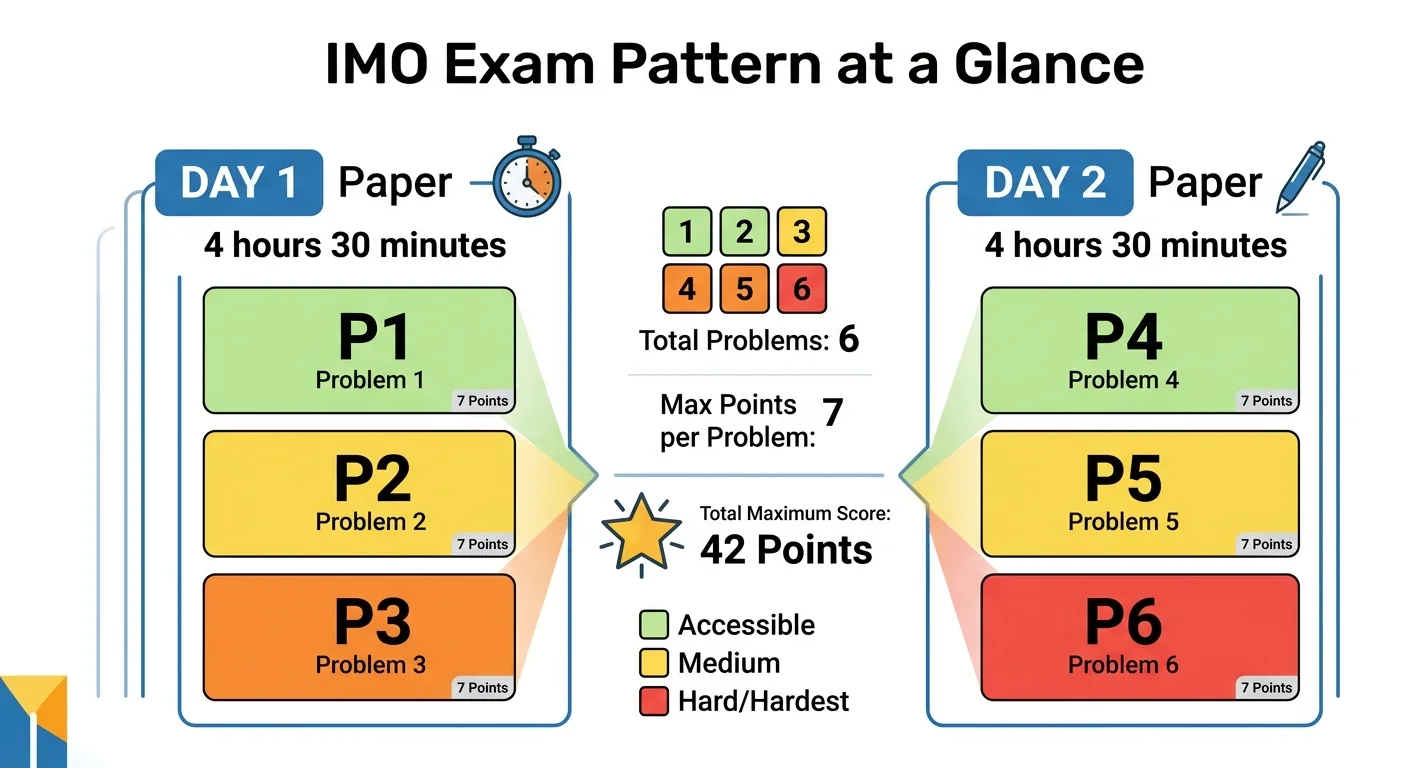
Problems are graded on the full written solution, not the final answer. Partial credit exists, but it is awarded for genuine progress toward a proof, not for scattered observations. Medals are set by score boundaries each year and go to roughly the top half of contestants. At IMO 2026 in Shanghai, the boundaries were 29 for gold, 23 for silver and 16 for bronze.
The next edition, the 68th IMO, takes place in Budapest, Hungary, from 16 to 26 July 2027. Check imo-official.org for the current year’s dates before you plan a training schedule around them.
How to Qualify for the IMO
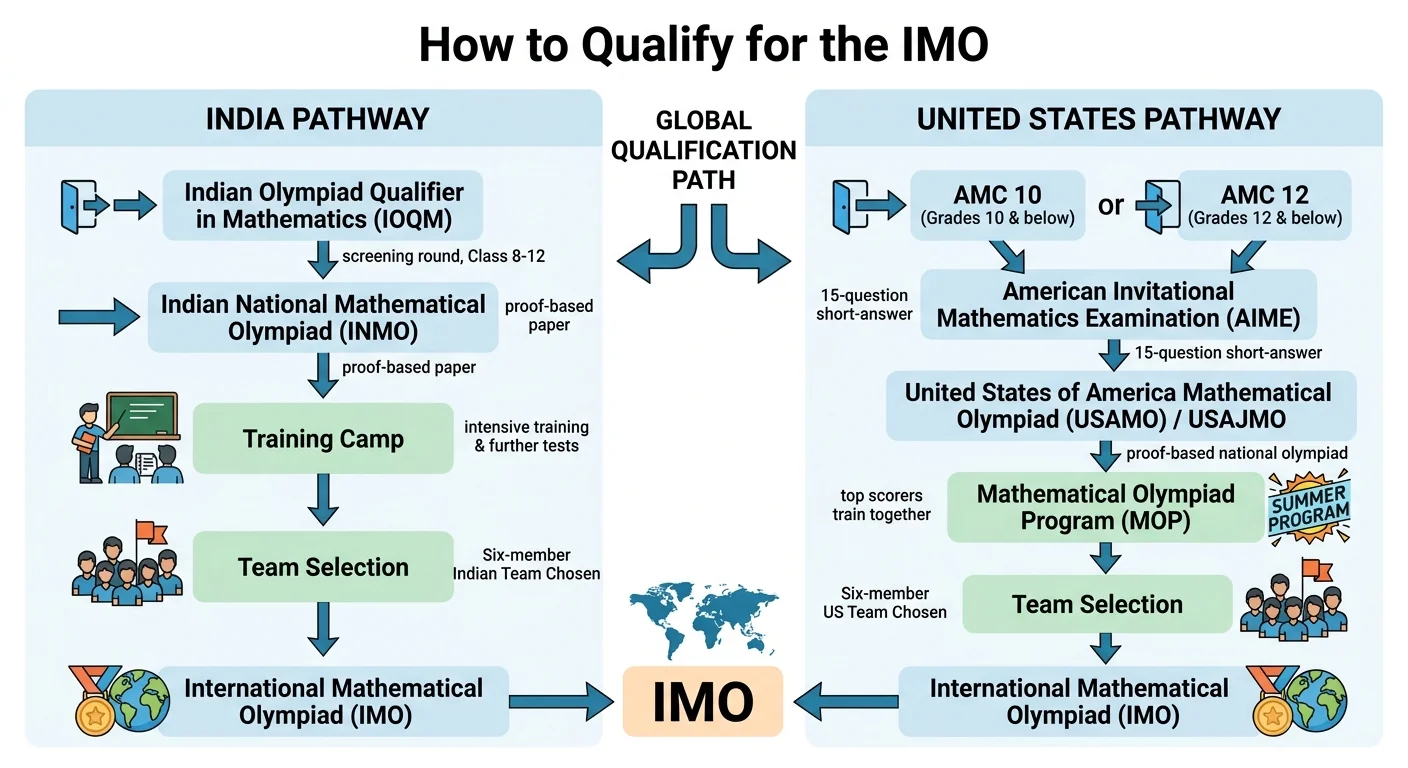
You cannot register for the IMO directly. Every contestant is selected by their own country through a chain of national rounds, so your first target is the entry-level olympiad in your country, not the IMO itself.
India: IOQM to INMO to the training camp
India runs its selection through the Mathematics Teachers’ Association and HBCSE. The path runs from the Indian Olympiad Qualifier in Mathematics in the autumn, to the Indian National Mathematical Olympiad in January, to the training camp, and finally to the six-member team.
- IOQM: A short-answer screening round open to students in Classes 8 to 12. Start here. The IOQM syllabus tells you exactly what to study.
- INMO: A proof-based paper for IOQM qualifiers. This is where olympiad writing really begins, and the INMO guide breaks down the format.
- Training camp: Top INMO scorers are invited for intensive training and further selection tests.
- Team selection: Six students are chosen to represent India.
United States: AMC to AIME to USAMO
The American route starts earlier and has more public practice material than most. Students move up through three graded rounds before the national olympiad.
- AMC 10 or AMC 12: Multiple-choice qualifying contests. Our AMC preparation guide covers the scoring cutoffs and how the two levels differ.
- AIME: A 15-question short-answer round for AMC qualifiers. Work through AIME problems to see the jump in difficulty.
- USAMO or USAJMO: The proof-based national olympiad.
- MOP and team selection tests: Top scorers train together, and six are selected for the team.
If you are in the US, the full route is mapped in our guide on how to qualify for the IMO in the USA.
Other countries
Most countries follow the same shape with different names: a school or regional round, a national olympiad, a training camp, then team selection. Search for your national mathematical society or olympiad committee to find the entry round and its registration deadline. Students in Bangladesh can follow our guide on how to qualify for the IMO from Bangladesh.
IMO Eligibility and Age Limit
Contestants must be under 20 years old on the day of the second paper and must not have enrolled in any tertiary institution. There is no minimum age, and a few contestants compete while still in middle school.
In practice, the real limit is your national selection round, which usually has its own grade restrictions. Check those rules first, because they decide when you can start competing, not the IMO age rule.
Build Strong Fundamentals in the Four IMO Subjects
A strong foundation in school math is necessary but not sufficient for the IMO. Olympiad problems test the same four areas every year, and each one has a standard toolkit you are expected to know cold.
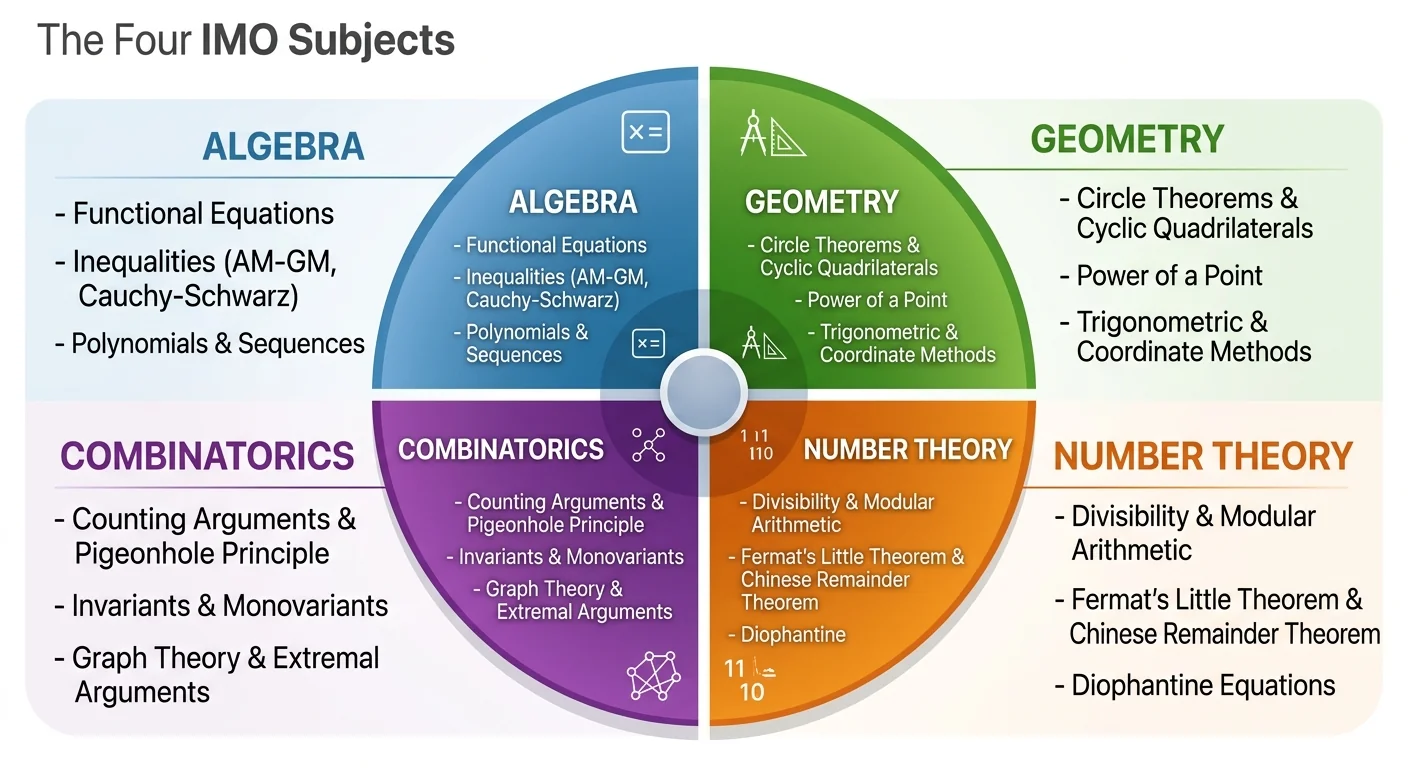
- Algebra: Functional equations, inequalities such as AM-GM and Cauchy-Schwarz, polynomials, and sequences.
- Geometry: Circle theorems, similar triangles, power of a point, cyclic quadrilaterals, trigonometric identities, and coordinate or projective methods.
- Number theory: Divisibility, prime factorisation, modular arithmetic, Fermat’s little theorem, Chinese remainder theorem, and Diophantine equations.
- Combinatorics: Counting arguments, pigeonhole principle, invariants and monovariants, graph theory, and extremal arguments.
Work through one topic at a time rather than sampling all four at once. Use your school textbook to close any gaps, then move to dedicated olympiad books for the techniques, since school syllabi stop well short of what the IMO asks. Many students find geometry and combinatorics the hardest to self-teach, so give those two extra weeks.
Solve Past IMO Questions the Right Way
Past papers are the most reliable training material available, and every IMO problem since 1959 is free on the official site. How you use them matters more than how many you attempt.
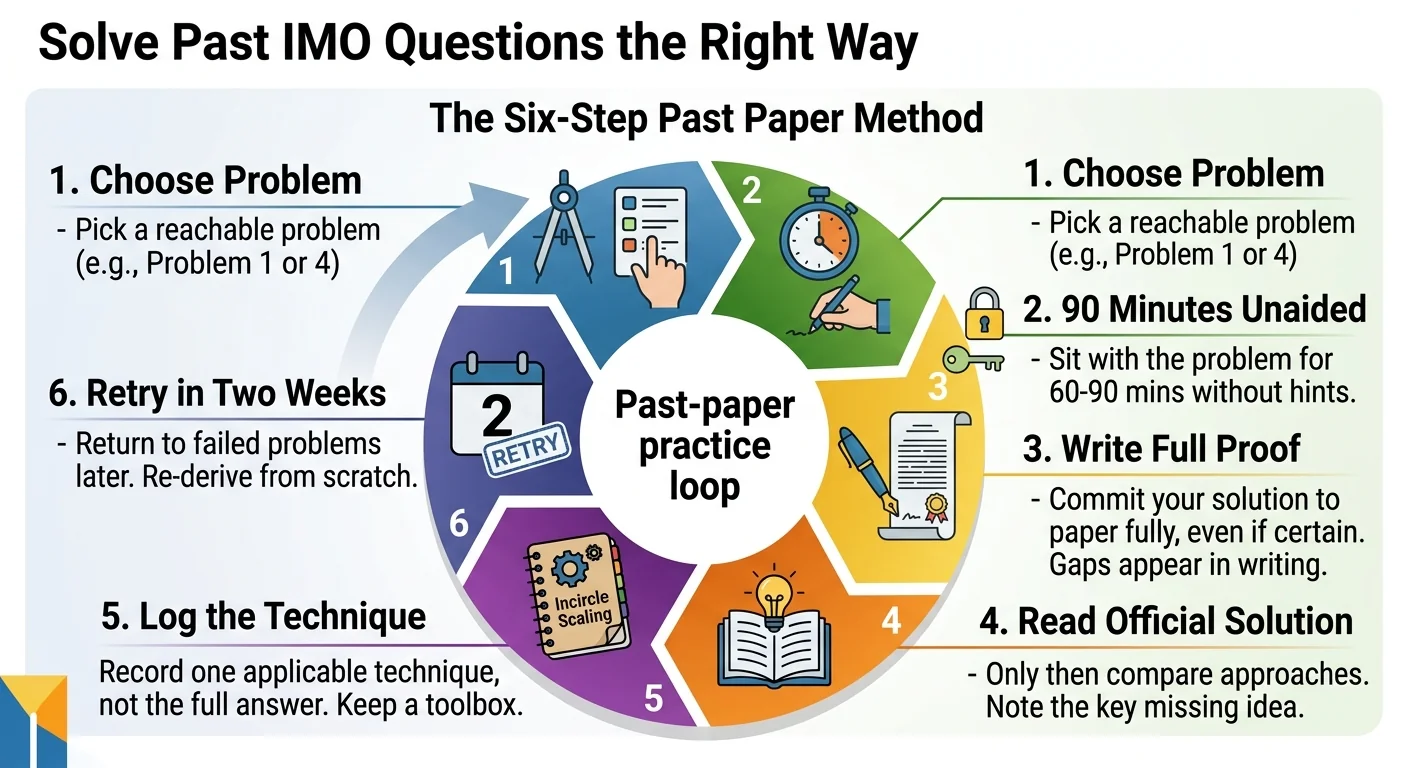
- Pick a problem at the right level. Start with problem 1 and problem 4 from older papers, since those are designed to be the accessible ones.
- Give yourself 60 to 90 minutes with no hints. Sitting with a hard problem is the skill being trained.
- Write the full solution out, even when you are sure you have it. Gaps show up in writing that feel fine in your head.
- Only then read the official solution. Compare your approach, and note the one idea you were missing.
- Keep a notebook of techniques, not answers. A line such as “scale the whole figure so the incircle has radius 1” is worth more than a finished proof you will never reread.
- Return to failed problems after two weeks and try again from scratch.
Good sources for past questions include the official IMO problem archive at imo-official.org, the contest collections on the Art of Problem Solving forum, and national shortlists, which are where IMO problems are drawn from. Our collection of math olympiad questions is a lighter starting point if full IMO papers still feel out of reach.
Develop Problem-Solving Techniques That Work Under Pressure
IMO problems rarely yield to a method you can recall. They reward students who can generate several angles of attack quickly and recognise which one is going somewhere. These habits are trainable.
- Break the problem into smaller parts: Prove a weaker version first, then strengthen it.
- Try small cases: Test n = 1, 2, 3 before attacking the general statement. Patterns usually appear here.
- Switch representations: Recast a geometry problem in coordinates, or an algebra problem as a counting argument.
- Look for invariants: Ask what stays fixed when the configuration changes. Most combinatorics problems hide one.
- Work backwards: Assume the conclusion and see what it forces.
- Check your work: Reread the problem statement after you finish. Misread conditions cost more points than weak algebra.
Deliberate reflection builds these faster than volume does. For a longer breakdown, see our guides on how to improve problem-solving skills for IMO and how to solve math olympiad problems.
Build a Weekly IMO Preparation Routine
Preparation for the IMO takes months or years, so the routine you can repeat beats the one that burns you out in six weeks. Most serious contestants train 10 to 15 hours a week outside school, with more during holidays and camp periods.
A workable week looks like this.
| Day | Focus | Time |
|---|---|---|
| Monday and Thursday | New theory in one subject | 1 to 1.5 hours |
| Tuesday and Friday | Problem sets on that subject | 1.5 to 2 hours |
| Wednesday | Review failed problems and techniques notebook | 1 hour |
| Saturday | Timed mock paper, 3 problems in 4.5 hours | 4.5 hours |
| Sunday | Rest, or read solutions from the mock | 0 to 1 hour |
Over a longer horizon, a 12-month plan usually splits into three phases: four months building subject fundamentals, five months on mixed problem sets and shortlist problems, and three months of timed papers and weak-area repair before your selection round.
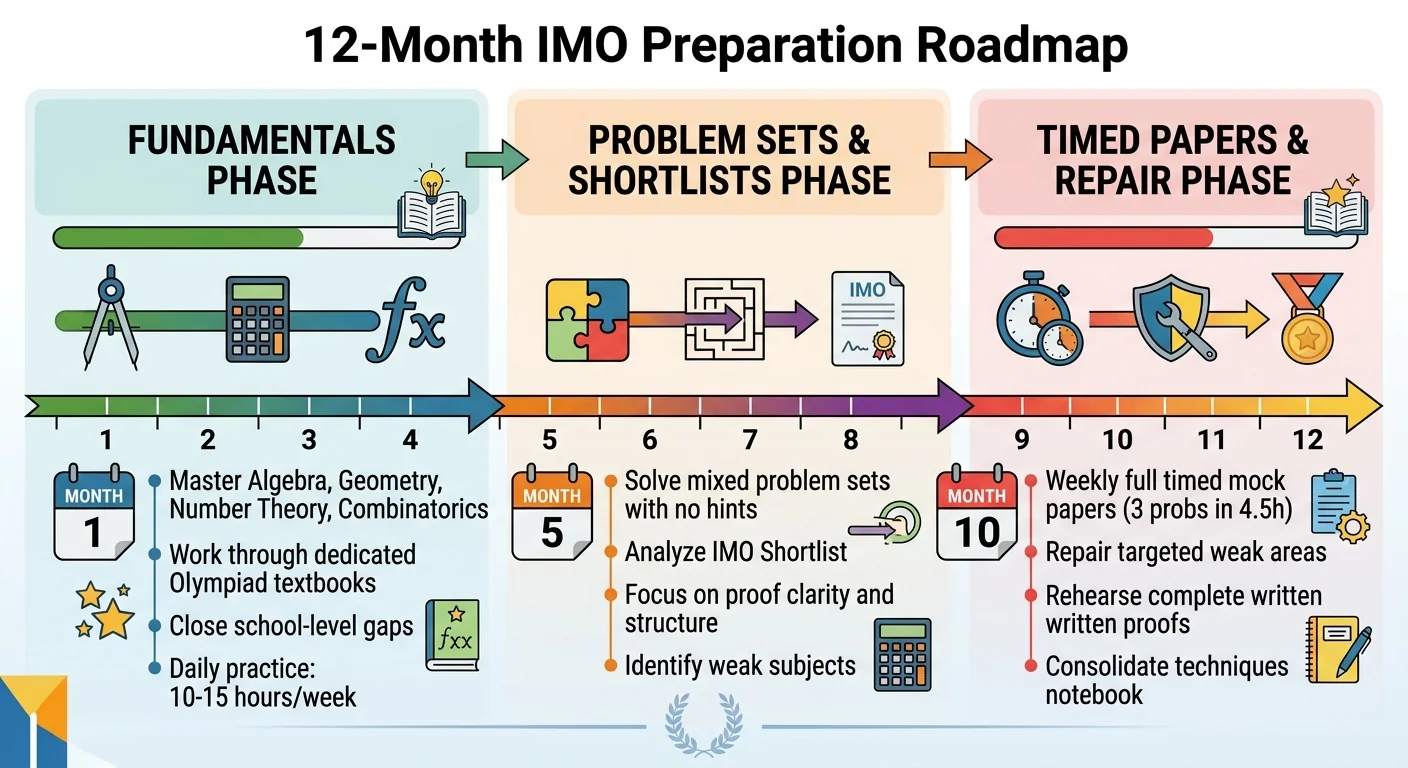
Keep the routine sustainable. Sleep, regular meals, exercise and real breaks are not optional extras for this kind of work, since tired students lose far more marks to careless slips than to missing theory. Track your progress in a simple log, review mistakes weekly, and stay connected to other olympiad students so motivation does not depend on a single result.
Join a Math Olympiad Training Program
Structured training is the single biggest accelerator for most students, mainly because someone experienced reads your proofs and tells you where they fail. Many countries run free national programs tied to their olympiad selection rounds.
- National training camps: Run by your country’s olympiad committee for qualifiers. Free in most countries.
- School math clubs: Useful for weekly problem sessions and for finding peers at your level.
- Art of Problem Solving: Paid online olympiad courses and a large free community forum with contest archives.
- Khan Academy: Free, and best used to close gaps in school-level foundations rather than for olympiad technique.
- Free online training: Our roundup of free math olympiad training online lists options that do not need a budget.
If no program is available near you, a study group of three or four students who mark each other’s proofs covers most of the benefit.
Best Books and Resources for IMO Preparation
Most IMO medallists work from a small set of well-known olympiad books rather than many. These are the standard recommendations by subject.
| Resource | Best for |
|---|---|
| Problem-Solving Strategies, Arthur Engel | General technique across all four subjects |
| The IMO Compendium | Past IMO problems and shortlists with solutions |
| Euclidean Geometry in Mathematical Olympiads, Evan Chen | Olympiad geometry from the ground up |
| 104 Number Theory Problems, Titu Andreescu | Number theory drilling |
| Art of Problem Solving, Volume 2 | Bridging school math to competition math |
| imo-official.org | Free past papers and official solutions |
| AoPS contest forum | Multiple community solutions to almost every IMO problem |
Buy one book per subject and finish it. Working through a single book fully teaches more than sampling five, and most of the free material above covers the rest.
Time Management and Exam Strategy on Competition Day
Each day gives you four and a half hours for three problems, which is enough time if you spend it deliberately. The most common scoring mistake is spreading effort evenly across all three.
- Read all three problems in the first 10 minutes and rank them by how much traction you get.
- Secure the easiest problem completely, including a clean written proof, before moving on.
- Allocate roughly 90 minutes per problem, then reassess rather than committing blindly.
- If you are stuck for 30 minutes with no new idea, switch problems and return later.
- Write complete, logically ordered solutions. Partial marks follow clear progress, so state what you have proved even if the proof is unfinished.
- Save the last 20 minutes for rewriting anything a grader would struggle to follow.
Practising under real time limits is the only way to make this automatic. Our guide on how to get full marks in a maths olympiad goes deeper into proof presentation and scoring.
Final Preparation in the Last Four Weeks
The last month is for consolidation, not new material. Starting a new topic this late usually costs more confidence than it gains marks.
- Take two full mock papers a week under exam conditions.
- Reread your techniques notebook instead of new books.
- Revisit your weakest subject with easier problems to rebuild speed.
- Rehearse writing proofs by hand at exam pace.
- Sleep properly in the final week and stop heavy practice two days before the paper.
IMO vs SOF IMO: Which Exam Are You Preparing For
Two different exams share the IMO abbreviation, and students regularly prepare for the wrong one. The International Mathematical Olympiad is the global proof-based competition described in this guide. The SOF IMO is the International Mathematics Olympiad run by the Science Olympiad Foundation in India, and it is a multiple-choice school olympiad.
| Feature | International Mathematical Olympiad | SOF IMO |
|---|---|---|
| Organiser | IMO Board, hosted by a different country each year | Science Olympiad Foundation, India |
| Who takes it | Nationally selected students under 20 | Students in Classes 1 to 12, school registered |
| Format | 6 proof-based problems over 2 days | Multiple-choice objective paper |
| Duration | 4.5 hours per day | About 60 minutes |
| Entry | Through national olympiad selection rounds | Through your school, with a registration fee |
| Preparation time | Years | Weeks to months |
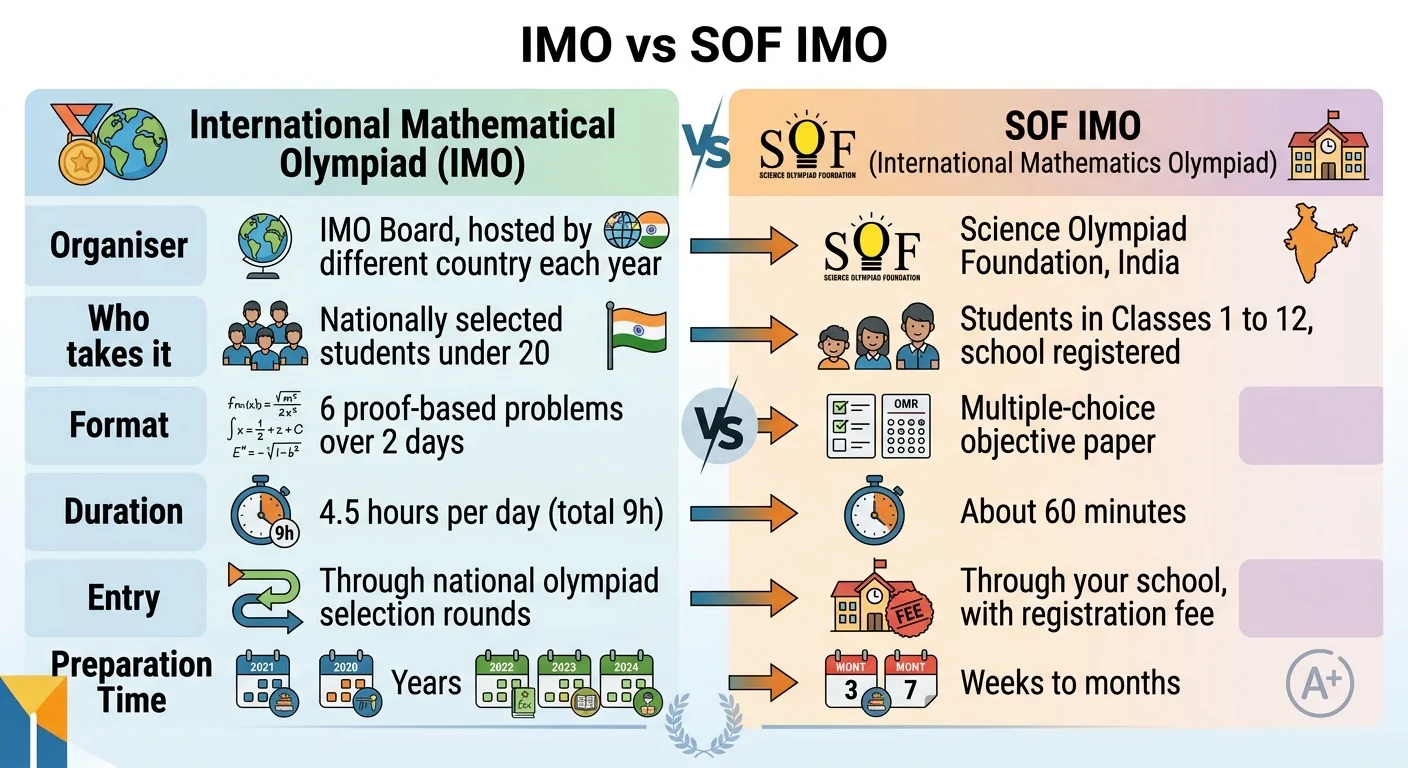
If the SOF exam is the one you need, start with our guides on how to prepare for SOF IMO and the SOF IMO syllabus. For a direct comparison of Indian olympiad routes, see SOF IMO vs IOQM.
Practice Tools for IMO Preparation: The Gonit App
The Gonit app gives you timed olympiad practice on your phone, which makes daily reps possible on days when sitting down with a book does not happen. It is free on Android and iOS.
Use it alongside past papers rather than instead of them. Short daily sets keep technique sharp between the longer weekend sessions where real IMO training happens.
Key features
- A large bank of olympiad-style problems sorted by topic and difficulty
- Step-by-step solutions you can compare against your own approach
- Timed practice tests that mirror competition pressure
- Interactive lessons across algebra, geometry, number theory and combinatorics
- Progress tracking and streaks so weekly consistency is visible
Make Preparing for Math Olympiad Simple!


Frequently Asked Questions
What is the IMO exam?
The IMO, or International Mathematical Olympiad, is the world championship mathematics competition for pre-university students. Contestants solve six proof-based problems over two days, three per day, with four and a half hours per paper. Each problem is worth 7 points out of a maximum 42. Teams of up to six students represent their country.
How many questions are there in the IMO?
There are six questions in total, split into two papers of three questions each. Problems 1 and 4 are the most accessible, problems 2 and 5 are harder, and problems 3 and 6 are the hardest of the set. Each is graded out of 7 points on the written proof.
Is the IMO hard?
Yes. The IMO is widely considered the hardest mathematics competition for school students, and many contestants finish with single-digit scores. Problems are designed so that no standard school method solves them directly. That said, problems 1 and 4 are reachable with one or two years of focused olympiad training.
What is the age limit for the IMO?
Contestants must be under 20 years old on the day of the second paper and must not be enrolled at any tertiary institution. There is no minimum age. University students are not eligible, which is why the IMO is restricted to pre-university competitors.
How long does it take to prepare for the IMO?
Most contestants train for two to four years before reaching the IMO, usually starting with their national entry-level olympiad. A realistic schedule is 10 to 15 hours a week outside school, with heavier work during holidays and training camps. Progress is measured by national round results, not by hours alone.
Where can I find quality IMO practice problems beyond textbooks?
Start with the official archive at imo-official.org, which holds every IMO paper with solutions, and the annual IMO Shortlist, which is where competition problems are selected from. The Art of Problem Solving contest forum carries community solutions to almost every problem. National olympiad papers from other countries add thousands more at the right difficulty.
Is the IMO the same as the SOF IMO?
No. The International Mathematical Olympiad is the global proof-based competition for nationally selected students. The SOF IMO is a multiple-choice school olympiad run in India by the Science Olympiad Foundation for Classes 1 to 12. They share an abbreviation and nothing else, including syllabus, format and selection route.
Conclusion
Preparing for the IMO comes down to three things done repeatedly: real depth in the four olympiad subjects, steady work through past papers, and proofs you can write cleanly under time pressure. The route runs through your national olympiad, so the practical next step is to find your country’s entry round, check its deadline, and start training toward that paper rather than toward the IMO itself.
Pick one subject, one book and a weekly schedule you can hold for a year. Progress at this level is slow and then sudden, and the students who reach the team are usually the ones who kept showing up after the problems stopped being fun. Stay curious, mark your own mistakes honestly, and give the competition your best effort when it comes.

Contributor at Gonit Worksheets, writing about math learning that works for real kids.


Write more, thats all I have to say. Literally, it seems as though you
relied on the video to make your point. You clearly know what youre talking
about, why throw away your intelligence on just posting videos to your site when you could be giving us something enlightening to read?