

To study for a math test, start three nights out and do practice problems pulled from every lesson in the unit, shuffled so nothing tells you which method each one needs, closed-book against a clock.
- What Does the Test Ask That Homework Doesn't?
- What Should You Do Instead of Rereading Your Notes?
- The Three-Night Plan, Night by Night
- What Do You Do With the Problems You Got Wrong?
- How to Study for a Math Test in One Night
- Adapting the Plan to the Grade and the Test
- What Do You Do in the First Two Minutes of the Test?
- Frequently Asked Questions
- Related guides
Then sort every miss by why it happened and fix those causes first. Homework tells you the method before you start and a test doesn’t, so choosing the method is the one skill a test asks for that homework never rehearses.
Why does a test on 4 lessons feel harder than the homework, when you got 18 of 20 homework problems right? Say the unit test is on Thursday. On Tuesday night you do what most people do: reread your notes and redo a few homework problems. Every page looks familiar.
Then in the test, question 4 could belong to any of those 4 lessons, nothing on the paper says which method it wants, and the clock is already past halfway.

What Does the Test Ask That Homework Doesn’t?
A test asks you to choose the method. Homework almost never does, because it groups problems by lesson, so the method is decided before you read the question.
Rereading your notes and redoing homework do some good. They remind you what each method looks like, and you need that first. The trouble is the order. If tonight’s page is all inequalities, you know problem 7 is an inequality before you read it.
A unit test or a final usually mixes problems from several lessons and doesn’t label which method each one needs. So the step your homework did for you, picking the method, is the first thing the test asks of you.
Doug Rohrer and colleagues at the University of South Florida ran a randomized study of 787 seventh graders in 54 Florida math classes. Both groups worked the same basic algebra problems, such as simplifying expressions and solving inequalities.
One group got them grouped by type, the way most homework is set, and the other got them mixed. On a surprise test weeks later, the mixed group averaged about 61% versus 38%. The U.S. Department of Education’s What Works Clearinghouse reviewed the study and rated it as meeting its standards without reservations.
An earlier, smaller trial with 63 seventh graders at one Tampa school pointed the same way: 30 days later, the mixed group averaged 65 versus 29 on slope problems and 84 versus 54 on graphing problems.
Tuesday night’s rereading never rehearsed choosing the method, which is why question 4 can cost you marks on a kind of problem you solve fine at home.
The practical reading of that research is narrow and useful: the shuffling is not a study trick, it is the part of the test you have not practised.
What Should You Do Instead of Rereading Your Notes?
To study for a math test, start three nights out. Pull problems from every lesson in the unit, shuffle them so nothing tells you the method, and do them closed-book against a clock. Then sort every miss by why it happened, and fix the misses that will come back on the test first.
That plan leans on two habits with strong support. A 2013 review of ten common study techniques rated self-testing and spreading study out over days highest, and rereading and highlighting low. Rereading still helps you recall what the methods are. It just can’t be the whole plan.
What You Need Before Night 1
None of this costs anything, and gathering it takes about ten minutes:
- Your syllabus or unit outline, so you know which lessons the test covers. Ask your teacher if you don’t have one.
- Index cards or a numbered sheet — anything that lets you separate a problem from its chapter heading.
- A timer. A kitchen timer or a phone on airplane mode. The clock is part of the practice.
- Your marked homework, especially the problems you got wrong. Those are the highest-value problems you own.
- A blank page for the formula sheet, written from memory before you check it.
- The test’s length and question count, which you need for the pace number on night 2.
The usual advice is sound as far as it goes:
| When | The standard advice |
|---|---|
| Before | Start a few days early. Do problems instead of reading. Use the homework you got wrong. Make a formula sheet. Sleep. |
| During | Read the directions. Do the easy questions first and come back. Show your steps. Check your answers. |
| After | Go through the marked test when you get it back. |
What it leaves out is the shuffling, the clock and the miss log. Those are the three things the plan below adds.
The Three-Night Plan, Night by Night
This is the plan we’d use. The research above supports mixing and self-testing in general; it didn’t test this exact schedule.
| Night | What you do | Time | What you know after |
|---|---|---|---|
| 1 (three nights out) | Build a shuffled set and a formula sheet from memory | About 45 minutes | Which formulas you can’t recall yet |
| 2 | Sit the set against a clock and log every miss | Your test’s length plus 15 minutes | Which misses will cost you |
| 3 (the night before) | A short fresh set, then the first-move drill | 30 minutes or less | That you can start any problem in the unit |
Night 1: Build a Set With No Chapter Titles
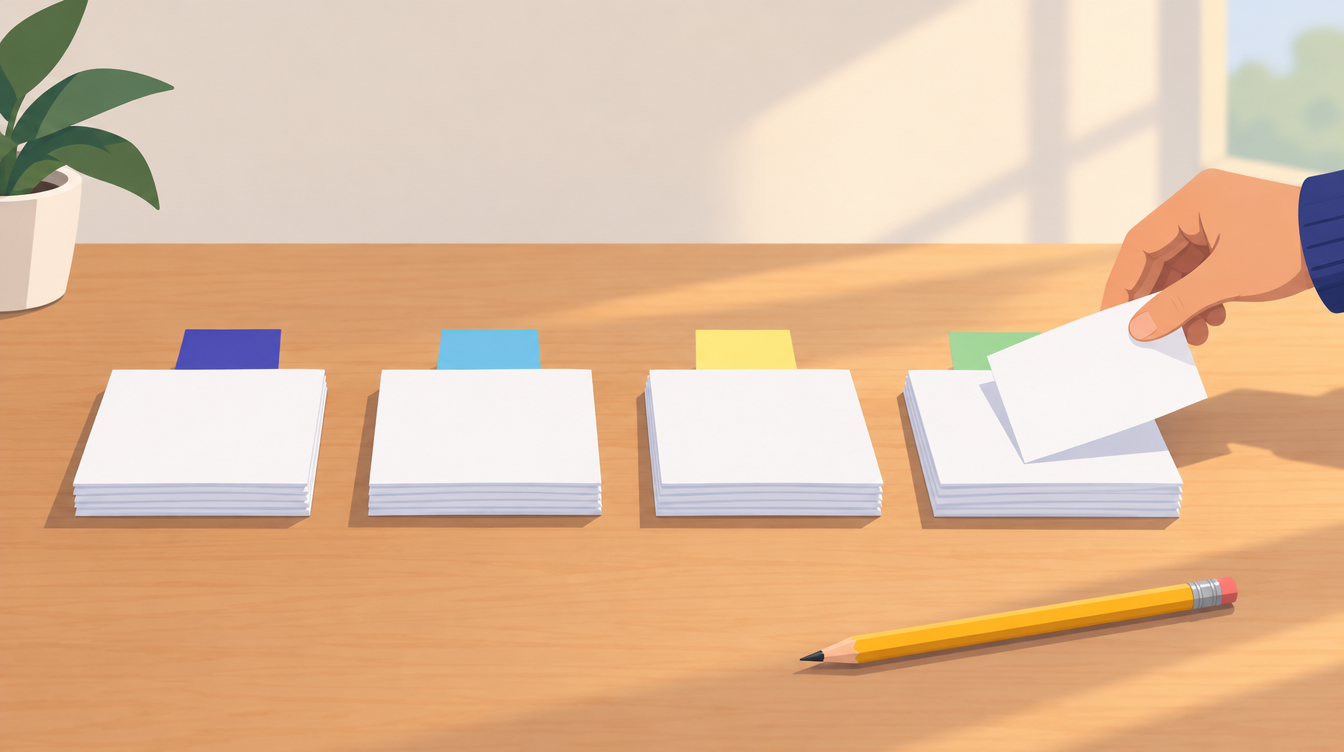
Take 2 problems from each lesson in the unit, plus every homework problem you got wrong. A unit with 4 lessons and 6 old misses gives you 14 problems. Copy each onto its own index card or numbered line, and leave off the lesson title and section number. That label is the clue the test won’t give you. If you’re not sure what the unit covers, check the full list of grade 8 topics against your syllabus.
Then write a one-page formula sheet from memory and check it against your notes. Whatever you left out is your first real information about this test.
Night 2: Sit It Against the Clock
Work out your pace number first: the test’s minutes divided by its number of questions. A 45-minute test with 15 questions is 3 minutes each, so your 14 cards get 42 minutes. Shuffle the cards, set a timer and do the whole set closed-book.
Grade it straight away. Every miss goes in a log with one of four labels (see the next section). If you have a contest coming up as well, the same habit carries over to timed practice for the AMC 8.
Night 3: Practice the First Move, Then Stop
Do a fresh mixed set of about 8 unworked problems, such as your textbook’s chapter review, in 30 minutes or less.
Then the first-move drill. Take 10 mixed problems and, for each one, write only the first step and the name of the method. Don’t solve anything. It rehearses the exact moment that went wrong in question 4. Three lines from a drill look like this (our own problems; other first moves work too).
| Problem | One first move | Method, with the answer for checking |
|---|---|---|
| A jacket costs $24 after a 20% discount. What was the original price? | 0.8p = 24 | Percent equation ($30) |
| Solve 3(x − 2) = 2x + 5. | 3x − 6 = 2x + 5 | Distribute, then solve a linear equation (x = 11) |
| A right triangle has legs of 6 cm and 8 cm. How long is the hypotenuse? | 6² + 8² = c² | Pythagorean theorem (10 cm) |
The drill is fast because you never finish a problem. Ten problems take about ten minutes, and the thing you are training is the first ten seconds of each one.
After the drill, put the cards away and go to bed. We’d skip the extra hour of rereading.
What Do You Do With the Problems You Got Wrong?
Every miss from night 2 gets one of four labels. The label decides what you do about it, which is the whole point of sorting them.
| Label | What happened | What to do |
|---|---|---|
| A | You didn’t know which method to use | Add two more problems of that kind to night 3 |
| B | You knew the method and slipped a step | Pick one checking habit for the test |
| C | You ran out of time | Fix your pacing with the pace number |
| D | You didn’t know the idea at all | Reread that lesson, then do two problems on it |
Fix the D and A misses first, because the same idea and the same choice are likely to show up on the test again.
B misses need one habit, such as putting your answer back into the original equation. C misses are pacing, so check the clock at halfway.
The labels are worth more than the score. A night-2 result of 9 out of 14 tells you almost nothing on its own. The same 9 out of 14 made of four A misses tells you to spend night 3 on choosing methods, and made of four C misses tells you the problem is the clock and you should start the test differently.
How to Study for a Math Test in One Night
Do a smaller version of the same plan. Build a set of 10 problems from across the unit with no lesson titles, starting with your old homework misses. Shuffle it, sit it against your pace number and log every miss with the four labels. Finish with the first-move drill on 5 to 10 problems, and go to bed.
In order, with rough timings for a two-hour evening:
- 15 minutes. Pull 10 problems from across the unit, old misses first, and strip the lesson titles.
- 10 minutes. Write the formula sheet from memory, then check it.
- 30 minutes. Sit the shuffled set closed-book against the clock.
- 20 minutes. Grade it and label every miss A, B, C or D.
- 15 minutes. First-move drill on 5 to 10 problems, writing only the opening step.
- Stop. Sleep matters more than a sixth round.
One night gives you one round of choosing methods and no time to fix what the log finds. It still rehearses the part of the test your homework never did.
If it is the morning of the test, skip the set and do the first-move drill alone on 10 problems. It takes ten minutes and it trains the one moment you cannot fix during the test itself.
Adapting the Plan to the Grade and the Test
The three nights stay the same. What changes is how many problems go in the set and how far back the set reaches.
| Test | Where the problems come from | Set size for night 2 |
|---|---|---|
| Unit or chapter test | Every lesson in the unit, plus old misses from that unit | 10–15 problems |
| Midterm | Two problems per unit covered, weighted toward units you scored worst on | 20–25 problems, split across two evenings |
| Final or end-of-year exam | Two per unit across the whole course, plus every test you got back | 25–30 problems, split across three evenings |
| Quiz on one lesson | The lesson itself, mixed with the two lessons before it | 6–8 problems |
The quiz row is the one that surprises people. A quiz on a single lesson is the one case where the method is genuinely not in doubt, so shuffling buys you less. Mixing in the two previous lessons keeps the choosing skill alive and costs nothing.
By grade, the plan scales down rather than changing shape:
- Grades 4–6: 8 to 10 problems, 20 minutes on the clock, and an adult reading the problem aloud if reading speed is the real obstacle. The formula sheet becomes a facts sheet.
- Grades 7–9: the plan as written. This is the band the Rohrer research was run in, and the band where unlabelled problems start to appear on tests.
- Grades 10–12: longer sets and a real pace number, since high school tests are where running out of time becomes the most common miss. Keep the old tests; a final is mostly a reshuffle of them.
For the units themselves, the full list of grade 8 topics is a useful checklist to run against any syllabus.
What Do You Do in the First Two Minutes of the Test?
Write your formulas down, then make a first pass marking anything you can’t start quickly. The first two minutes are for setting up, not for solving question 1.
Spend the first minute writing the formulas from your sheet in a corner of the paper. If your teacher doesn’t allow writing before the start, follow the teacher.
Then make a first pass. Do every question you can start within about 30 seconds and mark the rest. That 30 seconds is our rule of thumb. When half the time is gone, check that you’re near halfway through the questions. On the second pass, go back to the marked ones.
Read a word problem twice and name the unknown before you write anything, then follow our word-problem steps for the rest.
If a marked question still has no way in on the second pass, work backwards from what it asks for, or try it with smaller numbers first. Both are contest-math moves that work on a unit test too; our guide to solving olympiad problems shows each one on a worked example.
Does Writing Down Your Worries Before a Test Help?
Probably not, on the current evidence. A 2011 study in a ninth-grade biology class tested writing down your worries for about ten minutes before a test. Highly anxious students who wrote averaged a B-plus, against a B-minus for those who didn’t.
The result hasn’t held up well since. A 2018 project that repeated one of that paper’s experiments with more students found no effect. A 2021 study of college students writing before real course exams found it didn’t lower anxiety or raise exam scores. Try it if you like, but don’t build your plan on it.
What does reliably reduce the feeling of being unprepared is having already sat a timed set. Night 2 is the anxiety plan.
By Thursday morning you’ll have a shuffled set already sat against the clock, a short list of the misses that mattered and a routine for the first two minutes. Question 4 can still come from any of the 4 lessons. You’ll have practiced that exact moment three nights running, with no heading on the page to tell you the method.
When your log keeps pointing at one topic, topic practice helps. Gonit is Olympiad-style practice for grades 1–12, with 10,000+ original questions.
Its practice is sorted by grade and topic, the opposite of your shuffled set, and it shows your accuracy by topic. It isn’t your class’s textbook and doesn’t know your teacher’s test. Hints and step-by-step explanations are Premium. Use it after night 2, on the one topic your log says is costing you.
Make Preparing for Math Olympiad Simple!


Frequently Asked Questions
How long should you study for a math test?
Three short nights rather than one long one. A 2013 review of study techniques rated spreading study out over days among the most useful methods, and rereading low. Night 1 is about 45 minutes, night 2 is your test’s length plus 15 minutes, and night 3 is 30 minutes or less.
Can you study for a math test in one night?
Yes, with a smaller version of the plan. Do 10 shuffled problems from the whole unit against the clock and log every miss. Then do the first-move drill and go to bed. You get one round of choosing methods and no time to fix what the log finds, but it still rehearses the part the homework skipped.
Is redoing homework a good way to study for a math test?
Only the problems you got wrong, shuffled in with problems from other lessons. Most homework groups problems by lesson, so redoing it in order skips the step of choosing the method, which is the step the test actually tests.
What is the best way to study for a math test?
Mixed practice problems, closed-book, against a clock, with every miss sorted by cause. In a randomized study of 787 seventh graders, students who practised mixed problems averaged about 61% on a later test against 38% for students who practised the same problems grouped by type.
How many practice problems should you do?
About 10 to 15 for a unit test: two from each lesson plus every homework problem you got wrong. For a midterm or final, two per unit across everything covered, split over two or three evenings. More problems in one sitting is usually worse than the same number spread out.
Why do I understand math in class but fail the test?
Usually because class and homework tell you which method to use and the test doesn’t. Understanding a method while someone names it is a different skill from recognising which method an unlabelled problem needs. The shuffled set is how you practise the second one.
How do you study for a math final exam?
Same three nights, wider net. Pull two problems from every unit in the course, weight it toward the units you scored worst on, and use every test you got back during the year. A final is mostly a reshuffle of tests you have already sat.
Should you make a formula sheet?
Yes, and write it from memory first. The point isn’t the sheet, it’s finding out which formulas you couldn’t recall. Whatever you left out is your first real information about the test, and that happens on night 1 while there is still time to fix it.
How do you stop running out of time on a math test?
Work out your pace number before the test: the minutes divided by the number of questions. Practise against it on night 2, start the real test by marking anything you can’t begin within about 30 seconds, and check at the halfway point that you are near halfway through the questions.
How can I calm math test anxiety?
The most reliable thing is having already sat a timed set, because much of the feeling comes from not knowing what the test will be like. Writing down your worries before a test was promising in a 2011 study but has not replicated well since, so it is worth a try rather than a plan.
Related guides
- Competition Math for Middle School: Which Contest to Pick?
- How to Improve Your Problem Solving for Math Olympiad

Donald A. Kroll holds a Master's degree in Mathematics and has spent years helping students prepare for competition-level problem solving. Based in the United States, he writes about study strategy, test readiness, and the habits that turn steady practice into real results.



There are no comments posted here yet.
Sign in to leave a comment