


An analogy is a way of comparing two things that are different to show how they share a similar relationship.
A math analogy compares two pairs of numbers that follow the same rule, written as A : B :: C : D and read as “A is to B as C is to D”. To solve one, find the rule that turns A into B, then apply that same rule to C. In 2 : 4 :: 5 : ?, the rule is multiply by 2, so the answer is 10.
- Download the Free Math Analogy Worksheet (Grades 1-3)
- What Is a Math Analogy?
- Why Are Math Analogies Important for Grades 1-3?
- How to Solve a Number Analogy Step by Step
- How to Teach Math Analogies to Kids
- Easy Math Analogy Examples for Kids (Grades 1-3)
- Number Analogies: Extra Practice Problems
- Tips to Make Math Analogies More Fun
- Bonus: Create Your Own Math Analogy
- Where to Use Math Analogies for Olympiad Prep
- Frequently Asked Questions
- Key Takeaways
One of the best ways to help kids understand complex ideas is through math analogies, short puzzles that compare numbers or ideas in a relatable way. Whether it is a simple addition pattern or a number relationship, math analogy questions train kids to think logically before they even realize it.
In this guide, we explain what analogy in maths means, how to solve number analogies step by step, and share 25+ easy math analogy examples with answers. There is also a free printable worksheet you can download below.
Download the Free Math Analogy Worksheet (Grades 1-3)
The printable worksheet gives your child graded analogy practice away from a screen, with an answer key so a parent or teacher can mark it quickly. It covers the same rules this guide explains, in the same A : B :: C : D format used in Olympiad papers.
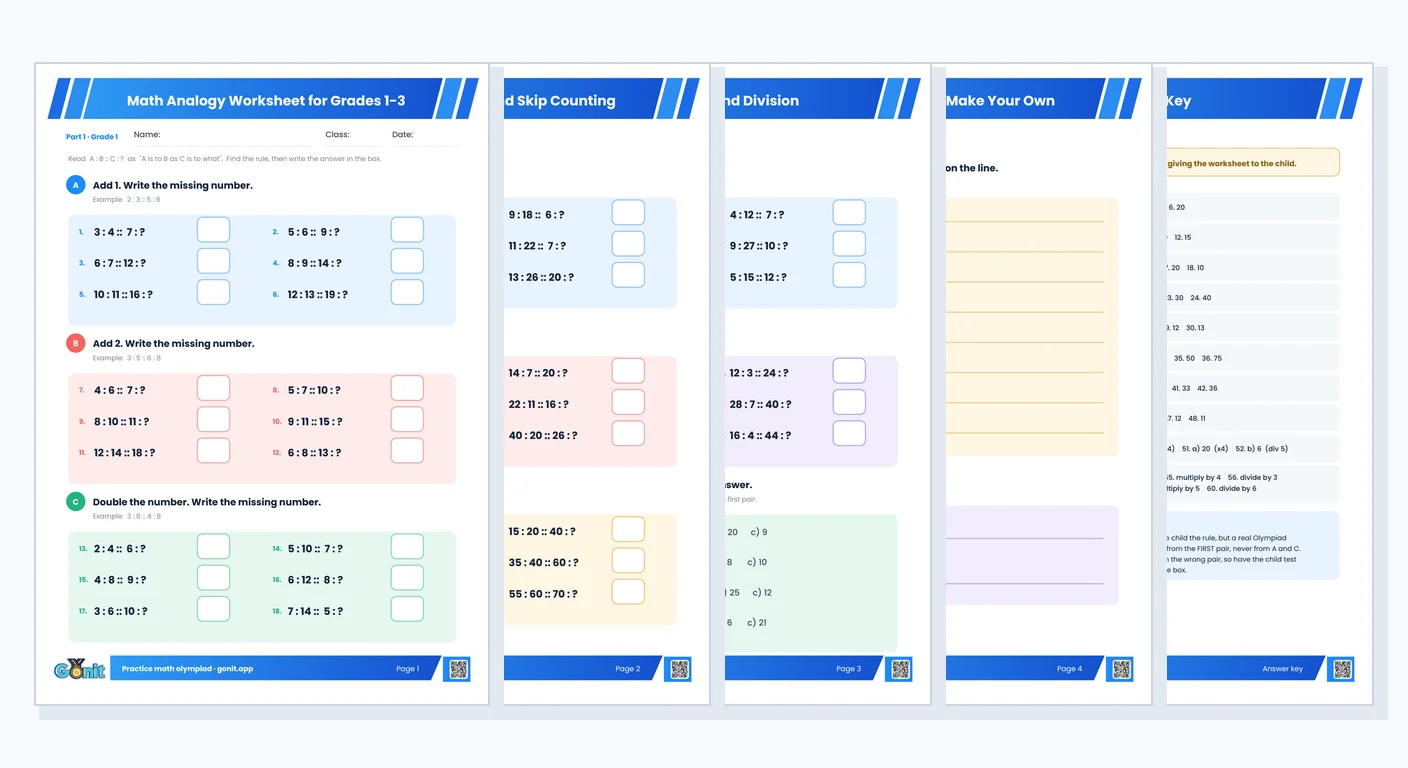
The worksheet is 5 pages with 62 questions and a separate answer key. Here is what each part covers.
| Part | Level | What it covers |
|---|---|---|
| Part 1 | Grade 1 | Add 1, add 2, and doubling analogies |
| Part 2 | Grade 2 | Doubling, halving, and skip counting patterns |
| Part 3 | Grade 3 | Times tables, division, and find-the-rule questions |
| Part 4 | All grades | Write the rule, then write your own analogy |
| Page 5 | Parents | Every answer with the rule named |
Print one part at a time. Ten analogies solved properly beat forty rushed ones.
What Is a Math Analogy?
A math analogy is a way to compare two pairs of numbers or ideas to find a pattern or relationship between them. It helps kids think logically and solve problems using simple rules like addition, subtraction, or multiplication.
Analogy meaning in maths: an analogy shows that two pairs of numbers share the same relationship or rule.
It follows this format:
A : B :: C : D (read as: A is to B as C is to D)
The single colon means “is to”. The double colon means “as”. So 3 : 6 :: 4 : 8 reads as “3 is to 6 as 4 is to 8”, and the shared rule is doubling.
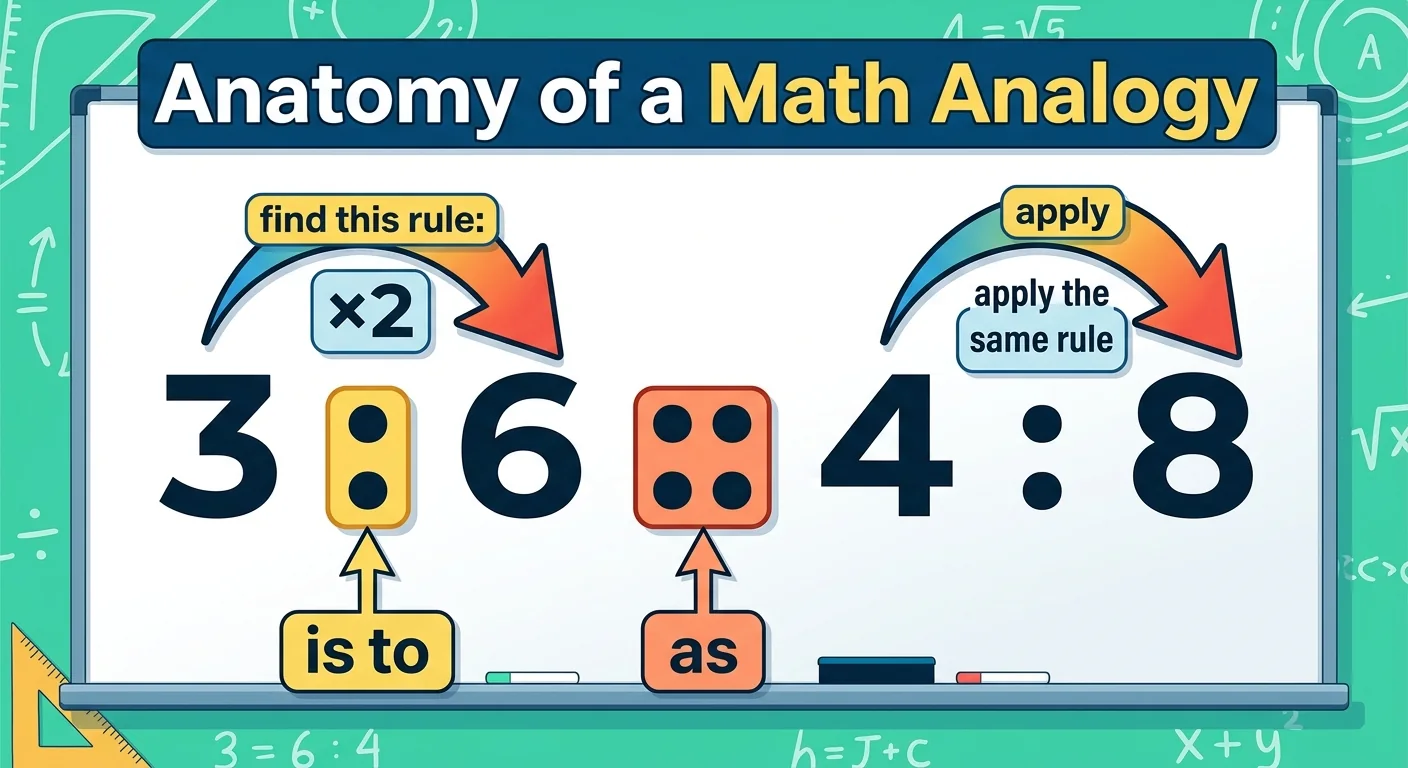
This type of question helps kids find patterns and apply them to new numbers. It improves problem-solving skills and builds confidence for Olympiad exams. A mathematical analogy follows the same logic, two things related in the same way.
What Is a Number Analogy?
A number analogy is the most common type of math analogy. It uses only numbers and asks the child to find the missing number by spotting a pattern.
Example: 2 : 4 :: 5 : ? (Rule: x2. Answer: 10)
Number analogies appear in almost every Math Olympiad for Grades 1 to 3. They test whether a child can recognize patterns like skip counting, doubling, halving, or simple addition. Some textbooks call them numerical analogies, and the words mean the same thing.
What Does Analogous Mean in Math?
Two things are analogous in math when they share the same structure or relationship, even if the numbers themselves are different. The pairs 3 : 6 and 10 : 20 are analogous because both follow the rule multiply by 2. Spotting that two situations are analogous is the whole skill an analogy question is testing.
Math Analogy vs Word Analogy
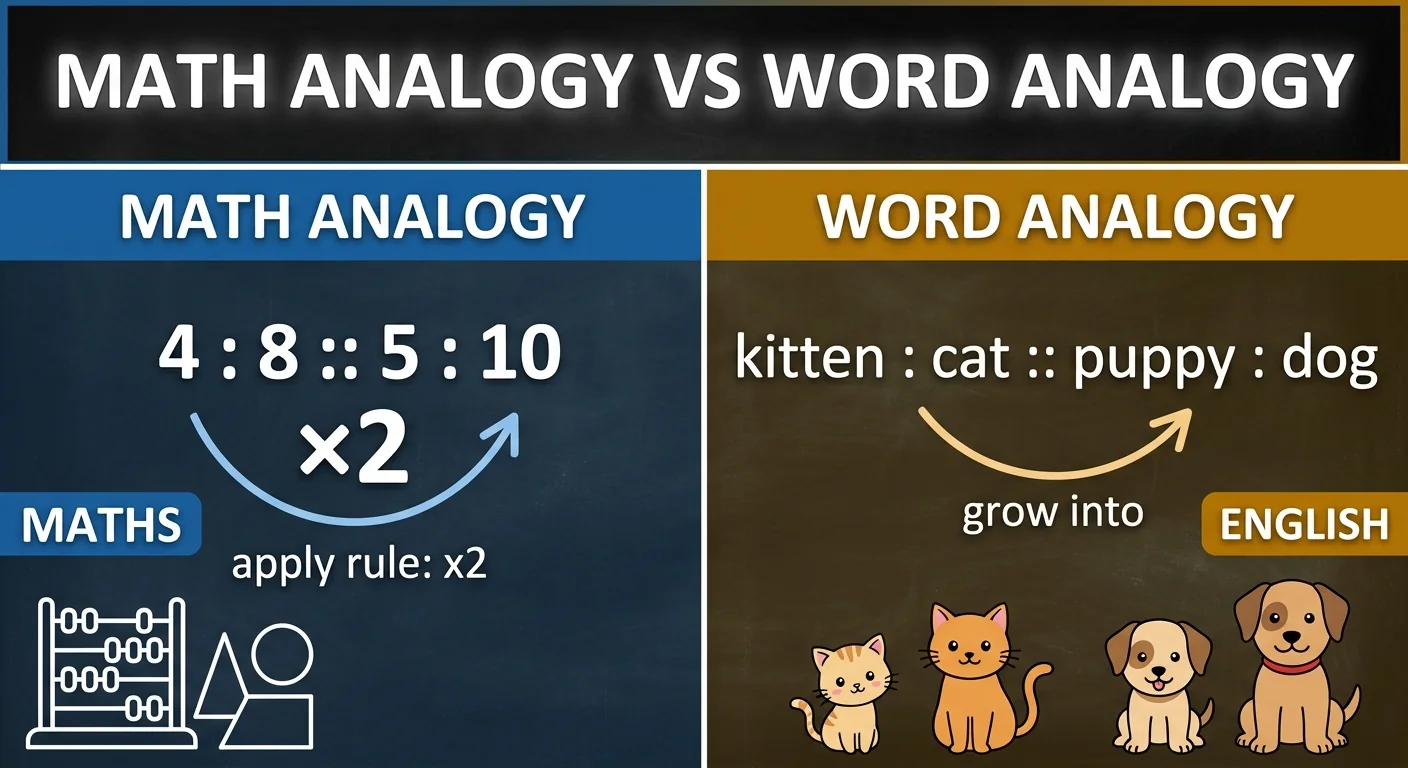
Search for “analogies for kids” and you will mostly find word analogies, which belong to English rather than maths. Both use the same A : B :: C : D format, so it helps to know which one your child has been set.
| Math analogy | Word analogy | |
|---|---|---|
| Subject | Maths and reasoning | English and vocabulary |
| What is compared | Numbers, shapes, quantities | Words and meanings |
| Example | 4 : 8 :: 5 : 10 | kitten : cat :: puppy : dog |
| The rule is | An operation such as x2 or +3 | A relationship such as synonym or part to whole |
| How you check it | Apply the operation and see if it holds | Read it aloud as a sentence and see if it makes sense |
| Where it is tested | Math Olympiads, reasoning papers | ELA tests, vocabulary papers |
If the question has numbers in it, it is a math analogy and you are in the right place. Everything below covers the number side.
Types of Math Analogy for Grades 1-3
Most Olympiad analogy questions fall into one of these eight groups.
- Number Relationship Analogy
- Addition/Subtraction Analogy
- Multiplication/Division Analogy
- Even and Odd Number Analogy
- Skip Counting Analogy
- Shape and Pattern Analogy
- Time and Money Analogy (Advanced Grade 3)
- Positional or Sequence Analogy
Shape and pattern analogies lean on the same skill as visual reasoning for kids, and skip counting analogies get much easier once a child is fluent in skip counting for Class 1.
Why Are Math Analogies Important for Grades 1-3?
Children in early grades are just starting to build a strong foundation in math. Analogies help by:
- Teaching them to look for patterns and relationships
- Strengthening logical thinking
- Making abstract math ideas easier to understand
- Boosting problem-solving speed and confidence
Math Olympiad questions often test more than just calculation, they test thinking. Analogies are a great way to train that thinking from an early age, alongside other reasoning formats like odd one out for Class 1 and general critical thinking for kids.
How to Solve a Number Analogy Step by Step
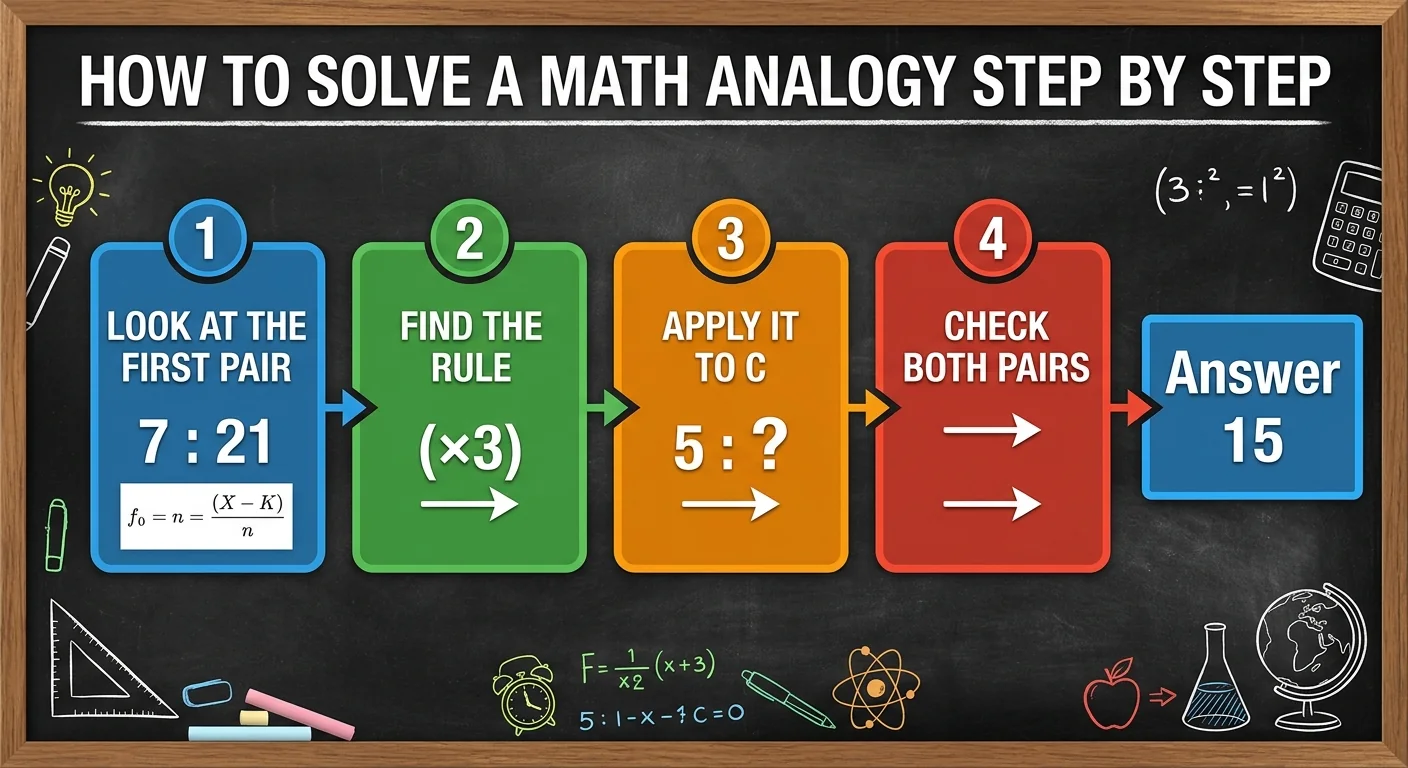
To solve a number analogy, find the rule connecting the first pair, then apply that same rule to the second pair. Learning how to solve number analogies is a key skill for Olympiad prep. Here is a simple method that works for any grade.
- Look at the first pair. What is the relationship between A and B?
- Find the rule. Is it addition, subtraction, multiplication, or division?
- Apply the same rule to the second pair (C : ?).
- Check your answer. Does the rule work for both pairs?
The Number Analogy Formula
There is no single number analogy formula, but the logic is always the same. Whatever operation turns A into B must also turn C into D.
- If B = A + 3, then D = C + 3
- If B = A x 2, then D = C x 2
- If B = A / 3, then D = C / 3
Worked through an example: in 7 : 21 :: 5 : ?, start with the first pair. 7 becomes 21, and 7 x 3 = 21, so the rule is multiply by 3. Apply it to 5, which gives 5 x 3 = 15. Check it: both pairs triple, so 15 is correct.
The key is to find the pattern in the first pair and apply it consistently. Once kids master this approach, they can solve any number analogy question quickly.
Number Analogy Tricks and Shortcuts
These shortcuts cut solving time in half, which matters in a timed paper.
- Compare the size first. If B is bigger than A, the rule adds or multiplies. If B is smaller, it subtracts or divides. That halves the options before any calculation.
- Check doubling and halving before anything else. They are the most common rules in Grades 1 to 3, so test them first.
- If the numbers are close, think addition. 6 : 7 is almost certainly +1, not a times table.
- If B is much bigger, think times tables. 4 : 20 jumps too far for addition, so try x5.
- Read it aloud. Saying “three is to six as four is to what” often makes the rule obvious when staring at it does not.
- Always verify with the first pair. If your rule does not also work on A and B, it is the wrong rule.
Common Mistakes Kids Make with Analogies
Most lost marks come from one of these four habits rather than from weak arithmetic.
- Using the wrong pair to find the rule. The rule always comes from A and B, never from A and C.
- Finding a rule that only fits by accident. In 2 : 4, both +2 and x2 work. Check which one also fits the second pair before committing.
- Reversing the direction. If the first pair halves, the second pair must halve too, not double.
- Rushing past the check. One extra second verifying the rule catches most errors.
How to Teach Math Analogies to Kids
Here are simple steps to teach math analogies at home or in class.
- Start with simple examples using small numbers or real-world objects.
- Explain the pattern clearly, naming it out loud as add, subtract, or double.
- Let kids try similar problems on their own.
- Give hints if they are stuck, not the full answer.
- Practice regularly to build confidence.
A child who already recognizes patterns in a number sequence for Class 1 will pick up analogies much faster, because both ask the same question: what is the rule here?
Easy Math Analogy Examples for Kids (Grades 1-3)
Here are easy math analogy examples organized by grade level. Each set builds on the previous one.
Analogy for Class 1: Grade 1 Math Analogies
1. 1 : 2 :: 3 : ?
Answer: 4
Rule: Add 1 each time (1+1=2, so 3+1=4)
2. 5 : 10 :: 2 : ?
Answer: 4
Rule: Multiply by 2 each time
3. 10 : 5 :: 4 : ?
Answer: 2
Rule: Divide by 2 each time
4. 2 : 4 :: 5 : ?
Answer: 10
Rule: Multiply by 2
5. 6 : 7 :: 9 : ?
Answer: 10
Rule: Add 1 each time
Grade 2 Analogy Questions (Class 2)
1. 3 : 6 :: 4 : ?
Answer: 8
Rule: Double the number (multiply by 2)
2. 7 : 14 :: 5 : ?
Answer: 10
Rule: Multiply by 2
3. 9 : 3 :: 6 : ?
Answer: 2
Rule: Divide by 3
4. 4 : 8 :: 6 : ?
Answer: 12
Rule: Multiply by 2
5. 15 : 10 :: 10 : ?
Answer: 5
Rule: Subtract 5
Analogy Questions for Class 3: Grade 3 Examples
1. 2 : 4 :: 3 : ?
Answer: 6
Rule: Multiply by 2
2. 8 : 4 :: 6 : ?
Answer: 3
Rule: Divide by 2
3. 10 : 12 :: 20 : ?
Answer: 22
Rule: Add 2 to both numbers
4. 6 : 18 :: 4 : ?
Answer: 12
Rule: Multiply by 3
5. 15 : 5 :: 9 : ?
Answer: 3
Rule: Divide by 3
6. 5 : 25 :: 3 : ?
Answer: 15
Rule: Multiply by 5
Grade 3 analogies lean heavily on times tables, so a child who knows the multiplication table by heart will spot these rules in seconds.
Number Analogies: Extra Practice Problems
These number analogy questions are great for extra Olympiad practice. Try them with your child or student.
Easy Level (Grade 1-2)
1. 2 : 6 :: 3 : ?
Answer: 9
Rule: Multiply by 3
2. 4 : 8 :: 7 : ?
Answer: 14
Rule: Multiply by 2
3. 10 : 8 :: 6 : ?
Answer: 4
Rule: Subtract 2
Medium Level (Grade 2-3)
1. 12 : 4 :: 9 : ?
Answer: 3
Rule: Divide by 3
2. 3 : 9 :: 4 : ?
Answer: 12
Rule: Multiply by 3
3. 20 : 5 :: 16 : ?
Answer: 4
Rule: Divide by 4
Number Analogy Patterns to Remember
Nearly every Grades 1 to 3 analogy uses one of these five patterns.
- Skip counting: add the same number each time
- Doubling: multiply by 2
- Halving: divide by 2
- Times tables: x3, x4, x5
- Near numbers: +1, +2, or -2 when the pair is close together
Tips to Make Math Analogies More Fun
Here is how to keep kids excited about analogies:
- Use puzzles or games
- Draw analogies with pictures or colors
- Let kids create their own analogy questions
- Give small rewards for solving a set
- Practice daily for just 5 to 10 minutes
Bonus: Create Your Own Math Analogy
Try this simple trick. Pick a number rule (like add 1, multiply by 2, etc.) and make your own question.
Example: If your rule is +2, then: 4 : 6 :: 5 : ? (Answer: 7)
Encourage your child to be the teacher and make analogy questions for you. This is one of the best ways to deepen understanding of number analogy patterns.
Where to Use Math Analogies for Olympiad Prep
Analogy practice fits into a school week in several places without needing a dedicated lesson.
- In class warm-ups
- At home during homework time
- In math clubs or Olympiad training
- On the printable worksheet above
- With a Math Olympiad learning app like Gonit
Analogies are only one question type in an Olympiad paper. For the wider picture, see our guides on math Olympiad questions and how to solve math Olympiad problems, or check the full IMO syllabus for Class 1.
Make Preparing for Math Olympiad Simple!


Frequently Asked Questions
What is analogy in math?
In math, an analogy is a comparison between two pairs of numbers or values that share the same relationship. The most common format is A : B :: C : D, which means A is to B as C is to D. Kids use analogies to spot patterns and solve missing-number problems. Analogy in mathematics trains logical thinking rather than just calculation.
What are simple analogies for kids?
Simple analogies for kids use small numbers and basic rules like adding 1, doubling, or skip counting. For example, 2 : 4 :: 3 : ? (Answer: 6, Rule: multiply by 2). These easy analogy examples are a great starting point for Grade 1 and Grade 2 students who are just learning to spot number patterns.
What is a number analogy?
A number analogy uses two pairs of numbers where the same rule connects both pairs. If 3 : 6 :: 5 : ?, the answer is 10 because the rule is multiply by 2. Number analogies are very common in Math Olympiad papers for Grades 1 to 3. They are also called numerical analogies in some textbooks.
What is the number analogy formula?
There is no single formula, but the approach is consistent. Find the rule that connects A to B in the first pair, then apply it to C to get D. If B = A x 2, then D = C x 2. If B = A + 5, then D = C + 5. The key is finding the consistent pattern, not memorizing a formula.
What are math analogy examples for Grade 3?
For Grade 3, math analogy examples often involve multiplication and division: 6 : 18 :: 4 : 12 (Rule: x3), or 20 : 10 :: 14 : 7 (Rule: divide by 2). Students at this level can also handle two-step addition patterns such as 10 : 12 :: 20 : 22 (Rule: +2).
What is analogy meaning in maths?
Analogy meaning in maths refers to finding a shared relationship between two number pairs. If one pair follows a rule like doubling, the other pair must follow the same rule. It trains kids to think beyond calculation and look for the underlying pattern that connects numbers.
What is the quickest way to solve a number analogy?
Compare the size of A and B first. If B is larger, the rule adds or multiplies. If B is smaller, it subtracts or divides. That one check removes half the possible rules before you calculate anything. Then test doubling or halving, since those are the most common rules in Grades 1 to 3.
Where can I get a free math analogies worksheet?
The printable math analogy worksheet linked at the top of this page is free and covers Grades 1 to 3, with a separate answer key for parents. It has 62 questions across addition, doubling, halving, skip counting, times tables and division, all in the standard A : B :: C : D format.
Key Takeaways
- A math analogy compares two number pairs that follow the same rule, written as A : B :: C : D.
- Number analogies are the most common analogy type in Olympiad exams for Grades 1 to 3.
- To solve any analogy, find the pattern in the first pair and apply it to the second.
- Compare the size of the first pair before calculating. Bigger means add or multiply, smaller means subtract or divide.
- Common rules include doubling, halving, skip counting, and times tables.
- The rule always comes from A and B, never from A and C. That one mix-up causes most wrong answers.
- Daily practice with easy analogy examples builds speed and confidence over time.
- Analogies in math train logical thinking, not just calculation skills.

Contributor at Gonit Worksheets, writing about math learning that works for real kids.



There are no comments posted here yet.
Sign in to leave a comment