

A multiplication table is a list of the multiples of a number, formed by adding that number to itself repeatedly. The multiplication table of 4 is 4, 8, 12, 16, 20 and so on, because each step adds one more group of four.
- What Is a Multiplication Table?
- How Multiplication Tables Are Built
- Multiplication Table Chart 1 to 12
- Patterns Hiding Inside the Multiplication Table Chart
- How the Commutative Property Halves the Work
- Table-by-Table Breakdown with a Trick for Each
- Memory Strategies for the Hardest Tables (6, 7, 8, 9, 12)
- How Multiplication Tables Connect to Division
- Multiplication Tables in Real Life
- Common Mistakes Class 4 Students Make
- Ten Activities and Games That Build Fluency
- How to Learn Multiplication Tables Fast
- Tips for Parents
- Tips for Teachers
- From Tables to Olympiad Thinking
- Practice Questions with Answers
- Conclusion
A multiplication table chart arranges these lists into a grid, with numbers running across the top row and down the left column, so that the product of any two numbers sits in the cell where their row and column meet.
A standard multiplication table chart for Class 4 covers 1 to 12 and contains 144 products. In the CBSE curriculum, multiplication tables are taught in the Class 4 chapter titled Tables and Shares, which introduces multiplication and division together.
What Is a Multiplication Table?
A multiplication table is a list of the multiples of a number, arranged in order. The table of 4, for example, is 4, 8, 12, 16, 20 and so on, because each step adds one more group of four. When people say “times table” they mean the same thing.
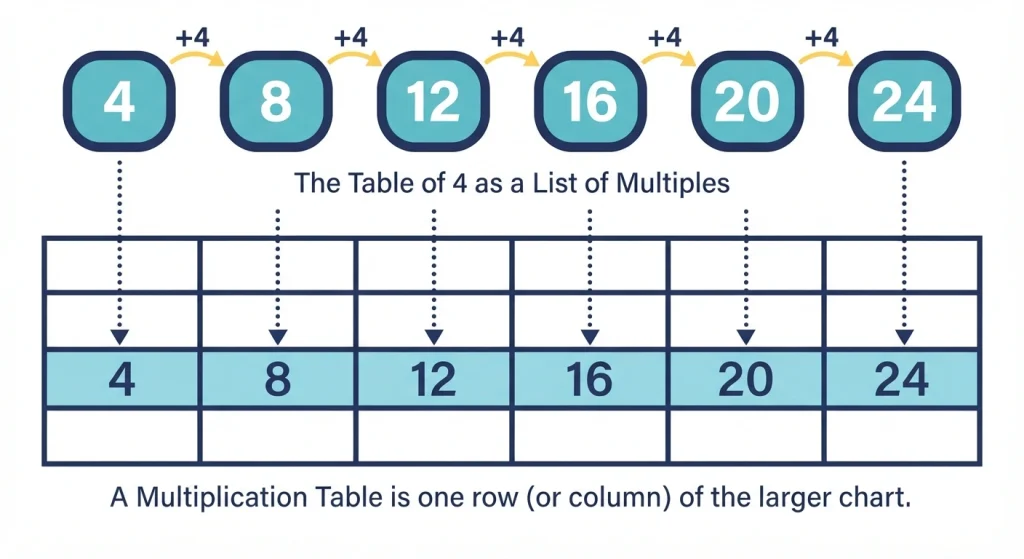
A multiplication table chart puts all of these lists into one grid. Numbers run across the top and down the left side, and the box where a row and a column meet holds the product of those two numbers. Find the 7 row, slide across to the 8 column, and the box reads 56. That single square is telling you 7 x 8 = 56.
In the CBSE syllabus this sits in the Class 4 chapter usually titled Tables and Shares, which deliberately teaches multiplication and division side by side. That pairing matters. Your child is not learning 144 isolated answers. They are learning a set of number relationships that will be reused in division, factors, fractions, area, percentages and every word problem for the next eight years.
By the end of Class 4, the expectation is straightforward recall of multiplication tables up to 12 x 12, in any order, without counting on fingers or restarting the table from the beginning.
How Multiplication Tables Are Built
Before your child memorises anything, they should be able to build a table themselves. Your child first met multiplication in Class 1 as equal groups of objects, and extended that idea through multiplication in Class 2 using arrays and repeated addition.
In Class 4, those ideas have to become instant recall. This is the difference between a child who forgets 7 x 6 and gives up, and a child who forgets 7 x 6 and recovers it in three seconds.
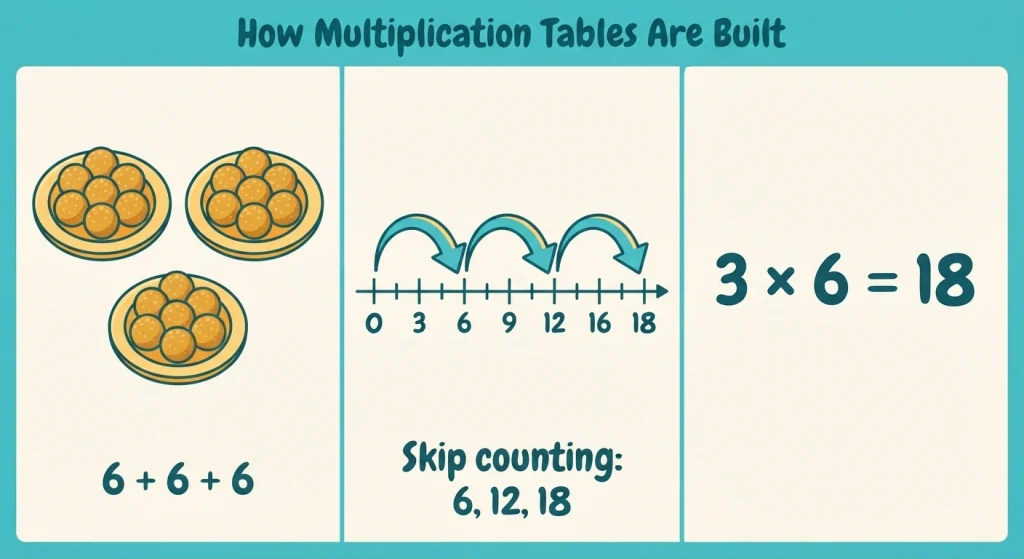
Multiplication is repeated addition
Three plates with 6 laddoos on each plate is 6 + 6 + 6, which is 18. Written as multiplication, that is 3 x 6 = 18. The multiplication sign is shorthand for “groups of”. Read 3 x 6 aloud as “three groups of six” and the meaning stays attached to the symbol.
Skip counting turns addition into a table
Ask your child to count in sixes: 6, 12, 18, 24, 30, 36, 42, 48, 54, 60, 66, 72. They have just recited the entire table of 6 without writing a single multiplication sign. Skip counting is the bridge between addition and fluency, and it is also the recovery route. A child who blanks on 6 x 7 can count 6, 12, 18, 24, 30, 36, 42 and land on the answer.
Arrays make the table visible
Arrange 24 buttons into 4 rows of 6. Now turn the arrangement ninety degrees: it is 6 rows of 4, and there are still 24 buttons. Nothing was added or removed. This single demonstration teaches the commutative property better than any explanation, and it is the reason a multiplication table chart is symmetrical.
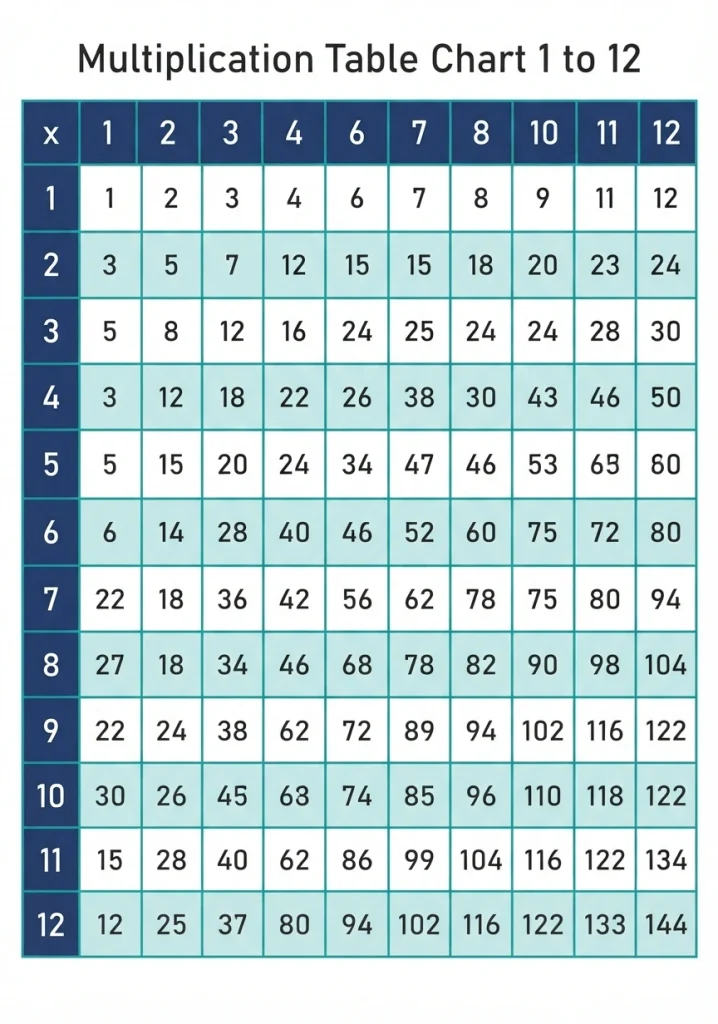
Multiplication Table Chart 1 to 12
Here is the complete multiplication chart 1 to 12. Read it by picking a row, sliding across to a column, and taking the number where they meet.
| x | 1 | 2 | 3 | 4 | 5 | 6 | 7 | 8 | 9 | 10 | 11 | 12 |
|---|---|---|---|---|---|---|---|---|---|---|---|---|
| 1 | 1 | 2 | 3 | 4 | 5 | 6 | 7 | 8 | 9 | 10 | 11 | 12 |
| 2 | 2 | 4 | 6 | 8 | 10 | 12 | 14 | 16 | 18 | 20 | 22 | 24 |
| 3 | 3 | 6 | 9 | 12 | 15 | 18 | 21 | 24 | 27 | 30 | 33 | 36 |
| 4 | 4 | 8 | 12 | 16 | 20 | 24 | 28 | 32 | 36 | 40 | 44 | 48 |
| 5 | 5 | 10 | 15 | 20 | 25 | 30 | 35 | 40 | 45 | 50 | 55 | 60 |
| 6 | 6 | 12 | 18 | 24 | 30 | 36 | 42 | 48 | 54 | 60 | 66 | 72 |
| 7 | 7 | 14 | 21 | 28 | 35 | 42 | 49 | 56 | 63 | 70 | 77 | 84 |
| 8 | 8 | 16 | 24 | 32 | 40 | 48 | 56 | 64 | 72 | 80 | 88 | 96 |
| 9 | 9 | 18 | 27 | 36 | 45 | 54 | 63 | 72 | 81 | 90 | 99 | 108 |
| 10 | 10 | 20 | 30 | 40 | 50 | 60 | 70 | 80 | 90 | 100 | 110 | 120 |
| 11 | 11 | 22 | 33 | 44 | 55 | 66 | 77 | 88 | 99 | 110 | 121 | 132 |
| 12 | 12 | 24 | 36 | 48 | 60 | 72 | 84 | 96 | 108 | 120 | 132 | 144 |
How to use this chart properly
Do not hand this over as a lookup sheet and walk away. A chart used only as a reference never gets memorised, because the brain has no reason to store what it can look up. Use it in three stages instead.
First, exploration. Sit with your child and colour in patterns (the squares, the even numbers, the 9s). This is where understanding is built.
Second, partial support. Cover the answer, say the fact aloud, then uncover to check. The chart becomes a self-marking tool rather than a crutch.
Third, retirement. Print a blank 12 by 12 grid and have your child fill it in from memory, timing themselves once a week. The gaps they leave are exactly the facts that need work, and nothing else does.
Patterns Hiding Inside the Multiplication Table Chart
The grid above is not a random block of numbers. Almost every answer in it is predictable, and pointing out these patterns is what turns a frightening wall of 144 numbers into something a nine year old can hold in their head.
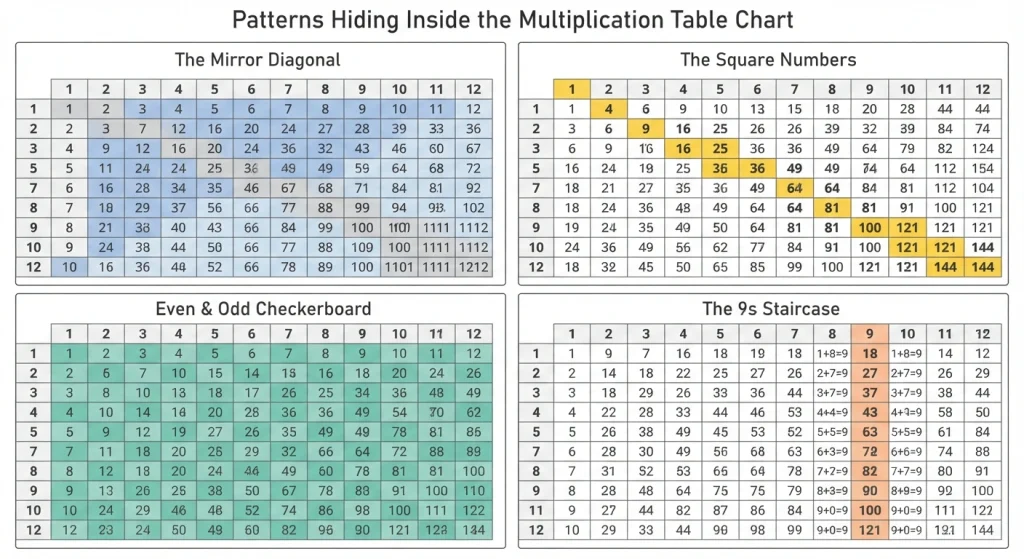
The mirror line. Draw a diagonal from the top left corner to the bottom right. Every number on one side of that line appears again on the other side. The chart is a mirror image of itself, because 3 x 9 and 9 x 3 are the same fact.
The square numbers. The numbers sitting on that diagonal are 1, 4, 9, 16, 25, 36, 49, 64, 81, 100, 121 and 144. These are the square numbers, the answers when a number is multiplied by itself. They are worth learning as a separate short list because they anchor everything around them. Once your child knows 7 x 7 = 49, then 7 x 8 is just seven more, which is 56.
The odd and even checkerboard. Colour every even answer and a pattern appears immediately. Any row or column with an even number at its head is entirely even. An odd answer only appears when both the row number and the column number are odd. Children find this genuinely surprising, and it is a useful checking tool: if your child answers 6 x 7 = 43, the odd answer alone proves it is wrong.
The 9s staircase. Look down the 9 column: 9, 18, 27, 36, 45, 54, 63, 72, 81, 90. The tens digit climbs by one each time while the units digit falls by one each time. Better still, the two digits of every answer add up to 9. Check: 6 + 3 = 9, 7 + 2 = 9, 8 + 1 = 9.
The 11s doubling. From 11 x 1 to 11 x 9, the answer is just the digit written twice: 33, 44, 55, 66, 77, 88, 99. The pattern breaks at 11 x 10, and 11 x 11 = 121 and 11 x 12 = 132 have to be learned outright.
The 5s ending. Every answer in the 5 row and 5 column ends in 0 or 5, alternating. The 5 times table is also exactly half of the 10 times table, which gives a fast route: 5 x 8 is half of 80, so 40.
How the Commutative Property Halves the Work
This is the single most useful thing you can tell a struggling Class 4 student, and most children are never told it explicitly.
The commutative property says that the order of the two numbers does not change the answer. 4 x 9 = 36 and 9 x 4 = 36. The array demonstration from earlier proves it: turning a rectangle of buttons sideways does not change how many buttons there are.
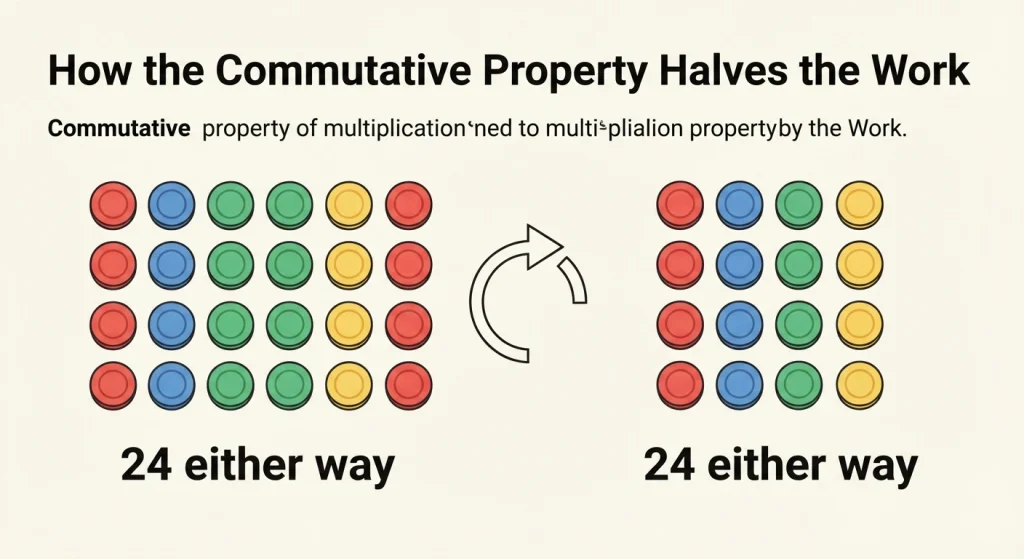
The consequence is arithmetic on the workload itself. A 12 by 12 chart holds 144 facts. Because each fact off the diagonal appears twice, there are only 78 genuinely different facts. Now remove the ones that need no memorisation at all:
- The 1 times table (12 facts): the answer is always the other number.
- The 10 times table: write the number and add a zero.
- The 2 times table: doubling, which most children already do.
- The 5 times table: half of the 10 times table.
- The 11 times table up to 11 x 9: the digit written twice.
What is left is a much smaller set, and the genuinely difficult core is roughly a dozen facts: 3 x 7, 3 x 8, 4 x 6, 4 x 7, 4 x 8, 6 x 7, 6 x 8, 6 x 9, 7 x 8, 7 x 9, 8 x 9 and 12 x 12.
Tell your child this. A child who believes they must memorise 144 things feels defeated before they start. A child who knows they already own most of the chart and have about a dozen stubborn facts left will keep going.
Table-by-Table Breakdown with a Trick for Each
Table of 1
1 x 1 = 1 up to 1 x 12 = 12. Multiplying by 1 leaves a number unchanged, because one group of a number is just that number. Watch for the common slip where a child treats 7 x 1 as 8, confusing it with addition.
Table of 2
2, 4, 6, 8, 10, 12, 14, 16, 18, 20, 22, 24. This is doubling. Every answer is even. If your child can double, they already own this table.
Table of 3
3, 6, 9, 12, 15, 18, 21, 24, 27, 30, 33, 36. Trick: double the number, then add one more group. For 3 x 7, double 7 to get 14, then add 7 to get 21. There is also a neat check: the digits of every answer in the 3 times table add up to 3, 6 or 9.
Table of 4
4, 8, 12, 16, 20, 24, 28, 32, 36, 40, 44, 48. Trick: double twice. For 4 x 8, double 8 to 16, then double 16 to 32. Children who are fluent at doubling find this table almost free.
Table of 5
5, 10, 15, 20, 25, 30, 35, 40, 45, 50, 55, 60. Trick: halve the ten times answer. 5 x 6 is half of 60, so 30. Every answer ends in 5 or 0, and the answers to even numbers always end in 0.
Table of 6
6, 12, 18, 24, 30, 36, 42, 48, 54, 60, 66, 72. Trick: double the three times table. If 3 x 8 = 24, then 6 x 8 = 48. There is also a lovely pattern for even numbers: 6 x 2 = 12, 6 x 4 = 24, 6 x 6 = 36, 6 x 8 = 48. In each case the answer ends in the number you multiplied by, and the tens digit is half of it.
Table of 7
7, 14, 21, 28, 35, 42, 49, 56, 63, 70, 77, 84. This is the table most Class 4 students find hardest, because it has almost no visible pattern. Trick: split it into 5 plus 2. For 7 x 8, work out 5 x 8 = 40 and 2 x 8 = 16, then add to get 56.
Table of 8
8, 16, 24, 32, 40, 48, 56, 64, 72, 80, 88, 96. Trick: double three times. For 8 x 6, double 6 to 12, double to 24, double to 48. The units digits also cycle predictably: 8, 6, 4, 2, 0 and then repeat.
Table of 9
9, 18, 27, 36, 45, 54, 63, 72, 81, 90, 99, 108. Trick: multiply by 10 and subtract the number. 9 x 7 is 70 minus 7, which is 63. And there is the finger method described in the next section.
Table of 10
10, 20, 30, 40, 50, 60, 70, 80, 90, 100, 110, 120. Write the number and add a zero. The easiest table in the chart, and useful as a launchpad for the 5s and 9s.
Table of 11
11, 22, 33, 44, 55, 66, 77, 88, 99, 110, 121, 132. For single digits, write the digit twice. The last three answers break the pattern and must be learned as facts: 11 x 10 = 110, 11 x 11 = 121, 11 x 12 = 132.
Table of 12
12, 24, 36, 48, 60, 72, 84, 96, 108, 120, 132, 144. Trick: split into 10 plus 2. For 12 x 7, work out 10 x 7 = 70 and 2 x 7 = 14, then add to get 84. This splitting method is the same distributive thinking that will power algebra later, so it is worth teaching properly rather than as a gimmick.
Memory Strategies for the Hardest Tables (6, 7, 8, 9, 12)
These five tables account for almost all of the difficulty. Here are strategies specifically for them.
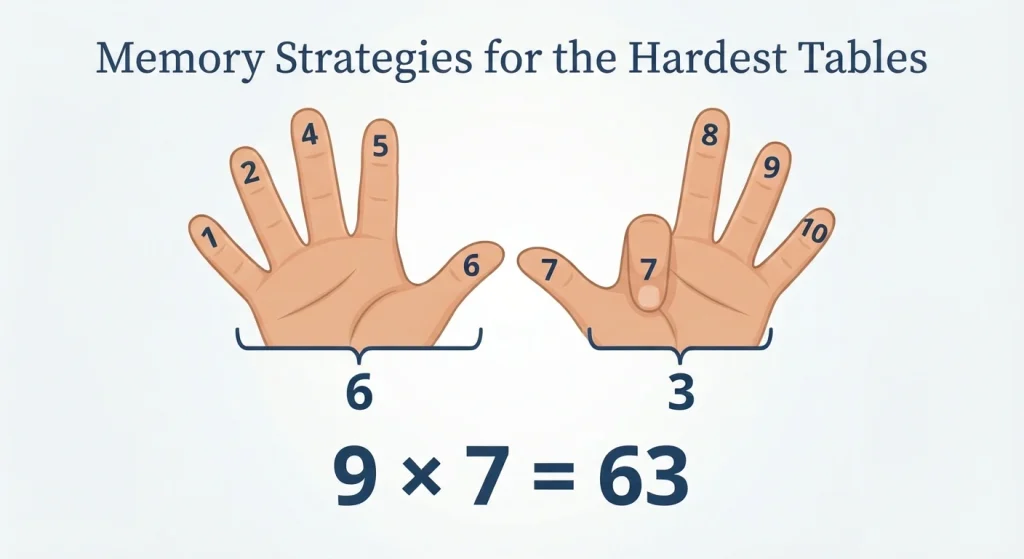
The 9s finger method. Hold both hands out, palms down, and number the fingers 1 to 10 from the left. To find 9 x 7, fold down the seventh finger. Six fingers stand to its left and three to its right, giving 63. It works for every 9 fact from 9 x 1 to 9 x 10, and it gives a nervous child a reliable fallback.
The 5,6,7,8 rhyme. For 7 x 8 = 56, say “five, six, seven, eight” and note that 56 = 7 x 8. The digits land in order. This one fact is the single most commonly missed in the whole chart, so it is worth a dedicated memory hook.
Build from a neighbour. If your child knows 7 x 7 = 49, then 7 x 8 is one more seven, so 56. If they know 6 x 6 = 36, then 6 x 7 is 42. Teaching the square numbers first gives your child an anchor in every neighbourhood of the chart.
Split and add. Any hard fact can be broken into two easy ones. 8 x 7 becomes (8 x 5) + (8 x 2), which is 40 + 16 = 56. 12 x 9 becomes (10 x 9) + (2 x 9), which is 90 + 18 = 108. This is slower than recall, but it is reliable, and children who use it consistently end up memorising the answer anyway.
Double the easy table. 6 is double 3, 8 is double 4, and 12 is double 6. If the easier table is secure, the harder one is one step away.
Name the three hardest facts and attack only those. Most children who “do not know their tables” actually know almost all of them and fail on four or five specific facts, usually 6 x 7, 6 x 8, 7 x 8, 7 x 9 and 8 x 9. Find out exactly which ones by asking randomly, write those on a card, and work on nothing else for a week.
How Multiplication Tables Connect to Division
Every multiplication fact is also two division facts. This is the part that the Tables and Shares chapter is really about, and it is why table fluency pays off twice.
Take 6 x 7 = 42. That single fact also tells you 42 divided by 6 = 7 and 42 divided by 7 = 6. The three numbers 6, 7 and 42 form what teachers call a fact family, and they are best drawn as a triangle with 42 at the top and 6 and 7 at the bottom corners. Cover any one corner and your child works out the missing number.
The practical effect: a child who knows the tables does not have to learn division facts separately. A child who does not know the tables has to learn division twice as painfully. When your child starts long division in Class 4 and 5, the speed at which they can answer “how many 7s go into 45” is the speed at which they can do the whole sum.
Multiplication Tables in Real Life
Class 4 students remember what they use. Here are the four contexts that come up most often in textbooks and in the SOF IMO style question papers.
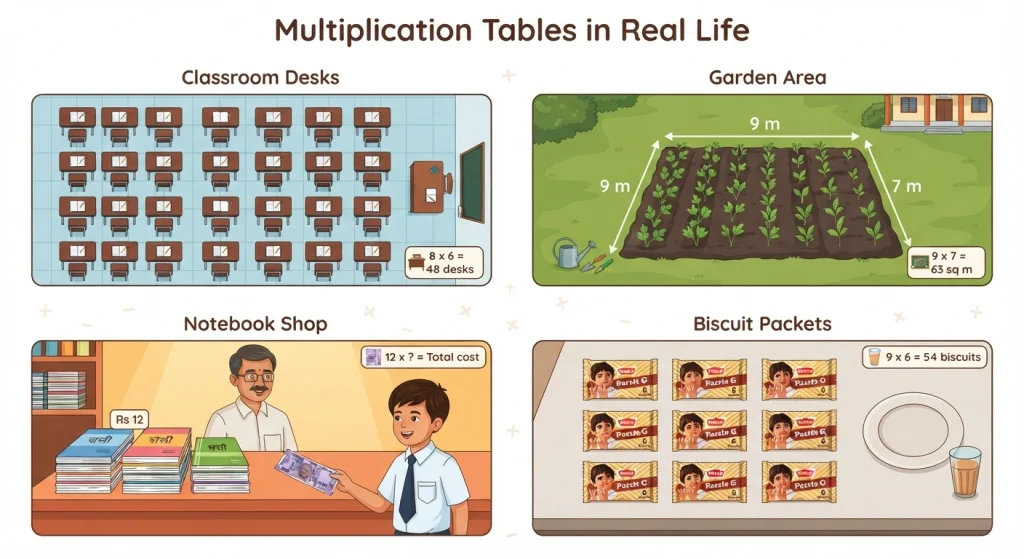
Arrays and rows. A classroom has 8 rows of 6 desks. Total desks = 8 x 6 = 48. Any time objects sit in equal rows, multiplication is faster than counting.
Area. A rectangular garden is 9 metres long and 7 metres wide. Its area is 9 x 7 = 63 square metres. Area is nothing more than a multiplication table fact with units attached, which is why children with weak tables struggle with area chapters that have nothing to do with multiplication conceptually.
Money in rupees. One notebook costs Rs 12. Your child buys 8 notebooks, so the bill is 12 x 8 = Rs 96. If they hand over a Rs 100 note, the change is Rs 4. Shop problems are the single best practice context because the answer matters to the child. The same thinking drives rupee word problems in the Class 3 and Class 4 syllabus.
Equal grouping and sharing. A packet holds 6 biscuits. How many biscuits in 9 packets? 6 x 9 = 54. Reverse it and you get division: 54 biscuits shared among 9 friends gives 6 each.
Scaling up to larger numbers. Once tables are secure, they extend instantly. If one ticket costs Rs 7, then 1,000 tickets cost Rs 7,000 and 10,000 tickets cost Rs 70,000. The table fact 7 x 1 is doing all the work; the zeros are bookkeeping. This is how tables carry a child into the lakh range without new memorisation.
Common Mistakes Class 4 Students Make
Reciting in order but freezing on random questions. This is the most common complaint parents bring, and it has a specific cause. The child has memorised the table as a song, where each answer is cued by the previous one. Asked 8 x 6 out of nowhere, there is no cue, so they silently restart from 8 x 1. The fix is to practise only in random order once the sequence is known, and to mix tables together in the same session.
Confusing multiplication with addition. 7 + 8 = 15 and 7 x 8 = 56 get mixed up under pressure, especially when a child is working fast. Ask them to read the sign aloud before answering.
The 1 and 0 slips. 9 x 1 answered as 10, or 6 x 0 answered as 6. Both come from addition habits. Return to the meaning: one group of nine is nine, and zero groups of six is nothing at all.
Treating 4 x 7 and 7 x 4 as separate facts. A child who has not internalised the commutative property is doing double the work and does not know it.
The 6, 7 and 8 collisions. 6 x 7 = 42, 6 x 8 = 48 and 7 x 8 = 56 sit close together and get swapped. Isolate these three, teach a distinct hook for each, and test them apart from everything else.
Skip counting under time pressure. Counting 7, 14, 21, 28, 35, 42 works, but it is slow and one slip ruins the chain. It is a good recovery tool and a bad primary strategy. If your child is still skip counting for most facts by the middle of Class 4, they need more retrieval practice, not more explanation.
The 9s finger trick beyond 10. The method stops working at 9 x 11. Children who rely on it exclusively get stuck. Teach the “multiply by 10 and subtract” route alongside it.
Ten Activities and Games That Build Fluency
None of these need anything you do not already have at home. If your child responds better to structured play, pair these with the maths games they already enjoy from earlier classes.
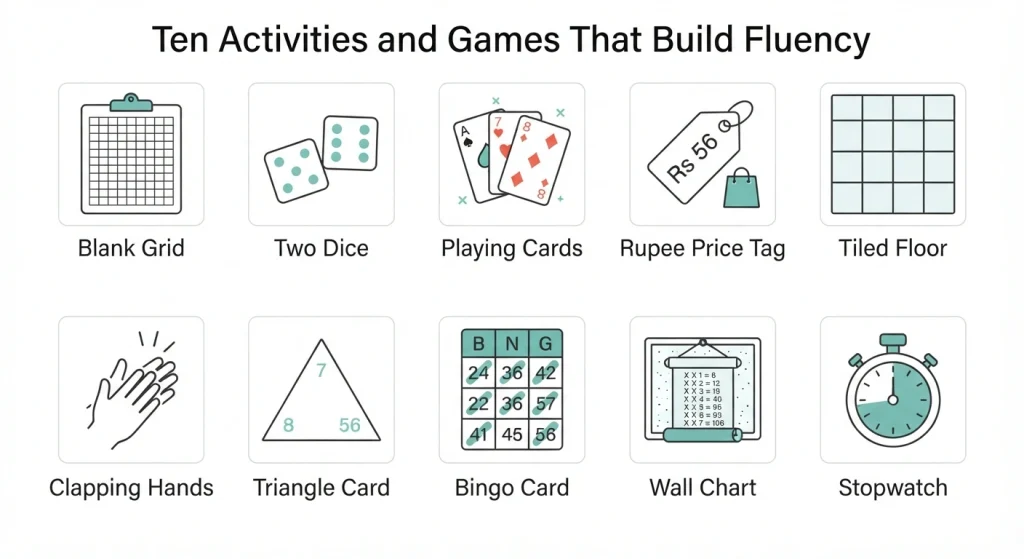
1. Blank grid challenge. Print or draw an empty 12 by 12 grid. Your child fills it in from memory, once a week, timing themselves. The blank squares are the syllabus for the following week.
2. Two dice duel. Roll two dice, multiply the numbers, fastest correct answer wins the point. Add a third die later and multiply all three for a stretch version.
3. Playing card snap. Remove the face cards. Each player flips a card, and the first to call the product of the two cards keeps them. Ace counts as 1. This covers the whole 1 to 10 range in random order, which is exactly what sequence-dependent children need.
4. Rupee shop. Put price labels on household objects (Rs 6 for a spoon, Rs 12 for a cup). Your child is the shopkeeper. You order four spoons and three cups and hand over a Rs 100 note. They calculate the bill and the change.
5. Array hunt. Spend ten minutes finding rectangular arrangements around the house: tiles on the floor, squares on a chess board, windowpanes, chocolate bar segments, chairs in rows. For each one, your child writes the multiplication sentence.
6. Skip counting claps. Count in sixes out loud, clapping on each number. Do it while walking, on the stairs, or during a commute. Then switch to counting backwards from 72, which is much harder and far more useful. Several skip counting activities from the early classes adapt well to the harder tables.
7. Fact family triangles. Write three numbers on a triangle of paper, one per corner: 7, 8 and 56. Cover a corner with your thumb and your child names the hidden number. This trains multiplication and division at once.
8. Multiplication bingo. Each player draws a 3 by 3 grid and fills it with any nine answers from the chart. Call out facts (“six sevens”) and players cross off the matching product if they have it. Three in a row wins.
9. Table of the week. Pick one table, write it on a sheet, and stick it where your child will pass it several times a day. Ask two random questions from it each time you both walk past. Twenty seconds, ten times a day, beats one long session.
10. Beat your own record. Twenty random facts, written down, timed. Record the time and the score in a notebook. The competitor is last week’s version of themselves, not a sibling or a classmate. This keeps the pressure motivating rather than crushing.
How to Learn Multiplication Tables Fast
The fastest route is short daily retrieval practice, spaced out over increasing gaps and mixed across tables, rather than long blocked sessions on one table at a time. Here is the method as a sequence of steps.
Step 1: Test first, teach second. Ask 30 random facts and write down exactly which ones are missed. Most children miss far fewer than parents expect. You now have the real list.
Step 2: Secure the free tables. Confirm that 1s, 2s, 5s, 10s and 11s (to 9) are automatic. If they are not, fix these first. They are quick wins and they carry most of the chart.
Step 3: Teach the pattern before the fact. For each remaining table, show the pattern or the trick (double the 3s for the 6s, double three times for the 8s, ten minus one for the 9s). Understanding is what makes the memory stick and what lets a child recover a forgotten fact.
Step 4: Practise in random order only. Once the sequence is known, never chant it again. Sequence chanting builds the exact dependency you are trying to break.
Step 5: Interleave the tables. Do not spend a week on 6s then a week on 7s. Mix 6s, 7s and 8s in the same five minute session. Mixed practice feels harder and produces noticeably better retention, because the child has to identify the fact before retrieving it.
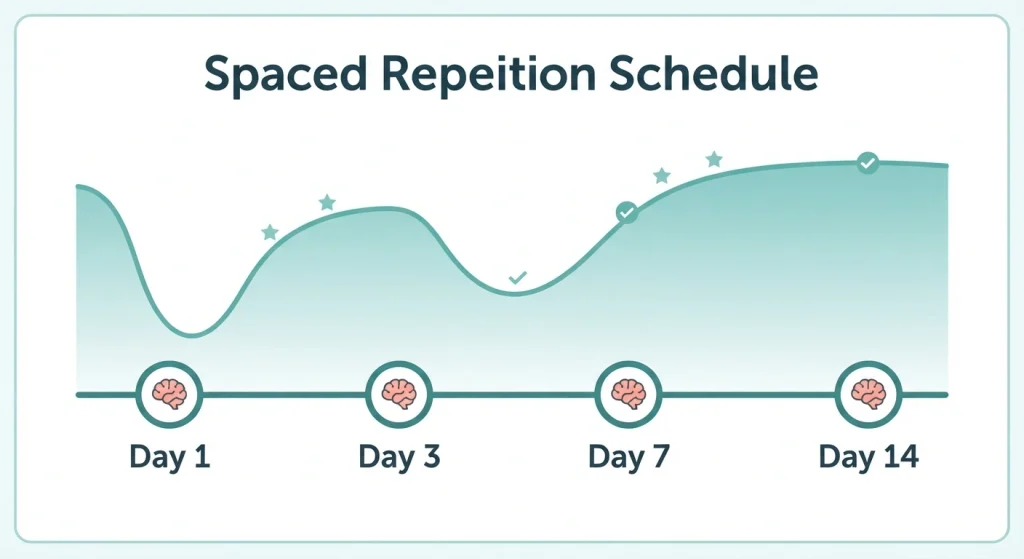
Step 6: Space the reviews out. Revisit a newly learned fact the next day, then three days later, then a week later, then a fortnight later. Each successful recall after a gap makes the memory more durable than three recalls in a row on the same day.
Step 7: Keep the sessions to five or ten minutes. Daily and short beats weekly and long, every time. Fifteen minutes of frustration undoes more than five minutes of practice builds.
Step 8: Retire the chart gradually. Move from full chart visible, to chart face down and checked afterwards, to no chart at all. Most children reach solid recall of the full 1 to 12 range in six to ten weeks of daily five minute practice.
Tips for Parents
Keep the tone calm. A child who associates tables with a tense parent will avoid practice, and avoidance is the only real failure mode here. Speed will come from familiarity, not from pressure.
Practise in the gaps rather than in a study block. The walk to school, the queue at the shop, the two minutes before dinner. Ten short exposures across a day beat one long sitting.
Ask backwards as well as forwards. “What are six eights?” is useful. “What two numbers multiply to make 48?” is more useful, because it builds the factor thinking that division, fractions and olympiad questions depend on.
Do not correct instantly. Give a few seconds of silence. A fact recovered after a pause is being stored; a fact supplied by a parent is not.
Celebrate the recovery strategy, not only the right answer. If your child says “I did not know 7 x 6, so I did 7 x 5 = 35 and added 7”, that is a better outcome than a lucky guess.
Track progress visibly. A weekly blank grid, dated and kept in a folder, shows a child that the empty squares are shrinking. That evidence sustains effort far better than praise does.
Tips for Teachers
Diagnose at the fact level, not the table level. A class list showing which specific facts each child misses is far more actionable than a score out of 30. Most classes converge on the same eight or ten problem facts.
Teach the commutative property explicitly and early, with arrays, and refer back to it every time a hard fact appears. It is the highest leverage five minutes in the whole unit.
Use short daily retrieval starters rather than a weekly test. Six random facts on the board at the start of every lesson, answered on mini whiteboards, gives you live data and costs two minutes.
Interleave deliberately in your planning. Once a table has been introduced, it stays in the mix permanently. Blocked practice produces good lesson-end results and poor retention a month later.
Pair tables with division from the first lesson. Fact family triangles on the wall make the link permanent and save you reteaching division facts in a separate unit.
Give struggling students the strategy, not the chart. A child who has been taught “double the 3s” can rebuild the 6 times table anywhere. A child holding a chart can only read it.
From Tables to Olympiad Thinking
Table fluency is not the goal in itself. It is the working memory that olympiad-style reasoning runs on. In the SOF IMO syllabus,
Math Kangaroo papers and school olympiad papers at the Class 4 level, multiplication table knowledge shows up in disguised forms.
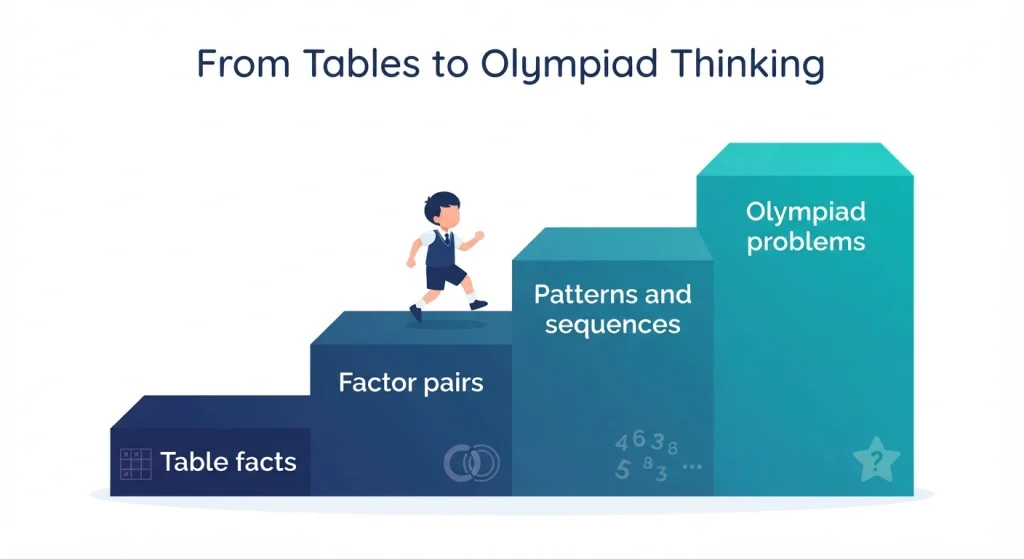
Factor questions. “Which two numbers multiply to give 36?” A child with fluent tables sees 4 x 9, 6 x 6, 3 x 12 and 2 x 18 almost at once. A child without them tries numbers one at a time.
Pattern and sequence questions. A sequence reading 7, 14, 21, 28 is recognised instantly as the 7 times table, so the next term is obvious. Recognition, not calculation, is what saves time under exam conditions.
Working backwards. “A number multiplied by 8 gives 72. What is the number?” This is a division question wearing a multiplication costume, and it is answered in one second by a child who owns the fact family. Recognising the reversal quickly is one of the habits behind how to approach olympiad problems efficiently.
Multi-step word problems. These are where weak tables really cost marks. The child understands the problem perfectly, but spends so much attention calculating 12 x 7 that they lose track of what they were solving. Fluency frees up the mental space that the actual reasoning needs.
Divisibility and remainders. Olympiad questions about what leaves a remainder of 3 when divided by 7 assume the 7 times table is instantly available as a mental ruler.
The pattern is consistent. Tables do not make a child a better problem solver. They remove the obstacle that stops a good problem solver from showing what they can do. Once recall is automatic, your child can spend their attention on the reasoning that olympiad-style questions actually test.
Practice Questions with Answers
Mixed and random, exactly as they should be practised. Cover the answers first.
- 7 x 8
- 6 x 9
- 12 x 4
- 8 x 8
- 9 x 11
- 3 x 12
- 6 x 7
- 11 x 11
- 4 x 9
- 12 x 12
- A box holds 8 pencils. How many pencils in 7 boxes?
- One kite costs Rs 9. What is the cost of 6 kites?
- A garden is 7 metres by 12 metres. What is its area?
- 63 divided by 9
- What two numbers multiply to give 48? Give two different pairs.
Answers: 1. 56 2. 54 3. 48 4. 64 5. 99 6. 36 7. 42 8. 121 9. 36 10. 144 11. 56 pencils 12. Rs 54 13. 84 square metres 14. 7 15. 6 x 8 and 4 x 12 (also 2 x 24 and 3 x 16)
Make Preparing for Math Olympiad Simple!



What is a multiplication table?
A multiplication table is a list of the multiples of a number, formed by adding that number to itself repeatedly. The table of 4 is 4, 8, 12, 16 and so on. A multiplication table chart arranges all of these lists into a grid so that any product can be found where a row and a column meet.
How many multiplication facts does a Class 4 student need to learn?
A 12 by 12 chart contains 144 facts, but because order does not change the answer, only 78 are different. Once the 1s, 2s, 5s, 10s and 11s are secure, the genuinely difficult set comes down to roughly a dozen facts.
Which multiplication tables are the hardest to learn?
The 6, 7, 8 and 12 tables cause the most difficulty, and the single most commonly missed facts are 6 x 7, 6 x 8, 7 x 8, 7 x 9 and 8 x 9. These tables have the least visible patterns, which is why strategy-based approaches (doubling, splitting into 5 plus 2, ten minus one) work better than repetition alone.
How long does it take to learn multiplication tables 1 to 12?
With five to ten minutes of daily random-order practice, most Class 4 students reach reliable recall across the full 1 to 12 range in about six to ten weeks. Progress is faster at the start, since the easy tables carry a large share of the chart.
Should my child learn tables up to 12 or up to 20?
Master 1 to 12 completely first. Tables up to 20 are useful later for mental arithmetic and competitive exams, but they are far less valuable than genuine fluency to 12, and pushing to 20 before 12 is secure usually weakens both.
Is it bad to let my child use a multiplication table chart while solving problems?
Not at the start. A chart is a useful learning tool during the exploration and checking stages. It becomes a problem only when it stays available permanently, because a fact that can always be looked up never gets stored. Move from visible chart, to checking afterwards, to no chart.
My child can recite tables in order but freezes on random questions. What do I do?
This means the table has been learned as a sequence, where each answer is cued by the one before it. Stop all sequential chanting. Practise only in random order, and mix several tables in the same session so your child has to identify the fact before retrieving it.
How to learn multiplication tables fast?
Test first to find the specific facts your child misses, secure the pattern-based tables (1s, 2s, 5s, 10s, 11s), teach a trick for each remaining table, then practise those facts in random order for five minutes a day with reviews spaced at one day, three days, one week and two weeks.
Do multiplication tables help with division?
Directly. Every multiplication fact carries two division facts with it. Knowing 8 x 9 = 72 means you also know 72 divided by 8 and 72 divided by 9. A child with secure tables does not need to learn division facts separately.
At what age should a child know all their tables?
Most curricula, including CBSE and the Class 4 Tables and Shares chapter, expect recall of tables to 12 x 12 by the end of Class 4, around age nine or ten. Children who arrive later than this are not behind in any permanent sense, but the gap widens quickly once long division, fractions and area chapters begin.
Conclusion
A multiplication table looks like 144 things to memorise, which is exactly why children give up on it. It is not. Once the mirror pattern removes the duplicates and the easy tables take care of themselves, your child has about a dozen stubborn facts left.
Teach the pattern before the fact, then practise in random order for five minutes a day. Six to ten weeks of that is usually enough, and what you are building is not speed. It is the mental space your child will need later for division, fractions and area.

Mikha Piregu is a Content Writer with experience spanning educational content, including math and math olympiad topics, as well as advocacy writing, research-based articles, and SEO-driven web content. He creates high-quality blog content, web copy, and feature articles that support brand visibility, audience engagement, and long-term organic growth through data-informed storytelling. Skilled in WordPress, WooCommerce, and modern digital tools, Mikha adapts content across various platforms, including blogs, websites, campaigns, and advocacy initiatives, with clarity and purpose.

There are no comments posted here yet.
Sign in to leave a comment