

Rounding to the nearest 10 means replacing a number with the closest multiple of ten, so 27 becomes 30 and 42 becomes 40.
- What Rounding to the Nearest 10 Actually Means
- Why We Round Numbers in Real Life
- Seeing Rounding on a Number Line
- The Rounding Rule, Explained Intuitively
- Step by Step: How to Round Any Number to the Nearest 10
- Worked Examples from Easy to Harder
- Numbers That End in Exactly 5
- How Rounding Connects to Place Value
- Common Mistakes Children Make When Rounding
- Hands-On Rounding Activities and Games
- Using Rounding for Mental Math and Estimation
- Tips for Parents Teaching Rounding at Home
- Tips for Teachers Delivering a Rounding Lesson
- From the Nearest 10 to the Nearest 100 and Beyond
- Rounding in Olympiad Style Problems
- Practice Questions with Answers
- Final Thoughts
Children use this skill long before they meet the word rounding, every time they say a cricket match had about 50 people watching or a walk took roughly 20 minutes.
This guide shows you how to teach rounding to the nearest 10 as a number sense skill rather than a rule to memorise, with a number line method, worked examples, eight activities, practice questions and answers you can use at home or in the classroom.
What Rounding to the Nearest 10 Actually Means
Rounding to the nearest 10 means asking one simple question: which multiple of ten is this number closest to? A multiple of ten is any number in the counting-by-tens sequence, so 10, 20, 30, 40, 50, and so on. Every whole number sits somewhere between two of these, and rounding picks the nearer one.
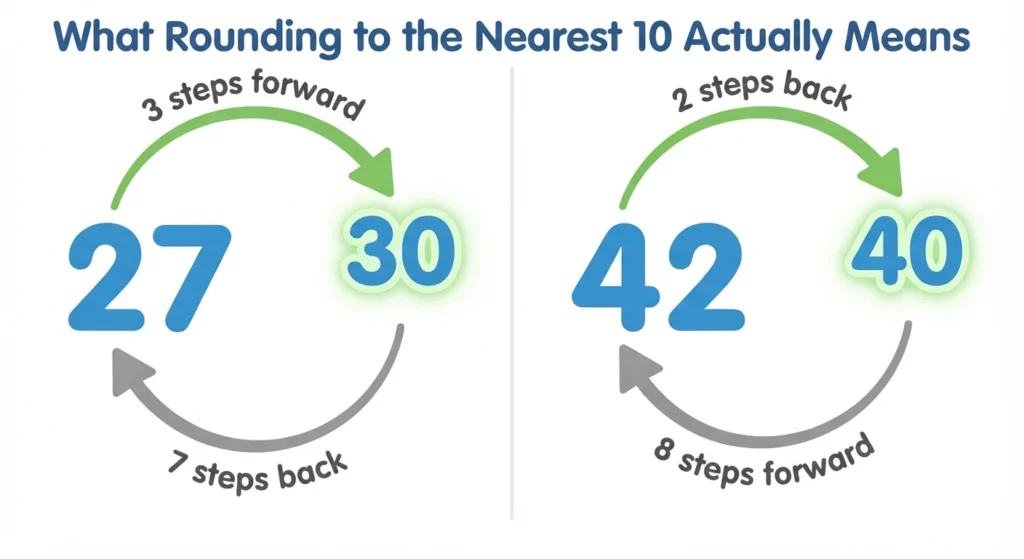
Take 27. It sits between 20 and 30. Count the gaps: 27 is seven steps past 20 but only three steps away from 30. Thirty wins, so 27 rounds to 30. Take 42. It sits between 40 and 50, two steps past 40 and eight steps short of 50. Forty wins, so 42 rounds to 40.
Notice what you did not do there. You did not apply a rule. You compared two distances and chose the shorter one. That comparison is the whole idea, and a child who understands it can round correctly even if they forget every rule they have been taught. The rule that comes later is simply a shortcut for the comparison.
One more thing worth saying out loud to your child: a rounded number is not the right answer to a counting question. If there are 27 mangoes in a basket, there are 27 mangoes.
Rounding gives a useful nearby number for thinking and talking quickly, not a replacement for the exact count. Children who grasp this early never fall into the habit of rounding when a question wanted precision.
Why We Round Numbers in Real Life
Children round numbers constantly without naming it. Making that visible is the fastest way to get a child interested in rounding to the nearest 10, because it moves the topic out of the textbook and into their own day.
Here are contexts your child already knows:
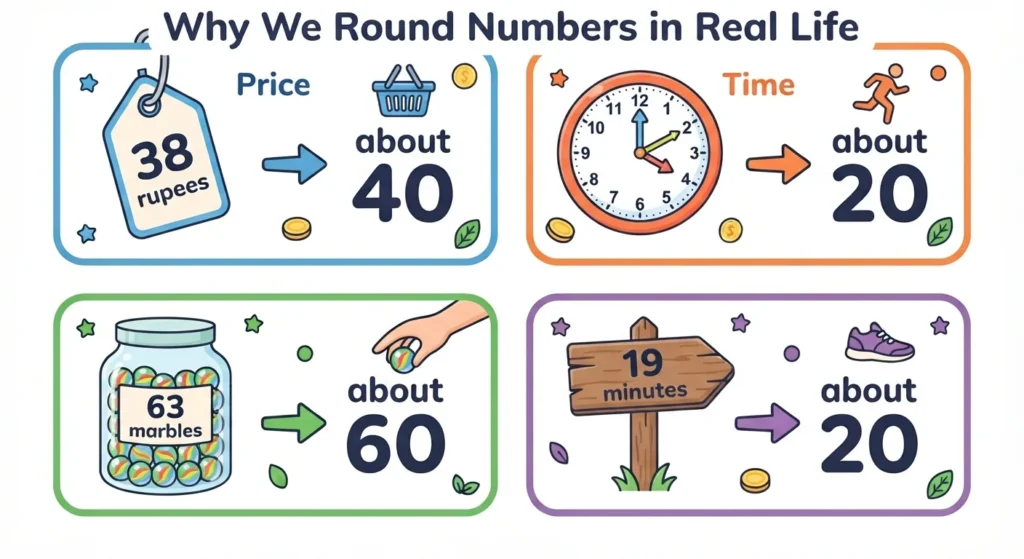
- Money. A pencil box costs 38 rupees and you say it costs about 40. At a shop, quick rounding tells you whether 100 rupees will cover three items before you reach the counter.
- Time. A journey takes 22 minutes and you tell someone it takes about 20 minutes. Nobody says twenty-two on the phone.
- Distance. The school is 19 minutes away on foot, so you call it 20.
- Quantity. A jar has 63 marbles and you say roughly 60. A birthday party had 28 guests, so about 30 people came.
- Scores and measurements. A child scored 47 out of 50 and says they got about 50, or a plant grew 11 cm and gets described as about 10 cm.
Ask your child to catch you rounding for one day. Every time you say about, roughly, nearly or almost with a number, they get a point. By evening they will have noticed that adults round constantly, and the concept stops feeling like school work. This kind of real-world noticing is exactly what builds number sense, the flexible feel for quantity that makes later arithmetic easier.
Seeing Rounding on a Number Line
The number line is the single most useful tool for teaching rounding to the nearest 10, because it turns an abstract comparison into something a child can see and point at.
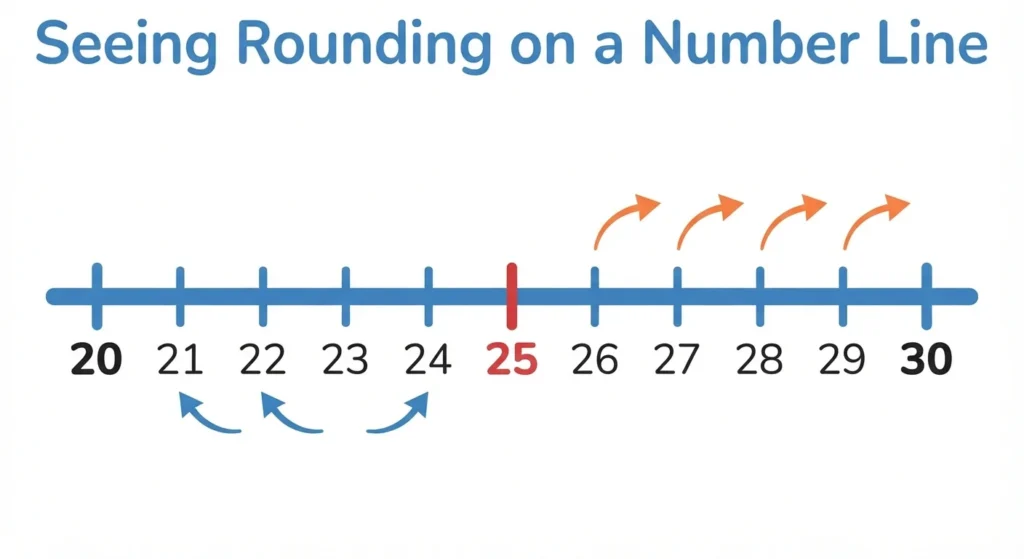
Draw a line and mark only two numbers at the ends: 20 on the left and 30 on the right. Then mark the halfway point, 25, with a taller tick. Now fill in the numbers between. Ask your child to put a finger on 23 and then answer which end is closer. They will walk their finger both ways and land on 20. Do the same for 28 and they will land on 30.
After four or five numbers, the pattern becomes clear. Everything to the left of the halfway mark falls back to the lower ten. Everything to the right of it climbs to the higher ten. Children often describe it as a hill: numbers past the middle roll forward, numbers before the middle roll back. That image sticks far better than any sentence you could give them.
Do this for several different decades, not just 20 to 30. Try 50 to 60, then 80 to 90, then 0 to 10. The last one matters because numbers like 3 and 7 confuse children who have only ever practised with two-digit numbers.
Three rounds to 0, and that surprises them the first time. If your child is still shaky on placing numbers accurately, spend a session on the number line itself before adding rounding on top of it, and practise reading positions on the line first.
Keep the number line available even after your child learns the rule. When they get stuck later on a harder number, sending them back to the line resolves the confusion faster than repeating the rule louder.
The Rounding Rule, Explained Intuitively
The rule for rounding to the nearest 10 is this: look at the ones digit. If it is 5, 6, 7, 8 or 9, round up to the next ten. If it is 0, 1, 2, 3 or 4, round down to the ten you are already in.
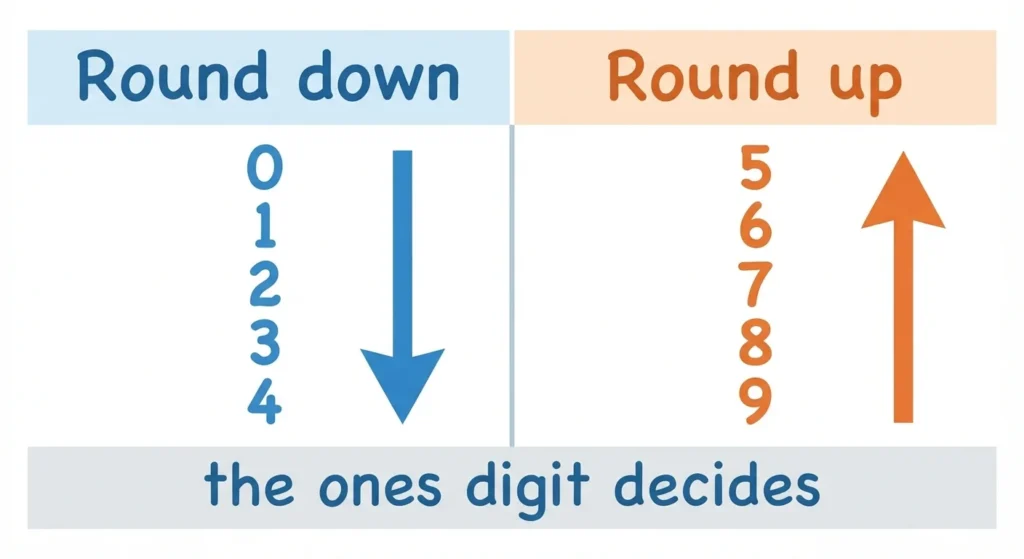
Introduce it only after the number line work, and introduce it as a discovery rather than an instruction. Ask your child: on the line from 30 to 40, which numbers went back to 30? They will list 31, 32, 33, 34. Which went forward to 40? They will list 35, 36, 37, 38, 39. Now ask what all the back-numbers have in common and what all the forward-numbers have in common. Most children spot the ones digit themselves within a minute.
When a child derives the rule this way, it is a summary of something they already understand rather than a fact handed to them. That difference shows up months later, when the rule has faded and they can still rebuild it.
A phrase that helps: the ones digit is the only digit that decides. The tens digit does not get a vote, it just tells you which two tens you are choosing between. Children who hear this stop staring at the whole number and start looking at the one digit that matters.
Step by Step: How to Round Any Number to the Nearest 10
Here is the full method your child can use on any whole number.
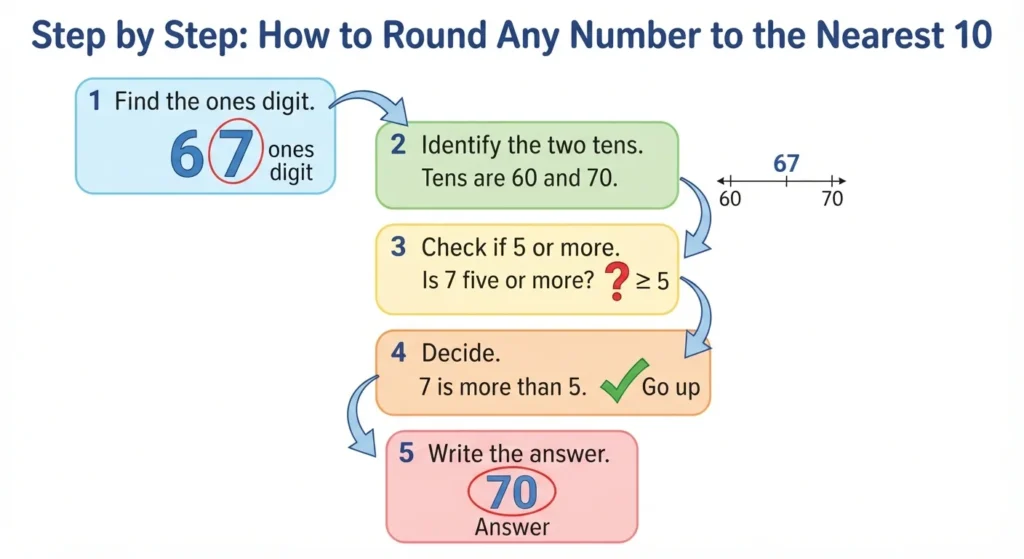
- Step 1: Find the ones digit. It is the last digit of the number, the one on the far right. In 67, the ones digit is 7.
- Step 2: Identify the two tens on either side. In 67, the tens on either side are 60 and 70. The tens digit tells you the lower one, and the next ten up is the higher one.
- Step 3: Check whether the ones digit is 5 or more. Seven is more than five.
- Step 4: Decide. Five or more means go up to the higher ten. Four or less means stay at the lower ten.
- Step 5: Write the answer with a zero in the ones place. Sixty-seven rounds to 70, not to 7 or to 67.
Step 5 sounds obvious to an adult and is not obvious to a child. A rounded number always ends in zero when you are rounding to the nearest 10. If your child writes an answer that does not end in zero, they have made a mistake, and that is a self-check they can run on their own work. Teach it as a checking habit, not a warning.
Say the steps aloud together for the first week, then let your child say them silently, then let the steps disappear. The goal is that rounding becomes a glance, not a procedure.
Worked Examples from Easy to Harder
Work through these with your child, saying the reasoning out loud each time. Cover the answer, let them try, then compare.
Example 1: Round 14 to the nearest 10
The ones digit is 4. The two tens on either side are 10 and 20. Four is less than five, so stay low. The answer is 10. On the number line, 14 is just four steps past 10 and six steps short of 20, so 10 is genuinely closer.
Example 2: Round 38 to the nearest 10
The ones digit is 8. The tens on either side are 30 and 40. Eight is more than five, so go up. The answer is 40.
Example 3: Round 61 to the nearest 10
The ones digit is 1. The tens on either side are 60 and 70. One is less than five, so stay low. The answer is 60. Children sometimes hesitate here because 61 looks so close to 60 that they wonder whether anything is meant to happen. Tell them nothing happening is a valid result.
Example 4: Round 7 to the nearest 10
One-digit numbers throw children off. The ones digit is 7 and the number itself is 7. The tens on either side are 0 and 10. Seven is more than five, so the answer is 10. Practise 0 to 10 explicitly, because textbooks often skip it.
Example 5: Round 96 to the nearest 10
The ones digit is 6, so go up. The tens on either side are 90 and 100. The answer is 100. This example matters because crossing into a new hundred surprises children who expect a two-digit answer. Show it on a number line running from 90 to 100 and the surprise disappears.
Example 6: Round 143 to the nearest 10
Three-digit numbers work exactly the same way. The ones digit is 3, so stay low. The tens on either side are 140 and 150. The answer is 140. Point out that the 1 in the hundreds place did nothing at all. Once your child sees that the method does not change with bigger numbers, their confidence jumps.
Example 7: Round 205 to the nearest 10
The ones digit is 5, which is the edge case covered in the next section. Five means round up, so 205 becomes 210.
Numbers That End in Exactly 5
Numbers ending in 5 sit exactly halfway between two tens, and this is the one place where rounding stops being about closeness.
Twenty-five is five steps from 20 and five steps from 30. Neither is nearer. So mathematicians agreed on a convention: when a number is exactly halfway, round up.
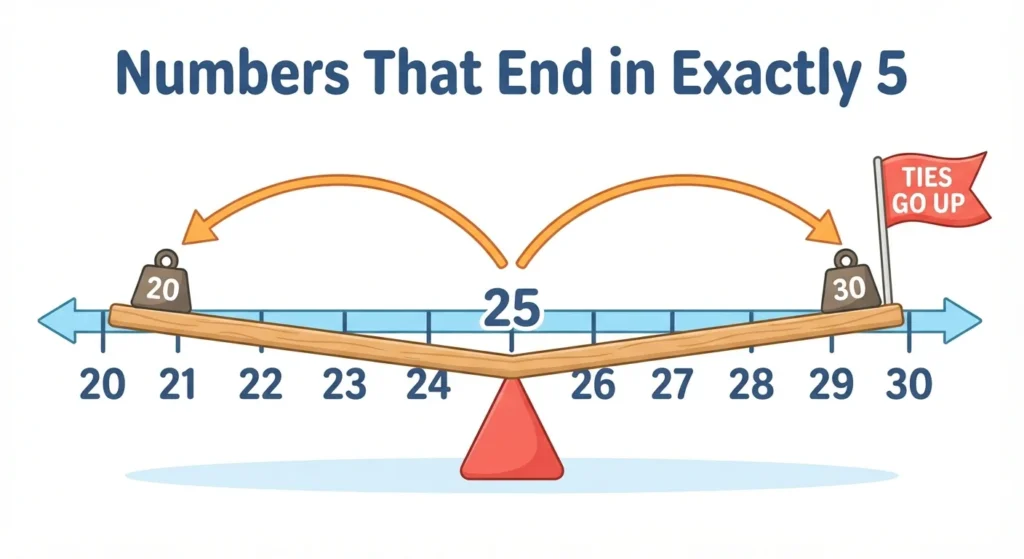
Be honest with your child about this. Do not pretend 25 is closer to 30, because a sharp child will check on the number line and catch you. Say instead that 25 is a genuine tie, and that everyone agreed to break ties by going up so that all of us get the same answer. Children accept conventions easily once they are labelled as conventions. What they resent is being told something false.
So 15 rounds to 20, 25 rounds to 30, 45 rounds to 50, 85 rounds to 90, and 5 rounds to 10.
One question that comes up: why up and not down? The practical answer is consistency. If some people rounded ties down and others rounded up, two children solving the same problem would get different answers. Choosing one direction makes the result predictable. Some advanced fields use a different tie rule, but for school mathematics, ties always go up.
How Rounding Connects to Place Value
Rounding to the nearest 10 is really a place value skill wearing a different hat. The whole method rests on being able to name which digit is in the ones place and which is in the tens place.
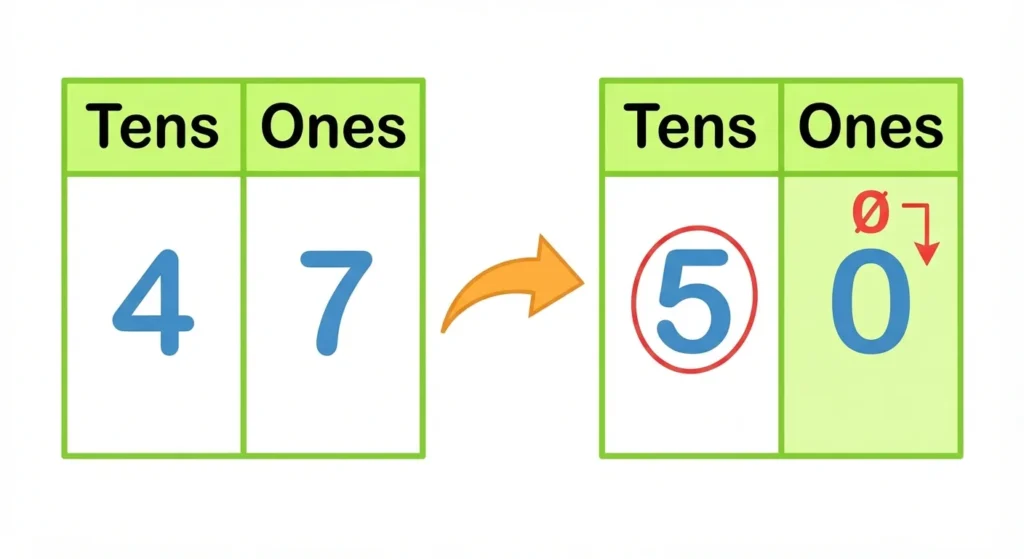
A child who is still unsure about place value will guess at rounding, and no amount of rule practice will fix it.
Check this before you go further. Ask your child what the 4 means in 47, and then what the 4 means in 74. If they answer four tens and four ones confidently, they are ready. If they hesitate, go back and shore up place value first. Half an hour there saves a week of rounding confusion.
Once place value is solid, rounding has a neat description: you keep the tens digit or bump it up by one, and you flatten the ones digit to zero.
Put that way, children see rounding as a tidy-up operation on digits rather than a mysterious transformation. It also sets up rounding to the nearest 100 later, where the same sentence works with one word changed.
Common Mistakes Children Make When Rounding
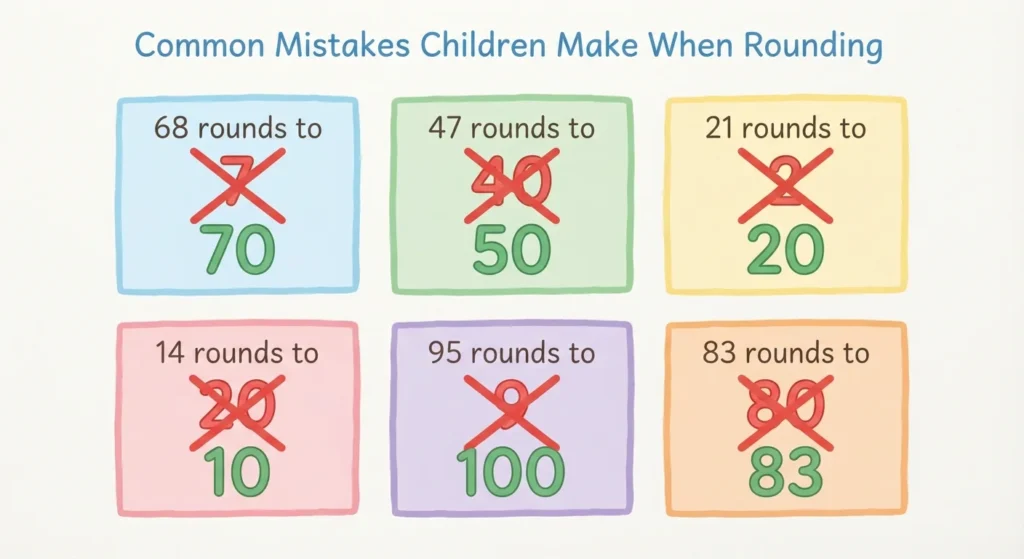
These six mistakes account for most rounding errors in Grades 2 to 4. Knowing them in advance lets you spot the cause rather than just marking the answer wrong.
Mistake 1: Rounding the wrong digit
A child rounds 47 by looking at the 4 instead of the 7 and answers 50 for the wrong reason, or answers 40 when the correct answer is 50. Fix: ask which digit gets the vote. Have them circle the ones digit before doing anything else.
Mistake 2: Dropping the zero
A child rounds 68 and writes 7. They have rounded the tens digit up correctly but forgotten that the answer is a whole number ending in zero. Fix: the answer must end in zero, always. Make it a check they run themselves.
Mistake 3: Rounding in chains
A child rounds 46 to 50 and then decides 50 should become 100, or rounds 145 to 150 and then to 200. Fix: state the target before starting. We are rounding to the nearest 10 once, and then we stop. One round, one answer.
Mistake 4: Always rounding up
Some children decide that rounding means making numbers bigger, so 42 becomes 50. Fix: number line. Ask them to show you why 50 is closer than 40 and they will see it themselves.
Mistake 5: Freezing on numbers already ending in zero
Asked to round 70 to the nearest 10, a child stalls or answers 80. Seventy is already a multiple of ten, so it stays 70. Fix: include a few of these in every practice set so they stop being surprises.
Mistake 6: Rounding when the question wanted an exact answer
Once rounding is fresh, children start rounding inside problems that asked for exact totals. Fix: ask what the question wants, an exact number or an estimate, before any calculation begins. This habit pays off for years, especially in word problems where reading carefully matters more than arithmetic speed.
8 Hands-On Rounding Activities and Games
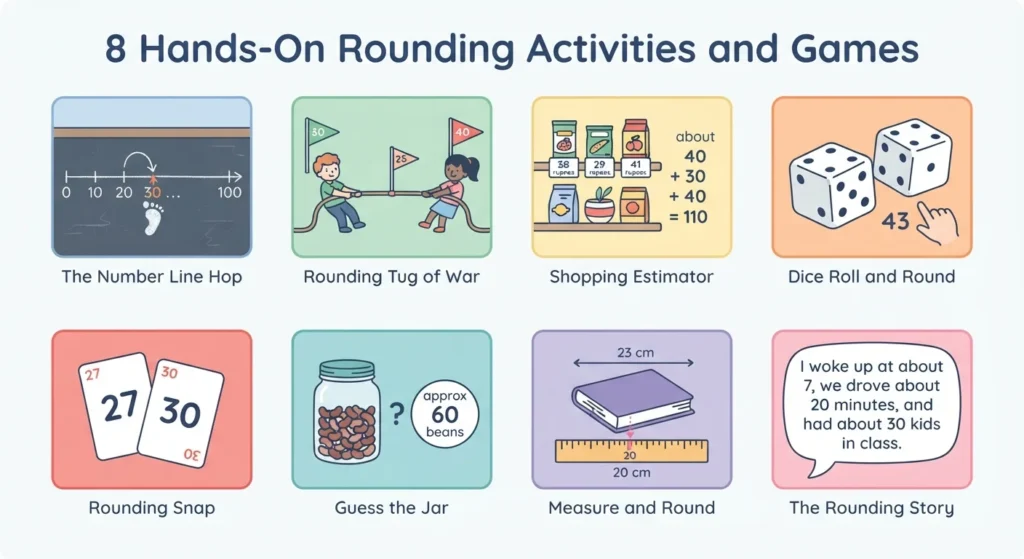
All of these use materials you already have. Ten to fifteen minutes each is plenty, and rotating between them keeps rounding fresh for weeks.
1. The Number Line Hop
Chalk a number line from 0 to 100 on the floor, marking only the tens. Call out a number and have your child stand where it belongs, then hop to the nearest ten. The physical movement of choosing a direction makes the comparison concrete. Works beautifully for children who fidget.
2. Rounding Tug of War
Two children stand at 30 and 40 and pull a rope. Call out a number between them. Whoever owns the nearer ten wins that round. Ties, meaning any number ending in 5, go to the higher side by agreement, which makes the convention memorable because they had to live with it.
3. Shopping Estimator
Give your child five grocery items with price tags. Ask them to round each price to the nearest 10 rupees and add the rounded prices mentally, then check against the real total with a calculator. They see that the estimate lands close, which is the entire point of rounding. Pairs naturally with practice in counting money.
4. Dice Roll and Round
Roll two dice to make a two-digit number, for instance a 4 and a 3 becomes 43. Round it. Score a point for a correct answer and two points if they can also say the two tens it was between. A ten-minute game covers thirty numbers.
5. Rounding Snap
Make cards with numbers on some and multiples of ten on others. Deal them out and play snap, but a match means the number rounds to that ten. So 27 snaps with 30. This one creates a lot of arguing, which is good, because arguing about rounding means thinking about rounding.
6. Guess the Jar
Fill a jar with beans or buttons, let your child estimate, then count the exact number together and round it. Comparing the estimate, the exact count and the rounded value in one session shows all three ideas sitting next to each other. Repeat weekly with different jars and their estimates improve visibly.
7. Measure and Round
Measure household objects in centimetres and round each to the nearest 10. A book that is 23 cm becomes about 20 cm. Then ask which objects are about 30 cm and have them find more. Rounding becomes a sorting tool rather than an exercise, and it reinforces measurement skills at the same time.
8. The Rounding Story
Ask your child to tell you about their day using only rounded numbers. I woke up at about 7, we drove about 20 minutes, there were about 30 children in class. Then retell it with exact numbers and discuss which version was easier to say and which was more accurate. This one produces the best conversations about why rounding exists.
If you want more short games to slot around these, a set of math games for Grade 2 gives you enough variety for a full term.
Using Rounding for Mental Math and Estimation
Rounding earns its place in the curriculum because it makes mental arithmetic possible. Adding 38 and 41 in your head is work.
Adding 40 and 40 is instant, and it tells you the answer is near 80 before you calculate anything.
Teach your child to use rounding in three ways.
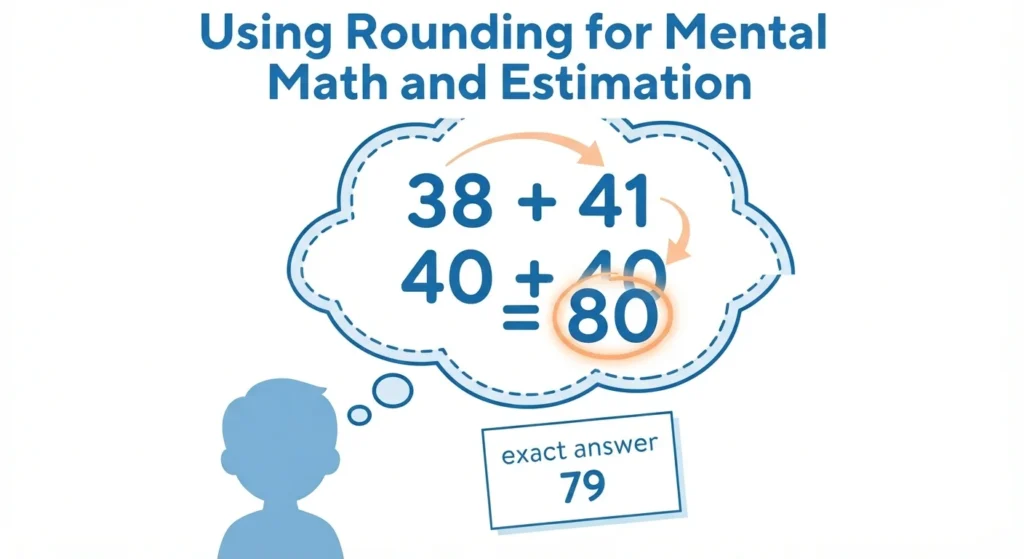
- Predicting. Before solving 27 plus 34, round to 30 plus 30 and predict about 60. Then solve exactly and get 61. The prediction was close, which builds confidence.
- Checking. After solving a problem, round the numbers and see whether the exact answer is near the estimate. If a child computes 27 plus 34 and gets 512, the estimate of 60 flags the error instantly. This is the single most useful error-catching habit in primary mathematics.
- Deciding quickly. When precision does not matter, the rounded answer is the answer. Is 100 rupees enough for items priced 38, 29 and 41? Round to 40, 30 and 40, total 110, so no.
Build this into everyday arithmetic practice rather than treating it as a separate topic. When your child works on addition and subtraction, ask for an estimate first and the exact answer second, every single time. Within a month, estimating first becomes automatic.
Tips for Parents Teaching Rounding at Home
- Start with the number line and stay there longer than you think you need to. The rule can wait a week.
- Use rupee amounts and minutes rather than bare numbers. Context does the explaining for you.
- Ask why rather than what. Why did 43 go down? gets you far more information than a correct answer alone.
- Keep sessions to ten or fifteen minutes. Rounding is a noticing skill and it does not improve with long drills.
- Do not correct immediately. Ask your child to show you on the number line and let them find their own error.
- Round out loud in front of them during ordinary errands so they hear the skill used by an adult who is not testing them.
- If your child is applying the rule mechanically and getting everything right, that is not the finish line. Ask a why question and see whether the understanding is underneath.
Tips for Teachers Delivering a Rounding Lesson
- Open with estimation, not definition. Show a jar of counters, take estimates, then count. Rounding arrives as the answer to a question the class already asked.
- Give every child a personal number line strip for the first three lessons. Removing it too early pushes them to guess.
- Teach one decade at a time before mixing. Mastery of 20 to 30 transfers quickly to every other decade.
- Include 0 to 10 and numbers already ending in zero in the very first practice set, because both are common stumbling points.
- Handle the ends-in-5 case in its own short lesson, named as a convention. Burying it inside general practice creates confusion that resurfaces for months.
- Use error analysis as a task. Show three worked examples, one wrong, and ask the class to find and explain the mistake. Diagnosing errors teaches more than producing correct answers.
- Assess understanding by asking children to write a number that rounds to 60, rather than asking them to round a number. Working backwards reveals whether the concept is real.
From the Nearest 10 to the Nearest 100 and Beyond
Once rounding to the nearest 10 is secure, everything that follows uses the same three moves: find the two landmarks the number sits between, check the digit to the right of the place you are rounding to, and decide.
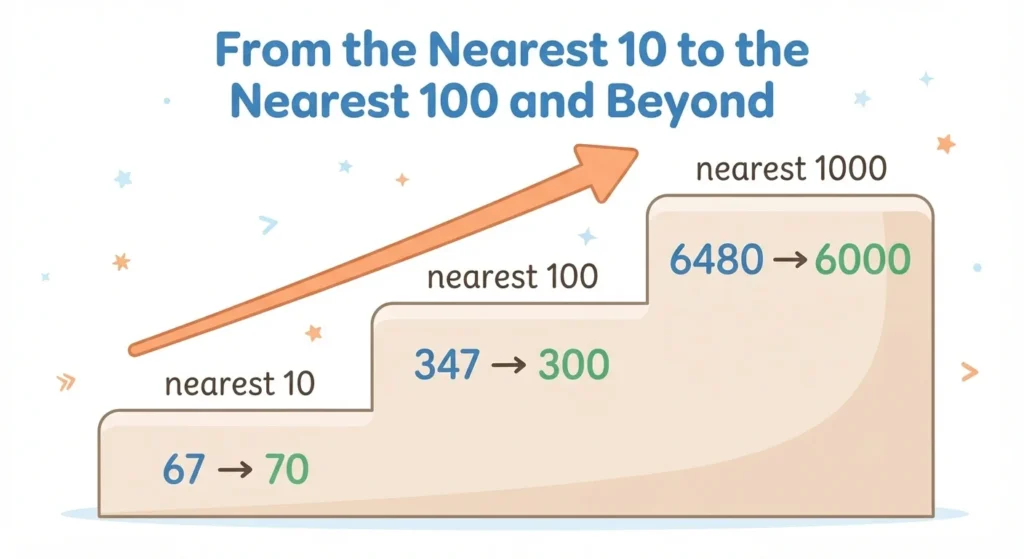
For the nearest 100, the landmarks are hundreds and the deciding digit is the tens digit. So 347 sits between 300 and 400, the tens digit is 4, which is less than 5, so 347 rounds to 300. For the nearest 1000, the landmarks are thousands and the deciding digit is the hundreds digit. So 6,480 sits between 6,000 and 7,000, the hundreds digit is 4, so it rounds to 6,000.
Decimals follow the same logic in the other direction. Rounding 4.7 to the nearest whole number means asking whether it is closer to 4 or 5, and the digit to the right of the ones place decides. Seven is more than five, so the answer is 5.
Do not rush into these. A child who has genuinely mastered the nearest 10 will pick up the nearest 100 in a single session. A child who memorised a rule without the number line will need to memorise a second unrelated rule, and then a third, and the whole topic becomes a burden. The order matters more than the pace.
Rounding in Olympiad Style Problems
Estimation appears in competition mathematics more often than parents expect, and rounding is the tool behind it. Olympiad style questions reward children who can eliminate wrong answers quickly instead of computing everything.
Three ways rounding shows up:
- Eliminating options. A multiple choice question asks for the value of 38 times 21. Rounding gives 40 times 20, which is 800. Any option far from 800 can be discarded without calculation.
- Sanity checking. After a long calculation, a quick rounded estimate tells you whether the answer is plausible. Competition mathematics punishes small slips, and estimation catches them.
- Reverse reasoning. Questions like how many numbers round to 40 when rounded to the nearest 10 require thinking about the whole range from 35 to 44, which is a genuinely different skill from rounding a single number. Try this question with your child once they are comfortable, because it separates memorised rules from real understanding.
If your child enjoys this kind of thinking, work through some math olympiad problems together and watch for places where a quick estimate would have saved time. Shorter math puzzles work well as a warm-up at this age.
Practice Questions with Answers
Let your child work through these on paper, then check together. Ask for reasoning on at least three of them.
Set A: Round to the nearest 10
- 23
- 47
- 8
- 55
- 91
- 80
- 136
- 275
Set B: Think a little harder
- Write three numbers that round to 50.
- What is the smallest number that rounds to 70?
- What is the largest number that rounds to 70?
- Rina says 64 rounds to 70. Is she right? Explain why or why not.
Answers
- The ones digit is 3, so round down.
- The ones digit is 7, so round up.
- The ones digit is 8, and the tens on either side are 0 and 10.
- Ends in 5, so it is a tie and ties round up.
- The ones digit is 1, so round down.
- Already a multiple of ten, so it stays the same.
- The ones digit is 6, so round up. The hundreds digit does nothing.
- The ones digit is 5, so round up.
- Any three of 45, 46, 47, 48, 49, 50, 51, 52, 53 or 54.
- 65, because 65 is a tie and ties round up to 70.
- 74, because 75 would round up to 80.
- No. The ones digit is 4, which is less than 5, so 64 rounds down to 60. On the number line, 64 is four steps past 60 and six steps short of 70.
For a steady weekly routine, mix a few rounding questions into general math practice for second graders rather than doing rounding alone. Mixed practice is what makes a skill stick.
Make Preparing for Math Olympiad Simple!



How do you round to the nearest 10?
Look at the ones digit of the number. If it is 5 or more, round up to the next multiple of ten. If it is 4 or less, round down to the multiple of ten you are already in. The answer always ends in zero. For example, 67 has a ones digit of 7, so it rounds up to 70, while 62 has a ones digit of 2, so it rounds down to 60.
What is the rule for rounding to the nearest 10?
The rule is that the ones digit decides. Ones digits of 5, 6, 7, 8 and 9 round up, and ones digits of 0, 1, 2, 3 and 4 round down. The tens digit only tells you which two multiples of ten you are choosing between.
At what age or grade do children learn rounding to the nearest 10?
Most children meet rounding to the nearest 10 in Grade 3, around ages 8 to 9, after place value and the number line are established. Many Grade 2 children handle it comfortably if they have solid number sense, and some curricula introduce informal estimation even earlier.
Why does 5 round up instead of down?
Because a number ending in 5 sits exactly halfway between two tens, so neither is closer. Rounding up is an agreed convention that makes sure everyone gets the same answer. It is a rule of agreement, not a rule of distance, and it is worth telling children that honestly. Twenty-five rounds to 30. It is exactly halfway between 20 and 30, and the convention is that halfway values round up.
What does 25 round to?
Twenty-five rounds to 30. It is exactly halfway between 20 and 30, and the convention is that halfway values round up.
Does a number that already ends in zero change when rounded?
No. A number like 40 or 90 is already a multiple of ten, so rounding it to the nearest 10 leaves it unchanged. Children often expect something to happen, so practise a few of these deliberately.
How do you round a one-digit number to the nearest 10?
The same way. The tens on either side are 0 and 10. Numbers 1 to 4 round down to 0, and numbers 5 to 9 round up to 10. So 3 rounds to 0 and 8 rounds to 10.
My child gets every answer right but cannot explain why. Is that a problem?
It is worth addressing. Correct answers from a memorised rule collapse when the numbers change shape, for instance with three-digit numbers or when rounding to the nearest 100. Ask your child to show you on a number line or to write a number that rounds to 60. If they manage both, the understanding is real.
How is rounding different from estimating?
Rounding is one specific method for producing a simpler number. Estimating is the broader skill of getting a reasonable answer without exact calculation, and rounding is usually the tool you use to do it. You round the numbers, then you estimate the result.
How do I know when to round and when to be exact?
Ask what the number is for. If someone needs to know how much to pay, how many chairs to set out or how many marks were scored, be exact. If the number is for thinking, comparing or deciding quickly, round. Teaching a child to ask this question before calculating prevents most rounding errors in word problems.
Final Thoughts
A child can round 67 correctly and still not understand rounding. What matters is whether they can say why 70 is the answer and show it on a number line.
Keep the order: compare distances, then the number line, then the rule as a shortcut they find themselves. Call the ends-in-5 case a convention. Check place value before blaming the rounding.
Ten minutes a few times a week is enough. Round prices out loud, estimate before calculating, and rounding becomes a habit rather than a chapter.

Mikha Piregu is a Content Writer with experience spanning educational content, including math and math olympiad topics, as well as advocacy writing, research-based articles, and SEO-driven web content. He creates high-quality blog content, web copy, and feature articles that support brand visibility, audience engagement, and long-term organic growth through data-informed storytelling. Skilled in WordPress, WooCommerce, and modern digital tools, Mikha adapts content across various platforms, including blogs, websites, campaigns, and advocacy initiatives, with clarity and purpose.

There are no comments posted here yet.
Sign in to leave a comment