

Roman numerals 1 to 100 are written using just five symbols: I for 1, V for 5, X for 10, L for 50, and C for 100. Combine them by adding or subtracting, and you can write every number in that range. 1 is I, 50 is L, 99 is XCIX, and 100 is C.
- What Are Roman Numerals 1 to 100?
- Where Roman Numerals Came From
- The Seven Roman Numeral Symbols
- Rule 1: The Additive Rule
- Rule 2: The Subtractive Rule
- Roman Numeral Rules: What Is and Is Not Allowed
- Complete Roman Numerals 1 to 100 Chart
- Patterns Hidden Inside the Chart
- How to Write Roman Numerals 1 to 100: Step by Step
- How to Read a Roman Numeral Back Into a Number
- Roman Numerals in Everyday Life
- Common Mistakes Children Make
- Activities and Games for Learning Roman Numerals
- Tips for Parents Teaching Roman Numerals at Home
- Tips for Teachers Delivering Roman Numeral Lessons
- Roman Numerals in Olympiad Problems
- Practice Questions With Answers
- Conclusion
That is the short answer. The longer answer is what most parents actually need, because a chart alone does not teach a child anything.
This guide walks through the whole system in the order a child can absorb it: the symbols first, then the adding rule, then the subtracting rule, then the full chart with its patterns marked, then practice.
What Are Roman Numerals 1 to 100?
Roman numerals are a number system that uses letters instead of digits. Where we write 7, the Romans wrote VII. Where we write 40, they wrote XL.
The system that covers roman numerals 1 to 100 needs only five letters: I, V, X, L, and C. Two more letters, D for 500 and M for 1000, exist in the full system, but your child will not need them until numbers pass 100.
Here is the key difference from the number system your child already knows. Our system is positional. In 47, the 4 means forty because of where it sits. Roman numerals do not work that way. Each letter always means the same thing no matter where it appears. X is always ten, in XI and in LX and in XC. What changes is whether you add it or subtract it, and that depends only on the letter sitting next to it.
That single idea, fixed values plus a left-right reading rule, is the whole system. Everything else is detail.
Where Roman Numerals Came From
Roman numerals grew out of ancient Rome, over two thousand years ago. They were carved into stone, stamped onto coins, and cut into wooden tally sticks.
That last point explains a lot about how they look. Many historians think I, II and III started as simple notches cut into a stick, one notch per item. The V was a wider mark, possibly a hand shape, for a group of five. Two V shapes joined tip to tip give you X for ten. Once you know that, the early numerals stop looking arbitrary and start looking like counting marks, which is exactly what they were.
The Romans used this system for centuries across their empire. It worked well enough for recording quantities, dates and lists. It worked badly for calculation, because there is no zero and no place value, which makes column arithmetic almost impossible. That is why the Hindu-Arabic digits we use today eventually replaced it everywhere that mattered for maths.
Roman numerals never disappeared, though. They survived as a system for labelling and naming, which is where your child still meets them today.
Keep the history to about this much when you teach it. Children find the tally-stick origin genuinely interesting, and it helps them remember the symbols. Longer history lessons pull attention away from the rules.
The Seven Roman Numeral Symbols
The complete system uses seven letters. For roman numerals 1 to 100 you need the first five.
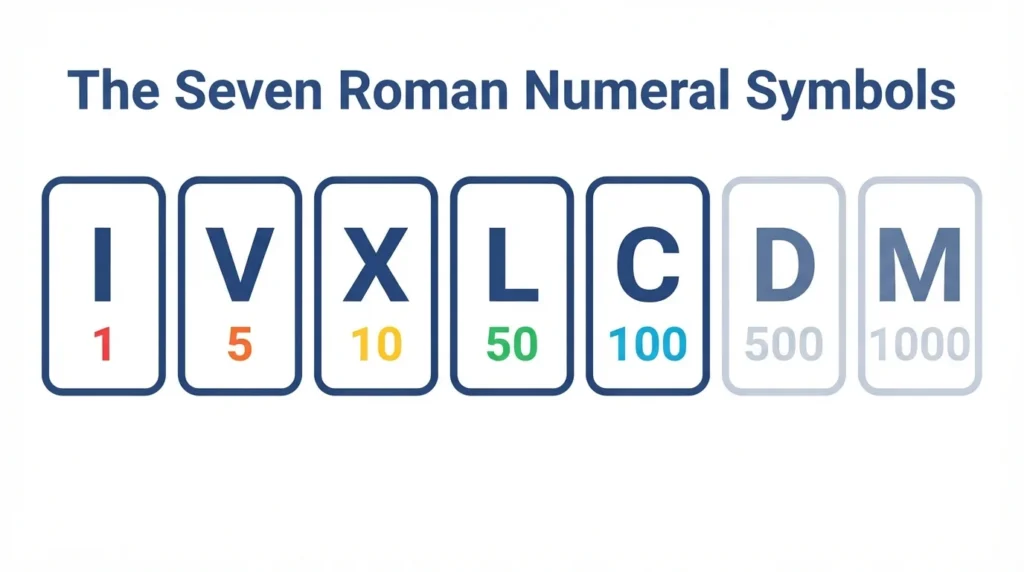
| Symbol | Value | Needed for 1 to 100? | Memory hook |
|---|---|---|---|
| I | 1 | Yes | One finger held up |
| V | 5 | Yes | An open hand, five fingers, thumb and index forming a V |
| X | 10 | Yes | Two V shapes joined, five and five |
| L | 50 | Yes | Half of C, so half of a hundred |
| C | 100 | Yes | Century, Cent, 100 |
| D | 500 | Not yet | Half of the old symbol for 1000 |
| M | 1000 | Not yet | Mille, Latin for thousand |
Teach these five in order and do not rush. A child who is fluent with I, V, X, L and C can build any number up to 100. A child who is shaky on them will guess at everything that follows.
The C for century link is the most reliable hook for Indian and international students alike, since “century” already means a hundred in cricket, in history, and in everyday speech. L for fifty has no natural hook, so teach it as “L sits exactly halfway between X and C,” which is true in value and gives the child a place to put it.
Why Only Seven Symbols?
The values follow a repeating one-five-ten shape: 1, 5, 10, then 50, 100, then 500, 1000. Every step is either a five-times jump or a two-times jump.
This is not random. The Romans counted on their hands, so five and ten were natural grouping points, and the symbols mark those groups. Point this out to your child, because it turns seven separate facts into one pattern. Once they see that V, L and D are all “half of the next big one,” the list gets much easier to hold in memory.
Rule 1: The Additive Rule
The additive rule is where every child should start, because it covers most of the chart and it feels obvious once shown.
The rule: when the letters get smaller or stay the same as you read left to right, add their values together.
Worked examples:
- VI = 5 + 1 = 6
- XII = 10 + 1 + 1 = 12
- XXVII = 10 + 10 + 5 + 1 + 1 = 27
- LXVI = 50 + 10 + 5 + 1 = 66
- LXXXVIII = 50 + 10 + 10 + 10 + 5 + 1 + 1 + 1 = 88
Notice what is happening. The numeral is arranged from biggest value to smallest, like coins sorted into piles. LXVI is one fifty-note, one ten, one five and one single. Your child already knows how to do this, because it is the same skill as counting mixed currency, and it links directly to place value, where a number is broken into the values that make it up.
Say the addition out loud the first several times. “Fifty, sixty, sixty-five, sixty-six.” Running totals are easier for a child to hold than a long sum written at the end, and this habit carries over to their addition and subtraction work too.
Eighty-eight, LXXXVIII, is worth showing early. It is the longest numeral under 100 and it is entirely additive. If your child can read LXXXVIII, they have the additive rule.
Rule 2: The Subtractive Rule
This is the rule that confuses parents as much as children, so it deserves the most care.
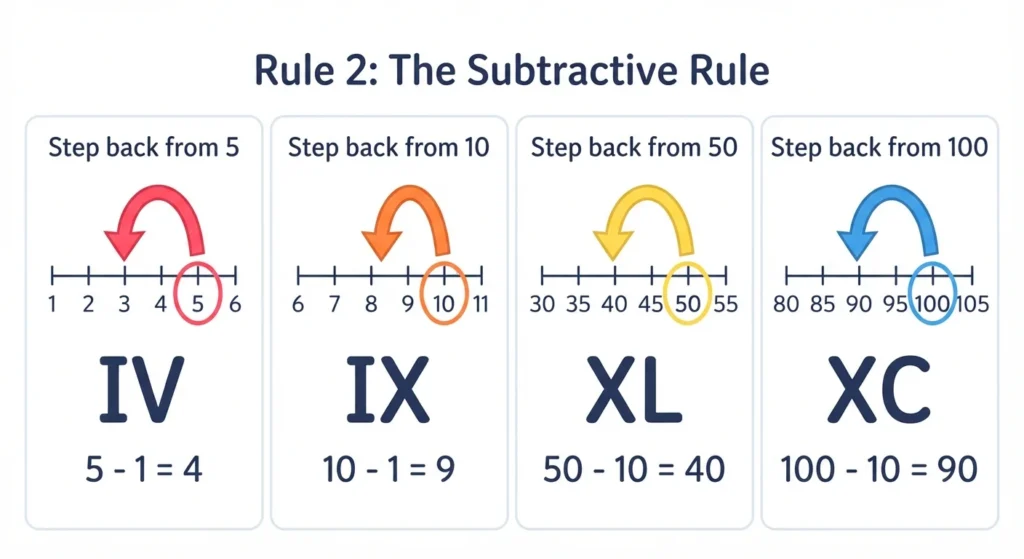
The rule: when a smaller letter sits before a larger letter, subtract the smaller from the larger. Read the pair as one unit.
- IV = 5 minus 1 = 4
- IX = 10 minus 1 = 9
- XL = 50 minus 10 = 40
- XC = 100 minus 10 = 90
The mental model that works best is one step back from a landmark. V, X, L and C are landmarks. Put a smaller letter in front and you have stepped back from that landmark.
- IV is one step back from 5, so 4
- IX is one step back from 10, so 9
- XL is one ten back from 50, so 40
- XC is one ten back from 100, so 90
Children pick this up faster than “subtract the left from the right,” because it is a single motion rather than an arithmetic operation. It also matches how they already think about numbers on a number line, moving backwards one step from a known point.
Mixed numerals combine both rules. Handle the subtractive pair first, then add the rest:
- XIV = X + IV = 10 + 4 = 14
- XXIX = XX + IX = 20 + 9 = 29
- XLII = XL + II = 40 + 2 = 42
- XCVII = XC + VII = 90 + 7 = 97
- XCIX = XC + IX = 90 + 9 = 99
XCIX is the hardest numeral under 100. It has two subtractive pairs back to back. Break it as XC and IX, ninety and nine, and it becomes manageable. Children who try to read it letter by letter will get lost every time, which is exactly why the pair-first habit matters.
Why Subtractive Notation Exists
Here is the part almost no chart page explains, and the part parents keep asking about.
The Romans had a limit: no symbol repeats more than three times in a row. So 4 cannot be IIII, and 40 cannot be XXXX. Something else was needed, and subtraction filled the gap.
There is a practical reason behind the limit. These numerals were carved into stone and stamped onto coins, where space cost money and effort. IIII takes four strokes; IV takes two. XXXX takes twelve strokes; XL takes three. On an inscription with dozens of numbers, that adds up fast.
There is also a reading reason. Four identical marks in a row are easy to miscount at a glance, especially carved in stone. Three is about the limit of what the eye reads reliably without counting. Put IIII and IIIII side by side and your child will see the problem immediately, which is a nice demonstration to do on paper.
So subtractive notation is not an awkward exception bolted onto the system. It is the solution to a real problem the Romans had, and framing it that way makes it feel logical instead of arbitrary.
The Only Six Subtractive Pairs
In the entire Roman numeral system there are exactly six legal subtractive pairs. Four of them appear in roman numerals 1 to 100.
| Pair | Value | Appears in 1 to 100? |
|---|---|---|
| IV | 4 | Yes |
| IX | 9 | Yes |
| XL | 40 | Yes |
| XC | 90 | Yes |
| CD | 400 | No |
| CM | 900 | No |
Four pairs to learn. That is it. This is worth stating plainly to your child, because it turns a scary-sounding rule into a short list. Anything else that looks subtractive, such as IL, IC, VX or LC, is simply not valid Roman numeral notation.
Roman Numeral Rules: What Is and Is Not Allowed
Six rules govern the whole system. Each one is given here with what goes wrong if you ignore it.
Rule 1: Write from largest value to smallest, except in a subtractive pair.
66 is LXVI, not VILX or IVLX. Break the rule and the numeral becomes unreadable.
Rule 2: I, X and C can repeat up to three times. V, L and D never repeat.
III is valid. IIII is not. VV is not valid either, because 10 already has its own symbol, X. Similarly LL is never written, because 100 is C.
Rule 3: Only I, X and C can be used to subtract.
V, L and D never appear in front of a larger letter. So VX for 5 and LC for 50 are both invalid, and neither number needs them anyway.
Rule 4: A subtracting letter can only go before the next two larger values.
I can go before V and X only. X can go before L and C only. C can go before D and M only. This is what makes IC invalid for 99. I may not stand before C, because C is four steps up from I, not one or two. The correct form is XCIX.
Rule 5: Only one subtracting letter per pair.
8 is VIII, never IIX. 18 is XVIII, never IIXX.
Rule 6: There is no zero and no negative numbers.
The system has no symbol for nothing. This is worth mentioning, because it shows your child why the Romans struggled with calculation and why zero was such an important invention.
Try Rule 4 as a puzzle with your child. Ask them to write 99. Almost every child reaches for IC, “one less than a hundred.” Then show why it breaks and let them find XCIX. The moment of working it out themselves is worth more than being told, and this kind of rule-checking builds the same critical thinking they will need in competition maths.
Complete Roman Numerals 1 to 100 Chart
Here is the complete roman numerals chart 1 to 100, grouped in tens. Read it row by row rather than searching it like a dictionary, because the point is the pattern, not the lookup.
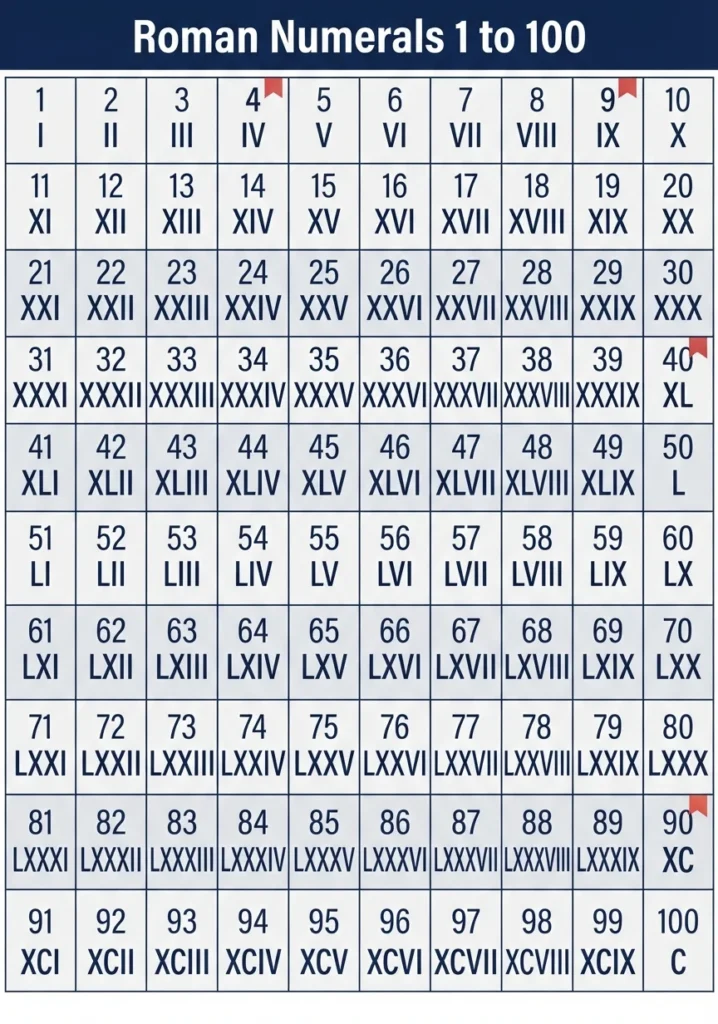
1 to 10
| 1 = I | 2 = II | 3 = III | 4 = IV | 5 = V |
|---|---|---|---|---|
| 6 = VI | 7 = VII | 8 = VIII | 9 = IX | 10 = X |
11 to 20
| 11 = XI | 12 = XII | 13 = XIII | 14 = XIV | 15 = XV |
|---|---|---|---|---|
| 16 = XVI | 17 = XVII | 18 = XVIII | 19 = XIX | 20 = XX |
21 to 30
| 21 = XXI | 22 = XXII | 23 = XXIII | 24 = XXIV | 25 = XXV |
|---|---|---|---|---|
| 26 = XXVI | 27 = XXVII | 28 = XXVIII | 29 = XXIX | 30 = XXX |
31 to 40
| 31 = XXXI | 32 = XXXII | 33 = XXXIII | 34 = XXXIV | 35 = XXXV |
|---|---|---|---|---|
| 36 = XXXVI | 37 = XXXVII | 38 = XXXVIII | 39 = XXXIX | 40 = XL |
41 to 50
| 41 = XLI | 42 = XLII | 43 = XLIII | 44 = XLIV | 45 = XLV |
|---|---|---|---|---|
| 46 = XLVI | 47 = XLVII | 48 = XLVIII | 49 = XLIX | 50 = L |
51 to 60
| 51 = LI | 52 = LII | 53 = LIII | 54 = LIV | 55 = LV |
|---|---|---|---|---|
| 56 = LVI | 57 = LVII | 58 = LVIII | 59 = LIX | 60 = LX |
61 to 70
| 61 = LXI | 62 = LXII | 63 = LXIII | 64 = LXIV | 65 = LXV |
|---|---|---|---|---|
| 66 = LXVI | 67 = LXVII | 68 = LXVIII | 69 = LXIX | 70 = LXX |
71 to 80
| 71 = LXXI | 72 = LXXII | 73 = LXXIII | 74 = LXXIV | 75 = LXXV |
|---|---|---|---|---|
| 76 = LXXVI | 77 = LXXVII | 78 = LXXVIII | 79 = LXXIX | 80 = LXXX |
81 to 90
| 81 = LXXXI | 82 = LXXXII | 83 = LXXXIII | 84 = LXXXIV | 85 = LXXXV |
|---|---|---|---|---|
| 86 = LXXXVI | 87 = LXXXVII | 88 = LXXXVIII | 89 = LXXXIX | 90 = XC |
91 to 100
| 91 = XCI | 92 = XCII | 93 = XCIII | 94 = XCIV | 95 = XCV |
|---|---|---|---|---|
| 96 = XCVI | 97 = XCVII | 98 = XCVIII | 99 = XCIX | 100 = C |
If you need roman numerals 1 to 50 only, stop at the fifth table. Many Grade 3 syllabuses cover 1 to 20 first, then extend to 50, then to 100, and that sequence works well at home too.
Patterns Hidden Inside the Chart
This is where the chart stops being a lookup table and becomes something your child can actually learn.
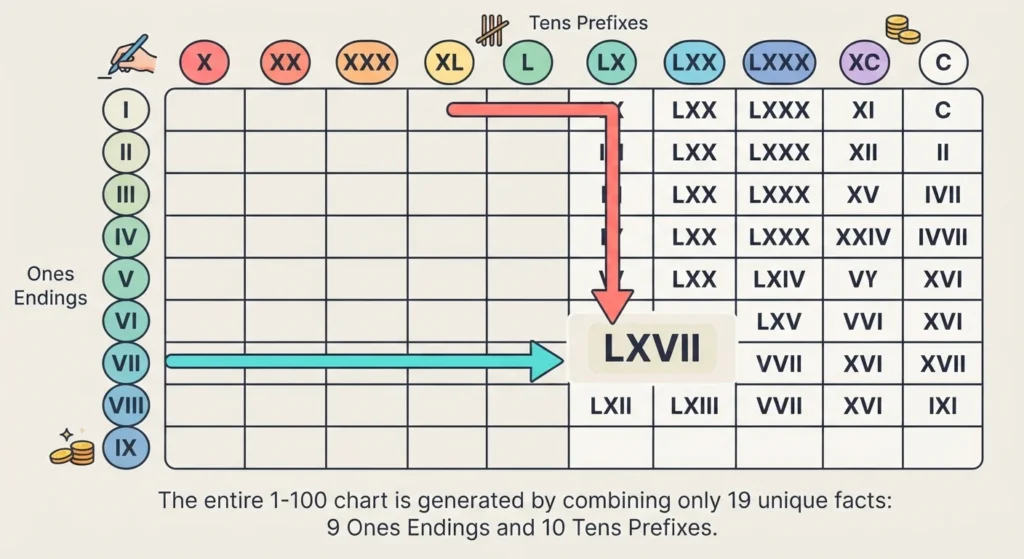
Pattern 1: the ones digits repeat, every single decade.
Look down any column in the tables above. The ones place follows the same cycle throughout:
I, II, III, IV, V, VI, VII, VIII, IX
Then a tens symbol goes in front. Compare:
| Ones | Twenties | Fifties | Eighties |
|---|---|---|---|
| I (1) | XXI (21) | LI (51) | LXXXI (81) |
| IV (4) | XXIV (24) | LIV (54) | LXXXIV (84) |
| VII (7) | XXVII (27) | LVII (57) | LXXXVII (87) |
| IX (9) | XXIX (29) | LIX (59) | LXXXIX (89) |
Nine endings, learned once, used ten times. That is the single most useful fact in this entire article. A child who knows I through IX and the tens prefixes does not need to memorise a hundred numerals. They need to memorise nineteen things and combine them.
Pattern 2: the tens prefixes are their own short list.
| 10 | 20 | 30 | 40 | 50 | 60 | 70 | 80 | 90 | 100 |
|---|---|---|---|---|---|---|---|---|---|
| X | XX | XXX | XL | L | LX | LXX | LXXX | XC | C |
Ten entries, and only two of them, XL and XC, break the build-by-adding pattern. Learning the tens row is exactly like skip counting by tens, just with different symbols, and it is a good place to start once the ones are secure.
Pattern 3: the numerals get longer, then suddenly shorter.
38 is XXXVIII, eight letters. 40 is XL, two letters. 88 is LXXXVIII, eight letters. 90 is XC, two letters. The subtractive pairs act as reset points. Children find this genuinely funny, and noticing it means they have understood why subtraction was introduced.
Pattern 4: length does not track size.
III is three letters and means 3. C is one letter and means 100. In our digit system, longer numbers are bigger. Here they are not. Point this out, because it prevents a real misconception when children start comparing and ordering numbers written as Roman numerals.
How to Write Roman Numerals 1 to 100: Step by Step
Use this method for any number from 1 to 100.
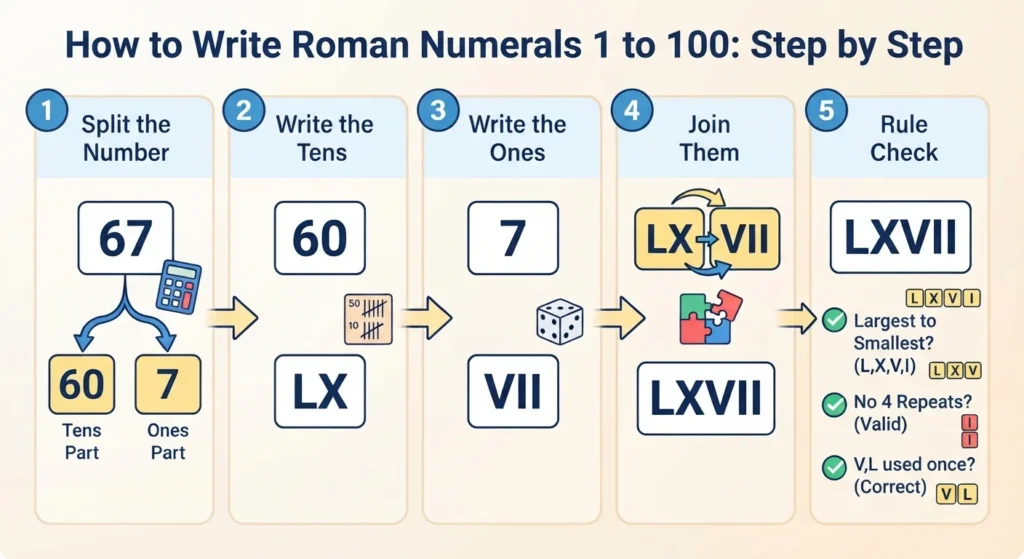
Step 1: Split the number into tens and ones. Take 67. Split it into 60 and 7.
Step 2: Write the tens part. 60 is LX. Use the tens row above, or build it: 50 is L, plus 10 is X, giving LX.
Step 3: Write the ones part. 7 is VII.
Step 4: Join them, tens first. LX + VII = LXVII.
Step 5: Check the rules. Largest to smallest, no letter repeated more than three times, V and L appearing once each. LXVII passes.
More worked examples:
Write 49. Split: 40 and 9. Tens: XL. Ones: IX. Join: XLIX. Note this is not IL. I cannot stand before L.
Write 94. Split: 90 and 4. Tens: XC. Ones: IV. Join: XCIV.
Write 83. Split: 80 and 3. Tens: LXXX. Ones: III. Join: LXXXIII.
Write 100. No split needed. C.
The splitting step is the one children skip, and skipping it is the source of most errors. Insist on it in writing until the habit sticks. It is the same decomposition skill they use for word problems: break the big thing into parts you already know how to handle.
How to Read a Roman Numeral Back Into a Number
Going the other direction needs its own method, and this is the direction exams and Olympiad papers usually test.
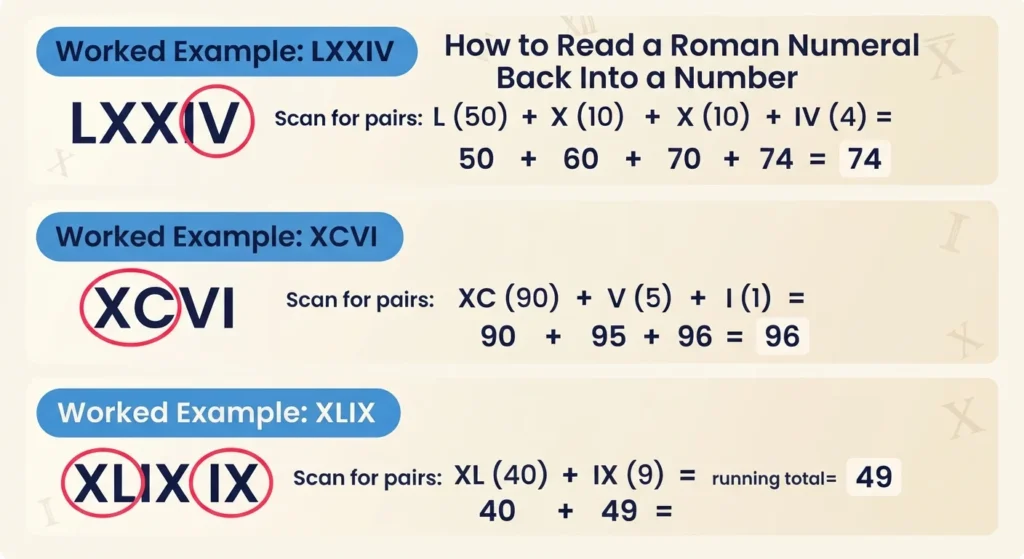
Step 1: Scan for subtractive pairs first. Look for a smaller letter immediately before a larger one. Circle those pairs. The possible pairs are only IV, IX, XL and XC.
Step 2: Give each pair and each leftover letter its value.
Step 3: Add everything up, left to right, keeping a running total.
Worked example: LXXIV
- Scan: IV at the end is a subtractive pair. Circle it. Remaining letters: L, X, X.
- Values: L = 50, X = 10, X = 10, IV = 4.
- Running total: 50, 60, 70, 74.
LXXIV = 74.
Worked example: XCVI
- Scan: XC is a pair. Remaining: V, I.
- Values: XC = 90, V = 5, I = 1.
- Running total: 90, 95, 96.
XCVI = 96.
Worked example: XLIX
- Scan: two pairs, XL and IX. Nothing left over.
- Values: 40 and 9.
- Total: 49.
XLIX = 49.
Scanning for pairs before reading is the whole trick. A child who reads letter by letter will treat XLIX as 10 + 50 + 1 + 10 and get nonsense. Teach the scan as a separate, deliberate first move.
Roman Numerals in Everyday Life
Roman numerals survive wherever labelling matters more than calculating. Showing your child real examples is what makes the topic feel worth learning.
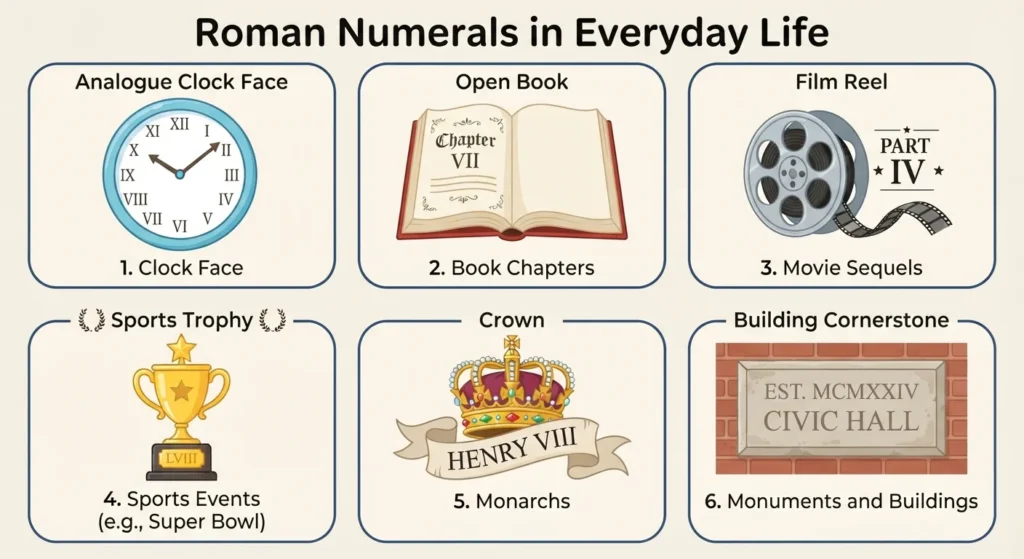
Clock and watch faces. Analogue clocks in the Roman style use I through XII. This is the single best teaching resource in most homes, and it pairs naturally with practice on telling the time. One oddity worth mentioning: many clock faces show IIII for 4 instead of IV. This is a design convention, chosen for visual balance against the VIII opposite it, and it is not correct Roman numeral notation. Tell your child so before they conclude their homework was marked wrong unfairly.
Book chapters and front matter. Chapter headings often use Roman numerals, and the preface and contents pages of printed books are frequently numbered i, ii, iii in lowercase Roman.
Movie and game sequels. Rocky IV, Star Wars Episode IX, Final Fantasy VII.
Sporting events. Super Bowl LVIII. The Olympic Games number each edition in Roman numerals. Cricket and football tournaments sometimes do the same.
Monarchs and popes. Henry VIII, Elizabeth II, Louis XIV, Pope John Paul II.
Buildings and monuments. Cornerstones, foundation plaques and memorials carry dates in Roman numerals, though these usually run past 100 into M territory.
Exam papers and outlines. Question sections are often labelled I, II, III, and sub-points i, ii, iii.
Set your child a spotting challenge for a week. Every Roman numeral they find, written down with its value, goes on the fridge. Real-world hunting beats worksheet repetition for retention, and it builds the observation habit that underpins good number sense.
Common Mistakes Children Make
These are the errors that show up again and again, with the correction logic for each.
Mistake 1: Writing IIII for 4 and XXXX for 40. Correct: IV and XL. Why it happens: children apply the tally logic they used for 1, 2 and 3. Fix it by restating the three-repeat limit and asking them to count IIII at a glance, which is hard.
Mistake 2: Writing IC for 99 and IL for 49. Correct: XCIX and XLIX. Why it happens: the child correctly thinks “one less than a hundred” but ignores Rule 4. I may only stand before V and X. Handle the tens first, then the ones.
Mistake 3: Reading letter by letter and ignoring pairs. A child reads XIV as 10 + 1 + 5 = 16 instead of 14. Fix it by making pair-scanning a separate first step, circled on paper before any adding.
Mistake 4: Writing VX for 5 or LC for 50. Correct: V and L. Why it happens: over-applying the subtractive rule. Only I, X and C subtract, and the numbers in question already have their own symbols.
Mistake 5: Order confusion, writing IXL or VIL. Correct: XLIX for 49, LVI for 56. Fix it with the coin-sorting image. Big piles first, always.
Mistake 6: Mixing up L and C. Fix it with the century hook for C and “L is halfway between X and C” for L. Drill the tens row until the pair is automatic.
Mistake 7: Writing VV for 10 or LL for 100. Correct: X and C. The rule: if a bigger single symbol exists, use it. V, L and D never repeat.
Mistake 8: Assuming longer means bigger. A child ranks VIII above C because it has more letters. Address it directly with ordering practice on mixed-length numerals.
8 Activities and Games for Learning Roman Numerals
All eight of these use materials you already have.
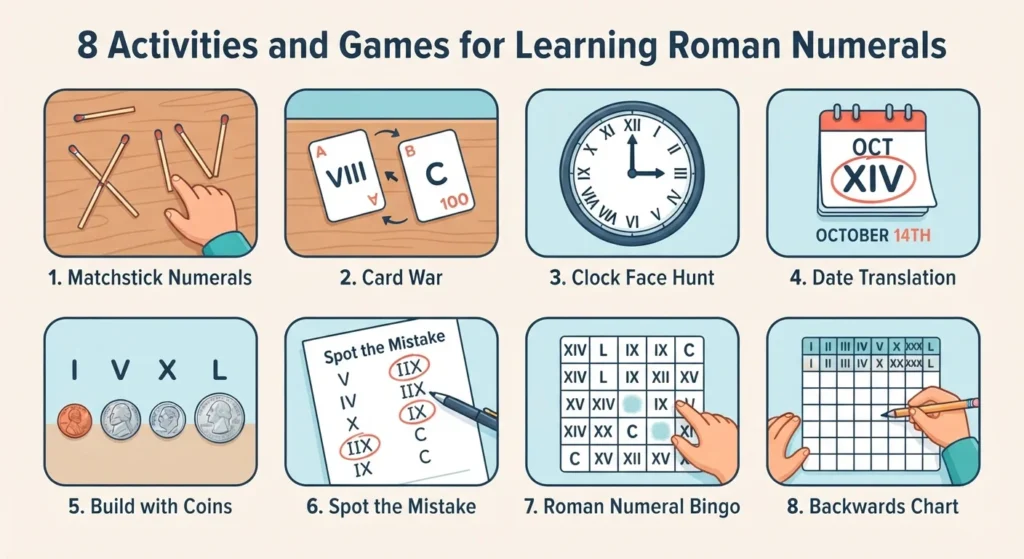
1. Matchstick or cotton-bud numerals. Give your child matchsticks, toothpicks or cotton buds. I is one stick, V is two sticks in a wedge, X is two sticks crossed, L is two sticks at a right angle. Call out numbers and let them build the numeral physically. The tactile version sticks far better than copying letters, and it quietly reinforces why the symbols look the way they do.
2. Roman numeral card war. Write numerals 1 to 100 on slips of paper. Each player flips one; higher value wins both. This forces fast conversion and comparison, and it hammers home that VIII loses to C despite being longer.
3. Clock face hunt. Find a Roman-numeral clock, in the house, in a shop window, in a photo. Ask your child to read every position. Then ask why some faces show IIII. The discussion is as valuable as the reading.
4. Date translation. Write birthdays, today’s date and family milestones in Roman numerals. A birth date of 14 March becomes XIV / III. Personal numbers get remembered.
5. Build it with coins. Lay out coins of different denominations as stand-ins for I, V, X, L and C. Building 67 means selecting one L coin, one X coin, one V coin and two I coins. This makes the largest-to-smallest ordering rule physical, and it connects Roman numerals to the money-handling work your child already does.
6. Spot the mistake. Write out a list where some numerals are wrong: IIII, IX, VX, XL, IC, XCIX, LL, XLIX. Your child marks each as valid or invalid and names the broken rule. Error-finding tests understanding much harder than copying does, and it is close cousin to the reasoning in maths puzzles.
7. Roman numeral bingo. Each player draws a grid and fills it with numerals of their choosing from the chart. You call out numbers in digits; players find the matching numeral. Converting under mild time pressure, with no penalty for slowness, is exactly the right kind of practice.
8. Backwards chart building. Give your child a blank ten-by-ten grid and ask them to fill in roman numerals 1 to 100 from memory, using the patterns rather than a reference chart. Most children get further than they expect once they realise the ones cycle repeats. Time them, save the sheet, and repeat a week later so they can see the improvement. Pair this with other hands-on maths activities to keep sessions varied.
Tips for Parents Teaching Roman Numerals at Home
Teach in the order of the rules, not the order of the numbers. Symbols, then addition, then subtraction, then the full chart. Handing a child the 1 to 100 chart on day one produces memorisation without understanding, which collapses the moment a question is phrased differently.
Stop at 20, then 50, then 100. Three short stages beat one long push. Most Grade 3 curricula follow this sequence for good reason.
Never let “because that is the rule” be the final answer. Every rule here has a reason, and the reasons are in this article. A child who knows why IIII is not allowed will not write it.
Practise both directions every session. Digits to numerals, and numerals to digits. Children get fluent one way and freeze the other way, and it is the reading direction that exams test.
Keep sessions to ten or fifteen minutes. This topic is symbol recognition, which rewards short and frequent over long and occasional.
Use the clock, not a worksheet, when attention is fading. Reading a real clock face feels like noticing rather than studying.
Let them correct you. Write something wrong on purpose, IIII or IC, and wait. Catching an adult’s mistake is the strongest confidence-builder available.
Tips for Teachers Delivering Roman Numeral Lessons
Open with the tally-stick origin. Two minutes on notches cut into wood, and I, II, III, V and X stop looking arbitrary. This framing pays off for the rest of the unit.
Physicalise the three-repeat limit. Put IIII and IIIII on the board and ask the class to read them at a glance without counting. The confusion in the room makes the rule self-evident, and subtractive notation then arrives as a solution rather than an imposition.
Teach the ones cycle as the core object. Nine endings, ten decades. A class that internalises this has learned the chart. A class that does not has ninety-one separate facts to remember.
Separate pair-scanning as its own skill. Devote an exercise purely to circling subtractive pairs in a list of numerals, with no conversion required. Splitting the skill out prevents the letter-by-letter error entirely.
Use invalid numerals as assessment items. Asking whether IC is valid, and why, discriminates between understanding and recall far better than conversion questions do.
Build in a bridge to place value. The contrast between a positional system and a non-positional one is a genuine conceptual insight, and Roman numerals are the easiest way to teach it.
Extend, do not repeat, for fast finishers. Ordering mixed numerals, arithmetic performed entirely in Roman numerals, and the Olympiad-style questions below all work better than more of the same conversions.
Roman Numerals in Olympiad Problems
Competition papers rarely ask for a plain conversion. They ask questions that use Roman numerals as the setting for reasoning, which is why understanding the rules matters more than memorising the chart.
This style of question appears in Olympiad papers and in preparation material for contests such as Math Kangaroo.
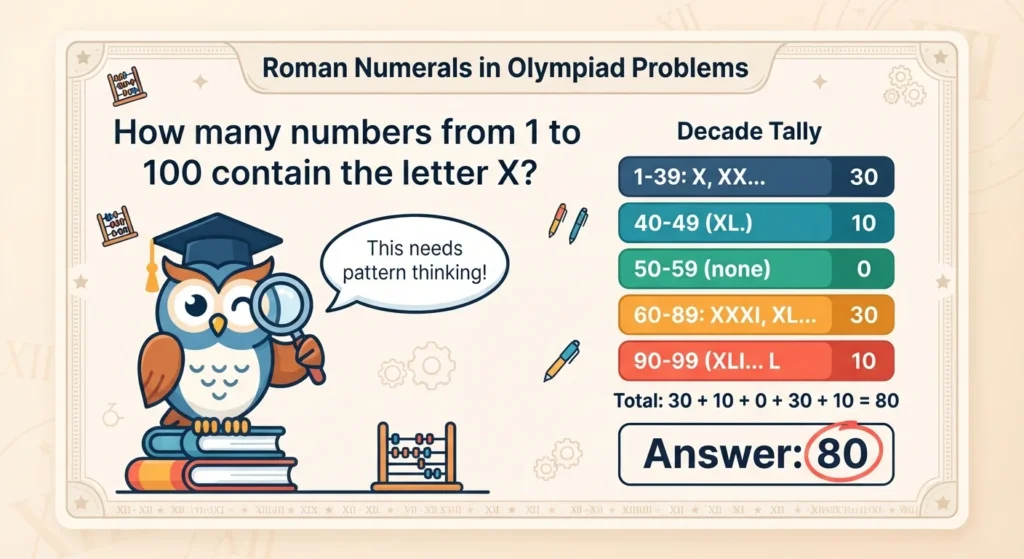
Type 1: Counting problems.
How many numbers from 1 to 100 contain the letter X?
X appears in every numeral from 10 to 100 except those where the tens part uses XL, L, XC or C without an X. Working it out requires the child to think about the structure of the chart rather than look numbers up. Answer: 10 to 39 all contain X (30 numbers), 40 to 49 contain X in XL (10 numbers), 50 to 59 do not (LI to LIX have no X), 60 to 89 contain X (30 numbers), 90 to 99 contain X in XC (10 numbers), 100 is C and does not. Total: 80.
Type 2: Longest and shortest.
Which number between 1 and 100 needs the most letters?
88 as LXXXVIII, with eight letters. Finding it requires understanding why length spikes just before a subtractive reset.
Type 3: Arithmetic in Roman numerals.
Calculate XLVII + XXVI and give the answer in Roman numerals.
47 + 26 = 73 = LXXIII. Convert, calculate, convert back. Three steps, each a chance to slip.
Type 4: Validity puzzles.
Which of these are not valid Roman numerals: XXXX, XCIX, IC, LXXXX, XLIX?
Invalid: XXXX (four repeats), IC (I cannot precede C), LXXXX (four repeats). Valid: XCIX, XLIX.
Type 5: Letter-rearrangement puzzles.
Rearrange the letters of XIV to make the largest possible valid Roman numeral.
The letters are X, I, V. Options include XVI (16), XIV (14), and IXV which is invalid. Answer: XVI.
These reward exactly the rule-based reasoning this article has been building. Children who learned only the chart cannot attempt them. If your child enjoys this type of question, the broader problem-solving approaches used in Olympiad maths are a natural next step.
Practice Questions With Answers
Part A: Write in Roman numerals.
- 7
- 14
- 29
- 40
- 56
- 68
- 74
- 89
- 94
- 100
Part B: Write as ordinary numbers.
- XVII
- XXIV
- XXXIX
- XLV
- LXII
- LXXVIII
- LXXXIV
- XCI
- XCVIII
- XCIX
Part C: Valid or invalid? Give the reason.
- IIII
- XLIX
- VX
- LXXXX
- IC
Part D: Reasoning.
- Which is larger, XLIV or XLVI?
- Write the numbers 19, 40, 91 and 66 in ascending order, then write each in Roman numerals.
- XXIX + XLII = ? Give the answer in Roman numerals.
- How many letters does the Roman numeral for 88 need?
- Why can 99 not be written as IC?
Answers
Part A: 1. VII 2. XIV 3. XXIX 4. XL 5. LVI 6. LXVIII 7. LXXIV 8. LXXXIX 9. XCIV 10. C
Part B: 11. 17 12. 24 13. 39 14. 45 15. 62 16. 78 17. 84 18. 91 19. 98 20. 99
Part C:
- Invalid. I cannot repeat four times. Correct form is IV.
- Valid. XL is 40 and IX is 9, giving 49.
- Invalid. V never subtracts, and 5 is simply V.
- Invalid. X cannot repeat four times. Correct form is XC.
- Invalid. I may only precede V and X. Correct form is XCIX.
Part D:
- XLVI is larger. XLIV is 44 and XLVI is 46.
- 19, 40, 66, 91. In Roman numerals: XIX, XL, LXVI, XCI.
- 29 + 42 = 71 = LXXI.
- Eight letters: LXXXVIII.
- Because a subtracting letter may only stand before the next two larger values. I can precede V and X only, never C. The tens part is handled first as XC, then the ones as IX, giving XCIX.
Make Preparing for Math Olympiad Simple!



What are Roman numerals 1 to 100?
Roman numerals 1 to 100 are the numbers 1 to 100 written using the Roman letter symbols I (1), V (5), X (10), L (50) and C (100). The letters are combined by adding or subtracting their values. 1 is I, 25 is XXV, 50 is L, 99 is XCIX and 100 is C.
How do you write Roman numerals 1 to 100?
Split each number into tens and ones, write the tens part using the row X, XX, XXX, XL, L, LX, LXX, LXXX, XC, C, write the ones part using I to IX, then join them with the tens first. For 67: 60 is LX, 7 is VII, so 67 is LXVII.
Why is 4 written as IV and not IIII?
No Roman symbol may repeat more than three times in a row. IIII breaks that limit, so 4 is written as IV, meaning one less than five. The limit existed because these numerals were carved into stone, where shorter was cheaper, and because four identical marks are hard to read at a glance.
What are the four subtractive pairs in 1 to 100?
IV for 4, IX for 9, XL for 40 and XC for 90. Only these four appear below 100. Two more exist higher up: CD for 400 and CM for 900.
Why can 99 not be written as IC?
A subtracting letter may only stand before the next two larger values. I can precede V and X only, so I may not precede C. Write the tens first as XC, then the ones as IX, giving XCIX.
Which Roman numeral below 100 is the longest?
88, written LXXXVIII, with eight letters.
What grade are Roman numerals taught in?
Most curricula introduce them in Grade 3 or Grade 4, usually starting with 1 to 20, then extending to 50 and 100. Roman numerals Grade 4 and Grade 5 work typically covers the full 1 to 100 range plus conversion in both directions.
Is there a zero in Roman numerals?
No. The system has no symbol for zero and no negative numbers, which is one reason calculation in Roman numerals is so difficult and why our current digit system replaced it.
Why do some clocks show IIII instead of IV?
That is a clockmaking design convention, chosen so the numeral balances visually against the VIII on the opposite side of the dial. It is not correct Roman numeral notation and should not be copied in written work.
What comes after 100 in Roman numerals?
101 is CI, 200 is CC, 500 is D and 1000 is M. The same additive and subtractive rules apply, using the two extra symbols D and M.
What is the fastest way to memorise roman numerals 1 to 100?
Do not memorise all one hundred. Learn the nine ones endings, I to IX, and the ten tens prefixes, X to C. The ones cycle repeats in every decade, so nineteen facts cover the whole chart.
Conclusion
Roman numerals 1 to 100 come down to five symbols, one adding rule, one subtracting rule and a short list of things you are not allowed to write.
The chart looks like a hundred separate facts, but it is really nineteen: nine ones endings that repeat in every decade, and ten tens prefixes that go in front of them.
A child who sees that structure can rebuild the whole chart from memory, and a child who only memorises the chart cannot.
Work in the order the rules build. Get the five symbols solid, then adding, then subtracting with the “one step back from a landmark” picture, then the full chart with its patterns pointed out, then practice in both directions. Keep the sessions short, use the clock on the wall, and let your child find the mistakes in what you write. The topic takes a week or two of light daily practice, and once it is in, it stays.

Mikha Piregu is a Content Writer with experience spanning educational content, including math and math olympiad topics, as well as advocacy writing, research-based articles, and SEO-driven web content. He creates high-quality blog content, web copy, and feature articles that support brand visibility, audience engagement, and long-term organic growth through data-informed storytelling. Skilled in WordPress, WooCommerce, and modern digital tools, Mikha adapts content across various platforms, including blogs, websites, campaigns, and advocacy initiatives, with clarity and purpose.



There are no comments posted here yet.
Sign in to leave a comment