

To learn how to tell time on a clock, read the short hand first to find the hour, then read the long hand to find the minutes by counting around the face in 5s from the 12. Say the hour, then say the minutes.
- Why Telling Time Is Still a Real-Life Skill
- The Parts of an Analog Clock
- How to Tell the Hour Hand from the Minute Hand
- How to Tell Time on a Clock in Four Steps
- Reading the Hour Hand
- How the Minute Hand Works
- Skip Counting by 5s and the Minute Hand
- Telling Time to the Hour
- Telling Time to the Half Hour
- Telling Time to the Quarter Hour
- Telling Time to the Nearest Minute
- AM and PM Explained for Kids
- Analog and Digital Clocks
- Worked Examples
- Common Mistakes Children Make When Learning How to Tell Time on a Clock
- Hands-On Activities and Games for Telling Time
- Telling Time in Daily Life
- Tips for Parents Teaching Clock Reading at Home
- Tips for Teachers Delivering Time Lessons
- What Comes Next: Elapsed Time
- Time in Olympiad-Style Word Problems
- Practice Questions with Answers
That is the whole method. Everything else in this guide is about making those two steps feel obvious to a six, seven, or eight year old who is still building the number sense the clock face quietly assumes.
If your child mixes up the hands, freezes at 3:40, or can say “half past” without knowing why it means 30 minutes, the problem is almost never effort.
Clock reading is usually taught as a set of positions to memorise instead of a skill built on what the child already knows: counting to 12, skip counting by 5s, and the shape of their own day.
Why Telling Time Is Still a Real-Life Skill
Phones show the time in large digits, so parents sometimes wonder whether analog clocks are worth the trouble. They are, for two reasons.
The first is practical. Analog clocks sit on classroom walls, on station platforms, in hospitals, on wrists, and above shop counters. A child who cannot read one is dependent on someone else to tell them how long is left.
The second reason is mathematical, and it is the bigger one. A clock face is the first place most children meet a circular number line, two different scales printed on the same twelve marks, and skip counting used for a real purpose. Reading a clock trains spatial reasoning, multiplication by 5, fractions of a whole, and the idea that one symbol can mean two things depending on which hand is pointing at it. A child who understands the clock has quietly practised several ideas they will need again in measurement, angles, and word problems.
Time is also the first measurement children feel, and it builds the same number sense that supports every other topic at this stage. They do not experience a centimetre, but they feel twenty minutes.
The Parts of an Analog Clock
Before any reading happens, the child should be able to name the parts. Sit with a real clock, or a paper plate clock you make together, and point to each one.
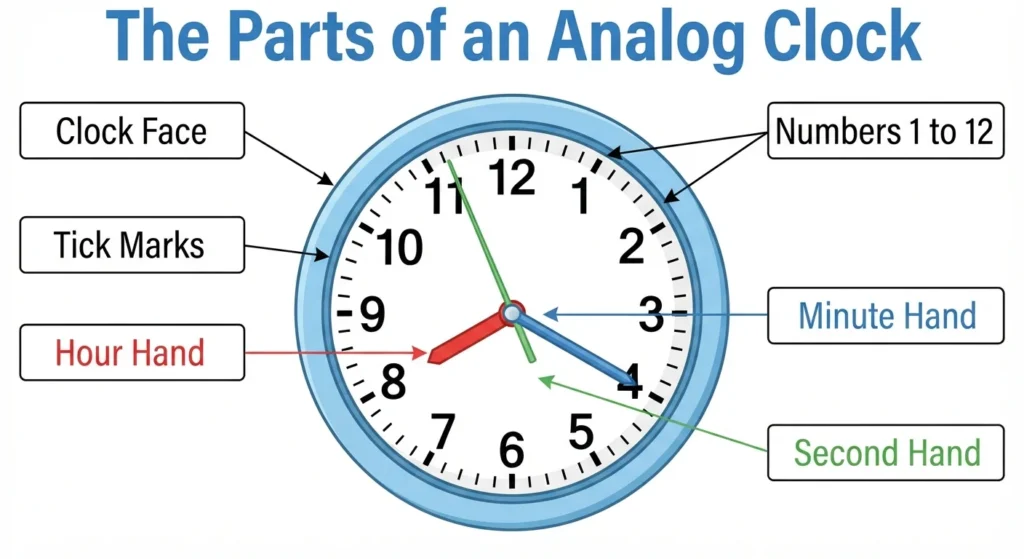
The clock face. The round surface where everything is printed. It is also called the dial.
The numbers 1 to 12. These run clockwise, meaning in the direction the hands travel, starting from 12 at the top. Ask your child to point to 12, then 3, then 6, then 9. Those four numbers are the anchors of the whole face, and getting them solid first makes everything after it easier.
The tick marks. Between each pair of numbers there are small lines. Count them together with your child. There are four small marks between two numbers, which divides that gap into five equal spaces. Sixty of these spaces go all the way round.
The hour hand. The short, thick hand. It moves slowly and takes twelve hours to travel once around the face.
The minute hand. The long, thinner hand. It takes one hour to travel once around the face.
The second hand. A very thin hand, often a different colour, that sweeps around once every minute. Not every clock has one. Children find it useful because it is the only hand whose movement they can actually see, which makes the other two believable.
Let your child watch the second hand for a full minute before you teach anything else. It is one minute of your day, and it turns an abstract word into something they have sat through.
How to Tell the Hour Hand from the Minute Hand
This is where most children get stuck, so it deserves a section of its own. Give them three separate ways to tell the hands apart, because different children hold on to different ones.
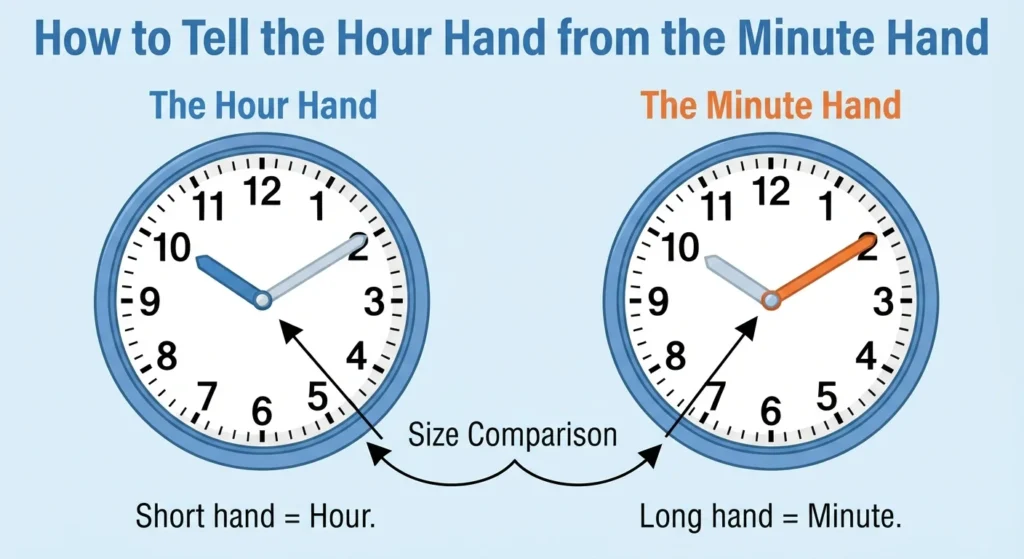
By size. The short hand is the hour hand. The long hand is the minute hand. A phrase that sticks: short hand, short word, hour. Long hand, long word, minute.
By speed. Watch the clock for five minutes. The long hand visibly moves. The short hand looks as though it has not moved at all. The hand that races is the one counting the smaller unit.
By job. The hour hand answers “roughly when in the day is this?” The minute hand answers “how far into that hour are we?” Asking those two questions in that order gives the child the reading sequence for free.
A common trap is that on many cheap clocks the two hands are nearly the same length. If your child is struggling, find a clock with a clearly short hour hand, or make one where the difference is exaggerated. Do not make them fight the clock design and the concept at the same time.
How to Tell Time on a Clock in Four Steps
Here is the core method, and it does not change no matter how detailed the time gets. Teach these four steps in this order, every single time, until the order becomes automatic.
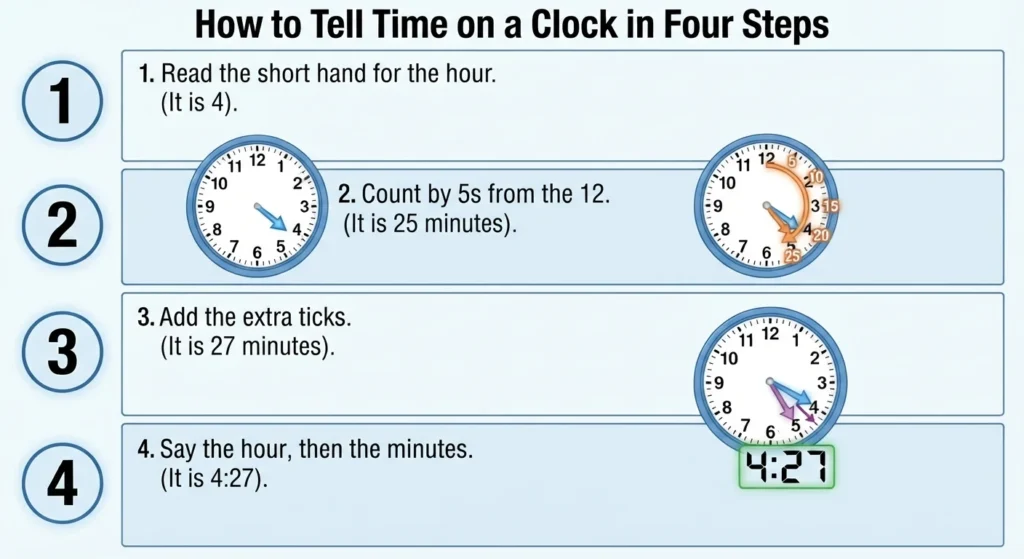
- Find the short hand and read the hour. If it points exactly at a number, that is the hour. If it sits between two numbers, the hour is the smaller number, the one it has already passed.
- Find the long hand and count the minutes. Start at the 12 and count clockwise in 5s, one number at a time, until you reach the long hand.
- Add the extra tick marks. If the long hand has gone past a number, count the small marks after it, one minute each.
- Say the hour first, then the minutes. “Four” then “twenty five” gives 4:25.
Say the steps aloud as you do them for the first few weeks. The internal script is what children eventually keep. If you are starting from scratch with a younger child, our guide on how to teach telling time to Grade 1 kids covers the earliest stage in more detail.
Reading the Hour Hand
Start here and stay here longer than feels necessary. Take a clock, remove or ignore the minute hand, and let your child point the short hand at each number in turn: 3 is 3 o’clock, 7 is 7 o’clock, 11 is 11 o’clock. There is no counting to do and no ambiguity, which is exactly what makes it a good first step.
Then introduce the harder case. Move the short hand so it sits between the 2 and the 3. Ask what hour it is. Many children say three, because three is closer or because they read left to right. The rule is that the hour is the number the hand has already passed, so it is still 2 o’clock, and some minutes have gone by.
An image that helps: the hour hand is slowly walking from one number to the next, and it does not get to call itself the new hour until it arrives. Between 2 and 3 it is still “2 and a bit.”
Practise this alone, with no minute hand in play, until your child gets it right every time. Almost every later mistake at 3:50 or 8:55 traces back to this one idea being shaky.
How the Minute Hand Works
Now the second scale. This is the part children find genuinely strange, and it helps to name the strangeness out loud: the same twelve numbers mean something different depending on which hand is pointing at them.
There are 60 minutes in one hour. The minute hand takes one full trip around the clock to cover them all. But the face only has 12 numbers printed on it, so each number has to stand for five minutes.
Work it out with your child rather than telling them. Count the small tick marks between the 12 and the 1. There are five spaces. So by the time the minute hand reaches the 1, five minutes have passed. By the 2, ten minutes. Sixty minutes divided among twelve numbers gives five minutes each.
This is the sentence to keep coming back to: when the long hand points at the 3, it does not mean three minutes. It means fifteen.
Skip Counting by 5s and the Minute Hand
Here is where clock reading stops being a new skill and becomes an old one used in a new place.
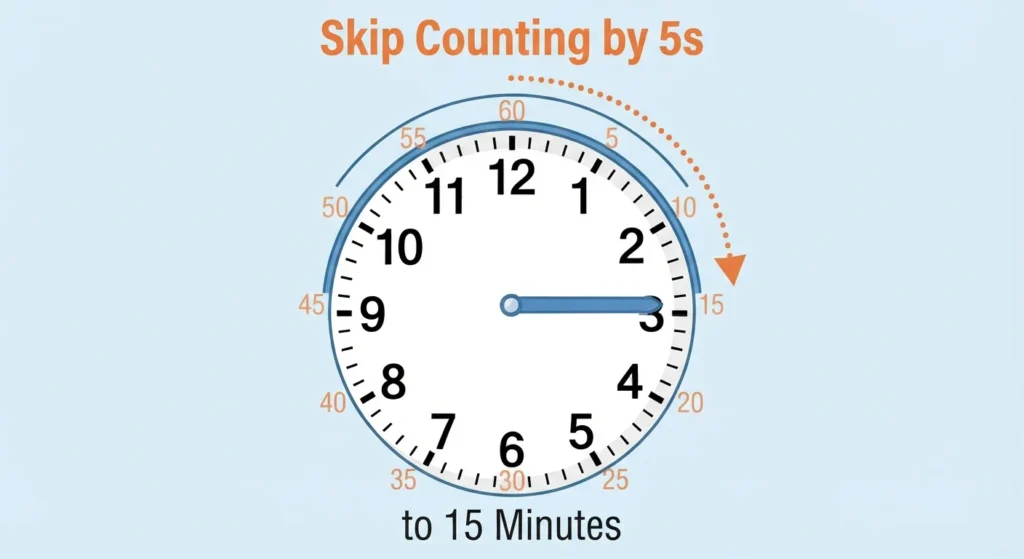
If your child can already skip count by 5s through 5, 10, 15, 20, 25, 30, 35, 40, 45, 50, 55, 60, they already know the minute hand. All they need is to map that chant onto the face.
Do this literally. Write the minute numbers in a second ring outside the hour numbers, either on a printed clock or with a marker on a paper plate: 5 outside the 1, 10 outside the 2, 15 outside the 3, and so on to 60 outside the 12. Let your child fill the ring in themselves by skip counting. A clock they have labelled is a clock they understand.
Use the outer ring as a support for a few weeks, then cover it and let them count round in 5s from the 12 instead. The chant carries them. Children who have this fluently rarely struggle with the rest.
If skip counting by 5s is not yet automatic, pause clock work and practise it on its own. Counting on fingers in 5s, counting 5 rupee or 5 taka coins, or counting pairs of hands in a room all build the same fluency, and our easy skip counting activities for Class 1 give you a ready set to work through. The clock will be much easier afterwards.
Telling Time to the Hour
The starting point. When the minute hand points straight up at the 12, no minutes of the new hour have passed yet, so we say “o’clock.”
Short hand on 6, long hand on 12: 6 o’clock, written 6:00.
Show your child that both digits after the colon are zero, because zero minutes have gone by. That link between the position and the written form matters, and it is the first bridge between the two kinds of clock.
Anchor these times to their day. 7 o’clock is breakfast. 8 o’clock is leaving for school. 9 o’clock is bedtime. When a child can say “that’s my bedtime” before they can say “that’s nine,” they are learning time and not just clock positions.
Telling Time to the Half Hour
When the minute hand points straight down at the 6, it has travelled exactly halfway around the face. Half of 60 is 30, so 30 minutes have passed. We say “half past.”
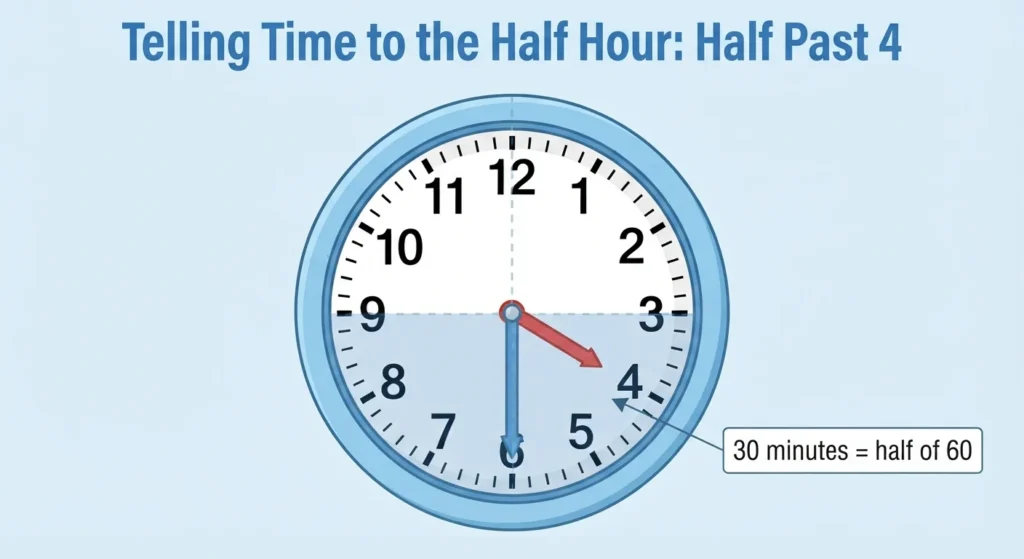
Short hand between 4 and 5, long hand on 6: half past 4, written 4:30.
Two things to point out here, both of which prevent later errors.
First, half past is a fraction, not a new rule to memorise. Fold a paper circle in half and lay it over the clock so your child can see that the 12 to 6 sweep really is half the face. This is the same halving they will meet again in fractions, and meeting it here makes both easier.
Second, at half past, the hour hand is sitting squarely between two numbers. This is the moment to go back to the hour-hand rule: it has passed the 4 and not yet reached the 5, so it is still 4. Children who read half past 4 as half past 5 have not got the hour hand rule solid yet.
Telling Time to the Quarter Hour
A quarter means one of four equal parts, and 60 divided by 4 is 15. If your child has already met fractions in Class 3, say the word quarter and the fraction out loud together so the two ideas connect.
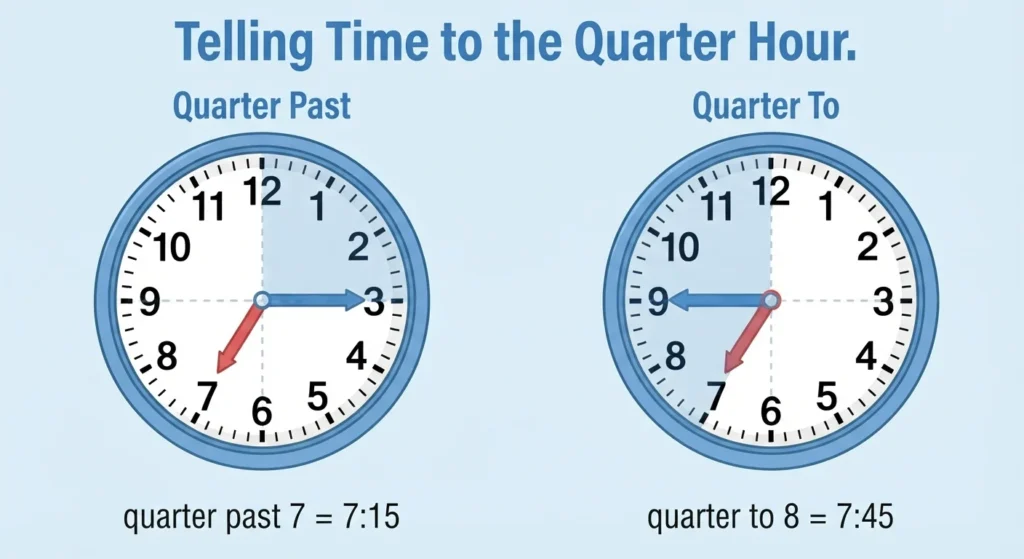
Quarter past. The minute hand is on the 3. It has covered one quarter of the circle, so 15 minutes have passed. Short hand just past 7, long hand on 3: quarter past 7, or 7:15.
Quarter to. The minute hand is on the 9. It has covered three quarters of the circle, so 45 minutes have passed and 15 minutes are left until the next hour. Short hand nearly at 8, long hand on 9: quarter to 8, or 7:45.
“Quarter to” is the hardest phrase in early clock work, because the spoken form names the hour that has not arrived yet while the written form names the hour we are still in. Say both out loud together every time: “quarter to 8, which we write as 7:45.” Do not drill one and leave the other, because your child will meet both in the same week.
Fold the paper circle into quarters and lay it on the face. The 12, 3, 6, and 9 line up with the folds, which is why those four numbers are worth anchoring early.
Telling Time to the Nearest Minute
Once 5s are comfortable, exact minutes need only one extra move: count in 5s to the last number the minute hand has passed, then count on in 1s using the small tick marks.
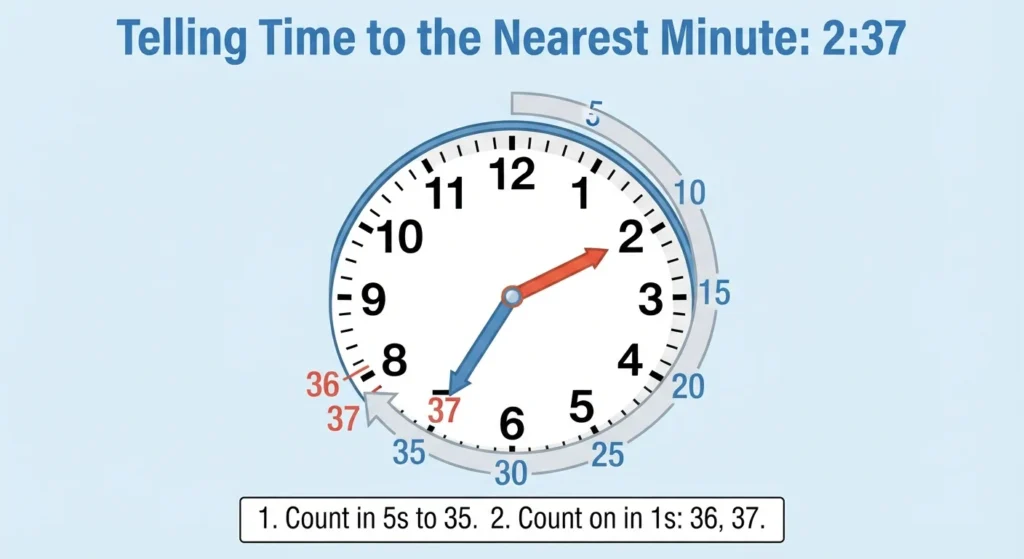
Long hand two ticks past the 7: count 5, 10, 15, 20, 25, 30, 35 to reach the 7, then 36, 37. If the short hand is between 2 and 3, the time is 2:37.
Two habits make this reliable. First, always start counting at the 12, never at the nearest number, because starting anywhere else invites guessing. Second, always finish the 5s before beginning the 1s. Children who mix the two lose count.
Expect this stage to take several sessions across a few weeks. It is not a single lesson, and speed here is worth nothing. A child who gets 3:47 right slowly understands more than a child who guesses 3:45 quickly.
AM and PM Explained for Kids
A clock face only has 12 numbers, but a day has 24 hours. That means the hands go around twice a day, and every time appears twice. AM and PM are how we say which of the two we mean.
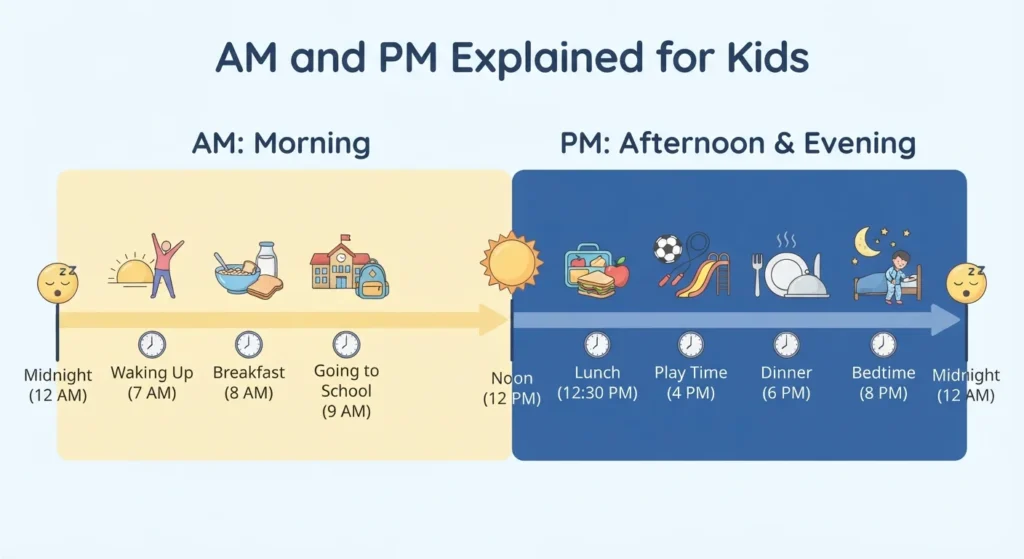
- AM covers midnight to noon. The morning half.
- PM covers noon to midnight. The afternoon, evening, and night half.
Skip the Latin unless your child asks. What works is anchoring each one to something they do.
7 AM is breakfast. 7 PM is dinner. 12 PM is lunch at midday. 12 AM is the middle of the night when everyone is asleep. Ask your child to sort a handful of their own daily events into the AM half and the PM half. Getting dressed for school, lunch break, cricket in the park, brushing teeth at night.
The two confusing cases are noon and midnight, and they confuse adults too. Handle them simply: 12 PM is lunchtime, 12 AM is the middle of the night. That is enough at this age.
Analog and Digital Clocks
A digital clock shows four digits split by a colon. The digits on the left of the colon are the hour. The digits on the right are the minutes.
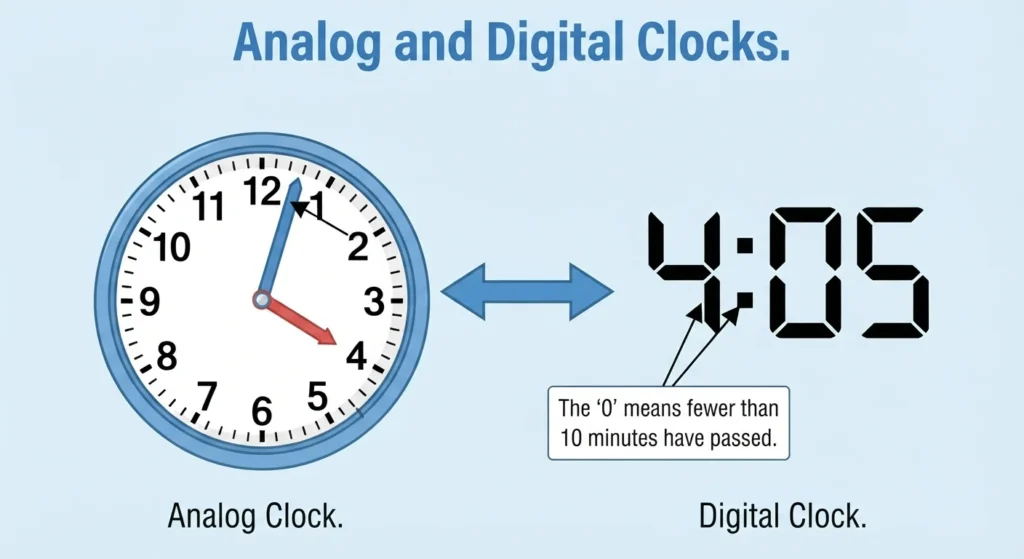
Children often read digital clocks fluently long before analog ones, which is useful, because it gives you a bridge. Set an analog and a digital clock side by side, or use a teaching clock that shows both. Move the hands and ask your child to say what the digital display should read. Then reverse it: call out a digital time and have them set the hands.
Two points worth making explicit:
The digital clock still hides the minute hand’s logic. 4:45 gives the answer directly, but it does not show you that 45 minutes is three quarters of the way round. The analog face shows you how much of the hour is gone, which is why it is easier to estimate with.
A digital clock shows 4:05 with a zero in front of the 5. On an analog clock the minute hand is barely past the 12. Practise this pair, because “four oh five” and “five minutes past four” are the same time in two languages, and children need both.
Worked Examples
Work through these with a real clock in front of you, moving the hands to match.
Example 1. Short hand on 5, long hand on 12. The short hand points exactly at 5, so the hour is 5. The long hand is on the 12, so no minutes have passed. The time is 5 o’clock, or 5:00.
Example 2. Short hand between 9 and 10, long hand on 6. The short hand has passed 9, so the hour is 9. The long hand on the 6 means 30 minutes. The time is half past 9, or 9:30.
Example 3. Short hand just past 1, long hand on 3. The hour is 1. Count in 5s: 5, 10, 15. The time is quarter past 1, or 1:15.
Example 4. Short hand almost at 11, long hand on 9. The short hand has not reached 11 yet, so the hour is still 10. Count in 5s to the 9: 5, 10, 15, 20, 25, 30, 35, 40, 45. The time is quarter to 11, or 10:45.
Example 5. Short hand between 6 and 7, long hand three ticks past the 4. The hour is 6. Count in 5s to the 4: 5, 10, 15, 20. Then count the ticks: 21, 22, 23. The time is 6:23.
Example 6. Short hand between 12 and 1, long hand one tick before the 11. The hour is 12. Count in 5s to the 10: 50. Then count on: 51, 52, 53, 54. The time is 12:54. If this is happening after lunch and before school ends, it is 12:54 PM.
Notice that every example uses the same four steps. That consistency is the point.
Common Mistakes Children Make When Learning How to Tell Time on a Clock
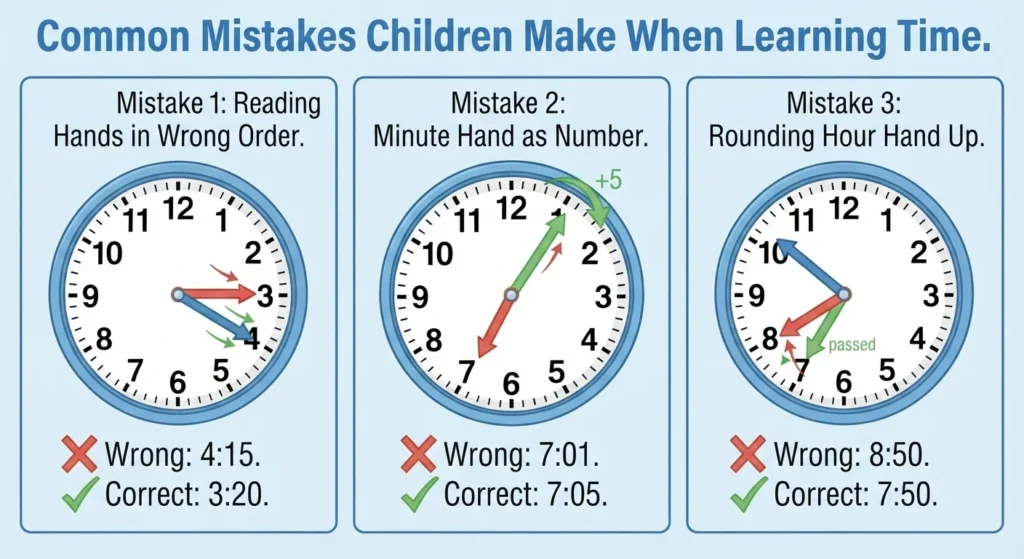
Reading the hands in the wrong order. A child looks at the long hand first and reads 3:20 as 4:15. Fix it by always asking “what hour is it?” before “how many minutes?” Cover the minute hand with a finger while they answer the first question.
Reading the minute hand as a plain number. Long hand on 4, child says “four minutes.” Fix it by going back to the outer ring of minute numbers and rebuilding the 5s by counting the tick marks, not by correcting the answer.
Rounding the hour hand up. Hand between 7 and 8, child says 8. Fix it by moving the hand very slowly from 7 towards 8 and asking at each step “has it arrived yet?”
Confusing quarter past and quarter to. Fix it by always pairing the spoken and written forms, and by using the folded paper circle so the child can see that the 9 is three quarters round, not one.
Losing count during the 5s. Fix it by having the child touch each number as they count, and by always starting at the 12.
Guessing from the general shape. Some children learn what 3:00 looks like as a picture and recognise times by shape rather than by reading. This works until it does not. Test with awkward times like 2:37 or 11:53 to find out whether the method is really there.
Struggling because the clock itself is unclear. Hands of similar length, no tick marks, or decorative faces with no numbers all make the task harder than the concept is. Use a plain, clearly labelled clock while learning.
8 Hands-On Activities and Games for Telling Time
None of these need anything you would have to buy specially. For more in this style, see our collection of fun math activities.
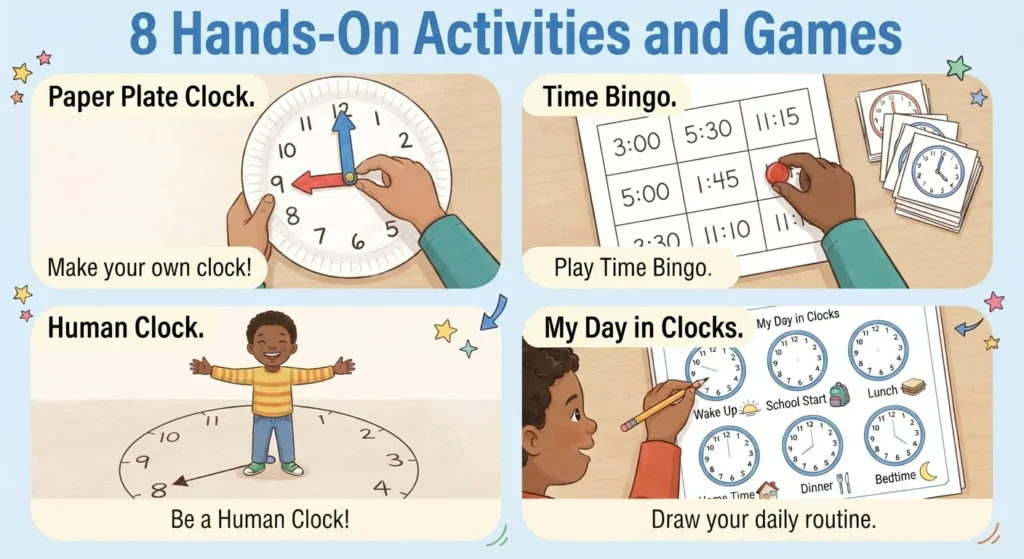
1. Paper plate clock. Cut two card hands, one clearly shorter, and fix them to a paper plate with a split pin. Let your child write the numbers 1 to 12 themselves, then add the outer minute ring in 5s. Making the clock teaches more than using it.
2. Time bingo. Draw a grid of six or nine written times. Call out a time, or show it on a teaching clock, and let your child cover the match. Swap roles so they get practice calling times too.
3. Set the clock race. Call out a time and have your child set the hands as fast as they can. Producing a time is harder than reading one, and it exposes misunderstandings that reading alone hides.
4. Human clock. Stand in the middle of a room. One arm is the hour hand, the other is the minute hand. Call out times and have your child pose. Ridiculous, physical, and surprisingly effective at fixing which hand is which.
5. Minute hunt. Set a timer for one minute and see how many times they can bounce a ball, write their name, or hop. Then try five minutes doing something dull. Children learn that minutes are not all the same length in feeling, which is the beginning of estimation.
6. What’s the time, Mr Wolf? The classic playground game, with a twist: instead of calling a number, Mr Wolf holds up a clock and the players read it before stepping forward.
7. My day in clocks. Draw six blank clock faces down a page. Your child draws the hands for waking up, school start, lunch, home time, dinner, and bedtime, and writes the digital time beside each. This is the single best activity for connecting the clock to real life.
8. Clock detective. For one week, whenever you are out, ask your child to find and read any analog clock they can see, at a shop, a station, a classroom, a relative’s wall. Reading unfamiliar clocks in poor light at odd angles is what fluency actually looks like.
Telling Time in Daily Life
Formal practice builds the skill. Daily use is what makes it stick.
Replace time instructions with clock instructions. Instead of “we’re leaving in ten minutes,” say “we’re leaving when the long hand reaches the 4.” Instead of “read for a while,” say “read until half past.”
Put an analog clock where your child already looks: near the dining table, next to their study desk, in the kitchen. Ask them for the time rather than checking your phone, and let the answer matter.
Cooking is ideal, because timings are real and the consequences are visible. So are travel times, cricket overs, television schedules, the school timetable, and shopping trips where your child is also counting money. Give your child the job of announcing when it is time for something. A child with a responsibility attached to the clock will learn it faster than one with a worksheet.
Tips for Parents Teaching Clock Reading at Home
Short sessions beat long ones. Five to ten minutes a few times a week is plenty at this age, and far more effective than a long weekend session.
Move through the sequence in order and do not skip ahead: parts of the clock, hour hand alone, minute hand alone, o’clock, half past, quarter past and quarter to, nearest minute. Each stage rests on the one before it.
Use a real clock with moving hands, not only printed pictures. The movement is where the meaning lives, and children who can move the hands themselves build a much better mental model.
When your child makes a mistake, ask them to talk you through the four steps rather than telling them the answer. The step they skip is the thing to work on.
Avoid timing them. Speed comes on its own once the method is solid, and a stopwatch at this stage teaches guessing.
If your child is still shaky on counting to 60 or skip counting by 5s, spend a week on those alone. It is not a detour. It is the prerequisite.
Tips for Teachers Delivering Time Lessons
Give every student their own manipulative clock. A class where thirty children watch one demonstration clock produces thirty children who can follow and only a few who can do.
Teach production alongside reading. Asking students to set a given time, or draw hands on a blank face, reveals misconceptions that multiple-choice reading questions hide entirely.
Use a whole-class minute regularly. Everyone sits in silence for exactly sixty seconds. Repeat it occasionally through the year so the unit stays concrete.
Display a large analog clock and refer to it constantly in ordinary classroom talk: when the lesson ends, when the break starts, how long is left. Incidental exposure across a term does work that a time unit cannot.
Expect a wide spread. Clock reading depends on number fluency, spatial reasoning, and language all at once, so classes spread out more on this topic than on most. Group by the stage of the sequence a student has reached rather than by general ability. Our lesson plan on skip counting for Class 1 shows the same staged structure applied to the prerequisite skill.
Time also sits inside the wider measurement strand covering length, weight, and time, so revisit it when those units come round. Keep the 24-hour clock and elapsed time calculations for later. Introducing them before o’clock, half past, and quarter times are secure produces confusion that takes weeks to unpick.
What Comes Next: Elapsed Time
Once your child can read a clock confidently, the natural next step is working out how much time has passed between two times.
Start with whole hours. From 2 o’clock to 5 o’clock is three hours. Count the hours on the face with a finger.
Then move to times within one hour. From 3:10 to 3:40 is 30 minutes, and you can see it as half a turn of the minute hand.
Then cross the hour, which is the first genuinely hard case. From 3:45 to 4:20, count 15 minutes to reach 4:00, then 20 minutes more, giving 35 minutes in total. Breaking the jump at the whole hour is the technique that carries all the way through.
A number line drawn under the two times helps enormously here. But do not start any of this until the reading itself is automatic. Elapsed time asks a child to hold two clock readings and an operation in mind at once, and there is no room for that if reading a single clock still takes effort.
Time in Olympiad-Style Word Problems
Once the basics are solid, time becomes a rich source of reasoning problems, and it shows up regularly in junior Olympiad and competition papers. These problems rarely ask a child to read a clock. They ask a child to reason about one.
These are close cousins of ordinary math word problems, so the same reading and planning habits apply. Typical examples at an early level:
- A film starts at 4:15 PM and runs for 1 hour 50 minutes. When does it end?
- A train leaves at 9:40 AM and reaches its destination at 1:25 PM. How long is the journey?
- A clock shows 3:00. Through what angle does the minute hand turn in 20 minutes?
- At what time between 4 and 5 o’clock are the hour hand and minute hand exactly opposite each other?
The later two are for older students, but they show where this leads. The clock is a circle divided into 60 parts and 12 parts at the same time, which makes it a natural setting for problems about angles, ratios, and rates. Every one of those problems is easier for a child who genuinely understands what the hands are doing, and nearly impossible for one who memorised twelve clock pictures.
This is the strongest argument for teaching clock reading conceptually. The memorisation route works for one school term. The conceptual route keeps paying for years. For practice at the next level up, see our sets of Grade 2 word problems and math olympiad questions.
Practice Questions with Answers
Try these with your child. Use a real clock for the first few.
- The short hand is on 8 and the long hand is on 12. What is the time?
- The short hand is between 3 and 4, and the long hand is on 6. What is the time?
- The short hand is just past 11 and the long hand is on 3. What is the time?
- The short hand is nearly at 5 and the long hand is on 9. What is the time?
- The long hand is on the 8. How many minutes past the hour is it?
- The short hand is between 7 and 8, and the long hand is two ticks past the 5. What is the time?
- Is 7:30 in the morning written as AM or PM?
- A digital clock shows 2:05. Where is the minute hand pointing?
- The short hand is between 12 and 1 and the long hand is on the 12. It is the middle of the night. Write the time with AM or PM.
- The long hand is on the 11 and the short hand is between 6 and 7. What is the time?
Answers
- 8 o’clock, or 8:00
- Half past 3, or 3:30
- Quarter past 11, or 11:15
- Quarter to 5, or 4:45
- 40 minutes
- 7:27
- AM
- Just past the 12, one tick mark after it
- 12:00 AM
- 6:55
Make Preparing for Math Olympiad Simple!



At what age should a child learn to tell time on a clock?
Most children read o’clock and half-past times around ages 5 to 6, quarter past and quarter to around ages 6 to 7, and times to the nearest minute around ages 7 to 8. This is a wide range, and it depends heavily on how secure a child’s counting and skip counting are. A child who is not ready is usually missing a number skill, not a time skill.
Which hand do you read first on a clock?
Read the short hour hand first, then the long minute hand. We say time the same way: hour then minutes, so reading in that order matches how the answer will be spoken.
Why does the number 3 on a clock mean 15 minutes?
Because there are 60 minutes in an hour and only 12 numbers on the face, so each number stands for five minutes when the minute hand points at it. Three numbers from the 12 gives 3 times 5, which is 15 minutes.
My child keeps mixing up the hour and minute hands. What should I do?
Practise with the minute hand removed or covered for a week. Once the hour hand alone is reliable, add the minute hand back. Also check that the clock you are using has a clearly shorter hour hand, because many clocks make the two hands almost the same length.
Should I teach digital or analog first?
Teach analog first for the concept, but connect it to digital straight away. Children encounter digital time constantly, so keeping the two separate makes the analog clock feel pointless. Say both forms aloud every time you read.
What does o’clock actually mean?
It is a short form of “of the clock,” an old phrase used to say the time was from a clock rather than from a sundial. We use it when the minute hand is on the 12 and no minutes of the hour have passed.
When should I introduce the 24-hour clock?
After AM and PM are secure, usually around ages 8 to 9. Introducing it earlier competes with the 12-hour system while that system is still being built.
How long should it take a child to learn to tell time?
Spread across several months rather than a single unit, with short and frequent practice. The stages build on each other, so a child who seems stuck on the nearest minute usually needs to revisit skip counting or the hour hand rule rather than more practice on the hard stage itself.
Is it worth learning analog clocks when phones show the time?
Yes. Analog clocks remain in classrooms, stations, and public buildings, and reading one is the only way to see at a glance how much of an hour is left. They also build skip counting, fractions, and spatial reasoning that reappear throughout the primary maths curriculum.
Final Thoughts
Learning how to tell time on a clock is a sequence, not a single lesson: name the parts, read the hour hand alone, understand why each number carries five minutes, then work up through o’clock, half past, quarter times, and the exact minute.
If your child is stuck, the fix is usually behind them. A child who cannot manage 3:47 needs the hour hand rule or skip counting by 5s rebuilt, not more practice on exact minutes.
Keep sessions short, keep a real clock within reach, and tie times to breakfast, the school bell, and bedtime. Speed arrives on its own once the method is secure.

Mikha Piregu is a Content Writer with experience spanning educational content, including math and math olympiad topics, as well as advocacy writing, research-based articles, and SEO-driven web content. He creates high-quality blog content, web copy, and feature articles that support brand visibility, audience engagement, and long-term organic growth through data-informed storytelling. Skilled in WordPress, WooCommerce, and modern digital tools, Mikha adapts content across various platforms, including blogs, websites, campaigns, and advocacy initiatives, with clarity and purpose.


There are no comments posted here yet.
Sign in to leave a comment