

Money word problems for class 3 are short maths questions set in real shopping and saving situations, where a child reads a small story and works out a total, the change due, the amount left, or which of two amounts is larger.
- What Are Money Word Problems for Class 3?
- Rupees and Paise: The Money Your Child Will See
- How to Read a Money Word Problem Before You Solve It
- Keyword Identification: The Words That Tell You What to Do
- How to Solve Money Word Problems for Kids: A Five-Step Method
- Money Word Problems for Class 3 With Full Solutions
- Category 1: Simple Addition Problems
- Category 2: Simple Subtraction Problems
- Category 3: Making Change Problems
- Category 4: Comparison Problems
- Category 5: Multi-Step Problems
- Category 6: Olympiad-Style Challenge Problems
- Common Mistakes in Money Word Problems and How to Fix Them
- Tips for Parents Helping With Money Word Problems at Home
- Tips for Teachers Using Money Word Problems in Class
- Six Fun Money Activities and Games
- Real-Life Money Situations to Talk About
- How Money Word Problems Build Wider Mathematical Reasoning
- Practice Problems Without Solutions
- Conclusion
They use rupees and paise; they stay within addition, subtraction, and simple multiplication; and they matter because they are the first place a child has to decide for themselves which operation to use.
This guide gives you 28 problems with complete worked reasoning, a five-step method your child can apply to any question, the mistakes to watch for, and activities you can run with nothing but coins and paper.
What Are Money Word Problems for Class 3?
A money word problem is an arithmetic question wrapped in a sentence or two of story. Instead of being handed “₹35 + ₹48”, your child is told that Aarav bought a notebook for ₹35 and a pencil box for ₹48, and asked how much he spent in all. The sum is identical. The work is not.
That extra work is the whole point. In a plain sum, the operation is printed on the page. In a word problem, your child has to find it. She has to read the sentence, decide what is being asked, notice whether money is coming in or going out, choose the right operation, do the calculation, and then write the answer back in rupees.
Six jobs instead of one. At Class 3 level, the arithmetic itself stays modest. Two-digit and three-digit addition and subtraction, multiplication by small numbers, and simple equal sharing. What grows is the reasoning.
This is why a child who scores well on a page of vertical sums can still stumble on money word problems, and why practising the two separately is a mistake. The sums build fluency. The word problems build judgement.
Why They Matter Beyond the Maths Test
Class 3 money maths is the closest thing in the primary syllabus to a life skill your child will use next week. She will check whether the shopkeeper gave the right change. She will work out whether her saved-up ₹200 covers the ₹165 toy. She will notice that the same biscuit packet costs less at one shop than another.
There is also a quieter benefit. Money gives abstract number work a body. A child who cannot explain what 245 minus 178 means can usually explain what happens when you pay ₹245 for groceries with ₹178 in your pocket. The money context does the explaining for you.
Rupees and Paise: The Money Your Child Will See
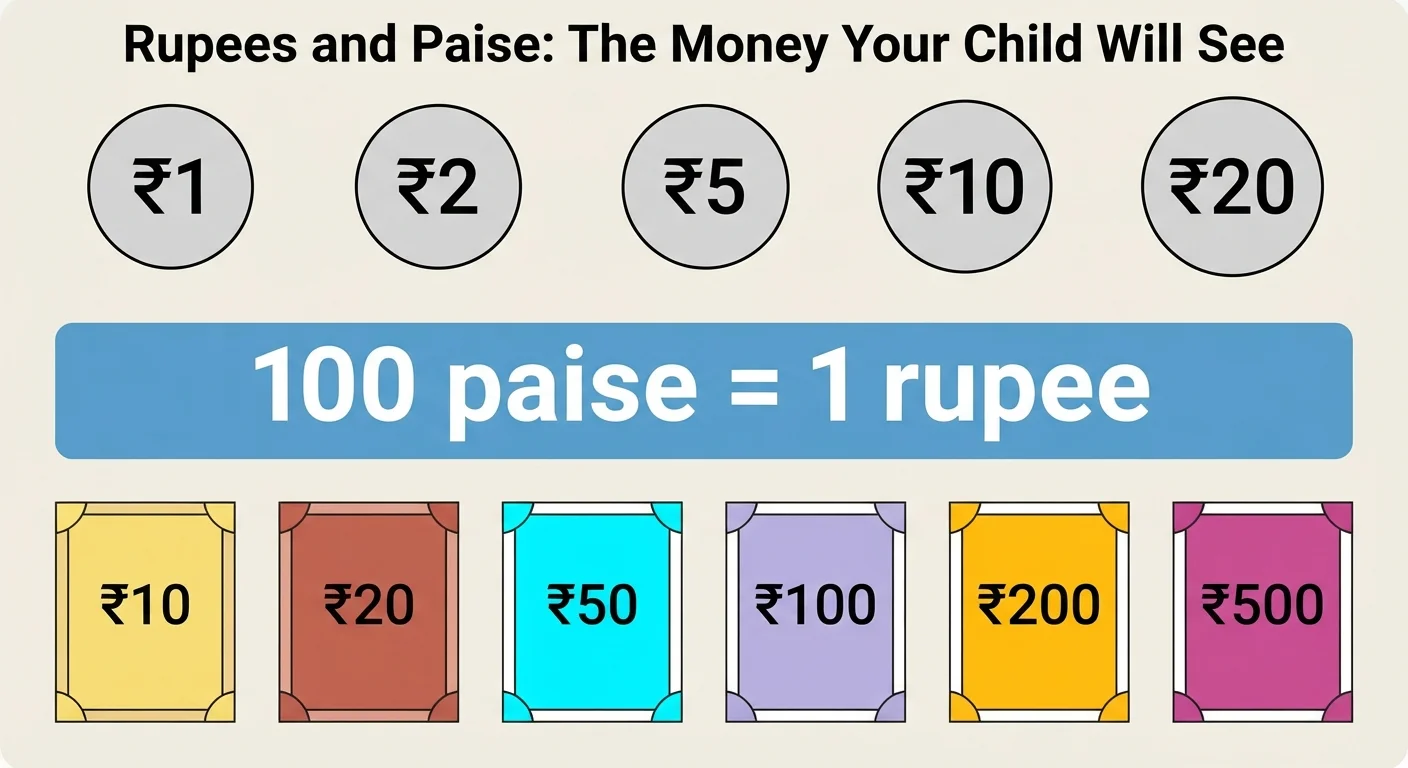
Indian currency has two units. The rupee is written with the symbol ₹, and the paisa is the smaller unit.
100 paise = 1 rupee
That single fact carries most of what a Class 3 child needs. If she can convert between the two units, she can handle any Class 3 money question.
- 100 paise = ₹1
- 250 paise = ₹2 and 50 paise
- ₹5 = 500 paise
- ₹3 and 75 paise = 375 paise
A useful habit at this age: keep rupees and paise as two separate named quantities rather than writing them as a decimal. “₹7 and 50 paise” is clearer for an eight year old than “₹7.50”, and it avoids dragging decimal place value into a topic where it does not belong yet. Decimals arrive in Class 4 and Class 5. Let them wait.
Notes and Coins in Use Today
Your child will handle coins of 1, 2, 5, 10 and 20 rupees, and notes of 10, 20, 50, 100, 200 and 500 rupees. Paise coins have largely gone out of everyday circulation, but paise still appear in Class 3 textbooks and in shop prices, so the conversion is worth knowing even if she rarely holds a paisa coin. If your child is still building this foundation, it’s worth revisiting counting money at the grade 1 level or practising with pennies, nickels and dimes if you’re working across currency systems.
Sit with a real handful of coins and notes for ten minutes before you start any worksheet. A child who has physically counted five ₹10 coins into ₹50 finds the written work far easier than a child who has only seen pictures.
A Quick Note for Readers Using Dollars and Cents
Everything in this guide transfers directly. Dollars work like rupees, cents work like paise, and 100 cents make 1 dollar just as 100 paise make 1 rupee. Swap the symbol and the problems read the same. The only change is that dollar-and-cent prices are usually written as decimals, which is one reason many international worksheets sit slightly above Class 3 level.
How to Read a Money Word Problem Before You Solve It
Most wrong answers at this age are not calculation errors. They are reading errors. The child solved a question correctly. It just was not the question on the page.
Teach this reading routine before you teach any arithmetic:
- Read it twice, out loud, the first time without a pencil. Pencils invite guessing. The first read is only for the story. Who is in it? What are they doing? Are they buying, selling, saving, or sharing?
- Then find the question sentence. It is usually the last line, and it usually contains a question mark. Have your child underline it. Ask her to say it back in her own words: “they want to know how much money is left.”
- Then list what you know. Every number in the problem, with its label. Not “35” but “notebook ₹35”. A bare number loses its meaning the moment it leaves the sentence.
- Then check for a trap. Is there a number in the problem that the question does not need? Later problems often include one. Is anything asked in paise when the prices are in rupees?
Only after those four steps should anything be calculated. The routine takes about twenty seconds once it is habitual, and it removes the majority of errors. This same discipline is what makes children successful at story sums more generally, not just money questions.
Keyword Identification: The Words That Tell You What to Do
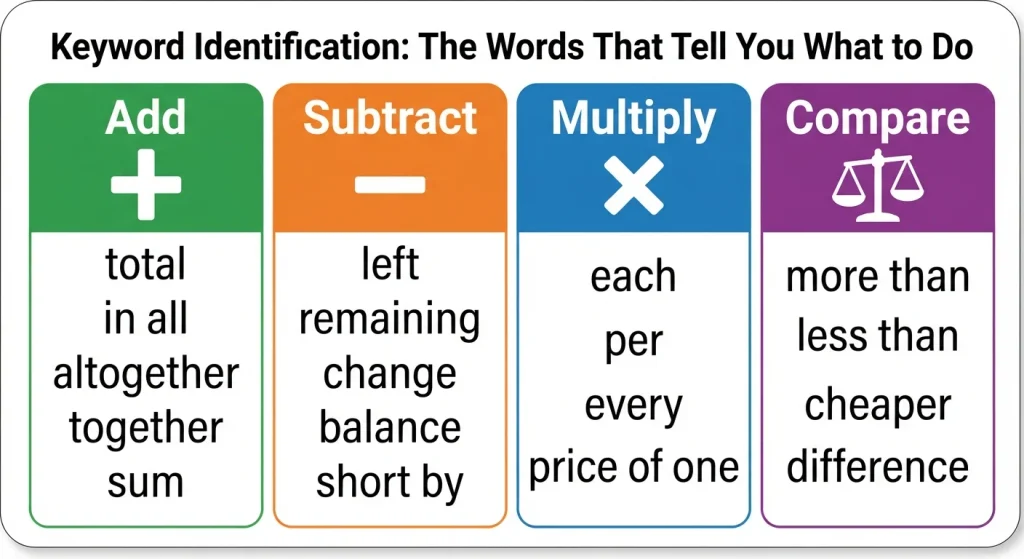
Word problems use a small and fairly reliable vocabulary. Once your child recognises the signal words, choosing the operation stops being a guess.
Make this into a chart and stick it above the study table.
Signal Words for Adding
total, in all, altogether, sum, both, together, how much did she spend on all the items
These appear when separate amounts come together into one. Two or more prices are given and the question wants the combined figure.
Signal Words for Subtracting
left, remaining, how much more is needed, change, balance, spent from, short by, after buying
These appear when an amount is taken away from a larger one, or when the gap between two amounts is wanted. Change and money left are both subtraction, even though they feel like different questions to a child.
Signal Words for Multiplying
each, per, every, the price of one, 5 pens at ₹12 each
The word each is the single most valuable clue in Class 3 money maths. When a price is given for one item and the question asks about several identical items, it is multiplication. Repeated addition also works and is often safer at first.
Words That Mean Compare
more than, less than, cheaper, costlier, who spent more, which is the better buy, difference
Comparison questions look like subtraction and are solved by subtraction, but the answer has to be written as a comparison: not “₹25” but “Sara spent ₹25 more than Rohit.”
One warning. Signal words are a strong guide, not a law. “Ravi had ₹80 more than Sunil” contains the word “more” but may need subtraction. Always check the story against the words. The keyword chart gets your child to the right operation perhaps nine times in ten, and the reading routine catches the tenth.
How to Solve Money Word Problems for Kids: A Five-Step Method
Here is the framework to use on every problem. Keep it identical every time. Consistency is what turns it into a habit rather than one more thing to remember.
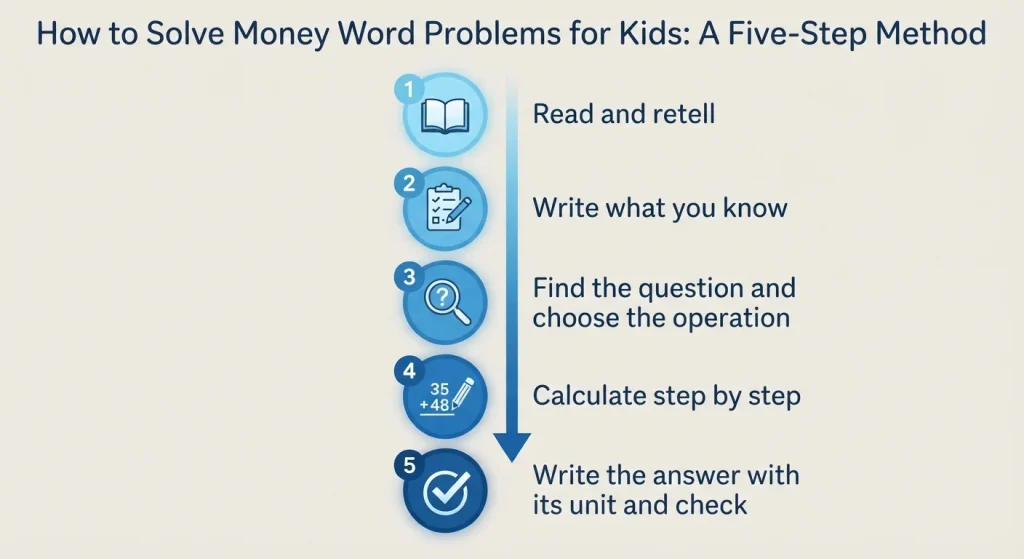
Step 1: Read and retell. Read the problem twice and say what is happening in your own words, without numbers.
Step 2: Write down what you know. List each amount with its label. Rupees with rupees, paise with paise. If the problem mixes units, convert everything into one unit first.
Step 3: Find the question and choose the operation. Underline the question sentence. Look for signal words. Decide: am I putting amounts together, taking one away, or repeating the same amount?
Step 4: Calculate, showing the line. Write the sum out properly, one step per line. If the problem has two parts, finish and label the first part before starting the second.
Step 5: Write the answer with its unit, then check it makes sense. Every answer ends in ₹ or paise. Then ask the sense question: is the change smaller than the note you paid with? Is the money left smaller than the money you started with? If not, something has gone wrong.
Step 5 is the step children skip and the step that catches the most errors. A child who has answered “the change is ₹132” after paying with a ₹100 note has all the information needed to spot her own mistake. This method works just as well for grade 2 word problems once your child is ready to move up a level.
28 Money Word Problems for Class 3 With Full Solutions
The problems below are grouped by type and get harder as you go. Work through one category at a time rather than jumping around. Every solution shows the reasoning, not just the number, so you can compare your child’s thinking against it and see exactly where a wrong answer came from.
Category 1: Simple Addition Problems
Two or more amounts come together into one total. Start here.
Problem 1
Aarav buys a notebook for ₹35 and a pencil box for ₹48. How much does he spend in all?
Clue: The words “in all” tell us to add. Two amounts are coming together.
Working: ₹35 + ₹48 = ₹83
Answer: ₹83
Check: The total is larger than either single price, which is right for an addition.
Problem 2
Ravi’s mother buys bread for ₹32, butter for ₹55 and jam for ₹78. What is her total bill?
Clue: “Total bill” means add all three prices. Add two at a time.
Working: Step 1: ₹32 + ₹55 = ₹87
Step 2: ₹87 + ₹78 = ₹165
Answer: ₹165
Problem 3
Meera buys a ball for ₹64, a skipping rope for ₹27 and marbles for ₹19. How much money does she spend altogether?
Clue: “Altogether” means add.
Working: Step 1: ₹64 + ₹27 = ₹91
Step 2: ₹91 + ₹19 = ₹110
Answer: ₹110
Problem 4
A pencil costs 75 paise and an eraser costs 50 paise. What is the cost of both together?
Clue: Both prices are already in paise, so no conversion is needed first. “Together” means add.
Working: Step 1, add: 75 paise + 50 paise = 125 paise
Step 2, convert: 100 paise make ₹1, so 125 paise = ₹1 and 25 paise
Answer: ₹1 and 25 paise
Teaching note: This is the step children forget. An answer of “125 paise” is not wrong, but the tidy form is rupees and paise.
Problem 5
Three friends put money together to buy a birthday gift. Ishaan gives ₹125, Tara gives ₹90 and Kabir gives ₹85. How much money do they collect?
Clue: “Put money together” and “collect” both point to addition.
Working: Step 1: ₹125 + ₹90 = ₹215
Step 2: ₹215 + ₹85 = ₹300
Answer: ₹300
Category 2: Simple Subtraction Problems
Money goes out, or you want the gap between two amounts.
Problem 6
Anil had ₹200. He spent ₹145 on a cricket ball. How much money is left with him?
Clue: Money was spent, so it has gone out. “Left” means subtract.
Working: ₹200 − ₹145 = ₹55
Answer: ₹55
Check: ₹55 is less than the ₹200 he started with. Correct.
Problem 7
Nidhi’s piggy bank has ₹480. She gives ₹175 to her sister. How much is still in the piggy bank?
Clue: Money leaves the piggy bank, so subtract.
Working: ₹480 − ₹175 = ₹305
Answer: ₹305
Problem 8
A box of sweets costs ₹250. Nisha has only ₹180. How much more money does she need?
Clue: There is no “left” or “remaining” here, but “how much more is needed” is still subtraction. We want the gap between what the sweets cost and what she has.
Working: ₹250 − ₹180 = ₹70
Answer: She needs ₹70 more
Teaching note: Notice that the answer is written as a sentence. A bare “₹70” does not say whether that is what she has, needs or spent.
Problem 9
Sameer has one rupee. He spends 65 paise on a toffee. How much money is left with him?
Clue: The two amounts are in different units, so convert first. This is Step 2 of the method.
Working: Step 1, convert: ₹1 = 100 paise
Step 2, subtract: 100 paise − 65 paise = 35 paise
Answer: 35 paise
Problem 10
The annual fee for a music class is ₹750. Rhea’s father has already paid ₹525. How much is still to be paid?
Clue: “Still to be paid” is the gap between the full fee and the part paid. Subtract.
Working: ₹750 − ₹525 = ₹225
Answer: ₹225
Category 3: Making Change Problems
Change problems confuse children because two amounts are in play: the price, and the money handed over.
The rule: Change = money given − money spent. Always in that order.
Problem 11
Divya buys a water bottle for ₹68. She pays with a ₹100 note. What change does she get back?
Clue: Money given is ₹100. Money spent is ₹68.
Working: ₹100 − ₹68 = ₹32
Answer: ₹32
Check: Change must be smaller than the note handed over. ₹32 is smaller than ₹100. Correct.
Problem 12
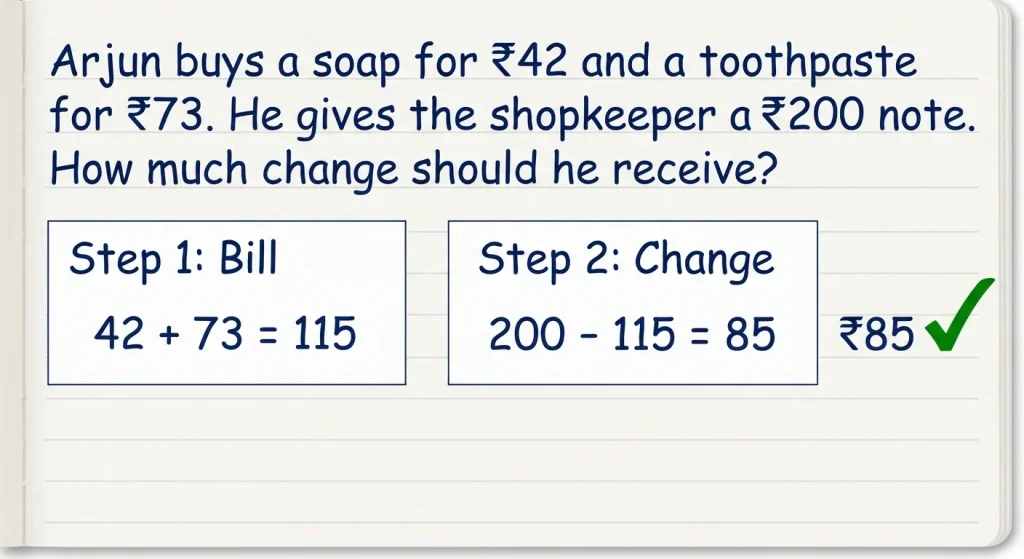
Arjun buys a soap for ₹42 and a toothpaste for ₹73. He gives the shopkeeper a ₹200 note. How much change should he receive?
Clue: Two steps. First find the bill, then find the change.
Working: Step 1, the bill: ₹42 + ₹73 = ₹115
Step 2, the change: ₹200 − ₹115 = ₹85
Answer: ₹85
Problem 13
A school bag costs ₹365. Pooja pays with a ₹500 note. What change does she get, and which notes and coins could the shopkeeper give her?
Clue: Find the change first, then break it into real currency.
Working: Step 1, the change: ₹500 − ₹365 = ₹135
Step 2, break it up: ₹100 + ₹20 + ₹10 + ₹5 = ₹135
Answer: ₹135, which can be given as ₹100 + ₹20 + ₹10 + ₹5
Teaching note: Other combinations also work, and it is worth asking your child to find a second one.
Problem 14
Karan buys 3 pens. Each pen costs ₹18. He pays ₹100. How much change does he get?
Clue: The word “each” signals multiplication first, then change.
Working: Step 1, cost of 3 pens: ₹18 × 3 = ₹54
Step 2, the change: ₹100 − ₹54 = ₹46
Answer: ₹46
If multiplication is still new, add instead: 18 + 18 + 18 = 54. Repeated addition gives the same answer and is safer at first.
Category 4: Comparison Problems
These are solved by subtraction, but the answer must be written as a comparison.
Problem 15
Rohit spent ₹95 at the stationery shop. Sara spent ₹120. Who spent more, and by how much?
Clue: ₹120 is more than ₹95, so Sara spent more. To find by how much, subtract the smaller from the larger.
Working: ₹120 − ₹95 = ₹25
Answer: Sara spent ₹25 more than Rohit
Problem 16
The same storybook costs ₹145 at Shop A and ₹128 at Shop B. Which shop is cheaper, and how much would you save by buying there?
Clue: ₹128 is less than ₹145, so Shop B is cheaper. The saving is the difference.
Working: ₹145 − ₹128 = ₹17
Answer: Shop B is cheaper. You would save ₹17
Problem 17
Four pencils cost ₹6 each. One gel pen costs ₹15. Which costs more, the four pencils or the gel pen, and by how much?
Clue: You cannot compare until both sides are a single amount, so work out the pencils first.
Working: Step 1, the pencils: ₹6 × 4 = ₹24
Step 2, compare: ₹24 is more than ₹15, and ₹24 − ₹15 = ₹9
Answer: The four pencils cost ₹9 more than the gel pen
Problem 18
Aman saves ₹15 every week for 4 weeks. Ishaan saves ₹25 every week for 3 weeks. Who saves more money, and by how much?
Clue: “Every week” means multiply each saving before comparing.
Working: Step 1, Aman: ₹15 × 4 = ₹60
Step 2, Ishaan: ₹25 × 3 = ₹75
Step 3, compare: ₹75 − ₹60 = ₹15
Answer: Ishaan saves ₹15 more than Aman
Teaching note: This problem rewards a child who resists comparing ₹15 with ₹25 and instead compares the totals.
Category 5: Multi-Step Problems
From here on, finish and label each step before starting the next. Most errors in multi-step problems come from losing track of which number means what.
Problem 19
Vikram has ₹300. He buys a shirt for ₹175 and a cap for ₹60. How much money is left with him?
Working: Step 1, total spent: ₹175 + ₹60 = ₹235
Step 2, money left: ₹300 − ₹235 = ₹65
Answer: ₹65
Problem 20
A shop sells notebooks at ₹28 each. Priya buys 5 notebooks and pays with a ₹200 note. How much change does she get?
Working: Step 1, cost of 5 notebooks: ₹28 × 5 = ₹140
Step 2, the change: ₹200 − ₹140 = ₹60
Answer: ₹60
Problem 21
Anaya saves ₹20 every week for 6 weeks. She then spends ₹45 on a box of colours. How much money does she have left?
Working: Step 1, total saved: ₹20 × 6 = ₹120
Step 2, money left: ₹120 − ₹45 = ₹75
Answer: ₹75
Problem 22
Dev buys 3 packets of biscuits at ₹22 each and 2 juice boxes at ₹35 each. He pays with a ₹150 note. What change does he receive?
Working: Step 1, biscuits: ₹22 × 3 = ₹66
Step 2, juice: ₹35 × 2 = ₹70
Step 3, total bill: ₹66 + ₹70 = ₹136
Step 4, the change: ₹150 − ₹136 = ₹14
Answer: ₹14
Problem 23
Lata’s mother has ₹500. She spends ₹215 on groceries and ₹135 on vegetables. She then wants to buy fruit costing ₹150. Does she have enough money?
Working: Step 1, spent so far: ₹215 + ₹135 = ₹350
Step 2, money left: ₹500 − ₹350 = ₹150
Step 3, compare: the fruit costs ₹150 and she has exactly ₹150
Answer: Yes, she has just enough, and she will be left with nothing
Teaching note: Questions phrased as “does she have enough” want a yes or no plus the figure that proves it.
Category 6: Olympiad-Style Challenge Problems
These are for children who find the earlier categories comfortable. They use the same arithmetic but require an extra turn of thought: working backwards, finding a missing value, or counting possibilities.
Problem 24
A pen and a notebook together cost ₹90. The notebook costs ₹30 more than the pen. What is the cost of each?
Clue: Take away the extra ₹30 first, so that the two items become equal in price.
Working: Step 1, remove the extra: ₹90 − ₹30 = ₹60, which is the cost of two pens
Step 2, the pen: ₹60 ÷ 2 = ₹30
Step 3, the notebook: ₹30 + ₹30 = ₹60
Answer: Pen ₹30, notebook ₹60
Check: ₹30 + ₹60 = ₹90, and ₹60 is ₹30 more than ₹30. Both conditions hold.
Problem 25
Tara spent ₹45 on a book and then ₹30 on a pencil case. She now has ₹25 left. How much money did she have at the start?
Clue: Work backwards. Money left plus money spent equals money at the start.
Working: Step 1: ₹25 + ₹30 = ₹55
Step 2: ₹55 + ₹45 = ₹100
Answer: ₹100
Check: Forwards, ₹100 − ₹45 = ₹55, and ₹55 − ₹30 = ₹25. Correct.
Teaching note: The problem is full of subtraction words but is solved by adding. This is exactly why signal words must be checked against the story.
Problem 26
Kabir wants to pay ₹25 using only ₹5 coins and ₹10 coins. In how many different ways can he do it?
Clue: Count the possibilities in order, starting with the fewest ₹10 coins.
Working: No ₹10 coins: five ₹5 coins make ₹25. Works.
One ₹10 coin: ₹25 − ₹10 = ₹15, which needs three ₹5 coins. Works.
Two ₹10 coins: ₹25 − ₹20 = ₹5, which needs one ₹5 coin. Works.
Three ₹10 coins would be ₹30, which is already more than ₹25. Stop.
Answer: 3 ways
Teaching note: Working in order matters more than the answer here. A child who guesses randomly misses one.
Problem 27
₹100 is to be shared equally among 3 children, using only whole rupees. How much does each child get, and how much is left over?
Clue: Divide, then look at what will not divide.
Working: Step 1: 3 × 30 = 90, which leaves ₹10
Step 2: 3 × 3 = 9, which leaves ₹1
Step 3: 3 × 33 = 99, and ₹100 − ₹99 = ₹1
Answer: Each child gets ₹33, and ₹1 is left over
Teaching note: The leftover is the part children drop. Ask “where did the last rupee go?” until the question becomes automatic.
Problem 28
6 pencils cost ₹42. At the same rate, what would 9 pencils cost?
Clue: Find the cost of one pencil first, then scale up.
Working: Step 1, cost of one pencil: ₹42 ÷ 6 = ₹7
Step 2, cost of 9 pencils: ₹7 × 9 = ₹63
Answer: ₹63
Check: 9 pencils cost more than 6 pencils, so ₹63 being larger than ₹42 is right.
Common Mistakes in Money Word Problems and How to Fix Them
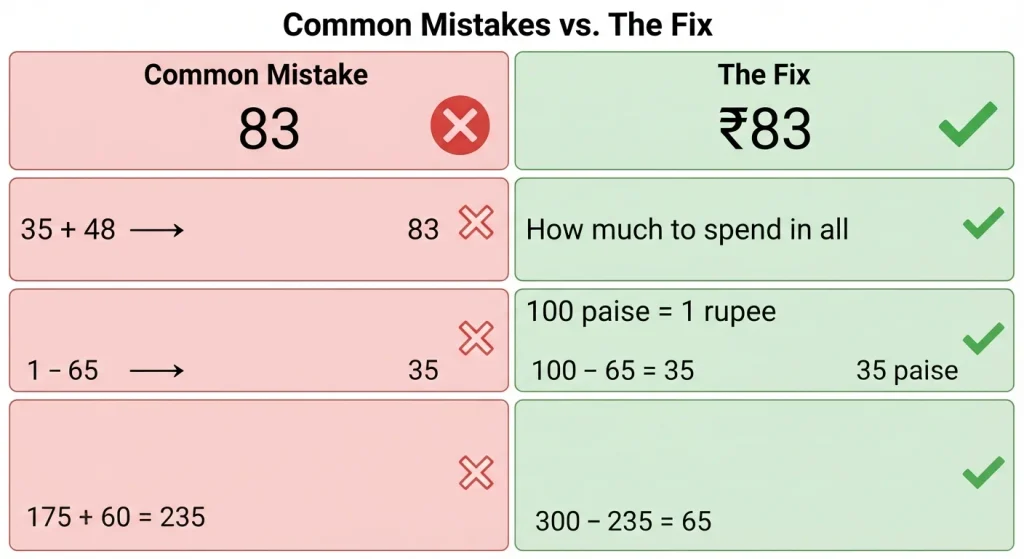
- Choosing the wrong operation. The commonest error by a wide margin. A child sees two numbers and adds them because adding is comfortable. Fix: make underlining the question sentence compulsory before any arithmetic, and keep the signal-word chart visible. Ask “is money coming in or going out?” before asking what the sum is.
- Dropping the unit. An answer written as “83” instead of “₹83”. It looks small, but it is the habit that later lets a child answer 50 when the answer is 50 paise. Fix: no answer counts as finished without ₹ or paise attached.
- Mixing rupees and paise without converting. Subtracting 65 from 1 in Problem 9 and answering “35 rupees” or similar. Fix: Step 2 of the method. Before any calculation, put everything into one unit.
- Stopping halfway through a multi-step problem. In Problem 20 the child finds ₹140 and writes that as the answer, having forgotten the change. Fix: number the steps on the page and re-read the question sentence after the first step.
- Subtracting in the wrong order for change. Working out 68 − 100 or, more often, answering the price instead of the change. Fix: the fixed sentence “change equals money given minus money spent”, plus the sense check that change is always smaller than the note handed over.
- Using a number that the question does not need. Later problems often include one. A child who uses every number given will get it wrong. Fix: after listing what you know, ask which of those amounts the question actually asks about.
- Ignoring the remainder. In Problem 27, answering “₹33 each” and saying nothing about the leftover rupee. Fix: for any sharing problem, ask “is there anything left over?” as a separate question.
- Rushing the read. Reading once, spotting the numbers, and calculating. Fix: the two-read rule, the first read without a pencil in hand.
Tips for Parents Helping With Money Word Problems at Home
- Use real money for the first week. Give your child actual coins and notes and let her act the problem out. Pay the ₹68, count the change back. Physical handling builds a mental picture that no worksheet can.
- Ask her to explain, not to answer. “Tell me how you knew to subtract” teaches more than “is it ₹55?”. If she cannot explain a correct answer, she guessed, and the guess will not survive a harder problem.
- Do not correct the arithmetic first. When an answer is wrong, find out where the thinking broke down. Was the operation wrong, or the reading, or just the carrying? The three need different responses, and only one of them is a maths problem.
- Two or three problems a day, not twenty on Sunday. Word problems are tiring in a way that sums are not, because each one demands a fresh decision. Short daily sessions work far better than a weekend marathon.
- Let her write the problems. Ask her to invent a money problem for you to solve, using prices from your kitchen. A child who can build a problem understands its structure, and this is one of the fastest routes to comfort with the topic.
- Bring her to the shop. Hand over a ₹100 note and let her check the change herself. Nothing you do at the study table will match this.
Tips for Teachers Using Money Word Problems in Class
- Sort before you solve. Give the class a set of ten problems and ask only for the operation each one needs, not the answers. Sorting drills the exact skill that is failing, and a whole set can be done in ten minutes.
- Display the reasoning, not the answer key. When you go over a problem on the board, write each step on its own line and label it. Children copy the format you model. If you only ever write the final figure, that is what they will write too.
- Run a classroom shop. Price twenty everyday objects, issue paper money, and let pairs of children take turns as shopkeeper and customer. The shopkeeper role is the valuable one, because giving change is harder than receiving it.
- Plant a spare number deliberately. Once the class is confident, include problems with one number that is not needed. It shifts attention from calculating to reading, which is where the marks are lost.
- Ask for the problem, not the answer. Give the class a completed sum, such as ₹200 − ₹145 = ₹55, and ask them to write a money story that fits it. Working backwards from the arithmetic to the situation exposes who has understood the structure.
- Use error analysis as a task. Show a worked solution containing one mistake and ask the class to find it. Children who can spot an error in someone else’s work start catching their own.
Six Fun Money Activities and Games
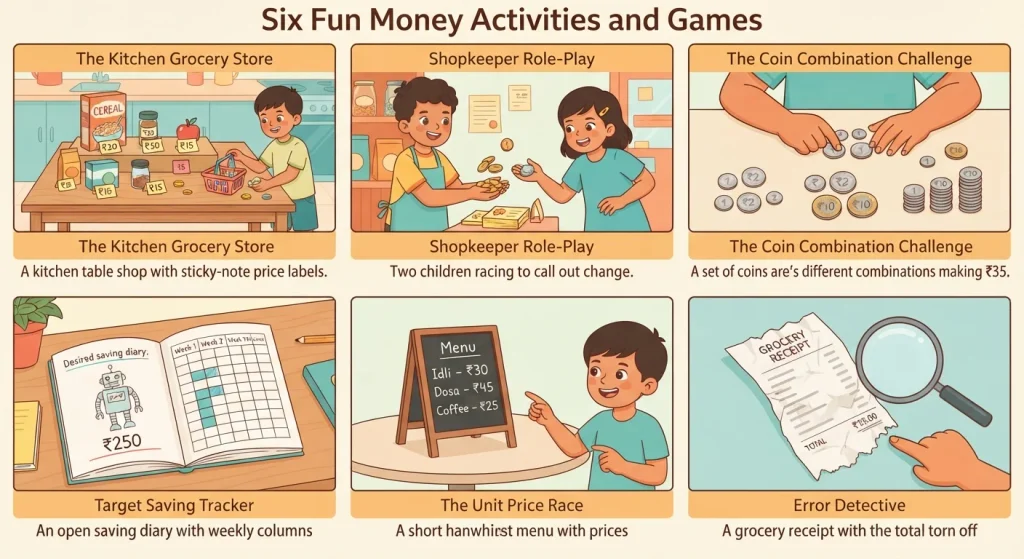
- The kitchen shop. Put price labels on ten items from your kitchen shelf, give your child ₹100 in paper money, and set a challenge: buy three things and tell me your change. Vary it by asking her to spend as close to ₹100 as possible without going over. Needs nothing but sticky notes.
- Change race. Call out a price and a note. “Item ₹73, you paid ₹100.” First correct change wins a point. Two players is enough, and it fills ten minutes in a car or a queue. This drills the single most useful money skill there is.
- Coin combinations. Name an amount, such as ₹35, and ask how many different sets of coins make it. Then ask for the smallest number of coins possible. This is Problem 26 turned into a game, and it builds the systematic listing that Olympiad-style questions reward.
- The saving diary. Give your child a small notebook. Every week she records what she received, what she spent and what is left. After six weeks she has a real multi-step problem with her own numbers in it, and she will care about the answer in a way no worksheet can manage.
- Menu maths. Write a short menu with prices: samosa ₹15, juice ₹25, sandwich ₹40. Give a budget of ₹75 and ask for an order that uses it exactly. Then ask for a second different order. Open-ended problems with several right answers build flexibility.
- Receipt detective. Keep a real grocery receipt and cut off the total. Ask your child to work it out, then check against the real figure. Genuine receipts contain awkward numbers and a satisfying self-check, and children take them seriously precisely because they are real.
Real-Life Money Situations to Talk About
The problems on this page are practice. The conversations below are where the skill actually settles.
- Checking change at the shop. Before the shopkeeper hands it over, ask your child what the change should be.
- Choosing between two sizes. A 200 gram packet at ₹40 or a 100 gram packet at ₹25. Which is better value? The arithmetic is within Class 3 reach and the reasoning is genuinely useful.
- Saving towards something. She wants a ₹250 toy and gets ₹30 a week. How many weeks? This is division by repeated addition, arrived at by a child who wants the answer.
- Splitting a bill. Three cousins share a ₹120 snack bill. How much each? And what if one of them only ate half as much?
- Comparing shops. The same item at two prices. Noticing the difference and naming it is a comparison problem she has already practised.
How Money Word Problems Build Wider Mathematical Reasoning
The skills a child builds here are not confined to money.
- Choosing an operation from a written situation is the core of every word problem she will meet, whether it is about money, length, time or weight. The five-step method transfers unchanged.
- Working backwards, as in Problem 25, is the seed of algebra. When she later writes x − 45 − 30 = 25 and solves it, she will be doing formally what she did informally here.
- The missing-value reasoning in Problem 24, where an extra ₹30 is removed to make two amounts equal, is a genuine Olympiad technique. It appears in competition papers for years afterwards in progressively fancier clothing.
- Counting possibilities systematically, as in Problem 26, is the beginning of combinatorics. The habit that matters is going in order rather than guessing.
- Unit conversion between rupees and paise is the same reasoning as centimetres to metres, grams to kilograms, or minutes to hours. One idea, many topics — the same logic your child will use for fractions in Class 3 once they start splitting quantities into equal parts.
12 Practice Problems Without Solutions
Work these independently, using the five-step method. Write out every step.
- A comb costs ₹24 and a mirror costs ₹57. What is the total cost?
- Riya had ₹350. She spent ₹185 on a game. How much is left?
- A pencil costs 80 paise and a sharpener costs 45 paise. Find the total in rupees and paise.
- A cap costs ₹79. Sahil pays with a ₹100 note. What change does he get?
- 4 erasers cost ₹9 each. What is the cost of all four?
- Anika spent ₹135. Her brother spent ₹98. Who spent more, and by how much?
- Neel has ₹500. He buys shoes for ₹275 and socks for ₹85. How much money is left?
- A tiffin box costs ₹165 at one shop and ₹142 at another. How much would you save at the cheaper shop?
- Meera saves ₹35 every week for 5 weeks. How much has she saved?
- 7 samosas cost ₹105. What would 4 samosas cost at the same rate?
- A ball and a bat together cost ₹240. The bat costs ₹60 more than the ball. Find the cost of each.
- After spending ₹60 and then ₹35, Rahul has ₹55 left. How much did he start with?
Make Preparing for Math Olympiad Simple!



What is the difference between “change” and “money left”?
Both are subtraction, but they subtract different things. Change is the money given to the shopkeeper minus the price. Money left is the money you started with minus what you spent. When the child pays with exactly what she had, the two happen to be the same, which is why the distinction is worth naming.
Do these problems help with Maths Olympiad preparation?
The first five categories build the fluency and reading accuracy that any competition paper assumes. Category 6 goes further, using working backwards, missing-value reasoning and systematic counting, which are genuine Olympiad techniques introduced here at a Class 3 level. If you’d like to take this further, see our guides on Math Olympiad questions and MOEMS.
How do I make money word problems less boring?
Replace worksheets with situations. A shop set up on the kitchen table, a real receipt with the total cut off, or a saving diary with your child’s own money in it will hold attention far longer than a printed page, and the maths is identical.
Can we use dollars and cents instead of rupees?
Yes. Cents work exactly like paise, with 100 cents to a dollar just as 100 paise make a rupee. Swap the symbol and every problem here works unchanged, though dollar prices are usually written as decimals, which adds a layer Class 3 children do not need.
Conclusion
Money word problems are one of the few places in the Class 3 syllabus where the maths and the life skill are the same thing. A child who can work out change, saving and comparison shopping in a story has already learned to work them out at the till.
What separates a child who freezes on these questions from one who breezes through them is rarely the arithmetic; it is the five-step habit of reading first, labelling what she knows, and checking that the answer makes sense before she writes it down.
None of this needs a workbook to practise. A handful of coins, a real receipt, or ten minutes of pretend shopping at the kitchen table will do more than another page of sums. Start with the easier categories, let her explain her thinking out loud, and move to the Olympiad-style problems only once the basics feel automatic. That order matters more than the pace.

Mikha Piregu is a Content Writer with experience spanning educational content, including math and math olympiad topics, as well as advocacy writing, research-based articles, and SEO-driven web content. He creates high-quality blog content, web copy, and feature articles that support brand visibility, audience engagement, and long-term organic growth through data-informed storytelling. Skilled in WordPress, WooCommerce, and modern digital tools, Mikha adapts content across various platforms, including blogs, websites, campaigns, and advocacy initiatives, with clarity and purpose.


There are no comments posted here yet.
Sign in to leave a comment