September 22, 2025
 10 min. read

The benefits of AMC math go far beyond a single test score.
The American Mathematics Competitions (AMC), organized by the Mathematical Association of America (MAA), is the official entry point into the U.S. math competition pathway, but its value reaches well beyond rankings and qualification cutoffs.
Whether you are considering your first AMC 8 or preparing for the AMC 10 or AMC 12, understanding what you stand to gain makes the preparation worthwhile.
Before diving in, confirm which exam is right for you by checking the AMC age limit and eligibility rules.
What is the AMC, and Why Does It Matter?
The AMC is a series of three math competitions held annually across the United States and internationally:
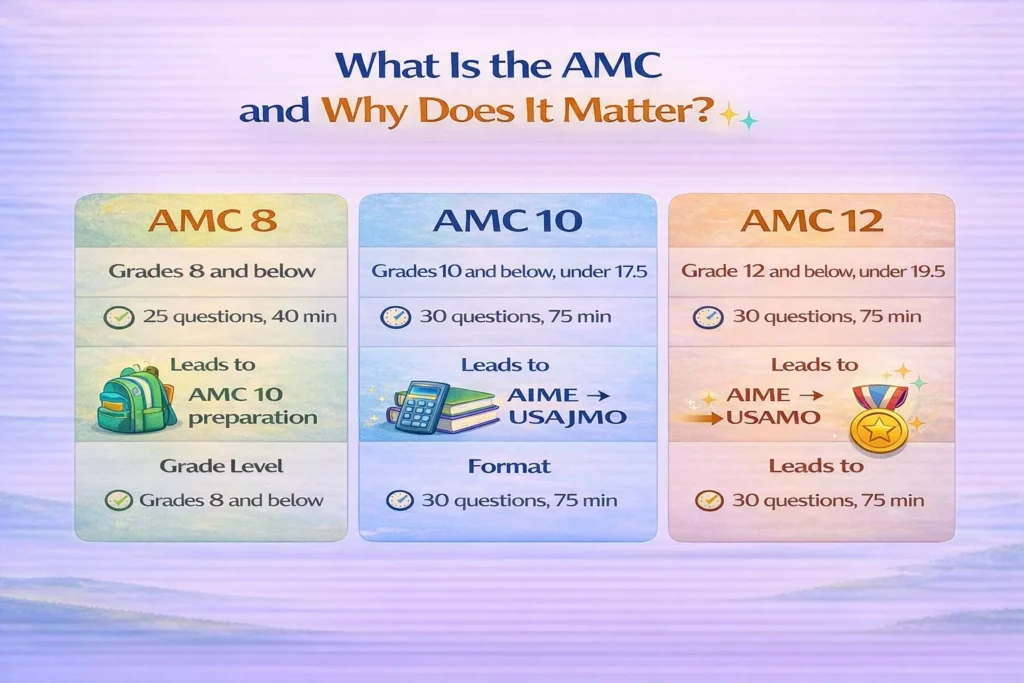
| Exam | Grade Level | Format | Leads To |
|---|---|---|---|
| AMC 8 | Grade 8 or below | 25 questions, 40 min | AMC 10 preparation |
| AMC 10 | Grade 10 or below, under 17.5 | 30 questions, 75 min | AIME → USAJMO |
| AMC 12 | Grade 12 or below, under 19.5 | 30 questions, 75 min | AIME → USAMO |
More than 300,000 students compete in AMC exams each year, making it the most widely participated math competition in the United States.
Understanding how to register for AMC math competitions is the first practical step once you know which level fits you.
7 Key Benefits of AMC Math
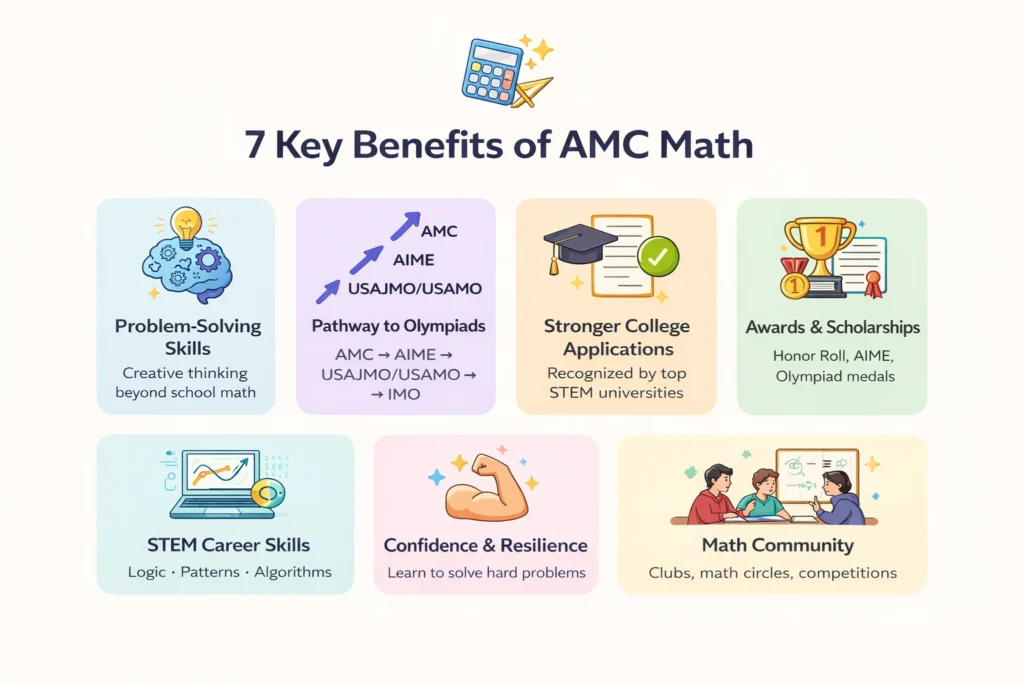
1. Builds Problem-Solving Skills Beyond the Classroom
One of the most significant benefits of AMC math is that the problems are fundamentally different from anything students encounter in standard school curricula.
AMC questions are designed to require creative thinking, multi-step reasoning, and the ability to recognize patterns not just formula application.
The core topics tested across all AMC levels include algebra, geometry, number theory, combinatorics, and probability. At the AMC 10 and AMC 12 level, these topics demand genuine mathematical insight rather than memorized procedures.
This type of problem-solving training develops a mental flexibility that carries directly into university mathematics, engineering, computer science, and research environments.
Students who regularly engage with AMC-style problems approach new challenges more creatively and systematically than peers who have only encountered classroom exercises.
For a clear breakdown of what each AMC level tests, see the AMC maths competition syllabus.
2. Opens the Gateway to the AIME, USAJMO, USAMO, and IMO
For students with serious competitive ambitions, one of the most concrete benefits of AMC math is the direct pathway it opens to elite competitions.
The progression works as follows:
- AMC 10/12 → AIME: Top scorers qualify for the American Invitational Mathematics Examination — roughly the top 2.5%–7% on AMC 10 and top 15%–16% on AMC 12
- AMC 10 + AIME → USAJMO: Combined index score determines eligibility for the USA Junior Mathematical Olympiad
- AMC 12 + AIME → USAMO: Combined index score determines eligibility for the USA Mathematical Olympiad
- USAMO/USAJMO → MOP: Top performers are invited to the Mathematical Olympiad Program, the elite training camp for Team USA
- MOP → IMO: The highest-performing MOP students represent the United States at the International Mathematical Olympiad
No other pathway in the U.S. leads to these competitions; AMC is the mandatory first step. For a complete guide on what scores open each door, see what is a good AMC math competition score.
For the full roadmap from AMC to IMO, see how to qualify for the IMO in the USA.
3. Strengthens College Applications at Top Universities
The benefits of AMC math for college admissions are real and well-documented. Top universities, including MIT, Caltech, Stanford, Harvard, Princeton, and the Ivy League, actively value AMC performance as evidence of genuine mathematical ability.
What makes AMC scores meaningful to admissions officers is what they represent: creative problem-solving under time pressure, self-directed preparation, and the ability to perform above and beyond standard academic expectations.
Specifically, the following AMC achievements carry the most weight in applications:
- AIME qualification — places a student in the top 5%–7% of AMC participants nationally and is recognized as a strong signal at elite STEM universities
- AMC Honor Roll — top 5% nationally on AMC 8, 10, or 12
- AMC Distinguished Honor Roll — top 1% nationally
- USAJMO or USAMO qualification — among the highest possible math competition achievements for a high school student in the United States
For students who do not reach AIME, any AMC participation still demonstrates voluntary engagement with advanced mathematics a meaningful differentiator in competitive STEM applications.
4. Earns Scholarships and Formal Recognition
Another direct benefit of AMC math is the formal recognition and scholarship opportunities it generates for high-performing students.
The MAA awards multiple forms of recognition through the AMC program:
- AMC 8 Honor Roll (top 5%) and Distinguished Honor Roll (top 1%)
- AMC 10/12 Honor Roll and AIME floor recognition
- USAMO and USAJMO awards including medals and certificates for the highest-ranked participants
- College scholarships — several universities and STEM-focused foundations offer scholarships specifically to AMC and AIME qualifiers
For a complete breakdown of what recognition each score level earns, see what the AMC maths competition awards are.
5. Develops Career-Ready Skills in STEM Fields
The skills built through AMC preparation are not limited to competitions. They translate directly into career success in mathematically demanding fields.
The specific competencies that AMC math develops include:
Logical reasoning — AMC problems require constructing valid arguments from limited information, the same skill used in software engineering, financial modeling, and scientific research.
Pattern recognition — identifying mathematical structure across unfamiliar problems is a core skill in data science, machine learning, and algorithm design.
Precision under pressure — the timed format trains students to produce accurate work efficiently, directly applicable to professional environments with deadlines.
Multi-approach thinking — AMC problems rarely have a single solution path. Students who practice AMC regularly become comfortable exploring multiple strategies before committing to a habit that distinguishes strong engineers and researchers.
Students who want to develop these skills in a structured way can use free math olympiad training online as a starting point alongside AMC preparation.
6. Builds Resilience, Confidence, and Mathematical Identity
One of the less visible but deeply important benefits of AMC math is what it does for a student’s relationship with difficulty.
AMC problems are hard by design. The average AMC 10 participant answers fewer than half the questions correctly.
This means that every student who competes, regardless of their final score, regularly experiences the challenge of not immediately knowing how to solve a problem.
This experience, practiced repeatedly over months of preparation and through multiple competition sittings, builds genuine resilience. Students learn that being stuck is part of the process, not a sign of failure.
They develop persistence in the face of confusion, which is among the most valuable cognitive habits a young person can develop.
The by-products of this process are measurable: improved self-confidence in approaching hard problems, stronger time management under pressure, and a clearer sense of mathematical identity, the understanding that they are a person who can solve hard things.
7. Connects Students With a Community of Like-Minded Peers
AMC participation places students inside a national community of mathematically motivated peers, something that is genuinely rare and valuable, particularly for students who may not find many peers with the same mathematical interests in their local school environment.
This community extends into AMC study groups, math circles, online forums, and eventually to competitions like ARML (American Regions Mathematics League) and university math programs where AMC alumni consistently find each other.
The social dimension of AMC — competing, preparing, and comparing results with peers who share the same passion reinforces motivation in ways that purely individual study cannot.
For students looking to connect with that community, understanding what type of questions are asked in math olympiads is a good way to start those conversations.
Is AMC Math Worth It Even If You Don’t Qualify for AIME?
This is the most common concern parents and students raise — and the answer is unambiguously yes.
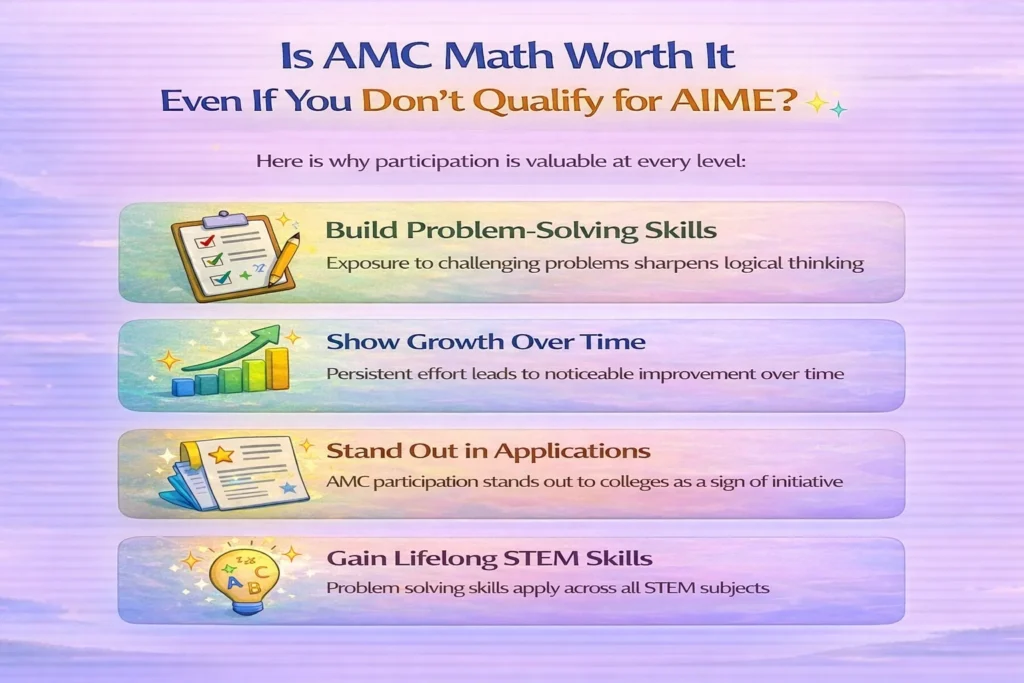
The benefits of AMC math do not begin at the AIME cutoff. They begin the moment a student starts preparing. Here is why participation is valuable at every level:
Below-average scores still build skills. A student who scores 55 on AMC 10 has worked through 30 carefully crafted problems, practiced timed reasoning, and identified specific gaps in their mathematical knowledge all of which inform better preparation for the next attempt.
Repeated attempts show growth. Many students who eventually qualify for AIME did not come close on their first attempt. The competition structure rewards persistence, and colleges value the narrative of improvement over multiple years.
Participation is itself a differentiator. The vast majority of students in the U.S. never attempt the AMC. Any student who voluntarily sits a 75-minute math competition demonstrates initiative and mathematical seriousness that stands out on applications.
The skills transfer regardless of score. The problem-solving, resilience, and logical reasoning built through AMC preparation are useful in every STEM course, standardized test, and professional environment, completely independent of any competition result.
How to Start Benefiting From AMC Math
Getting started with AMC math is straightforward:
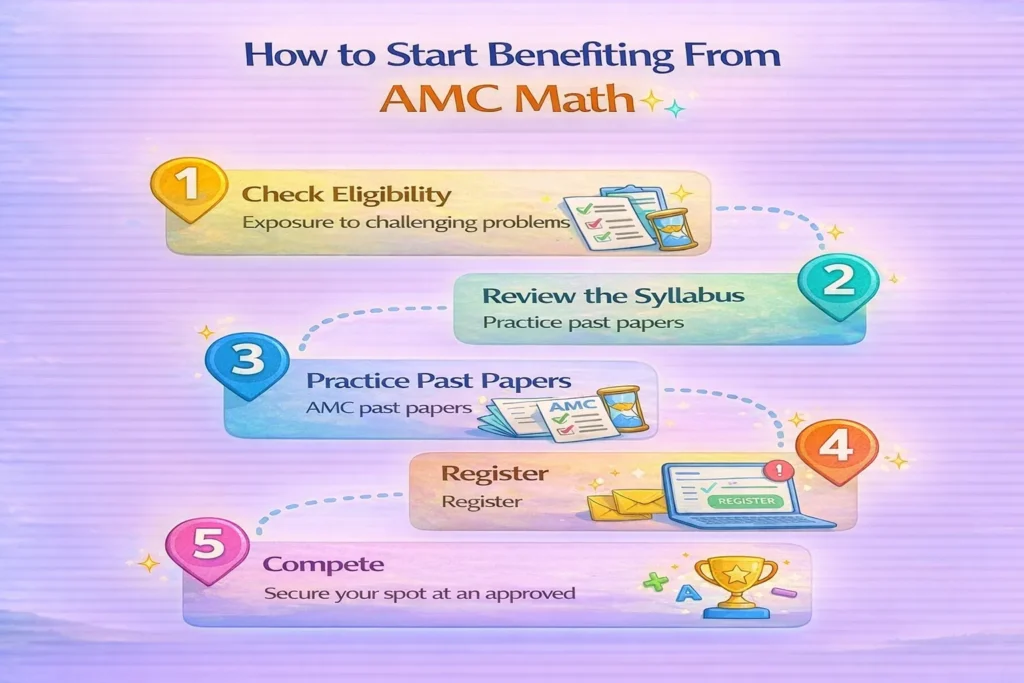
Step 1 — Confirm your eligibility. Check the AMC age limit to confirm whether you qualify for AMC 8, AMC 10, or AMC 12.
Step 2 — Know the syllabus. Review the AMC math competition syllabus to understand which topics each exam covers and where to focus your preparation.
Step 3 — Understand what a competitive score looks like. Use the AMC score benchmarks guide to set a realistic target for your first sitting.
Step 4 — Build a preparation plan. Follow the structured guidance in how to prepare for an AMC math competition to organize your study approach around past papers, topic practice, and timing strategy.
Step 5 — Register. Follow the registration steps in how to register for AMC math competitions and secure your spot at an approved testing center.
Does AMC help with college admissions?
Yes. AMC Honor Roll, AIME qualification, and USAJMO/USAMO recognition are all valued by top STEM universities as evidence of exceptional mathematical ability beyond standard academic performance.
What are the benefits of AMC 8 specifically?
AMC 8 builds foundational problem-solving skills, introduces students to competition mathematics, and prepares them for AMC 10 in future years. Honor Roll and Distinguished Honor Roll recognition on AMC 8 is meaningful for middle school students exploring STEM.
Is AMC only for students who want to become mathematicians?
No. The skills AMC builds — logical reasoning, pattern recognition, precision, and persistence — are valuable across engineering, computer science, finance, medicine, and research. Many AMC alumni pursue careers outside pure mathematics.
How many times can you take AMC?
Students can take both the A and B sittings in the same year. AMC 10 and AMC 12 each have two sittings (10A/10B and 12A/12B) held on different dates. Eligible students can sit up to two AMC exams per year.
Can a below-average AMC score still help a college application?
Participation alone signals voluntary mathematical engagement. A score that shows improvement over previous years can be a strong narrative element. AIME qualification is the threshold where AMC scores become a standout differentiator in competitive applications.
Make Preparing for Math Olympiad Simple!



Conclusion
The benefits of AMC math are broad, lasting, and meaningful at every level of participation.
From the first AMC 8 attempt to AIME qualification to USAMO recognition, every stage of the AMC journey builds skills, opens doors, and shapes mathematically capable, resilient thinkers.
The competition does not ask for perfection; it asks for engagement. Students who show up, prepare seriously, and compete repeatedly gain something that goes well beyond a score.
To begin the process, start with how to prepare for an AMC math competition and take the first step on your AMC journey today.