 October 22, 2025
 15 min. read

Math Olympiad questions are fundamentally different from school math.
They test creative problem-solving and rigorous logical reasoning, your ability to apply basic principles in unconventional ways across four core subjects: number theory, algebra, combinatorics, and geometry.
This guide covers all 6 major types of math olympiad questions, the main topics tested, how difficulty scales across levels, and how to prepare effectively.
Whether you’re entering Math Kangaroo for the first time, working through olympiad math problems at the regional level, or training for the IMO, this breakdown will help you focus your preparation.

What Types of Questions Are Asked in Math Olympiads?
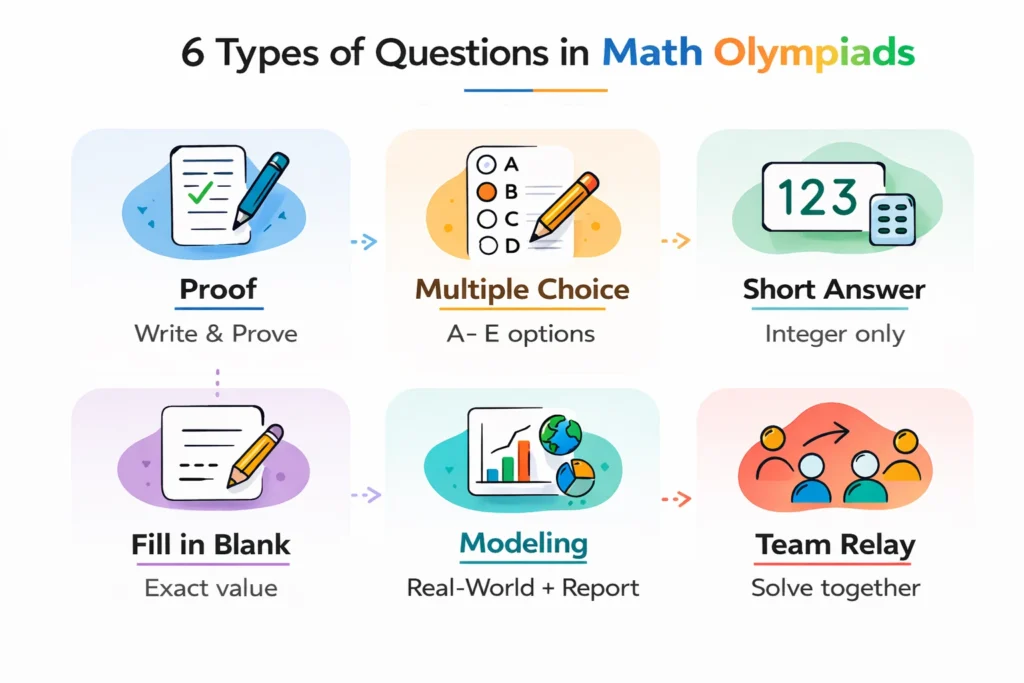
Math olympiads ask 6 main types of questions: (1) proof-based problems, (2) multiple-choice, (3) short answer/numerical response, (4) fill-in-the-blank, (5) exploratory/modeling problems, and (6) team-based problems. The format depends on the competition level beginner contests use multiple-choice, while advanced olympiads like the IMO use open-ended proofs.
6 Types of Math Olympiad Questions — At a Glance
| Question Type | Used In | Skills Tested | Example Contest |
|---|---|---|---|
| Proof-Based Problems | IMO, USAMO, INMO | Deep reasoning, proof-writing | IMO, APMO |
| Multiple-Choice | AMC 8/10/12, Kangaroo | Speed, accuracy, intuition | AMC, SEAMO |
| Short Answer / Numerical | AIME, regional olympiads | Precision, calculation | AIME, BdMO |
| Fill-in-the-Blank | Junior olympiads | Conceptual understanding | APMOPS, SMO Junior |
| Exploratory / Modeling | HiMCM, IMMC | Creativity, applied math | HiMCM, IMMC |
| Team-Based Problems | ARML, relay rounds | Collaboration, speed | ARML, HMMT |
The 6 Types of Questions Asked in Math Olympiads
1. Proof-Based Problems (Subjective Questions)
Proof-based problems are the defining format of elite math olympiads.
Instead of just calculating an answer, you must construct a rigorous logical argument that proves a statement is true for all cases not just one example.
These problems are found in the IMO, USAMO, APMO, EGMO, and most national olympiads at the advanced level.
They test not just what you know, but how deeply and clearly you can reason.
- Format: Open-ended, written solution required
- Time allowed: Typically 4–4.5 hours for 3 problems
- Scoring: 7 points per problem at the IMO (0–7 scale)
- Skills needed: Logical deduction, proof-writing, mathematical creativity
Example problem type: Prove that for any positive integers a and b, the expression a² + b² cannot be divisible by 3 unless both a and b are divisible by 3.
Why it matters: A proof-based answer that is elegant and concise often scores higher than a lengthy but clunky one. Olympiad judges reward insight.
IMO problems at positions 3 and 6 are widely considered the hardest math questions given to high school students anywhere in the world.
2. Multiple-Choice Questions (Objective Questions)
Multiple-choice questions appear in the qualifying rounds of major competitions, particularly in the AMC series, Math Kangaroo, and SEAMO.
They test speed, intuition, and the ability to eliminate wrong answers quickly.
The format may look familiar, but the problems are significantly harder than school multiple-choice tests.
A student who has never encountered olympiad-style questions will struggle even with the multiple-choice round.
- Format: 5 answer choices (A–E), one correct
- Time pressure: AMC 10/12 gives 75 minutes for 30 questions — about 2.5 minutes per question
- Scoring: AMC awards 6 points for correct, 0 for blank, 1.5 deducted for wrong (discourages guessing)
- Skills needed: Pattern recognition, estimation, elimination strategies
Example problem type: How many integers between 1 and 1000 are divisible by 3 but not by 9?
The AMC awards 6 points for correct answers, but what score do you actually need to advance? → What is a good AMC score?
3. Short Answer / Numerical Response Questions
Short-answer questions ask for a precise numerical answer, no working required, just the final result.
This format is used in the AIME (American Invitational Mathematics Examination) and many regional olympiads, including the Bangladesh Mathematical Olympiad (BdMO).
The AIME is the critical bridge between the AMC multiple-choice rounds and the proof-based USAMO.
Its answers are always integers from 000 to 999, which makes guessing nearly impossible.
- Format: Integer answer only (no units, no fractions)
- AIME specifics: 15 questions, 3 hours, answers range from 000–999
- Skills needed: Careful calculation, number theory, checking for errors
Example problem type: If a + b = 6 and ab = 8, find the value of a³ + b³.
The AIME is the bridge between AMC and USAMO. Want to know how your AMC score compares? → See average AMC scores and AIME qualification cutoffs
4. Fill-in-the-Blank Questions
Common in junior-level olympiads and Asian regional competitions, fill-in-the-blank questions require a specific answer, a number, expression, or term, without multiple-choice options as a guide.
This format tests conceptual understanding more directly than multiple-choice.
- Found in: APMOPS, Singapore Mathematical Olympiad (Junior), various Asian olympiads
- Skills needed: Clean calculation, conceptual clarity, no room for partial guessing
Example problem type: The sum of the interior angles of a polygon with n sides is 1800°. Find n.
5. Exploratory / Mathematical Modeling Problems
Exploratory and modeling questions appear in team competitions like HiMCM (High School Mathematical Contest in Modeling) and the International Mathematical Modeling Challenge (IMMC).
These problems ask you to use math to analyze and solve a real-world scenario.
Instead of one clean answer, you produce a written report explaining your mathematical model, assumptions, and conclusions.
These competitions are evaluated on both mathematical rigor and clarity of communication.
- Format: Written report, team-based, 14–36 hours to complete
- Topics: Traffic optimization, disease spread modeling, resource allocation, social network analysis
- Skills needed: Applied math, data analysis, teamwork, written communication
Example problem type: Model how a viral post spreads through a social network of 10,000 users.
Identify the point at which the spread becomes self-sustaining.
6. Team-Based and Relay Problems
Team rounds appear in competitions like the American Regions Mathematics League (ARML) and the Harvard-MIT Mathematics Tournament (HMMT).
In relay rounds, each team member solves a problem and passes their answer to the next member, whose question depends on it.
- Format: 4–15 students per team, relay-style passing of answers
- Skills needed: Speed, accuracy under pressure, trusting teammates
- Found in: ARML, HMMT, NIMO, various state and national team olympiads
Team rounds reward not just individual ability but the ability to work quickly and accurately in a group setting a valuable skill for mathematical research and collaboration.
Math Olympiad Exam Format by Competition
Different math olympiad competitions use very different exam formats.
Understanding the specific structure before you begin preparing is essential training, for the wrong format is a major source of underperformance.
| Competition | Question Format | Number of Questions | Time Limit | Level |
|---|---|---|---|---|
| Math Kangaroo | Multiple-choice | 24–30 | 75–90 min | Beginner |
| AMC 8 | Multiple-choice | 25 | 40 min | Beginner–Intermediate |
| AMC 10/12 | Multiple-choice | 30 | 75 min | Intermediate |
| AIME | Short answer (integer) | 15 | 3 hours | Advanced |
| USAMO/USAJMO | Proof-based | 6 | 2 days × 4.5 hrs | Advanced |
| INMO | Proof-based | 6 | 4 hours | Advanced |
| IMO | Proof-based | 6 | 2 days × 4.5 hrs | Elite |
| HMMT | Mixed (individual + team) | Varies | Varies | Advanced |
Main Topics Covered in Math Olympiad Questions
Regardless of question format, almost all math olympiad problems draw from the same core topic areas.
Understanding these topics deeply, not just superficially, is the most important part of your preparation.

| Topic | Key Subtopics | Most Common In |
|---|---|---|
| Algebra | Equations, inequalities, polynomials, functional equations, sequences | All levels |
| Number Theory | Divisibility, primes, modular arithmetic, Diophantine equations | IMO, USAMO, AIME |
| Geometry | Euclidean proofs, circles, triangles, transformations, coordinate geometry | IMO, APMO, EGMO |
| Combinatorics | Counting, graph theory, pigeonhole principle, invariants | IMO, AMC, AIME |
| Inequalities | AM–GM, Cauchy–Schwarz, Jensen’s, optimization problems | Advanced olympiads |
| Applied / Real-World | Ratios, percentages, probability, logic puzzles | Junior & beginner levels |
Algebra — The Foundation of All Olympiad Math
Algebra appears in virtually every math olympiad at every level. At beginner level, you’re solving equations.
At the IMO level, you’re proving functional equations hold for all real numbers using creative substitutions and logical chains.
Key areas to master: solving and manipulating inequalities, understanding polynomial roots, recognizing patterns in sequences, and working with functional equations that have no obvious solution method.
Number Theory — The Deepest Rabbit Hole
Number theory problems often look deceptively simple and then require two pages of careful logic to solve.
OThis is one of the most rewarding and challenging areas of olympiad mathematics.
Focus on: modular arithmetic (the foundation of cryptography), prime factorization, properties of divisibility, and Diophantine equations (finding integer solutions to equations like x² + y² = z²).
Number theory is also one of the most heavily tested topics in the AMC series. → See the full AMC syllabus breakdown
Geometry — Visual Reasoning and Elegant Proofs
Geometry is a uniquely visual subject in olympiads. A well-drawn diagram can immediately suggest the proof strategy.
Many students who struggle with algebra-heavy subjects excel in geometry because the problems reward spatial intuition.
Master: circle theorems, angle chasing, similar triangles, power of a point, and the properties of key triangle points (centroid, circumcenter, incenter, orthocenter).
Combinatorics — Counting Creatively
Combinatorics problems are beloved by olympiad coaches because they can be stated simply but require deep insight.
The pigeonhole principle, if you have more pigeons than pigeonholes, at least one hole has two pigeons, leads to some of the most surprising proofs in mathematics.
Study: permutations and combinations, bijections, double counting, graph theory basics, and the principle of inclusion-exclusion.
Distribution of Topics in International Mathematical Olympiad Problems
A common question among serious competitors is which topics appear most often in IMO problems.
Historically, the distribution across algebra, geometry, number theory, and combinatorics has been roughly even, with each appearing in about 25% of problems.
However, combinatorics and number theory tend to appear in the harder positions (problems 3 and 6), while algebra and geometry are more common in positions 1 and 4.
Understanding this distribution helps you allocate your study time effectively. If you’re aiming for the IMO, neglecting any of the four core topics is a strategic mistake.
Math Olympiad Difficulty Levels Explained
One of the most common questions from students and parents is: “Is this competition right for my level?”
Here’s a clear breakdown of how difficulty scales across math olympiads:
| Level | Who It’s For | Question Format | Example Competitions |
|---|---|---|---|
| Beginner | Grades 1–6, first-timers | Multiple-choice, fun puzzles | Math Kangaroo, APMOPS Primary |
| Intermediate | Grades 7–10, developing skills | Mixed formats, some proofs | AMC 8/10, SMO Junior, BdMO |
| Advanced | Grades 10–12, serious competitors | Proof-based, 4–9 hours | AMC 12, USAMO, INMO, APMO |
| Elite/International | Top students from 100+ nations | 6 open proofs over 2 days | IMO, EGMO, CGMO |
| University | Undergraduates | Abstract proofs, 6 hours | Putnam, IMC |
The key insight: question difficulty is not just about the math involved, but the format.
A student who is excellent at multiple-choice AMC problems may struggle with open-ended IMO proofs not because they lack knowledge, but because proof-writing is a completely different skill that must be developed separately.
Not sure which competition sits at your level? → See the world’s top math competitions ranked by difficulty and prestige
What Is a Math Olympiad? A Quick Overview
A math olympiad is a competitive mathematics examination designed to identify and nurture mathematical talent in students.
Unlike regular school exams, olympiad questions go beyond textbook formulas.
They require creative problem-solving, logical reasoning, and, at advanced levels, the ability to construct formal mathematical proofs.
Math olympiads exist at every level: local, regional, national, and international.
Some of the most well-known competitions include the International Mathematical Olympiad (IMO), the American Mathematics Competitions (AMC 8/10/12), Math Kangaroo, the Indian National Mathematical Olympiad (INMO), and the Bangladesh Mathematical Olympiad (BdMO).
The olympiad meaning in the context of mathematics, is simply a high-level academic competition.
While the term originated from the ancient Olympic Games, a math olympiad focuses purely on problem-solving skills and mathematical reasoning.
Hardest Math Olympiad Questions: What Makes Them Difficult?
Many students wonder: what is the hardest type of question in math olympiads?
The answer is proof-based problems at the IMO level, specifically problems 3 and 6. These are intentionally designed to challenge even the world’s best mathematical minds.
A single problem may require 4+ hours of sustained concentration, and most competitors score 0 points on problem 6.
What makes these problems so hard isn’t the advanced math they require (the IMO explicitly excludes calculus).
It’s the level of insight and creativity needed to find a solution path that doesn’t exist in any textbook. You’re essentially doing original mathematical research under time pressure.
Hard math questions in olympiads share these traits:
- they combine multiple topics (e.g., number theory + combinatorics),
- they have no obvious starting point, and
- the solution requires an idea you’ve never seen before.
Math Olympiad Questions with Solutions: Where to Find Practice Problems
One of the best ways to prepare is by studying past math olympiad questions with solutions. Here’s where to find them:
- AMC/AIME/USAMO: Art of Problem Solving (artofproblemsolving.com) hosts a complete archive of past papers with community solutions.
- IMO: The official IMO website (imo-official.org) publishes all problems and shortlisted problems with solutions from 1959 to the present.
- Math Kangaroo: mathkangaroo.us provides sample papers for all grade levels.
- Regional olympiads (BdMO, INMO, etc.): National math societies typically publish past papers on their websites or through affiliated training programs.
When practicing, always attempt the problem yourself before reading the solution.
The struggle is where learning happens.
How to Prepare for Math Olympiad Questions
Effective olympiad preparation is different from exam revision.
You’re not memorizing content, you’re building mathematical instincts through repeated exposure to problems that require genuine thinking.

1. Know Your Competition’s Format Before You Start
The single most overlooked preparation step. Students who train for proof-based problems and then enter an AMC multiple-choice round often underperform, and vice versa.
Before you do anything else, confirm: what format does your target competition use? How long is each session? How is it scored?
Not sure which competition to target first? → Best math competition in the world: top 7 ranked
2. Master the 4 Core Topics — In Order of ROI
Not all topics give equal return on study time. For most competitions, study in this order:
- Algebra — highest frequency across all levels; master this first
- Number Theory — appears heavily in AIME and advanced olympiads
- Combinatorics — often the highest-scoring topic at IMO level
- Geometry — rewarding but requires dedicated diagram practice
3. Practice Past Papers Under Exam Conditions
There is no substitute for timed practice with real past papers. Set a timer. No calculator. No notes.
Review every solution afterward, especially the ones you got right, to find faster methods.
Past papers are freely available for AMC (artofproblemsolving.com), IMO (imo-official.org), and Math Kangaroo (mathkangaroo.us).
Consistent timed practice is the single most effective way to improve. → How to get better at solving math olympiad problems
4. Learn Proof-Writing as a Separate Skill
If you are targeting advanced olympiads, proof-writing must be practiced independently of problem-solving.
A correct idea that is poorly communicated will score 0–2 points at the IMO. The same idea written with clarity and structure scores 6–7.
Practice writing proofs for problems you have already solved. Focus on: clear definitions, logical flow, handling of edge cases, and concise language.
5. Build a Strategy Notebook
Keep a dedicated notebook for techniques you encounter: the substitution that cracked a functional equation, the construction that solved a geometry problem, the counting argument that worked for a combinatorics puzzle.
This becomes your personal problem-solving toolkit.
6. Train Consistently — Not in Bursts
Olympiad mathematics is a skill that degrades without practice. One focused problem per day, every day, is more valuable than a 5-hour session once a week.
Consistency builds the mathematical intuition that competition problems demand.
For structured daily training with olympiad problems at every level → Free math olympiad training platforms online
What is the hardest type of question in math olympiads?
Proof-based problems are the hardest type of question in math olympiads. Unlike multiple-choice or short-answer questions, proofs require you to construct a complete logical argument from scratch — often for a problem that has no obvious solution path. IMO problems at positions 3 and 6 are considered among the hardest math problems given to high school students anywhere in the world.
Do all math olympiads use the same question format?
No. Question formats vary significantly by competition. Math Kangaroo uses multiple-choice. The AIME uses short-answer integer responses. The IMO uses open-ended proof problems. Knowing your competition’s specific format before you begin preparing is essential — training for the wrong format is a major source of underperformance.
What math topics come up most often in olympiads?
Algebra, number theory, geometry, and combinatorics are the four core topics that appear across virtually all math olympiads. At beginner level, arithmetic and logic puzzles dominate. At advanced level, the four core topics are tested with much greater depth. Calculus is notably absent from most olympiads — the IMO explicitly excludes it.
How long are math olympiad exams?
This varies widely. Math Kangaroo is 75–90 minutes. The AMC 10/12 is 75 minutes for 30 questions. The AIME is 3 hours for 15 questions. The IMO is two consecutive days of 4.5 hours each, for 3 problems per day. Most proof-based national olympiads run 3–5 hours per session.
Can beginners participate in math olympiads?
Yes — and they should. Math Kangaroo is specifically designed for students from Grade 1 upward, with age-appropriate problems that introduce competition math without overwhelming beginners. The AMC 8 is another excellent first competition for middle school students. Starting early, even without strong preparation, builds familiarity with competition problem styles and helps students identify which topics to develop.
Ready to take the next step? → How to prepare for the Junior Math Olympiad
What is the difference between AMC and IMO question types?
AMC questions are multiple-choice, designed to be solved in under 3 minutes each, and reward speed and pattern recognition. IMO questions are open-ended proofs that may take an entire 4.5-hour session to solve, and reward deep mathematical insight and rigorous argumentation. The AMC pathway (AMC → AIME → USAMO) eventually leads to IMO selection for US students, but the question styles become progressively more proof-based at each stage.
→ How to qualify for the IMO in the USA — step by step
What is a math olympiad exam?
A math olympiad exam is a competitive mathematics test that goes beyond school-level problems. It evaluates students on creative problem-solving, logical reasoning, and mathematical insight rather than rote calculation. Olympiad exams are held at school, regional, national, and international levels, with the International Mathematical Olympiad (IMO) being the most prestigious.
How many questions are there in a math olympiad?
The number of questions depends on the specific competition. Math Kangaroo has 24–30 multiple-choice questions. The AMC 10/12 has 30. The AIME has 15 short-answer questions. The IMO has only 6 problem-based problems spread over two days. Generally, fewer questions mean harder problems with more time per question.
Make Preparing for Math Olympiad Simple!



Final Thoughts
Math olympiads use six main question formats: proof-based problems, multiple-choice, short answer, fill-in-the-blank, exploratory modeling, and team relay problems.
The format you’ll face depends entirely on which competition you enter and at what level.
Math olympiads are not just about the medal. Every problem you wrestle with, even unsuccessfully, builds the kind of mathematical thinking that serves you for life.