November 18, 2025
 16 min. read

Math Kangaroo prizes are one of the most frequently asked questions among students and parents preparing for the world’s largest math competition.
At the national level, top scorers receive gold, silver, and bronze medals, with the top 20 students per grade earning national winner status.
At the state level, the top three students per grade earn colored ribbons and additional recognition. And at the participation level, every single student who sits the exam receives an official certificate.
This complete guide covers exactly how the Math Kangaroo award system works, every prize tier in detail, that give you the best chance of reaching the top prize tiers.
If you are not yet familiar with the competition itself, what is Kangaroo Math covers the full format, eligibility, and scoring structure before we get into the prizes.
How the Math Kangaroo Award System Works
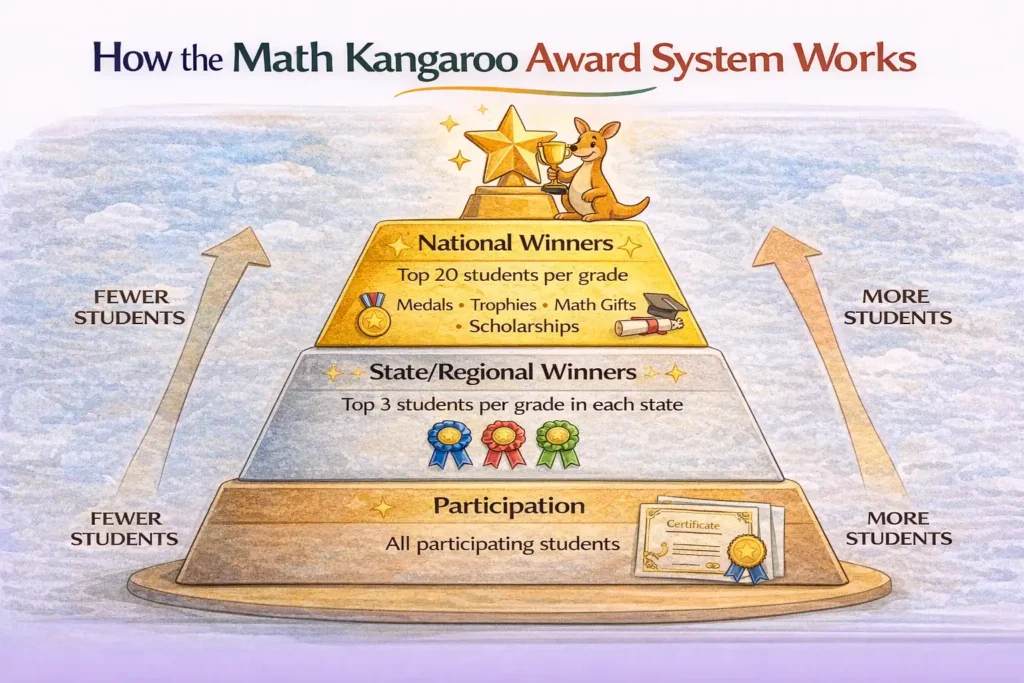
Math Kangaroo uses a consistent ranking structure that operates simultaneously at three levels: national, state (or regional), and individual participation.
Understanding how each level works helps you set realistic targets and understand exactly what score you need to reach each prize tier.
The Scoring Foundation
Before rankings are determined, every student’s raw score is calculated from their completed exam paper. The scoring structure is:
| Grade Range | Questions | Easy (3pts) | Medium (4pts) | Hard (5pts) | Max Score |
|---|---|---|---|---|---|
| Grades 1–4 | 24 questions | 8 questions | 8 questions | 8 questions | 96 points |
| Grades 5–12 | 30 questions | 10 questions | 10 questions | 10 questions | 120 points |
There is no penalty for wrong answers or blank answers. Every student is encouraged to attempt every question, a strategic consideration that differs meaningfully from competitions like AMC 10/12, where blank answers (1.5 points) outperform wrong answers (0 points).
For a full comparison of how scoring works across major competitions, the average AMC math scores explain the AMC scoring system in detail.
National Ranking
After the competition, each student’s score is ranked against all other students in the same grade across the entire country.
In the United States, the top 20 students per grade nationally become National Winners and qualify for the full national prize package including medals, educational gifts, and scholarship eligibility.
State Ranking
Within each state, the top 3 students per grade are recognized as State Winners and receive state-level ribbons and additional prizes.
This means that even students who do not reach the national top 20 can still earn meaningful recognition if they perform strongly relative to their state peers.
Percentile Ranking
Each participating student receives a percentile score indicating how their performance compares to all students in their grade nationally.
Being in the 90th percentile, for example, means your score exceeded 90% of all students in your grade.
This percentile data appears on the student’s results report and provides meaningful performance context even for students who do not reach the top prize tiers.
Tied Scores
When two or more students achieve identical scores, they share the same rank and prize tier. No student is disadvantaged by a tiebreaker every student at the tied score receives the full prize for that rank.
To understand the full scale of students you are competing against and how participation numbers affect the competitive landscape.
Math Kangaroo participation covers global and country-specific participation data in detail.
Every Math Kangaroo Prize Tier Explained
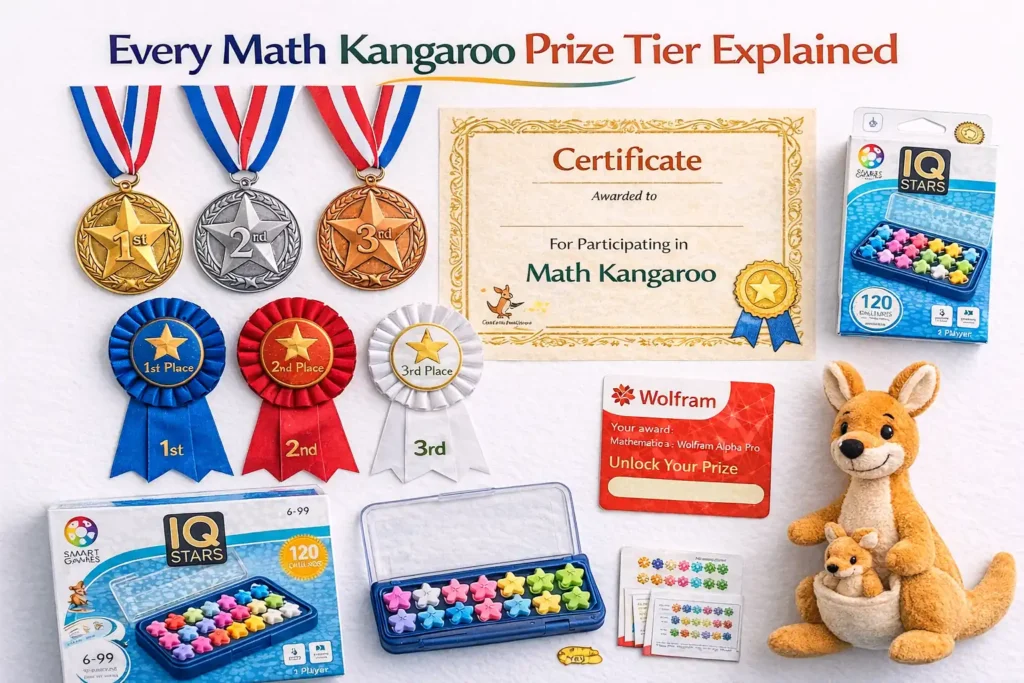
Math Kangaroo prizes span five distinct tiers, from the most exclusive national awards to the universal participation certificate that every student receives. Here is every tier in full detail.
Tier 1: National Winner Awards (Top 20 Per Grade)
The most prestigious Math Kangaroo prizes go to the top 20 students per grade nationally. These students receive:
Medals: Gold (1st place), Silver (2nd place), and Bronze (3rd place) medals for the top three nationally. Students ranked 4th through 20th nationally receive a medal of distinction recognizing their national winner status.
Educational and Recreational Gifts: National winners receive a curated prize package that typically includes puzzle boxes and mathematical games, a plush kangaroo toy (a signature Math Kangaroo prize),
Wolfram Mathematica or Wolfram Alpha Pro licenses for Grades 5–12 students, STEM learning kits, and math-themed books and resources.
College Grants (U.S. — High School Students): This is the most financially significant Math Kangaroo prize. Exceptional high school performers are eligible for college grants structured as follows:
| Award Level | Grant Amount |
|---|---|
| First place (per grade) | Up to $1,000 |
| Second place (per grade) | $750 |
| Third place (per grade) | $500 |
| Additional national winners | $250 |
These grants are administered by Math Kangaroo USA and are available to high school students (Grades 9–12) who place at the top of their grade nationally.
Availability and amounts may vary by year; confirm current figures with Math Kangaroo USA directly.
Invitations to International Math Camps and Research Programs: Top national winners receive invitations to exclusive mathematical enrichment experiences.
Including international math camps hosted in Poland and China, Wolfram Summer Research Programs for advanced mathematical computing, and specialist mathematical workshops and seminars.
These invitations are among the most valuable non-material Math Kangaroo prizes.
The opportunity to work alongside other high-achieving students in immersive mathematical environments accelerates development in ways that no single competition or textbook can replicate.
Tier 2: State Winner Awards (Top 3 Per Grade Per State)
The top three students per grade in each state receive state-level recognition:
Ribbons: Blue ribbon (1st place in state), Red ribbon (2nd place in state), White ribbon (3rd place in state).
State Winner Gift Package: State winners receive additional prizes that typically include a flashlight (a signature Math Kangaroo state prize in the U.S.), a deck of Kangaroo-branded playing cards, and a Certificate of Ranking showing their state placement.
State winner status is a meaningful achievement in larger states with high participation; the top 3 per grade represent the top fraction of a percent of all participants in that grade and state.
Tier 3: Certificate of Ranking
Students who achieve strong national or state percentile rankings but do not place in the top prize tiers receive a Certificate of Ranking.
This certificate shows the student’s national percentile position, their score, and their ranking within their grade a meaningful document for academic portfolios and scholarship applications even without a top-tier placement.
Tier 4: Creative Contest Prizes
Math Kangaroo runs annual creative competitions alongside the main exam, including a Best Poster competition and a Best T-shirt Design competition. Winners of these creative contests receive:
Gift Cards: Cash-equivalent gift cards for educational suppliers and bookstores.
Special Recognition: Winning designs are featured on official Math Kangaroo materials, giving student artists national visibility within the competition community.
These contests are open to all participants and provide a recognition pathway for students whose strengths extend into visual creativity alongside mathematical thinking.
Tier 5: Certificate of Participation (All Students)
Every student who sits the Math Kangaroo exam receives an official Certificate of Participation.
This is not a consolation prize; it is an intentional design feature of the competition reflecting Math Kangaroo’s core philosophy that curiosity and mathematical engagement deserve recognition at every level.
The certificate shows the student’s name, grade level, competition year, and the official Math Kangaroo seal.
For younger students in their first competition experience, this certificate represents a meaningful milestone and is often displayed prominently at home or school.
School-Level Recognition
Beyond the official Math Kangaroo prize structure, many schools create their own internal recognition for top-performing students in national and state tiers.
School-level recognition typically includes trophies or plaques displayed in the school’s competition achievements area, announcements at school assemblies, features in school newsletters and social media, and special mentions at end-of-year award ceremonies.
Schools that produce multiple national or state winners are often recognized by Math Kangaroo at a school level as well.
U.S. Math Kangaroo Prizes vs International Awards
While the core recognition structure medals for nationals, ribbons for state winners, and certificates for all is consistent globally, the specific prizes vary between the U.S. program and international programs.
| Prize Element | Math Kangaroo USA | International (General) |
|---|---|---|
| National medals | Gold, Silver, Bronze | Gold, Silver, Bronze |
| State/regional awards | Blue, Red, White ribbons | Country-specific equivalents |
| College grants | Up to $1,000 (high school) | Varies by country |
| Educational gifts | Puzzle kits, Wolfram licenses, STEM kits | Books, educational materials |
| International camp invitations | Poland, China, Wolfram programs | Varies by national coordinator |
| Participation certificate | All students | All students |
| Creative contest prizes | Gift cards | Varies by country |
The scholarship/grant component is one of the most distinctive features of the U.S. program.
Many international programs do not offer direct cash grants, focusing instead on educational materials and camp invitations as the primary non-medal prizes.
For students outside the U.S., the best source of country-specific prize information is your national Math Kangaroo coordinator’s website, as prizes are administered nationally and can vary significantly.
If you are weighing how Math Kangaroo prizes compare to what AMC and olympiad competitions offer, AMC math competition awards cover the full AMC recognition structure.
Including Honor Roll, Distinguished Honor Roll, and AIME qualification — a useful reference for understanding the full competition prize landscape.
For a broader comparison of the two competition styles, difference between math olympiad and kangaroo math covers the key distinctions in format, recognition, and pathway.
The Long-Term Value of Math Kangaroo Prizes
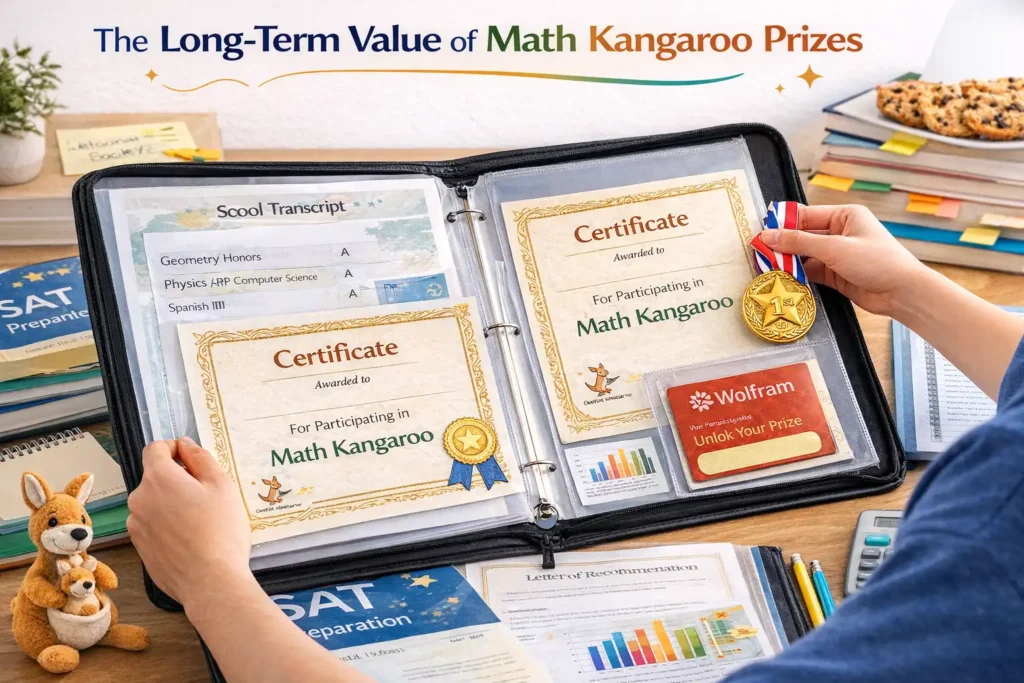
Beyond the immediate prizes, Math Kangaroo recognition carries meaningful long-term value across three areas: academic profile, skills development, and competition pathway progression.
Academic Profile and College Applications
Math Kangaroo achievements, particularly national winner status, state placements, and strong percentile rankings, contribute positively to academic portfolios and scholarship applications.
For high school students, national winner status demonstrates mathematical ability, initiative, and competitive achievement to college admissions evaluators.
The college grants available to top U.S. high school performers provide direct financial value. The Wolfram software licenses and math camp invitations provide educational value that compounds over time.
Students who attend math camps and gain access to professional mathematical computing tools develop skills and networks that extend well beyond the competition itself.
This long-term academic value is comparable to, and in some cases exceeds, the profile value of participation-level achievement in harder competitions.
Understanding the full academic benefit of competition math participation from Kangaroo through AMC and beyond is covered in the benefits of AMC math, which explains why competition recognition matters to college admissions at top universities.
Skills That Compound Over Time
The problem-solving skills developed while preparing for Math Kangaroo prizes do not disappear after the competition.
The logical reasoning, pattern recognition, spatial thinking, and creative problem framing that Kangaroo Math builds are cognitive assets that transfer to academic performance in all STEM subjects.
Students who take Math Kangaroo seriously, who prepare with past papers, practice logical reasoning regularly, and engage with the competition’s mathematical style, develop skills that directly feed into stronger performance on AMC, AIME, and higher-level olympiad competitions.
The preparation framework that produces the best Kangaroo results is the same framework that produces improvement at every competition level, as detailed in how to get better at solving math olympiad questions.
Gateway to Higher Competition Recognition
Math Kangaroo prizes are not an endpoint they are a launching point. Students who perform strongly in Math Kangaroo have demonstrated the reasoning foundations and competition temperament that AMC preparation builds on.
The AMC pathway AMC 8, AMC 10/12, AIME, USAMO, IMO begins at a level of difficulty above Kangaroo but rewards the same core reasoning abilities.
For students who want to understand where the competition pathway leads after Kangaroo, how to qualify for the IMO in the USA maps every step from accessible entry competitions through international olympiad qualification.
For the specific score benchmarks and recognition tiers at AMC level, what is a good AMC math competition score provides the full context.
How to Maximize Your Chances of Winning Math Kangaroo Prizes
Reaching the top Math Kangaroo prize tiers requires targeted preparation rather than general study. The strategies below are organized by impact the highest-value activities coming first.

Practice With Official Past Papers Under Timed Conditions
The single most effective preparation activity for Math Kangaroo prizes is solving official past papers at your grade level under strict timed conditions.
Past papers are available free from the official Math Kangaroo website and national coordinator websites.
Work through the full 75 minutes without stopping. After finishing, analyze every problem you could not solve not just to find the correct answer but to understand the reasoning structure that the solution uses.
This systematic reflective practice is the same approach that produces the fastest improvement across all competition math formats.
For a complete past paper practice system, including error log methodology, how to prepare for Math Kangaroo covers the full preparation framework.
Build Logical Reasoning Through Regular Puzzle Practice
Math Kangaroo questions reward logical deduction, pattern recognition, and spatial reasoning — not memorized formulas.
The most direct way to develop these skills outside of past paper practice is through consistent engagement with logic puzzles, visual reasoning challenges, spatial problems, and brain teasers.
For students in lower grade levels (Pre-Ecolier through Benjamin), foundational skills in number patterns, spatial reasoning, and counting build directly on concepts developed in number sense for class 1, spatial understanding for class 1, teach number sequences to class 1 students, and geometrical shapes for grade 1.
Target the Hard Question Tier Specifically
Since the three question tiers are worth 3, 4, and 5 points respectively, the strategic priority for students aiming for national prizes is maximizing accuracy on the 5-point questions while maintaining speed on the 3-point and 4-point questions.
Students who can solve all 10 hard questions (5 points each) and all 10 medium questions (4 points each) earn 90 out of 120 points a score that places comfortably in the national competition range for most grades.
Identifying which problem types appear in the hard tier at your grade level and practicing those specifically gives you the most direct path to the top prize tiers.
For a detailed breakdown of what types of problems appear across olympiad competitions, including the reasoning challenges that populate the hard tiers of Kangaroo papers, what type of questions are asked in math olympiads provides useful context for the types of logical and spatial challenges you will encounter.
Understand the No-Penalty Scoring Strategy
Because Math Kangaroo carries no penalty for wrong answers, the optimal exam strategy is different from penalty-scoring competitions.
You should attempt every single question. Never leave a question blank a random guess on a five-option question gives you a 20% expected return (worth 0.6 to 1.0 points depending on difficulty tier), while a blank always returns 0.
On questions where you can eliminate even one or two obviously wrong options, your expected value from guessing increases significantly.
This strategic awareness always attempts to eliminate before guessing, prioritize the hard-tier questions is the exam execution skill that separates students who score near their preparation ceiling from those who leave points behind.
Build a Consistent Weekly Practice Routine
Consistency matters more than intensity in competition math preparation.
Students who practice for 30–45 minutes six days a week improve faster than students who study for 4 hours on weekends and nothing in between. A practical weekly structure for Kangaroo preparation:
| Day | Activity | Duration |
|---|---|---|
| Monday | Logic puzzles and spatial reasoning exercises | 30–45 min |
| Tuesday | Number patterns, arithmetic, and counting | 30–45 min |
| Wednesday | Past paper — 10–15 questions timed | 45 min |
| Thursday | Geometry and visual reasoning | 30–45 min |
| Friday | Review error log + retry problems missed | 30 min |
| Saturday | Full past paper under exam conditions | 75 min |
| Sunday | Solution analysis and reflection | 30 min |
For free structured training resources that support this weekly schedule, free math olympiad training online covers every free platform available including AoPS, Brilliant, Khan Academy, and official Kangaroo resources.
For Grades 9–12: Integrate AMC Preparation
At the Junior (Grades 9–10) and Student (Grades 11–12) levels, the hardest Math Kangaroo problems approach the difficulty of lower AMC 10/12 problems.
Students in these grade levels who are simultaneously preparing for AMC will find significant overlap between the two competition preparation approaches.
The AMC maths competition syllabus shows exactly which topics are tested at AMC 10 and AMC 12 level — content that overlaps substantially with the advanced reasoning tested in the hard tier of Senior Kangaroo papers.
Does every student receive a prize in Math Kangaroo?
Every student receives an official Certificate of Participation. Beyond that, prizes are awarded to national winners (top 20 per grade), state winners (top 3 per grade per state), students with strong percentile rankings (Certificate of Ranking), and creative contest winners.
What score do I need to win a medal at Math Kangaroo?
Medal scores vary by year and grade level, depending on the national distribution of participants’ overall performance. There is no fixed cutoff score — medals are awarded to the top-performing students regardless of their absolute score. In practice, national winner scores tend to cluster in the upper 80–110 range out of 120 for Grades 5–12, but this varies year to year.
Are the college grants available outside the U.S.?
The specific college grant structure described in this post is administered by Math Kangaroo USA and applies to U.S. participants. International programs have their own prize structures administered by national coordinators. Some countries offer equivalent educational grants or scholarships; check with your country’s national coordinator.
Can homeschooled students win Math Kangaroo prizes?
Yes. Homeschooled students who register through an authorized test center or their national coordinator are fully eligible for all prize tiers, including national medals, state ribbons, scholarships, and camp invitations.
When are prizes distributed after the competition?
Prizes are typically distributed 6–10 weeks after the competition date. Award ceremonies, when held, are usually at the end of the academic year. Digital results and percentile rankings are typically available sooner through the Math Kangaroo USA website.
How valuable is a Math Kangaroo national winner award for college applications?
National winner status (top 20 per grade nationally in a competition with hundreds of thousands of participants) is a meaningful credential for college applications — it demonstrates mathematical ability, initiative, and competitive achievement. For top-tier university applications, it is a positive supporting credential. For the most selective universities, combining Math Kangaroo achievement with strong AMC performance and deeper olympiad credentials creates the strongest possible competition mathematics profile.
How does winning Math Kangaroo compare to AMC achievement?
They serve different purposes. Math Kangaroo national winner status demonstrates strong logical reasoning and mathematical thinking. AMC Honor Roll and AIME qualification demonstrate advanced mathematical content knowledge and problem-solving ability at a higher technical level. Both contribute to a strong academic profile. For the specific AMC recognition tiers and what each means for college applications, AMC Math Competition Awards covers every AMC award in detail.
Make Preparing for Math Olympiad Simple!



Conclusion
Math Kangaroo prizes operate across five tiers: national medals and college grants for the top 20 per grade nationally, state ribbons for the top 3 per grade per state.
Certificates of Ranking for strong percentile performers, creative contest prizes for visual and artistic achievements, and Certificates of Participation for every student who sits the exam.
For complete preparation guidance, see how to prepare for Math Kangaroo. For everything you need to know about the competition format, eligibility, and structure, see what is Kangaroo Math.
For where the competition pathway leads beyond Kangaroo, how to qualify for the IMO in the USA maps every step from accessible entry competitions through international olympiad qualification.