November 28, 2025
 12 min. read

Why number sense is important for Class 1 becomes clear when we realize that counting numbers and truly understanding them are very different.
A child may recite numbers perfectly but still struggle to understand what those numbers represent or how they relate to each other.
Number sense is a group of connected skills understanding quantities, comparing numbers, breaking numbers apart and combining them, and recognizing numbers in everyday situations.
When these foundations are strong in Class 1, later topics like addition, subtraction, and multiplication become far easier to learn.
This guide explains why number sense is important for Class 1, highlighting key reasons it shapes future math success, warning signs of weak number understanding, and practical ways parents and teachers can strengthen these skills early.
What the Research Says: Number Sense as a Long-Term Predictor
Research consistently identifies early number sense as one of the strongest predictors of mathematical achievement through school, stronger than general intelligence or later instruction quality.
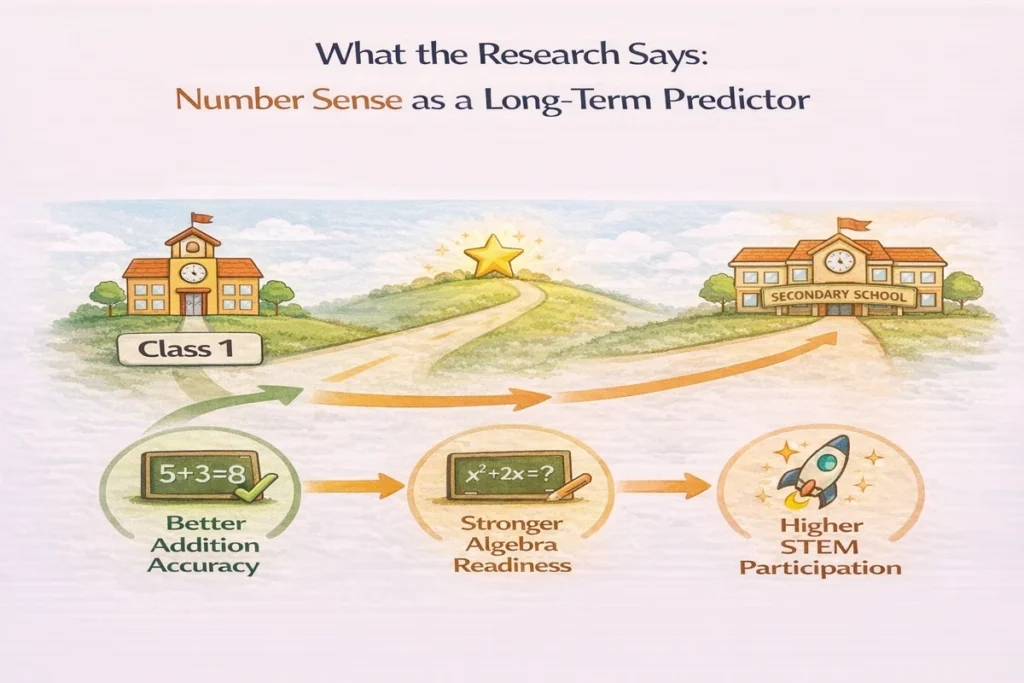
Children who enter Class 1 with weak number sense are significantly more likely to struggle with arithmetic, fractions, and algebra in later years.
The reason is structural. Arithmetic builds on number sense. Fractions build on division and parts of wholes. Algebra builds on flexible numerical reasoning. Every gap in the foundation makes the next level harder to build.
This is why Class 1 is the critical window. Strengthening number sense at age 6–7 is dramatically more effective than remediation at age 9 or 11. For the complete picture, see Number Sense for Class 1.
8 Reasons Why Number Sense Is Important for Class 1
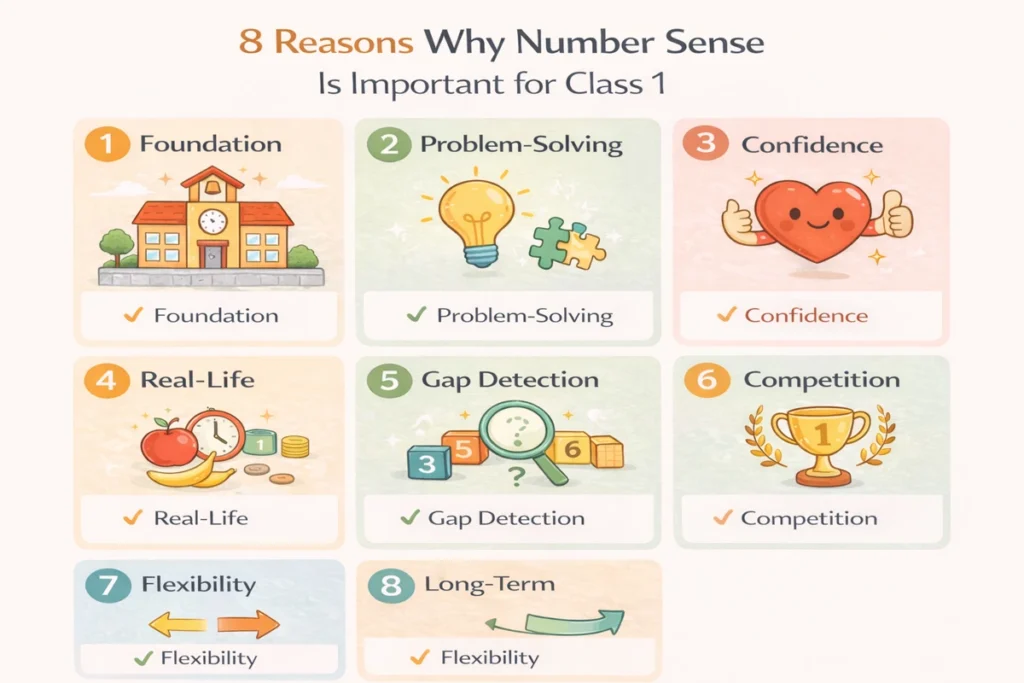
Reason 1: It Builds the Foundation That All Future Mathematics Requires
The single most important reason number sense matters in Class 1 is that it is the ground on which every subsequent mathematical concept is built.
Addition requires understanding that quantities can be combined. Subtraction requires understanding that quantities can be separated. Both require the foundational knowledge that numbers represent real, countable quantities.
Multiplication in Class 1 requires understanding repeated addition, which relies on number sense.
Fractions require understanding that a whole can be divided into equal parts, which in turn requires understanding what a whole quantity means in the first place.
This dependency chain continues through algebra, geometry, and beyond.
A child who solves 8 + 5 by reasoning “8 needs 2 to make 10, and 5 has 2 plus 3, so 13” has genuine number sense. A child who only counts on fingers has a procedure but not the understanding — and this gap will grow.
Reason 2: It Develops Genuine Problem-Solving Ability
Number sense is the engine behind mathematical problem-solving, not just calculation.
Children with strong number sense break numbers apart flexibly, recognize unreasonable answers, and adapt when their first approach fails.
Children without it default to fixed procedures and get stuck when the procedure does not fit.
This flexibility connects directly to what number sense teaching strategies for first graders aim to build — the ability to apply number understanding creatively to unfamiliar problems.
Reason 3: It Builds Mathematical Confidence That Lasts
Math anxiety consistently traces back to early years when children did not fully understand foundational concepts and began experiencing mathematics as arbitrary and threatening.
Number sense is the antidote. When a child genuinely understands numbers, mathematics feels like reasoning, not guessing.
This confidence compounds. Children who feel confident participate more, attempt harder problems, and develop the mathematical identity that sustains engagement through harder years ahead.
Children who find Class 1 mathematics incomprehensible develop avoidance patterns that are difficult to reverse.
Reason 4: It Makes Real-World Mathematics Visible and Meaningful
A child with strong number sense notices that 12 people cannot fit in 10 seats. They estimate that five biscuits shared between two people means two each with one left over.
They know a 20-taka item should return 5 taka in change from a 20-taka note — and notice immediately if it does not.
This real-world awareness also supports related Class 1 learning.
The positional understanding developed in spatial understanding for Class 1 and ordinal numbers for Class 1 both draw on the same flexible number awareness that strong number sense builds.
Reason 5: It Supports the Understanding of Patterns and Relationships
When a child notices that adding 10 always changes only the tens digit, or that 6 + 4 = 4 + 6, they are discovering mathematical regularities through number sense rather than being told rules.
This pattern awareness is the earliest form of algebraic thinking.
The structured development of these skills is explored in what is the number sequence for Class 1 maths and how to teach number sequences to Class 1 students.
Strong pattern recognition also prepares children for ascending and descending order in Class 1 maths — one of the first formal applications of number relationship understanding.
Reason 6: It Enables Early Detection of Learning Gaps
Number sense is observable in daily interactions in how children count, compare, and estimate making specific gaps identifiable before they compound.
A child who cannot say which of 7 and 9 is larger without counting both is showing a gap in magnitude understanding. A child who always counts from 1 rather than counting on is showing a gap in counting fluency.
Each gap identified and addressed in Class 1 is straightforward to remediate. The same gaps discovered in Class 3 or 4, buried under learned procedures, are significantly harder to fix.
The milestone framework in number sense for Class 1 provides clear term-by-term benchmarks for what development should look like.
Reason 7: It Prepares Children for Mathematical Competition
Class 1 competition mathematics does not test advanced content it tests the depth and flexibility of a child’s number understanding in novel problem contexts.
Finding how many ways objects can be arranged, identifying missing numbers in patterns, and comparing groups visually every one requires genuine number sense.
Children with strong number sense approach these problems with real advantage. The geometric reasoning assessed at competition level is also supported by geometrical shapes for Grade 1.
Reason 8: It Establishes a Positive Long-Term Relationship With Mathematics
Children who experience mathematics as something they understand develop a positive mathematical identity.
They are more likely to enjoy it, pursue enrichment, choose STEM subjects, and enter quantitative careers. Children who experience it from the start as confusing and stressful develop avoidance patterns that persist for life.
Building strong number sense in Class 1 is an investment in the child’s relationship with one of the most powerful reasoning tools humans have developed, and the returns compound for decades.
Start with number sense resources for parents to support this at home.
The Signs of Weak Number Sense in Class 1: What Parents and Teachers Should Watch For
Identifying weak number sense early is only possible if parents and teachers know what to look for.
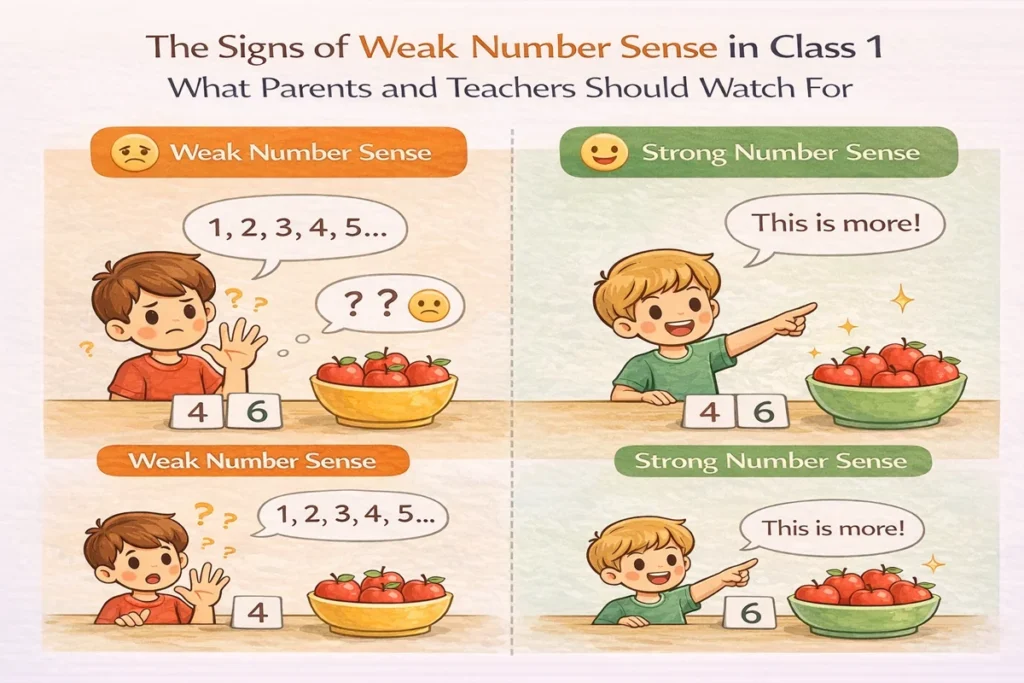
The following are the most significant observable indicators that a Class 1 child’s number sense needs more targeted support:
| Observed Behaviour | What It Indicates | Area to Strengthen |
|---|---|---|
| Always counts from 1, never counts on from a given number | Lack of counting flexibility | Counting fluency activities |
| Cannot compare 7 and 9 without counting up to both | Weak number magnitude understanding | Comparing and number line work |
| Cannot instantly recognize 3 or 4 objects without counting | Subitizing not developed | Dot card and ten-frame activities |
| Does not notice when an answer is clearly wrong | Weak estimation and reasonableness checking | Real-world number discussions |
| Reverses digits (writes 31 for 13) consistently | Incomplete place value understanding | Tens-and-ones hands-on activities |
| Struggles to extend a simple pattern (2, 4, 6, ___) | Weak pattern recognition | Number pattern games and hundred charts |
| Counts objects multiple times, losing track of the total | One-to-one correspondence not secure | Physical counting with objects |
None of these behaviours alone signals a serious problem all are normal at various points in Class 1 development.
What matters is whether they persist despite appropriate teaching and support, and whether they appear together across multiple areas.
When multiple indicators are present and persisting, the most effective response is always to return to hands-on, concrete activities, physical objects, number lines, ten-frames, and counting games rather than accelerating to worksheets and written exercises.
Number sense is built through doing and experiencing, not through reading or being told.
How Parents Can Actively Support Number Sense Development
One of the most consistently supported findings in early mathematics education research is that parental engagement with number sense activities at home significantly strengthens classroom learning.
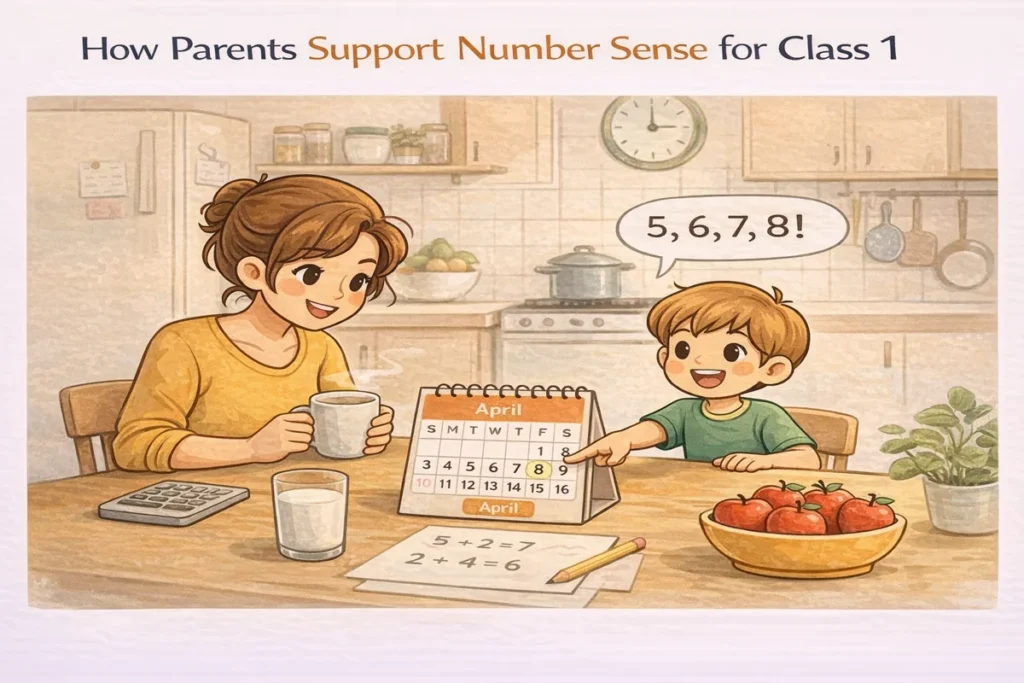
This does not require special materials, formal instruction, or dedicated lesson time it requires integrating number sense into the everyday moments that already exist in family life.
At mealtimes: Count the items on plates. Compare who has more or fewer. Ask your child to share items equally and notice whether there are any left over.
These conversations naturally develop quantity understanding, comparison, and early division intuition.
At the shops: Let your child handle money transactions in small amounts. Ask them to estimate whether a purchase will cost more or less than a given amount.
Involve them in comparing prices and quantities. Shopping is one of the richest natural environments for real-world number sense development.
With calendars and clocks: Ask your child to find today’s date and tomorrow’s. Count how many days until a special event. Notice the patterns in a weekly calendar (every 7 days, the same day reappears).
Read the time together and discuss what it means. These activities build number reading and pattern recognition simultaneously.
During play: Dice games, card games, and board games all build number sense naturally.
Any game that involves counting, comparing, or totalling scores builds the fluency that structured practice alone cannot develop.
In conversation: Simply talking about numbers, “I wonder which queue is shorter,” “how many steps do you think it is to the door?” develops the estimation and reasonableness habits that are central to strong number sense.
These habits are available in every moment and cost nothing to develop.
Why Number Sense Is Important Now, Before Gaps Compound
The urgency of building strong number sense in Class 1 specifically, rather than addressing gaps later, comes down to how mathematical knowledge compounds both positively and negatively.
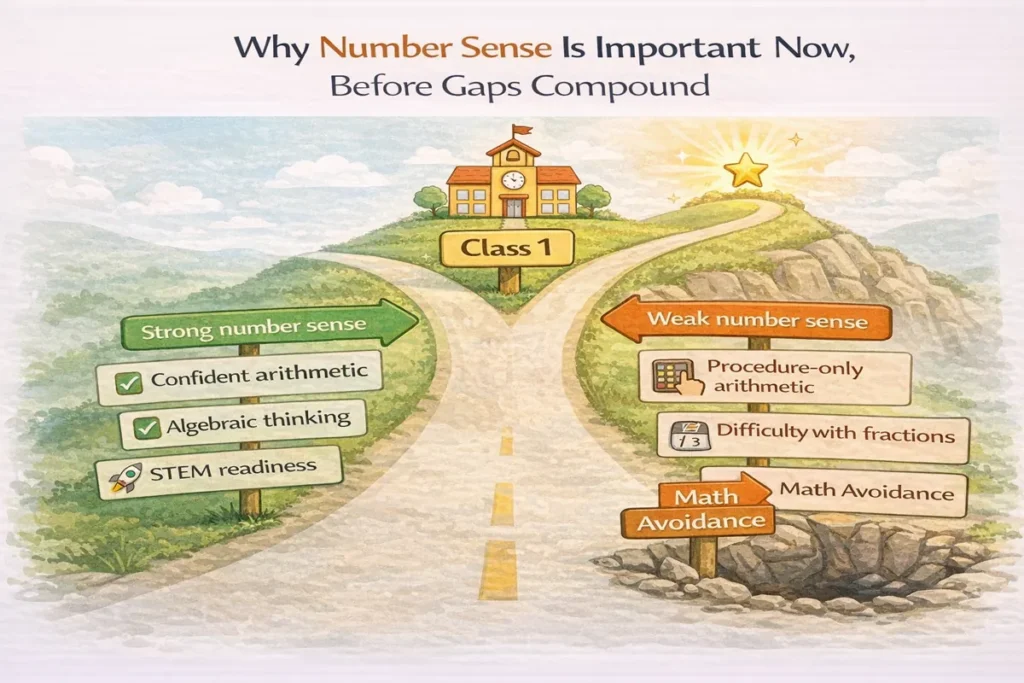
When number sense is strong in Class 1, each new mathematical concept encountered in subsequent years has a secure foundation to attach to.
Addition is already intuitive; subtraction simply extends it. Multiplication is already intuitive fractions extend the same understanding in a new direction.
Each new concept clicks into place rather than being learned as an isolated procedure.
When number sense is weak in Class 1 and gaps are not addressed, procedural learning begins to substitute for conceptual understanding. Children learn to follow steps without understanding why the steps work.
This is sustainable until the steps become too complex or unfamiliar to follow, typically around Class 4 or 5 when fractions, decimals, and multi-step problem-solving demand the conceptual foundations that were never built.
The remediation of number sense gaps at Class 4 or 5 level is significantly more time-consuming and emotionally costly than building the foundations correctly at Class 1 level.
This is the core practical reason why number sense matters most during the year it is being formed and why the activities, milestones, and parent guidance in this post are worth acting on now.
Can a child catch up on number sense if they start Class 1 behind?
Yes — absolutely. Number sense responds well to targeted hands-on intervention at any point in Class 1 or early Class 2. The key is identifying the specific gap (counting flexibility, comparison, subitizing, place value) and addressing it directly through physical, game-based activities rather than worksheets. Earlier intervention produces faster results, but even mid-year or end-of-year identification and support is highly effective compared with leaving gaps unaddressed.
Is number sense the same as being “good at maths”?
No — and this distinction is important. Many children who are described as “good at maths” in early school years are demonstrating strong memorization of procedures rather than genuine number sense. Conversely, children who struggle to recall number facts quickly may have strong number sense, excellent reasoning and estimation, but slow fact recall. Number sense is about understanding, not speed. Both matter, but understanding is the more fundamental and the more teachable.
How is number sense different from numeracy?
Numeracy refers broadly to the ability to apply mathematical knowledge to real-life situations. Number sense is the foundational component of numeracy that deals specifically with understanding numbers and their relationships. Strong number sense is necessary for but not the same as full numeracy.
Does strong number sense predict success in math competitions?
Yes, particularly at the Class 1 level. Competition mathematics for young children tests creative numerical reasoning, exactly what number sense develops. Children who have strong number sense tend to approach Class 1 Olympiad problems with significantly more confidence and flexibility than those who have only procedural knowledge. The competition pathway from Class 1 Olympiad through to higher-level competition mathematics consistently rewards the deep number understanding that begins with strong Class 1 number sense.
How much time should parents spend on number sense activities at home?
Research suggests that even 10–15 minutes of varied number activity per day, counting during daily routines, brief comparison conversations, dice or card games, produces measurable improvements in number sense over a school term. The key is variety and regularity rather than duration. Short, frequent, embedded activities are far more effective than longer, occasional sessions.
Make Preparing for Math Olympiad Simple!



Conclusion
Why number sense is important for Class 1 comes down to one truth: it is the ground on which every mathematical concept for the next twelve years is built.
When your child genuinely understands what numbers mean and how they relate, every new concept has something secure to attach to. When it is not, gaps compound.
Children who understand numbers think better with them, feel better about them, and use them more effectively across every area of their lives.
The habits of mind that strong number sense develops at age 6–7 become the natural way a child thinks about mathematics for life.
For deeper reading, see number sequences for Class 1 and number sense resources for parents.